TattoosAI
You're probably here because you like the look of a rose tattoo, but you don't want to walk into a studio asking for “just a rose” and walk out with something that feels generic. That hesitation is smart. A rose can say love, grief, loyalty, faith, memory, tenderness, or survival. The same flower can feel soft in one design and severe in another.
That's why rose tattoo meaning is better understood as a system, not a single definition. Color changes the message. Style changes the tone. Extra motifs change the story. Placement changes how public or private that story feels. Once you see the rose this way, choosing a tattoo gets easier. You stop asking what a rose means in the abstract, and start deciding what you want your rose to say.
Table of Contents
- Why the Rose Endures in Tattoo Art
- The Roots of Rose Symbolism Through History
- Decoding the Language of Rose Colors
- Beyond the Bloom Pairing Roses with Other Motifs
- How Tattoo Style and Placement Shape Meaning
- Bringing Your Personal Rose Tattoo Concept to Life
- Key Questions to Ask Your Tattoo Artist
Why the Rose Endures in Tattoo Art
A lot of first-time clients make the same mistake. They choose a rose because it's timeless, then worry it will look basic. The fix isn't avoiding the rose. The fix is understanding why it lasts.

The rose survives trends because it holds more than one message at once. It's visually familiar, easy for artists to adapt, and emotionally flexible. That's rare in tattooing. A skull tends to arrive with a narrower set of associations. A name is specific but less visually versatile. A rose can be personal without losing its classic shape.
One useful way to think about it is this. A rose tattoo isn't one meaning. It's a configurable symbol system, a point highlighted in a short explainer on how rose tattoo meaning changes by color, style, and placement. That's why two rose tattoos can look related but say completely different things.
If you're browsing rose tattoo ideas for visual inspiration, you'll notice that the strongest designs don't rely on the flower alone. They use choices. A clean single stem says something different from a thorn-heavy blackwork rose. A soft pink bloom on the ankle doesn't read like a black rose on the hand.
Why people get confused
The shorthand version is often the first one heard. Rose equals love. That's not wrong. It's just incomplete.
Confusion usually shows up in three places:
- Color choice: Red and black don't send the same message.
- Design style: Fine line, traditional, and realism create different emotional tones.
- Add-ons: A rose with a clock, dagger, or name changes the reading fast.
Practical rule: Don't ask whether a rose tattoo has meaning. Ask which variables are carrying your meaning.
That shift matters. Once you stop treating the rose as a generic flower, you can use it like a design language. The flower becomes your base symbol. Then you decide the emotional setting, the visual voice, and the story details.
The Roots of Rose Symbolism Through History
A rose tattoo carries weight because the symbol already had a long life before it reached tattoo culture. That history doesn't force one fixed meaning on your design, but it does explain why the flower feels bigger than decoration.
According to this history of rose symbolism in tattoo culture, roses date back to antiquity in symbolic use. In ancient Egypt, roses were tied to fertility. In Rome, they adorned gladiators. In China, they represented wealth. In the Middle Ages, they expressed love.
That kind of symbolic range is unusual. Most visual symbols stay closer to one lane. The rose moved through many.
A symbol that kept absorbing meaning
By the Victorian era, the rose also stood for purity and love, which added another layer to an already loaded flower. That's part of why rose tattoo meaning feels so rich today. It wasn't invented by modern tattoo flash. It was built over centuries through religion, ritual, romance, status, and remembrance.
You can think of the rose as a symbol that kept collecting emotional assignments:
- Ancient Egypt: fertility
- Rome: courage and adornment
- China: wealth
- Middle Ages: love
- Victorian symbolism: purity and love
Each culture added something, and none of those associations fully erased the others.
A rose tattoo often feels “deep” before you even explain it because people already sense that history in the image.
Why this matters for your tattoo
If you're choosing a rose for your first piece, this historical layering gives you more freedom, not less. You don't need to use the flower in the most obvious way. You're working with a symbol that already supports tenderness, beauty, devotion, memory, and ceremonial weight.
That's also why the same motif can fit very different intentions. One person uses a rose to mark a relationship. Another uses it for grief. Another chooses it because it feels timeless and still leaves room for private meaning.
A seasoned artist usually reads a rose as an open framework. They know it can be classic, sacred, romantic, memorial, or elegant depending on how the rest of the design is built. That flexibility is part of the appeal. The rose doesn't lock you into one story. It gives you a strong base for writing your own.
Decoding the Language of Rose Colors
If history gives the rose depth, color gives it direction. Color is often the fastest way to narrow rose tattoo meaning into something personal and readable.
A red rose usually lands one way. A black rose lands another. Before you think about style or placement, decide what emotional category you want the tattoo to live in.

A quick color map
Across tattoo references, rose color meanings are commonly understood this way:
| Color | Primary Meaning | Secondary Meanings |
|---|---|---|
| Red | Love | Passion, romance, respect |
| Black | Mourning | Strength through hardship, farewell, rebellion |
| White | Purity | Innocence, peace, new beginnings |
| Pink | Gratitude | Admiration, affection, gentleness |
| Yellow | Friendship | Joy, warmth |
| Blue | Mystery | The unattainable, uniqueness |
Red is the classic. If someone wants a rose to express romantic devotion, this is usually the clearest route.
Black has a different emotional gravity. It often suits memorial pieces, designs about loss, or tattoos meant to signal resilience after a hard period. White tends to feel quieter. Pink often reads as softer and more affectionate than red. Yellow shifts the tone away from romance and toward connection, optimism, or warmth. Blue usually signals rarity, distance, mystery, or something hard to reach.
A visual reference helps if you're still undecided.
Why color works so well
Color is useful because it changes meaning without changing the core shape. That makes the rose one of the easiest motifs to customize cleanly. You keep the timeless silhouette, but the emotional signal changes.
Here's a practical way to choose:
- If your tattoo is about romantic commitment, red is the most direct choice.
- If your tattoo marks loss or survival, black often carries that weight better.
- If your tattoo is about renewal, white gives you a calmer emotional register.
- If your tattoo honors affection without heavy drama, pink often feels more nuanced.
- If your tattoo celebrates platonic love or good memories, yellow makes sense.
- If your tattoo is meant to feel elusive or unusual, blue can create that distance.
Design note: Choose color first if you know the emotion but not the composition. Choose motifs first if you know the story but not the tone.
You may have noticed the infographic includes orange too. It appears often in design conversations, but if you want to stay anchored to established, repeated tattoo meanings, the colors above are the safest foundation for planning.
Beyond the Bloom Pairing Roses with Other Motifs
A rose by itself can be elegant. A rose with another symbol becomes narrative. Here, tattoo design gets interesting, because the flower stops being the whole message and starts acting like the anchor point.

If you want more floral inspiration beyond roses, it helps to browse a wider set of flower tattoo ideas and compositions and notice how supporting symbols change the mood.
How combinations change the story
According to this breakdown of how attached motifs alter rose tattoo symbolism, thorns, skulls, daggers, and clocks all materially change the tattoo's semantic output. That sounds technical, but the idea is simple. Add one object, and the rose starts saying something more specific.
A few common examples:
- Rose with thorns: beauty and pain, sacrifice, emotional cost
- Rose with skull: life and death, mortality, beauty in decay
- Rose with dagger: betrayal, conflict, love under attack, defiance
- Rose with clock: memory, timing, cherished moments, passing time
- Rose with name or banner: tribute, memorialization, direct dedication
These combinations work because they create tension or context. A flower is soft. A dagger is sharp. Put them together and the design gains friction. A clock introduces time. A skull introduces mortality. A banner introduces identity.
Thinking in visual sentences
The easiest way to plan a rose tattoo is to think in sentence form.
A single red rose says, “This matters emotionally.” A black rose with visible thorns says, “This beauty came with pain.” A rose and clock say, “This memory is tied to time.” A rose and skull say, “Life and loss belong in the same frame.”
That sentence-building mindset helps you avoid random design stacking. If every element answers a purpose, the final tattoo feels intentional instead of crowded.
Don't add motifs because they look cool in isolation. Add them because they change the sentence in a way you want.
When clients feel stuck, I usually tell them to name the core message in plain language first. Not “I want something deep.” Something clearer. “I want this to honor my father.” Or, “I want this to show that love and pain can coexist.” Once the statement is clear, the motif choices get easier.
How Tattoo Style and Placement Shape Meaning
Two people can choose the same subject, the same color, and even the same companion symbol, yet end up with tattoos that feel completely different. That's what style and placement do. They don't usually replace the meaning, but they heavily shape how that meaning is felt.
Style changes tone
A traditional rose with bold lines and solid color feels confident, iconic, and direct. It doesn't whisper. It announces itself.
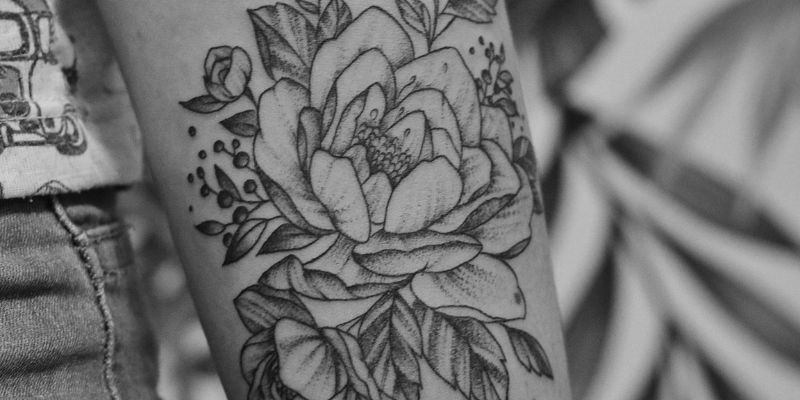
A fine line rose feels quieter. It can read as intimate, elegant, or fragile depending on the composition. A realistic rose often feels emotional because texture and depth make the flower look more lifelike. A black-and-grey rose can be especially powerful in memorial work or dramatic pieces. One technical guide notes that black-and-grey roses rely on layered shading, controlled value changes, and careful petal-edge definition to create depth and realism, which directly affects how intense or solemn the final image feels. That discussion appears in this black-and-grey rose tattoo technique article.
Here's a simple comparison:
| Style | How it tends to feel |
|---|---|
| Traditional | Bold, classic, confident |
| Fine line | Delicate, private, modern |
| Realism | Emotional, detailed, lifelike |
| Blackwork | Strong, graphic, severe |
| Minimalist | Clean, understated, symbolic |
Placement changes audience
Placement affects who sees the tattoo first and how often. That matters.
A rose on the hand, neck, or forearm behaves like public language. People will read it often, and quickly. A rose on the ribs, chest, thigh, or back can stay personal for longer. It may feel less like a public identity marker and more like a private archive.
Consider these questions before you settle on placement:
- How visible do you want the story to be?
- Does this design need room for detail?
- Will the placement support the style you chose?
- Do you want this piece to stand alone or connect into a future sleeve?
A tiny realism rose on a cramped area may lose what makes realism beautiful. A big traditional rose can dominate a small placement. Good tattoo planning is part symbolism and part engineering.
Bringing Your Personal Rose Tattoo Concept to Life
Once you know the emotional direction, you can turn a broad idea into a usable concept. At this stage, many people freeze. They know they want a meaningful rose tattoo, but their thoughts are still foggy. The best cure is structure.

Build your concept in layers
Start with the emotional purpose. One sentence is enough.
Examples:
- I want this tattoo to honor a loss without looking bleak.
- I want it to represent love, but not in an obvious Valentine's way.
- I want it to show that I became stronger after a painful period.
Then build outward.
Choose the core rose meaning
Pick the base message. Love, remembrance, friendship, renewal, gratitude, mystery, survival.Choose the color language
Match the emotional intent to the color family that supports it best.Choose whether the rose stands alone
If the answer is no, add one supporting motif with purpose. Clock for time. Dagger for conflict. Name for tribute. Thorns for beauty and pain.Choose the visual voice
Traditional, realism, black-and-grey, fine line, minimalist, blackwork. This determines how the tattoo feels, not just how it looks.Choose the body placement
Let placement match the scale and privacy level you want.
Workshop prompt: “My rose tattoo means ___, so I want the color to be ___, the style to feel ___, and the extra motif to say ___.”
Write yourself a usable design brief
A tattoo artist can do much more with a clear brief than with vague inspiration screenshots. Keep it short, but specific.
A strong brief sounds like this:
- Subject: single black rose
- Meaning: grief, resilience, farewell
- Motifs: visible thorns, small clock
- Style: black-and-grey realism
- Placement: outer forearm
- Mood: solemn, clean, not gothic
- Avoid: heavy background, excessive ornament
A weaker brief sounds like this: “I want a cool rose that's kind of dark and meaningful.”
Specificity helps the artist solve design problems earlier. It also helps you notice contradictions before the stencil stage. If you say you want a subtle private memorial but choose a huge hand tattoo with high contrast blackwork, your design choices are arguing with each other.
If you like using digital tools before a studio consultation, they're best used for exploration and reference building. Generate variations. Compare whether a black rose with a clock feels too literal, or whether white ink accents soften the piece too much. Bring the most promising directions to your artist, then let them adapt the concept to skin, anatomy, and longevity.
Key Questions to Ask Your Tattoo Artist
A good tattoo appointment isn't just about taste. It's about translation. Your artist has to turn a symbolic idea into something that works on skin for years. That means asking better questions than “Can you do roses?”
Start with fit. Ask whether your chosen style suits your placement and size. A design that looks balanced on a mood board may need simplification or more room once it's mapped to the body.
Then ask about legibility. If you want realism, ask how much detail the placement can hold. If you want visible thorns, ask whether they'll read clearly from a normal viewing distance. If you want a memorial tone without a heavy look, ask what line weight and shading approach will create that feeling.
Use questions like these:
- How would you adapt this concept for my placement?
- What details should be enlarged or simplified so the rose ages well?
- Would this idea work better in black-and-grey, color, or a hybrid approach?
- How visible should the thorns or companion motif be for the meaning to read clearly?
- Does any part of this design carry cultural or symbolic baggage I might be missing?
That last question matters. A rose doesn't mean exactly the same thing everywhere. As noted in this discussion of cross-cultural tattoo symbolism and personal design choices, roses often signal love or remembrance in Western tattoo culture, but meanings can shift with religion, memorial customs, and local tattoo traditions.
The smartest client in the room isn't the one with the most references. It's the one who can explain what the tattoo needs to say.
Clear communication gives your artist room to do their best work. You don't need to speak like a designer. You just need to know your message, your absolute requirements, and what feeling you want the finished piece to carry.
If you want help turning a rough idea into something visual before you book a session, TattoosAI is a practical place to start. You can describe your rose tattoo meaning in plain language, choose from 18+ styles, test color directions, and generate multiple concepts to compare. It works well for first-time clients who need clarity, collectors building a sleeve, and artists who want stronger client references. Use it to explore options, tighten your design brief, and walk into the studio with a concept that already feels like yours.