TattoosAI
You've probably done this already. You stop on a tattoo photo, save it, zoom in on the placement, then flip your own arm in the mirror and try to guess whether that same idea would look sharp on you or just look crowded.
That pause is where most back of arm tattoo decisions go right or wrong. The artwork might be beautiful, but the back of the upper arm has its own shape, its own movement, and its own healing quirks. A design that sings on a flat forearm can feel awkward when it's pushed onto the tricep side.
The good news is that this placement is far from unusual. A large 2023 study of tattooed adults found that the upper arms were the single most common tattoo location, reported by 41.5% of participants (445 people), while upper back and shoulder placements were also common at 35.4% (380 people). The same study reported an average age at first tattoo of 22.6 years, which fits the reality that many people start with arm placements in early adulthood rather than much later in life (upper arm tattoo location study).
Table of Contents
- Why the Back of the Arm Deserves Its Own Plan
- Understanding the Canvas Beneath the Skin
- Pain, Healing, and How the Area Ages Over Time
- Style and Motif Ideas That Work on a Tricep Panel
- Turning a Vague Idea Into a Clear Brief and AI Prompt
- Aftercare That Protects Linework and Color for Years
- Your Back of Arm Tattoo Decision Checklist
Why the Back of the Arm Deserves Its Own Plan
A back of arm tattoo isn't just “an arm tattoo, but turned a bit.” It behaves more like a narrow wall behind a doorway. You don't decorate it the same way you'd decorate the wide wall in a living room.
The confusion starts because people usually collect references from all over. One saved image might be a forearm dagger. Another might be a shoulder flower cluster. Another might be a wraparound serpent. Then all three ideas get mentally pasted onto the tricep area as if skin were standard paper.
It isn't.
Why copied ideas often fall apart
The back of the arm is a vertical panel. It sits behind the bicep, follows the roundness of the upper arm, and tapers into a more sensitive, tighter zone as it approaches the elbow. If you take a wide, horizontal concept and force it onto that panel, the design can look like it's trying to escape around the sides.
Hanging a painting in a tall hallway niche works on its own, but the frame and wall shape are fighting each other.
Common examples of mismatch include:
- Wide scenes: A long skyline, horizon line, or panoramic animal pose often loses clarity because the arm curves away.
- Perfectly centered circles: Mandalas and round seals can work, but only if the artist adjusts them to the body rather than treating the arm like a flat print.
- Borrowed shoulder caps: A design made to spread across the shoulder can feel cut off when compressed onto the tricep strip.
Why this placement appeals to so many people
The back of the arm gives you a useful middle ground. It's visible, but not constantly in your own line of sight. It can connect into a sleeve later, or stand alone as a clean vertical piece. It also suits people who want something present without placing it on the most front-facing part of the body.
Practical rule: If your idea depends on width, spread, or a perfectly flat read, it probably needs to be redesigned before it belongs on the back of the arm.
This is also where concept planning matters more than people expect. If your idea is still vague, “something strong,” “something feminine,” “something about change,” that's normal. But vague ideas get better tattoos when you shape them around the actual canvas first, instead of hoping the artist will solve every mismatch on the day.
Understanding the Canvas Beneath the Skin
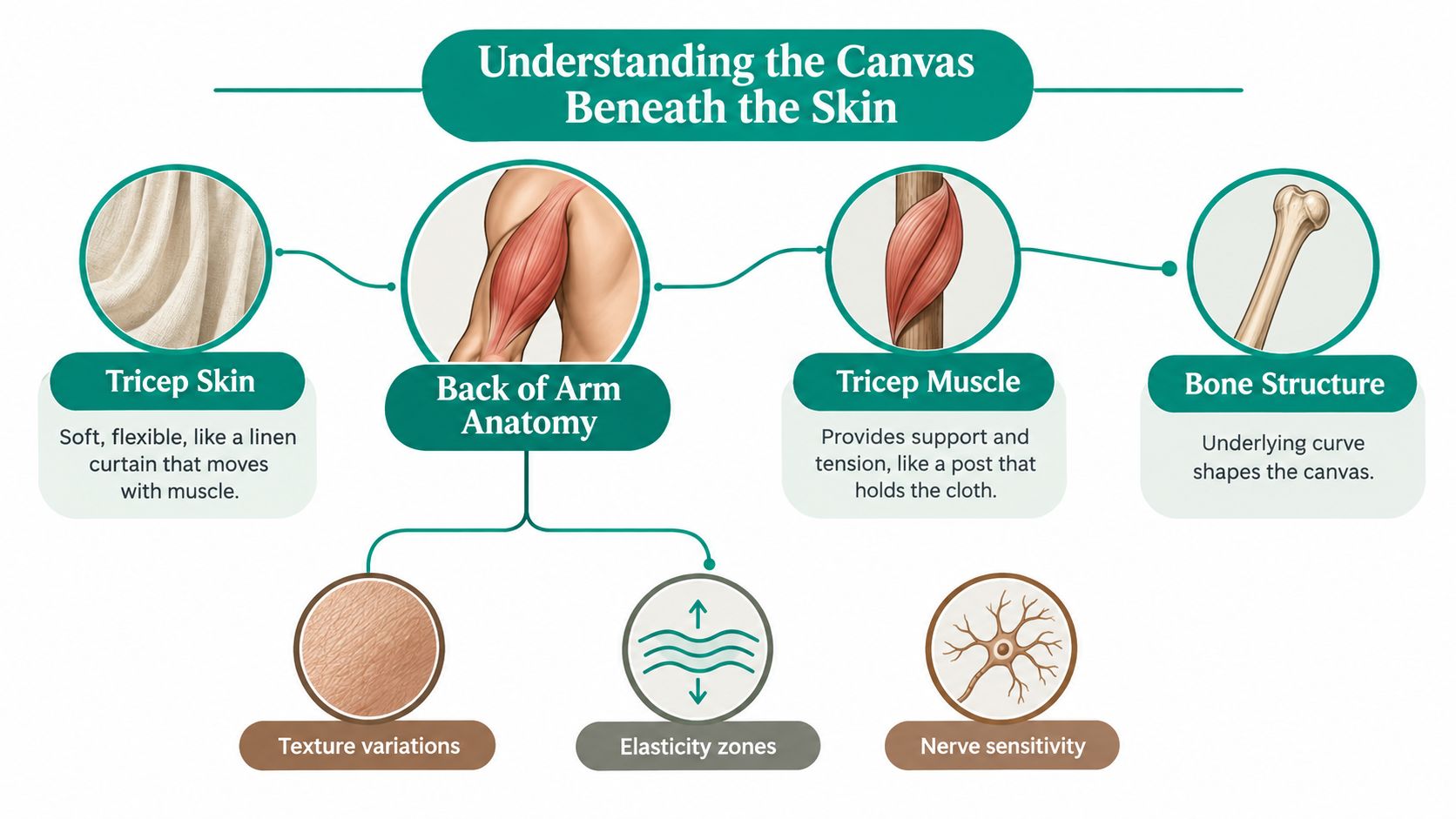
A back of arm tattoo sits on a curved, flexible panel, not on a flat sheet. That single fact explains why some ideas look calm and balanced here, while others seem to twist or disappear around the sides.
How the tricep panel is built
The skin over the tricep works a bit like cloth laid over a rounded pole. It has give. It also has a direction. The tricep muscle creates most of the shape you see from behind, while the humerus sits deeper underneath, so the area usually feels less hard and sharp than placements where bone sits close to the surface.
A placement guide focused on the upper arm describes the back of the upper arm as a low-friction, high-cushion placement because of its thick skin, subcutaneous fat, and deeper bone position. The same guide notes that the back or triceps side is slightly less sensitive than the front biceps side, and that it often heals faster than more mobile or bony areas. It also advises avoiding tight sleeves and heavy arm training for the first 2 to 3 weeks to reduce friction and pressure on healing skin (upper arm placement guide).
That anatomy affects design more than first-timers expect.
A stencil can look balanced on a phone screen and feel off once it wraps onto the arm. Straight lines may bow a little. A perfect circle may read more like an oval from certain angles. Fine detail near the side edge can drift out of view unless the artist places it on the part of the tricep that faces backward most often.
What shape reads best here
The clearest fit is usually vertical. Vines, daggers, snakes, stems, koi, script columns, ornamental drops, and cropped portraits tend to follow the arm's natural length instead of fighting it.
Wide concepts need editing before they become tattoo-ready. It is similar to hanging a wide poster in a tall, narrow alcove. The artwork might be strong, but the proportions can still argue with the space.
That usually leaves two smart options:
- Build in a wrap on purpose so the design continues around the arm.
- Crop the idea into a panel so it reads as a framed section, not a squeezed full-width image.
A branch dropping from shoulder level toward the elbow often works because the eye can follow it downward. A broad wing span or long horizon scene often needs more planning, since the arm curve can split the image and hide part of the read.
Placement inside the placement matters too.
- Upper section: Often gives more forgiving skin and more room for a focal point.
- Mid tricep: Usually offers the cleanest read for main linework and shape.
- Near the elbow: Movement increases, skin gets busier, and tiny detail becomes harder to keep crisp.
If your skin tends to feel dry or irritated, prep matters as well. Some people review options such as HempWell USA CBD body lotion benefits while building a skincare routine for fully healed tattooed skin, but your artist's aftercare instructions should lead right after the appointment.
How motion changes the picture
This area is almost never viewed in a frozen pose. Your arm swings when you walk. The tricep shifts when you lift a bag, reach for a shelf, or turn slightly in a mirror. Good back of arm tattoos account for that movement instead of pretending it does not exist.
That is where idea planning gets practical. If your concept is still vague, AI image generation can help you test the brief before you book. The useful part is not letting a tool "design your tattoo." The useful part is using it to check whether your idea still reads well as a tall, curved tricep panel.
For example, “phoenix with flowers” is still too loose for this spot. “Vertical phoenix, wings partially folded, body centered on the back of the upper arm, detail concentrated in the mid tricep, no full-width spread” gives both an AI tool and a tattoo artist a much clearer starting point. That closes the gap between a mood in your head and a design that fits the canvas on your body.
Pain, Healing, and How the Area Ages Over Time
People ask, “How bad does a back of arm tattoo hurt?” The honest answer is more useful than a pain score. This area is manageable, but not uniformly easy. It sits in a comfort zone for many, then surprises them in a couple of small bands where the sensation sharpens.
An independent arm and shoulder guide puts the tradeoff well. Outer upper arm and shoulder zones are often framed as lower-pain placements, but the back of the arm is often singled out as “surprisingly tender” compared with what first-timers expect (arm and shoulder tattoo guide).
How it compares with nearby spots
The back of the arm usually feels different from the neighboring areas for three separate reasons: the needle sensation, the healing pattern, and how the tattoo settles visually over time.
| Placement | Pain During Session | Healing Speed | How It Ages Over 3 Years |
|---|---|---|---|
| Back of upper arm | Usually manageable, with sharper tenderness near the elbow and upper edge | Often steady if sleeves don't rub | Holds shape well when composition follows the panel |
| Front or outer shoulder | Often more comfortable for many people | Can heal well, though straps and shirt seams may irritate it | Usually ages well if the design respects the shoulder curve |
| Outer forearm | Often straightforward to sit through | Can be easy to protect day to day | Often stays readable because the surface is fairly stable |
| Inner bicep | Commonly feels more tender | Friction and moisture can complicate healing | More vulnerable to softening because the skin is stretch-prone |
| Elbow ditch area | Usually one of the harder sits | Healing can be fussier because of constant bending | Fine details may need especially careful design choices |
For a broader placement-by-placement discussion, the tattoo pain by location guide is useful when you want to compare this area with the rest of the body.
What healing feels like in real life
Healing doesn't happen in a vacuum. It happens while you're sleeping on your side, pulling on a T-shirt, carrying a gym bag, and reaching for shelves.
Three common trouble points catch people off guard:
- Sleeve friction: Tight sleeves can brush the healing tattoo over and over.
- Gym pressure: Bench work, pressing movements, and direct arm contact can disturb forming scabs.
- Sleep contact: If you sleep with that arm pressed into the mattress, the area can feel hotter and more irritated the next morning.
A back of arm tattoo often behaves well because the area isn't bending constantly like the elbow ditch. But “often” isn't the same as “automatic.” If you ignore rubbing and pressure, even a forgiving placement can heal rough.
How it tends to age
Long-term appearance matters just as much as session pain. General aftercare guidance from Cleveland Clinic notes that stable areas like the upper back, shoulder, or outer forearm tend to hold up better, while stretch-prone areas like the inner arm are more vulnerable. The same guidance stresses loose clothing during healing, sun avoidance early on, and daily sunscreen afterward (tattoo aftercare and longevity guidance).
That matters here because the back of the upper arm sits in a relatively favorable middle zone. It isn't as exposed as a forearm all day, but it still deals with sun, shirt seams, and body changes over time. Designs that flow with the tricep usually stay readable better than designs that force perfect symmetry across moving skin folds.
Style and Motif Ideas That Work on a Tricep Panel
Some tattoo ideas seem born for this placement. Others need heavy redesign before they stop looking borrowed.
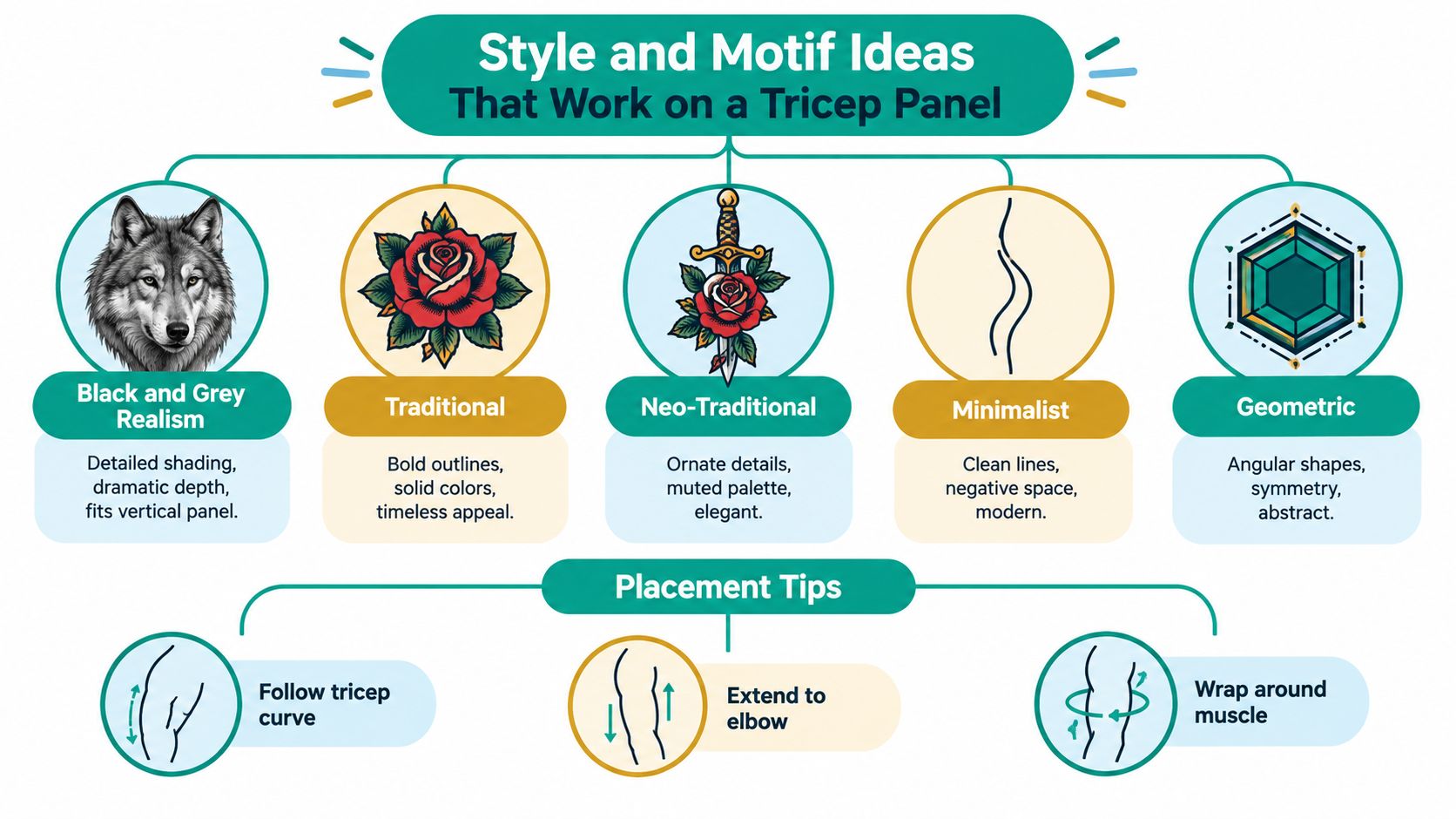
Style families that usually fit well
The easiest winners are motifs that already have a natural up-and-down movement.
- Black and grey realism: Wolf heads, statues, ravens, hands, or cropped faces can sit well if the focal point stays centered and the shading doesn't get too busy near the elbow.
- Fine-line botanicals: Olive branches, lilies, climbing stems, lavender, and thorned roses work because they can taper elegantly.
- Geometric work: Repeating shapes, stacked symbols, or sacred-geometry-inspired columns can look clean if the artist adjusts the symmetry to the body.
- Traditional and neo-traditional: Daggers, snakes, roses, candles, panthers, and hearts hold up because stronger outlines suit moving skin.
- Japanese-inspired panels: Koi, snakes, waves, peonies, and wind bars can be built as a vertical flow rather than a flat sticker.
- Ornamental pieces: Beads, chains, filigree, lace-like drops, and pointed mandala forms tend to flatter the panel.
- Micro-realism portraiture: Best used carefully. This area can hold a portrait crop, but tiny detail packed too low toward the elbow may not age as gracefully.
Motifs that stretch gracefully
If you're unsure where to start, choose a subject that can elongate without looking distorted.
Good examples include:
- Serpents
- Koi
- Branches
- Feathers
- Daggers
- Vertical script
- Hanging florals
Harder fits include perfect circles, broad vistas, and anything built around a flat horizon.
A tricep panel rewards flow more than width.
Size and detail rules that save headaches
The smaller the tattoo, the more ruthless you need to be about detail. A back of arm tattoo can carry subtle linework, but the design still needs room to breathe. If your arm is smaller, simplify inner textures before you shrink the whole composition. It's better to have fewer details that stay crisp than many details that merge.
A simple sizing test helps. Draw the rough shape with a washable marker on the actual back of your arm. Then look at it in three positions: arm relaxed, arm slightly bent, and arm raised. If the design only looks good in one pose, it still needs work.
If you want more placement-specific inspiration, this collection of tricep tattoo ideas can help you compare motif types before you settle on a direction.
Turning a Vague Idea Into a Clear Brief and AI Prompt
You are in a consultation chair, and the artist asks what you want. You say, “Something about resilience.” That is a real starting point, but it is still too foggy to draw from. The goal is to turn that fog into instructions.
A strong brief for the back of the arm works like a house sketch before construction. It does not need every brick, but it does need the footprint, shape, and purpose. If you skip that step, you and the artist may both be talking about “strength” while picturing completely different tattoos.
Start by splitting your idea into two parts. First, decide what the tattoo needs to mean. Then decide how that meaning should look on this specific canvas. The back of the upper arm is not a blank sheet of printer paper. It is a tall, slightly curved panel, so your brief should guide the design in that direction from the start.
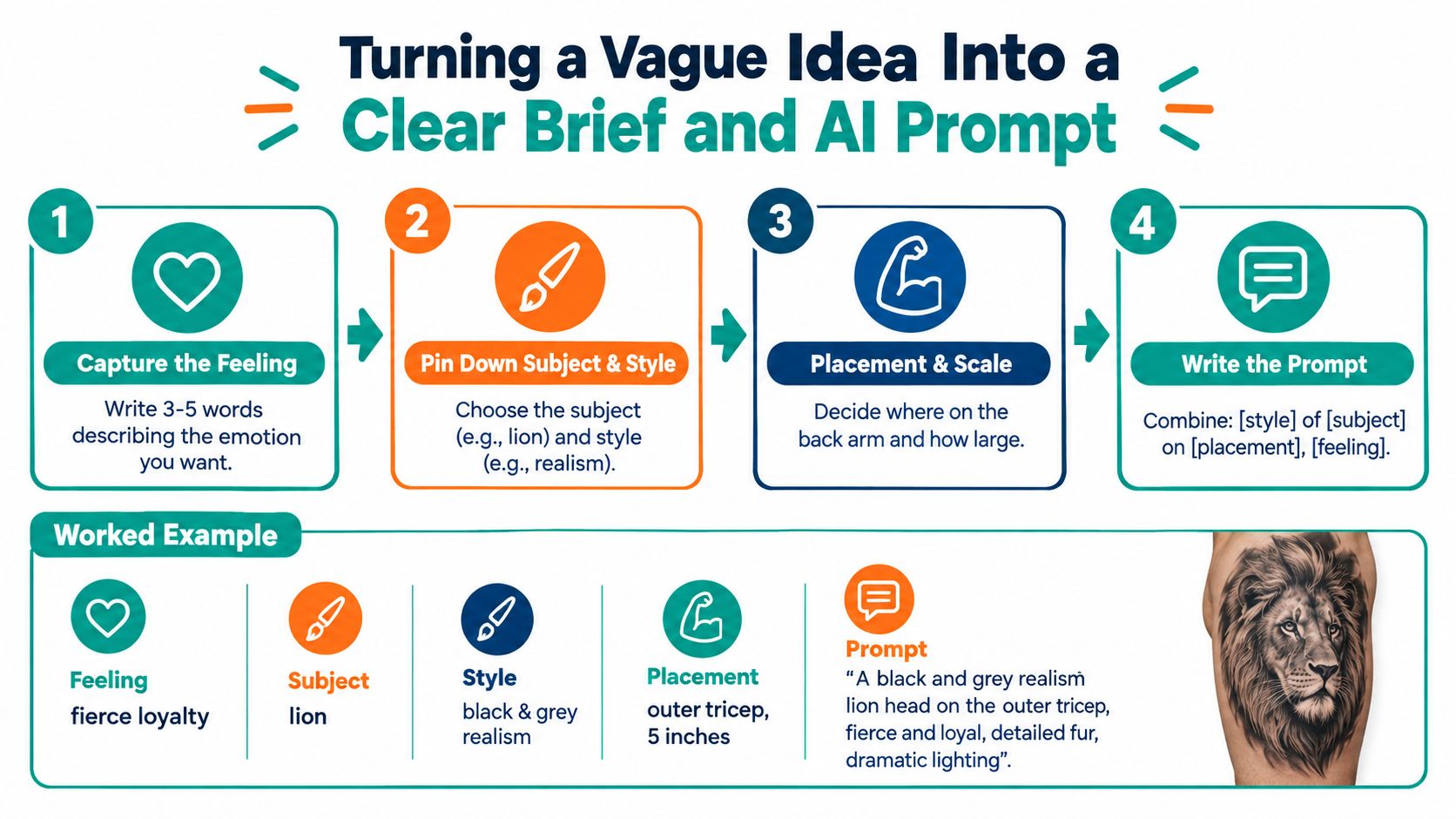
A simple process helps:
Name the feeling
Write a few plain words. For example: steady, resilient, calm, protective, grounded.Pick a subject that carries that feeling
Resilience could become a branch growing through stone, a repaired chain, or a snake shedding skin. Each says something slightly different.Define the tricep fit
Write the placement the way you would describe a frame on a wall: back of upper arm, vertical composition, centered on the tricep, ending above the elbow.Add style rules
Note black and grey or color, fine line or bold line, light shading or high contrast, minimal background or ornamental detail.Turn it into one clean prompt
Put the parts together so the artist, or an AI image tool, can interpret one clear direction instead of five loose fragments.
Here is what that looks like in practice.
Vague idea: resilience and growth
Meaning translated into image: olive branch pushing through cracked stone
Style: fine-line black and grey with light shading
Canvas rule: vertical tricep panel, medium size, no wide horizontal background
Mood: quiet strength, understated, calm
That becomes a usable prompt:
Fine-line black and grey tattoo of an olive branch growing through a cracked stone form, designed for the back of the upper arm on the tricep, medium vertical composition, delicate outer lines with a slightly stronger main stem, calm and resilient mood, minimal background, no wide horizontal elements.
That prompt is not final tattoo art. It is closer to a good blueprint. It gives shape to the conversation before the artist redraws it for your body.
AI can help at this stage because it is fast at showing variations. TattoosAI is one example people use to test subject, style, and composition ideas before a consultation. The useful part is not getting a finished tattoo from a machine. The useful part is discovering what you mean when you say “I want something strong but subtle.”
Keep the testing controlled. Change one variable at a time.
- Change the subject if the symbolism feels wrong
- Change the style if it looks too soft, too heavy, or too busy
- Change the scale if the concept feels cramped
- Change the composition if it stops fitting the tricep panel cleanly
This matters more than people expect. If you change the subject, style, size, and mood all at once, you cannot tell which choice improved the concept and which one weakened it.
A quick visual walk-through can help before you start refining prompts:
Bring these to the consultation:
- Reference images that show style, contrast, and level of detail
- A rough measurement of the usable back-of-arm area
- A sleeveless or loose-sleeve top so placement is easy to check
- Notes about nearby tattoos if this piece needs to connect, avoid overlap, or leave future space
The best result usually comes from treating AI drafts as rough thumbnails and your artist as the person who solves the design problem. Your brief gets the idea out of your head. Your artist gets it onto skin in a way that fits.
Aftercare That Protects Linework and Color for Years
The first surprise after a new back of arm tattoo is how often daily life tries to rub it. Shirt sleeves. Car seats. Sleep. Gym benches. Even the way you dry off after a shower matters more than people expect.
The first days
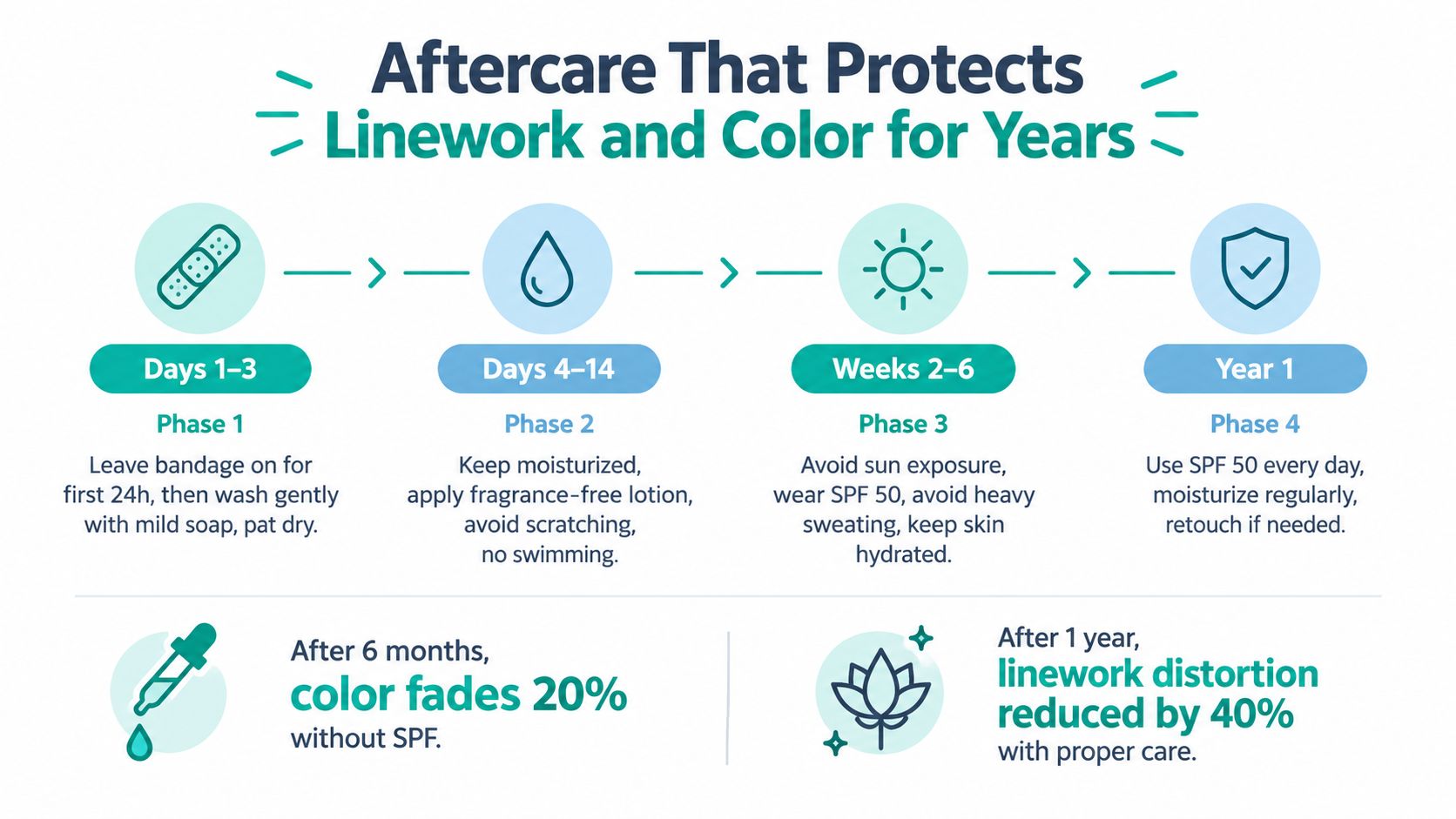
For the first stretch, your job is simple. Keep the tattoo clean, avoid friction, and don't over-apply product.
- Leave the bandage on as directed: Your artist's timing comes first because wrapping methods differ.
- Wash gently: Use fragrance-free soap, lukewarm water, and clean hands.
- Pat dry: Don't scrub with a towel.
- Use a thin layer only: More ointment isn't better. Heavy product can smother the area.
If you're looking for a broader reference to compare with your artist's instructions, this complete tattoo aftercare guide gives a useful general overview.
The awkward middle stage
Days later, the tattoo often looks better than it feels. That's when people get careless.
You might think, “It's fine now,” then pull on a fitted sleeve, hit an upper-body workout, or rest your arm against rough fabric all day. That's the stage where a back of arm tattoo can get irritated even though the top layer appears calmer.
Keep loose clothing in rotation until the tattoo stops acting like fresh skin.
Useful habits in this phase include:
- Choose softer sleeves: Loose cotton usually beats tight synthetic fabric.
- Skip soaking: Pools, hot tubs, and baths can wait.
- Watch carrying straps: Backpack and bag straps can catch the upper edge depending on placement.
The part people forget
The tattoo may look healed before the deeper layers fully settle. That's why continued care matters after the peeling phase ends.
Sun is the long-game issue. So is repeated rubbing. If the back of your arm gets frequent daylight exposure, daily sunscreen becomes part of tattoo maintenance, not just beach-day behavior. Moisturized skin also helps the tattoo keep a cleaner, healthier look over time.
Call the studio, or a medical professional when needed, if you notice spreading redness, heat, or ongoing oozing that doesn't seem to be settling. A little tenderness is normal. Escalating irritation isn't something to “tough out.”
Your Back of Arm Tattoo Decision Checklist
A back of arm tattoo usually starts with a simple sentence. “I want a snake.” “I want flowers.” “I want something meaningful.” That is a fine starting point, but it is not enough to make good placement decisions on a tricep panel. This part of the arm has shape rules, visibility tradeoffs, and future sleeve implications. A short checklist helps you catch those details before they turn into regrets.
Use this like a marked-up studio note, not a test you have to pass perfectly.
Before you commit
- Check whether the design matches the panel. The back of the arm works best for designs that read clearly in a vertical lane or soft curve. If your idea spreads wide like a chest piece, redraw it before trying to squeeze it into a narrow strip.
- Decide how visible you want it to be in daily life. Some placements stay fairly private with your arms relaxed. Others peek out from short sleeves. Be clear about which version you want.
- Choose solo piece or future sleeve piece. A tricep tattoo can stand on its own, but it can also act like one wall in a larger room. If you may add more later, leave space and direction for that.
- Gather references that show more than subject matter. Bring examples of line weight, shading, spacing, and how the tattoo sits on the back of the arm. “Rose” is a topic. “Fine-line rose with open skin and a tall flow” is a usable direction.
During the artist conversation
- Bring a written brief. A few plain lines are enough: subject, mood, style, size range, and whether you want it hidden, partly visible, or easy to show.
- Ask to test the placement on your actual arm. A small stencil shift can change the whole read. What looks centered in a flat reference photo can feel too far inward or too close to the outer arm once you turn naturally.
- Ask how the design will wrap. Some pieces should stay mostly on the back panel. Others improve when they curl slightly toward the side. Your artist can show the difference with marker lines or stencil placement.
- Look at healed tattoos. Fresh work can look sharp, dark, and glossy. Healed work shows how that artist's linework and shading settle in real skin.
After you decide
- Prepare for the first week before your appointment day. Set out soap, clean towels, loose shirts, and clean bedding so you are not improvising with a fresh tattoo.
- Check your calendar. If you have a beach day, a wedding with tight formalwear, or upper-body training planned, timing matters as much as design.
- Save your brief and reference set. If you used TattoosAI earlier in the planning stage, bring the strongest concept images as visual notes. Use them to clarify direction, not to replace a custom design built for your arm.
- Write down the long-term plan. Include sunscreen, skin care, and whether you want to add surrounding work later. Good tattoos age better when the owner treats them like something worth maintaining.
The goal of this checklist is simple. You walk into the studio with a clear idea, a realistic sense of the canvas, and better questions. That is how a vague concept turns into a back of arm tattoo that fits your arm instead of fighting it.