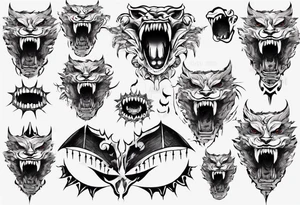
Kirtimukha tattoos represent the face of glory or "Face of Glory". It is a mythical creature in Hindu and Buddhist iconography that is often depicted as a fierce and protective mask-like face with bulging eyes, fangs and a protruding tongue. Kirtimukha is believed to possess the power to ward off evil spirits and bring good fortune. It is a symbol of protection, strength, and auspiciousness. The tattoo can be placed on the upper arm or shoulder to symbolize strength and defense, or on the chest to represent the importance of protecting one's inner self. Below you will find a collection of kirtimukha tattoo design ideas for you to browse and get inspired by.

Join 9,635 happy customers.
The Kirtimukha's story is one of self-devouring hunger. In a widely told version, a fierce being was created from the wrath of Shiva to punish a demon. When the threat backed down, the ravenous creature had nothing left to consume, so Shiva commanded it to devour itself. It ate its own body until only the face remained. Pleased, Shiva named it Kirtimukha and decreed it should guard his thresholds forever. This is why the symbol carries meanings beyond simple protection: it speaks to ego consumed, appetite turned inward, and the surrender of the self. As a tattoo, it can represent conquering one's own destructive impulses rather than only defending against outside harm.
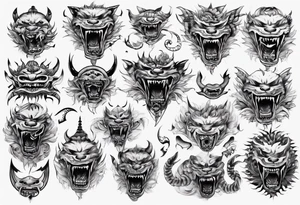
Kirtimukha is above all a threshold guardian. In Hindu and Buddhist temple architecture across India, Nepal, Southeast Asia and beyond, you find it carved above doorways, on lintels, crowning arches over deities, and at the top of decorative torana arches. Its job is to devour negativity before it can pass through. Because it is a face without a lower jaw or body, it reads as an ornamental mask rather than a full creature. Regional styles vary considerably: the version found in South Indian temples differs from Javanese Kala heads or Nepalese carvings. If a specific tradition matters to you, look at examples from that region rather than treating the motif as one uniform image.
Kirtimukha is detail-heavy: bulging eyes, fangs, curling foliage, and often lions' or makara elements pouring from the mouth. Fine line work can lose that density over time, so many artists favour bolder linework or blackwork that holds up as the ink settles. It suits larger surfaces — chest, upper back, forearm, or as a centrepiece framing other imagery — where the ornamental detail has room to breathe. Because the motif is sacred in living traditions, consider its cultural weight before committing. If you have a personal connection to Hindu or Buddhist practice, that lends the piece meaning; if not, approach it as respectful appreciation and choose an artist who understands the iconography rather than copying a photo blindly.
It isn't inherently disrespectful, but it is a sacred guardian motif in living traditions. Approach it with genuine understanding of its meaning rather than treating it as pure decoration. Learning the myth, choosing accurate iconography, and working with a knowledgeable artist all help you honour the symbol rather than flatten it.
They are closely related threshold guardians and the names are sometimes used interchangeably. Kala is the term commonly used in Javanese and Southeast Asian temple architecture, while Kirtimukha is more widespread in Indian and Sanskrit contexts. Both depict a devouring face without a lower jaw placed above entrances to consume negativity.
Traditionally no. Because it devoured its own body down to the face, it is usually rendered without a lower jaw, showing just the upper teeth, fangs and open mouth. Some modern tattoo interpretations add a full jaw, but the jawless form is the more authentic and recognisable version.