TattoosAI
You're at the flash wall with a half-finished plan on your phone, and every sleeve in the case is color. The dragon is red. The koi is orange and white. Then the grey pieces at the bottom of the glass make the choice obvious: which motif still works when pigment is reduced to black, grey and skin.
A black and grey Japanese sleeve runs on contrast, shading and composition. Strip color away and three decisions remain: where the darkest anchor sits, how the background moves, and whether the focal point reads from across a room. A screen preview flattens those decisions fast, and fixing plastic-looking skin in renders makes the same point in another medium: surface detail carries realism, so the artist has to build texture into the design instead of leaning on more contrast.
Use that test on the seven motifs ahead. Favor shading that carries the focal point, grey that can soften without turning muddy, and a layout you can brief clearly on contrast, negative space and placement before the first consultation.
Table of Contents
- 1. Black-and-Grey Hannya Mask Sleeve
- 2. Koi Carp Climbing the Waterfall (Koi no Takinobori) Sleeve
- 3. Fujin and Raijin (Wind and Thunder Gods) Sleeve
- 4. Black-and-Grey Dragon and Cloud (Ryu) Sleeve
- 5. Great Wave Sleeve Inspired by Hokusai
- 6. Peony and Chrysanthemum Floral Sleeve
- 7. Tiger and Bamboo Sleeve (Tora to Take)
- How the seven black and grey Japanese sleeve motifs compare
- Choosing Your Sleeve Before Your First Consultation
1. Black-and-Grey Hannya Mask Sleeve
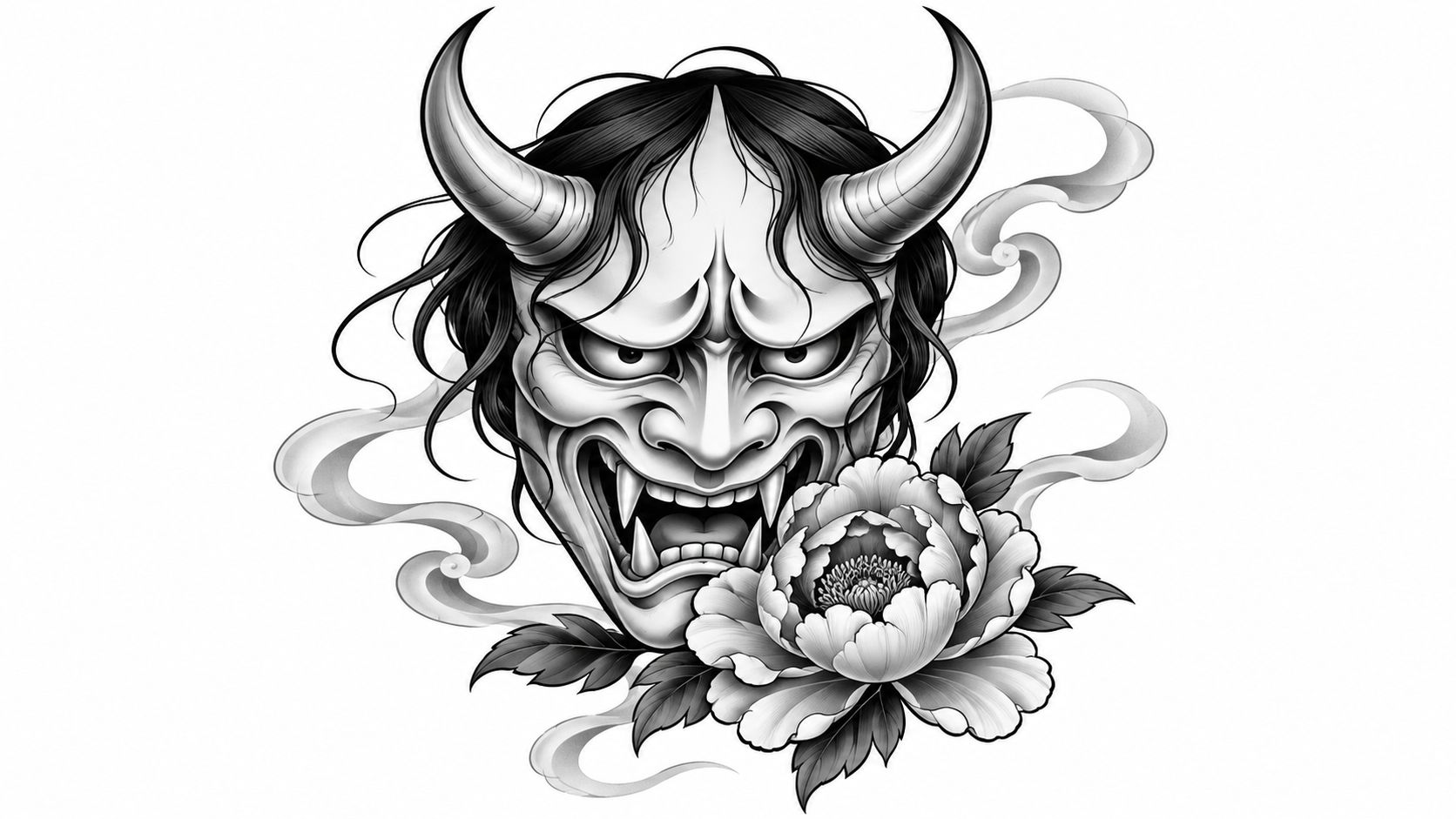
A hannya puts the whole emotional range of Japanese tattooing into one focal point. It's the horned female demon mask from Noh theatre, jealousy hardened into rage, and in grey it has to carry that expression through shading alone. Flatten the gradients and you're left with a grey blob with teeth.
The mask sits inside a tattoo culture with sharp social and legal turns: decorative tattooing expanded through the Edo period (1603 to 1868), the Meiji government banned the practice in 1872, the ban lifted in 1948, and Japan's Supreme Court ruled in 2020 that tattooers don't need medical licences, as Behind Japan documents. That history is why a hannya still lands as a warning rather than a portrait.
Reading the mask in grey
Three value zones do the work. Deep black sits in the eye sockets, nostrils and open mouth. Mid-grey models the cheeks, brow and horns. Open skin holds the highlight on the bridge of the nose and the upper lip. Let those zones run together and the face stops turning.
Placement usually puts the mask across the forearm or over the elbow, with peonies, smoke or water framing it so the top of the sleeve doesn't stop on a hard line. Say a client wants the mask centred on the forearm and the peony at the wrist: the artist draws the flower first, so the mask has something to sit in rather than floating.
- Stencil at full size. A mask that reads well on a tablet can look wide and short on a real forearm.
- Name the mood. Fierce, sorrowful and grieving are three different mouths and brow lines, and the artist needs your pick before lining starts.
- Protect the darkest point. If anything else on the arm is blacker than the eye sockets, the mask has lost its job.
Practical rule: the mask is the focal point or it's a sticker. There's no middle setting.
2. Koi Carp Climbing the Waterfall (Koi no Takinobori) Sleeve
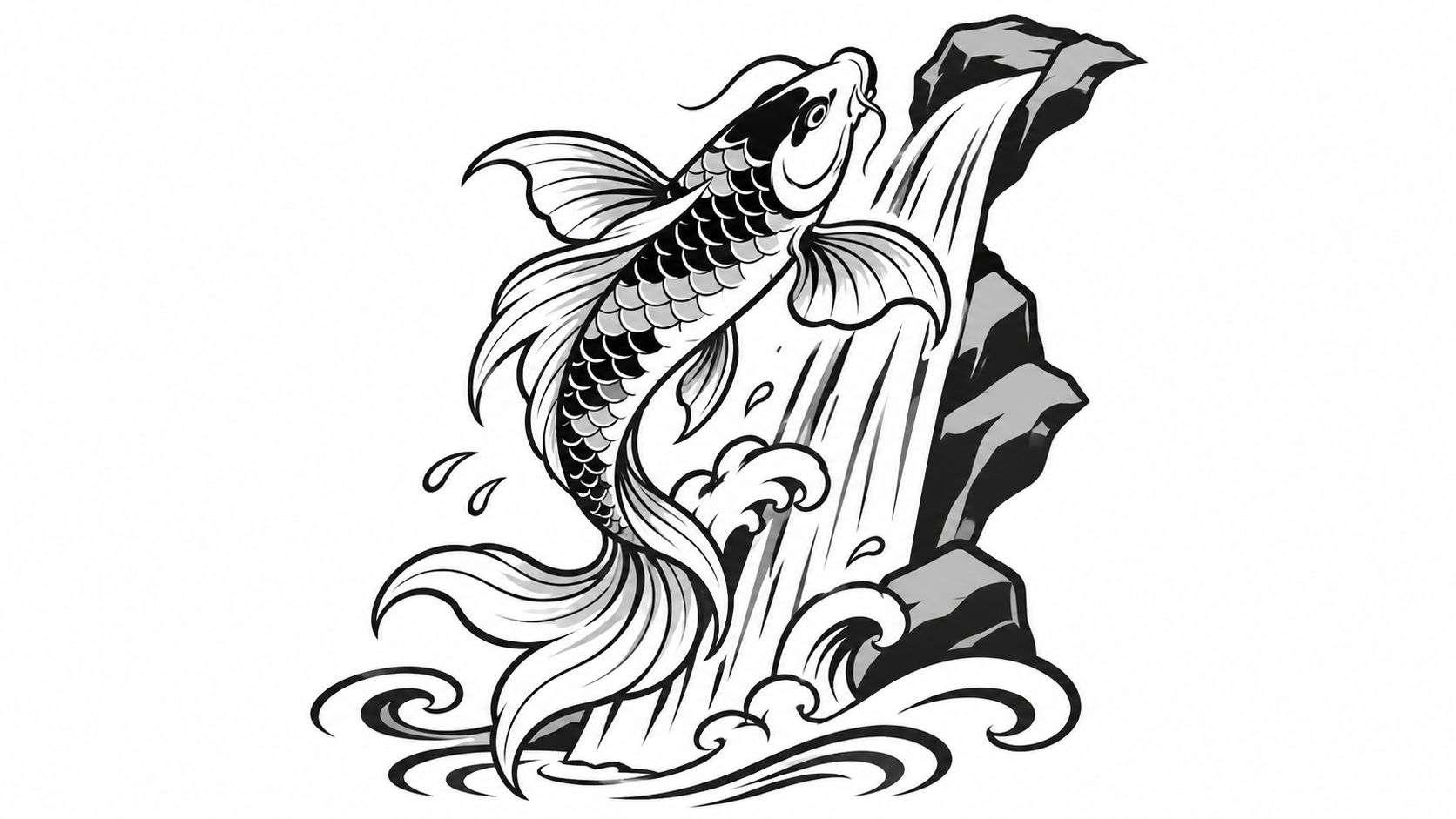
A koi climbing a waterfall is the most readable story in Japanese tattooing and one of the hardest to shade cleanly. The legend is the carp that swims up the Dragon Gate and becomes a dragon, so the design carries perseverance and courage through effort in a single image. In grey, the fish is built from scales, fin rays and layered body shading, while the waterfall is flowing line and wash.
The problem is tonal collision. Fish and water compete for the same mid-greys, and when both sit at the same value the koi dissolves into the falls.
Composition that follows the arm
Run the fish diagonally from wrist toward the shoulder instead of straight up the centre line. The diagonal keeps the body long, gives the water somewhere to fall, and lets the scales catch light along the top edge of the arm. Ask for solid black in the fish's back and lighter wash in the water, so the two separate at a glance from across a room.
Budget belongs in the design conversation, because this is a multi-session piece. In 2026, black-and-grey traditional or neo-traditional full sleeves in the United States were estimated at $2,500 to $6,000, inside a general full-sleeve range of $2,500 to $12,000, according to Peachy Tattoos.
- Follow the natural lines. Tendons and muscle give the water its direction.
- Spend your black once. The eye and the back of the fish, not the waves.
- Pick a partner motif. Lotus for calm, waves for force, cherry blossoms for the passing of time.
If you want the symbolism sorted before the shading, the traditional koi tattoo guide covers the variants and their meanings.
3. Fujin and Raijin (Wind and Thunder Gods) Sleeve
Two gods on one arm is a composition problem before it's a tattoo problem. Fujin carries the wind bag, Raijin beats the thunder drums, and each needs its own ground. Set them shoulder and elbow with cloud work bridging the gap and the arm reads as one storm. Crowd both onto the upper arm and you get a poster folded in half.
Where the two gods go
The classic split is Fujin high, Raijin low, with wind bars and cloud curls carrying the eye between them. Decide early whether you want both deities or one. A single Raijin framed by drums and storm cloud is often the stronger sleeve, because the figure gets room to breathe and the shading gets space to soften.
A pair of gods also means more hours. In 2026, black-and-grey full-arm sleeve work in the United States was estimated at $3,000 to $6,000, based on 15 to 25 hours at $150 to $250 per hour, according to Apprentice.
What grey does to a storm
Storm imagery is mostly atmosphere, and atmosphere is where black and grey either shines or muddies. The gods need the darkest values on their faces and hands, the drums and bag next, and the clouds a full step lighter. Wind bars carry the transition. If the clouds come out at the same weight as the figures, the whole sleeve flattens into weather.
The brief, in one sentence: two figures, two territories, one cloud system connecting them.
The symbolism runs deeper than the weather. If you're choosing between the gods and another pairing, this guide to Japanese tattoo meanings is worth reading before the consultation.
4. Black-and-Grey Dragon and Cloud (Ryu) Sleeve
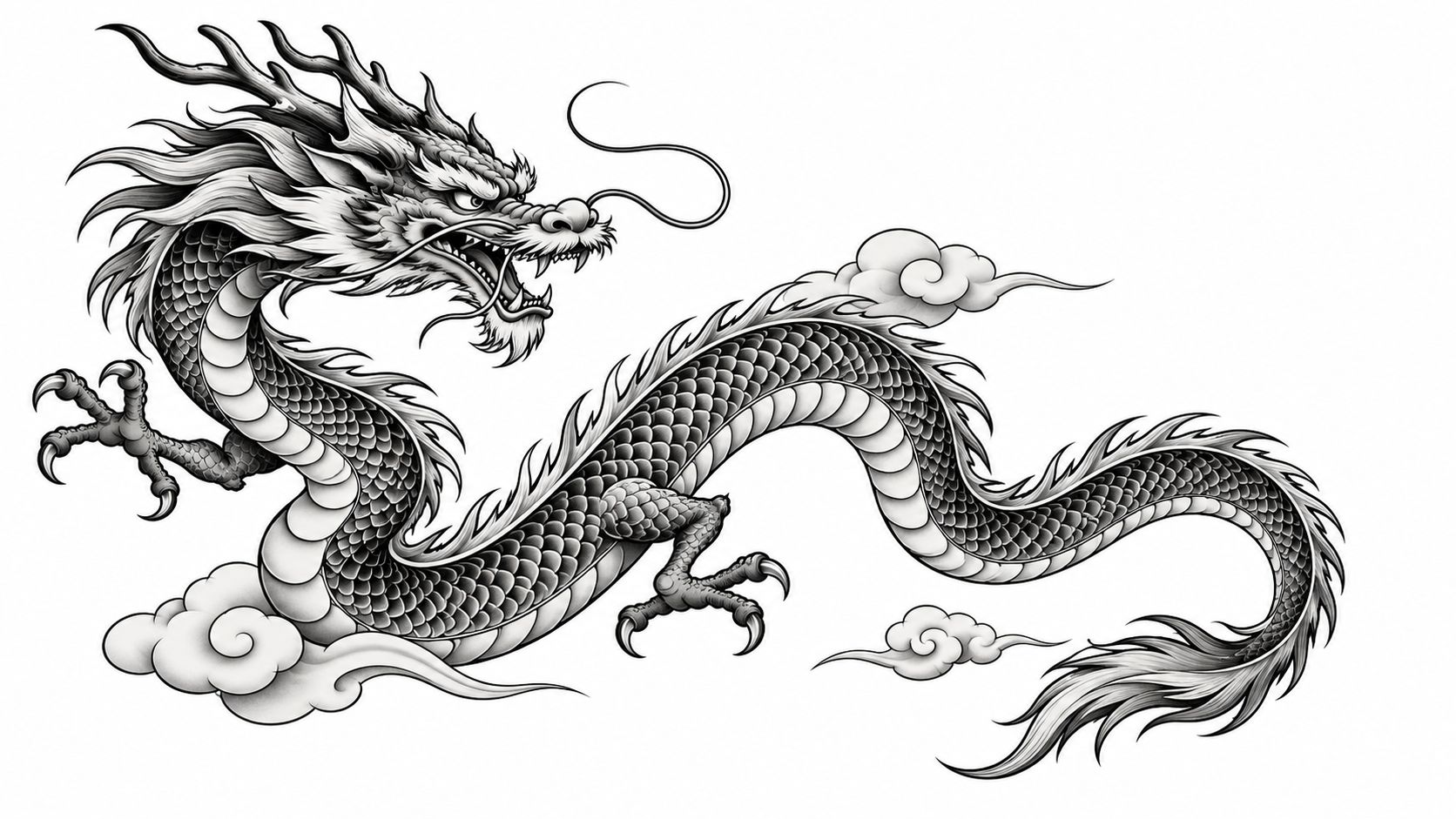
The dragon is the default Japanese sleeve and the cliché for exactly the same reason. Ryu carries strength, wisdom and control over water and weather, and the clouds aren't background filler. They're the mechanism that hides the body's impossible length and lets the head arrive somewhere that reads.
That makes cloud work the deciding factor. A good dragon in weak clouds looks like a snake in fog.
The needle brief behind convincing clouds
Professional guidance for Japanese backgrounds pairs bold outlines with larger curved or straight magnums for clouds, water and other expansive elements, then drops to smaller bugpin groupings for finer tonal transitions, as SVT Shop's guide to Japanese tattoo backgrounds sets out. A workable starting spec is 7RL to 9RL for defined contours, 5RL for small pattern detail, and 11RM to 15RM for broad background shading, adjusted for hand speed, machine behaviour, skin elasticity and scale.
Diameter matters at this size too. Standard sizes commonly run #8 at 0.25 mm, #10 at 0.30 mm and #12 at 0.35 mm; the smaller diameters hold gradients, while larger groupings cover ground faster.
Ask for this in the brief: focal motif, reserved negative skin around the head, and explicit bokashi-style fades, cloud bars and water movement. "Black and grey" on its own gets you a grey sleeve with no structure.
Pose and placement
Ask for a custom pose rather than a stock coil, and put the head where people see it. Shoulder or outer forearm beats the middle of the bicep, which disappears the moment your arm hangs. A crouching dragon suits a forearm panel; an ascending one suits the full sleeve, with the tail dissolving into cloud at the wrist.
5. Great Wave Sleeve Inspired by Hokusai
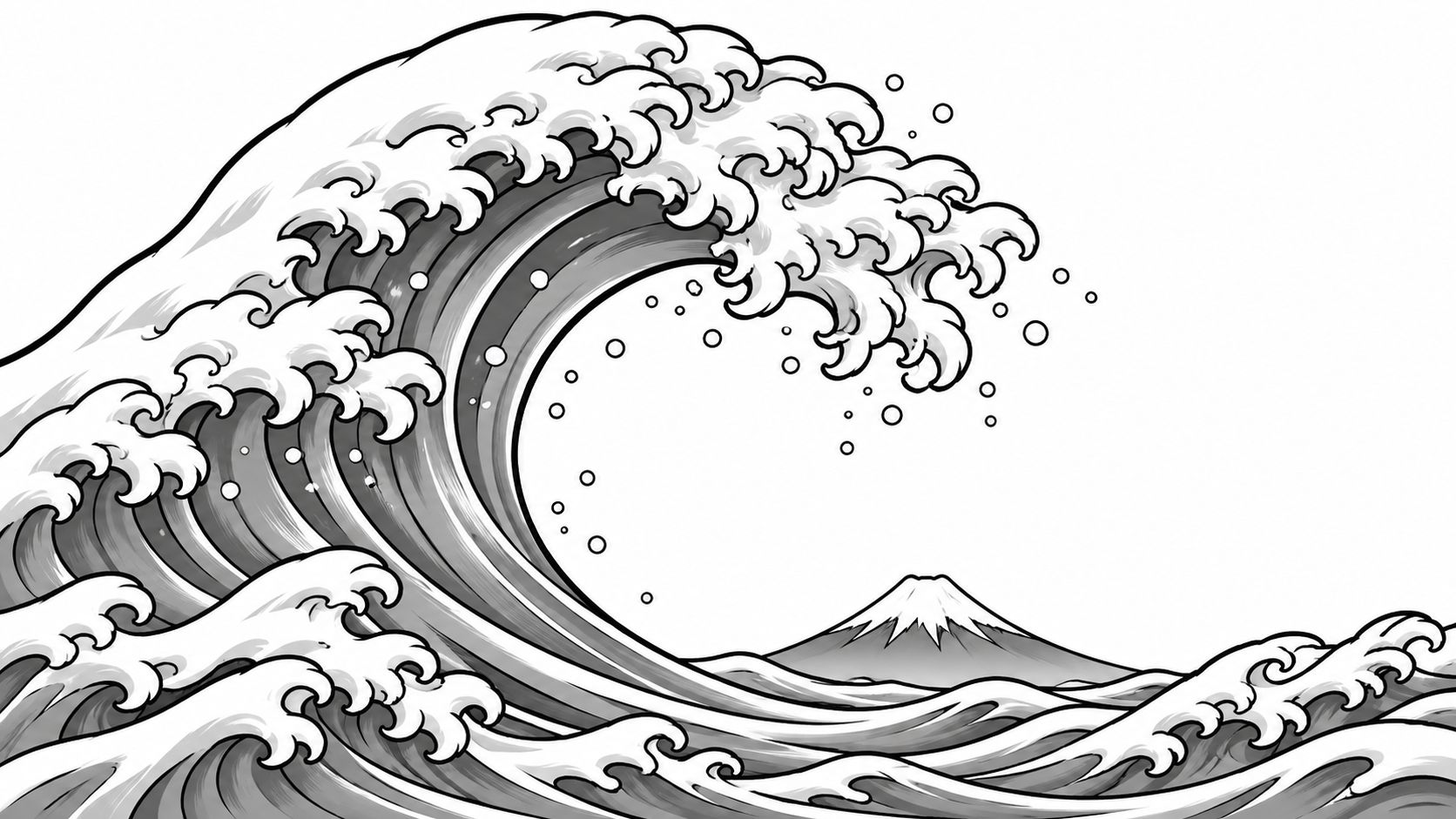
Everyone knows the print. Fewer people know that copying it straight onto an arm usually fails, because Hokusai composed for a rectangle and your forearm is a cone. The foam claws, the boaters and Fuji in the distance give you three focal points competing for the same sleeve.
Three values, or the wave turns to soup
A large monochrome Japanese sleeve needs tonal separation across at least three functional zones: opaque black anchors for major outlines and deep recesses, mid-grey modelling for the anatomy of the wave, and open or lightly washed skin for highlights and breathing room. Lighthouse Tattoo's guide to black and grey shading describes grey wash as black ink cut with sterile water, built progressively rather than pushed in one heavy pass, which matters once a sleeve contains smoke, waves, clouds or a dragon.
Curved magnums smooth gradients across wide areas; bugpins handle the tighter transitions. Shading setups around 7 to 9 volts on machines with 3 mm stroke lengths are a starting range, not a specification, because voltage, hand speed, grouping and skin response all interact.
- Pick one hero. The crest, not the crest plus Fuji plus boats.
- Wrap, don't stamp. A partial crest curling around the arm reads better than a square print shrunk to fit.
- Keep highlights open. Untouched skin is what makes foam look wet.
Say you want the wave on the outer forearm with the crest curling toward the elbow. That's a wrap, and it needs the artist to redraw the foam rather than trace the print. Ask for a personal interpretation, then judge it by contrast instead of resemblance.
6. Peony and Chrysanthemum Floral Sleeve
Flowers decide whether a black and grey Japanese sleeve looks expensive or like wallpaper. Peonies (botan) carry wealth and honor, chrysanthemums (kiku) carry longevity and the imperial family, and in most irezumi they sit behind a hannya, koi or dragon doing the narrative work. Drop the creature and the shading has to supply the drama on its own.
That shifts where the contrast lives. With no horns, stripes or scales anchoring the blacks, the deepest values move to leaf mass and background, so wind bars or dark foliage end up framing each flower head. Mid-grey petals also settle closer together as the sleeve ages, which makes the space between blooms matter as much as the petals.
Symbol clashes to avoid
Symbol guides tend to stop at one-line meanings: koi for perseverance, dragons for power and wisdom, cherry blossoms for impermanence. Few explain how to combine those meanings into a coherent narrative, or where traditional irezumi conventions end and modern black and grey adaptations begin.
Tattooing also remains socially sensitive in Japan, where visible work can still draw scrutiny in shared spaces, even as younger wearers challenge older assumptions. Treat the imagery as a tradition you're borrowing rather than a pattern library.
- Balance light and dark petals. Mid-grey petals against near-black leaves give depth; uniform grey reads flat from a metre away.
- Place along contours. A peony on the elbow point fights the skin; one on the flat of the forearm sits still.
- Cap the flower count. Two flower types plus one creature is usually the ceiling before a sleeve turns busy.
A peony with no creature and no background is a flower tattoo. A peony with wind bars and a hannya is a Japanese sleeve.
7. Tiger and Bamboo Sleeve (Tora to Take)
A tiger is the most honest value test on this list. Stripes are the blackest element on the arm, bamboo leaves are the softest, and the sleeve works only if both hold their place. The tiger carries courage and protection, bamboo carries resilience and flexibility, and the pairing is a balance of force and give.
What the stripes cost you
Tiger designs are stripe-heavy, which means dense black over large areas and often more than one pass to reach real depth. That's a commitment question as much as a design question.
Reviews of tattoo complications document granulomatous, infectious and allergic reactions, and MRI-related irritation, swelling, burning and image artifacts can occur in rare cases, with one review identifying 17 published MRI-related cases described as uncommon and routine MRI generally still possible, as a review in Anais Brasileiros de Dermatologia reports. None of that makes grey riskier than color. It makes the sleeve a medical conversation as well as an artistic one.
Pain depends on placement, session length, technique and your own sensitivity. Tell the artist about allergies, previous reactions and medications, and follow their aftercare rather than a forum thread.
- Balance the two subjects. Tiger and bamboo should each hold roughly half the visual weight.
- Choose the posture. Crouching reads as contained power; leaping suits a full sleeve where the body can stretch.
- Space the sessions. Heavy black needs healed skin before the next pass, not a long weekend.
How the seven black and grey Japanese sleeve motifs compare
| Item | Placement | Best For | Main Symbolism |
|---|---|---|---|
| Black-and-Grey Hannya Mask Sleeve | Upper or lower forearm, elbow, or outer upper arm | People who want a bold, meaningful focal point | Jealousy and rage |
| Koi Carp Climbing the Waterfall (Koi no Takinobori) Sleeve | Full upper arm to forearm, or a wrap-around sleeve | People who want movement and a message of resilience | Perseverance, courage, and success through effort |
| Fujin and Raijin (Wind and Thunder Gods) Sleeve | Full upper arm or shoulder-to-elbow sleeve | Enthusiasts who want a mythic, large-scale sleeve | Wind, thunder, and mythological power |
| Black-and-Grey Dragon and Cloud (Ryu) Sleeve | Full arm, shoulder-to-wrist, or wrap-around | People who want strength and an iconic, elemental symbol | Strength, wisdom, and control over water and weather |
| Great Wave Sleeve Inspired by Hokusai | Upper arm, forearm, or wrap-around sleeve | Art lovers who want a sleeve tied to a famous artwork | Nature's power and the flow of life |
| Peony and Chrysanthemum Floral Sleeve | Upper arm, elbow, or forearm | People who want a softer, more decorative sleeve | Wealth, honor, longevity, and imperial heritage |
| Tiger and Bamboo Sleeve (Tora to Take) | Upper arm, shoulder, or full sleeve | People who want a bold, protective symbol with a graceful counterpart | Courage, protection, resilience, and flexibility |
Choosing Your Sleeve Before Your First Consultation
One dominant motif. That's the rule I'd give anyone starting a black and grey Japanese tattoo sleeve. A single hero subject, whether hannya, koi, dragon, wave, floral group or tiger, gives the artist a focal point to build contrast around, and everything else becomes supporting structure.
Then decide whether the sleeve needs movement or stillness. Koi and dragons move; a hannya mask sits and stares. Movement designs want diagonal flow from wrist to shoulder and background that carries the eye along. A static focal point wants negative space around it and a dark anchor nothing else competes with.
Your job in the consultation is contrast and placement, not drawing. Say where the darkest value should land, which areas you want left open, and what the sleeve has to do for you in a t-shirt versus on a bare arm. Bring two or three reference ideas, not twenty.
Whatever you generate, treat it as a reference. TattoosAI produces concepts from a written prompt across nineteen styles, Japanese among them, but the site doesn't currently preview a design on your body, and the output isn't a stencil. The artist redraws it for your arm, your skin and how the piece will age, which is the part no generator can decide for you.
TattoosAI turns a written description into original black and grey Japanese concepts you can carry into a consultation, with nineteen styles and unlimited variations on a single idea. Describe the motif, the placement and the mood, then compare the results for contrast before you commit to anything. Visit TattoosAI to generate your first sleeve reference before you book the chair.