TattoosAI
It's common to treat an eye of horus and ankh tattoo as one ancient charm that already means "eternal life." That shortcut skips the central decision. The eye and the ankh did different jobs, and a tattoo that stacks them without a primary message ends up saying everything and nothing.
The Eye of Horus, also called the wedjat, is a protective sign tied to restoration and good health. The ankh is a hieroglyph for life. Put them together and you get a modern pairing, not a single formula fixed in stone. Before line weight or placement, you decide which story the tattoo has to tell.
Conventional pages list protection, healing, and eternity in one breath. A clearer path separates what Egypt used these signs for from later readings, including the disputed math of the eye, and locks one meaning before any drawing starts.
Table of Contents
- What the Eye of Horus and Ankh Pairing Means
- Where the Symbols Come From
- What the Combined Symbol Communicates
- Design Layouts That Read Clearly
- Placement, Size and Line Detail
- How to Brief TattoosAI for an Original Design
- Take Your Design to a Tattooist Before You Book
What the Eye of Horus and Ankh Pairing Means
| Symbol | Origin | Core meaning | Meaning in a tattoo |
|---|---|---|---|
| Eye of Horus (wedjat) | Egyptian myth of Horus's injured eye, restored | Protection, restoration, good health | Strong focal emblem for recovery or guardianship |
| Ankh | Egyptian hieroglyph for life or breath of life | Life, continuity, renewal | Supporting symbol for vitality or remembrance |
| Eye of Horus with ankh | Two protective and life-affirming signs | Protection that sustains life | Pairing that reads as recovery plus continuity |
The wedjat isn't a generic Egyptian eye. It comes from the story of Horus's eye being injured and later restored, so on skin it reads as protection, healing, and a return to good health. People often choose it when the tattoo marks recovery, or a promise to watch over someone else.
The ankh is the hieroglyph for life, or the breath of life. In a tattoo it usually plays a supporting role: vitality, continuity, or remembrance of a life that still matters. Its loop and stem already say that life goes on, so it doesn't need extra decoration to be readable.
Together, the honest reading is protection that sustains life. That fits recovery after illness, survival through a hard year, or guardianship of a family. It isn't an automatic claim to eternal life. Egypt used each sign in more than one setting, and a modern combination adds your own emphasis on top.
Don't swap in the Eye of Ra
The Eye of Horus isn't the Eye of Ra. They come from different myths, and tattoo pages often treat them as interchangeable "Egyptian eyes." Horus's eye is tied to restoration and health. Ra's eye is tied to the sun and divine force. Flip the story and you change what the tattoo is saying, even if the outline looks similar at a glance.
Practical rule: Name one primary meaning before you choose any visual. A combined symbol can carry protection, life, renewal, and remembrance at once. The design should favour one, or the lines won't know what to emphasize.
Say the line out loud. "This is about recovery, and life is the support." Or "This remembers my father, and protection is the frame." That sentence becomes the brief. Layout, line weight, and placement all have to serve it.
Where the Symbols Come From
The wedjat works like a mended object. In the myth, Horus's eye was damaged in a struggle and later restored. That repaired eye became a major protective sign, tied to healing and a return to wholeness. A tattoo that keeps the whole eye, the brow, the markings, and the lower curl is pointing at that restored state. A tattoo that isolates one curl is pointing at a piece of the repair, not the finished sign.
The six-part fraction reading
A frequently cited mathematical reading splits the eye into six components. A review of the Eye of Horus fraction claim sets those parts at 1/2, 1/4, 1/8, 1/16, 1/32, and 1/64. The values step down by powers of two. Added together they make 63/64, or 98.4375%, not a complete 1. The missing sliver is the part that sticks. It can feel like a wound that healing never quite erases, which is a strong personal metaphor.
Treat that math carefully. The same review records the debate: Egyptologist T. Eric Peet argued in 1923 that the component signs do not appear before the New Kingdom, and that Egyptian fraction signs had a separate origin. Later scholarship treats the mathematical reading as a possible later reinterpretation, not a securely proven original design.
You can still like the six parts. Tell that story as your metaphor, not as an Egyptian blueprint. If the six marks matter to you, ask the artist to keep those six shapes distinct. If the story is recovery, the completed eye is the point, and the fractions can stay off the skin.
Check a disputed reading against museum catalogues or peer-reviewed Egyptology before it becomes ink. One practical route is how to verify a symbol's meaning.
What the ankh attests
The ankh is a hieroglyph for "life," or the breath of life. World History Encyclopedia's account of the ankh places its use in Egypt's Early Dynastic Period, conventionally about 3150–2613 BCE, inside a hieroglyphic tradition that developed around 3250 BCE and lasted more than 3,000 years, into the early centuries of the Common Era.
In religious images, gods and rulers often hold or present the ankh. The gesture links the sign to divine power and enduring existence, including the afterlife. That range is wider than any single modern caption. Life is the core. The shade you add around it is yours.
The form did not vanish with the pharaonic period. Coptic Christians later used it in decorative and textile work, beside the cross-like crux ansata. That later life does not turn your tattoo into a Coptic cross. It shows the shape kept travelling, and that new communities kept reading it.
The ankh is historically a life sign. The exact story a modern pairing tells is a contemporary choice, and it should be labelled that way.
Renewal and remembrance build on that attested sense of life. They are not secret ancient captions. Say "contemporary reading" when you explain the tattoo. Protection and recovery sit on one side, life on the other, joined because you chose to join them.
Decide which history is primary before any line is drawn. The restored eye carries protection and healing, and that reading is the well-attested one. The fraction story is the disputed one. The ankh can support the first with life, without pretending the second was the original plan.
What the Combined Symbol Communicates
Pages usually hand you a word list: protection, healing, life, eternity. They rarely say how the two signs relate, or which detail makes the relationship visible. The drawing below is one way the pair can sit as a single mark, eye and ankh sharing one outline instead of floating as unrelated icons.
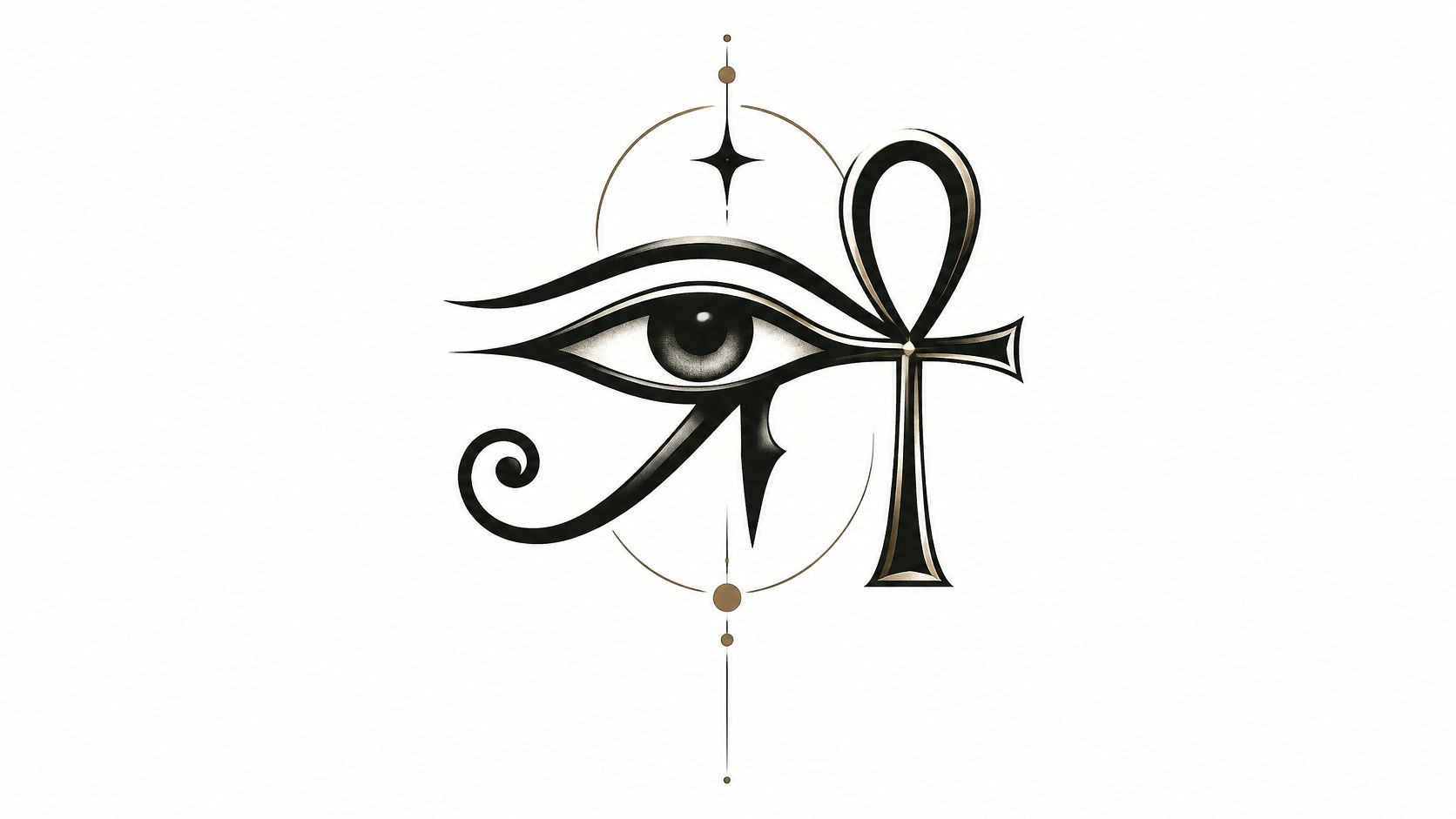
The British Museum's ancient Egypt visit resource identifies the Eye of Horus, or wedjat, with good health and the ankh with life. A careful reading is restored well-being and protection paired with life. It isn't an automatically authentic symbol of eternal life, and it isn't a guarantee that the tattoo will protect you. Amulets in museums had ritual contexts. A tattoo is a personal image inspired by those forms.
Four stories, and the detail that carries each one
Pick one theme as the primary message. The other ideas can stay in the background.
- Recovery after hardship: Keep the eye open and complete. The restored outline is the point, so don't bury it under extra symbols.
- Protection of family or a child: Put a clear ankh on the centre line, held inside the eye's shelter. Life is what's being guarded.
- Spiritual renewal: Keep the two signs as separate, clean marks with space between them. Neither one swallows the other, which reads as a life restarted under watch, not as one fused logo.
- Remembrance of someone: Use a framed cartouche only for a person you're entitled to honour. The frame is a memorial border, not a royal name ring you borrowed.
Before any of those themes, run a respect check. Don't present the pairing as an authentic ancient amulet or as guaranteed protection. Don't add invented hieroglyph-style text. Loose "Egyptian" letters often read as nonsense, and real inscriptions can be sacred writing you don't mean to copy. Save a cartouche for a memorial subject, not for a decorative name band.
A short museum walk-through helps if you want to see how these objects sit among other signs of life and health, rather than as isolated tattoo flash.
The question to answer before any layout is simple. What exact story does this combination tell, and which one detail makes that story legible to someone standing a few feet away?
Design Layouts That Read Clearly
Treat the piece as one symbol system. The Eye of Horus is the focal mark, because its wide shape is what people recognise first. The ankh is the supporting vertical axis. Its loop and stem give the design a stable centreline, while the eye's horizontal geometry needs open negative space so the brow and lower spiral don't collide.
Historical meanings shifted by period and context, so the brief should name the theme, such as protection sustaining life, instead of claiming one fixed translation. Then pick a layout that makes that theme obvious.
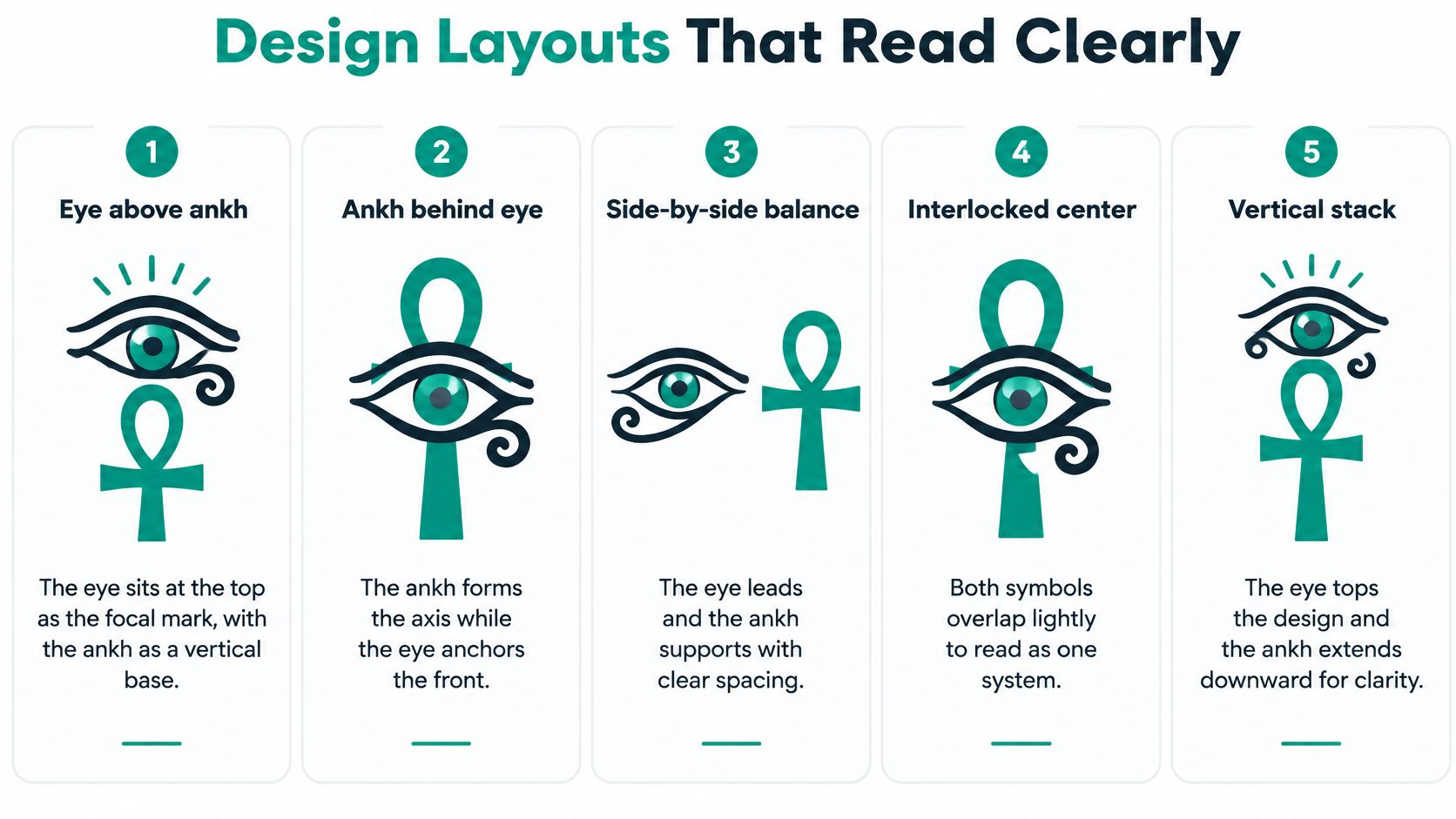
| Layout | How it is arranged | Visual message | Best fit |
|---|---|---|---|
| Eye above ankh | Eye as focal mark, ankh as vertical axis below | Protection watching over life | Back, chest centre, sternum |
| Ankh in negative space | Ankh sits beneath the brow in open space | Life held inside protection | Upper back, forearm |
| Side-by-side amulet pair | Two symbols of equal size with a clear gap | Two distinct meanings, balanced | Inner forearm, collarbone |
| Symmetric cartouche frame | Both symbols enclosed in an oval or band | Formal, memorial or family | Upper arm, calf |
| Blackwork solid | Bold contour, restrained interior detail | Graphic, strong at distance | Forearm, calf, thigh |
The eye-above-ankh stack is the clearest "watching over" picture, and it needs a tall area. An ankh tucked into the open space under the brow is quieter, and it fails if that gap is too tight. A side-by-side amulet pair keeps two meanings equal, which helps when protection and remembrance matter equally. A cartouche frame suits memorial or family work, not a casual filler. Solid blackwork wins when the tattoo will be seen across a room.
What has to stay readable
Ask the artist to preserve the eye's principal contour, brow, and lower spiral as shapes you can still name at the intended viewing distance. Tiny interior ticks feel precise on a screen and close up once the tattoo settles. A bold outer contour with restrained interior detail ages more calmly than a page of micro-lines.
Symmetry and open negative space keep the design from looking crowded. If you generate concepts first, a useful prompt is a historically inspired Eye of Horus above or integrated with an ankh, balanced symmetry, bold outer contour, restrained interior detail, in blackwork or fine line, designed for a named placement and size. That gives a tattooist structure, not a stencil.
Placement, Size and Line Detail
How small can an Eye of Horus and ankh go before they stop reading as two different signs? Needles place ink in the dermis, the deeper skin layer, where pigment generally stays for life. The surface can look closed long before the mark has finished settling. Full settling and remodelling take longer than that first “healed” week, so a pairing that looks crisp on day one can look softer once the skin has calmed.
Fine gaps behave like wet ink on thin paper. They look sharp at first, then the edges creep inward. Tight fine lines, tiny marks, and a narrow opening in the ankh loop lose their clear space as the skin remodels. Size those gaps for the body part, not for a phone screenshot, and size them for the message you already chose. If protection is primary, the eye needs enough width to stay recognisable at the distance people will see it. If life is primary, the ankh loop has to stay an open loop. If both messages are equal, you need a wider area so neither symbol is squeezed into a leftover corner.
| Placement | Detail that holds | Aging note |
|---|---|---|
| Inner forearm | Medium lines, open eye | Thinner skin, fades faster with sun |
| Upper arm | Fine detail possible | Stable surface, good for detail |
| Back of shoulder or upper back | Full detail | Stable, large canvas |
| Chest or sternum | Medium lines, bold contour | Movement and stretch soften fine lines |
| Ankle or wrist | Bold contour only | Small text and fine lines blur |
There is no single minimum width that fits every body. Ask the artist what is realistic for this design on your skin. An ankle with room only for a bold contour should not carry the eye's interior marks. An upper back can hold the full pairing because the canvas is larger and moves less.
Two drawings, then a safety check
Request two versions. One is a full-detail consultation drawing, so you can see the story. The other is a simpler production drawing with larger gaps, a clearer difference between thick and thin lines, and enough open space for that placement. If the two disagree, approve the simpler one. It still has to read after the tattoo has fully settled.
Before anyone starts:
- Ink identity: Confirm the ink brand and colour, and ask which batch will be used. Contaminated ink and allergic reactions to pigment are real risks, so this check belongs in the appointment.
- A human check: Have a professional tattooist check anatomy, scale, line spacing, and placement before skin is punctured.
- Not a finished stencil: A generated image is a reference. It has not been fitted to your body, your skin, or how the design will age, and the artist has to adapt it.
How to Brief TattoosAI for an Original Design

A prompt works like a short note to a drafter. It names the subject, the arrangement, the line weight, and the space the drawing has to fit. TattoosAI lets you design your own tattoo. The generator offers 19 tattoo styles: Sketch, Realistic, Minimalist, Black and White, Surreal, Geometric, Blackwork, Japanese, Old School, Cartoon, Watercolor, Dotwork, Tribal, Abstract, Negative Space, Lettering, Biomechanical, Portrait, and 3D. For this pairing, blackwork, fine line, or a restrained geometric treatment usually keeps both silhouettes readable. A busy watercolour wash tends to hide which symbol is carrying the message.
- Write the primary meaning in one sentence. "Protection that sustains life after recovery" is enough. If that sentence tries to hold protection, healing, royalty, and a mathematical reading at once, you have not chosen yet, and the picture will waffle too.
- Name the layout before you generate. "Eye above ankh, balanced symmetry" fixes the composition. Leaving arrangement open is how a pretty collage appears that does not match the story you picked.
- Set the line direction. Ask for a bold outer contour, restrained interior detail, and either a fine-line or blackwork variant. That stops the tool from filling every gap with texture.
- State placement and size in the same prompt. "Inner forearm, 3 inches wide" beats "small tattoo." Width decides which interior marks can stay.
- Pick one style and make several concepts. Blackwork, fine line, or a neo-Egyptian treatment should match the layout you already chose. Compare three or four. Do not mix styles inside one image.
- Check each result against three rules. The eye's principal contour reads at arm's length. The ankh keeps a stable centreline. No extra Egyptian motifs appeared that you did not ask for.
- Save the strongest concept and write change notes. Say what to enlarge, what to delete, and which gap must stay open. Then stop adding motifs.
If you want tighter control over how a prompt is phrased, ImagesArt AI's Midjourney prompting guide is a useful companion. Concrete subjects, a clear composition, and limits on extra detail keep an Egyptian brief from turning into a pile of unrelated icons.
historically inspired Eye of Horus above or integrated with an ankh, balanced symmetry, bold outer contour, restrained interior detail, blackwork or fine-line variant, designed for inner forearm, 3 inches wide
Generate again if the eye's brow collapses into the ankh's loop. That collision is the usual failure, and it is easier to fix in the prompt than after the lines are locked in.
Take Your Design to a Tattooist Before You Book
Take the chosen concept to a tattooist you trust before you book the session. We aren't a studio, and nothing on the site is a booking. The result is a reference for a tattoo artist, not a stencil, and the artist has to adapt it to your body, skin, and how the design will age. We also don't currently offer a way to preview a tattoo on your body, so the fitting happens in the studio, on you.
Bring four things: the one-sentence primary meaning, the layout you chose, the placement and size, and the simplified version with larger gaps and stronger line weight. A generated image can't show how the design will sit across a collarbone or wrap a forearm. Ask the artist to check scaling and spacing on your body, and be ready for them to enlarge a gap you'd hoped to keep delicate.
The same "ask before you book" habit shows up in other permanent work. If you want a sense of the questions people wish they'd asked earlier, explore cosmetic brow tattoo considerations and notice how much of it is about healing, pigment, and fit, not about the first pretty picture. Our walk-through of the tattoo design process covers the handoff from concept to artist in the same spirit.
Approve the design only when the meaning, the layout, and the placement all match the story you chose. Three questions make that check concrete:
- Line spacing: How will you adjust the gaps for this placement so the eye and the ankh don't merge?
- Ink: Which ink brand and batch will you use, and can I see that recorded?
- Aging: Which details are you willing to drop now because they'd blur within the first year?
If the answers match the sentence you wrote at the start, you're ready to book. If they don't, change the drawing, not your story.
TattoosAI turns a clear Eye of Horus and ankh brief into original concepts you can compare before you ever sit in a chair. Describe the primary meaning, the layout, and the style, then use the strongest image as a reference for a tattooist you trust. When you're ready to start that concept, visit TattoosAI.