TattoosAI
You're at a bus stop and the person next to you reaches for their phone. On their forearm, an owl is caught mid-flight, wings wide, face turned straight at you. It reads instantly from a few feet away. You start wondering if it would read that well on you, at the size you want, in the spot you've picked.
That's the core strength of flying owl tattoos. The spread wings create a strong silhouette before anyone sees the detail. A perched owl can shrink into a dark blob at distance. A flying one gives the eye a shape to lock onto.
The seven styles below solve different problems. Some prioritize lasting readability. Others trade durability for softness, discretion, or scale. I judge each one by how it ages, how much time it demands, and whether its wing shape fits your body. Pick by your priorities, not by the prettiest reference photo.
Table of Contents
- 1. Traditional American Flying Owl
- 2. Japanese Irezumi Flying Owl
- 3. Fine-Line Minimalist Flying Owl
- 4. Geometric Flying Owl
- 5. Watercolor Flying Owl
- 6. Dotwork Flying Owl
- 7. Neo-Traditional Night Flight Owl
- Flying Owl Tattoo Styles at a Glance
- Choosing Your Flying Owl: Style, Placement, and Next Steps
1. Traditional American Flying Owl
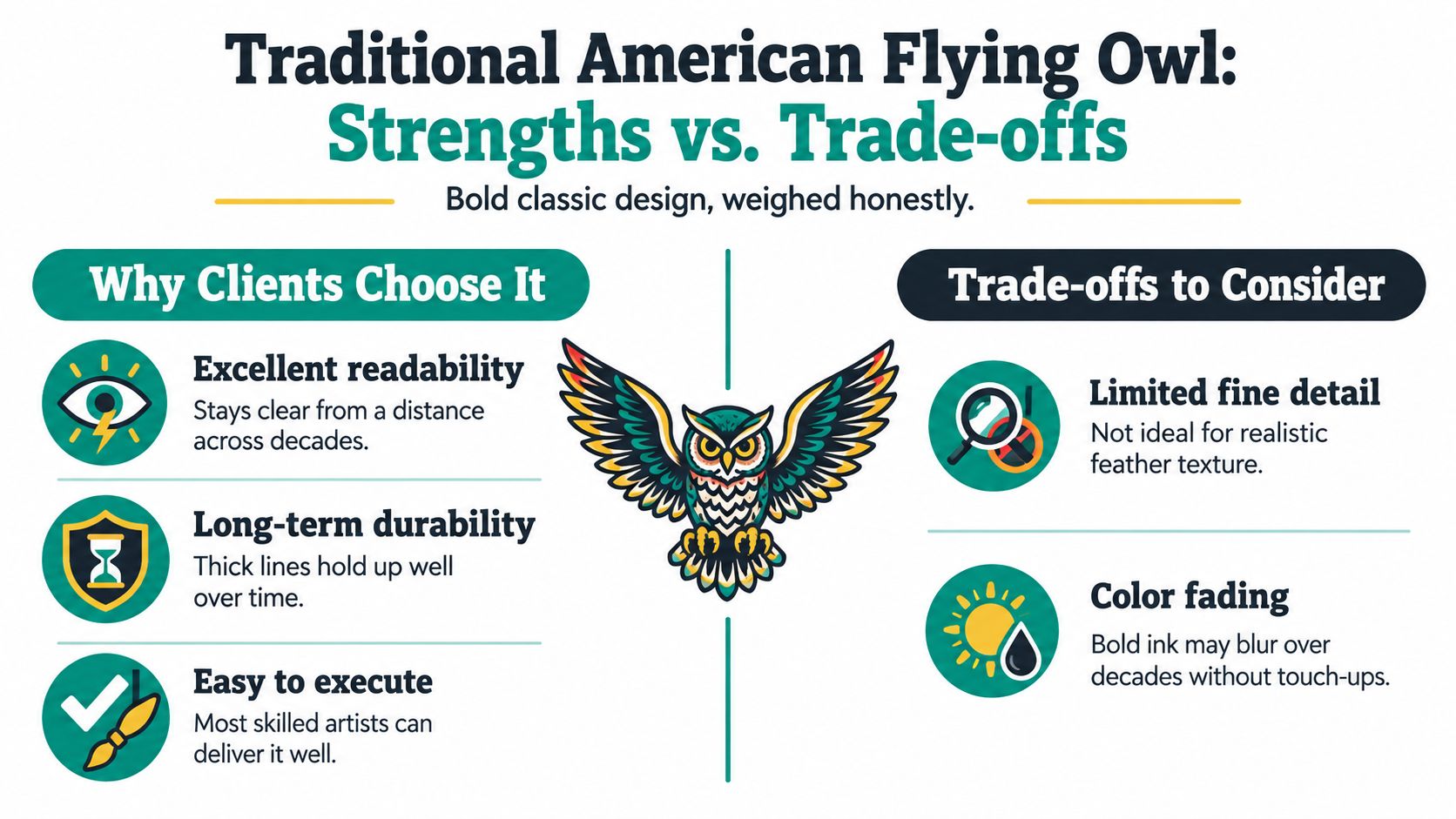
If distance readability is your top priority, start here. American traditional uses thick black outlines, flat red, yellow, and green, and simplified shading. The owl stays graphic on purpose. At conversation distance, people register wings, eyes, and beak before they register feathers.
The symbolism leans on a long record. A 2023 scholarly review of owl symbolism in Greek civilization traces the association across approximately 5,000 years, identifying the little owl, Athene noctua, as the sacred bird of Athena. That gives you wisdom, vigilance, and guardianship without inventing meaning. For a deeper breakdown, see this guide to owl tattoo meaning.
The trade-off is nuance. You won't get realistic feather texture. You'll get bold shapes that hold up as lines soften with age. Pair it with a rose, banner, moon, or stars if you want a personal layer, but don't crowd the wingspan.
Prompt and Placement Check
- Prompt: Try "traditional American flying owl, bold black outlines, red and yellow palette, spread wings, rose banner" and select American Traditional.
- Placement check: Choose a flat canvas like the upper arm, chest, or calf. Ask your artist to print it at final size and check the eyes stay separate from across the room.
2. Japanese Irezumi Flying Owl
You don't choose irezumi for a small, quick tattoo. You choose it for flow. The owl moves through wind bars, clouds, waves, or a moon, and the background carries your eye around the body. A shoulder-to-rib or back composition lets one wing sweep with your shoulder blade while the other drops with your torso.
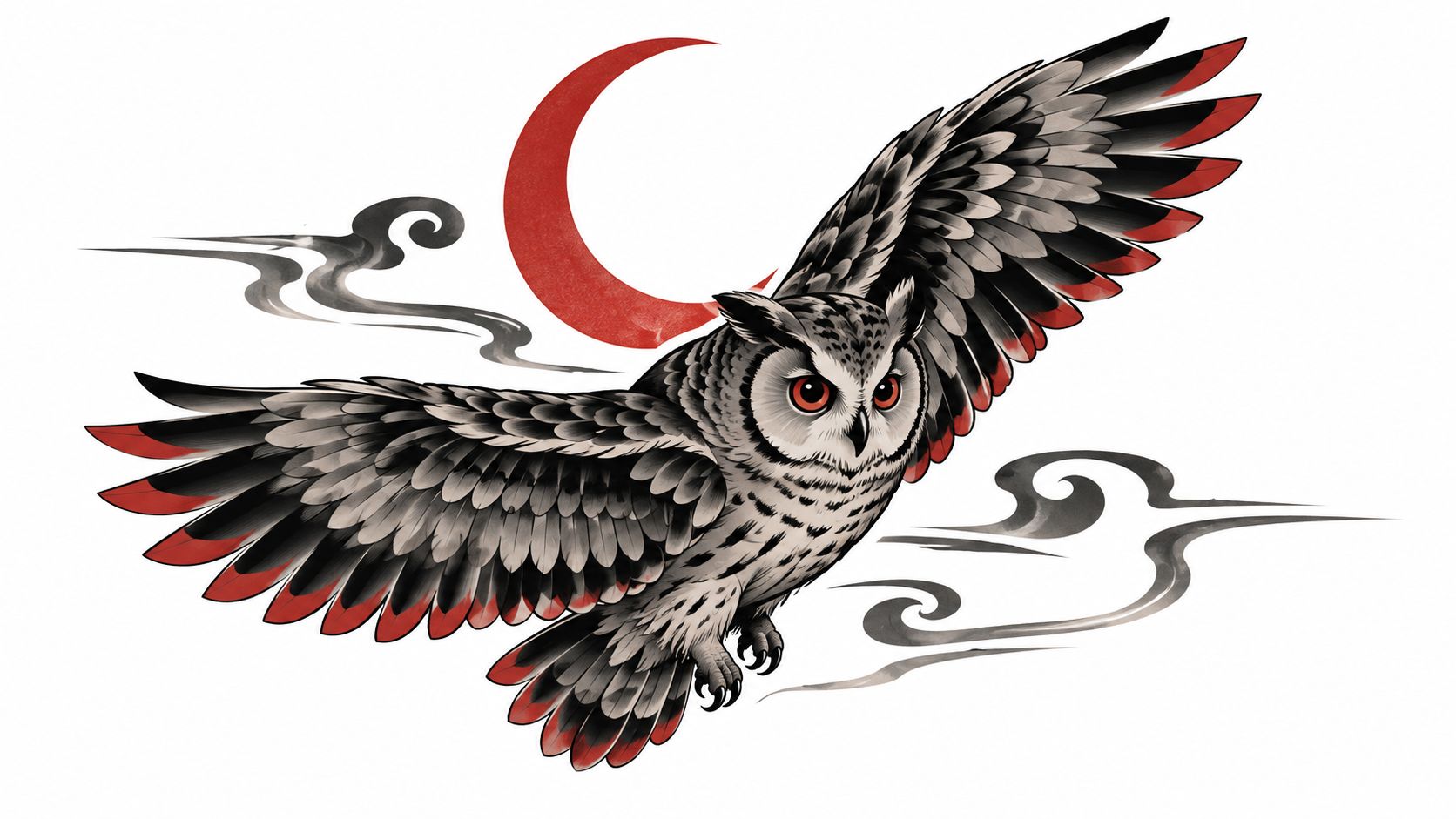
Meaning needs care here. The owl, fukurō, carries varied associations in Japan, including protection and good fortune in some contexts. As a guide to culturally varied owl symbolism notes, meanings range from Athena linked reason to death omens in medieval European folklore to messenger roles in some Indigenous traditions. Don't present a generic owl as authentically tradition specific. Choose your own anchor word, like guardian or night navigation, and verify any specific reference with your artist.
Irezumi ages well when the black structure is strong, but it costs time, money, and skin. Large and more detailed designs can cost several hundred to a few thousand dollars according to 91Tattoos. Budget for a long project, not a single session.
Prompt and Placement Check
- Prompt: Use "irezumi flying owl, wind bars, clouds, moon, black and grey."
- Placement check: Generate the concept, then have your artist redraw it to your musculature. Raise your arm during the stencil check. If the head warps over a crease, move the focal face.
3. Fine-Line Minimalist Flying Owl
A first tattoo client often wants the flying pose without the commitment of a chest piece. Fine-line minimalist work answers that. One clean outline, a few strokes for the wings, and plenty of negative space. It reads as quiet strength and intuition, not power.
Keep your expectations honest. Thin lines soften faster than bold ones, and tiny facial detail disappears first. Tattoo design guidance on bird tattoo sizing and detail warns owl facial detail can turn into visual noise below roughly 3 inches. Below that, drop the eyes to two simple marks or lose the face entirely and keep the silhouette.
Practical rule: If you can't read the wing shape on a printed stencil from arm's length, your healed tattoo won't read it either.
Pain and time are the upside. A small piece is fast, easier to hide, and easier to test. If you want to try placement first, a Temporary Tattoos soaring owl product lists at $2.63 at 3 × 3 inches, which helps you judge scale before committing.
Prompt and Placement Check
- Prompt: Use "minimalist fine-line flying owl, single line, small, clean."
- Placement check: Pick low friction skin, like the inner forearm or ribs, and ask about line weight for healing. Behind the ear only works for a true silhouette.
4. Geometric Flying Owl
Choose a geometric flying owl if you want a clear structure rather than feather-by-feather realism. The bird is built from triangles, circles, hexagons, and straight lines, with repeating angular patterns shaping the wings. This style pairs natural imagery with mathematical forms, but it needs enough space for those shapes to stay readable.
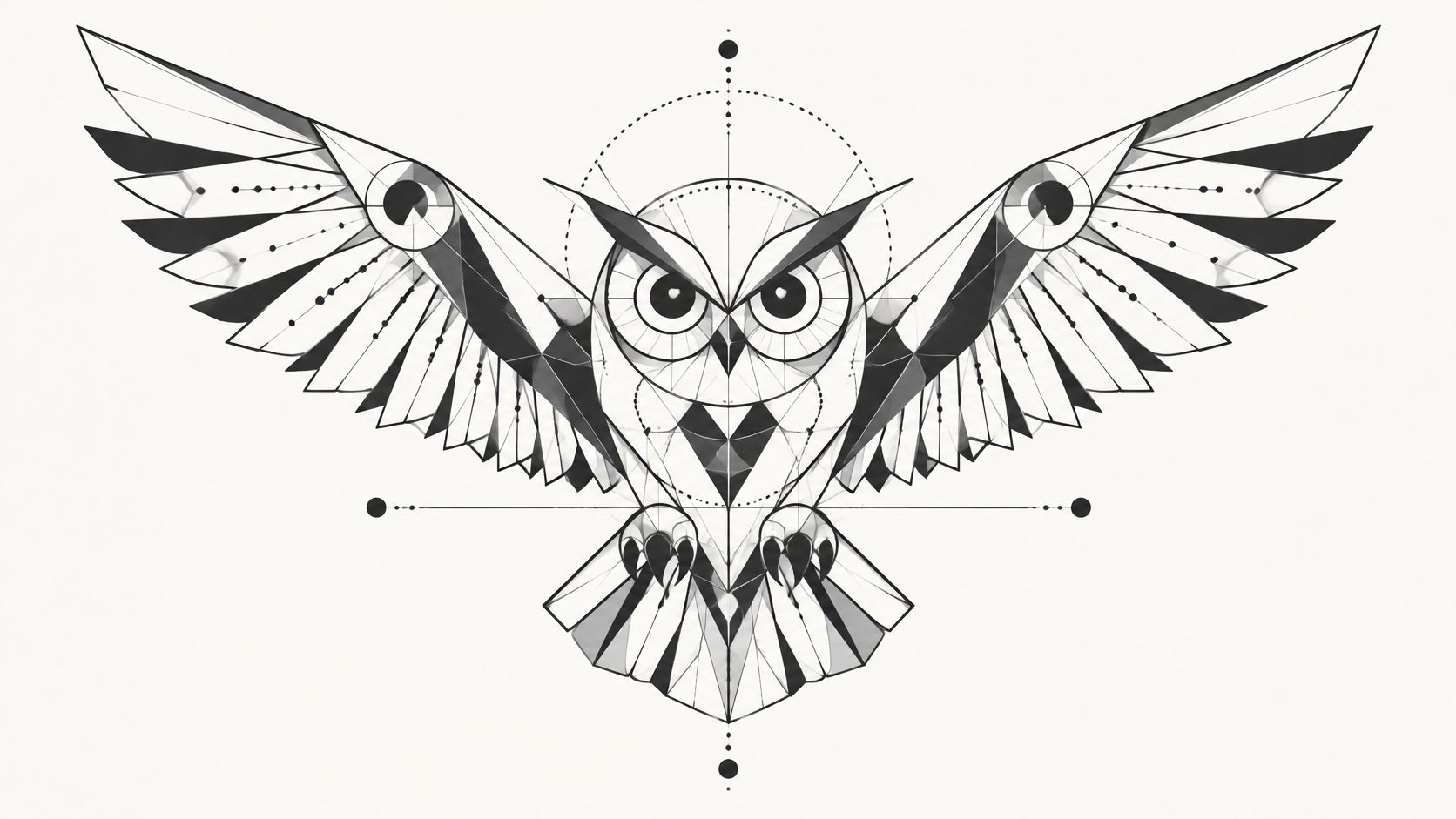
Symmetry gives the design its impact and makes placement less forgiving. A slight shift on a curved calf can look like a mistake, while an organic feather might hide it. Ask for a precise stencil and check its alignment standing, sitting, and moving. That extra placement time matters, especially on a curved area.
A smaller, simpler shape-based piece costs less than layered realism, but a larger geometric wing will be quoted by size and line count. Keep the trade-off clear: a complex design squeezed into a tiny budget may lose the spacing that makes it readable. Fewer shapes, placed cleanly, give the pattern room to hold its form.
Prompt and Placement Check
- Prompt: Try “geometric flying owl, symmetrical, triangles and circles, clean lines.”
- Placement check: Consider the sternum, forearm, or calf for a surface that can show the wing shape. Check the stencil in a mirror, then confirm the symmetry from more than one angle.
5. Watercolor Flying Owl
Watercolor clients aren't buying durability first. They're buying feeling. The owl emerges from soft splashes, color bleeds, and gradients, often in blue and purple. It looks like wearable painting, and when fresh, it's the most expressive style on this list.
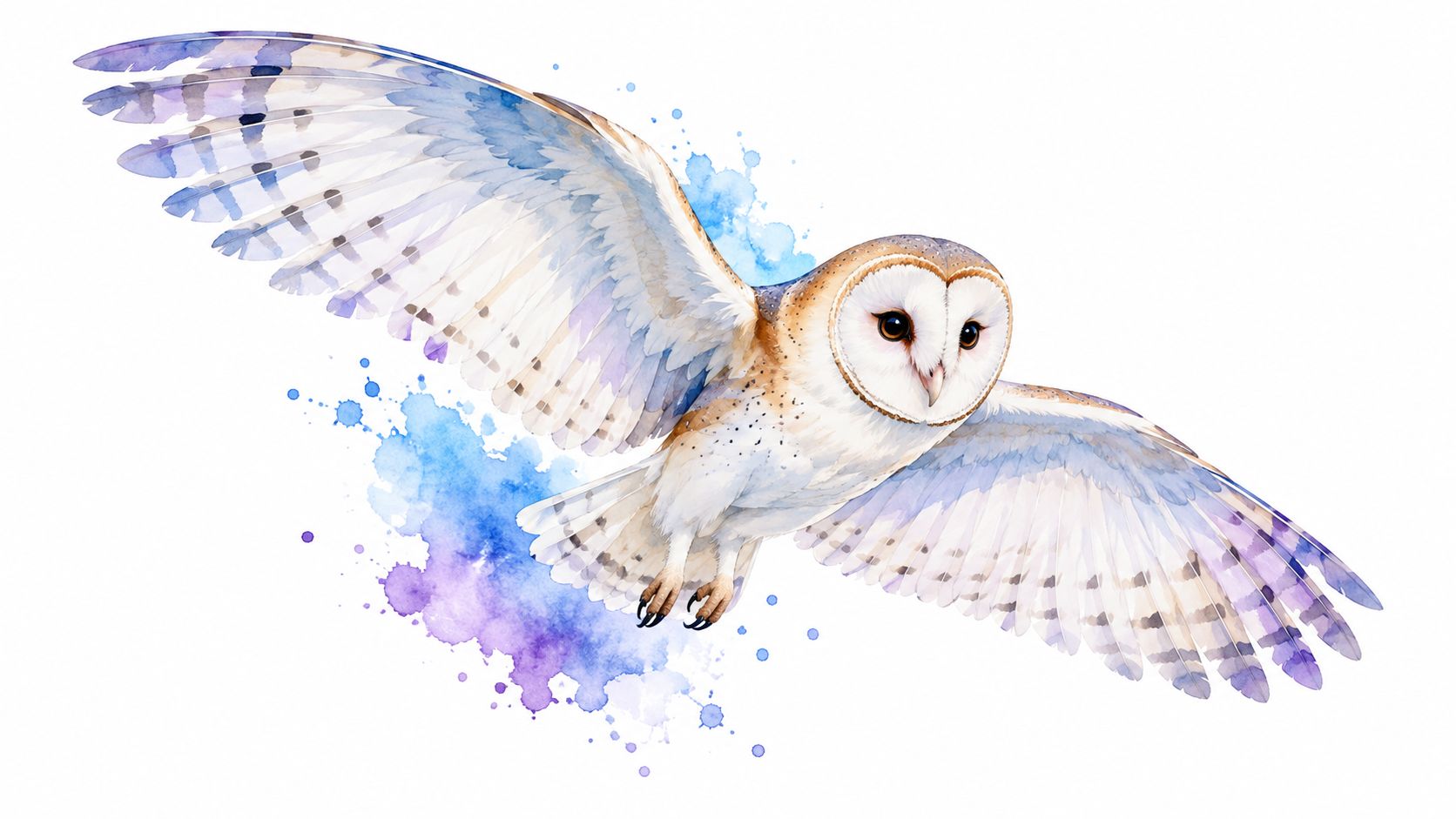
Here's where I push back in a consultation. Pale washes without a bold core structure fade unevenly. I'd recommend a clear owl silhouette underneath, saturated color in the main masses, and splashes kept secondary. Keep the facial disc and leading wing edge defined. Let the trailing edge dissolve if you want movement.
Sun exposure matters more here than in blackwork. If you work outdoors and won't use sunscreen consistently, pick another style or place it where clothing covers it. A barn owl works especially well because the pale, heart shaped face contrasts naturally with saturated washes behind it.
Prompt and Placement Check
- Prompt: Use "watercolor flying owl, soft splashes, pastel blue and purple" and test palettes before you finalize.
- Placement check: Ask your artist what will remain after the lightest washes fade. If the answer isn't a readable owl, add outline and contrast.
6. Dotwork Flying Owl
Dotwork builds the owl from thousands of individual dots. Shading comes from density, not solid black or whip shading. Done well, it gives feathers an engraved, moonlit texture you can't get with lines alone. It also takes patience, on both sides of the needle.
Watch how varied dot spacing creates value changes before you commit to the texture at scale.
Spacing decides aging. Dots placed too close merge into muddy patches as pigment spreads. Dots placed with breathing room keep the stippled gradient. Read up on the dotwork tattoo style before your consult so you can discuss dot size, not just the image.
Scale protects this style. A Los Angeles Tattoo Shop guide to owl sizing states a flying owl tattoo should be at least 8 inches wide for the wingspan to read clearly. That floor matters even more when every feather is stippled. Expect multiple sessions for anything large.
Prompt and Placement Check
- Prompt: Use "dotwork flying owl, stippling, monochrome, detailed feathers."
- Placement check: Pick the upper back, thigh, or chest. Ask your artist to show healed dotwork, not only fresh photos.
7. Neo-Traditional Night Flight Owl
If traditional feels too flat and realism feels too fragile, neo-traditional is your middle path. It keeps strong outlines but adds dimensional shading, detailed feathers, and a richer palette. A night flight version puts the owl across a moon, stars, or floral wreath, often in purple and gold, leaning into mystery and guidance through darkness.
Making the Wings Look Like an Owl
Generic bird wings ruin this style. A technically informed reference on owl wing morphology and silent flight identifies three features to preserve, comb-like leading-edge serrations, a soft trailing-edge fringe, and a velvet-like feather surface, with serrations mainly on the outer flight feathers. Ask for individually readable primary feathers and a slightly irregular leading edge. That detail separates an owl from an eagle in disguise.
A flying pose can feel protective with wings spread wide, or predatory in a banking hunt. Decide which message you want before your artist locks the posture.
For cost context, TattooBaz estimates for a realistic owl in flight put that tier at $700 to $1,200 with sessions of 4 to 6 hours. Neo-traditional detail can approach that commitment, so quote by size, not by style label.
Prompt and Placement Check
- Prompt: Try "neo-traditional flying owl, night sky, moon and stars, detailed feathers, purple and gold" and compare outputs.
- Placement check: Use the upper arm or chest and confirm the primary feather tips use bold silhouette or spaced negative lines.
Flying Owl Tattoo Styles at a Glance
| Item | Best For | Top Placements | Main Drawback |
|---|---|---|---|
| Traditional American Flying Owl | Clients who want a classic, bold piece that stays readable over time | Upper arm, chest, calf, back | Limited fine detail; bold colors may fade or blur over time |
| Japanese Irezumi Flying Owl | Clients planning a large back, sleeve, or full-body piece | Full back, upper back, full sleeve, thigh | Requires a large area, significant time, and an experienced artist |
| Fine-Line Minimalist Flying Owl | First-time tattoo seekers and clients wanting a subtle piece | Inner wrist, behind the ear, collarbone, inner forearm | Fine lines can blur or spread over time |
| Geometric Flying Owl | Design-savvy creatives who appreciate structure and symmetry | Sternum, forearm, calf, shoulder blade | Requires precise alignment; fine lines may fade |
| Watercolor Flying Owl | Creative clients who want an artistic, colorful piece | Upper arm, thigh, shoulder, ribs | Colors can fade or blur, and the design may be less legible at a distance |
| Dotwork Flying Owl | Detail-oriented clients who value texture and craftsmanship | Forearm, upper arm, calf, back | Time-intensive and requires an experienced stippling artist |
| Neo-Traditional Night Flight Owl | Clients who want a detailed, colorful piece with symbolic depth | Upper arm, chest, forearm, shoulder | Detailed designs take more time and cost, and fine details may soften |
Choosing Your Flying Owl: Style, Placement, and Next Steps
Match the style to your priority. If you want readability and durability, choose traditional American or neo-traditional with strong outlines. If you want discretion and low time commitment, choose fine-line and accept simpler detail. If you want large scale storytelling, irezumi and dotwork reward the space and patience they demand.
Wing shape and placement matter as much as color. A horizontal wingspan wants a horizontal canvas, like the upper back or chest. A banking, diagonal pose fits a shoulder blade, thigh, or forearm better. Always test the design at the exact size you plan to wear. A concept that looks sharp on your phone can collapse when printed at three inches.
Anatomy helps you brief your artist, too. A bio-inspired study in Nature Communications on owl serration engineering found a propeller combining owl style serrations with cicada wing geometry reduced overall sound pressure level by up to 5.5 dB and increased efficiency by more than 20% versus its benchmark. That describes a laboratory device, not a tattoo, but it explains why directional serrations and layered fringes read as silent flight on skin.
Don't borrow meaning carelessly. Use personal prompts like guardian, memorial, or intellectual curiosity. If you reference a specific cultural tradition, research it properly and discuss it with your artist. Your posture choice also changes the message, so state it clearly in your brief.
Now make the brief concrete. Write a prompt that names the style, species, pose, palette, mood, and intended size. Generate several concepts in TattoosAI and shortlist two or three. Take them to a tattooist and confirm line weight, dot spacing or color saturation, stencil placement, healing, pain level for that spot, and total sessions before you book. I recommend asking for both a detailed version and a simplified version at your target size. The simplified one is often the tattoo you'll still love in ten years.
Ready to turn one of these seven styles into a brief you can hand to an artist? Describe your flying owl in TattoosAI, choose a style, and generate multiple concepts you can refine by palette and mood. Shortlist your favorites, print them at true size, and take them to your tattooist to confirm placement and line weight.