TattoosAI
A lot of people start a leg tattoo search by saving isolated images. A rose on the thigh. A moon near the calf. Something delicate at the ankle. Then the practical question hits: will those pieces belong together if you commit to full coverage?
That's the shift with full leg tattoos for women. You're not picking single motifs anymore. You're building one connected composition that has to move from hip to ankle, bend at the knee, wrap around muscle, and still read clearly when you're standing, walking, or sitting.
The strongest designs usually begin with a story and a structure. Where is the focal point? Does the eye start at the thigh or calf? How much skin stays open so the tattoo can breathe? Will you use black and grey, controlled color, or one vivid accent palette? Those choices affect not just the look, but also session planning, pain management, healing, and how easy the piece will be to expand later.
A neutral studio benchmark puts a full leg sleeve at roughly 16–30+ total hours, with lower-leg and thigh wraps often split across long sessions. That alone makes planning worth the effort.
TattoosAI can help during the idea stage by generating multiple directions before your consultation. That's useful for comparing composition, style, and color. It shouldn't replace a professional tattooist's judgment, but it can give you a clearer brief and better reference material when you sit down with the artist.
Table of Contents
- 1. Floral Full-Leg Sleeve with Botanical Details
- 2. Celestial and Cosmic Full-Leg Design
- 3. Japanese-Inspired Full-Leg Sleeve with Traditional Elements
- 4. Geometric and Abstract Full-Leg Composition
- 5. Animal-Focused Full-Leg Sleeve with Wildlife Theme
- 6. Gradient and Watercolor Full-Leg Blend Design
- 7. Mandala and Spiritual Full-Leg Pattern Design
- 8. Blackwork and Bold Line Full-Leg Statement Piece
- 9. Narrative and Story-Driven Full-Leg Sequential Design
- 10. Fine Line and Minimalist Full-Leg Elegant Design
- Comparison of 10 Womens Full-Leg Tattoo Styles
- Turn Inspiration Into a Tattooist-Ready Brief
1. Floral Full-Leg Sleeve with Botanical Details
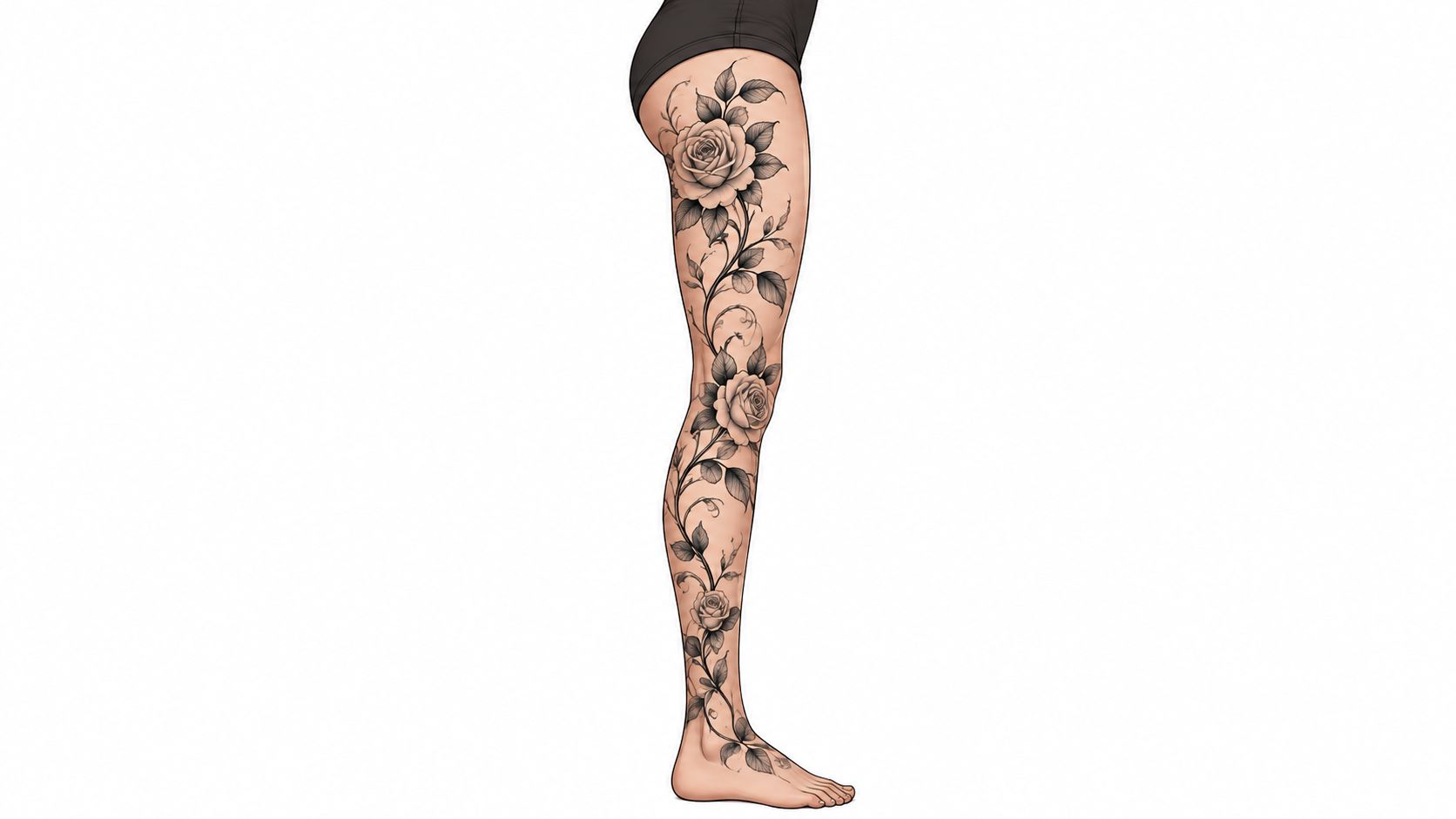
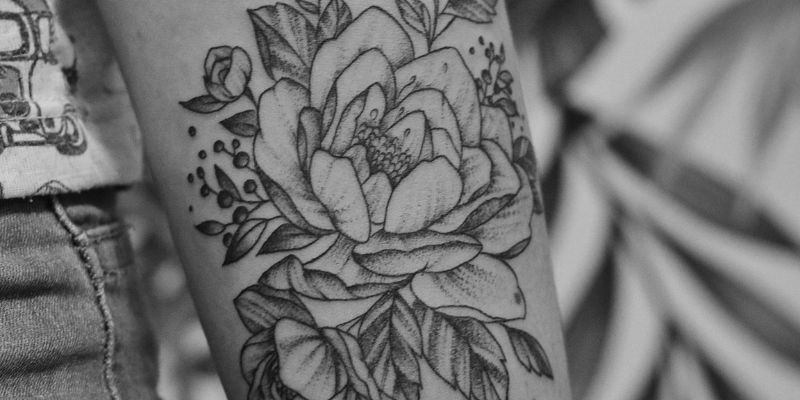
A botanical sleeve is often the easiest full-leg concept to personalize without losing cohesion. One woman might choose roses, peonies, and ivy for a lush wrapped look. Another might use birth flowers, wild stems, and soft leaves with more open skin between elements.
The visual structure usually works best when one large bloom anchors the upper thigh or outer calf, then smaller flowers and connective foliage guide the eye downward. That keeps the design from feeling like sticker placement. It also gives the artist room to shape petals and stems around the knee instead of forcing a flower head into an awkward bend.
Best placement logic
Floral work suits women who want movement more than symmetry. Vines can spiral around the calf, leaves can taper toward the ankle, and larger petals can soften transitions over broad areas like the thigh.
Trade-offs matter here. Dense floral packing can look romantic, but too many similarly sized blossoms flatten the composition. A better approach is size contrast, open breathing room, and one or two botanical species that repeat enough to create rhythm.
Practical rule: Pick one hero flower, one support flower, and one foliage type before adding extras.
Artist selection matters. You want someone whose healed florals still look readable, not just fresh work with dramatic lighting. If you're collecting references, a page on floral sleeve composition ideas can help you think about layering and flow, even if your project is on the leg instead of the arm.
For symbolism-heavy design choices in a home or spiritual setting, some readers also like broad visual placement references such as this Buddha statue placement guide, not as tattoo instruction but as a reminder that placement changes meaning and mood.
AI prompt direction
Try something like this:
- Base prompt: “Full leg botanical tattoo for a woman, large peony on upper thigh, roses and winding ivy flowing to ankle, elegant black and grey, organic wrap composition, open negative space, fine detail leaves”
- Style variation: “Same composition, but in botanical realism”
- Color variation: “Same composition with muted dusty pink accents and olive leaves”
A good floral sleeve feels grown, not pasted on.
2. Celestial and Cosmic Full-Leg Design
You spot a moon-and-stars leg tattoo online and save it immediately. Then the planning questions start. Should the moon sit on the thigh or the calf? Do planets make it feel richer or just busier? How much black shading keeps it atmospheric without turning the whole leg heavy?
A celestial full-leg piece works best as a case study in visual hierarchy. The leg gives you a long vertical path, but it also bends, twists, and narrows. That means the design needs one clear anchor, one movement path, and a quieter background that keeps the theme readable from several angles.
Here is a strong way to map it:
- Anchor: moon, sun, or planet on the upper thigh or outer calf
- Path: constellation trail, orbit line, or moon-phase sequence running down the side leg
- Atmosphere: dots, haze, soft clouds, or sparse stars filling selected gaps
That structure works like night-sky composition in a poster. One large shape catches the eye first. Smaller elements guide the eye downward. Empty skin acts as the sky, so the tattoo can breathe.
A common mistake is equal importance everywhere. If every starburst, planet, rune, and sparkle is rendered with the same contrast and size, the result feels stickered on rather than built for the body.
For cosmic work, skin is part of the design. If you shade every gap, you lose the sense of distance.
Placement changes the mood more than many clients expect. A large crescent on the outer thigh feels dramatic and fashion-forward because it shows in shorts and skirts. A vertical moon-phase sequence along the side leg feels calmer and more graphic. A dense galaxy wrapping around the calf can look striking up close, but it asks more of the artist because the calf curves sharply and the details can distort if the spacing is too tight.
Execution has trade-offs. Fine-line constellations and tiny stars can look elegant, but they need restraint and clean healed linework. Heavy black backgrounds create stronger contrast, yet they also make the leg feel visually heavier. If you want a mystical effect without a solid dark field, ask about dot shading, smoke-like texture, or selective black pockets near the anchor image.
Artist fit matters here in a specific way. You are not only looking for someone who can draw moons. You need an artist who understands flow, scale, and how to keep small celestial symbols from blurring into visual static over time. Review healed work on knees, calves, and outer thigh placement, not only flat stencil mockups.
Before you commit, decide which version of “cosmic” you mean. Some clients want astronomy. Others want fantasy. Those are different briefs. Astronomy-based designs usually benefit from cleaner spacing and fewer symbols. Mystic or ornamental cosmic designs can hold more abstraction, but they still need a clear visual leader.
AI prompt direction
Use prompts that describe layout logic, not just a list of objects.
- Outer-leg case study: “Full-leg celestial tattoo for a woman, large crescent moon on outer thigh, constellation trail flowing down side leg to ankle, sparse stars, soft black and grey shading, open negative space, elegant atmospheric composition”
- Wrap design case study: “Cosmic full-leg sleeve, moon phases wrapping from thigh to calf, one planet near upper leg, dust texture and scattered star field, readable spacing around knee, black and grey illustrative style”
- Graphic minimal case study: “Minimal celestial leg tattoo, vertical moon phase sequence, orbit lines, small star clusters, clean fine line, outer leg placement, lots of open skin, modern feminine composition”
Bring one prompt, then ask your artist to redraw it for your anatomy. The strongest celestial leg tattoo usually feels mapped to your body, not copied from the night sky.
3. Japanese-Inspired Full-Leg Sleeve with Traditional Elements
You fall in love with a koi, then add peonies, then waves, then a mask, and suddenly the leg has five focal points instead of one. That is the planning problem with Japanese-inspired work. The individual symbols are strong, so the full-leg sleeve has to be stronger.
A useful way to plan this style is to treat the leg like a vertical scroll. The thigh carries the headline image. The knee acts like a hinge or interruption. The calf keeps the movement going. The ankle usually resolves the composition rather than competing with it.
Here is a clear case study. If the koi is the lead subject, place its head where you want attention first, often upper calf or lower thigh, then let the body curve with the leg's natural line. Waves and wind bars support that motion. Flowers soften heavy sections and create breathing room. Without that hierarchy, the design can start to feel like separate stickers wrapped around the leg.
Traditional Japanese-inspired tattooing depends on flow more than object count. A simpler subject map often reads better from across the room and ages more cleanly on skin.
Respect matters here too. Japanese-inspired work is not only a bag of motifs. It has recurring background language, spacing habits, and compositional conventions. If you are still sorting out what appeals to you, review a few Japanese tattoo style references before your consultation so you can describe the direction more clearly.
The main trade-off is structure versus symbolism. A dragon, koi, hannya mask, snake, chrysanthemum, and maple leaves may all carry meaning, but every added symbol asks for space, contrast, and transition work. A leg sleeve usually gets stronger when one primary subject leads, one secondary subject supports, and the background ties them together.
Color choice changes the mood fast. Traditional color gives this style a drumbeat. Reds, golds, greens, and blue-black waves create rhythm and separation. Black and grey feels heavier and more sculptural, which can be beautiful on a full leg, but it needs careful value control so the knee and calf do not collapse into one dark mass.
Artist fit matters as much as concept fit. Look for healed examples on curved body parts, not only flat flash or thigh-only pieces. You want an artist who can draw movement around the shin, handle background fill without crowding the design, and keep major forms readable when the leg is standing, bent, and in motion.
Three planning directions to test before ink
1. Koi-led composition
Best for readers who want upward movement and a clear central figure. The koi can travel from ankle or calf toward the thigh, with waves wrapping the outer leg and peonies opening larger quiet areas near the upper leg. This version usually feels graceful rather than aggressive.
2. Snake or dragon-led composition
Better for a more dramatic leg. Long bodies solve placement well because they can wrap the calf, cross the knee, and reconnect on the thigh. The trade-off is density. These sleeves can get dark quickly if the background is also heavy.
3. Floral-dominant composition with traditional framing
Useful if you want the Japanese influence without a single fierce subject. Large peonies or chrysanthemums can anchor the thigh and calf, while wind bars, water, or leaves provide movement. This route often feels lighter on the body and easier to wear visually.
AI prompt direction
Prompt for body mapping and role assignment, not a pile of symbols.
- Koi case study: “Japanese-inspired full-leg tattoo for a woman, one large koi as primary subject, head near upper calf, body flowing upward toward thigh, waves wrapping outer leg, peonies as secondary accents, readable knee transition, traditional composition”
- Dragon case study: “Full-leg Japanese-style tattoo, dragon body wrapping calf and thigh, wind bars and clouds connecting sections, controlled dark background, clear focal point on outer thigh, black and grey sculptural flow”
- Floral case study: “Japanese-inspired leg sleeve with large peonies and chrysanthemums, water and leaf movement, airy spacing around knee, elegant vertical flow from thigh to ankle, traditional background language”
Bring one direction, not ten. Then ask the artist to redraw it for your anatomy, because the strongest Japanese-inspired leg sleeve looks composed for your leg, not assembled from reference pieces.
4. Geometric and Abstract Full-Leg Composition
A geometric leg sleeve usually starts with a strong reaction: you either love the control of it or you do not. On a full leg, that control can look striking because the body gives you long columns, round joints, and natural breaks to work with.
Use this style if you want the leg to read like a designed object rather than a scene. Geometry builds impact through repetition, spacing, contrast, and alignment. Abstract work loosens that system a little. It can still feel intentional, but with more interruption, distortion, or asymmetry.
Here is the planning question that matters first. Do you want the leg to feel engineered or interpreted?
An engineered composition uses symmetry, mirrored forms, grid logic, and repeated units that stay consistent from thigh to ankle. An interpreted composition uses geometric language in a freer way, such as fractured panels, dotwork fades, broken line paths, or shapes that shift scale across the body. Both can work well. The trade-off is tolerance for imperfection. The stricter the pattern, the more obvious even a small wobble becomes.
Full-leg geometry rewards discipline in the design phase. A beautiful motif is not enough. It has to stay readable while the leg bends, twists, and narrows.
A simple case study makes that easier to picture. If the outer thigh carries a large hexagonal or circular framework, the knee usually needs a different job. It can act like a hub, a ring, or a pause point, because hard precision across the kneecap often breaks apart visually when the body moves. Below that, the calf is good for vertical repetition, especially patterns that stretch with the muscle instead of fighting it. Near the ankle, simplification usually improves the finish. Small crowded geometry in that area can look busy fast.
Pain affects the design here because crisp geometric sleeves often cross many sensitive zones. A neutral placement guide notes that the outer thigh and calf are usually more manageable, while the knee ditch, shin, and top of the foot tend to be harder for many clients to sit through 3/10 to 5/10, while areas near the knee ditch, shin bone, and top of the foot can rise to 8/10 or 10/10. If your concept depends on exact line continuity through those areas, plan the session structure around that reality.
That artist choice matters more here than in many other styles.
You are not only looking for good drawing. You are looking for stencil control, line consistency, spacing judgment, and healed examples on curved body parts. A geometric specialist can explain why one pattern should widen on the calf, tighten at the ankle, or break before the knee. That is a strong sign they design for anatomy rather than placing flat artwork on skin.
AI prompt direction
Prompt for structure first, decoration second.
- Engineered route: “Full leg geometric tattoo for a woman, large symmetrical framework on outer thigh, circular knee transition, repeating vertical pattern on calf, simplified ankle finish, black ink, clean spacing, anatomy-aware composition”
- Abstract route: “Abstract full-leg tattoo composition, asymmetrical geometric panels, dotwork fades, fractured line paths, modern architectural feel, varied density from thigh to ankle, designed for body flow”
- Hybrid route: “Women's full-leg tattoo combining sacred geometry and abstract negative space, precise upper-leg patterning, controlled knee interruption, lighter lower-leg transitions, blackwork and dot shading”
Bring one system, not a folder of unrelated shapes. Then ask the artist to redraw it directly on your leg so the composition fits your proportions, your movement, and the level of precision you can realistically commit to.
5. Animal-Focused Full-Leg Sleeve with Wildlife Theme
Animal-led leg sleeves work best when the animal controls the composition instead of sitting inside it like a poster. A tiger can twist through the outer thigh. A wolf can face forward from the calf. A crane, serpent, octopus, or fox can create movement through body shape.
That's why this approach often feels more alive than motif collections. The animal gives you posture, gaze, direction, and emotional tone from the start.
Choosing the right structure
Start with one question. Do you want portrait impact or environmental storytelling?
A portrait-focused sleeve puts the animal face or body in command and uses supporting elements lightly. An environmental sleeve lets habitat or symbolic surroundings share the stage, such as reeds, waves, branches, florals, cliffs, or moonlight.
Both can work. The trade-off is clarity. If your chosen animal already has strong texture, like fur, scales, or feathers, adding a dense background can make the leg feel visually heavy. That's especially true on the calf, where the viewing angle changes constantly.
A practical example: a woman choosing a fox for transformation might place the head high on the thigh for emotional impact, then let the tail and surrounding grasses sweep down toward the knee. Another might put a stalking tiger on the outer leg, using stripes to echo the body's natural vertical lines.
AI prompt direction
- Portrait route: “Full leg animal tattoo for a woman, large tiger portrait on thigh, soft foliage connecting to calf, black and grey realism, strong focal hierarchy”
- Movement route: “Fox full leg sleeve, body twisting through wildflowers and wind, elegant flow, storytelling composition, feminine but strong”
- Stylized route: “Geometric wolf leg sleeve, angular shapes, minimal background, blackwork and open skin”
Choose an artist based on the animal itself. Great floral artists aren't always great at fur, eyes, or dynamic anatomy.
6. Gradient and Watercolor Full-Leg Blend Design
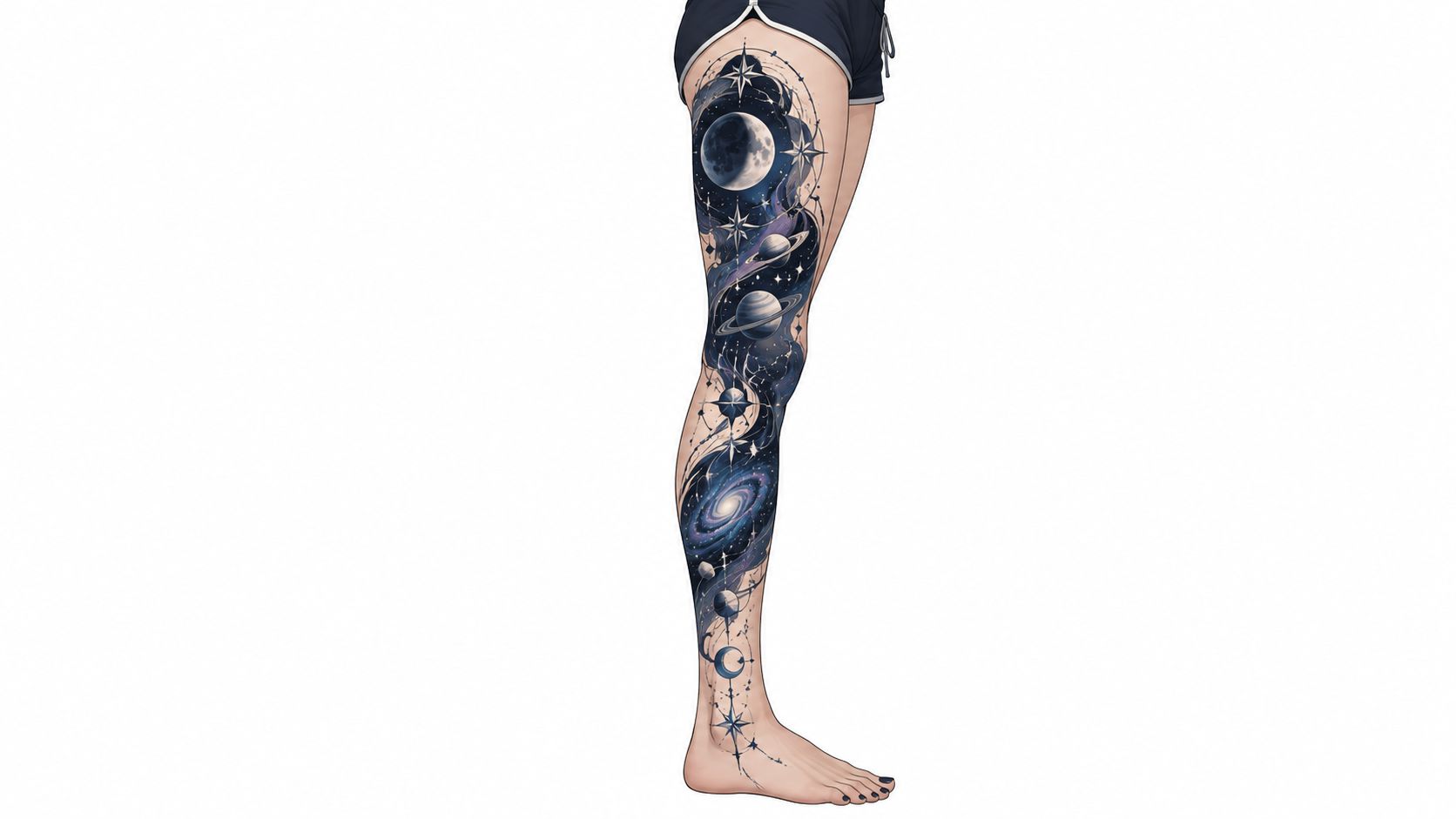
What happens if you fall in love with soft watercolor effects, then realize your full-leg piece still has to read clearly from across a room?
That is the planning test with this style. A watercolor leg can feel light, fluid, and expressive, but a full-leg composition still needs structure. Color behaves like atmosphere. It sets mood, adds motion, and softens transitions. The part that keeps the tattoo readable is usually something firmer underneath, such as linework, a silhouette, a floral vine, an animal form, or abstract contour shapes.
A useful case study is a thigh-led composition with the strongest image placed high, where the leg offers the broadest canvas. From there, the watercolor can thin out as it moves past the knee and into the calf. That pacing matters. If every area gets the same saturation, the leg can start to look stained rather than intentionally painted.
Watercolor works best when it has edges to disappear from, not when the whole leg dissolves at once.
This style also asks you to choose your backbone before your color palette. One route is botanical. Stems, petals, and leaves create a natural path for washes of pink, blue, violet, or amber. Another route is subject-led, where a face, bird, fox, or figure anchors the design and the color acts like motion around it. A third route is abstract, which can look striking but usually requires the strongest sense of placement because there is no obvious subject doing the organizing.
The trade-off is longevity versus softness. Diffused color and very light transitions can look beautiful fresh, but they may need stronger contrast in a few zones to keep the design readable over time. That does not mean the tattoo has to become heavy. It means the artist needs to decide where crisp detail belongs and where the color is allowed to stay airy.
Artist selection matters more here than many first-timers expect. A strong watercolor specialist should be able to show healed work, not just fresh tattoos with bright saturation. You are checking for control. Can they keep blends smooth, protect skin breaks, and stop the lower leg from becoming muddy once the piece settles?
Lower-leg sessions also bring practical limits. Aftercare sources note that lower legs can swell more because of gravity, the shin and knee are among the most painful areas, and surface healing often takes about 2 to 4 weeks while deeper healing can continue for months. If your plan includes broad washes across the shin, ankle, or foot, ask yourself how much walking, clothing friction, and recovery time you can realistically handle.
Here's a visual break with a watercolor-focused process video:
AI prompt direction
Use prompts that name both the subject and the structure, not just the mood.
- Botanical case study: “Full leg watercolor tattoo for a woman, large peony cluster on thigh, fine stems guiding color washes down calf, pink and blue gradients, open skin, light black linework”
- Figure-first case study: “Woman's full leg tattoo, central fox silhouette from upper thigh to knee, watercolor brush textures flowing toward ankle, readable outline, soft but controlled palette”
- Abstract case study: “Gradient full-leg tattoo design, painterly ink blooms with contour framework, strongest saturation on thigh, fading movement through calf, contemporary composition with clear focal hierarchy”
If you love this look, bring your artist one practical question: where will the tattoo stay sharp, and where will it stay soft? That answer usually tells you whether the design is ready for skin.
7. Mandala and Spiritual Full-Leg Pattern Design
You spot a full-leg mandala tattoo from across the room, and it reads as calm before you notice a single detail. That effect comes from structure. A good spiritual leg piece guides the eye the way stained glass guides light, with one clear center and supporting shapes that repeat with purpose.
For planning, this style works best as a case study in visual hierarchy.
Start with the anchor. On a full leg, the thigh usually carries the main mandala because it offers the broadest, flattest area for a circle to stay readable. The knee can act as a transition point with petals, dotwork, or a protective band, then the calf can shift into longer ornamental forms that follow the leg downward. If every zone gets the same radial pattern, the result can feel static. You want one place to pause, one path to follow, and quieter areas that let the design breathe.
Here is the trade-off many people miss. Symmetry looks peaceful on paper, but legs are not symmetrical surfaces. Muscles change the spacing, the knee interrupts clean geometry, and the ankle compresses detail. An artist who tattoos mandalas well on flat flash sheets may still struggle to keep circles stable once the design wraps around the body.
A spiritual tattoo feels stronger when the symbolism is edited, not crowded.
That matters with content choices too. Lotus shapes, sacred geometry, moons, chakras, prayer beads, script, and ornamental lace can all belong in the same visual family, but they should not all compete for attention. Pick one symbolic language as the lead, then let the others support it. A lotus-centered piece reads differently from a geometry-led piece. One feels organic and devotional. The other feels more architectural and meditative.
Artist selection matters more here than style labels. Look for healed tattoos with clean spacing, even dot saturation, and circles that still read as circles around joints. If the portfolio shows strong ornamental work but weak anatomy flow, ask for a stencil mockup that shows how the mandala sits while standing, bending, and walking.
Three ways to plan the layout
Centered and ceremonial
A large upper-thigh mandala acts as the focal point, with the knee treated like a framing ring and the calf carrying lighter repeats. This is the safest route if you want a spiritual design that still reads clearly from a distance.
Vertical and meditative
Instead of one dominant circle, smaller stacked symbols run from hip to ankle in a spine-like line. This can feel more personal and less formal, but it requires careful spacing or it starts to look like separate tattoos instead of one leg composition.
Ornamental full-wrap
Patterning circles the leg almost continuously, with mandala fragments, lacework, and dot shading joining each zone. The look is rich and immersive. The trade-off is density. Fine details can blur together if the artist does not protect enough open skin.
AI prompt direction
- Ceremonial anchor: “Mandala full leg tattoo for a woman, large thigh mandala as focal point, knee transition petals, ornamental calf flow, black ink, balanced negative space, anatomical placement”
- Lotus-led spiritual concept: “Women's full leg spiritual tattoo, lotus-centered thigh design, subtle sacred geometry, open skin through knee and shin, refined dotwork, calm elegant composition”
- Dense wrap study: “Full leg mandala sleeve design, layered radial patterns wrapping thigh and calf, decorative knee connector, detailed blackwork, clear hierarchy, readable spacing on curved anatomy”
Bring your artist one smart question before you commit: where does the main circle stay perfectly clean on my leg, and where should the pattern loosen to fit movement? The answer usually reveals whether the design was built for skin or only for a flat page.
8. Blackwork and Bold Line Full-Leg Statement Piece
You spot this style across a room before you notice the subject matter. A blackwork full-leg piece reads through silhouette first, detail second. That immediate read is the main reason to choose it.
Treat it like poster design on a moving surface. Large dark shapes act like headlines. Open skin works like margin. Thick lines guide the eye around the thigh, over the knee, and down the calf so the leg feels designed as one object instead of covered in separate tattoos.
A useful planning question is simple: do you want the leg to feel armored, architectural, or decorative? Each direction changes the structure.
Blackwork succeeds or fails on shape discipline. If the big forms are strong, the piece still holds up while you walk, sit, or view it from a distance.
An armored version usually relies on dense black sections high on the thigh or outer calf, with smaller cuts of negative space to stop the leg from looking visually heavy. An architectural version uses bars, blocks, grids, or repeated line systems that follow muscle groups more strictly. A decorative version keeps the contrast but softens the mood with floral curves, lace-like breaks, or ornamental framing around the knee and shin.
The knee is often the stress test. Solid black directly across it can look dramatic, but that area moves constantly and can make the whole leg feel stiff if the surrounding composition is equally dense. Many strong case-study layouts either frame the knee with a ring of open skin or use it as a hinge where heavy thigh work shifts into cleaner calf geometry.
Trade-offs matter more here than in many softer styles. Large saturated fills usually heal with serious impact, but they demand patience during sessions and aftercare. They also reduce your options if you later want to add delicate fine-line imagery. Crisp bold lines age well when the spacing is smart, yet spacing that is too tight can turn a powerful concept into one dark column.
Artist selection needs a narrower filter. Look for healed black saturation, clean edges on curved anatomy, and examples where the artist handled transitions around the hip, knee, and ankle without losing rhythm. A beautiful flat flash sheet is not enough for this category. You want proof that the artist can build with volume and body movement in mind.
For AI concepting, prompt for hierarchy, not just style words:
- Graphic silhouette study: “Full leg blackwork tattoo for a woman, bold silhouette-led composition, large black thigh mass, open knee break, structured calf shapes, high contrast, clear negative space, designed for curved anatomy”
- Architectural line system: “Women's blackwork full leg tattoo, thick line framework wrapping leg muscles, black blocks and repeating bands, controlled spacing, modern graphic look, readable from distance”
- Ornamental bold-line hybrid: “Full leg bold line tattoo design, blackwork with decorative curves, strong thigh focal shape, framed knee, refined calf ornament, balanced open skin, elegant but forceful”
Before you commit, ask the artist one practical question: where should the darkest area sit so the leg still has shape once I'm standing and walking? The answer reveals whether they are designing for your body or only for contrast on a screen.
9. Narrative and Story-Driven Full-Leg Sequential Design
Narrative sleeves are often the most personal full leg tattoos for women because they let you connect life events, symbols, people, places, and values inside one visual sequence. That doesn't mean you need a literal timeline. It means the leg becomes a path with emotional logic.
One woman might build a story from migration, family, and resilience using birds, roots, and a home environment. Another might use chapters of healing, motherhood, grief, and self-renewal through figures, plants, and changing seasons.
Keeping a story readable
The biggest mistake in story tattoos is trying to include every meaningful symbol at equal volume. A tattoo isn't a scrapbook. It needs editing.
Start by naming the central theme in one sentence. Then choose three to five visual ideas that support it. Let one image carry the emotional weight, and let the others act as bridges or echoes.
For readers interested in broader visual storytelling, this narrative art guide can be a useful framing reference.
AI prompt direction
Prompts work best when they explain the emotional thread.
- Personal journey prompt: “Full leg narrative tattoo for a woman about healing and growth, roots at ankle, flowering branches through calf, sunrise and protective figure on thigh, cohesive black and grey composition”
- Biographical prompt: “Sequential leg sleeve telling a family story, symbolic home, wildflowers, moon, pathway, elegant transitions, custom illustrative style”
- Mythic prompt: “Story-driven full leg tattoo, feminine archetype, nature symbols, transformation sequence, airy but connected composition”
This is the style where your written brief matters most. Bring notes, not just images.
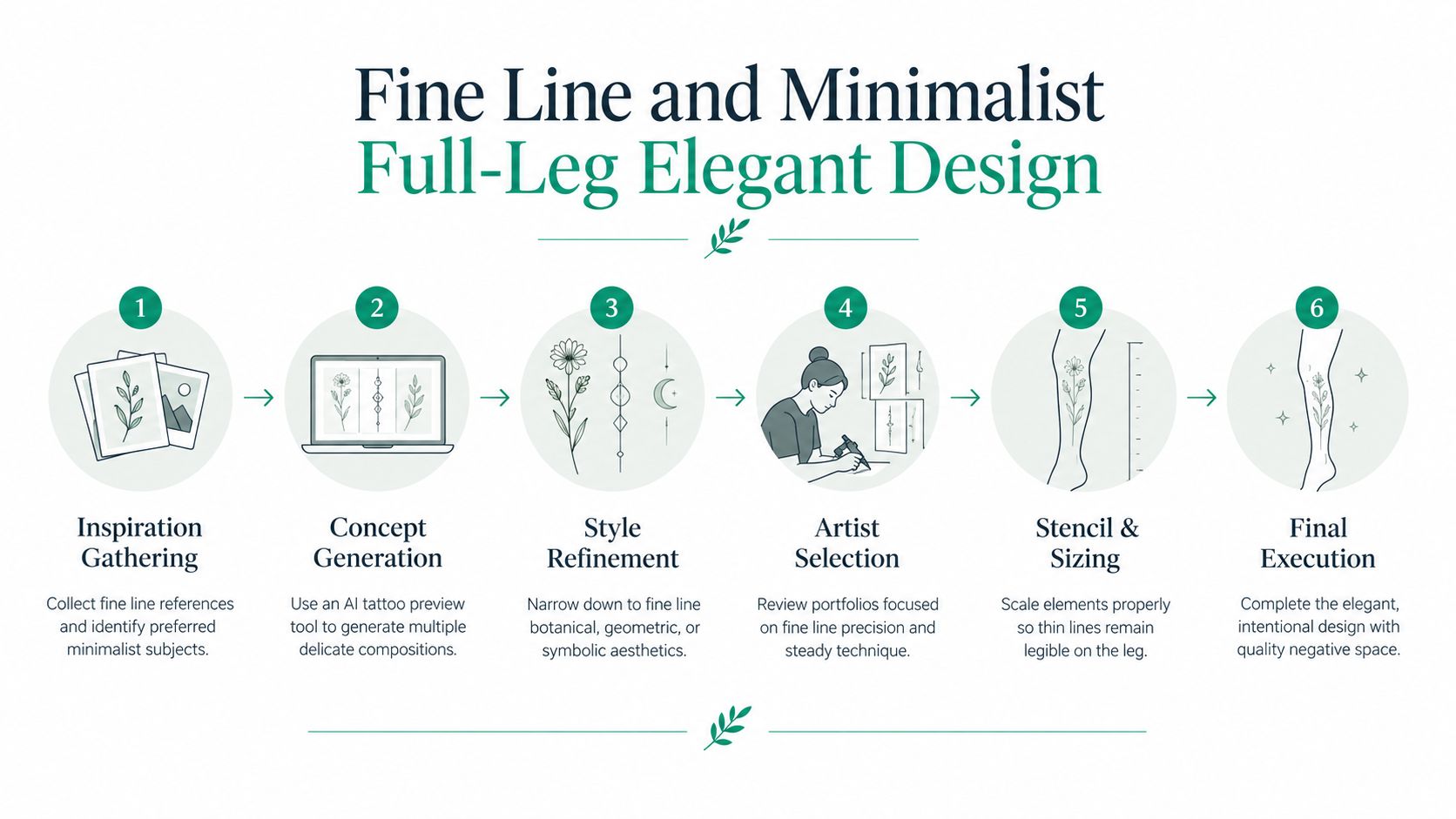
10. Fine Line and Minimalist Full-Leg Elegant Design
Minimalist full-leg work looks effortless when it's done well, but it's one of the hardest large-scale directions to design. The reason is simple. With less visual material, every line placement matters more.
A fine-line leg sleeve might use delicate florals, contour-like ornament, tiny symbols, a vertical branch system, or sparse abstract marks that guide the eye without filling the whole canvas. The effect can be elegant, modern, and surprisingly bold through restraint alone.
Why less still needs structure
A minimalist sleeve still needs a focal plan. Maybe the thigh carries the strongest detail and the lower leg becomes lighter. Maybe the outer calf holds the anchor and the rest acts like a whisper around it.
Trend coverage for 2026 suggests leg sleeves and lower-leg tattoos are gaining visibility, while placement-focused guides emphasize unified composition from hip to ankle and strategic use of negative space in larger leg work, as discussed in this 2026 leg tattoo trend and placement overview. That matters here because minimalist pieces depend on clean flow even more than dense ones do.
The trade-off is durability versus delicacy. Some ultra-fine concepts look stunning on screen but need scaling adjustments to stay readable on skin over time. That's where a skilled fine-line tattooist earns her place.
AI prompt direction
- Elegant botanical: “Minimalist full leg tattoo for a woman, fine-line wildflowers, airy spacing, elegant vertical flow, black ink only”
- Abstract minimal: “Fine-line abstract leg sleeve, delicate curves, sparse geometric accents, luxury editorial feel”
- Symbolic minimal: “Minimalist leg composition, moon, branch, tiny stars, negative space focused, refined and feminine”
If you love subtle work, don't confuse subtle with small. A minimal sleeve still needs enough size to breathe.
Comparison of 10 Womens Full-Leg Tattoo Styles
| Design | 🔄 Implementation Complexity | ⚡ Resource & Time | 📊 Expected Outcomes (⭐) | Ideal Use Cases | 💡 Key Advantages / Tips |
|---|---|---|---|---|---|
| Floral Full-Leg Sleeve with Botanical Details | High, detailed botanical accuracy, flow and spacing required | High, multiple sessions, skilled colorist, periodic touch‑ups | Elegant, feminine, timeless, ⭐⭐⭐⭐ | Customizable floral statement pieces, women seeking organic elegance | Customizable symbolism; generate variations, test palettes and symmetry |
| Celestial and Cosmic Full-Leg Design | Medium–High, layering, gradient control and balanced composition | Medium–High, fine‑line/shading skill, several sessions, color maintenance | Striking, personal (zodiac/constellations), ⭐⭐⭐⭐ | Astronomy/astrology lovers, mystical or abstract aesthetics | Generate multiple star maps, test black vs color, consider glow‑ink |
| Japanese-Inspired Full-Leg Sleeve with Traditional Elements | High, requires cultural research and traditional technique | High, specialist irezumi artist, long sessions, higher cost | Rich, narrative, culturally rooted, ⭐⭐⭐⭐ | Those seeking traditional Japanese storytelling and authentic motifs | Research symbolism, use specialist artists, prepare detailed references |
| Geometric and Abstract Full-Leg Composition | High, mathematical precision and grid planning needed | Medium, skilled line technician, stencil/grid work, fewer color needs | Modern, durable, visually precise, ⭐⭐⭐⭐ | Contemporary/avant‑garde clients, black ink or minimalist palettes | Test patterns extensively, request artist mark grids, consider test patch |
| Animal-Focused Full-Leg Sleeve with Wildlife Theme | Medium–High, realistic portraiture or stylized composition | High, long sessions for detail, skilled realism artist, color upkeep | Bold, personal, high visual impact, ⭐⭐⭐⭐ | Wildlife or symbolic animal devotees, portrait‑style focal pieces | Generate style variations, decide scale/supporting elements, check portfolios |
| Gradient and Watercolor Full-Leg Blend Design | High, specialized watercolor blending and soft transitions | High, specialist colorist, frequent touch‑ups, expensive | Visually stunning, artistic and contemporary, ⭐⭐⭐⭐ | Fashion‑forward clients wanting painterly, colorful leg art | Test palettes in AI, request healed examples, discuss longevity with artist |
| Mandala and Spiritual Full-Leg Pattern Design | High, intricate symmetry and exact placement required | Medium–High, precision artist, careful planning, moderate sessions | Meditative, harmonious, symbolically deep, ⭐⭐⭐⭐ | Spiritual, yoga/mindfulness practitioners, chakra representations | Generate multiple mandalas, confirm symmetry precision with artist |
| Blackwork and Bold Line Full-Leg Statement Piece | Medium, bold execution and consistent line weight essential | Medium, fewer touch‑ups, durable longevity, skilled linework | Dramatic, long‑lasting, high contrast, ⭐⭐⭐⭐ | High‑impact statement pieces, low‑maintenance longevity seekers | Review healed blackwork portfolios, discuss line width and spacing |
| Narrative and Story-Driven Full-Leg Sequential Design | Very High, complex sequencing and cohesive storytelling | Very High, extensive planning, many consultations and sessions | Deeply personal, unique, conversational, ⭐⭐⭐⭐⭐ | Clients wanting life stories, timelines, evolving tattoo projects | Create a detailed brief, use AI prompts, collaborate closely with artist |
| Fine Line and Minimalist Full-Leg Elegant Design | High, delicate lines demand extreme precision | Medium, skilled fine‑line artist, careful sizing, less color upkeep | Elegant, subtle, timeless, ⭐⭐⭐⭐ | Minimalist clients preferring refined, understated leg art | Use fine‑line previews, test scaling, ensure artist portfolio of healed work |
Turn Inspiration Into a Tattooist-Ready Brief
The best full leg tattoos for women usually become clear when you simplify the decision into a few priorities. First, choose the dominant subject. Floral, animal, celestial, Japanese-inspired, geometric, narrative, blackwork, watercolor, mandala, or minimalist. Then define the visual style. Realism feels different from illustrative work. Fine line behaves differently from blackwork. Soft color tells a different story than black and grey.
Next, identify your focal zones. Decide where you want the eye to land first. For many people that's the outer thigh or calf, but it depends on how you dress, how visible you want the piece to be, and which part of the leg best suits your idea. Once that anchor is set, the rest of the composition can flow around it more naturally.
Color is another early call. Black ink often gives stronger long-range readability and cleaner visual structure. Color can create mood, symbolism, and softness, especially in botanical, cosmic, Japanese-inspired, and watercolor work. Neither choice is more “serious.” The right answer is whichever supports the design without overcomplicating it.
Don't forget negative space. Open skin isn't empty space. It's what gives a full-leg composition rhythm, readability, and room to age gracefully. This matters even more on a moving, high-friction area like the leg.
When you start talking to artists, ask direct questions. Does their portfolio show healed work in the style you want? Have they built large leg compositions before? How would they size your idea around the thigh, knee, shin, calf, ankle, and foot? What session order do they recommend? What pain points should you expect in your chosen placement mix? What aftercare instructions matter most if you'll still need to walk, work out, wear fitted clothing, or spend time in the sun?
You should also think ahead about practical maintenance. Ask about touch-up expectations, sun protection, and any surrounding routines that could affect the area later, including beauty services near tattooed skin. If that's relevant to you, this guide on safe laser treatment around tattoos is a useful general planning reference.
A solid AI workflow can make all of this easier. Generate several prompt variations in TattoosAI or another concept tool. Compare black and grey against color. Compare dense wrap compositions against lighter negative-space versions. Shortlist the concepts that still look strong after you've stepped away and come back to them. Then bring those references, along with your notes and priorities, to a professional tattooist who can adapt the idea to your body.
That's when inspiration becomes a real project.
If you're narrowing down ideas for a floral wrap, a Japanese-inspired leg sleeve, or a minimalist full-leg concept, TattoosAI can help you generate multiple visual directions before your consultation. Use it to compare composition, style, and color options, then bring your strongest references to a tattooist who can refine them for your anatomy and long-term wear.