TattoosAI
You've found a nose ring that looks perfect in the product photos. The metal is polished, the design is affordable, and the description says “hypoallergenic.” But before you place the order, you need to answer a more important question: what exactly is the jewelry made of, and will it suit your piercing?
A high quality nose ring isn't defined by shine, color, or a premium-sounding label. It combines documented material, suitable sizing, smooth construction, a secure closure, and responsible aftercare. Those details matter even more when a piercing is new or still healing.
Table of Contents
- The Hidden Risks of Cheap Jewelry
- Understanding Safe Metals and Certifications
- Why Gauge and Diameter Matter
- Construction Details That Prevent Injury
- Styling and Aftercare for Healing Piercings
- Where to Buy and Verify Quality
The Hidden Risks of Cheap Jewelry
A nose ring can look polished on a marketplace page while hiding problems that only appear after wear. Product titles may say “surgical steel” or “nickel-free,” and reviews may praise the color or shape. Those details describe appearance and marketing, not a documented implant-grade material.
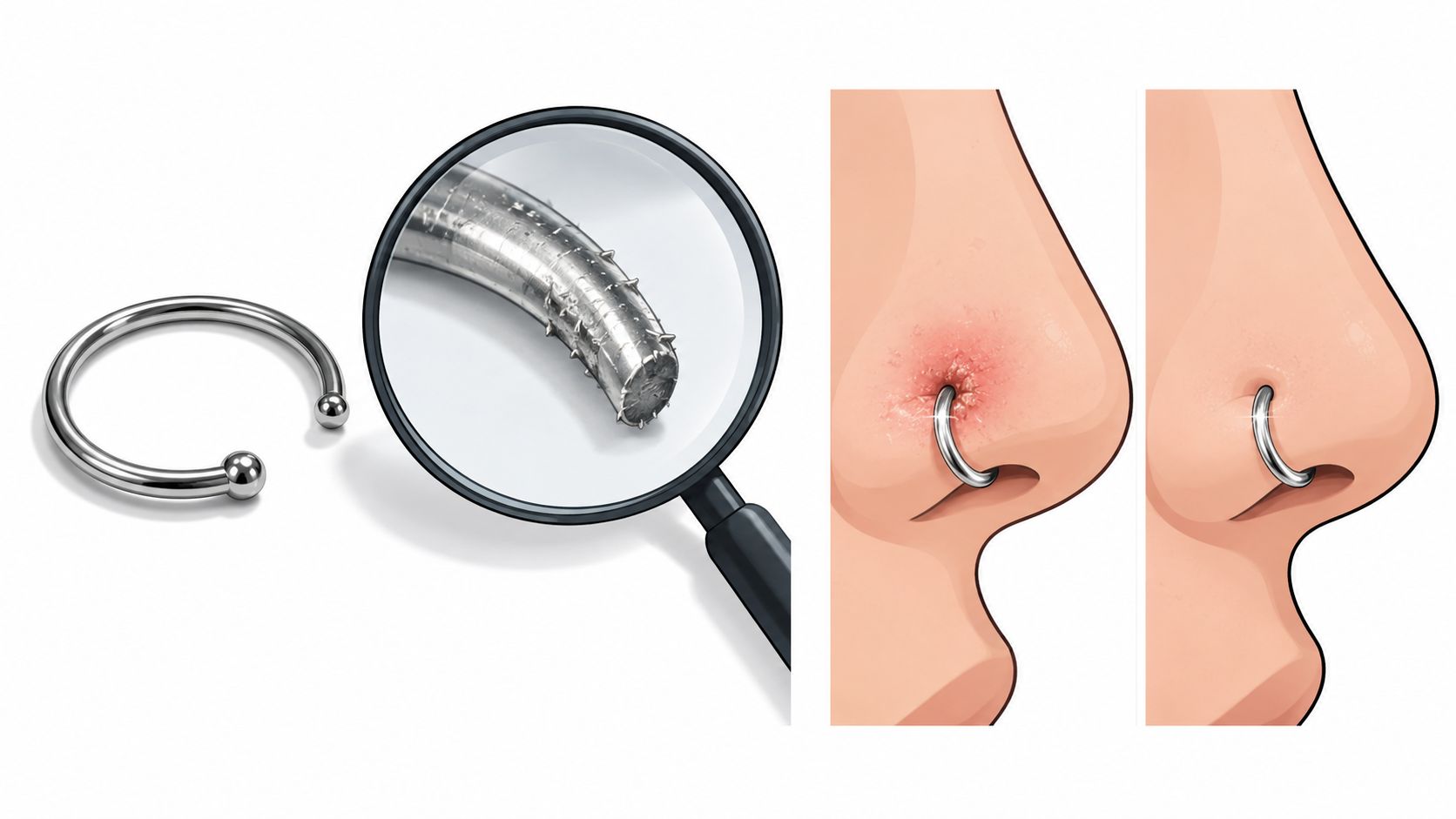
The risk is not limited to the alloy. A rough seam can scrape the piercing channel, while a hoop with too little room can press into the tissue. For someone with nickel sensitivity, an unidentified metal may trigger itching, persistent redness, swelling, or delayed healing through allergic contact dermatitis. Infection and mechanical irritation are different problems, so replacing a dull piece with a shinier one will not correct poor hygiene or repeated movement.
Why familiar labels aren't enough
“Hypoallergenic” expresses an intention rather than identifying the metal. “Nickel-free” is also difficult to assess if the seller provides no manufacturer or laboratory documentation. The same caution applies to “surgical steel.” Stainless-steel alloys can contain nickel, which matters if your skin already reacts to it.
Audit the listing like a label on a medical product. Look for the exact alloy, a recognized material designation, and documentation that connects the product to that claim. A seller's color name or broad safety promise cannot establish composition. The Association of Professional Piercers' published standards provide a useful reference for what documented jewelry information should include.
Practical rule: Treat an undocumented material claim as unverified, even if the product looks expensive.
What irritation can tell you
A stable stud replaced with a low-cost hoop may lead to itching and redness within days. The alloy could be responsible, but the hoop may also be too tight, too heavy, or poorly finished. Jewelry works like a frame around a healing channel: even a suitable material can cause trouble if its shape keeps rubbing the tissue.
Use professional piercing guidance and ideas to compare styles, then inspect each product page before buying. Check the exact alloy, certification, gauge, diameter, surface finish, and closure design. If the seller lists only a color and general promises, you lack the information needed for a safety-based choice. A high quality nose ring should make its material and construction easier to verify, not harder.
Understanding Safe Metals and Certifications
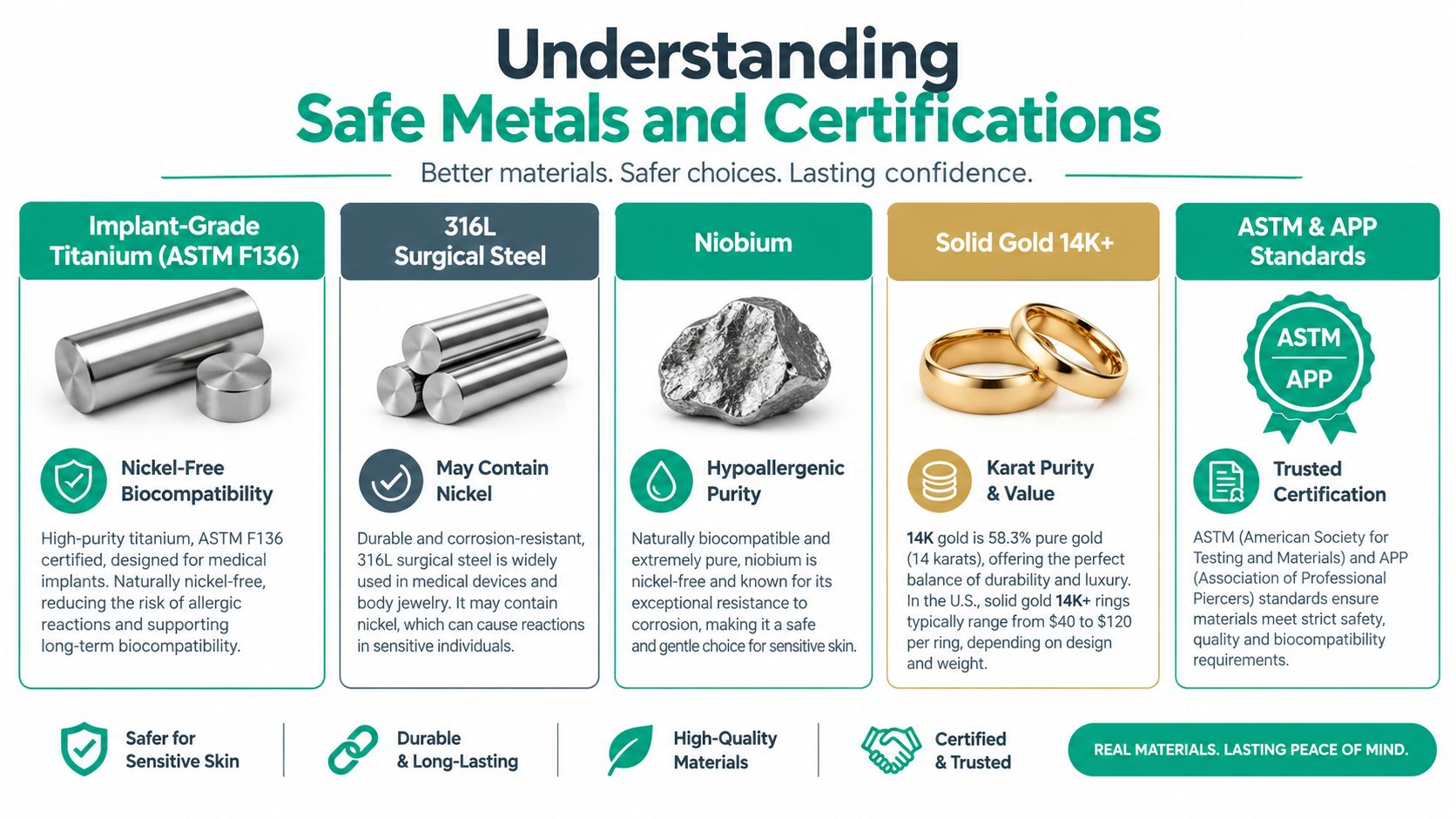
A safe-looking finish proves very little. The useful distinction is between a specific, documented implant material and a broad label such as “titanium” or “surgical steel.” Recognized specifications include titanium alloy Ti-6Al-4V ELI compliant with ASTM F136 or ISO 5832-3, commercially pure titanium compliant with ASTM F67, and titanium-niobium alloys compliant with ASTM F1295, under its published guidance.
These standards identify controlled material specifications associated with medical implants. A product page that says only “titanium” leaves important questions unanswered: which alloy is it, and can the seller connect that claim to documentation? Treat the label like a medical-product label. The exact material and designation should be visible.
Compare the main choices
| Material or label | What to verify | Why it matters |
|---|---|---|
| Implant-grade titanium | ASTM F136, ASTM F67, ISO 5832-3, or supporting documentation | Lightweight, useful for people concerned about nickel sensitivity, and suitable for anodized color |
| Titanium-niobium alloy | ASTM F1295 or equivalent documentation | A titanium-based option with controlled composition |
| Niobium | Clear material identification and professional sourcing | Often suitable for sensitive skin |
| Solid gold | Solid 14-karat or higher gold, with no plating or filling | The surface does not rely on a coating that can wear away |
| Surgical steel | Exact alloy and available documentation | May contain nickel, so the label alone does not resolve allergy concerns |
| Gold-plated or gold-filled jewelry | Whether the piece is solid or coated | Wear can expose reactive base metals |
Use this audit before buying: identify the exact material, check for a recognized implant designation where applicable, look for nickel information, and ask how the documentation relates to the specific product. A certificate for one alloy does not automatically validate every item in a seller's catalog.
Titanium is practical for a healing piercing because it is lightweight and durable. It can also be anodized into different colors without changing the underlying metal, as described in this titanium safety overview.
Solid gold isn't the same as gold-colored jewelry
A gold finish describes appearance, not the metal beneath it. Plated or filled jewelry can wear through and expose its base alloy, which may irritate skin that reacts to certain metals. Solid gold is the more defensible gold choice when the piece is made for body jewelry and its karat and composition are clearly stated.
For another explanation of how professional body jewelry materials and construction are evaluated, see this Fountainhead New York piercing guide. Use that information to assess the listing, then request documentation for the exact piece you plan to wear.
Why Gauge and Diameter Matter
A ring can be made from implant-grade titanium and still be the wrong purchase if its dimensions don't match your anatomy. Gauge describes the thickness of the wire or post. Diameter describes the width of a hoop, while a stud is usually assessed by post length and the amount of room it leaves around the tissue.
The fit changes how force reaches the piercing. A hoop that's too small presses against the nostril and can compress healing tissue. A hoop that's too large moves more freely, catches more easily, and creates strain at the piercing channel. Either situation can cause friction, swelling, or migration.
Think about the piercing, not the product photo
Product images are often styled on an idealized model, so they can't show whether the ring will sit correctly on your nose. The position of your piercing, the curve of your nostril, and the amount of space around the channel all affect the appropriate diameter.
An undersized ring may leave a constant indentation. An oversized ring may hang away from the nostril, snag on clothing, or shift whenever you sleep. Neither result means the jewelry itself is defective. It means the dimensions weren't chosen for the wearer.
The right size should sit securely without pressing into the tissue or swinging freely.
For a fresh piercing, professional fitting is the safest route. A piercer can assess the placement and select a suitable gauge and diameter rather than asking you to estimate from a photograph. If you're ordering replacement jewelry for a healed piercing, measure a piece that already fits well, then confirm whether the retailer states measurements in the same way.
Choose the shape for the stage of wear
Hoops create more movement than a well-fitted stud, particularly when the piercing is still settling. A lightweight, correctly fitted stud can provide a more stable starting point, while a hoop may be appropriate once the tissue is ready and a professional has confirmed the fit.
Don't force a thicker piece through a smaller channel, and don't use a diameter that depends on pressure to stay in place. A high quality nose ring should feel secure because its geometry suits your anatomy, not because it pinches.
Construction Details That Prevent Injury
Metal certification is only one part of the inspection. The jewelry also needs a smooth surface, suitable connection, and closure that won't injure the channel. Run your eyes over the product photos and ask the seller how the piece is finished, especially around seams, hinges, and decorative settings.
Inspect the parts that touch tissue
A polished, burr-free surface is less likely to scrape the channel or hold residue in tiny imperfections. Rough edges, visible casting marks, and an uneven seam are reasons to reject a piece, even if the metal is documented.
For studs and labrets, internal threading or a threadless connection keeps the rougher joining mechanism away from the piercing channel. External screw threads can scrape tissue during insertion or movement. A secure closure should hold firmly without requiring repeated twisting or force.
Never substitute an ordinary earring with a straight-back post. Its backing can trap bacteria inside the nostril and may strike or press against tissue. Nose jewelry is shaped for the anatomy and movement of the nose, while earrings are designed for a different placement.
Use this construction checklist
- Surface: Look for a mirror-smooth, burr-free finish.
- Connection: Prefer internal threading or a threadless design for appropriate studs and labrets.
- Closure: Check that the hinge, bead, or segment closes evenly and securely.
- Shape: Reject pieces with sharp corners, exposed wire ends, or an uneven seam.
- Purpose: Choose jewelry designed specifically for a nose piercing, not an adapted earring.
See the practical insertion and construction principles demonstrated in the video below, then have a professional handle installation if the channel is new, tender, or difficult to access.
A quality closure should make installation controlled rather than stressful. If the jewelry catches, causes sharp pain, or requires force, stop instead of pushing through resistance.
Styling and Aftercare for Healing Piercings
A high quality nose ring needs a protective routine around it. Even smooth titanium can become irritated if you twist it, snag it, apply cosmetics over it, or replace it before the piercing has settled. Material, fit, hygiene, and patient handling work together.
A standard nostril piercing commonly needs about 2–4 months to heal, although the exact process varies by placement and person. Choose lightweight jewelry sized by a professional, and do not change it just because the outside appears calm. The channel beneath the skin may still be delicate.
Build a low-friction routine
Wash your hands before touching the jewelry. Follow your piercer's aftercare instructions, keep the area clean, and leave the ring still rather than turning or playing with it. Apply makeup and skincare around the piercing, so brushes and product do not cross the opening.
Everyday pressure can restart irritation. Avoid sleeping directly on the pierced side when possible. Take care while changing clothes, drying your face, or using towels, because a hoop can catch on fabric and pull the channel. A small snag may lead to swelling that lasts longer than the original contact.
Use this tattoo aftercare timeline to organize general care reminders, while following the instructions your piercer gave for a nose piercing. The comparison is useful for planning, but tattoo guidance does not replace piercing-specific advice.
Know when the pattern has changed
Mild tenderness or brief irritation can follow accidental movement. Worsening pain, redness that spreads, or yellow or green discharge needs medical attention. Do not respond by changing the jewelry repeatedly. A piercer can check whether the fit or construction is causing pressure, while a healthcare professional can assess possible infection or tissue injury.
Aftercare principle: Leave the jewelry alone as much as possible. Stability gives the tissue a better chance to settle.
Anodized titanium can provide color, but the color itself does not prove quality. Check the underlying material, smoothness, fit, and documented grade. A bright finish is decoration, not evidence that the jewelry is safe for a healing piercing.
Where to Buy and Verify Quality
A reputable piercing studio should be able to explain the material, show or provide documentation, and fit the jewelry to your anatomy. That transparency is more valuable than a large product catalog. A low price can become expensive if the piece causes an allergic reaction, embeds because of its size, or needs immediate replacement.
Before purchasing, send the seller a short, specific checklist:
- What exact metal is used?
- Which ASTM or ISO designation supports the material?
- Is the piece solid, plated, or filled?
- Can you provide manufacturer or mill documentation?
- What are the gauge, diameter, or post-length measurements?
- How is the surface finished?
- What type of threading or closure does it use?
- Is the jewelry intended for a fresh, healing, or healed piercing?
A seller who answers clearly gives you something to evaluate. A seller who repeats “hypoallergenic” without naming the alloy hasn't answered the question.
Professional fitting beats guesswork
For a new or healing piercing, buy through a qualified piercer whenever possible. The professional can select jewelry that suits the placement, install it without unnecessary trauma, and identify whether the ring is too tight, too loose, heavy, or poorly shaped. This reduces the number of variables you're trying to solve alone.
Online shopping can work for a healed piercing, but the retailer should publish meaningful specifications rather than relying on lifestyle photography. If you're comparing suppliers for a studio or resale business, this guide on how to evaluate wholesale piercing jewelry suppliers can help frame questions about sourcing and product transparency.
Make documentation your final filter
Choose the piece only after the material and dimensions pass inspection. For someone concerned about nickel sensitivity, documented implant-grade titanium or niobium is a more defensible option than an unspecified steel alloy. Solid gold can also be appropriate when its purity and construction are clear, but a gold-colored coating doesn't provide the same assurance.
If the seller won't identify the alloy, certification, coating status, or measurements, keep browsing. A high quality nose ring should make its safety information easy to verify, not force you to infer it from a polished photograph.
Use TattoosAI to explore tattoo concepts that complement your jewelry style, from minimalist and geometric ideas to Japanese, watercolor, and blackwork designs. Generate several original directions before meeting your tattooist, so your studio consultation starts with a clear visual reference rather than a vague idea.