TattoosAI
A koi fish tattoo most commonly signifies perseverance, strength, and overcoming adversity, anchored in the Dragon Gate legend where a koi that swims upstream and clears a waterfall becomes a dragon. A client once came in with a koi sketched on a phone, convinced the direction was the whole meaning, but the color and surrounding elements told a much more personal story.
Table of Contents
- Why the Koi Fish Tattoo Endures
- The Dragon Gate Legend Behind Koi Symbolism
- How Koi Colors Change the Meaning
- What Koi Direction and Placement Really Mean
- Koi Tattoo Styles and Design Variations
- How to Choose Your Personal Koi Design
- Bringing Your Koi Story Together
Why the Koi Fish Tattoo Endures
The koi's story begins in moving water. A carp fights its way through the Yellow River, reaches a waterfall called the Dragon Gate, and keeps leaping when the current pushes it back. When it finally clears the gate, it transforms into a dragon. That image gives the koi tattoo its central message: persistence can change who you become.
A koi fish tattoo can therefore mark an obstacle, a recovery, a demanding ambition, or a personal turning point. Koi are also associated with luck, abundance, and wealth in Japanese usage, so the design often carries two messages at once. It can honor the hard road while expressing hope for what follows it, as described in this overview of koi fish tattoo meaning.
The mistake first-time clients often make is treating the koi as a single symbol with a fixed translation. The fish is only the beginning. The legend provides the narrative, color changes the emotional register, direction suggests a life chapter, and family codes can make the tattoo relational rather than purely personal.
A useful starting point: don't ask only, “What does a koi mean?” Ask, “Which part of the koi story belongs to me?”
A red koi moving upward may speak about courage during an active challenge. A blue koi moving downward may feel calmer, more reflective, or connected to a family member. The same animal can tell very different stories depending on the choices around it.
By the end of the design process, you should be able to explain your koi in plain language: what event it marks, why you chose its color, whether its journey is still underway, and how its style supports the message. That clarity starts with the legend that made the fish more than a decorative subject.
The Dragon Gate Legend Behind Koi Symbolism
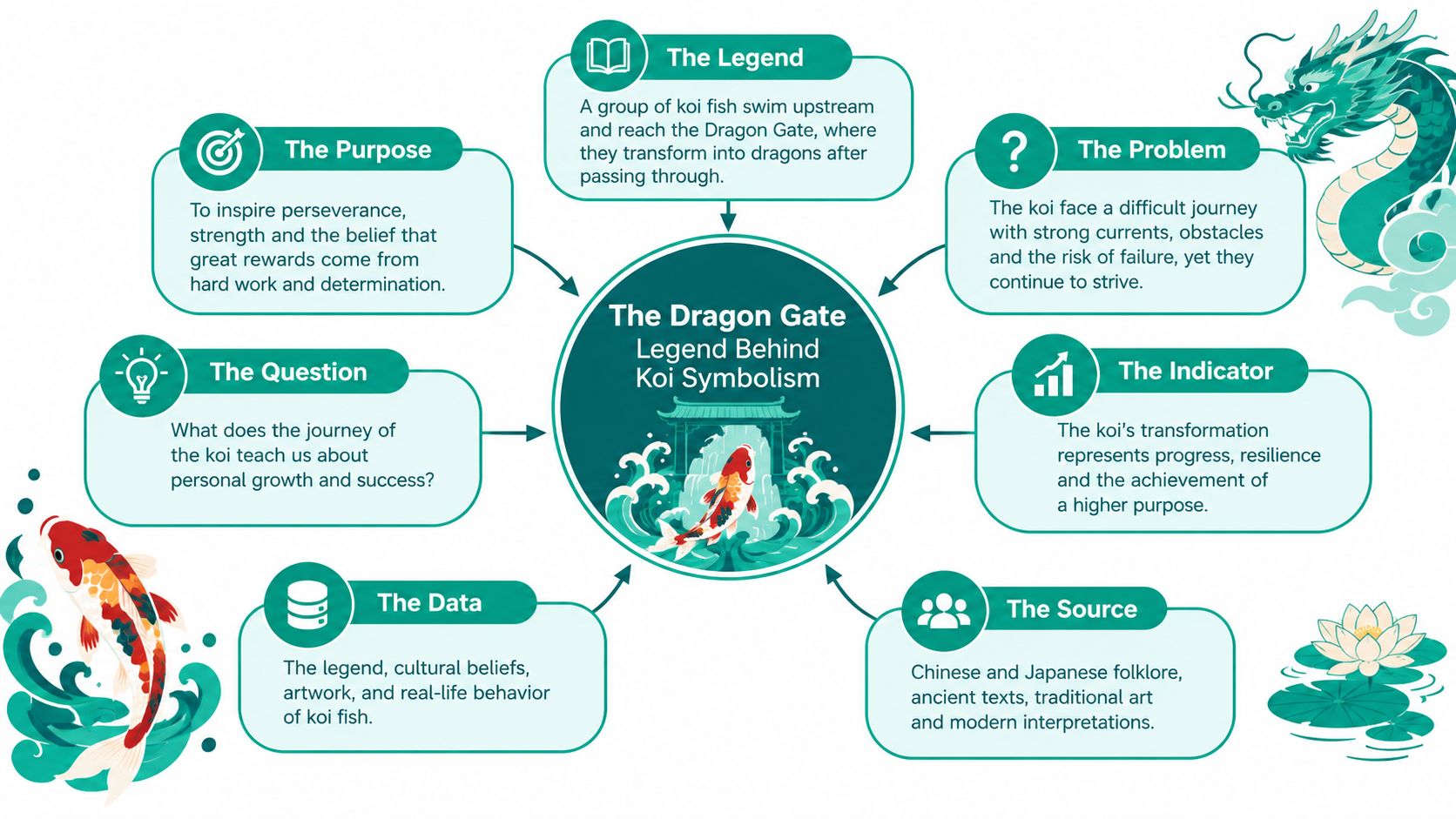
The oldest layer of koi symbolism is a transformation story. Carp swim upstream through the Yellow River, pushing against the current toward a powerful waterfall. At the waterfall, known as the Dragon Gate, the fish face the final barrier. Those that pass through can become dragons.
The story is often connected with the Japanese phrase tōryūmon, which refers to passing through the Dragon Gate. In tattoo symbolism, that phrase adds an important dimension. The koi isn't only surviving difficulty. It is crossing into a new stage of life, with the dragon representing the change that follows sustained effort.
That distinction matters when you're choosing a design. A koi can represent the exhausting middle of a challenge, but it can also represent the identity you build after the challenge has altered you. The tattoo becomes a visual sentence: I kept going, I crossed a threshold, and I became something more than I was before.
A symbol beyond tattoo culture
Koi imagery also appears in Japanese public life. Families display koi-shaped windsocks called koinobori on Children's Day, celebrated on May 5, and one source describes one windsock for each child. The custom connects the fish with hopes for strength, growth, and success, so koi symbolism exists beyond the tattoo studio.
That cultural setting helps explain why the motif can feel both individual and communal. One wearer may choose a koi to remember a private recovery, while another may use several koi to represent family members. The symbol has room for both meanings because its history includes personal struggle, transformation, and hopes for the next generation.
For a broader look at related imagery, compare your ideas with this guide to Japanese tattoo meanings. The point isn't to copy a traditional composition without understanding it. It's to recognize that the koi carries a narrative with cultural roots, and your design choices should respond to that narrative thoughtfully.
How Koi Colors Change the Meaning
Color is often the fastest way to shift a koi tattoo from a general resilience symbol into a more specific personal statement. The fish stays the same, but the emotional emphasis changes. Red feels active and heartfelt, black feels hard-won, gold or yellow feels prosperous, and blue feels calm.
The commonly cited associations are:
- Red koi: Love and bravery.
- Black koi: Overcoming obstacles.
- Gold or yellow koi: Prosperity and wealth.
- Blue koi: Tranquility.
These associations come from tattoo culture and shouldn't be treated as a universal dictionary. Your own history still matters more than a color chart. Someone may choose black because it reflects survival, while another person may choose it for a family connection rather than an obstacle.
Personal and family readings
Color can also carry a family meaning in more granular Japanese tattoo codes. One documented set associates blue with a son, black with the father, red with the mother, and pink with the daughter. That gives a pair or group of koi a different function. Instead of showing one person's journey, the composition can become a portrait of the people who shaped it.
| Koi Color | Personal Meaning | Family Code |
|---|---|---|
| Red | Love and bravery | Mother |
| Black | Overcoming obstacles | Father |
| Gold or yellow | Prosperity and wealth | No specific family code listed |
| Blue | Tranquility | Son |
| Pink | Personal affection or a softer emotional tone | Daughter |
The family codes and personal associations are documented together in this guide to traditional koi tattoos. Use them as a starting point, not a requirement. If a color has a private meaning in your life, that meaning can sit alongside the broader cultural association.
Design question: are you choosing the color to describe your own character, to honor another person, or to do both?
Combining colors can make that answer visible. A red and blue pair might represent two family members, while a black koi with a gold accent could connect survival with a hopeful new chapter. You can also keep the koi in one dominant color and use secondary shades in the water, flowers, or background. That approach preserves visual focus while adding another layer.
Before settling on color, show the artist references with the same level of detail you'd use for direction. Bright color, muted color, and black-and-grey shading create different visual weights. The symbolic choice should work with the tattoo's long-term appearance, size, and placement, not exist separately from them.
What Koi Direction and Placement Really Mean
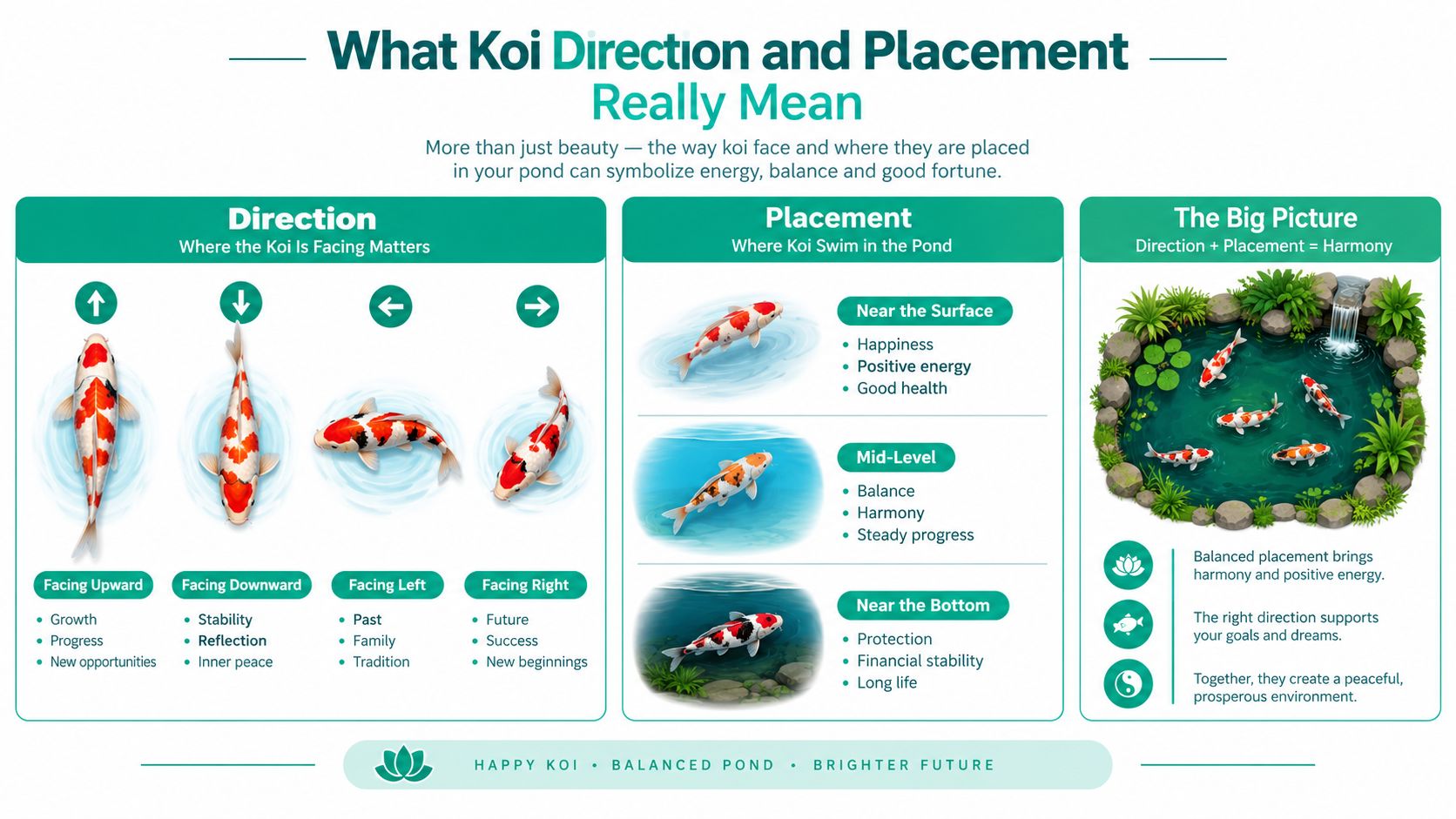
Most tattoo explanations use a simple formula: an upstream koi represents struggle, while a downstream koi represents success. That convention can be useful, especially if you want the direction to show whether your challenge is ongoing or complete.
It isn't a rigid symbolic code, though. In traditional Japanese tattooing, direction can primarily serve the composition, helping the fish follow the body's shape and interact with water, waves, flowers, or other elements. A downstream koi may also mean that the wearer has already moved through the difficult stage and is now carrying the result of it.
Choose the chapter, not a rule
An upstream koi suits a story that still has motion in it. You might choose it while pursuing a demanding career goal, rebuilding after a loss, or developing the discipline to change your life. The upward movement gives the design tension and makes the current part of the story visible.
A downstream koi can honor a completed struggle without suggesting passivity. It can say, “I made it through, and I'm allowed to move with more peace now.” The direction marks the relationship between the wearer and the obstacle, not a judgment about ambition.
Let the body guide the movement
Placement affects how naturally the koi appears to swim. On an arm, the fish can travel along the forearm or follow the length of a sleeve. On a leg, an upward composition can emphasize vertical movement, while a downward one can settle into the calf's natural line. A back or chest offers more room for water, a waterfall, or a larger surrounding scene.
Your artist should also consider how the tattoo looks when your body is relaxed and when it moves. A koi that appears to swim into the body's natural direction usually feels integrated, even when the symbolic reading is personal rather than traditional.
Practical rule: decide what the koi is marking first, then let anatomy and composition determine the most convincing direction.
Koi Tattoo Styles and Design Variations
Style changes the volume of the message. A bold Japanese-inspired koi with dense water, sweeping waves, and expressive movement feels declarative. A fine-line fish with restrained shading feels quieter, as if the wearer is keeping the story close.
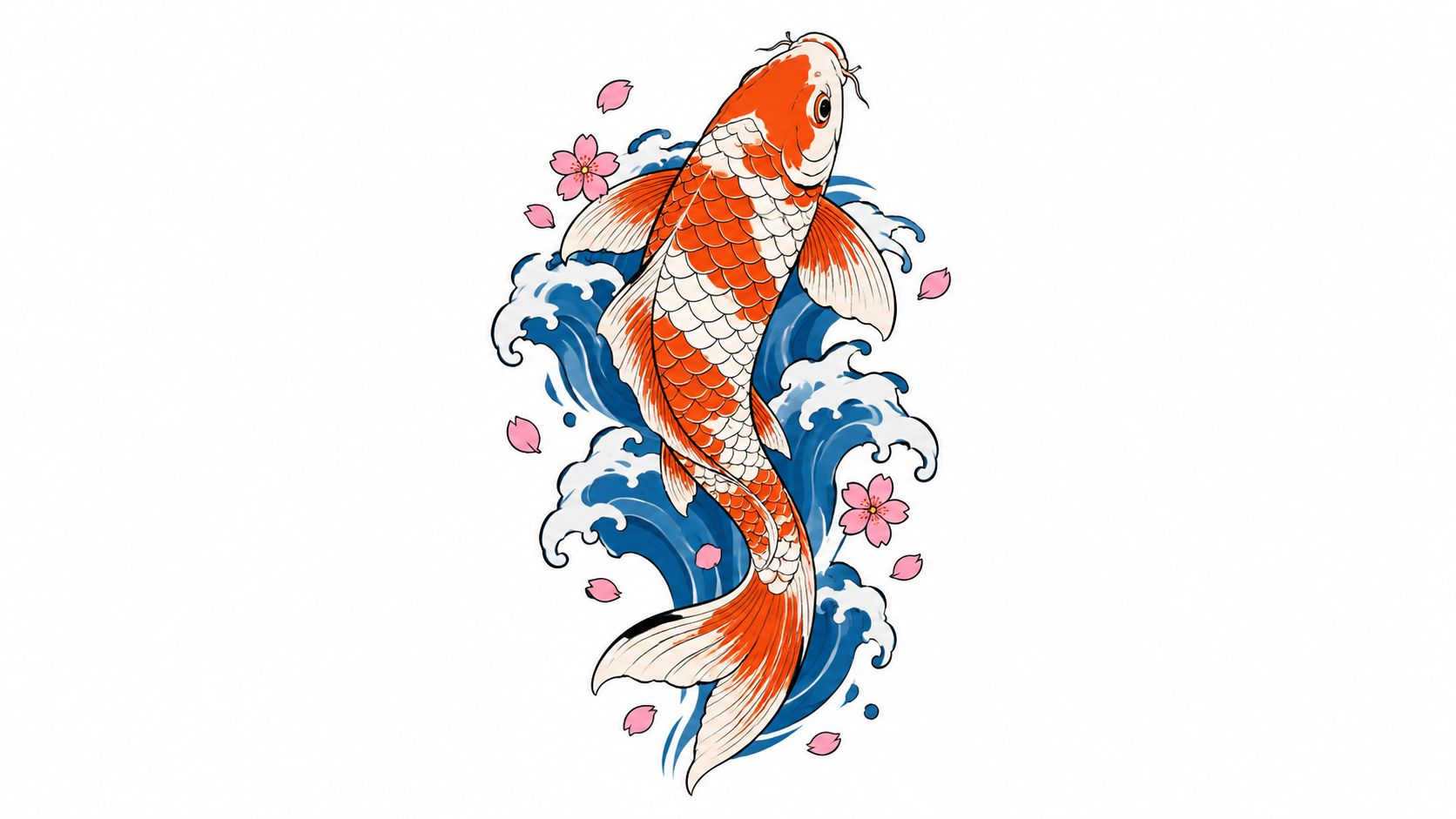
Match the visual language to the story
Traditional Japanese style emphasizes flow, scale, and context. Water, wind bars, cherry blossoms, and a strong body shape can make the koi feel connected to established tattoo traditions. It suits a wearer who wants the resilience narrative to read clearly from a distance.
Neo-traditional work can preserve the fish's bold outline while giving the colors and supporting elements a more illustrative, personal treatment. Minimalist and fine-line designs reduce the story to the essential silhouette, which works well for quiet resolve or a private milestone.
Watercolor treatments can make the koi feel fluid and atmospheric, while blackwork gives the design weight through solid contrast and negative space. Neither approach is more meaningful on its own. The style should reflect whether you want the tattoo to announce the story or invite someone to look closer.
Historical context adds another useful layer. Modern Japanese koi are generally traced to early 19th-century Japan, when rice farmers kept and selectively bred colorful carp. Koi had entered Japanese culture much earlier, around the 5th or 6th century, through the transmission of Buddhism and Chinese traditions, as summarized in this account of koi history and symbolism. The result is a motif shaped by older cultural transmission and more recent breeding history.
Supporting elements can sharpen the concept. Waves reinforce movement, a lotus can suggest growth through difficult conditions, and dragon imagery can point toward transformation. Cherry blossoms can add a reminder of life's changing nature. For more visual reference on koi fish tattoo symbolism, compare how black-and-grey designs use contrast rather than bright color to carry the story.
A short visual example can help you evaluate the difference between styles and compositions:
How to Choose Your Personal Koi Design
Start with the event, not the image. Before choosing a reference, write one sentence answering: What am I marking? Keep the wording concrete, such as “I'm honoring the career setback I'm still working through” or “I'm remembering the recovery I've already completed.”
Then make four decisions:
- Choose the story. An active effort may suit an upstream koi, while a completed chapter may suit a downstream composition. If you prefer direction as a design decision, tell your artist that the body flow matters more than a fixed symbolic reading.
- Choose the color. Use red, black, gold or yellow, and blue as broad associations, then decide whether a family code or private memory matters more for your piece.
- Choose the placement. A long body area can support swimming motion. A broader area can hold water, flowers, or transformation imagery. Ask the artist to show the design on the body rather than judging it only as a flat drawing.
- Choose the style. Traditional Japanese work makes the story visible and expansive. Fine line, watercolor, or blackwork can make it more personal in tone.
You can explore early drafts with an AI tattoo generator such as TattoosAI. Describe the koi's direction, dominant color, body placement, supporting elements, line quality, and emotional tone instead of typing only “koi tattoo.” A detailed prompt might ask for an upstream black koi, controlled waves, restrained shading, and a strong vertical composition for the calf.
Use the output as a conversation starter, not a substitute for an artist's judgment. Refine the body shape, simplify details that won't age well, and ask the tattooist to adapt the concept to your skin and chosen placement. The koi tattoo and flowers guide can also help you think through how floral elements change the composition.
Bringing Your Koi Story Together
Consider someone marking a career comeback after a painful failure. They choose an upstream red koi in a traditional Japanese style. The direction says the effort is still active, red introduces bravery and emotional investment, and the bold composition gives the wearer a visible reminder to keep moving toward the next threshold.
Another person could choose the same legend differently. A black koi moving downstream might honor a hardship that has already ended, with the darker color representing the obstacle and the calmer direction representing life after it. Neither design is more authentic. Each one answers a different personal question.
Use this checklist before you book the appointment:
- Legend: Do you understand the transformation story behind the koi?
- Color: Have you chosen a color for a reason beyond appearance?
- Direction: Are you marking an ongoing effort, a completed struggle, or just following the body's natural flow?
- Style: Does the visual treatment match how openly you want the story expressed?
- Brief: Can you describe the fish, color, direction, placement, supporting elements, and mood in a few sentences?
A layered tattoo usually feels more personal than a generic symbol because each choice carries part of the message. Start with the story, sketch the simplest version by hand or explore a digital concept, then bring the clearest draft to an experienced tattoo artist for refinement.
TattoosAI lets you describe a koi concept, explore it across different tattoo styles, and generate visual drafts that you can refine with your artist. Visit TattoosAI to turn your chosen color, direction, placement, and personal story into a clearer tattoo brief.