TattoosAI
You know you want a lion tattoo. You've saved portraits with fierce eyes, calm expressions, and sweeping manes, but the flowers keep changing your mind. Should they sit beside the lion, form its mane, or replace the background entirely?
That choice changes more than decoration. A rose crown creates a different silhouette from a lotus beneath the chin. A floral mane needs different spacing from a realistic portrait beside a sunflower. The composition also determines whether the design suits your forearm or needs the broader surface of your thigh or back.
A lion tattoo with flowers can express protection, love, remembrance, or personal growth. Those meanings aren't fixed rules. Choose the relationship you want between the animal and the flowers, then build the design around it.
Eight ways to pair a lion with flowers offer distinct starting points:
- Traditional and symbolic: Japanese guardian lions, rose crowns, marigold skulls, and lotus compositions.
- Integrated and graphic: Floral manes and geometric lions with structured blooms.
- Painterly and realistic: Watercolor wildflowers and detailed portraits with sunflowers.
Each concept below includes a sample generation prompt you can bring to a tattooist as a design reference, along with the compromises worth settling before you book.
Table of Contents
- 1. Japanese Lion with Peonies and Cherry Blossoms
- 2. Lion Head with Rose Crown
- 3. Floral Mane Lion (Flowers Forming the Mane)
- 4. Lion Skull with Marigolds
- 5. Lion and Lotus (Buddhist-Inspired)
- 6. Geometric Lion with Blooming Flowers
- 7. Watercolor Lion with Wildflowers
- 8. Realistic Lion Portrait with Sunflowers
- How the eight lion and flower concepts compare
- Turning Your Favorite Lion and Flower Concept Into Ink
1. Japanese Lion with Peonies and Cherry Blossoms
Choose a shishi guardian lion if you want a stylized creature with curling fur and an animated posture, rather than a wildlife portrait. Peonies suit its substantial shapes. Cherry blossoms create a lighter effect, especially when scattered around the body.
Peonies can suggest prosperity and noble beauty; sakura can express impermanence. You don't need both. If you want a traditionally coherent composition, ask a Japanese-style specialist whether your flowers, background, and seasonal references belong together.
Build the movement around your body
For a full-back design, a leaping shishi can stretch diagonally while peonies anchor the lower composition. Wind bars can connect the animal and flowers without filling every opening. On a forearm, simplify to a lion head and a restrained fall of petals.
- Style: Strong outlines, deliberate black areas, and stylized anatomy.
- Color: Pink or red flowers against a limited palette, with enough skin showing between forms.
- Placement: Back, shoulder, or sleeve when you want branches and background elements.
You can explore traditional Japanese tattoo styles to clarify the visual language before your consultation. Ask about healed pink pigment and whether the planned background requires staged sessions.
Sample prompt
Japanese-style shishi guardian lion with curling mane, large peonies, restrained cherry blossom petals, flowing wind bars, bold black shading, muted pink accents, diagonal full-back composition, generous open skin, no lettering.
Don't shrink a back-piece composition onto an arm. Remove elements instead.
2. Lion Head with Rose Crown
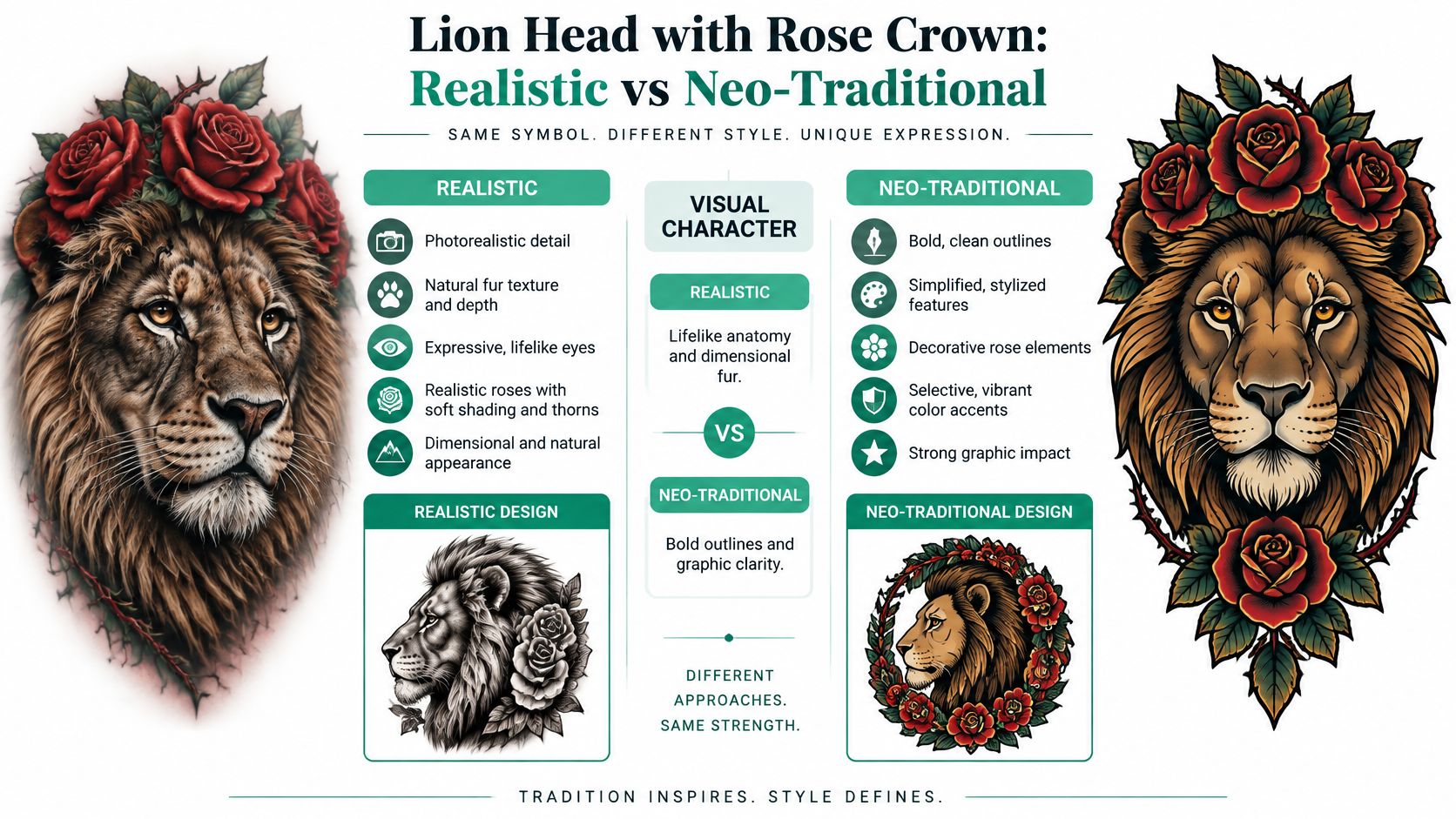
The rose crown works best when the lion's expression stays readable. Set the blooms above and beside the brow, not across the eyes. A closed mouth and steady gaze usually create a more composed portrait than exposed teeth.
For an upper-arm memorial piece, try a black-and-gray lion with roses curving around the crown and shoulder. Red petals can add emphasis, but they shouldn't become the only way to distinguish flowers from mane.
Choose realism or stronger outlines
Realism depends on accurate anatomy, controlled shading, and sufficient room for the muzzle. Neo-traditional uses clearer boundaries and simplified shapes, making it a useful choice when you want a more graphic rose crown.
The Archaeological Institute of America describes protective lion imagery, including lions serving as guardians for the dead. That association can support a memorial design without making the roses' meaning universal.
For another way to balance affection with strength, compare the composition of a rose and sword tattoo.
Placement check: Test the stencil with your arm relaxed. A crown that looks level on a flat image may tilt around your shoulder.
Sample prompt
Semi-realistic lion portrait with a calm forward gaze, rose crown above the ears, black-and-gray shading, separated petals and mane, vertical upper-arm composition, clear muzzle, no ornamental crown.
3. Floral Mane Lion (Flowers Forming the Mane)
Here, the flowers replace the mane rather than decorate it. That makes the outer silhouette the central design decision. Large blooms establish the shape; smaller flowers and leaves connect them.
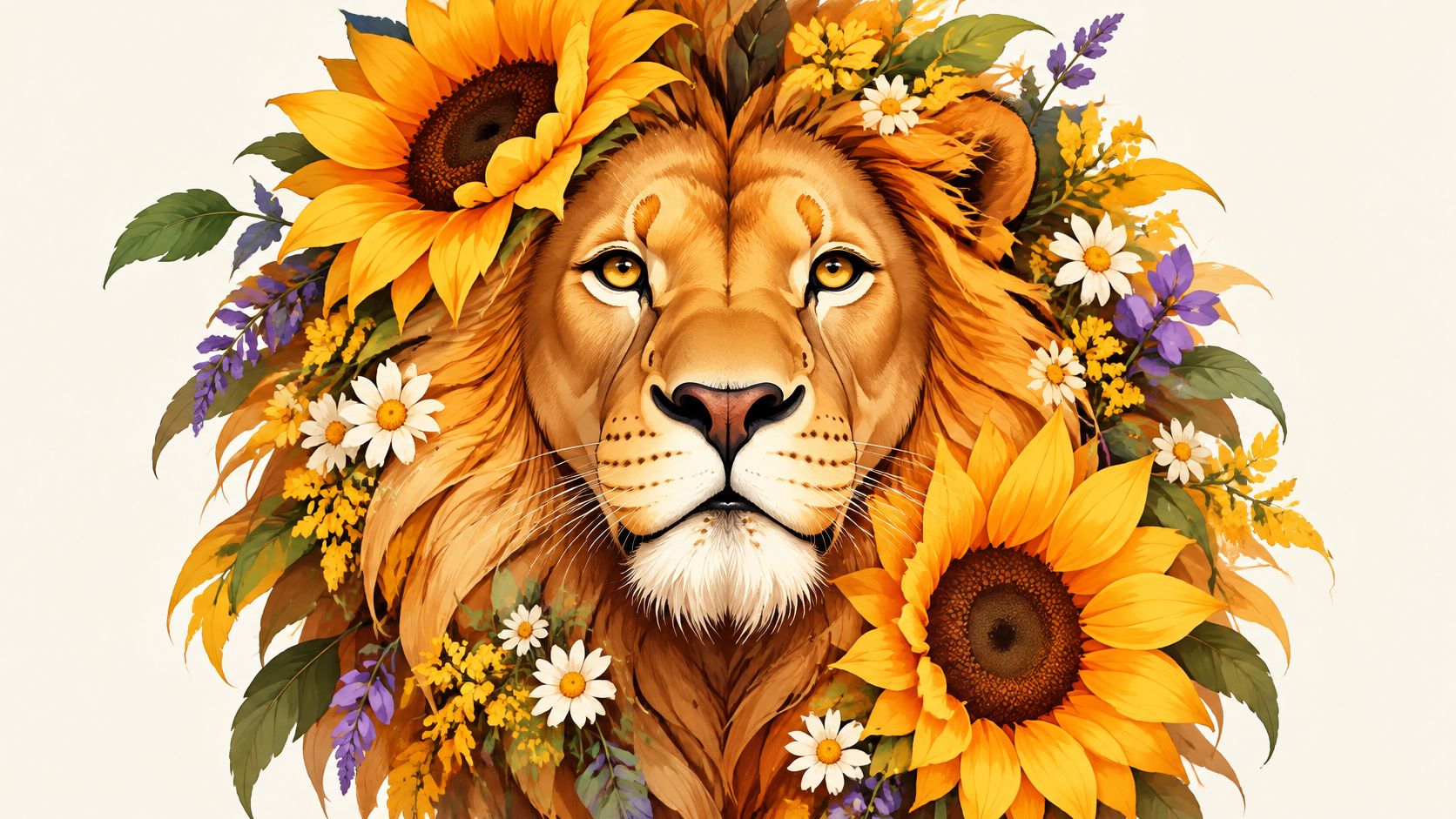
A sunflower mane suits bold illustrative color. Wildflowers work well in blackwork or dotwork, particularly on a thigh where stems can spread without squeezing the face. Don't combine every favorite flower into the same ring.
Keep the animal recognizable
The compositional guidance in Glaminati's lion tattoo ideas emphasizes preserving the eyes and muzzle while directing flowers around the mane. That's especially important when you remove the natural fur outline.
- Face: Keep the eyes, nose, cheekbones, and chin distinct from the botanical detail.
- Flowers: Vary bloom size so the mane doesn't resemble a uniform wreath.
- Color: Separate yellow petals from adjacent shading with clear edges and open skin.
Say you want a colorful forearm piece. Use broad sunflower petals along the outside, with smaller leaves near the jaw, rather than miniature daisies packed against whisker dots.
Sample prompt
Illustrative lion face with a mane formed entirely from sunflowers and simple wildflowers, recognizable cheek structure, strong black nose, clear eyes, warm yellow petals, open spacing, tapered outer-forearm composition, no background.
Ask your artist which internal petal lines to remove. A convincing digital flower can contain more detail than the tattoo needs.
4. Lion Skull with Marigolds
A lion skull changes the tone immediately. Instead of a living guardian, you're working with mortality, memory, and what remains. Marigolds can make the composition warmer without making it cheerful.
If you're drawing from Día de los Muertos, learn the role of cempasúchil in remembrance before choosing additional symbols. Don't treat the tradition as a general skull aesthetic, and don't add ceremonial details just to fill space.
For a memorial upper-back piece, a frontal skull with marigolds above the temples offers a clear arrangement. On the calf, a slightly angled skull and a descending flower cluster can follow the leg more naturally.
Make the bone structure convincing
An artist needs an actual lion-skull reference, not a human skull with feline teeth. The broad muzzle, eye sockets, jaw, and canine roots should remain identifiable after the flowers are added.
Keep the darkest flower shadows away from the deepest skull cavities. Otherwise, the marigolds and bone can merge into an unreadable patch.
Use orange and golden accents sparingly if you want the skull to remain dominant. Neo-traditional outlines suit this approach; soft realism needs more room for gradual changes in tone.
Sample prompt
Neo-traditional lion skull with anatomically credible feline proportions, marigold crown and descending leaves, warm orange accents, strong black outlines, open bone highlights, vertical calf composition, respectful memorial mood, no text or additional ceremonial symbols.
Ask the tattooist to adjust the jaw angle for your placement rather than stretching the entire skull.
5. Lion and Lotus (Buddhist-Inspired)
A calm lion above a lotus suits someone who wants strength without aggression. Start with a closed mouth, relaxed brow, and grounded posture. An intense snarl usually conflicts with the meditative direction.
The lotus is associated with purity and spiritual growth in Buddhist and Hindu contexts. The lion also carries religious associations in some Buddhist traditions. If those connections matter to you, discuss the specific imagery with someone knowledgeable rather than combining sacred motifs by appearance alone.
Decide how much symbolism you need
A chest composition could place a lion head above an open lotus, with petals spreading outward. An upper-back version has more room for a seated animal and a restrained geometric background.
- Composition: Align the nose, chin, and flower center, then check that alignment on your body.
- Style: Use clean blackwork for clarity, or fine-line shading with simplified petal interiors.
- Background: Add a mandala only if it serves the design, not as automatic filler.
The Smithsonian's history of tattooing describes tattoos serving purposes including protection, religious belief, love, and adornment across different societies. Your interpretation can be personal without claiming it's universal.
Sample prompt
Calm lion head above an open lotus, balanced blackwork composition, relaxed expression, clear petal outlines, restrained dot shading, broad negative space, centered upper-back placement, no script, no deity imagery.
Fine lines don't need a separate healing ritual. They need careful application, sensible spacing, and the artist's written aftercare instructions.
6. Geometric Lion with Blooming Flowers
Perfect symmetry on a screen doesn't guarantee a balanced tattoo. Your forearm rotates, your chest moves, and your sternum isn't a flat drawing surface. Geometric work makes small alignment errors conspicuous.
For an outer-forearm design, try a faceted lion face with an organic flower beside the jaw. Keeping the bloom natural gives your eye a break from the straight lines. If you prefer fully geometric flowers, simplify their interiors so they don't compete with the face.
Use fewer, stronger intersections
A useful brief separates the structure from the decoration:
- Lion: Broad planes around the brow, nose, and cheekbones.
- Flower: A recognizable silhouette, such as a lily with clearly separated petals.
- Linework: A deliberate hierarchy, with stronger outer boundaries and lighter internal divisions.
- Placement: A stencil checked while standing naturally, not only while lying on the tattoo bed.
A sternum composition can suit a centered lion and spreading lily, but its proportions must fit the available space. Don't force a broad face into a narrow strip by compressing the muzzle.
Longevity priority: Choose readable shapes over a dense mesh of tiny triangles. More intersections don't make the lion more convincing.
Sample prompt
Geometric lion head built from broad angular planes, organic lily beside the lower jaw, bold outer contour, restrained internal lines, black ink, generous negative space, tapered outer-forearm layout, no tiny polygon mesh.
Choose an artist with healed geometric work. Fresh photographs alone won't show whether closely spaced lines remain distinct.
7. Watercolor Lion with Wildflowers
Choose watercolor when you want the effect of loose paint rather than a tightly enclosed illustration. Wildflower stems can extend beyond the mane, while controlled splashes soften the edge.
The trade-off is definition. Pale petals and soft color transitions can become less distinct, especially when the entire design relies on them. A watercolor tattoo still needs an underlying drawing that works without its brightest accents.
Give the color a stable foundation
For an upper-arm piece, use a clearly drawn eye, nose, and jaw beneath loose botanical strokes. On a thigh, you can allow more space between the portrait and scattered wildflowers.
Ask to see healed watercolor tattoos on skin tones similar to yours. Don't judge the palette solely from a bright digital mockup or a freshly photographed tattoo.
The International Agency for Research on Cancer's tattoo background describes inks as complex mixtures and notes that intended intradermal safety testing isn't routinely performed before market introduction. Ask about ink documentation and disclose previous pigment reactions before choosing your palette.
Sample prompt
Painterly lion portrait with loose wildflowers, defined black eye and nose, readable jawline, restrained blue and muted pink washes, skin breaks between color areas, asymmetrical upper-arm composition, minimal splatter, no lettering.
Use sunscreen once the tattoo has healed, and protect it from unnecessary sun exposure. Touch-ups may refresh selected areas, but they won't turn an overcrowded design into a well-spaced one.
8. Realistic Lion Portrait with Sunflowers
The strongest version usually gives the lion and sunflower different jobs. The face supplies expression; the flower supplies a broad, contrasting shape. If both are equally detailed and equally dark, neither stands out.
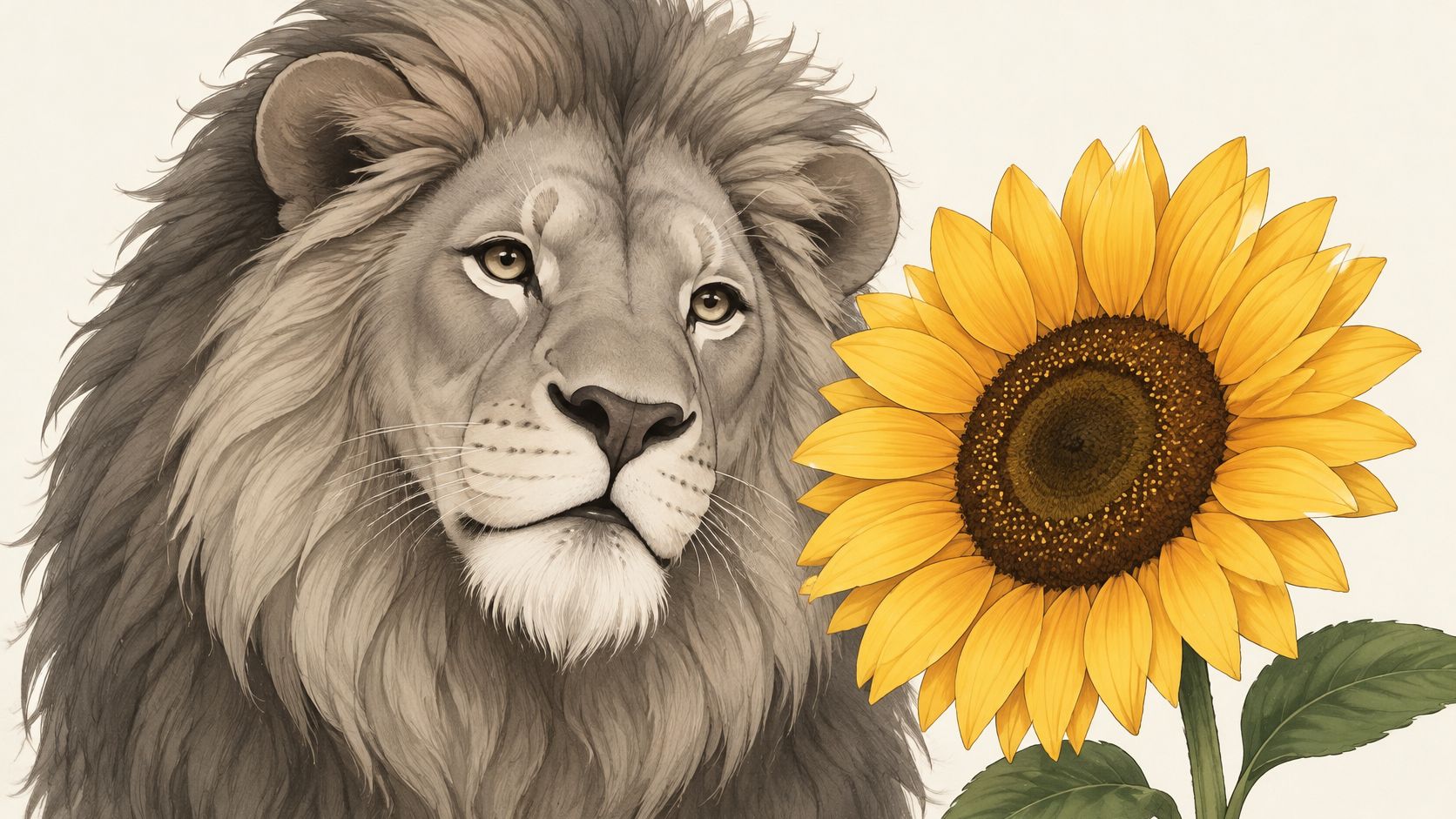
For an upper-arm portrait, place the sunflower beside the cheek rather than directly across the muzzle. A larger back piece can accommodate a fuller mane and a flower angled toward the face.
Let the reference determine the lighting
Bring a sharp lion photograph with visible eye, nose, and muzzle structure. Ask the artist to draw the sunflower under compatible lighting. A brightly lit bloom beside a heavily shadowed lion can look pasted together.
- Color choice: A black-and-gray lion with yellow petals provides a clear accent.
- Detail choice: Simplify the seed head rather than requesting every seed.
- Artist choice: Prioritize healed animal portraits, especially believable eyes and clean muzzle highlights.
If you're weighing a smaller floral element, these small sunflower tattoo ideas can help clarify which details can be removed. Don't shrink a realistic flower without redesigning it.
Sample prompt
Realistic black-and-gray lion portrait with a calm three-quarter gaze, large sunflower beside the cheek, restrained golden-yellow petals, consistent side lighting, simplified seed texture, open highlights, upper-arm composition, no background.
You can use the sunflower to express warmth or optimism. Its meaning doesn't need to follow a fixed symbolic dictionary.
How the eight lion and flower concepts compare
| Item | Core Style | Typical Placements | Color Approach | Detail Level |
|---|---|---|---|---|
| Japanese Lion with Peonies and Cherry Blossoms | Traditional Japanese irezumi | Back, thigh, sleeve, forearm | Bold color, soft pinks, traditional shading | High |
| Lion Head with Rose Crown | Realism or neo-traditional | Upper arm, chest, forearm | Often black and grey with optional color accents | High |
| Floral Mane Lion (Flowers Forming the Mane) | Botanical or illustrative | Forearm, thigh | Saturated colors or dotwork shading | Moderate to high |
| Lion Skull with Marigolds | Traditional, neo-traditional, or illustrative | Upper back, calf | Bone tones with vibrant orange and yellow accents | High |
| Lion and Lotus (Buddhist-Inspired) | Fine-line or mandala-inspired | Chest, back, calf | Mostly black and grey with subtle color | Fine, precise linework |
| Geometric Lion with Blooming Flowers | Geometric and minimalist | Outer forearm, sternum | Black linework with optional metallic or pastel accents | Precise, pattern-focused |
| Watercolor Lion with Wildflowers | Painterly watercolor | Forearm, thigh, shoulder | Soft gradients, color bleeds, and splashes | Loose, expressive |
| Realistic Lion Portrait with Sunflowers | Color or black-and-grey realism | Shoulder, upper arm, back | Grey shading with warm yellow and orange accents | High |
Turning Your Favorite Lion and Flower Concept Into Ink
Choose the concept you'd still want without the dramatic background, bright screen colors, or polished mockup. That usually reveals what matters most: the lion's expression, a particular flower, or the relationship between them. Keep that priority clear when you brief the artist.
A generated design is a reference, not a stencil. Your tattooist must adapt the lion, flowers, and spacing to your body, skin, and how the tattoo will age. Expect them to redraw awkward anatomy, remove unnecessary detail, and change overlaps that won't translate well into ink.
Bring a brief, not an unchangeable image
Use this short checklist before your consultation:
- Pick a style and placement: Decide whether you want realism, Japanese, geometric, or another clear direction, then identify the body area.
- Generate contrasting variations: Compare a floral frame, an integrated mane, and a side-by-side arrangement without changing every other feature.
- Check the detail against the space: View the reference at its intended physical size. Ask which petals, fur marks, and shading transitions need simplification.
- Discuss pigment longevity: Ask how the proposed palette may heal on your skin and which areas are likely to lose contrast.
- Review healed work: Look for examples in the artist's portfolio that resemble your chosen technique, not merely the same subject.
Safety belongs in that conversation too. Ask about sterile practice and pigment documentation, and disclose allergies or a history of keloids. Follow the studio's written aftercare guidance, but seek medical assessment for spreading redness, worsening pain, pus, or fever rather than assuming they're normal healing.
Don't add symbols just to make the design feel more personal. A clear expression and a flower you care about can carry more meaning than a crowded collection of initials, dates, crowns, and background patterns.
We offer a free trial of TattoosAI so you can test detailed prompts before committing to a subscription. Use it to compare a focused set of references, then bring your favorite direction to a tattooist you trust before booking the tattoo itself.
TattoosAI lets you describe your lion-and-flower idea, select a style and color direction, and generate design references. Visit TattoosAI to compare a rose crown, floral mane, or sunflower portrait before taking your preferred concept to a tattooist.