TattoosAI
You want a heart tattoo, but the design saved on your phone doesn't yet answer the practical questions. Will a fine line stay clear on your wrist? Will bright red remain attractive as the tattoo ages? Does a banner make the heart personal, or does it turn a simple idea into something too busy? The right choice depends on line weight, color, placement, body movement, and meaning, not only on how the design looks in a first-day mock-up.
These eight nice heart tattoo styles cover traditional flash, anatomical detail, religious symbolism, Japanese composition, watercolor, geometric work, heartbeat lines, and mended-heart imagery. Each one has a different relationship with skin over time. Before booking, you can also compare your concept with examples of patient chest surgery results if you're considering a chest placement and want to think about how artwork may sit around the body's natural contours.
Table of Contents
- 1. Traditional American Heart with Banner
- 2. Anatomical Heart
- 3. Sacred Heart
- 4. Japanese Heart with Peony or Koi
- 5. Watercolor Heart Splash
- 6. Geometric and Dotwork Heart
- 7. Heartbeat EKG Line Heart
- 8. Kintsugi-Inspired Mended Heart
- Comparison of 8 Heart Tattoo Styles
- Pick One Heart Style and Test It Before Your Next Studio Visit
1. Traditional American Heart with Banner
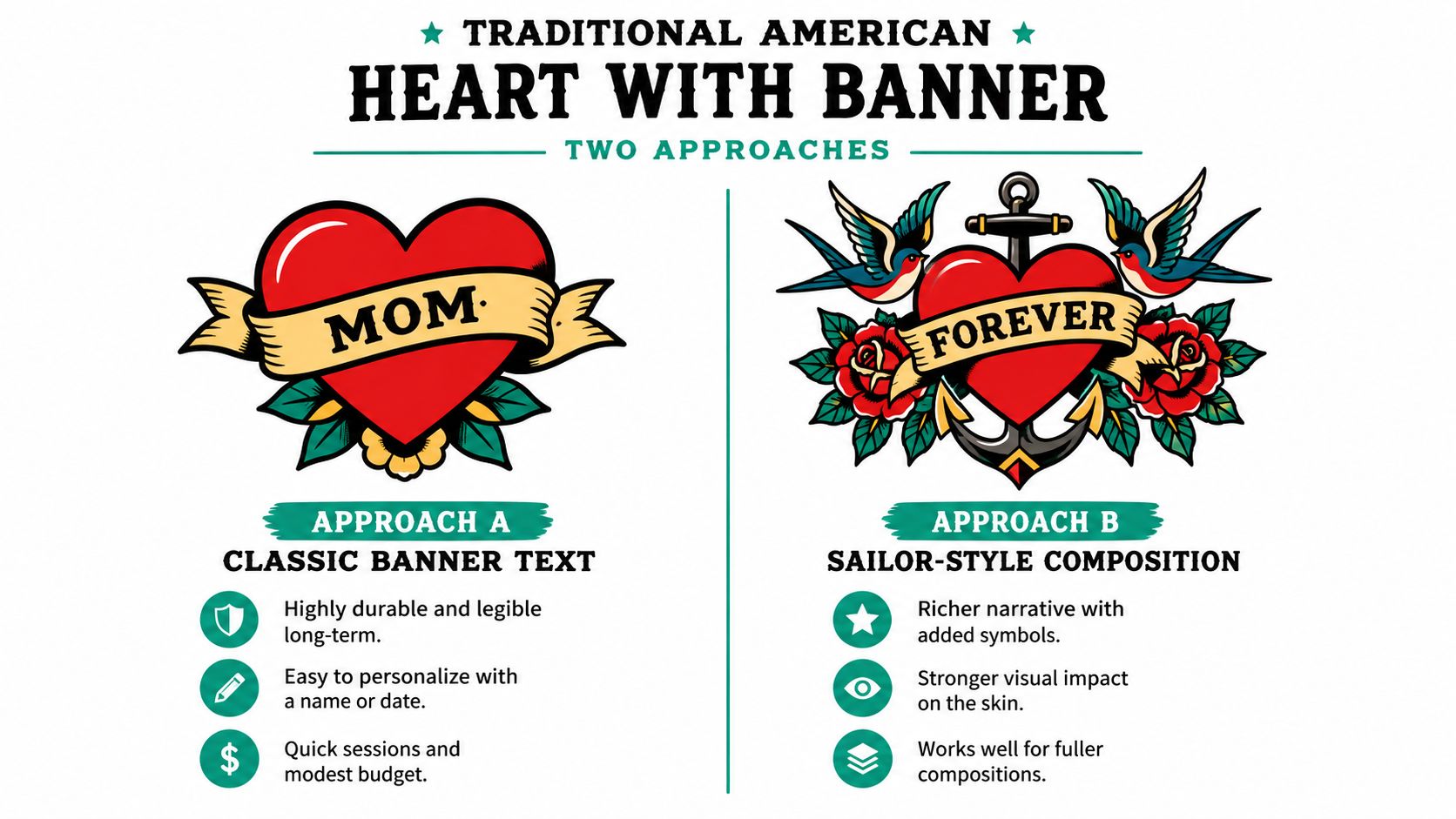
A banner heart should still read clearly after the novelty of a fresh tattoo fades. Its solid heart, heavy black outline, limited palette, and ribbon lettering come from American traditional tattoo vocabulary. Historical accounts place the standardization of the modern tattoo heart roughly between 1900 and 1950, with tattooers including Charlie Wagner, Cap Coleman, Paul Rogers, Bert Grimm, and Norman “Sailor Jerry” Collins helping establish recurring designs such as name-banner, dagger-through-heart, anchor, and winged hearts (Tattoo History Atlas).
Keep the message short. “Mom,” “Mother,” “Forever,” or one name usually remains legible longer than a sentence. A banner can follow the body's curve, but tightly folded ribbon ends may fill with pigment and lose definition if the tattoo is made too small.
Practical rule: Keep the lettering short, and let the outline carry the design.
The upper arm, outer thigh, calf, and chest provide room for a strong silhouette. On areas that stretch or move, such as the upper arm and thigh, use a bold outline and generous spacing. A swallow, rose, or anchor adds narrative, but every extra symbol competes for space. The Smithsonian's account of wartime “sweetheart” tattoos describes hearts paired with a loved one's name and sometimes a swallow, a symbol linked with a sailor's journey and return home (Smithsonian).
Placement changes the design's long-term balance. A simple heart may remain readable at a smaller size, while a sailor-style composition needs enough area for each symbol to age without merging. For context on how banners and added symbols change the emotional reading, see this guide to heart tattoo meaning.
TattoosAI prompt: “American traditional heart with a red ribbon banner, one short word, bold black outline, limited red and black palette, classic flash composition, readable at small tattoo size.” Generate a plain heart and a sailor-style version, then compare which silhouette remains clearer at your intended dimensions.
2. Anatomical Heart
An anatomical heart is less about a universal symbol and more about a personal interpretation of life, emotion, family, illness, recovery, or mortality. The aorta, ventricles, vessels, and branching structure give the tattoo a visual identity that a simple icon cannot match. It can look clinical in blackwork, romantic in realism, or decorative when vines, flowers, or lettering wrap around the structure.
This design needs space. If vessels are packed tightly into a small heart, they can merge visually as pigment settles and the tattoo loses the distinction that made it interesting. Ask the artist to simplify secondary vessels rather than forcing every anatomical feature into a miniature composition.
The chest, upper arm, shoulder blade, and outer thigh are useful placements because they allow the artist to preserve the main silhouette and leave negative space between interior elements. Ribs can produce a striking result, but body movement and the curvature of the area make a full-size stencil review especially important.
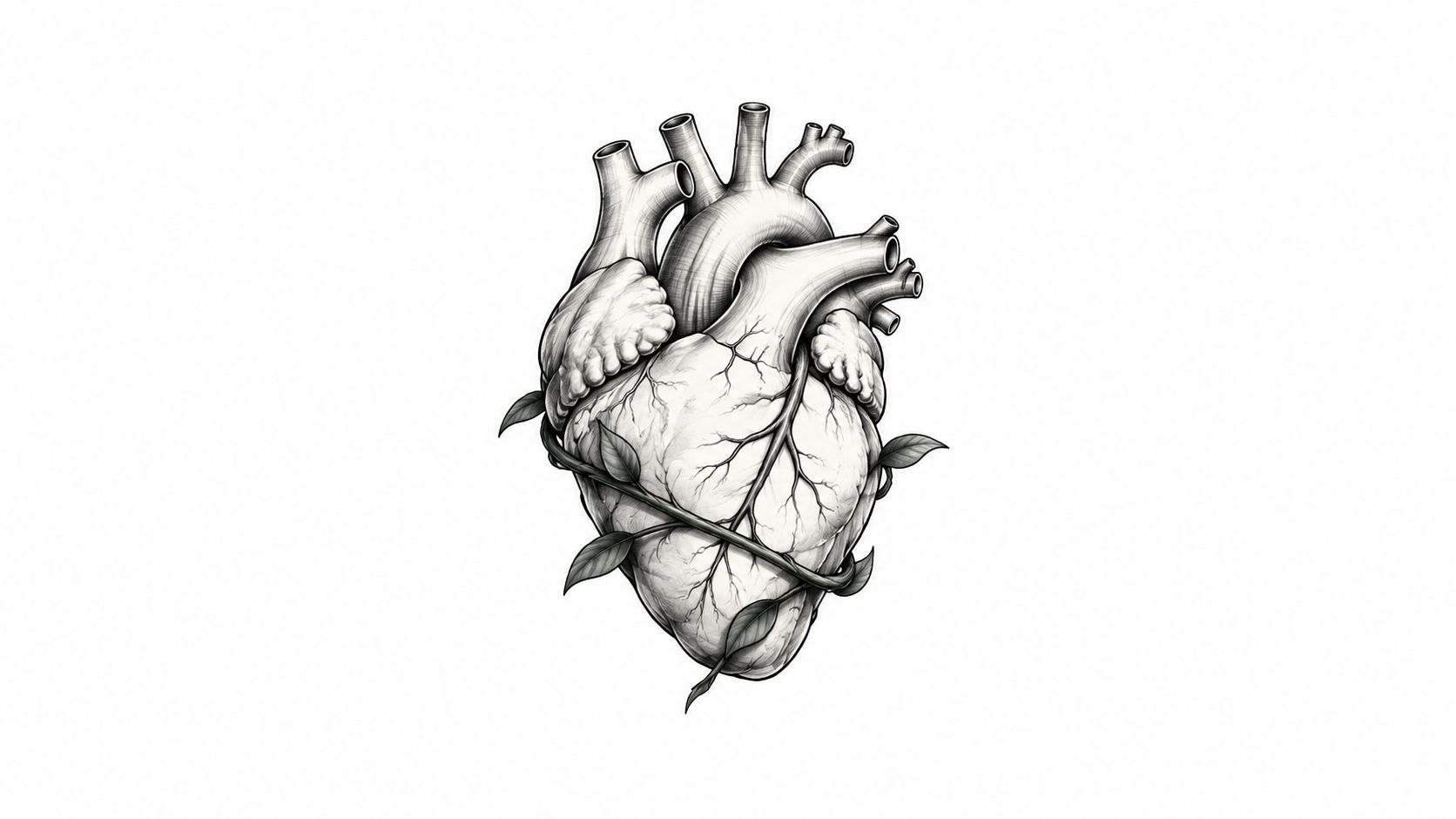
A detailed heart should be designed for the skin it will occupy, not for the phone screen where you first found it.
Blackwork is usually easier to evaluate for contrast and future revision than a densely multicolored anatomical heart. A clinical review of tattoo removal notes that complete removal can be difficult, particularly with multicolored professional tattoos, and that residual pigment or a ghost image may remain (clinical laser-removal review). That doesn't mean you should avoid color. It means the artist should separate the vessels, shadows, and decorative elements so the design has a clear hierarchy.
Watch the video below for visual reference before asking an artist to translate a medical or anatomical image into tattoo form.
TattoosAI prompt: “Anatomical human heart, blackwork, distinct aorta and vessels, ornamental vines, controlled negative space, high-contrast tattoo design, suitable for the upper arm.” Create a simplified version alongside a detailed version. Bring both to your artist and ask which one will remain legible at the chosen size.
3. Sacred Heart
A Sacred Heart placed on the chest can read as both devotional symbol and personal memorial, but the design needs clear iconography to carry that meaning. Catholic devotion to the Sacred Heart of Jesus was formally promoted by Pope Pius IX in 1856, following seventeenth-century visions associated with Saint Margaret Mary Alacoque in France. Common elements include flames, thorns, a cross, a sword, rays, and a crown. Each one affects how the tattoo is understood (Saint Margaret Mary Alacoque and the Sacred Heart).
People choose this image for faith, protection, remembrance, devotion, or family tradition. It can also become a memorial when paired with initials, a date, a rosary, or a dove. Decide which symbols carry the message before the artist builds the composition. Extra elements can make the piece personal, but they also reduce the space available for the heart itself.
The chest gives flames, thorn branches, and radiating details room to breathe, while reinforcing the heart's placement. The upper arm and back suit a taller arrangement. Small placements can work, though the artist may need to remove the cross, reduce the thorns, or simplify the flames. Fine details that look distinct on a screen can merge after healing, especially on areas exposed to friction and sunlight.
Make the symbolism readable
Leave visible gaps between thorns and flames. If the crown becomes a dense dark ring, the tattoo may look like a generic ornament instead of a Sacred Heart. A traditional artist can build the image with bold contours and controlled color. A realism specialist can create softer shading and more dimensional flames, but that approach usually needs more space and may be harder to revise later.
Red needs deliberate planning. In a retrospective tattoo-clinic cohort involving 301 patients and 308 complications, allergic reactions to red tattoos represented 50.2% of all complications, while chronic inflammatory reactions involving black pigment represented 18.2% (Journal of Cosmetic Dermatology). The same cohort study also reports that reddish pigments were implicated in approximately 97% of allergic tattoo reactions. These findings do not predict an individual outcome, but they justify discussing pigment history with the artist and testing a blackwork or limited-color draft first.
TattoosAI prompt: “Sacred Heart with crown of thorns, large readable flames, small cross, traditional tattoo style, controlled red and black palette, strong negative space, chest placement.” Test blackwork and red-accent versions before booking, then compare which remains clear at the intended size.
4. Japanese Heart with Peony or Koi
A Japanese-inspired heart works best when it becomes part of a composition rather than sitting alone like a sticker. Peonies, chrysanthemums, koi, daggers, waves, and wind bars can frame the heart and guide the eye across the body. Bold outlines and rich color make the central shape readable, while the surrounding elements create movement.
The key decision is scale. A heart wrapped in one peony may suit an upper arm or thigh. A heart with koi, waves, and background bars is more naturally planned as part of a sleeve, back piece, or larger panel. Trying to compress a full Japanese composition into a small wrist tattoo removes the breathing room that gives the style its strength.
Let the body guide the flow
The outer upper arm allows flowers and leaves to follow the limb. The thigh and back offer more room for a koi's movement and a layered background. On the ribs, the artist can use the body's vertical curve, but the design needs careful stencil placement so the heart doesn't twist when you bend.
Color can make the heart the focal point, especially if the surrounding flowers use a restrained palette. Alternatively, the heart can blend into the composition while the koi or peony carries the strongest contrast. Decide this before the artist draws the final design.
The American traditional vocabulary also places hearts beside roses, anchors, and swallows, but Japanese-inspired work follows different compositional rules. Mixing traditions can be effective when intentional. It can also look confused if a traditional banner, irezumi wind bars, and realistic anatomy all compete in the same small space.
TattoosAI prompt: “Japanese irezumi-inspired heart nestled in peonies with a koi swimming around it, bold outline, rich red and blue palette, flowing wind bars, upper-arm composition, heart as the focal point.” Generate one compact version and one sleeve-ready version. The difference will help you decide whether you're choosing a single tattoo or starting a larger project.
5. Watercolor Heart Splash
A watercolor heart uses soft washes, loose edges, drips, and splatters instead of the strong contour associated with traditional tattooing. It can feel personal and expressive, especially when pink, violet, blue, or orange washes suggest emotion without a literal symbol. A floral wreath or small linework detail can give the color a clear center.
The trade-off is structural. Without a dark outline, the tattoo may rely almost entirely on lighter or saturated pigments to remain recognizable. Those edges can soften as the tattoo ages, so the artist's technique matters more than the online mock-up suggests. Ask to see healed watercolor work, not only fresh photographs.
The forearm and upper arm are practical placements because the design can be viewed easily and given enough surface area for color transitions. A tiny watercolor heart on a finger or high-friction area is harder to preserve. If the concept must remain small, consider adding a restrained black contour or a defined central shape.
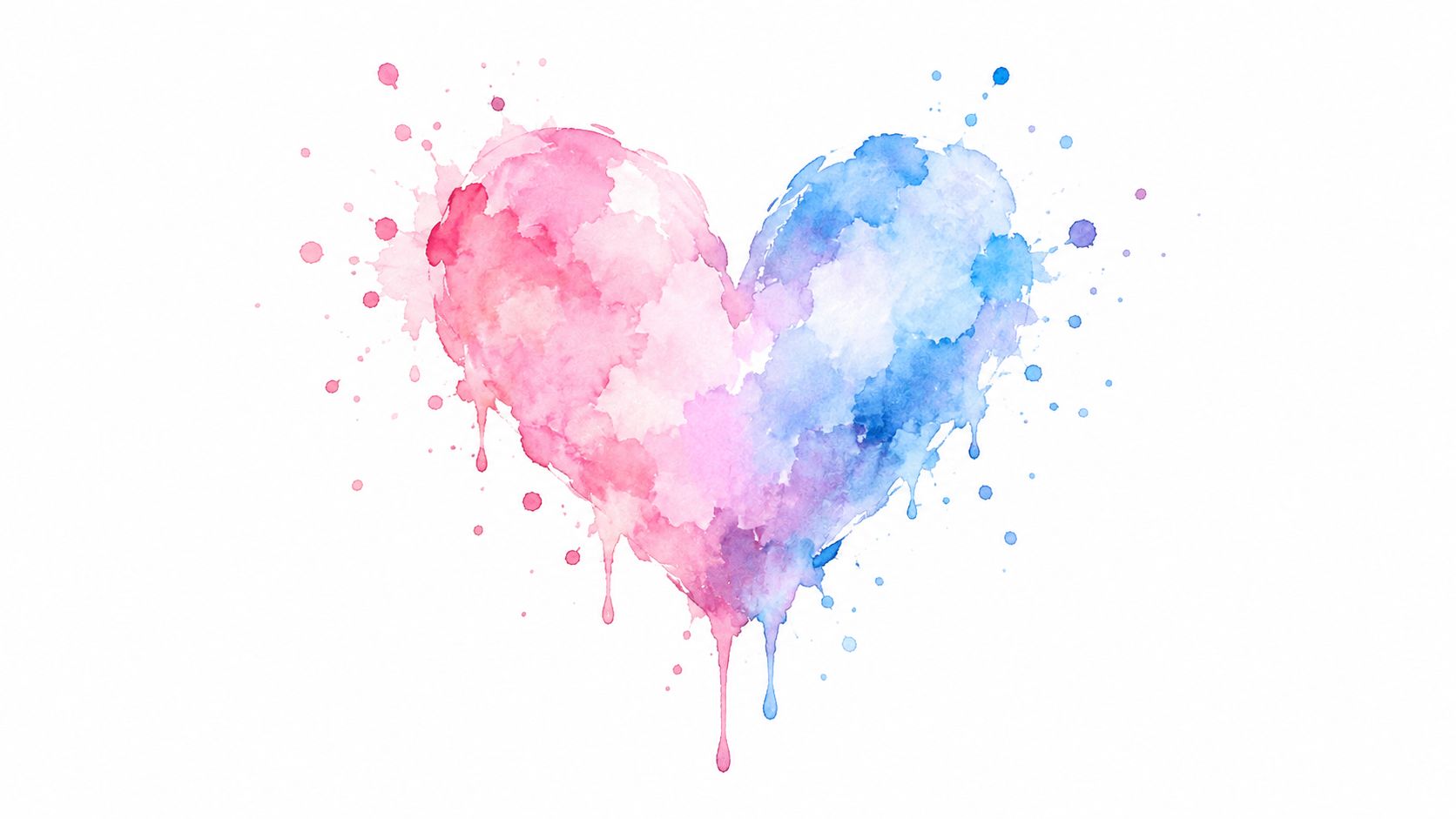
Color needs a long-term plan
Use a color palette that still has contrast when the washes soften. A design made from several pale tones may look delicate on day one but lose its hierarchy later. More saturated color can preserve visual impact, though it also makes pigment choice and skin response important.
The guide to how watercolor tattoos work can help you understand the technique before a consultation. Your artist should explain how they build the edges, where they'll use linework, and whether a future touch-up would preserve the original character or make it heavier.
TattoosAI prompt: “Watercolor heart with soft pink and blue washes, controlled paint drips, subtle black central contour, open negative space, forearm tattoo composition.” Generate several color variations, including one with less red and one with a stronger outline. Compare the emotional effect and the amount of structure each version retains.
6. Geometric and Dotwork Heart
Geometric hearts appeal to people who want order. Triangles, circles, polygons, symmetry, and precise intersections can turn a familiar motif into a measured, modern design. Dotwork adds another layer, using clusters of dots to create shading, gradients, and texture without relying on solid fills.
These styles reward restraint. A geometric heart with too many small triangles may become a dense mesh, while dotwork that packs dots too closely can lose its tonal separation. The artist needs to choose line weight and dot spacing based on the intended size, not just reproduce the finest detail visible in a digital image.
The forearm is a strong location for a symmetrical geometric heart because the design can be inspected easily and kept relatively flat. The shoulder and upper arm allow a mandala or circular frame to follow the body. Fingers and hands are less forgiving because friction and movement can affect fine details.
Build the smallest version around the outline, not around the decoration.
A heart inside a mandala can look balanced on the shoulder, but the mandala should support the heart instead of competing with it. For a more private meaning, the geometric pattern can encode initials, dates, or a personal sequence without making the reference obvious to everyone who sees it.
Dotwork also changes how the tattoo reads from different distances. Close up, the stippling provides texture. From across a room, the main silhouette and darkest areas do most of the work. Ask for a stencil at actual dimensions and inspect it from normal viewing distance before approving the final arrangement.
TattoosAI prompt: “Geometric heart with clean symmetrical triangles, medium-weight black lines, generous negative space, forearm placement.” Create a second prompt for “dotwork heart with stippled shading, circular mandala frame, readable central silhouette.” Show both versions to an artist and ask which details need enlargement.
7. Heartbeat EKG Line Heart
The heartbeat line heart is one of the clearest minimalist concepts. A single line forms or passes through a heart, representing life, rhythm, recovery, or a connection with someone important. It can be intimate without looking overtly romantic, which makes it suitable for family, friendship, self-commitment, or memorial meaning.
The design looks simple, but simplicity leaves little room for technical weakness. A wobbly line, uneven spacing, or an EKG segment that is too compressed can make the tattoo look accidental. The line should have enough weight to survive normal viewing and enough open skin around it to avoid visual clutter.
The inner forearm and upper arm usually offer better conditions than a finger, side of the hand, or area exposed to constant rubbing. A wrist placement is easy to see and emotionally direct, but the artist still needs to account for movement and friction. Rib placement gives the line a more private quality, though the body's curve may change how the heartbeat travels.
Keep the minimal idea honest
Tiny dates and initials are tempting additions. They can personalize the design, but they also turn a clean line into a lettering problem. If you add text, give it separate space rather than forcing it into the heartbeat itself.
A minimalist heart can also preserve the core symbol while removing older decorative elements. That approach reflects how heart tattoos have moved beyond one universal romantic message. Historical military and maritime examples show hearts functioning as reminders of home, relationships, courage, and belonging, not only as generic declarations of romance (Smithsonian).
TattoosAI prompt: “Minimalist heartbeat line forming a heart, black ink, clean continuous line, restrained peaks, balanced spacing, inner forearm placement, no extra lettering.” Make one version with a slightly bolder line and one with a finer line. Use the concepts to discuss what your artist can safely execute on your skin.
8. Kintsugi-Inspired Mended Heart
A mended heart suits someone whose story includes recovery, grief, acceptance, or resilience. Its defining feature is a controlled network of cracks, often filled with yellow, ochre, or muted-gold ink inspired by kintsugi, the Japanese practice of repairing broken pottery with visible metallic seams. The concept works beyond romance, but the repair lines must remain legible as the tattoo ages.
Start with a clear fracture pattern rather than scattering random breaks across the shape. A route from the upper curve toward the point gives the eye somewhere to travel. Small blossoms, leaves, or rays can grow around one repair, adding a sense of renewal without competing with the heart. A firm black outline preserves the silhouette, while lighter internal lines carry the emotional emphasis.
Placement determines how much detail the design can hold. The chest, upper arm, shoulder, and thigh provide enough room to separate each crack and maintain readable negative space. A wrist or ankle version needs fewer fractures and wider lines. Thin branches packed into a small area can blur as the ink settles and become difficult to distinguish from one another.
Digital previews make gold look metallic, but tattoo ink cannot reproduce reflective paint. Ask the artist to compare yellow, ochre, muted gold, and a contrasting light tone against your skin. Discuss likely touch-up needs before choosing a color. If you may revise the design later, keep the black heart and its internal crack structure distinct, so the repair lines can be adjusted without rebuilding the entire image.
Yellow and gold pigments appear frequently in fading and reaction case reports, so record the ink brand and batch used for the repair lines. That record can help an artist or clinician assess a delayed response. Seek medical advice if persistent swelling, itching, or other concerning changes develop after healing.
For a healing-focused concept, review this guide to plan a healing tattoo in Denver.
TattoosAI prompt: “Mended heart with bold black outline, three controlled kintsugi-style gold cracks, small blossoms growing from one repair, healing symbolism, upper-arm tattoo composition, readable negative space.” Generate black-and-gold, black-and-yellow, and mostly black versions to compare whether the repair lines should dominate or remain a restrained accent.
Comparison of 8 Heart Tattoo Styles
| Style | 🔄 Implementation Complexity | ⚡ Resource Requirements (time / cost / skill) | ⭐ Expected Outcome | 📊 Ideal Use Cases | 💡 Key Advantage / Tip |
|---|---|---|---|---|---|
| Traditional American Heart with Banner | Low, bold lines, simple shapes | Low, short session; beginner-friendly artist | Durable, highly legible over decades | First tattoos, memorials, classic placements (arm, chest) | Timeless and easy to personalize; keep banner to 1–2 words |
| Anatomical Heart | High, fine detail, realistic shading | High, experienced realism artist; long sessions | Striking, detailed centerpiece; high visual impact | Large areas (chest, back, thigh); science/medical themes | Very unique and conversation‑starting; size ≥3–4" and use references |
| Sacred Heart | Medium–High, multiple symbolic elements | Medium, careful composition and sizing | Deep spiritual symbolism; visually bold with flames/thorns | Faith-based or memorial pieces on chest/back/arm | Rich intergenerational symbolism; confirm iconography with artist |
| Japanese Heart with Peony or Koi | High, integrated Irezumi composition | High, multi-session, skilled colorist, larger area | Dynamic, flowing composition with strong color | Sleeves, back, thigh; those planning large pieces | Excellent body‑flow and cultural motifs; plan focal point and placement |
| Watercolor Heart Splash | Medium, painterly technique, soft edges | Medium, color expertise; touch-ups likely | Modern, artistic and eye‑catching but may fade faster | Creatives and expressive placements (forearm, shoulder) | Vibrant, personal color choices; choose bolder pigments and experienced artist |
| Geometric and Dotwork Heart | High, precision lines or dense stippling | Medium–High, time‑consuming dotwork; precise line weight | Crisp, symmetrical and modern; may blur if too small | Minimalists, symmetry lovers; inner forearm, shoulder | Visually satisfying geometry; keep elements slightly larger and check dot spacing |
| Heartbeat (EKG) Line Heart | Low, simple continuous fine line | Low, quick session but requires steady hand | Subtle and meaningful; discreet impact; may need touch‑ups | First‑timers, memorials, small discreet spots (wrist, behind ear) | Very subtle and fast; ask for ≥1 mm line thickness and low‑friction placement |
| Kintsugi‑Inspired Mended Heart | Medium, fine crack detail with color fills | Medium, gold/yellow inks require expertise and touch‑ups | Distinctive, symbolic of healing; gold may fade quicker | Recovery/personal‑growth tattoos on chest, forearm, back | Strong symbolic story; discuss gold ink longevity and bold crack lines |
Pick One Heart Style and Test It Before Your Next Studio Visit
The best heart tattoo isn't necessarily the most detailed design in your inspiration folder. It's the one that keeps its main message after the artist adapts it to your skin, placement, size, and tolerance for maintenance. A traditional banner heart usually gives you the strongest long-term readability. An anatomical heart offers more personal detail but needs more space. A Sacred Heart carries established religious symbolism, while a Japanese composition works best when the heart belongs to a larger flow. Watercolor creates softness, geometric and dotwork designs create precision, an EKG heart keeps the message minimal, and a mended heart turns damage into a visible part of the story.
Start by writing the meaning in one sentence. “I want to honor my mother,” “I'm marking recovery,” “I want a reminder of home,” and “I'm choosing self-commitment” lead to different design decisions. A name banner may make the first message immediate. A swallow or anchor can support the second idea if travel and return matter. A crack-filled heart may communicate recovery more clearly than a perfect red symbol.
Then choose the placement according to the design's needs. High-friction locations such as fingers and hands demand more caution with fine detail. Ribs and chest offer emotional privacy and room for larger compositions, but the artist must account for movement and curvature. Forearms, upper arms, shoulders, and thighs generally give a designer more usable surface for clear outlines and controlled negative space.
Color deserves a separate decision. Don't assume every heart needs red. A blackwork or limited-color version may better suit a minimalist concept, future revision plans, or a client with a history of pigment reactions. If you do choose saturated color, ask the artist what pigments they use, record the exact brand and batch, and discuss how they handle delayed reactions. Tattooing creates a permanent change to the skin, so medical concerns belong in the planning conversation rather than after the appointment.
Use TattoosAI to create two or three controlled variations at TattoosAI. Keep the subject consistent while changing one variable at a time: bold versus fine line, blackwork versus red accent, compact versus medium scale, or plain heart versus heart with a banner. The point isn't to replace an artist's judgment. It's to arrive with a clearer visual brief and fewer vague preferences.
Bring the strongest concepts to a professional tattooist and ask for a stencil at the intended dimensions. View it from normal distance, move the relevant body part, and check whether the text, vessels, cracks, dots, or decorative elements still separate cleanly. An AI image can show a promising direction, but it can't account for every detail of skin type, scar tissue, body movement, machine technique, or the artist's line-weight decisions.
Choose one style, one placement, and one primary meaning before you book. A heart that fits those three decisions will usually look more convincing years later than a busier design chosen only because it looked impressive on a screen.
TattoosAI can turn your heart tattoo idea into multiple concepts across minimalist, traditional, Japanese, watercolor, geometric, blackwork, and dotwork styles. Visit TattoosAI to test your preferred heart style, compare line and color options, and bring a focused concept to your tattoo artist.