TattoosAI
Could the same palm tree sunset tattoo mean something completely different depending on how it's drawn? A thin outline can feel quiet and personal, while a bold black silhouette looks graphic, a watercolor gradient feels painterly, and a detailed scene can resemble a small vista. Line work, palette, composition, and placement shape the message as much as the palm tree itself.
Palm imagery carries a long symbolic history. In Mesopotamia, the date palm was associated with sacred, life-sustaining qualities, ancient Egypt connected palms with eternal life, and Romans used palm branches as victory symbols, according to historical palm tree tattoo context. Modern designs also draw from travel posters, postcard art, and surf culture. That gives you plenty of room to create something about resilience, renewal, memory, travel, or paradise, rather than a generic beach scene.
The seven directions below compare visual style, palette, composition, placement, aging, and prompt strategy. Use them to narrow your idea, then turn the strongest version into a clearer TattoosAI reference before discussing size and skin-specific adjustments with a qualified tattoo artist. If your concept is tied to a trip, you can also find your perfect Key West dinner cruise for inspiration.
Table of Contents
- 1. Minimalist Line Art Palm Tree Sunset
- 2. Watercolor Gradient Palm Tree Sunset
- 3. Japanese Ukiyo-e Palm Tree Sunset
- 4. Geometric and Abstract Palm Tree Sunset
- 5. Realistic and 3D Palm Tree Sunset
- 6. Blackwork and Solid Black Palm Tree Sunset
- 7. Dotwork and Stippled Palm Tree Sunset
- 7-Style Palm Tree Sunset Tattoo Comparison
- Turn a Favorite Concept Into a Tattoo Brief
1. Minimalist Line Art Palm Tree Sunset
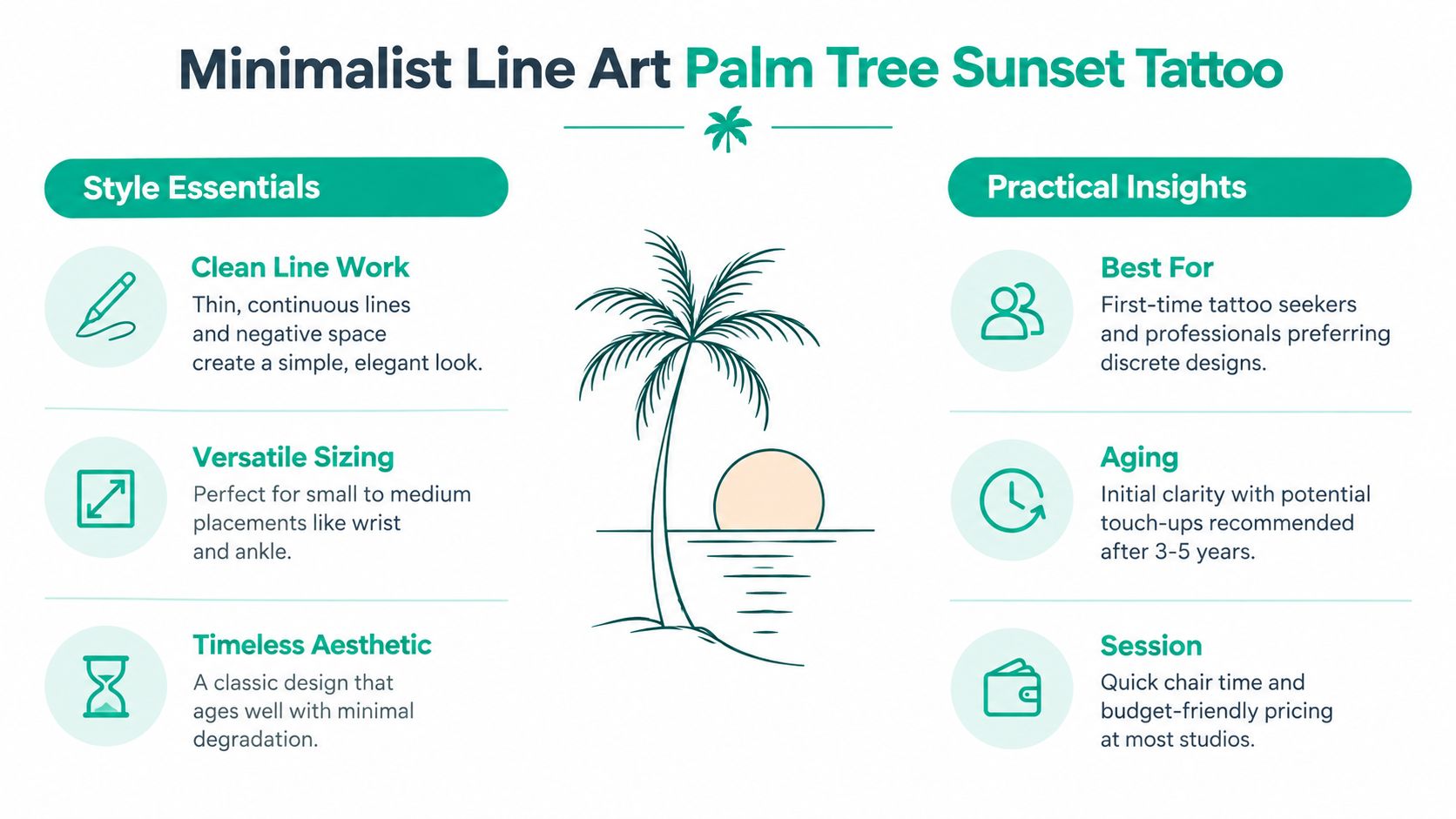
Minimalist line art reduces the scene to its most recognizable elements: a palm silhouette, a low horizon, and a simplified setting sun. The result can feel intimate and understated, especially when the design uses negative space instead of filling every part of the sky.
This approach suits a first tattoo seeker who wants a symbol rather than a full illustration. A single curved trunk and a few fronds may represent a place, a turning point, or a private memory without making the tattoo visually loud. It also works well for someone who wants the image to remain easy to style around in professional or formal settings.
Keep the design readable
The main trade-off is scale. A tiny tattoo can lose delicate gaps between fronds, while excessive detail defeats the minimalist purpose. Ask the artist to test the stencil at the intended size and explain how the line weight will behave on your skin. Inner wrist and ankle placements can support a discreet design, but exposed areas still need consistent sun protection after healing.
For a prompt, describe the structure rather than asking for “a pretty palm tattoo.” Try: “minimalist palm tree sunset tattoo, single thin-line palm silhouette, small setting sun, open negative space, clean horizon, no text, restrained composition, elegant fine-line tattoo flash.” Generate variations with different trunk angles and sun positions, then choose the version whose silhouette still reads clearly without color.
Practical rule: If the design only works because of tiny details in the digital preview, simplify it before showing it to your artist.
A black outline can help preserve form, while soft pale yellow and peach areas are more vulnerable to fading than darker magenta, orange, and blue-violet tones. Practical tattoo guidance places color touch-ups around year 3 to 5 in some sunset pieces, especially where lighter warm colors dominate, as described in sunset tattoo palette and aging guidance. Treat that as a planning consideration, not a guarantee.
2. Watercolor Gradient Palm Tree Sunset
A watercolor palm tree sunset tattoo replaces hard sky boundaries with flowing color. Orange can bleed toward pink, violet can soften into blue, and the palm silhouette can sit in front as the one stable, high-contrast element. The effect feels expressive and atmospheric rather than diagrammatic.
This direction works for a person who wants the tattoo to capture a mood, such as calm after a difficult period, the feeling of leaving a familiar place, or the warmth of a remembered holiday. It can also make the sunset feel larger than the palm, allowing color to carry the emotional weight.
Build the palette before the details
Start by choosing a limited color story. A warm orange and magenta sunset creates energy, while orange with deep blue-violet feels more dramatic. Pale peaches and yellows may look soft in a digital concept, but they can be less durable on exposed skin. A black or deep-colored palm silhouette gives the painterly background a visual anchor.
A useful prompt might read: “watercolor palm tree sunset tattoo, expressive orange and magenta washes, deep blue-violet at the outer sky, crisp black palm silhouette, loose pigment edges, subtle ocean horizon, no photorealism, balanced negative space.” Generate several concepts with the same composition but different palettes. That comparison helps you decide whether you prefer a tropical, moody, or restrained result.
For a clearer understanding of the technique, review how watercolor tattoos work before you commit to the look. Ask prospective artists to show healed work, not only fresh photographs, and discuss how they create contrast without relying on very pale washes.
The medium also benefits from patient planning. A layered watercolor concept may need more than one sitting, and a strong artist will adapt the digital color blend to your skin rather than copy it mechanically. You can explore the visual logic further through this watercolor painting resource, even though tattooing and paper painting remain different processes.
3. Japanese Ukiyo-e Palm Tree Sunset
An ukiyo-e-inspired palm tree sunset creates an intentional cultural fusion. Instead of copying a photographic beach view, it uses bold contour lines, flattened perspective, graphic waves, and controlled color blocks. A red or orange sun can dominate the composition, while the palm tree becomes part of a larger print-like scene.
This style suits someone who wants the tattoo to feel designed rather than merely realistic. It can connect tropical imagery with an appreciation for Japanese woodblock aesthetics, but the reference work should be studied carefully. A knowledgeable artist will help distinguish a respectful visual influence from a collection of disconnected symbols.
Let composition carry the meaning
Traditional-looking waves, clouds, and sun shapes can give the palm a stronger setting. You might frame the scene inside an oval, use a vertical scroll-like arrangement, or let the trunk divide the image into layers. Larger placements, such as the back or a full leg, provide room for the bold lines and flattened scenery to remain legible.
A TattoosAI prompt could specify: “Japanese ukiyo-e-inspired palm tree sunset tattoo, bold black contour lines, flattened ocean waves, large vermilion sun, layered clouds, limited traditional print palette, vertical composition, no lettering, clean ornamental balance.” Generate several versions with different wave directions and sun sizes. The best option should feel coherent as a print, not like a realistic palm placed on top of unrelated Japanese decoration.
Research the visual language behind actual ukiyo-e references and bring those references to an artist who works confidently with Japanese-inspired composition. The palm tree symbolism overview also discusses how modern viewers connect the motif with hardship, travel, and memorial meaning. Those ideas can guide the emotional brief, while the artist handles the visual translation.
Color should serve the structure. Too many soft gradients can weaken the woodblock character, while a limited palette and dark outlines make the scene easier to read as the tattoo settles.
4. Geometric and Abstract Palm Tree Sunset
A geometric palm tree sunset treats nature as a system of shapes. The sun might become a clean circle, the horizon a sharp horizontal division, and the fronds a series of angled lines. Triangles, polygons, arcs, or concentric forms can suggest the scene without reproducing every natural curve.
This direction fits design-focused clients who prefer precision and visual order. It can also represent balance between opposites, such as organic growth and structured intention. The main risk is that a geometric concept can look impressive on a flat screen but feel distorted when it crosses a joint or wraps around a rounded body area.
Test the geometry on the body
Ask the artist to consider how the placement changes the line relationships. A centered chest or upper arm composition may support symmetry, while a forearm can suit a vertical design that follows the limb. If you want deliberate asymmetry, say so. Otherwise, an artist may assume that the sun, horizon, and palm should align perfectly.
Use a prompt such as: “geometric palm tree sunset tattoo, black palm silhouette built from angular fronds, circular orange sun, thin horizon line, subtle polygonal sky, high contrast, precise negative space, modern tattoo design, no gradients.” Create alternatives with and without the abstract background. Sometimes the strongest result is a simple silhouette inside a geometric frame rather than a scene overloaded with shapes.
- Choose the line language: Decide whether the design should use razor-sharp angles, rounded arcs, or a combination.
- Define symmetry: Request a centered composition or state that an uneven arrangement should feel intentional.
- Protect clarity: Keep the palette black and dark gray, or use one controlled sunset accent instead of many competing colors.
- Check the stencil: Have the artist place the stencil in the intended position before deciding.
Precise stenciling matters more here than in a loose watercolor design. A slightly misplaced horizon or uneven polygon can change the entire balance, so the prompt should describe alignment as clearly as style.
5. Realistic and 3D Palm Tree Sunset
A realistic or 3D palm tree sunset aims to preserve the depth of a landscape photograph. Shading can separate the trunk from the sky, highlights can suggest atmospheric light, and the sunset can appear to glow behind a detailed silhouette. The finished piece may feel like a small window into a particular place.
Choose this route when the setting matters as much as the symbol. A shoreline, mountain outline, cloud bank, or recognizable horizon can make the tattoo feel connected to a specific memory. It also offers room for texture, but every added detail increases the need for a skilled artist and a placement that gives the artwork enough space.
Write a reference brief, not just a style label
“Realistic palm sunset” leaves too much open to interpretation. Specify the camera-like viewpoint, time of day, level of contrast, and emotional tone. A stronger prompt would be: “realistic palm tree sunset tattoo, single palm in foreground, glowing orange sun low behind the trunk, magenta and deep violet sky, subtle ocean reflections, detailed fronds, controlled black silhouette edges, cinematic depth, no text.”
Ask to see healed realism work and discuss how the artist handles small details as the tattoo ages. The upper arm, thigh, and back generally offer more room for a wide, scenic composition than a narrow ankle or finger placement. A highly detailed design can lose its visual hierarchy if the palm, sun, clouds, and reflections all compete at a small size.
The most convincing realism begins with a clear focal point. Decide whether the eye should land on the sun, the palm silhouette, or the horizon.
Sun exposure becomes especially important when a realistic sunset depends on blended warm colors. Fresh tattoos should be protected from direct sun during initial healing, and independent aftercare guidance commonly places that protected period at about 2 to 4 weeks, with peeling often occurring around days 8 to 14. See technical palm tattoo placement and aftercare guidance for the practical reasoning behind healing, pigment placement, and sun management.
6. Blackwork and Solid Black Palm Tree Sunset
Blackwork turns the palm tree sunset into a high-contrast graphic. Instead of painting the sky, the design can create the sunset through negative space, leaving a clean circle or band of untouched skin behind a solid black palm. The absence of color becomes the light source.
This is a strong choice for someone who values clarity and visual impact over a broad sunset palette. It also adapts well to bold Americana, minimalist, and contemporary silhouette approaches. A small scene can remain recognizable because the primary information comes from shape and contrast rather than subtle color transitions.
Make the negative space intentional
The artist needs to plan the untouched areas as carefully as the inked ones. A sun that is too narrow may close visually over time, while overly thin gaps between fronds can lose definition. Ask for a design with a stable silhouette, clear spacing, and enough breathing room around the horizon.
Try this prompt: “bold blackwork palm tree sunset tattoo, solid black palm silhouette, circular negative-space sun, thick clean outer contours, minimal ocean line, high contrast, no color, no gray wash, balanced tattoo flash composition.” Then request variations with different sun sizes and trunk positions. Compare them at the approximate final scale, not only as large digital images.
- Use the silhouette as the subject: Don't let decorative filler compete with the palm.
- Reserve skin strategically: Negative space should create the sun and atmosphere, not random gaps.
- Match the body area: Arms and torso can support broad black shapes, while highly curved areas may require a more adaptable composition.
- Discuss future expansion: If you may build a sleeve or larger scene later, leave a natural direction for the horizon or fronds.
Unlike a soft gradient, solid black depends on clean packing and strong edges. A qualified artist can tell you whether the chosen size leaves enough separation for the design to settle clearly.
7. Dotwork and Stippled Palm Tree Sunset
Dotwork creates the scene through clusters of individual marks. Dense dots can form the palm trunk and darkest parts of the horizon, while lighter spacing suggests a glowing sky. The effect feels textured, meditative, and quieter than a solid black silhouette, even when the composition is complex.
This style works particularly well for someone who likes illustration, sacred geometry, or an atmospheric black-and-gray tattoo. It can suggest a sunset without relying on bright color, which makes the design feel more contemplative than overtly tropical. The technique also rewards scale because the artist needs room to control dot density and transitions.
Control density, contrast, and space
A prompt should describe the pattern, not merely name dotwork. Try: “dotwork palm tree sunset tattoo, stippled palm silhouette, dense dots around the trunk and horizon, gradually spaced dots toward the glowing sun, subtle ocean texture, black and gray only, contemplative negative space, large vertical composition.”
The placement should support the method. A back piece or full leg gives the artist more room to create a convincing gradient from dense to sparse marks. Smaller designs can work, but the prompt should remove unnecessary background texture so the palm and sun don't merge.
Review dotwork tattoo style guidance before generating concepts, then look for artists whose portfolios show consistent stippling rather than only occasional dotted accents. Ask how they separate the darkest areas from the open skin and whether the design will need to be simplified at your chosen size.
Dotwork should look intentional at both a close distance and a conversational distance. If the image becomes an indistinct gray patch when viewed normally, the contrast needs revision.
A real-world example might be a large calf composition where the palm occupies the lower half and the sun sits in a wide field of untouched skin. That arrangement gives the eye a quiet focal point and allows the stippled horizon to remain distinct.
7-Style Palm Tree Sunset Tattoo Comparison
| Style | 🔄 Implementation complexity | ⚡ Time & resources | ⭐📊 Expected outcomes & longevity | 💡 Ideal use cases | 📊 Key advantages |
|---|---|---|---|---|---|
| Minimalist Line Art Palm Tree Sunset | Low, fine-line precision required | Short session (1–2 hrs); low cost | Clean, understated look; may blur after 5–10 yrs (touch-ups 3–5 yrs) | First-timers; discreet placements (wrist, ankle, forearm) | Timeless, scalable, budget-friendly |
| Watercolor Gradient Palm Tree Sunset | High, advanced color blending & layering | Multiple sessions; higher cost; specialized pigments | Very high visual impact; color fades faster (5–7 yrs); frequent touch-ups | Artistic clients; larger canvases (upper arm, thigh, sleeves) | Vibrant, painterly, photogenic |
| Japanese Ukiyo-e Palm Tree Sunset | High, requires knowledge of traditional technique | Medium–high cost; specialized artist recommended | Bold, lasting lines; timeless cultural aesthetic; ages well | Art-history enthusiasts; larger pieces/sleeves/back | Culturally rich, distinct, excellent line longevity |
| Geometric & Abstract Palm Tree Sunset | Medium, precision stenciling and symmetry | Moderate time; medium cost; exacting stencil work | Modern, crisp appearance; holds well if lines stay sharp (may date with trends) | Design-forward clients; professional/architectural placements | Contemporary, highly scalable, symmetry-friendly |
| Realistic and 3D Palm Tree Sunset | Very high, master-level realism & shading | Many sessions (6–12+ hrs); premium pricing ($3k+); high maintenance | Stunning photoreal impact; high shareability; color maintenance required | Affluent collectors; portfolio centerpieces; large visible areas | Exceptional realism, showpiece quality |
| Blackwork and Solid Black Palm Tree Sunset | Medium, bold saturation technique | Relatively quick; cost-effective | High-contrast, long-lasting results; minimal color degradation | Bold statement-makers; versatile placements; professional settings | Extreme longevity, high contrast, skin-tone friendly |
| Dotwork and Stippled Palm Tree Sunset | Very high, highly time-consuming, meticulous | Very long sessions (12–20+ hrs); premium pricing; specialist artist | Unique texture & fine gradients; may appear detailed up close but subtle from distance | Patient collectors; large canvases (back, leg); meditative pieces | Intricate texture, exceptional gradient control, standout artistry |
Turn a Favorite Concept Into a Tattoo Brief
Choosing a style is only the first decision. A strong palm tree sunset tattoo brief tells the artist what must remain, what can change, and how the design should behave on your body. Start with the visual direction, then describe the emotional reason behind it in one clear sentence. For example, you might want a minimalist line-art palm to mark a new beginning, or a bold blackwork silhouette to represent endurance after a difficult chapter.
Next, define the sunset palette. If color matters, name the dominant hues and the mood they should create. Orange and magenta can feel warm and energetic, while deep blue-violet can add contrast and seriousness. Darker edge colors and black outlines can help preserve form, while pale yellow and peach areas deserve a realistic conversation about sun exposure and future maintenance. A peer-reviewed tattoo aftercare review recommends broad-spectrum SPF 30 or higher, reapplication every two hours, midday shade, and avoiding tanning beds for exposed tattooed skin.
Then specify the detail level. Do you want one clean palm, a full shoreline, visible waves, clouds, reflections, or a recognizable location? Detail should match the placement. A narrow ankle design may need a simple silhouette, while a back or thigh can support a layered scene, dotwork texture, or ukiyo-e-inspired scene.
Use this selection checklist:
- Choose the style: Pick minimalist, watercolor, ukiyo-e-inspired, geometric, realistic, blackwork, or dotwork.
- Set the palette: State whether the design should be black and gray, limited color, or a broad sunset gradient.
- Define the focal point: Decide whether the palm, sun, horizon, or surrounding scene should draw attention first.
- Match the composition to the body: Tell the artist whether the piece should wrap, run vertically, sit centrally, or follow a natural curve.
- Plan for aging: Ask how line weight, negative space, color density, and sun exposure may affect the finished tattoo.
- Bring useful references: Show several focused concepts, not a random collection of unrelated tattoo images.
TattoosAI can help you generate multiple concept directions from detailed prompts, compare style filters, and refine color or composition before your studio appointment. Use those outputs as visual references rather than promises of an unchanged final tattoo. Your artist still needs to adapt the design to your skin, anatomy, preferred size, needle technique, and healing plan.
The best palm tree sunset tattoo isn't automatically the most detailed or colorful option. It's the one whose style, symbolism, scale, and maintenance demands fit your story and daily life. Give yourself enough time to compare variations, remove details that don't serve the idea, and ask the artist direct questions about placement and longevity.
TattoosAI can turn a palm tree sunset idea into multiple custom concepts across styles such as watercolor, Japanese, geometric, realistic, blackwork, and dotwork. Visit TattoosAI to test focused prompts, compare variations, and bring a clearer reference to your tattoo artist.