TattoosAI
You've saved a phoenix with spectacular wings, another with a curling tail, and a third with glowing orange feathers. Then you hold your phone against your arm and realize none of those pictures explains where the bird's head should sit, what happens at your elbow, or how the tail reaches your wrist without becoming a tangle.
A phoenix sleeve tattoo is a composition problem, not just a bird drawing. The artist has to make it readable around a moving cylinder, not across a flat screen. And the palette needs to work on your skin after the fresh-tattoo shine disappears, with enough structure to remain recognizable as the ink ages.
Choose through cultural tradition, contrast strategy, and detail density. A Japanese hō-ō needs different supporting imagery from a Western bird rising from ashes. A blackwork silhouette depends on open skin, while watercolor needs a deliberate plan for what remains visible when soft edges lose definition.
The strongest approach isn't necessarily the most elaborate. It's the one that gives the head, wings, and tail clear jobs, suits your tolerance for long appointments, and leaves your tattooist room to adapt the drawing to your body.
Table of Contents
- 1. Japanese Irezumi Hō-ō Phoenix Sleeve
- 2. Chinese Fenghuang Phoenix with Peonies and Clouds
- 3. American Traditional Phoenix Sleeve with Flames
- 4. Blackwork Phoenix Sleeve
- 5. Geometric Phoenix Sleeve
- 6. Watercolor Phoenix Sleeve
- 7. Realistic Phoenix Rising from Ashes Sleeve
- Phoenix sleeve approaches compared by style, color and long-term wear
- Take a Prompt, a Palette, and Two Artists into the Chair
1. Japanese Irezumi Hō-ō Phoenix Sleeve
For an arm that reads as a complete composition, start with the background and the bird together. Place the head and main wing across the shoulder and upper arm, then let the tail travel downward through clouds and wind bars rather than squeezing an entire bird onto the outer biceps.
This visual breakdown offers a starting point for discussing the arrangement.
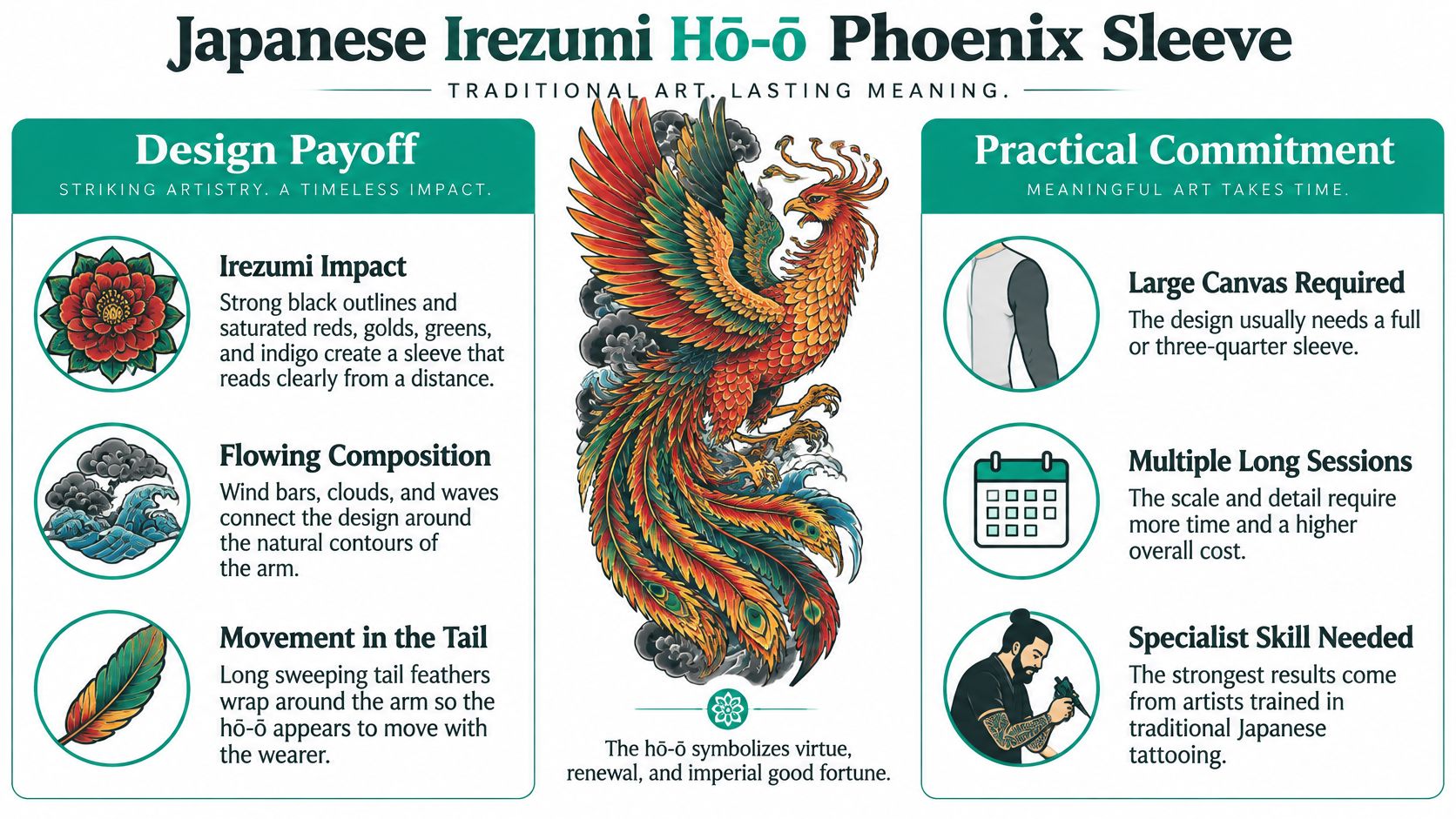
The hō-ō isn't a Western firebird with Japanese clouds. Tattoo History Atlas connects it with peace, virtue, and renewal through its relationship to the Chinese fenghuang. Choose that tradition intentionally, then use the traditional phoenix tattoo guide to refine your reference vocabulary.
Build Around the Joints
For a shoulder-to-wrist sleeve, a useful arrangement is a prominent upper-arm head, an outward-facing wing, and long feathers wrapping toward the inner forearm. Keep the elbow from becoming the meeting point for the beak, flower center, and wing tips.
- Composition choice: Use peonies as supporting masses, not competing focal points.
- Aging risk: Tightly packed feather lines can lose separation. Preserve clear skin channels between the tail, clouds, and background.
- Trade-off: Bold background work creates continuity, but it also commits more of your arm to ink.
Use the accompanying video as another visual reference when discussing flow with your artist.
Ready-to-type AI prompt
Japanese hō-ō full sleeve reference, head on outer upper arm facing forward, broad shoulder wing, long tail wrapping down forearm, peonies, clouds and wind bars, bold outlines, restrained red and gold, generous skin breaks at elbow, no Western flames, no lettering.
2. Chinese Fenghuang Phoenix with Peonies and Clouds
Choose a fenghuang composition when you want ornamental movement rather than an explosion of fire. A long, elegant neck and layered tail can lead the eye around the arm, while peonies provide broad shapes that interrupt the smaller feather details.
For example, place the bird's head on the outer upper arm and a large peony below it, slightly offset toward the inner arm. Let the tail pass behind the flower and reappear down the forearm, giving the sleeve depth without filling every opening.
Keep the Reference Tradition Clear
Use the phoenix tattoo meaning guide to clarify what you want the bird to communicate before choosing ornamental details. Don't ask an artist to combine every phoenix reference you like into a supposedly traditional design.
The illustration below is useful for its warm palette and upward movement, but its flames aren't a template for a culturally specific fenghuang.

The aging risk is ornamental congestion. Tiny feather eyes, narrow cloud curls, and tightly layered petals can compete once their edges soften. Ask the artist to simplify the tail before shrinking it, and separate red flowers from red plumage with dark boundaries or open skin.
A red-and-gold concept also needs a practical translation: gold is a color impression, not metallic ink shining beneath the skin. Compare healed yellow and ochre work on skin tones similar to yours.
Ready-to-type AI prompt
Chinese fenghuang-inspired full sleeve, graceful curved neck on upper arm, layered tail spiraling toward wrist, large peonies and spacious clouds, red and ochre palette, dark structural outlines, balanced asymmetry, separated feather groups, no flames, no Japanese wind bars.
3. American Traditional Phoenix Sleeve with Flames
Readability comes first in this version. Give the phoenix a clear head, an unmistakable wing silhouette, and flames broad enough to distinguish from the feathers at conversational distance.
The Western rebirth story has a substantial literary background. The historical account published by De Gruyter Brill traces surviving Greek phoenix references to approximately 700 BCE, with later classical writers developing associations with death and regeneration.
For a personal recovery sleeve, you might put dark embers near the wrist, rising flames across the forearm, and the bird opening its wings over the upper arm. That communicates transformation through placement rather than requiring a banner to explain it.
Practical rule: If the flames and feathers look interchangeable in a small black-and-white preview, simplify them before adding color.
Limit the Palette, Not the Personality
A restrained combination of black, red, yellow, and open skin can give this phoenix sleeve tattoo a strong graphic identity. Ask for a custom drawing rather than stretching a small flash design until it fills the arm.
The aging risk is crowding at the transitions, especially where flame tips meet tail feathers. Keep the flame shapes rounder or chunkier than the feather tips so the viewer can still tell them apart if small gaps become less distinct.
The trade-off is less surface realism. You won't get individually illuminated feather filaments, but you can get a bird that reads without close inspection.
Ready-to-type AI prompt
American traditional phoenix full sleeve, Western firebird rising from ashes, bold black outlines, broad wings over upper arm, simple flames ascending forearm, limited red yellow and black palette, large feather groups, open skin breaks, custom flash character, no tiny texture, no lettering.
4. Blackwork Phoenix Sleeve
A blackwork phoenix succeeds when the empty spaces describe the bird as clearly as the ink does. Squint at the concept: you should still recognize the head, wing direction, and tail instead of seeing an undifferentiated dark sleeve.
Say you prefer a severe, graphic design rather than colorful fire. Put a solid-black wing over the outer upper arm, carve feather separations with untouched skin, and extend a broken tail down the forearm.
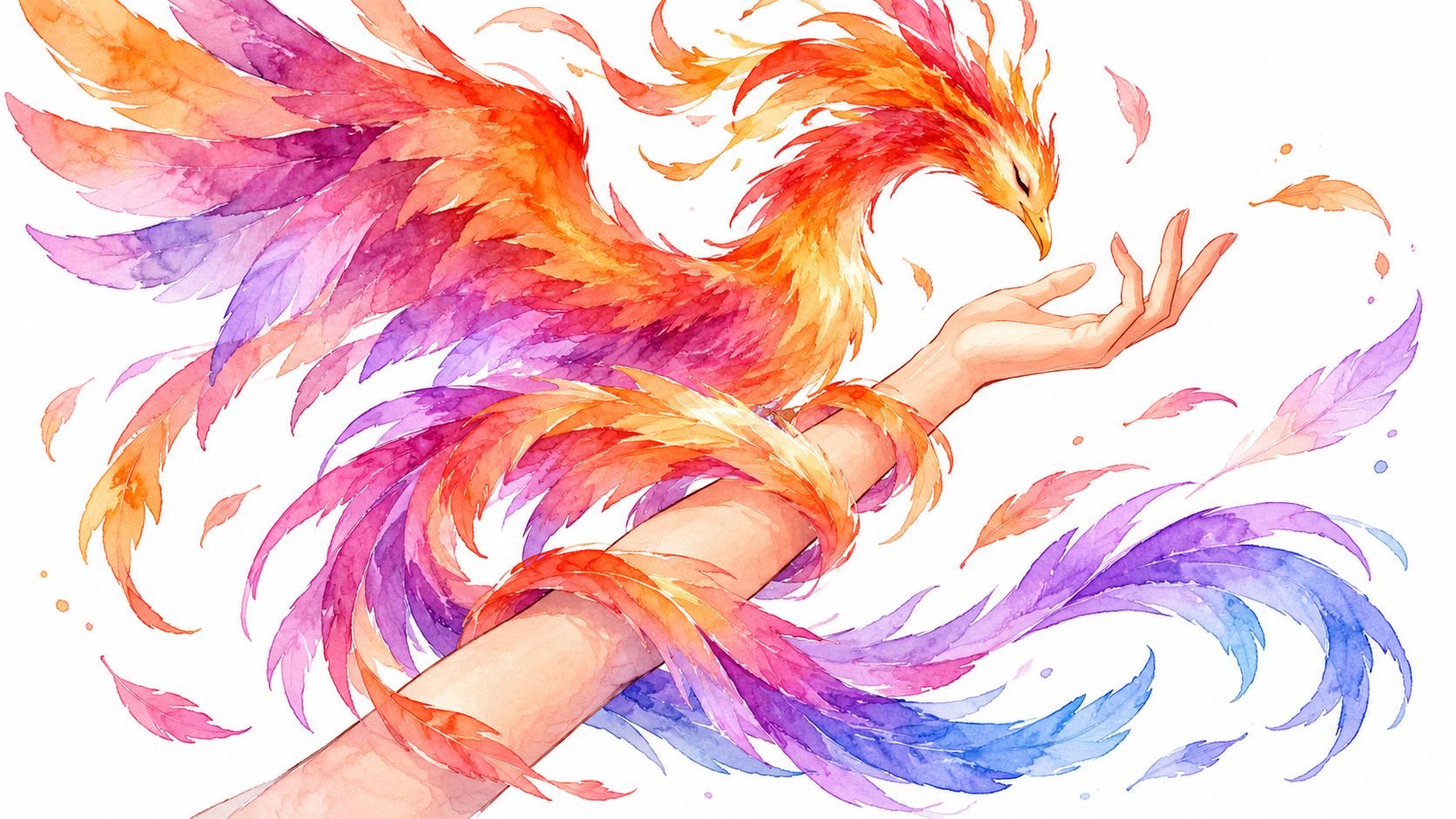
This painterly reference illustrates the opposite approach to edges and color. For blackwork, borrow only the sweeping bird gesture, not the washes.
Plan Saturation Before the Appointment
- Aging risk: Narrow skin slivers between black masses can become less distinct. Make important separations generous.
- Cover-up constraint: Existing dark ink limits where clean negative space can go. An artist needs to examine it before promising a silhouette.
- Session trade-off: Large saturated areas require disciplined execution and healing, not repeated passes to chase a fresh-photo finish.
A clinical review in the Journal of Cosmetic Dermatology documents tattoo complications in professional settings as well as elsewhere. Professional premises alone aren't a safety guarantee: choose an appropriately licensed artist using sterile single-use needles and clear hygiene procedures, and agree on staged work and aftercare.
Ready-to-type AI prompt
Graphic blackwork phoenix sleeve, solid black upper-arm wing, recognizable profile head, sweeping forearm tail, broad negative-space feather channels, open elbow transition, strong silhouette from front and side, no grey wash, no microtexture, no background filler.
5. Geometric Phoenix Sleeve
A perfectly symmetrical phoenix on a screen won't look perfectly symmetrical around an arm. Choose the main viewing angle first, then let the geometry wrap instead of forcing the entire sleeve into a flat, mirrored diagram.
For example, center an angular breast and head on the outer upper arm, with wing planes extending toward the front and back. Continue the forearm with staggered feather polygons rather than another complete, competing bird.
46 Tattoo's phoenix design guidance identifies wingspan, flame direction, and tail flow as key sleeve constraints and recommends mapping the composition on an arm template. That's especially useful here because a circle or straight line can look different once it crosses a curved surface.
Separate Structure from Decoration
Ask your artist for a photographed placement mockup, then examine it with your arm relaxed and bent. Keep essential geometry away from the deepest elbow crease, where movement makes exact alignment difficult to judge.
The aging risk is dense linework, particularly parallel hatching and tiny triangular cells. Use larger planes for the bird's anatomy and reserve fine construction lines for accents you can afford to become less prominent.
A geometric sleeve doesn't need identical wings. It needs deliberate relationships between angles, spacing, and the arm beneath them.
This approach trades feather softness for structure. If you want a geometric bird with realistic eyes, decide which visual language leads rather than splitting attention evenly.
Ready-to-type AI prompt
Geometric phoenix full sleeve reference, outer-arm focal view, angular head on upper arm, large polygonal wing planes wrapping front and back, staggered forearm feather shapes, black ink, generous line spacing, minimal construction circles, clear elbow gap, no microtriangles, no flat poster symmetry.
6. Watercolor Phoenix Sleeve
If your saved references are mostly orange washes and violet splashes, decide what will define the bird when the softest color boundaries become less distinct. Watercolor can be loose without leaving the anatomy unresolved.
For a warmer upper arm and cooler forearm, place an ember-orange head and breast above a violet tail. Keep the brightest washes around a darker wing structure, rather than asking pale color alone to separate every feather.
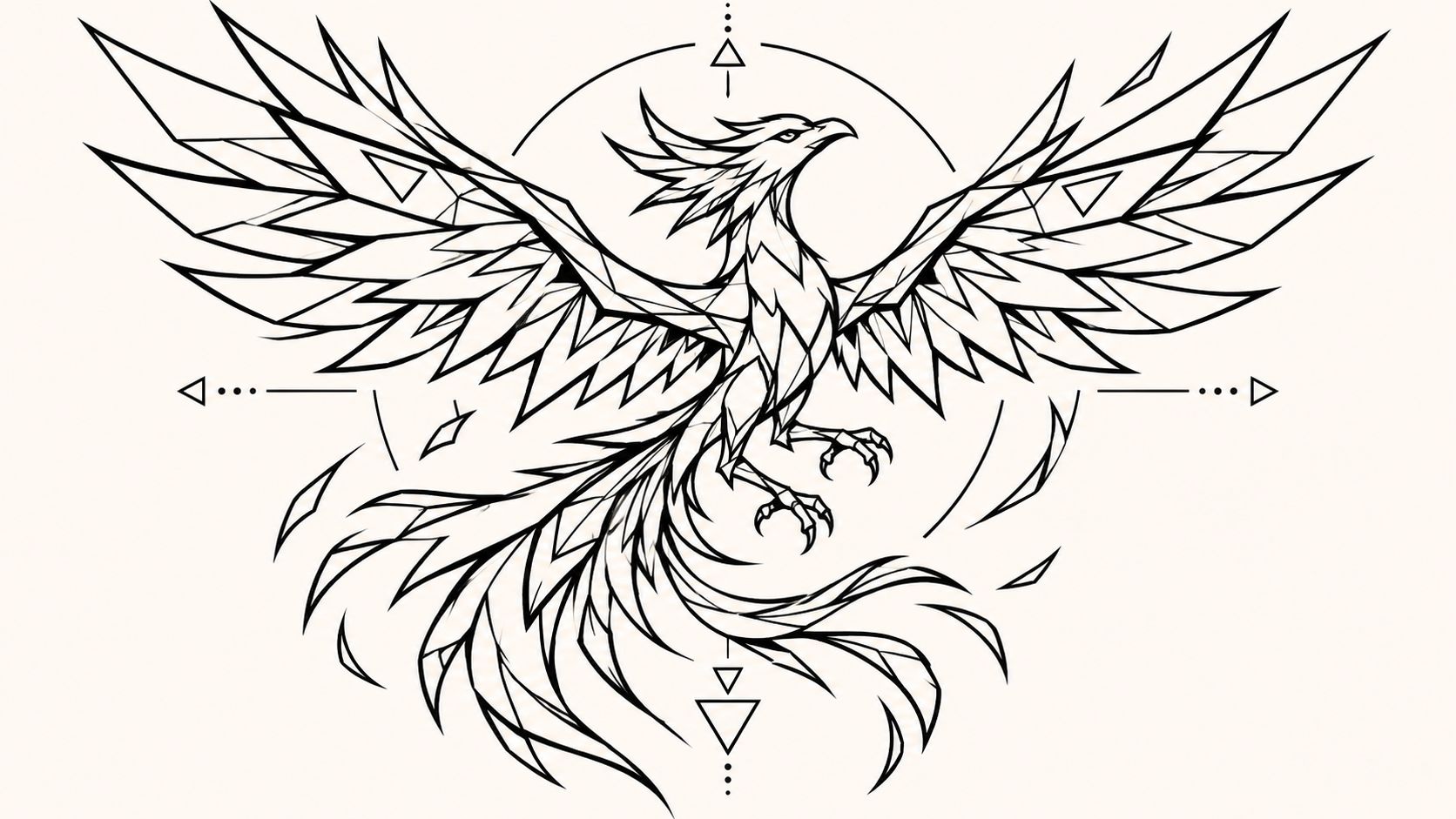
The line-art reference below isn't watercolor, but it demonstrates a useful test: can you identify the phoenix before adding the washes?
Give the Washes a Backbone
A full black outline isn't your only option. Selective dark edges around the beak, shoulder, and overlapping wings can provide structure while leaving the tail painterly.
- Aging risk: Pale washes and closely related colors may lose visual separation. Don't make them responsible for essential anatomy.
- Portfolio check: Request healed examples with comparable colors and skin tone, not just freshly saturated photographs.
- Maintenance trade-off: If your forearms get regular sun, plan for coverage and sunscreen once healed, following your artist's guidance.
Avoid placing every color in every part of the sleeve. Distinct warm and cool zones usually make the movement easier to understand than a uniform rainbow.
Ready-to-type AI prompt
Watercolor phoenix sleeve, ember-orange head and breast on upper arm, violet and muted blue tail flowing down forearm, selective dark structural edges at beak and wings, airy pigment washes, clear skin between splashes, readable bird silhouette, no dense background, no all-over rainbow, no lettering.
7. Realistic Phoenix Rising from Ashes Sleeve
Realism makes the most sense when light, shadow, and anatomy interest you more than decorative pattern. It's also unforgiving: smoke can obscure a weak wing, but it can't make that wing convincing.
For a transformation-themed sleeve, put the head and leading wing on the broad outer upper arm. Use the forearm for larger overlapping feathers and a restrained trail of embers, with smoke connecting the sections rather than covering every gap.
Choose a clear light source. Fire beneath the bird might illuminate the lower feather edges while leaving the upper planes darker, but scattered highlights everywhere will flatten the effect.
Ask to see healed work at ordinary viewing distance. A close-up of a fresh feather tells you less than a relaxed-arm photograph showing the whole sleeve.
Spend Detail Where It Matters
Prioritize the eye, beak, main wing overlaps, and silhouette. Let secondary feathers remain broader and quieter, especially as they turn toward the inner arm.
The aging risk is dependence on tiny highlights and closely spaced midtones. If the bird only separates from the smoke through delicate white accents, ask for stronger underlying value differences.
Realism also brings a budgeting trade-off: intricate rendering gives the artist more work than a simplified silhouette. Don't negotiate by making the bird smaller while keeping every feather; simplify the texture or revise the coverage.
Ready-to-type AI prompt
Realistic Western phoenix rising from ashes, full sleeve reference, head and leading wing on outer upper arm, large layered feathers flowing down forearm, firelight from below, strong light-dark separation, restrained smoke, sparse embers, readable silhouette without white highlights, no microscopic feather filaments, no competing background scene.
Phoenix sleeve approaches compared by style, color and long-term wear
| Design | Style Family | Color Approach | Longevity | Best For |
|---|---|---|---|---|
| Japanese Irezumi Hō-ō Phoenix Sleeve | Japanese traditional irezumi | Bold black outlines with reds, golds, greens, and indigo | Ages relatively well with bold outlines and saturated color | Clients who want a culturally rich, bold full sleeve |
| Chinese Fenghuang Phoenix with Peonies and Clouds | Asian-inspired floral | Often red, gold, and jade; also works in black and grey | Intricate details benefit from an experienced artist | Clients seeking an elegant, meaningful sleeve with florals |
| American Traditional Phoenix Sleeve with Flames | American traditional flash | Limited palette of red, orange, yellow, and black, sometimes green | Clean, bold design holds up well over time | Clients who want a timeless, high-contrast sleeve |
| Blackwork Phoenix Sleeve | Blackwork graphic | Solid black with negative space; optional dotwork | Solid black offers excellent longevity | Clients who want dramatic contrast and durability |
| Geometric Phoenix Sleeve | Modern geometric minimalist | Often black or single-color to emphasize structure | Predictable aging; fine lines need generous spacing | Clients who prefer clean, structured, contemporary designs |
| Watercolor Phoenix Sleeve | Modern watercolor | Soft blended hues, often warm reds and oranges shifting to cool violets or blues | Color may soften and fade faster, especially with sun exposure | Clients who want an artistic, painterly phoenix |
| Realistic Phoenix Rising from Ashes Sleeve | Realism and 3D | Grayscale or limited warm tones with detailed shading | Fine details may soften over time | Clients who want a detailed, meaningful transformation sleeve |
Take a Prompt, a Palette, and Two Artists into the Chair
Start with the composition that best matches how you want the bird to occupy your arm. Generate variations in contrasting styles, then shortlist a bold arrangement and a more detailed alternative rather than collecting near-identical pictures.
Keep the comparison useful. Use the same head placement, flight direction, and coverage in each prompt so you're judging the treatment, not being distracted by a completely different layout.
Turn the Concept into a Studio Brief
Take your shortlisted references to consultations with artists whose healed work matches the proposed style. Compare their recommendations, then choose an artist to develop the sleeve rather than asking separate artists to build disconnected sections.
- Show the full arm: Include existing tattoos, scars, and areas you want left open.
- Bring a restrained palette: Identify essential colors and colors you're willing to change for contrast.
- Test the joints: Review placement with the elbow bent and the arm hanging naturally.
- Discuss the whole project: Ask what the quote includes, how sessions are staged, and how touch-ups are handled.
For a location-specific budgeting example, Grand Avenue Tattoo's 2026 Phoenix pricing guide reports a full custom sleeve averaging about $3,500, with a typical range of $2,500–$5,000 or more. That's a benchmark for sleeves in Phoenix, Arizona, not a universal price for a phoenix bird design.
The checks that save money happen before the needle starts: healed-photo review, sensible joint placement, clear color separation, and a design that doesn't require unnecessary reworking. Discuss your usual sun exposure, particularly if the forearm will remain uncovered.
AI artwork is reference art, not a finished stencil. The tattooist must redraw it for your body, skin, existing ink, and long-term readability; an attractive generated arm isn't proof that the design will fit yours.
Arrive ready to choose priorities. If the artist recommends losing tiny embers to preserve the wing, or widening a skin break to separate the tail, judge the change by the sleeve's readability rather than its resemblance to the screen.
TattoosAI lets you describe your phoenix, select a style and color direction, and generate concepts for comparison. Visit TattoosAI to explore a bold silhouette and a more detailed alternative, then take your preferred references to a tattooist who can adapt them to your arm.