TattoosAI
Is the best sacred geometry tattoo the most intricate one, or the one whose symbolism, scale, and placement fit the person wearing it?
That's the gap a lot of idea roundups miss. They show dense linework, perfect circles, and dramatic sleeves, but they often skip the harder question: which symbol makes sense for your meaning, your pain tolerance, your body area, and your artist's strengths. That matters even more with sacred geometry, because these designs aren't just decorative patterns. Their roots reach back at least to the Vedic period in India, roughly 1500 to 500 BCE, and geometric symbolism also appears across ancient Egypt, Greece, Hindu traditions, and Mesoamerica, which is part of why these forms still feel timeless today, as noted in this overview of sacred geometry history and symbolism.
Sacred geometry tattoo ideas also sit inside a large and growing tattoo space. The global tattoo market is estimated at about USD 2.66 billion in 2026 and projected to reach USD 5.99 billion by 2034, according to Fortune Business Insights' tattoo market outlook. For clients, that means more options. For artists, it means faster concept comparison matters.
The eight ideas below are organized by the kind of design decision they solve. Some work as balanced standalone symbols. Some are better for compact precision tattoos. Others need more room to breathe. For each one, you'll get the meaning, practical sizing and placement guidance, line-weight choices, customization ideas, and a ready-to-use TattoosAI prompt so you can generate a few directions before bringing the strongest concept to your tattooist.
Table of Contents
- 1. Flower of Life
- 2. Mandala
- 3. Metatron's Cube
- 4. Platonic Solids
- 5. Vesica Piscis
- 6. Sri Yantra
- 7. Golden Ratio Spiral
- 8. Geometric Animal Sacred Geometry Fusion
- 8 Sacred Geometry Tattoo Ideas: Side-by-Side Comparison
- Turn the Pattern Into a Personal Design
1. Flower of Life
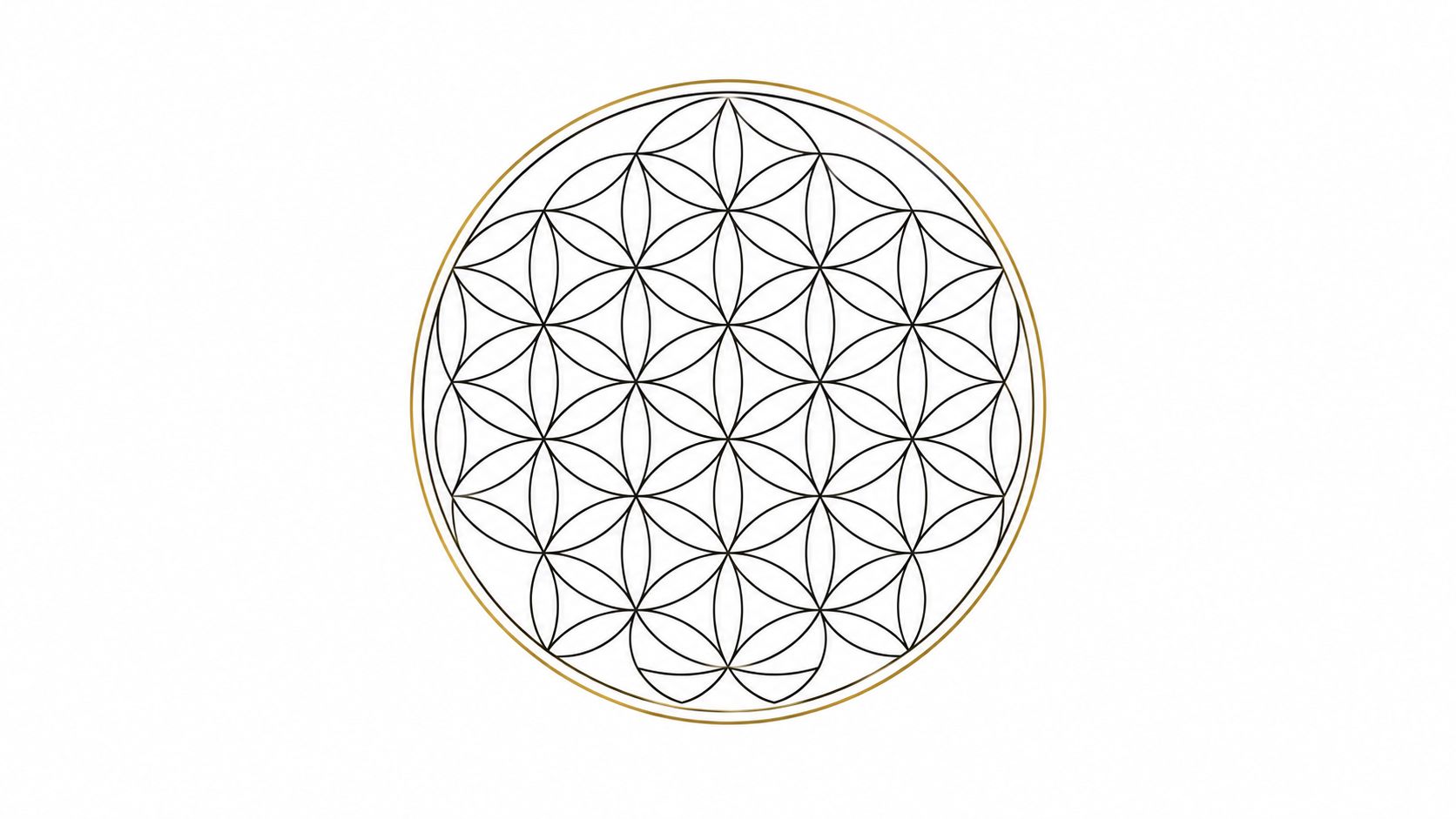
The Flower of Life works well when you want one symbol that feels complete on its own. It's built from evenly spaced overlapping circles, and that repeated structure creates a calm, balanced look even before you attach any personal meaning to it.
Historically, this is one of the motifs recognized when searching for sacred geometry tattoo ideas. It's often treated as universal because geometric symbolism appears across very old traditions and later sacred design systems, and modern summaries also place sacred geometry in timelines that stretch back before writing, including Neolithic stone circles dated about 3500 to 1500 BCE, as described in this history of sacred geometry traditions.
When it makes sense as a tattoo
A minimalist Flower of Life can sit on the inner forearm, upper arm, calf, or upper back. A larger version can anchor a chest panel or become the base layer for a sleeve that later adds a mandala, Metatron's Cube, or dotwork shading.
If you're choosing between small and large, lean medium or larger. The pattern depends on clean ratios. If the circles are cramped, tiny errors become obvious once the tattoo heals.
Practical rule: Ask your artist to show the circle spacing at final tattoo size, not only in a digital mockup. Sacred geometry fails fast when the stencil looks good on screen but too tight on skin.
Design decisions to make early
A Flower of Life can change character a lot with small style shifts:
- Fine-line version: cleaner, lighter, and more modern, but less forgiving if the tattoo is too small.
- Dotwork version: softer and more textured, especially around the outer ring.
- Blackwork version: bolder and easier to read from a distance.
- Color-accent version: best used sparingly, often as a halo, ring, or subtle gradient rather than full fill.
A real-world example is the client who wants a first sacred symbol but isn't ready for a full sleeve. A centered Flower of Life on the shoulder blade gives them a complete standalone design now and room to expand later.
TattoosAI prompt:
Flower of Life sacred geometry tattoo, perfectly symmetrical overlapping circles, clean proportional linework, optional dotwork shading, black ink, balanced standalone composition, stencil-ready, placement on upper forearm
2. Mandala
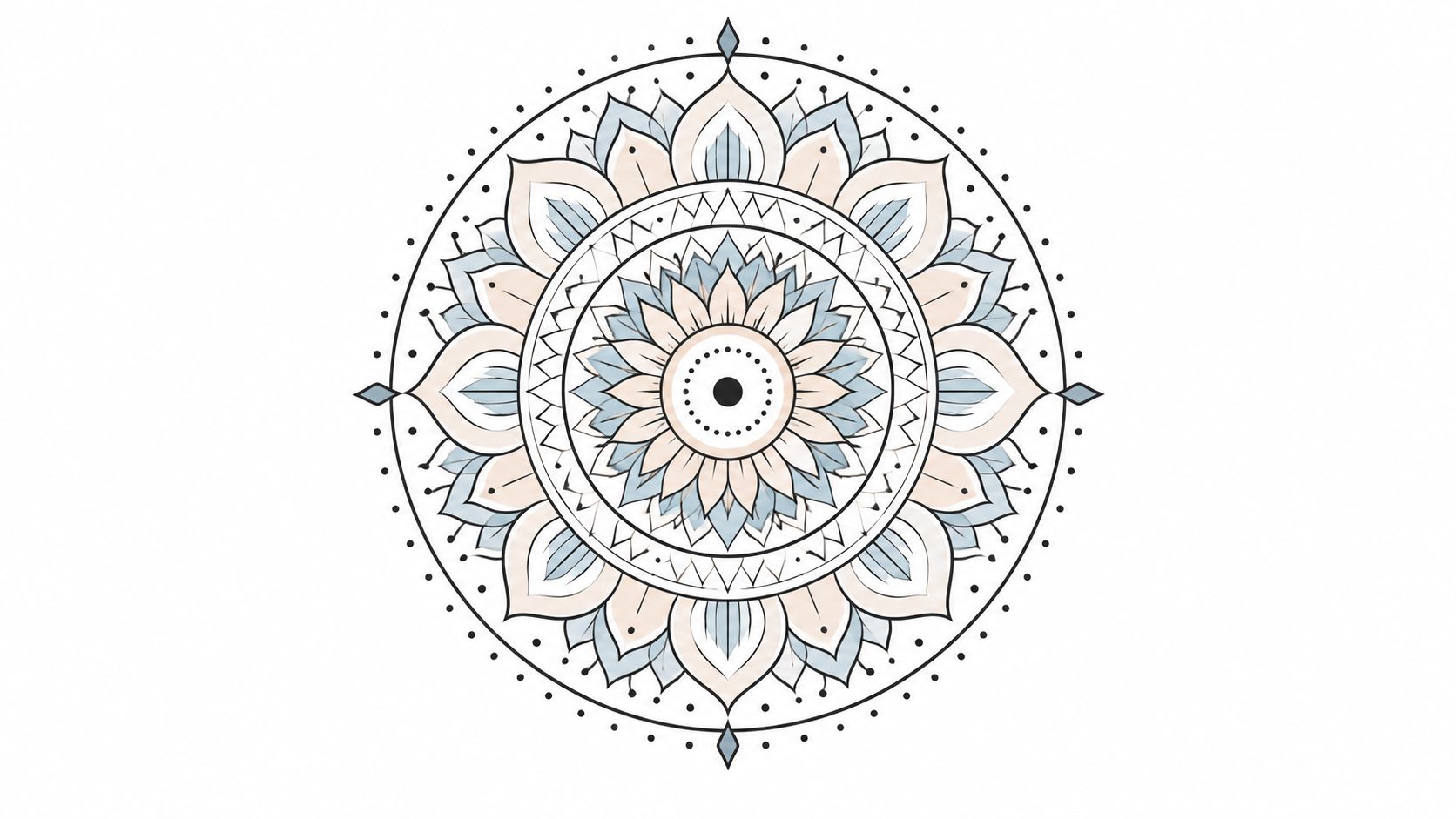
A mandala solves a different problem. It's ideal when you want a design that radiates from a center point and feels meditative, decorative, and symbolic at the same time.
Many trend galleries blur the line between sacred and geometric, but one useful distinction is that sacred geometry usually refers to patterns with cultural or spiritual meaning, while geometric tattoos can be purely decorative. That's why a mandala works best when you decide what the center means to you, instead of choosing it only because it looks intricate, as explained in this guide to sacred geometry versus generic geometric tattooing.
Best placements for symmetry
Mandalas usually look strongest on broad, stable areas. Upper back, sternum, chest, outer shoulder, and thigh all support circular symmetry well. On those placements, the design reads as intentional rather than squeezed into an awkward shape.
A forearm mandala can work too, especially if it's slightly elongated or paired with moon phases, floral elements, or ornamental framing. That approach often suits clients who want a sacred feel without a full back or chest piece.
How to keep it readable
Mandala tattoos age better when the artist leaves enough space between repeating petals, rings, and inner details. If every ring is equally thin, healed skin can flatten the design visually.
For that reason, it helps to study dotwork tattoo style before choosing your final finish. Dotwork can separate layers gently, while solid black fills create stronger contrast. Neither is automatically better. The right one depends on how soft or graphic you want the mandala to feel.
A mandala should still look centered and calm when you step back from a mirror. If it only works up close, the design may be too busy.
A good real-world direction is a thigh mandala with a simple lotus-like center and wider outer petals. It keeps the spiritual reference but avoids the crowded look that many first-time clients regret.
TattoosAI prompt:
Sacred geometry mandala tattoo, concentric radial symmetry, clear center point, balanced petal layers, optional dotwork shading, black and grey, elegant negative space, thigh placement, stencil-ready
3. Metatron's Cube
Want a sacred geometry tattoo that feels less like a flower and more like a blueprint?
Metatron's Cube solves that design choice. It is one of the clearest options for people who want a balanced standalone symbol with a technical, ordered look. The structure comes from a network of circles linked by straight lines, so the tattoo reads almost like a diagram laid over the body.
That precision is the appeal, but it also creates the main risk. Fine connections can blur together if the piece is too small.
A good way to judge it is to treat the design like a map. The outer shape may look simple at first glance, yet the internal routes do the work. If those routes get crowded, the symbol loses its logic. That is why Metatron's Cube usually performs better on the forearm, upper arm, shoulder blade, or calf than on the wrist or finger.
Here, the first decision is not style. It is complexity.
Ask your artist to sketch two versions: one with the full internal network, and one with a reduced line count. The simplified version often heals more cleanly, especially if you want a compact precision piece rather than a large statement tattoo. This makes collaboration easier too, because you are comparing readability, not only decoration.
Stylistically, small changes shift the mood fast. Crisp black linework keeps it diagram-like. A soft dotwork field around the cube adds breathing room and makes the center feel less rigid. A 3D treatment can look striking, but only if the artist has strong perspective control. Otherwise, the form can start to wobble.
Placement should match the geometry. Straight or gently curved body areas help the pattern stay even. On a rounded area with too much distortion, the symmetry can look accurate in the stencil and slightly off once healed.
One practical test helps: step back several feet from the draft. You should still recognize the overall cube before you notice the smaller connections. If the tattoo only makes sense up close, the line weight is probably too light or the design is carrying too much detail for its size.
This motif often suits clients who want sacred symbolism without a soft, floral, or overtly mystical tone. It feels spiritual through order.
Bring healed examples of geometric tattoos to your consultation. Fresh tattoos often make ultra-fine linework look more durable than it really is.
TattoosAI prompt:
Metatron's Cube sacred geometry tattoo, balanced standalone symbol, precise interconnected circles and lines, clear line weight, optional subtle dotwork aura, black and grey, forearm or calf placement, stencil-ready geometric design
4. Platonic Solids
Want sacred geometry that feels less like a pattern and more like a form you could almost hold in your hand. Platonic solids solve that design decision.
The five solids, tetrahedron, cube, octahedron, dodecahedron, and icosahedron, are built from equal faces and repeated angles. In tattoo terms, that gives you a different effect from a mandala or Flower of Life. You are not wearing a field of geometry. You are wearing a defined object.
That difference matters on skin. A flat motif spreads across the body like wallpaper. A solid acts more like a small sculpture translated into linework, so placement, tilt, and spacing affect the result more than extra ornament does.
You can choose this motif in two clear ways.
A single solid works well if you want a compact precision piece with one idea at the center. A tetrahedron or cube reads quickly, even at a modest size, because the eye can grasp the full structure without chasing too many intersections. Inner forearm, upper calf, back of the arm, or the outer wrist area often suit that cleaner approach.
A grouped set solves a different problem. It gives you a dimensional composition for a larger area such as the thigh, upper arm panel, chest, or upper back. Here, the goal is not only symbolism. It is giving each form enough room so the angles stay believable and the tattoo does not collapse into visual clutter.
The main decision is not spiritual first. It is technical first. Ask yourself whether you want the solids to read like a diagram, a floating object, or a study of volume.
Wireframe linework keeps the design crisp and teaches the eye how the form is built. Light shading or dotwork can add depth, but only if the artist handles perspective cleanly. If the angles drift, the tattoo can look mathematically wrong even when the lines are neat.
A simple way to test a draft helps here. Shrink the design on your phone screen. If the solid still reads as a stable form, the concept is working. If it turns into a knot of crossing lines, the tattoo needs fewer forms, thicker lines, or more space.
Artist fit matters more with Platonic solids than with softer sacred geometry motifs. Ask to see healed examples of cubes, polyhedra, or other isometric tattoos, not only fresh geometric work. Clean stencil placement is only the starting point. The test is whether the structure still feels balanced after healing on a curved body area.
The U.S. tattoo artist industry is estimated at USD 1.3 billion in 2026, according to IBISWorld's U.S. tattoo artists industry overview. In a fragmented studio market, clear concept planning helps narrow your search, especially for tattoos that depend on perspective, symmetry, and disciplined line control.
TattoosAI prompt:
Platonic solids sacred geometry tattoo, dimensional geometric form, single tetrahedron or grouped polyhedra, isometric wireframe linework, optional soft dotwork shading, black and grey, clean perspective, placement on thigh chest upper arm or calf, stencil-ready design
5. Vesica Piscis
The Vesica Piscis is one of the best compact sacred geometry tattoo ideas because its shape is simple, but its symbolism still feels layered. It's formed by the overlap of two equal circles, creating an almond-shaped center that many people read as a meeting point or threshold.
That makes it a strong choice for someone who wants sacred geometry without wearing a dense pattern. It's also one of the easiest motifs to personalize with a triangle, date, floral detail, or small internal symbol.
Where compact placement works
This symbol fits well on the inner wrist, back of the arm, ankle, side of the forearm, or behind the calf. Because the base form is simple, it can stay elegant at a smaller size than a mandala or Sri Yantra.
Still, simple doesn't mean careless. The circles have to be clean. If one side is even slightly distorted, the whole symbol feels off balance.
Aging and line-weight guidance
One practical issue with detailed sacred geometry is aging. Recent tattoo coverage notes that precise linework, symmetry, and spacing are important, that healed portfolio photos from 3 to 12 months matter, and that small detailed versions on hands and fingers tend to blur or fade faster, as discussed in this sacred geometry tattoo care and design guide.
That's especially relevant here. A tiny Vesica Piscis on a finger may look elegant in a concept image, but a slightly larger version on the wrist or forearm usually gives the tattoo a longer readable life.
Aging note: If you want the symbol to stay crisp, choose a body area with enough stable skin and don't force extra internal detail into a very small footprint.
A good real-world example is a discreet forearm Vesica Piscis with a fine central triangle. It keeps the design meaningful without looking overloaded.
TattoosAI prompt:
Vesica Piscis sacred geometry tattoo, two perfect overlapping circles, clean almond-shaped center, minimalist black linework, optional internal triangle, elegant compact design, inner forearm placement, stencil-ready
6. Sri Yantra
Want a sacred geometry tattoo that reads as a true centerpiece rather than a small accent? Sri Yantra solves that design decision.
Its structure is dense for a reason. Nine interlocking triangles radiate around the central bindu, then expand through layered geometry toward the outer boundary. A mandala often feels decorative first. Sri Yantra feels architectural. Every line depends on the others, like a cathedral window where one shift throws off the whole pattern.
That complexity changes the tattoo decision immediately. Sri Yantra works best when you want a dimensional sacred symbol with strong spiritual weight and enough visual depth to hold attention on its own.
Placement should support that job. Upper back, chest, thigh, and a broad outer forearm give the triangle network room to breathe. If the design is compressed too far, the center tightens, the outer layers merge, and the symbol stops reading clearly from normal viewing distance.
Line weight matters just as much as size. Fine lines can look beautiful in a fresh concept, but Sri Yantra usually benefits from slightly stronger line variation so the nested triangles stay separate after healing. Ask your artist where they would thicken lines, where they would leave open skin, and whether the border needs simplifying for your chosen scale.
Two customization paths usually work well.
A traditional version keeps the full structure, often with black and grey shading or dotwork, and suits a centered placement such as the upper back or sternum. A reduced version trims outer detail, keeps the bindu and main triangle relationships, and fits better if you want a cleaner forearm or thigh piece without losing the identity of the symbol.
Before booking, ask one practical question: will the artist construct the geometry from scratch or trace and adapt a reference? For Sri Yantra, that difference matters. A skilled geometric artist should be able to explain spacing, symmetry, and how they will keep the design readable on skin rather than only on screen.
TattoosAI prompt:
Sri Yantra sacred geometry tattoo, nine interlocking triangles around a central bindu, precise symmetrical black linework, optional dotwork shading, dimensional spiritual geometry, upper back or sternum placement, readable spacing, stencil-ready large composition
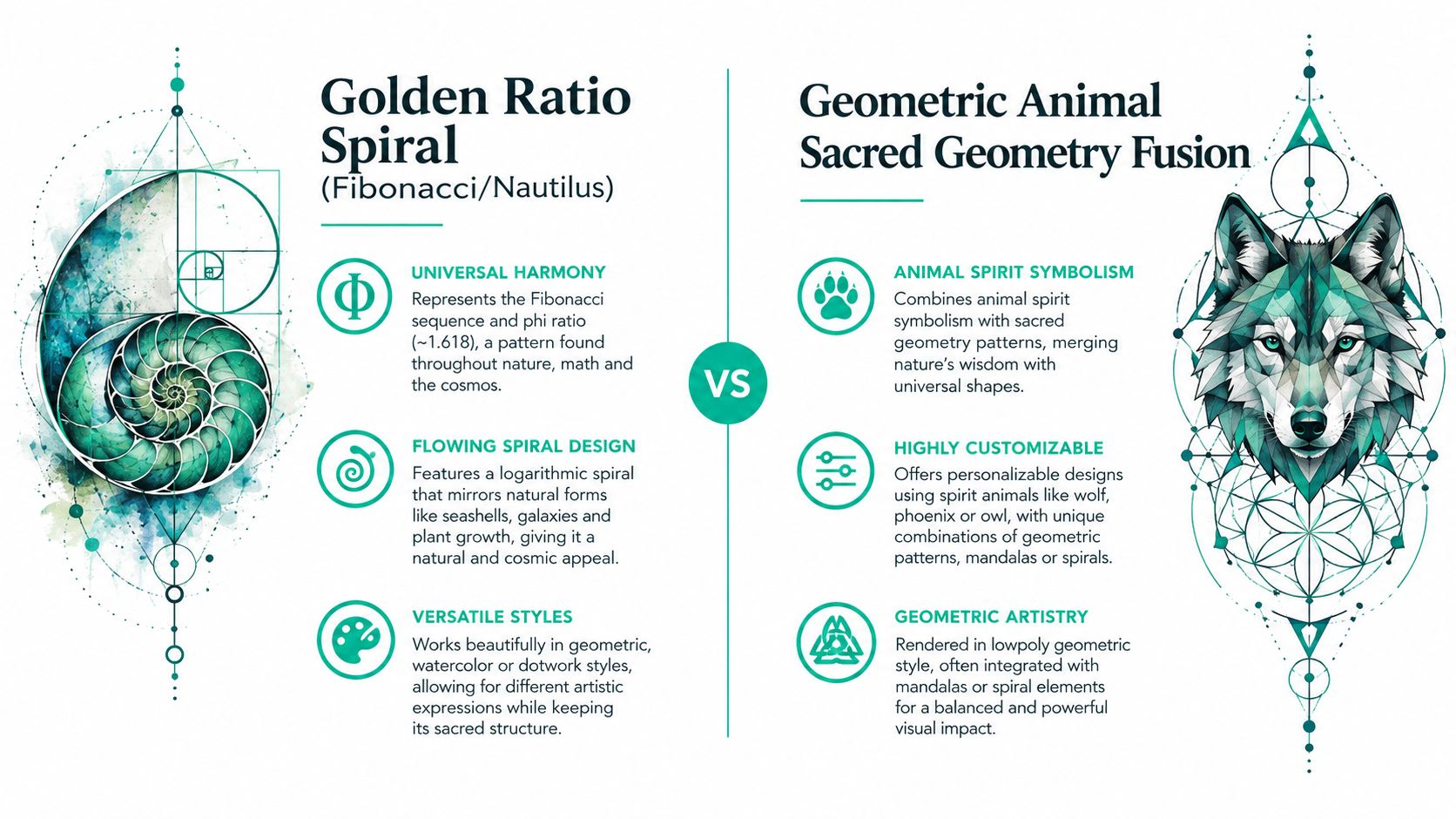
7. Golden Ratio Spiral
Some sacred geometry symbols feel still. The Golden Ratio spiral feels like movement. That makes it a smart choice when you want flow across the body instead of a centered emblem.
This motif often appeals to people who like natural growth patterns more than rigid symmetry. It can suggest expansion, evolution, rhythm, or a cleaner link between mathematics and the forms we already notice in shells, flowers, and waves.
Best body areas for motion
The spiral looks strongest where the body already has directional flow. Forearm, ribcage side, calf, thigh, and shoulder cap all work well because the line can travel instead of sitting stiffly.
This is also one of the easier symbols to combine with non-geometric imagery. A spiral can become a nautilus shell, move through a floral stem, or open into a subtle galaxy-like composition without losing its basic identity.
Why this one feels contemporary
Recent trend coverage suggests geometric tattoo taste is shifting away from the oversaturated generic mandala or compass look and toward either ultra-minimal sacred geometry or larger, more deliberate statement pieces. The same trends summary also notes that sacred geometry is often being framed in a more mathematical, less overtly spiritual way, as described in this 2026 tattoo trends roundup.
That trend suits the Golden Ratio spiral perfectly. You can wear it as a sacred symbol, a natural pattern, or a mathematically elegant design without explaining it to everyone who sees it.
A good real-world direction is a blackwork forearm spiral that starts clean at the center and opens into light stippled shading at the outer curve. It feels alive without becoming busy.
TattoosAI prompt:
Golden Ratio spiral sacred geometry tattoo, elegant flowing nautilus-inspired curve, clean black linework, optional dotwork shading, natural mathematical aesthetic, forearm or calf placement, balanced motion, stencil-ready
8. Geometric Animal Sacred Geometry Fusion
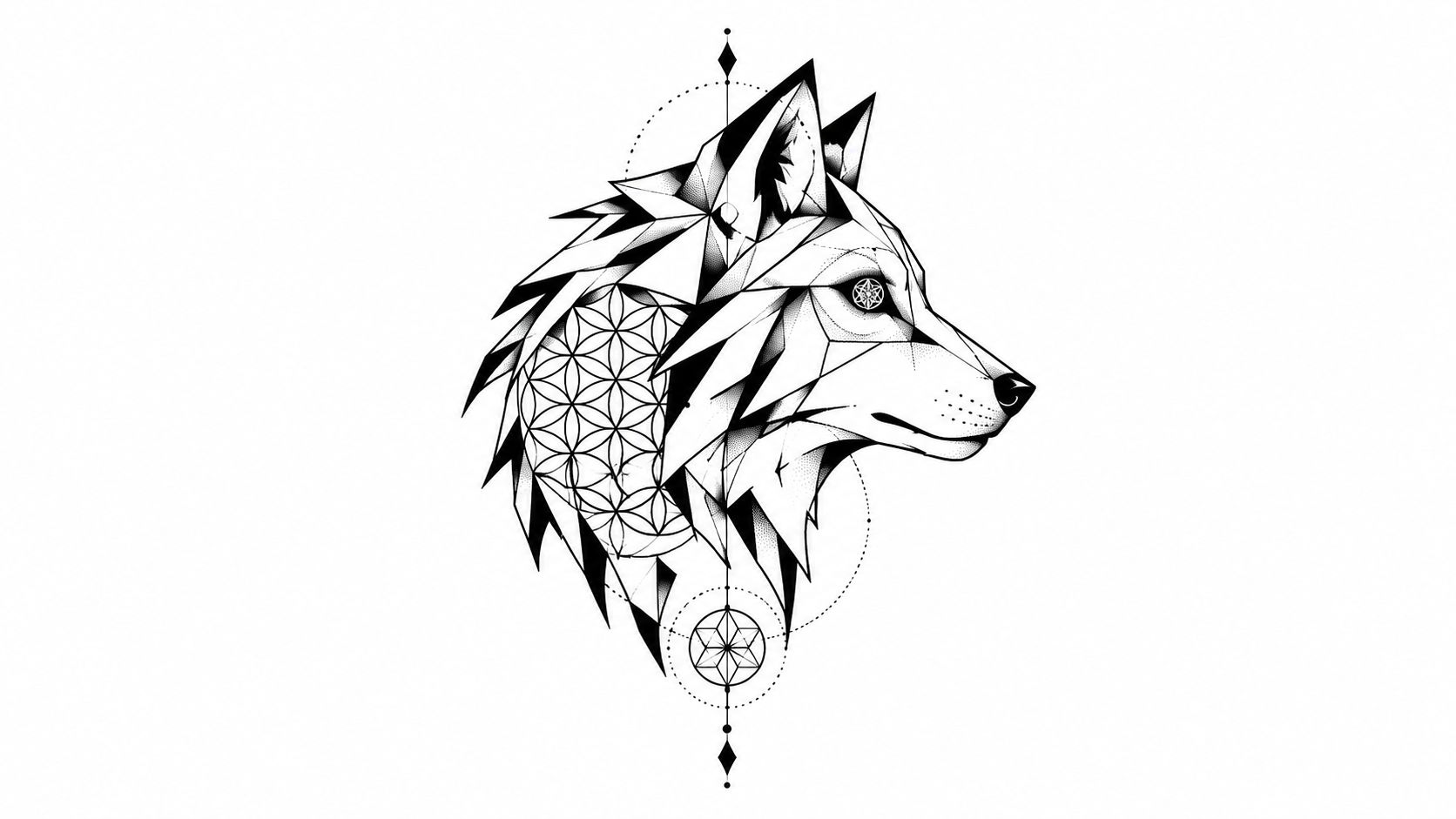
If the earlier ideas feel too abstract, sacred geometry becomes personal. A geometric animal fusion lets you keep the structure of sacred design while tying it to a creature you connect with.
That could be a wolf, owl, lion, deer, eagle, fish, or phoenix-like bird. The animal gives the tattoo emotional identity. The geometry gives it order.
How to keep the design from becoming cluttered
This category has the widest creative range, and that's exactly why it needs restraint. The best versions usually choose one dominant structure. For example:
- Wolf with a mandala eye
- Deer with antlers built from triangles
- Owl with patterned feather geometry
- Fish framed inside a Vesica Piscis
If you stack too many systems together, the tattoo loses focus. A lion with Flower of Life cheek panels, spiral mane sections, cube fragments, and a cosmic background may sound impressive, but it often reads as too many ideas in one space.
Placement and artist fit
These tattoos usually need more room than people expect. A shoulder cap, outer forearm, thigh, upper arm panel, or calf gives enough area for both the animal silhouette and the internal geometry.
They also demand an artist who can draw both subjects well. Strong geometry alone isn't enough. Strong animal portraiture alone isn't enough either. If you're exploring wolf concepts, browsing examples like these geometric wolf tattoos can help you decide how abstract or realistic you want the fusion to be.
Here's a useful visual reference point before you settle on complexity:
A practical real-world example is a forearm wolf head where the outer silhouette stays natural, but the interior planes break into triangles and a subtle Flower of Life halo sits behind the crown. That keeps the animal recognizable and the geometry intentional.
TattoosAI prompt:
Geometric wolf sacred geometry tattoo, realistic outer silhouette with internal triangle facets, subtle mandala eye detail, Flower of Life halo behind head, black and grey linework, upper forearm placement, balanced animal and geometry fusion, stencil-ready
8 Sacred Geometry Tattoo Ideas: Side-by-Side Comparison
| Design | Implementation Complexity 🔄 | Resource Requirements ⚡ | Expected Outcomes ⭐ | Ideal Use Cases 📊 | Quick Tips 💡 |
|---|---|---|---|---|---|
| Flower of Life | Medium, symmetry-critical | Medium, skilled geometric artist; time varies with layers | ⭐⭐⭐⭐ Balanced, photogenic, versatile (minimal → detailed) | Chest, forearm, shoulder, upper back, thigh; first-time seekers | Request proportional circles; prefer 3+ in. for detail; choose dotwork/geometric specialist |
| Mandala | High, multi-layered precision | High, very detail‑intensive; often 2–6 hrs | ⭐⭐⭐⭐⭐ Deeply meditative, highly detailed, scar-covering | Upper back, chest, thigh, shoulder, forearm; meditative/spiritual work | Generate many variations; customize center; confirm line weight/spacing |
| Metatron's Cube | High, extreme precision | Medium–High, precise line work; moderate time for clean design | ⭐⭐⭐⭐ Striking, compact, spiritually recognizable | Inner wrist, forearm, ankle, upper arm, behind ear; discrete spiritual pieces | Use simplest clean version initially; 3–4 in. recommended; verify artist precision |
| Platonic Solids | Medium–High, 3D/isometric skill | High, 3D shading or wireframe skill; time depends on dimensionality | ⭐⭐⭐ Intellectual, geometric, modular (single or set arrangements) | Back, chest, thigh, upper arm, shoulder blade; STEM or symbolic collections | Specify wireframe/isometric; test single solid first; review artist 3D work |
| Vesica Piscis | Low, simple geometry but exact circles required | Low, quick but needs clean execution | ⭐⭐⭐ Elegant, understated, compact and symbolic | Inner wrist, ankle, behind ear, collarbone, small forearm; minimalists | Use slightly thicker lines to prevent blur; insist on perfect circles |
| Sri Yantra | Very High, many interlocking ratios | Very High, expert geometric artist; 3+ hrs minimum | ⭐⭐⭐⭐ Profound, complex, strongly spiritual when accurate | Upper back, chest, thigh, full back, shoulder blade; tantric/meditation practitioners | Confirm traditional proportions; choose large placement (4+ in.); vet artist experience |
| Golden Ratio Spiral (Fibonacci) | Medium, mathematical accuracy important | Medium, moderate time; complexity rises with loops | ⭐⭐⭐⭐ Elegant, flowing, versatile; strong natural symbolism | Forearm, wrist, calf, shoulder, back; nature/math symbolism, growth themes | Specify “golden ratio/nautilus”; test flow on body; try multiple variations |
| Geometric Animal Fusion | High, combines figurative and geometry | High, skilled fusion artist; 2–4+ hrs depending on detail | ⭐⭐⭐⭐ Highly personal, visually engaging; wider audience appeal | Upper back, shoulder, full forearm, thigh, large chest; spirit-animal pieces | Generate many variations; choose 5+ in. for detail; review portfolio of fusion work |
Turn the Pattern Into a Personal Design
The right sacred geometry tattoo usually becomes clear when you filter these eight ideas through three practical questions.
First, what meaning do you want to carry? If you want a symbol that feels whole and balanced on its own, the Flower of Life or mandala may fit best. If you want something more compact and understated, the Vesica Piscis makes more sense. If you want a more mathematical or technical feel, Metatron's Cube, Platonic solids, or the Golden Ratio spiral often land better. If you want the tattoo to say something more personal at a glance, a geometric animal fusion gives you more emotional specificity than a pure symbol.
Second, how much space do you really have? Many strong concepts become weak tattoos. A Sri Yantra or a detailed mandala usually needs more room than a first-time client expects. A Vesica Piscis or reduced Metatron's Cube can succeed in a smaller area, but only if the artist preserves spacing and resists over-detailing. Placement changes everything. A broad upper back gives a symbol room to breathe. A wrist or ankle demands restraint.
Third, can your chosen artist execute the level of precision the design requires? Sacred geometry depends on proportion, symmetry, line confidence, and enough negative space to survive healing. That's why healed examples matter. Fresh tattoos can make nearly any geometric stencil look sharp. Healed work shows whether the artist knows how thin is too thin, how close is too close, and when a design should be simplified.
Concept generation helps. Use TattoosAI, or another concepting workflow you trust, to generate several variations before your consultation. Test geometric, dotwork, blackwork, fine-line, 3D, or watercolor-accent directions. Compare a compact version against a larger one. Try the same symbol on different body areas. You're not looking for final truth from AI. You're looking for a clearer brief.
Then bring the strongest concept to a qualified tattooist and let them adapt it. They can adjust proportion to your anatomy, thicken lines where needed, open up crowded sections, and tell you whether your preferred placement supports the level of detail you want. If you want more visual references before you book, you can also browse the tattoo gallery and compare how different geometry-heavy pieces sit on the body.
AI can give you direction. Your tattoo artist should give the design its final form.
TattoosAI lets you turn sacred geometry tattoo ideas into visual concepts by describing the symbol, style, and placement you want, then comparing multiple directions before you book. If you're choosing between a compact Vesica Piscis, a large Sri Yantra, or a geometric animal fusion, visit TattoosAI to generate drafts you can refine with your tattooist.