TattoosAI
Why do so many skull cherry tattoos end up as a gray smudge on a forearm two years later, when the reference image looked razor sharp on a phone screen? The answer is rarely the artist and almost never the idea. It's that the design was built for a screenshot instead of for skin.
A skull carries centuries of mortality symbolism. A cherry carries sweetness, fleeting pleasure, and a documented double life as an erotic symbol. Put them together and you get one of tattooing's most flexible pairings, capable of reading as a joke, a memorial, a warning, or a love letter depending on how it's drawn.
The seven styles below each come with a palette breakdown, a placement note, an honest aging assessment, and a ready-to-use prompt you can paste into an AI tattoo generator to produce reference concepts before you ever sit down for a consultation. Read the aging note first. That's where most disappointment starts.
Table of Contents
- 1. Traditional American Skull and Cherries
- 2. Neo-Traditional Skull with Cherry Blossom Cluster
- 3. Sugar Skull with Cherries (Día de Muertos Style)
- 4. Blackwork Skull and Cherry Pair
- 5. Fine-Line Minimalist Skull and Cherry
- 6. Watercolor Skull with Cherry Splashes
- 7. Japanese-Inspired Skull with Sakura and Cherries
- Skull and Cherry Tattoo Styles at a Glance
- From Concept to Ink and Into the Chair
1. Traditional American Skull and Cherries
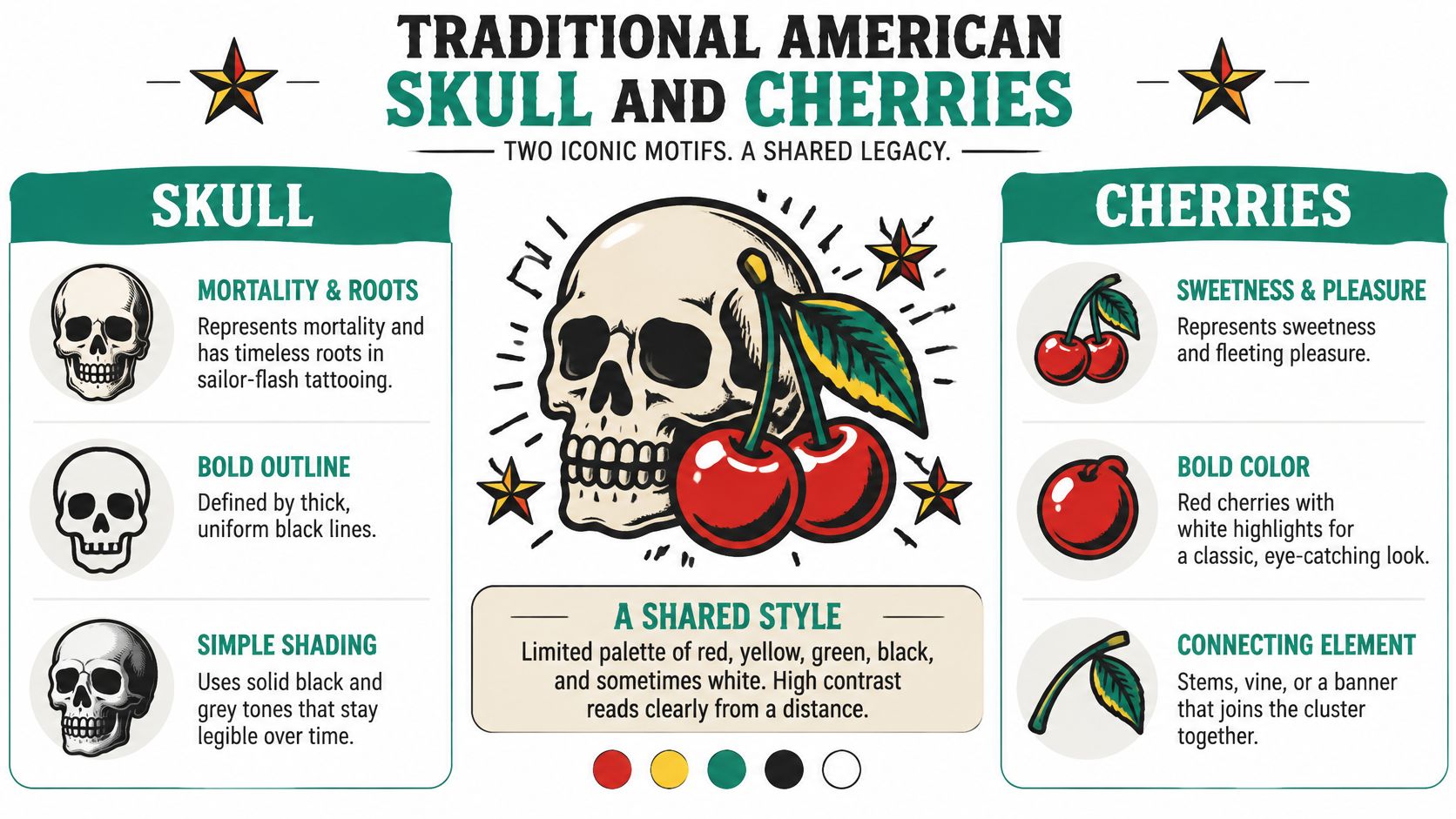
A front-facing skull with heavy outlines and three cherries on a hanging stem is the version newcomers picture before they know anything about tattooing, and it remains the safest bet for a piece that reads across a room. The classic flash composition is stripped down on purpose: skull as anchor, cherries tucked under the jaw or draped across a banner, red and black doing nearly all the work.
Skull imagery spent centuries in European religious and artistic traditions as a warning about lethal danger and a reminder that pleasure is temporary, and a 2015 social-history study of the skull motif traces how that meaning broadened through the twentieth century, with the skull's mass circulation becoming especially visible after 2000. Adding fruit turns a memento mori into a joke with teeth.
What the palette actually does
- Black carries the structure. Outline, sockets, tooth gaps, shadow side of the cranium. Whip-shaded rather than packed, so the skull stays open.
- One red, packed solid. Cherry bodies filled flat, with a single small highlight each. Skip the orange-to-red gradient.
- Barely any green. One saturated leaf, kept small. A leaf that grows turns muddy over red.
- Skin as breathing room. Leave a gap between the two cherries so they read as two fruits, not one blob.
Healing is predictable here: surface settled in two to three weeks, black first, red often looking angry a week longer than the black does. The trade-off is limited detail, and that limitation is exactly why it lasts.
Prompt to try: Traditional American tattoo flash of a forward-facing black skull with three red cherries hanging from a stem between its teeth, ribbon banner, heavy black outlines, flat red and black shading, cream background, high contrast, readable at 12 cm.
2. Neo-Traditional Skull with Cherry Blossom Cluster
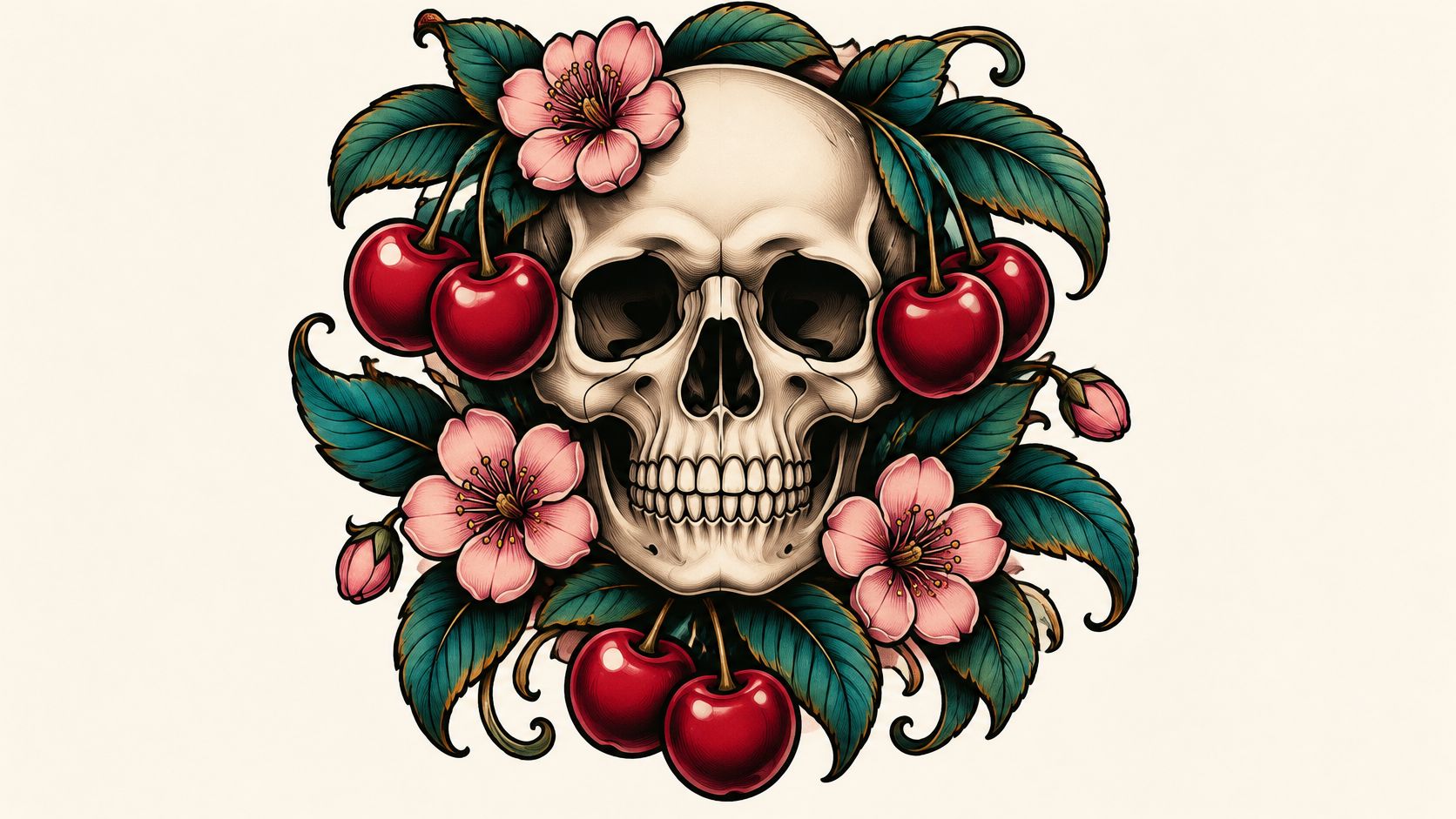
Neo-traditional keeps the bold outline and throws away the restraint. The skull gets richer shading, the fruit gets leaves and blossom, and the composition loosens into something closer to a painting than a stencil. For clients who love the traditional silhouette but want depth, this is the natural next step.
The cherry half of the motif earns its keep here. Cherries appear in medieval Christian imagery tied to purity and paradise, and Renaissance painters used them for innocence and sensuality at once, as in Titian's Madonna of the Cherries from around 1515. The erotic reading hardened into language later: Elephant's history of the cherry motif dates the first documented use of "cherry" as a euphemism for the hymen to 1889. That double meaning is why a cherry cluster can sit beside a skull without turning cute.
Where neo-traditional goes wrong
Too many elements at one focal point. A skull, six cherries, three blossoms, two leaves and a jeweled frame at eight centimeters wide becomes a dark coin. Pick one supporting element and let the rest go.
Palette for this style:
- Black outline, gray wash through the cranium and jaw for depth.
- Deep crimson to orange-red on the cherries, allowing a gradient the old school version can't carry.
- Sage or olive green on leaves, muted rather than bright.
- One accent metallic tone, gold or soft teal, used sparingly.
Aging favors the bold version. Smooth gray shading softens evenly; tight color transitions in a cherry can blur into one tone after a few years, which is fine if the shape is strong.
A skull at four centimeters wide and a skull at fourteen centimeters wide are different designs. Build the neo-traditional version at the size you'll wear it.
Prompt: Neo-traditional tattoo of a human skull in three-quarter view framed by a cluster of cherries, cherry blossoms and leaves, bold black outlines, smooth gray and deep crimson shading, subtle gold accent dots, flowing asymmetric composition, painterly but high contrast.
3. Sugar Skull with Cherries (Día de Muertos Style)
Say you want a memorial piece for someone who loved marigolds and left a kitchen full of fruit. A sugar skull with cherries works because it's decorative by tradition, not by accident, and it can carry pattern, color and personal symbols in the same shape.
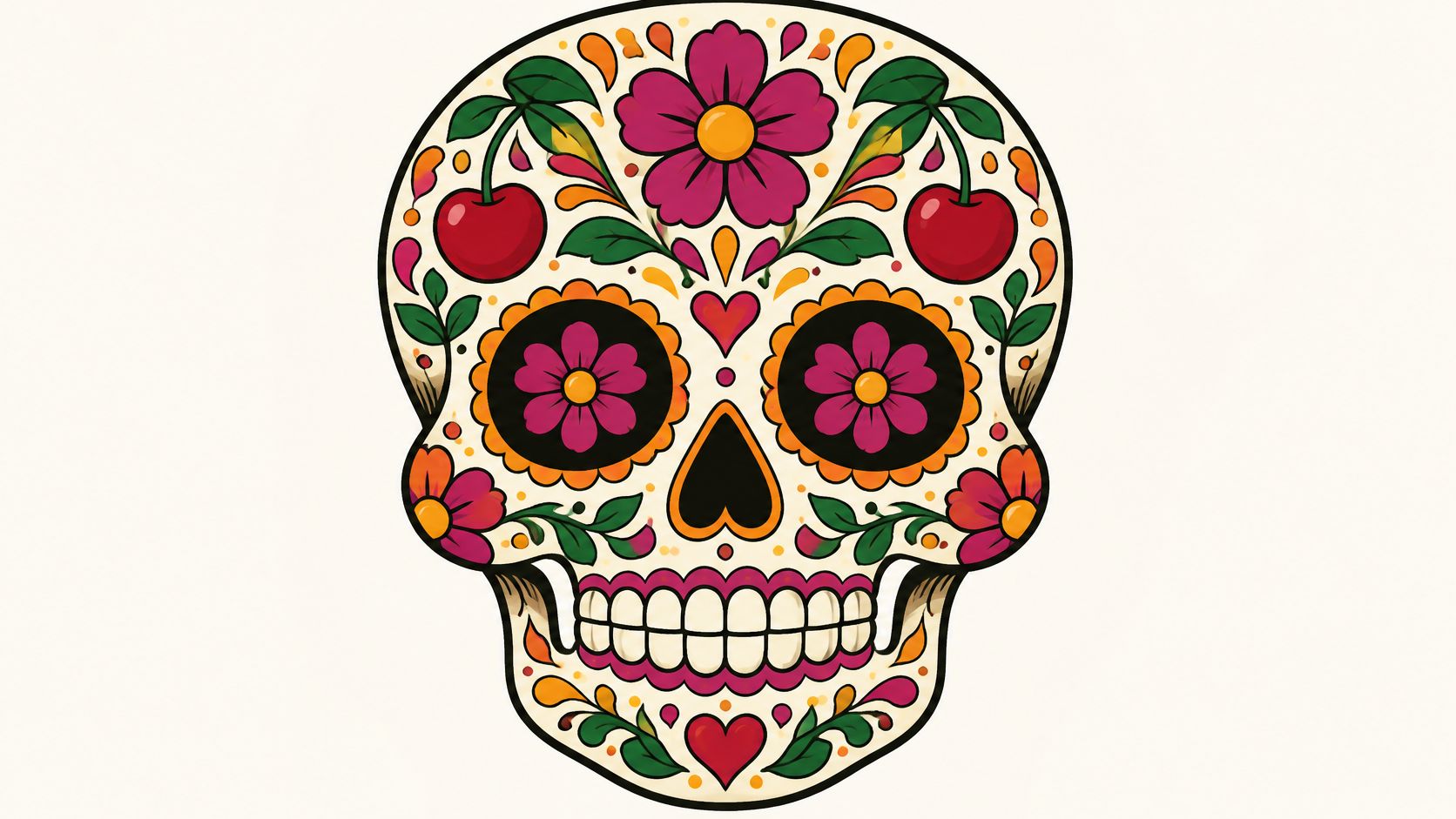
The style draws on Mexican Día de Muertos imagery: scalloped eye sockets, floral forehead patterns, dots and geometric bands, with cherries added as color accents. It celebrates remembrance rather than horror, which is why it's popular for memorial work and for chest and shoulder pieces where a full-color design has room to spread.
Red is the risk. The Mayo Clinic's guidance on tattoos and piercings notes that red pigments are disproportionately associated with allergic reactions compared with many other colors, and that reactions can appear years after the tattoo was done. If you've reacted to cheap earrings or red dye, say so at the consultation and let the artist test a small area or lean on magenta and orange-red instead.
Practical notes for this style:
- Research the cultural source. Día de Muertos imagery has living religious and family meaning. Borrow the visual language respectfully, and skip anything that reads as mockery.
- Pick flat, stable skin. Chest, shoulder blade and upper arm hold fine pattern better than ribs or a hand.
- Watch the small dots. Tiny dots and hairline swirls in a sugar skull are the first things to blur.
For the broader symbolism of skull designs, including how they moved from warning to fashion, see this guide to skull tattoo meanings. Artists who turn finished designs into prints or stickers will find useful packaging and production ideas in these small business craft ideas from Raccoon Transfers.
Prompt: Decorative sugar skull tattoo, full color, forehead patterned with marigolds and cherries, scalloped eye sockets, symmetrical front-facing, magenta, teal and orange accents, crisp linework, cream background.
4. Blackwork Skull and Cherry Pair
Blackwork is where the skull and cherry pairing gets interesting, because you lose color and gain nerve. Solid fills, stippled gradients and hard negative space turn the cherries into silhouettes with two small highlights. It reads as graphic design rather than flash, and it suits people who want the motif without the sweet-shop palette.
Reading blackwork at arm's length
Contrast is the whole design. A skull in solid black needs a clear value break from the fruit, or the two shapes merge into a dark mass at a glance. Ask for the cherries at a different value than the skull, solid black fruit against a stippled skull, or the reverse.
Pigment load matters with large solid areas. The IARC's background on tattoo inks notes that inks can be complex mixtures containing up to 100 chemicals, and that the long-term health effects of many color pigments remain incompletely characterized. Blackwork cuts out most color uncertainty, but a saturated black panel is still a large surface area, so skill and hygiene matter more than the palette.
- Solid fill gives the hardest edge and the most durable contrast, at the cost of a heavy, hot first session.
- Stippling looks softer and photographs beautifully, but it fades faster and needs touch-ups sooner.
- Negative space is free highlight. Plan it in, don't add it later.
- Line hierarchy keeps the skull from reading as a sticker: heavier outer contour, lighter internal lines.
A minimal black skull and cherry pair on the forearm ages better than people expect, because there's no color to shift and no fine detail to lose.
Prompt: Blackwork tattoo of a skull with two cherries, solid black fills, stippled gradient through the cranium, negative space highlights on the cherries, no color, graphic silhouette, high contrast, forearm composition.
5. Fine-Line Minimalist Skull and Cherry
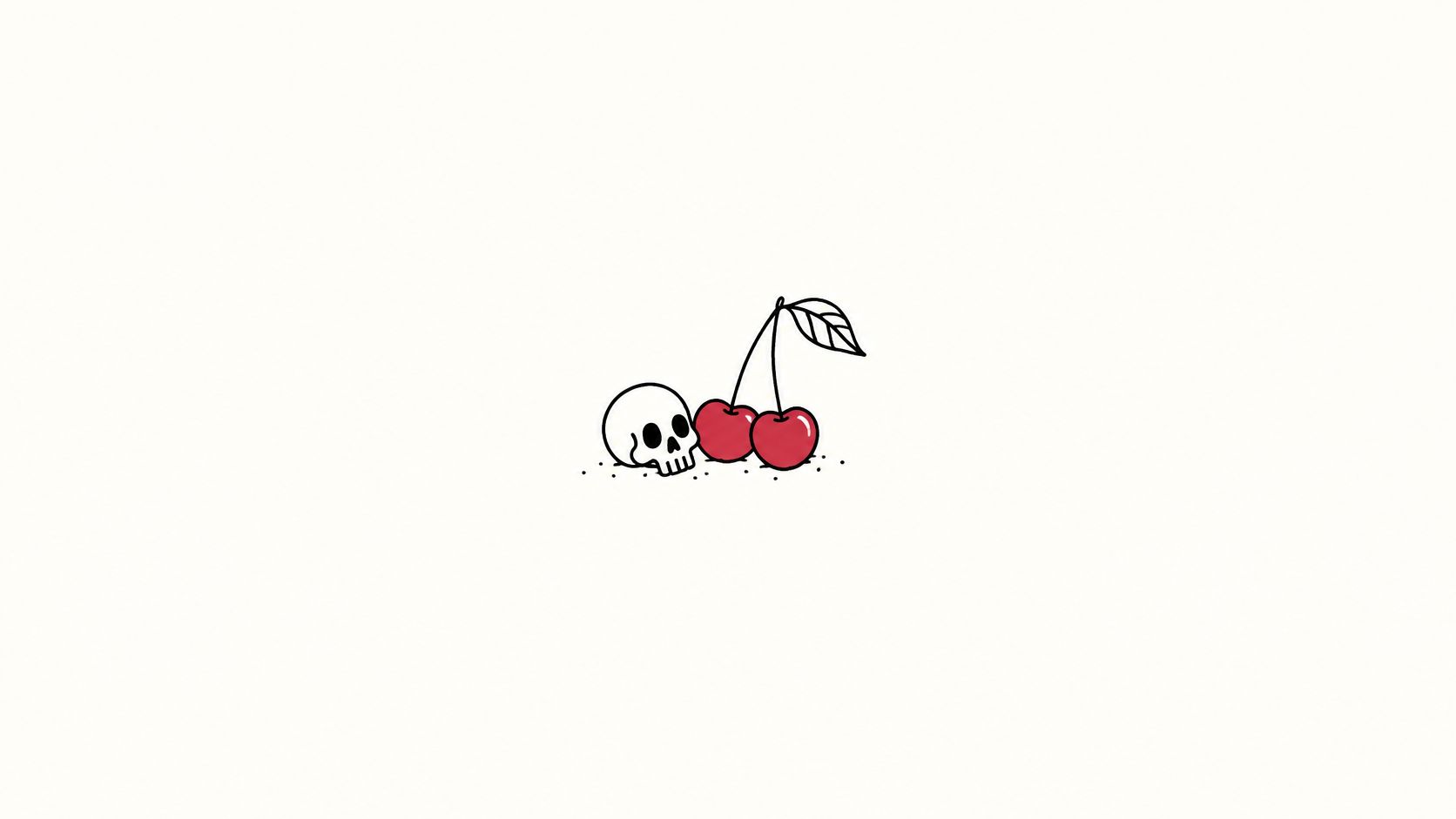
The minimalist version reduces the skull to a contour and the cherries to two circles on a shared stem. It's the quietest option on this list, and the one most likely to be chosen by someone getting a first tattoo on a wrist, an ankle, or behind the ear.
Sizing decides whether it survives. Ink spreads slowly in skin, so lines drawn a hair apart merge within a couple of years. Keep gaps between lines wide enough that they can't close up, and avoid shading at all if the piece stays small. The routine failure with this style is asking for a detailed skull at a size where the eye sockets collapse into two small dots.
Sizing rules that keep fine line legible
- Simplify before you shrink. Drop the teeth first, then the shading, then the jaw definition.
- Avoid high-friction placements. Fingers, palms, the side of the foot and inner lip all lose fine line quickly.
- Choose a slower-fading spot such as the inner forearm, upper back or thigh, and protect it from sun.
- Plan one touch-up in the first two years rather than pretending it won't be needed.
Ask the artist to draw the design at final size on paper, then hold it on the body part in a mirror. A stencil that looks delicate on a tablet can look like a scratch at three centimeters.
Prompt: Minimalist fine-line tattoo, single needle, small skull outline beside two cherries on a thin shared stem, no shading, clean even gaps between lines, wrist scale, black ink on light skin, white background.
6. Watercolor Skull with Cherry Splashes
Watercolor tattoos trade the outline for atmosphere. The skull is drawn lightly or left partly open, and the cherries arrive as saturated blooms with soft edges and splatter. It is the most painterly option here, and the one that depends most on how the artist handles saturation.
Building a palette that survives regulation
Color choice is no longer only aesthetic. The EU's REACH restrictions on tattoo inks have limited more than 4,000 hazardous chemicals in tattoo inks since January 2022, with transitional rules for Pigment Blue 15:3 and Pigment Green 7 running through January 2023. Specify cherry color by hue family and value, deep red, muted crimson or orange-red, rather than naming an ink brand. A studio in a different market may be working from a different compliant lineup.
Reviewing healed work matters more here than anywhere else. Fresh watercolor looks spectacular in every portfolio. Healed watercolor separates the artists who understand saturation from the ones who do not, so ask specifically for photos at least a year old.
- Outline discipline: a faint but present keyline on the skull holds the shape while the washes move.
- Cherry saturation: keep the fruit as the most saturated point in the design so the eye has somewhere to land.
- Placement: upper arm, thigh and back hold washes longer than hands, feet or anything under a waistband.
For how the technique behaves in skin, this explanation of how watercolor tattoos work is a useful primer. Screen tests are a separate exercise: you can make fantasy landscapes with AI to see how red blooms, splatter and soft washes sit together before you lock a palette.
Prompt: Watercolor tattoo of a loosely outlined skull with red and pink cherry color blooms, splatter edges, soft washes, thin keylines, generous white space, upper arm composition, no heavy black fill.
7. Japanese-Inspired Skull with Sakura and Cherries
Irezumi changes the logic of the design. Instead of a skull sitting on a background, the skull becomes part of a scene: blossoms crossing the jaw, wind bars pushing behind the cranium, water or clouds filling the gaps. Sakura carries its own weight here, since cherry blossoms symbolize impermanence and beauty in Japanese culture, which is the same thought a skull expresses with less poetry.
This is the style that rewards patience. A proper back or sleeve composition is multi-session work, and planning the flow around the body's curves matters more than any single element. A skull dropped onto a half-finished sleeve looks pasted on. A skull integrated into a branch, with petals breaking across the collarbone or shoulder cap, looks intentional.
Planning the sessions
Break the piece into blocks rather than tattooing it in one heroic sitting. Outline and primary black first, then background, then color, then any final highlights. Long sessions on large coverage are where hygiene questions matter most, and the FDA's tattoo safety guidance reports that even sealed tattoo inks can contain bacteria or other microorganisms, and that reactions can include infection or allergy.
Imaging is the other long-term consideration nobody mentions at booking. MRI worries get exaggerated online: tattoo-related reactions during scans are uncommon, but they do happen, usually reported as warmth or a pulling sensation around the inked area. The practical rule is simple. Tell MRI staff you have tattoos, and report burning or unusual sensation if it happens.
Prompt: Japanese irezumi tattoo of a skull half hidden behind a cherry blossom branch, sakura petals and wind bars, bold black outlines, limited palette of black, deep red and indigo, flowing background, back piece composition.
Skull and Cherry Tattoo Styles at a Glance
Read the columns together: palette drives the prompt, placement limits detail, and aging predicts touch-ups.
| Style | Color Palette | Best Placements | How It Ages |
|---|---|---|---|
| Traditional American Skull and Cherries | Red, yellow, green, black, and occasional white | Forearm, calf, upper arm | Bold outline and contrast usually stay readable; color may soften before the black |
| Neo-Traditional Skull with Cherry Blossom Cluster | Deep crimson to orange-red cherries, muted sage or olive leaves, gray wash shading, and one gold or soft teal accent | Sleeve and other large areas | Wider color range needs room; packed shading can lose separation if scaled too small |
| Sugar Skull with Cherries (Día de Muertos Style) | Saturated magenta, orange, yellow, and other bright colors | Shoulder, chest, or flat, stable areas | Fine patterns may blur over time, so keep decorative details larger |
| Blackwork Skull and Cherry Pair | Black ink with negative-space highlights | Chest, back, sleeve, forearm, or rib | Solid black tends to hold definition well; heavy fill needs confident execution |
| Fine-Line Minimalist Skull and Cherry | Mostly black linework with an optional accent color | Wrist, ankle, or behind the ear | Fine lines can soften or spread; tiny details may lose clarity |
| Watercolor Skull with Cherry Splashes | Blended washes, vivid reds or pinks, and splashes | Upper arm, thigh, or back; lower-friction areas | Color may fade or blur faster than bold styles; a firm silhouette helps |
| Japanese-Inspired Skull with Sakura and Cherries | Bold black outlines with traditional color fills | Full sleeve, back, or leg | Large, detailed compositions require careful planning for lasting clarity |
From Concept to Ink and Into the Chair
Pick your style with three filters, in this order.
- Placement first. Small and curved spots (wrist, ankle, behind the ear) rule out sugar skull pattern work and dense blackwork. Flat, broad areas like the upper arm, thigh or back let any style on this list breathe.
- Aging second. If you want the piece to read close to the original in five years, traditional, blackwork and Japanese compositions hold. Fine line and watercolor are beautiful choices, but they come with maintenance.
- Colour third. Full colour means more healing attention and more pigment considerations. Black and gray removes most of that variable without removing the symbolism.
Then build your reference set. A generator such as TattoosAI, which offers 19 tattoo styles from Blackwork and Japanese to Dotwork and Realistic, turns a written description into multiple concepts in minutes, and you can generate unlimited variations of the same idea until the composition clicks. Everything you generate is yours to use, including getting it tattooed. What a generator cannot do is feel your skin, judge how a line will spread on your forearm, or resize a design to fit a shoulder blade. Treat every output as a reference for your artist, and let a tattooist you trust adapt it to your body, your skin and how the design will age.
If you are the artist rather than the client, Sup Growth's Instagram guide for artists covers how to photograph and post portfolio pieces like these so they reach the right audience.
Your next step is concrete. Write one detailed prompt for each style you are seriously considering, generate a set for each, then lay the strongest three side by side at the actual size you want on the actual body part. Book the consultation with those images plus your prompt text in hand, and let the artist tell you which one will still read in five years.
TattoosAI lets you describe your skull and cherry idea in plain language, choose from 19 tattoo styles, and generate unlimited reference concepts before you book a single consultation. It shows you quickly how the same motif behaves as traditional flash, solid blackwork or a loose watercolor wash, so you walk into the studio with options instead of guesswork. Head to TattoosAI and start generating your first set of references today.