TattoosAI
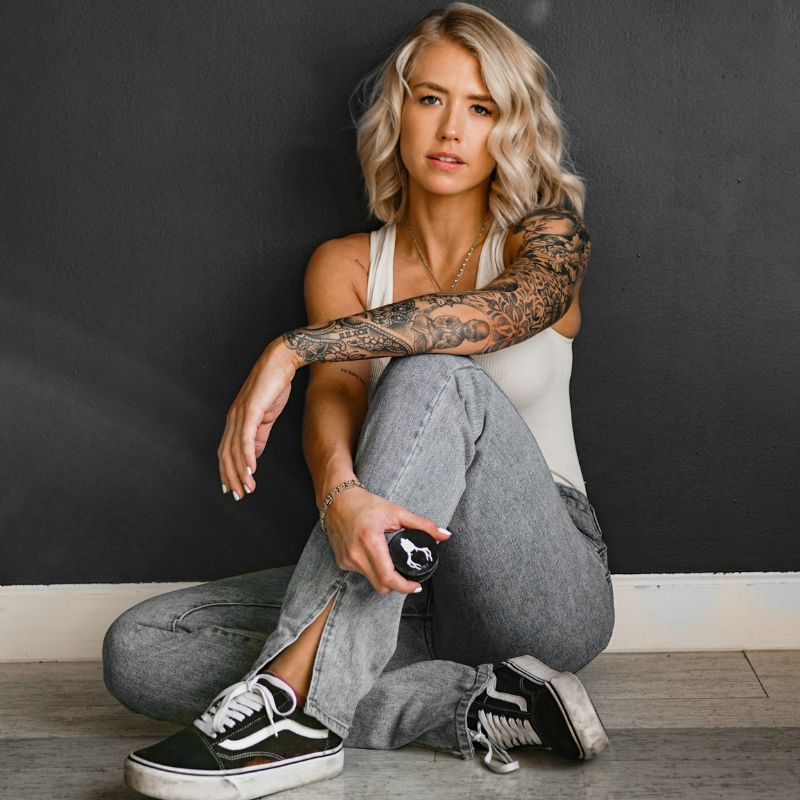
What should your sleeve tattoo say about you after the trend that inspired it has passed? A full-arm tattoo isn't a mere collection of attractive images. It's a long-term composition that has to work with your anatomy, wardrobe, daily visibility, personal meaning, and tolerance for maintenance.
Women are a major audience for large tattoo projects. A 2024 article reports that 22% of the female population in the UK is inked, which it describes as 7 percentage points higher than the male population. The figure helps explain why sleeve tattoo women ideas have moved from unusual to widely discussed alongside floral, watercolor, ornamental, and minimalist styles. For anyone considering a major piece, the more useful question isn't whether a sleeve is fashionable. It's whether the chosen visual language can stay coherent as the tattoo heals, ages, and potentially grows.
This guide presents eight distinct directions, from botanical compositions to meaningful portraits. Each one connects inspiration with practical decisions about motif selection, visual flow, placement, longevity, budget conversations, and artist collaboration. You'll explore the style, test how its parts work together, consider its trade-offs, and finish with a focused brief you can take to a qualified tattooist. If you already have ink you regret, review this guide to tattoo removal at 3D Aesthetics before adding a new large-scale project.
Table of Contents
- 1. Floral and Botanical Sleeve
- 2. Celestial and Cosmic Sleeve
- 3. Japanese and Asian-Inspired Sleeve
- 4. Minimalist and Line Art Sleeve
- 5. Watercolor and Artistic Sleeve
- 6. Geometric and Sacred Geometry Sleeve
- 7. Portraiture and Meaningful Faces Sleeve
- 8. Nature and Animal Sleeve
- 8-Style Womens Sleeve Tattoo Comparison
- Turn Inspiration Into an Artist-Ready Brief
1. Floral and Botanical Sleeve
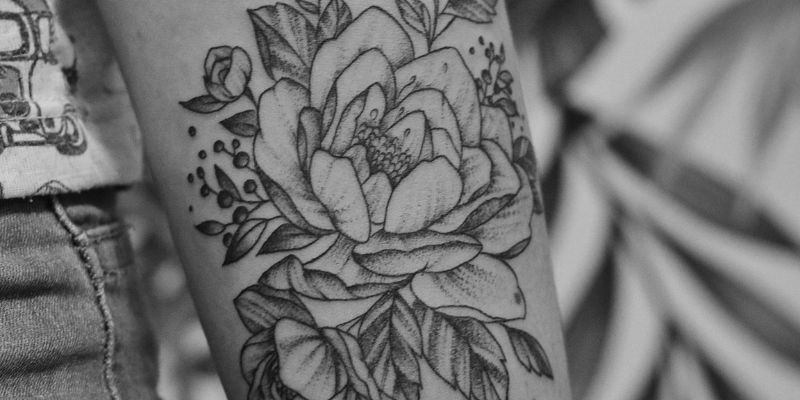
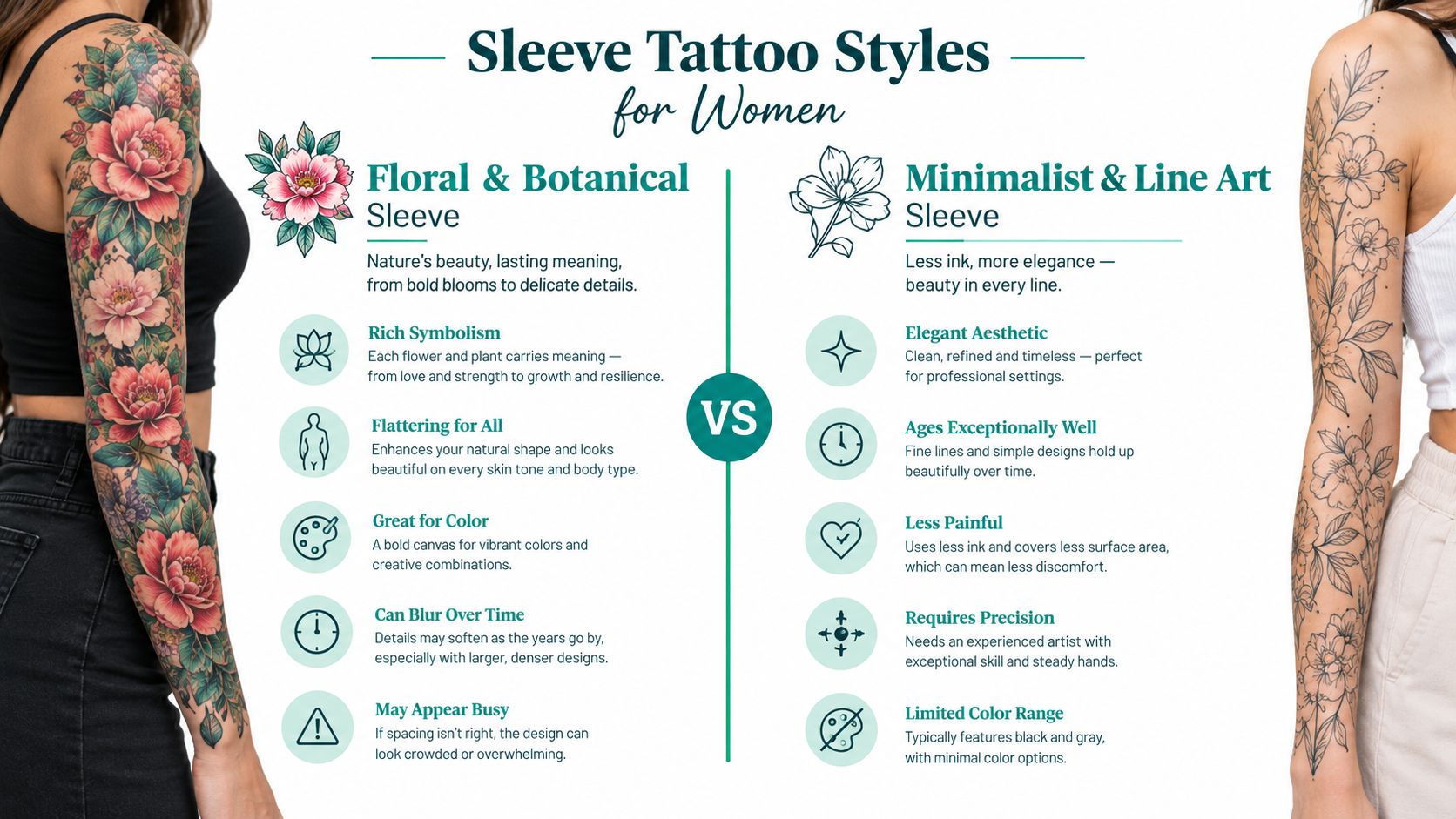
Flowers give you a flexible visual vocabulary, but a strong botanical sleeve needs more than a list of favorite blooms. Peonies, garden roses, ferns, vines, leaves, and seed heads can create movement from the shoulder down the arm while leaving breathing room between major forms. A sleeve might use realistic shading, loose watercolor washes, or fine dotwork, depending on the mood you want to wear.
Start with the story behind the plants. Roses can suggest love, while a lotus is often associated with transformation, but personal experience matters more than a fixed dictionary of meanings. A woman marking a new chapter might choose a lotus as an anchor motif, then use smaller leaves and open buds to connect it to the wrist. Someone who loves gardening could build the composition around plants from a real garden rather than relying on generic flowers.
Build movement before detail
Ask TattoosAI to compare a watercolor botanical sleeve, a dotwork garden composition, and a realistic peony arrangement before you commit to one direction. Its floral arm sleeve tattoo guidance can help you identify prompt ideas, but the final composition still needs to be redrawn for your arm by an experienced artist.
Place the largest flowers where you want the eye to pause, often around the shoulder cap or outer upper arm. Let stems, leaves, and negative space guide the eye through the elbow rather than forcing every gap to contain a flower. The elbow ditch and inner arm can be difficult areas for fine detail, so your artist may use softer shading or larger leaves there.
Practical rule: Choose the flowers first, then choose the style. A meaningful motif will give the artist more to compose than a vague request for something “pretty.”
Color can make petals vivid, but it also creates a maintenance conversation. Ask how the artist expects the palette to heal on your skin and how future touch-ups would fit into your plans. A botanical sleeve should feel like one garden, not eight unrelated flash designs.
2. Celestial and Cosmic Sleeve
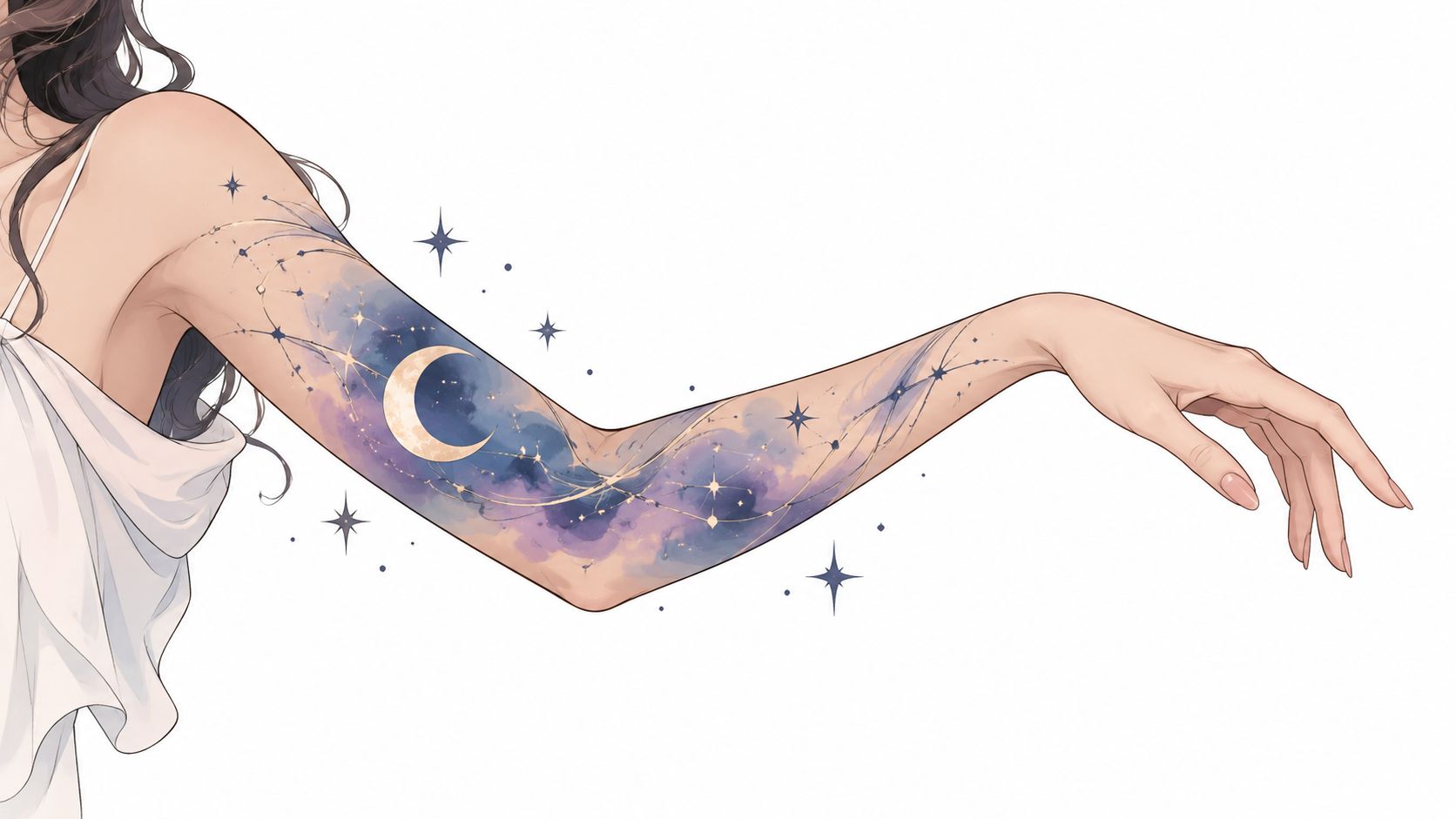
A cosmic sleeve can feel mystical, scientific, personal, or subtly decorative. The difference comes from how you combine the elements. A crescent moon with a meaningful date creates a different emotional tone from a detailed galaxy, while a constellation map can make the arm feel like a personal chart rather than a generic space scene.
Begin with one dominant celestial form. A large moon, planet, sun, or eclipse can establish the visual hierarchy. Smaller stars should support that anchor instead of competing with it. If you want a zodiac theme, check the constellation carefully and decide whether accuracy, symbolism, or visual beauty matters most to you. An artist can then adapt the arrangement to the curve of your upper arm and forearm.
Decide whether the sky should be soft or structured
Use TattoosAI to generate several prompts built around the same subject. Try a watercolor galaxy with a crescent moon, a minimalist constellation sleeve, and a geometric zodiac composition. Comparing these versions can reveal whether you prefer hazy color, crisp linework, or a controlled mixture of both.
A woman who wants subtle everyday visibility might choose thin constellation lines and carefully placed stars. Someone who wants the tattoo to read from across a room may need larger planets, stronger contrast, and fewer tiny details. The choice affects both mood and longevity. Tiny marks can disappear into visual noise, particularly when they sit close together.
Think about the spaces between the objects. Dark galaxy clouds can connect separate motifs, but a heavy background may reduce the lightness that attracted you to celestial work in the first place. Negative space can act like silence between lines of a song, allowing each moon or star cluster to remain legible.
For a realistic scenario, imagine planning a sleeve around a birth constellation, a moon phase, and a planet connected to a personal interest in astronomy. Rather than placing each symbol as an isolated sticker, ask the artist to use orbit lines, soft shading, and controlled spacing to create one route around the arm. The result can feel personal without requiring every detail to be explained.
3. Japanese and Asian-Inspired Sleeve
Japanese-inspired sleeves depend on composition, movement, and cultural understanding. Koi, dragons, phoenixes, cherry blossoms, peonies, waves, clouds, and mist can create a powerful arm narrative, but the motifs shouldn't be selected only because they look striking in separate reference images.
A koi composition often uses water and wave patterns to connect the fish to the body. A phoenix may need flames or smoke to create a sense of ascent. A dragon can move through clouds and wind bars so its body follows the arm rather than sitting like a large isolated illustration. These surrounding elements aren't empty decoration. They help the sleeve maintain rhythm as it wraps around the shoulder, elbow, and forearm.
Choose an artist for the whole visual system
Research the meanings and histories of the motifs that interest you, particularly if you want your tattoo to engage with Irezumi or another established tradition. Discuss your interpretation with an artist who has demonstrated experience in Japanese techniques and can explain how the selected elements work together.
TattoosAI's Japanese style option can help you compare early directions, such as a red koi with waves, a phoenix with peonies, or a dragon surrounded by clouds. Treat those generations as conversation material rather than a stencil. A tattooist must adjust the design for your proportions, skin, movement, and the technical demands of healed tattooing.
The historical context matters. A separate summary describes the mainstream rise of tattoo sleeves in Western culture through the late 1980s Tattoo Renaissance, when tattooing moved toward larger custom work influenced by Polynesian and Japanese art. It also notes that women's participation became more visible from the 1970s onward, as tattoos increasingly represented freedom and individuality. A 2017 poll cited by the same historical source reported that 16% of women were interested in full-sleeve tattoos, compared with 84% of men. Read the history and development of tattoo sleeves as context, not as a formula for choosing your design.
A woman planning a koi and peony sleeve might ask for a composition that begins with the koi at the upper arm, uses waves to pass around the elbow, and lets blossoms open toward the wrist. That structure gives the artist room to create a readable narrative while respecting the arm's natural movement.
4. Minimalist and Line Art Sleeve
Minimalist work looks simple only when the design has been edited carefully. A single-line vine, geometric arm pattern, constellation, or abstract portrait can use very little ink while demanding precise decisions about spacing, line weight, and placement. The absence of heavy shading makes every relationship between marks more visible.
Start by testing the design at a distance, not only as a close-up image on your phone. A fine-line composition that looks elegant on a screen may lose its structure when viewed across a room or wrapped around the arm. Ask whether the main shape remains recognizable when your elbow is bent and your forearm turns.
Let negative space do real work
TattoosAI can compare minimalist, line art, and dotwork versions of the same concept. For example, you could generate an interconnected leaf sleeve, a geometric arm pattern, and a fine-line portrait surrounded by open space. The comparison helps you see whether your idea needs more contrast, fewer elements, or a stronger anchor motif.
A woman who wants a subtle sleeve for flexible styling might choose a flowing botanical line that stops before the wrist. Another client may prefer a full-arm arrangement of asymmetric geometric shapes, with each form positioned to complement the bicep, elbow, and forearm. Neither approach is automatically more practical. The right choice depends on how much visibility and visual intensity you want.
Find an artist whose healed portfolio demonstrates consistent line quality. Ask to see work after it has settled, not only freshly completed photographs. Fine detail and delicate spacing need a careful discussion about skin, placement, and the way the tattoo may change over time.
“Minimal ink doesn't remove the need for planning. It makes planning visible.”
Avoid filling every open area just because you have paid for a sleeve. Negative space can make a design look intentional and give future additions somewhere to live. If you want a modular sleeve that evolves, ask the artist to establish a visual language first, such as shared line weight, repeated curves, or a limited motif family. That approach lets later pieces feel related without forcing every tattoo into one rigid illustration.
5. Watercolor and Artistic Sleeve
Watercolor sleeves bring the language of painting to the skin through blended color, loose edges, expressive marks, and unusual transitions. Birds, foxes, flowers, natural scenes, and abstract forms can all work, provided the subject has enough structure to stay readable as the softer effects settle.
Start with the emotional center, then choose the palette. A bird crossing layered blue and violet washes can suggest freedom. Muted greens can connect a scene to a meaningful place. An abstract botanical sleeve may use moving color instead of realistic leaves to represent growth or change. The motif sets the message, while the palette sets its emotional temperature.
Balance painterly effects with tattoo structure
Use TattoosAI to compare several concepts built around one motif. Try a watercolor bird with an abstract backdrop, a painted fox with controlled black outlines, and an impressionistic botanical sleeve. These variations can clarify whether you prefer recognizable subjects or color-led abstraction. Request monochrome and color versions as well, so you can judge how much the design depends on hue or contrast.
Review the full arm, not only a front-facing preview. A color wash that looks balanced on a flat image may feel crowded when it wraps around the upper arm, elbow, and forearm. Check the visual flow from the main subject to supporting marks, then decide where the strongest color should sit and where open skin should provide rest.
“Painterly freedom still needs a clear structure.”
Discuss longevity before booking. Bright saturation may define the first impression, but your artist should explain how the palette is expected to heal on your skin and whether future refresh work could affect your budget. No tattoo stays identical to its first photograph. Later care may involve simplifying, reinforcing, or rebalancing selected areas.
A client who loves loose watercolor effects may work in a setting where a vivid full sleeve feels too conspicuous. The artist could preserve the painterly idea by reducing background coverage, ending the main color field above the wrist, or adding black linework for stronger control. Your lifestyle, placement preferences, session plan, and budget should shape the brief before the first appointment.
Choose an artist with healed color work and complete sleeve compositions in their portfolio, rather than isolated watercolor splashes. Ask how they would adapt the TattoosAI concept to your skin, anatomy, and long-term plans. Strong artistic sleeves combine color movement with anchor shapes and intentional open skin, so the arm remains readable as one designed piece.
6. Geometric and Sacred Geometry Sleeve
Geometric sleeves reward precision. Mandalas, interlocking polygons, Metatron's cube, the flower of life, angular animals, and repeating line systems can create a structured arm composition with a strong sense of order. They can also reveal every placement mistake, because symmetry makes small inconsistencies easy to notice.
Decide whether the geometry is the subject or the framework. A mandala-centered sleeve may use layered circles and radial symmetry as its main event. A geometric wolf or moth can use angular planes to reinterpret an organic subject. You can also pair strict geometry with leaves, smoke, or soft shading to keep the arm from feeling too mechanical.
Protect the alignment
Generate several concepts with TattoosAI using prompts such as mandala sleeve with open negative space, sacred geometry with botanical accents, or faceted animal with geometric framing. Compare where the largest pattern sits and how much of the arm remains open. The most attractive front-facing image may not be the most workable design once it wraps around your body.
Research symbolic interpretations if they matter to you. Some people choose sacred geometry for spiritual reasons, while others respond primarily to its symmetry and architectural quality. Tell your artist which elements carry personal significance so the design doesn't use a symbol without understanding why you want it.
Before approval, ask the tattooist to map the central axes and major circular forms on your arm. The shoulder cap, elbow, and forearm each change how a pattern appears. A mandala that looks centered on a flat drawing can shift when the skin curves or the arm rotates.
Approval standard: If a geometric design isn't clear at full size, don't approve it because the small digital preview looks attractive.
A real-world example would be a woman combining a mandala near the shoulder with a faceted fox on the forearm. The mandala provides order, while the animal gives the composition a focal point and emotional character. A few organic leaves could soften the transition without weakening the geometric language. Document the approved direction clearly, then let the artist make the technical adjustments required for clean execution.
7. Portraiture and Meaningful Faces Sleeve
A portrait sleeve carries emotional weight that decorative motifs don't always carry. It may honor a parent, child, partner, pet, historical figure, or personal inspiration. Because the face becomes the focal point, the reference image, artist's specialization, and surrounding composition deserve careful attention.
Begin with the reason for choosing the subject. A family portrait may belong near symbols of home, while an inspirational figure might sit within books, flowers, or abstract color. Multiple faces can create a powerful story, but they can also compete for attention if every portrait receives the same scale and contrast.
Treat the reference photo as design material
Give the artist a clear, high-quality photograph that shows the expression and lighting you want to preserve. Don't assume that an artist who creates attractive realism is automatically a portrait specialist. Review healed portrait work and ask how the artist handles eyes, skin transitions, hair, and facial proportions.
TattoosAI can help you compare realistic grayscale, watercolor portrait, and abstract geometric portrait directions. Its portrait tattoo style guide can also help you identify the language you want to discuss at consultation. The generated concept may establish mood and placement, but your tattooist must interpret the reference for skin, scale, and long-term readability.
A woman memorializing a grandparent might choose a grayscale face on the outer upper arm, with flowers and a soft background leading toward the forearm. That arrangement gives the portrait a stable focal position while allowing the surrounding elements to carry additional memories. Another client may prefer an abstract version because the goal is to capture a feeling rather than create a photographic likeness.
Portrait placement is a commitment. You should feel comfortable seeing the face often and explaining, or not explaining, its significance. Discuss the emotional impact with the artist before you finalize the design, especially if the sleeve marks grief, remembrance, or a major life event.
Here is a short visual reference for thinking about portrait composition and style:
8. Nature and Animal Sleeve
Animal sleeves can express affection, resilience, independence, spirituality, or a lifelong connection to the natural world. Wolves, birds, snakes, foxes, owls, horses, pets, and phoenixes each offer a different visual and emotional starting point. The strongest compositions place the animal inside a believable environment rather than leaving it floating on the arm.
Choose the animal for both meaning and structure. A wolf can anchor a forest composition, while a bird can create upward movement through feathers and wind. A snake can wrap naturally around the arm, and a phoenix can use fire to connect separate sections. If you're honoring a pet, provide reference photos that show the animal's distinctive features, not just a generic breed image.
Give the subject a habitat
Use TattoosAI to compare realistic wolf with forest, dotwork owl with geometric framing, watercolor bird with abstract scene, and geometric animal portrait concepts. These variations can reveal whether you want natural detail, symbolic abstraction, or a hybrid. Ask for multiple arrangements, not just multiple color palettes, because flow is one of the main decisions in a sleeve.
A woman planning a wolf and forest sleeve might place the face on the outer upper arm, use trees to travel through the elbow area, and reserve the forearm for mist, branches, or smaller wildlife. That creates a visual journey from focal subject to environment. A client choosing a snake could use its body as the connective line, then add flowers or geometric elements where the anatomy leaves open space.
Select an artist with a portfolio that matches your animal's rendering style. Realistic fur, feathers, scales, and eyes require different decisions from illustrative or dotwork treatment. If you want more than one animal, decide whether they share a narrative, habitat, or visual treatment. Otherwise, the sleeve may become a set of unrelated portraits.
Avoid choosing symbolic elements only because they are popular. Write down what the animal represents to you and give that explanation to the artist. The meaning can influence expression, posture, background, and placement, turning an attractive reference into a composition that belongs to you.
8-Style Womens Sleeve Tattoo Comparison
| Style | 🔄 Complexity | ⚡ Resources & Time | ⭐📊 Expected outcomes | 💡 Ideal use cases | 📊 Key advantages |
|---|---|---|---|---|---|
| Floral & Botanical Sleeve | Medium, layered composition, botanical accuracy needed | Medium-High, color work, multiple sessions, touch-ups (2–3 yrs) | High, elegant, highly personalized; color may fade faster | Personal symbolism, colorful full/half sleeves, flattering décor | Timeless appeal, versatile color use, easy to expand |
| Celestial & Cosmic Sleeve | Medium, precision for constellations and placement | Medium, can be minimalist or color-forward; careful fine-detail care | High, meaningful and scalable; tiny stars may blur | Zodiac/astrology fans, subtle or watercolor cosmic looks | Deeply personal, versatile across styles, reads well at scale |
| Japanese & Asian-Inspired Sleeve | High, traditional Irezumi composition and cultural nuance | High, many sessions, experienced artist required, longer healing | Very High, bold lines age well; strong narrative impact | Full sleeves, cultural storytelling, traditional motif seekers | Rich symbolism, respected artistry, excellent longevity |
| Minimalist & Line Art Sleeve | Medium, demands exceptional line precision and spacing | Low-Medium, fewer sessions, less ink, faster sessions | High, ages gracefully; clarity depends on needle precision | Professional settings, first sleeves, understated aesthetics | Elegant, less painful, easy to modify or cover |
| Watercolor & Artistic Sleeve | High, translating painterly effects to skin is complex | High, color-heavy, frequent touch-ups, specialist artist | High (visual), striking and unique; colors fade faster | Wearable-art statements, expressive/creative clients | Very artistic and unique; forgiving of minor imperfections |
| Geometric & Sacred Geometry Sleeve | High, exact symmetry and technical precision required | Medium-High, careful planning, precise execution | High, timeless, photogenic; mistakes are obvious | Math/spiritual enthusiasts, modern minimal-to-complex designs | Symbolically rich, scalable, ages well with bold lines |
| Portraiture & Meaningful Faces Sleeve | Very High, hyper-realism demands top portrait skill | Very High, premium pricing, long sessions, hard to alter | Very High, deeply personal and impressive if accurate; can blur | Memorials, tributes, honoring loved ones or icons | Emotional significance, bespoke storytelling, high impact |
| Nature & Animal Sleeve | High, anatomical accuracy or stylized rendering needed | Medium-High, reference material, skilled artist, possible color work | High, visually engaging; fine fur/feather detail may blur | Wildlife enthusiasts, pet memorials, symbolic animal guides | Rich symbolism, versatile across styles, strong visual presence |
Turn Inspiration Into an Artist-Ready Brief
A sleeve becomes easier to plan when you stop treating the finished image as the first decision. Start with the experience you want the tattoo to create. Should it feel delicate, dramatic, mystical, structured, painterly, traditional, intimate, or wild? That answer gives you a primary visual language and helps you reject attractive references that don't belong in the same composition.
Next, choose a small group of anchor motifs. For a botanical sleeve, the anchors might be peonies and garden leaves. For a celestial sleeve, they could be a moon, constellation, and planet. For an animal sleeve, the main subject and its habitat may be enough. Supporting marks should connect those anchors, not compete with them.
Map the arm before approving the artwork
Ask the artist to discuss the sleeve as a series of anatomical zones:
- Shoulder and outer bicep: These areas often display large focal motifs clearly and can support the visual opening of the composition.
- Elbow and inner arm: These areas need careful planning because movement, folds, and healing can affect fine detail and readability.
- Outer forearm: This area can carry a strong secondary subject or a visual continuation of the main story.
- Wrist and hand transition: Decide how visible you want the project to be and whether the sleeve should stop before the wrist.
A neutral studio planning guide describes a full sleeve as shoulder to wrist, a half sleeve as shoulder to elbow or elbow to wrist, and recommends planning the arm in anatomical zones. It also places a full sleeve at about 20 to 40 tattooing hours across 4 to 8 sessions, commonly spaced 3 to 6 weeks apart, with many projects taking 6 to 12 months to complete. Review the tattoo sleeve planning guide with your artist, then ask how your chosen style, body placement, and healing needs could change that estimate.
Make visibility a deliberate choice
A full wrist finish creates a more permanent visibility commitment than a sleeve that stops higher on the forearm. One independent guide notes that a 3/4 sleeve ending at mid-forearm or a quarter sleeve ending at mid-bicep can be selected for concealment under blazers, while it also distinguishes the different visual and aging considerations of fine-line and bolder traditional work. Its guide to full-sleeve tattoo ideas for women is useful for thinking through clothing, workplace flexibility, pain zones, and style trade-offs.
Don't ask the artist for a concealment promise based only on a digital mockup. Bring the clothes you regularly wear into the conversation. A blazer, short-sleeved shirt, watch, or bracelet can change what remains visible. Decide whether you want a full sleeve, 3/4 sleeve, half sleeve, or a modular patchwork arrangement before the design becomes too detailed to revise.
Choose color, contrast, and detail honestly
Color can make watercolor, botanical, and Japanese work feel expansive, while black and gray can create a controlled, timeless visual language. Neither choice eliminates maintenance. Ask how the palette will heal, which details are likely to need attention, and whether the design has enough negative space to remain readable as the skin changes.
A peer-reviewed study on old tattoos found pigment localized inside cells in both the epidermis and dermis, and medical literature has reported pigment in tattoos older than 40 years, including in the deep dermis and local lymph nodes. The peer-reviewed research on tattoo pigment retention supports a practical planning point. A sleeve is a long-term skin project, so larger anchor shapes and durable negative space are generally more dependable than relying on tiny detail in high-movement areas such as the elbow.
Discuss time, money, and collaboration early
Budget conversations should include more than the artist's hourly rate. Ask how the artist estimates sessions, what happens if the composition changes, whether a later continuation will require a new consultation, and how touch-up decisions are handled after healing. Don't choose an artist solely because a concept looks inexpensive or because a single-session expectation sounds convenient. A large sleeve may need a schedule that fits your finances, work, travel, and recovery.
TattoosAI can help you compare concepts before that consultation. Describe specific motifs, select styles such as minimalist, dotwork, Japanese, watercolor, geometric, or blackwork, and generate several directions rather than becoming attached to the first image. You can use the results to identify the strongest anchor, compare color and monochrome, and show the tattooist what you mean by “soft,” “ornamental,” or “dramatic.” The platform can generate multiple concepts and offers style and color options, but it doesn't replace professional body-placement judgment.
Your final brief should answer six questions: What is the main story? Which motifs anchor it? How does the design travel from shoulder to wrist? Do you want color or monochrome? Which details may require maintenance? How will the artist adapt the concept to your body?
Before booking, review the artist's healed portfolio and ask about hygiene, aftercare, session spacing, and design ownership. If you have concerns about an old tattoo, scarring, or stubborn fading, read this clinic guide to picosecond tattoo fading and raise the issue before the new sleeve is planned around it.
AI concepts are starting points. The tattooist makes the final decisions about safe execution, scale, placement, line weight, color application, and scheduling. Bring your strongest references, your clothing and visibility preferences, your meaning behind the motifs, and an honest budget conversation. That preparation gives the artist something useful to refine instead of asking them to guess what you want.
TattoosAI lets you describe a sleeve idea, explore styles such as floral, Japanese, watercolor, minimalist, geometric, and portrait, and compare multiple concepts before your studio consultation. Visit TattoosAI to test your motifs, refine your visual direction, and bring a clearer starting point to a qualified tattoo artist.