TattoosAI
Can a sperm whale tattoo mean more than a love of the ocean? Its recognizable profile, block-shaped head, and deep-ocean presence can shift from subtle line art to an expansive statement piece, but the strongest design starts with the story you want it to carry. You might be drawn to survival, maritime history, conservation, mystery, navigation, lineage, or a personal relationship with the sea.
The right visual language depends on symbolism, viewing distance, skin area, detail level, color preference, and your tattooist's specialty. A realistic portrait needs room for anatomy and texture. A minimalist outline can suit a smaller area. Geometric, watercolor, Japanese-inspired, blackwork, dotwork, and 3D approaches each change how the whale reads.
The eight concepts below function as design systems rather than fixed templates. Compare their mood, scale, placement, readability, and trade-offs, then use TattoosAI to generate and compare original ideas by specifying the whale's pose, style, mood, palette, composition, and size. Generated artwork is a planning aid, not a substitute for a professional tattooist's advice about placement, skin, stencil transfer, execution, and long-term aging.
Table of Contents
- 1. Realistic Portrait Sperm Whale Tattoo
- 2. Minimalist Line Art Sperm Whale Tattoo
- 3. Geometric and Abstract Sperm Whale Tattoo
- 4. Watercolor and Splash Sperm Whale Tattoo
- 5. Japanese Irezumi Sperm Whale Tattoo
- 6. Blackwork and Tribal Sperm Whale Tattoo
- 7. Dotwork and Stipple Sperm Whale Tattoo
- 8. 3D and Shadow Sperm Whale Tattoo
- 8-Style Sperm Whale Tattoo Comparison
- Turn a Whale Motif Into a Tattoo-Ready Brief
1. Realistic Portrait Sperm Whale Tattoo
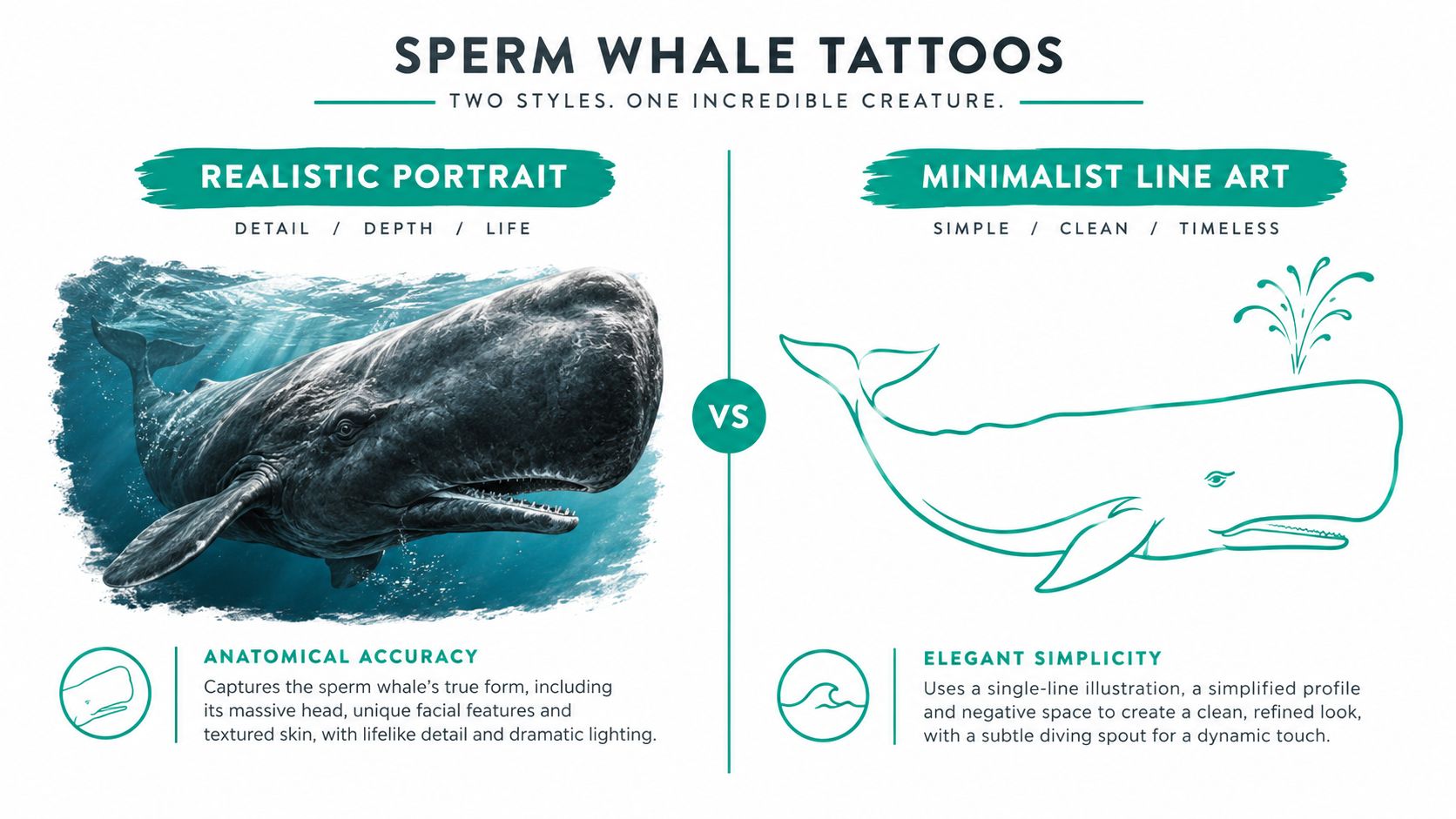
A realistic sperm whale portrait makes the animal's anatomy the central message. The massive head, wrinkled skin, small eye, and powerful upper body give the design an imposing presence without needing many decorative elements. The result can suggest respect for marine life, scientific curiosity, survival, or a direct fascination with the species itself.
This approach works best when the viewer has enough distance to read the texture. A back, chest, or thigh can provide the working area a realism artist needs, while a full sleeve can use the whale's body as a directional element that follows the arm. A very small version may lose the head-to-body relationship and turn into a generic whale silhouette.
Build the portrait around anatomy
Start with a clear reference image of a sperm whale, especially if you want the head angled toward or away from the viewer. The species' block-shaped head is one of its defining visual features, so flattening it into a conventional rounded whale can weaken the concept. NOAA's overview of sperm whales provides useful background on the animal's size, history, and distinctive cultural associations.
A marine biologist might choose a frontal or three-quarter head to express observation and advocacy. Someone interested in oceanography could add restrained sonar-like rings or deep-water negative space, but the whale should remain the dominant subject.
Practical rule: Ask for anatomical clarity first, texture second, and decorative elements third.
Use TattoosAI's 3D or hyperrealistic style settings to compare portrait directions, then test grayscale beside restrained color. A grayscale concept can make tonal structure easier to assess before an experienced realism tattooist adapts it to skin. Bring the strongest variation, your anatomy references, and a preferred placement to a consultation, because the artist will need to simplify some details for clean healing and future readability.
2. Minimalist Line Art Sperm Whale Tattoo
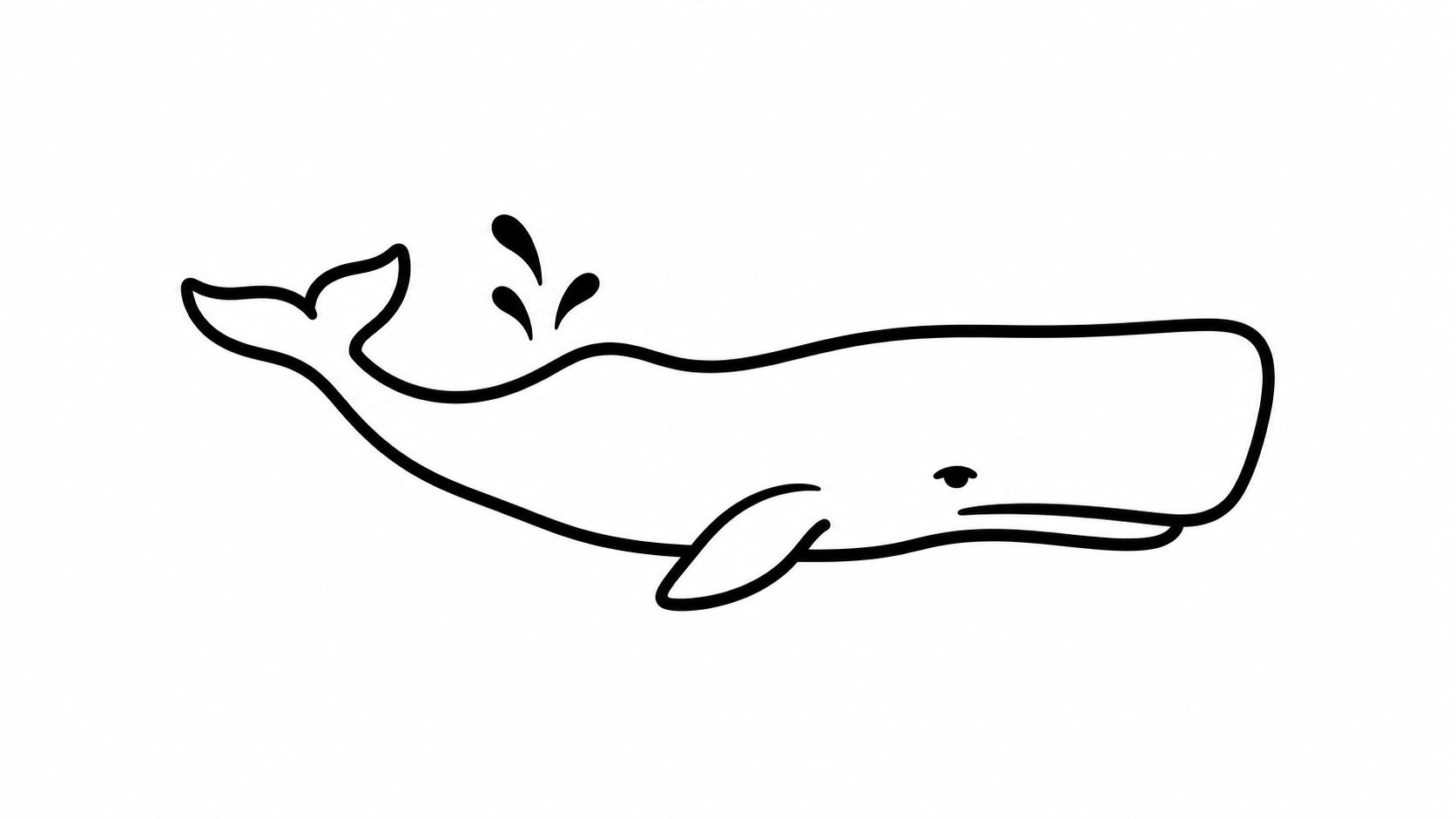
Minimalist line art reduces the whale to its most recognizable decisions. A single flowing contour can suggest the sloping head, tapering body, flukes, and swimming direction without trying to reproduce skin texture. That economy gives the design a quiet quality, which suits someone who wants ocean symbolism without a large, attention-seeking image.
The main challenge is recognition. If the line becomes too vague, the result may look like any whale. Keep at least one sperm-whale cue, such as the tall forehead, asymmetrical suggestion of the blowhole, or an unmistakable head-to-body proportion. A small water spout or a carefully placed eye can help, but extra details should remain subordinate to the silhouette.
Choose line weight with future readability in mind
Use TattoosAI's minimalist or line art settings to compare a continuous outline with a design built from several deliberate strokes. Generate both versions on a simulated wrist, forearm, ankle, or behind-the-ear concept, then ask your artist which lines need reinforcement for your skin and chosen size. The generator can help you compare visual layouts, but it doesn't replace a tattooist's judgment about how fine lines will settle.
A forearm design gives the whale a longer horizontal path and makes the swimming motion easy to read. An ankle can support a more compact profile. A finger or behind-the-ear piece needs especially careful simplification because the available area is limited and the design will be viewed at close range.
- Use negative space: Let open skin separate the head, body, and flukes rather than filling every gap.
- Strengthen essential contours: Ask for slightly more durable line weight than a digital sketch may show.
- Limit supporting marks: One spout, wave, or tiny star field can establish context without crowding the whale.
- Select a specialist: Choose an artist whose portfolio shows controlled, precise line work.
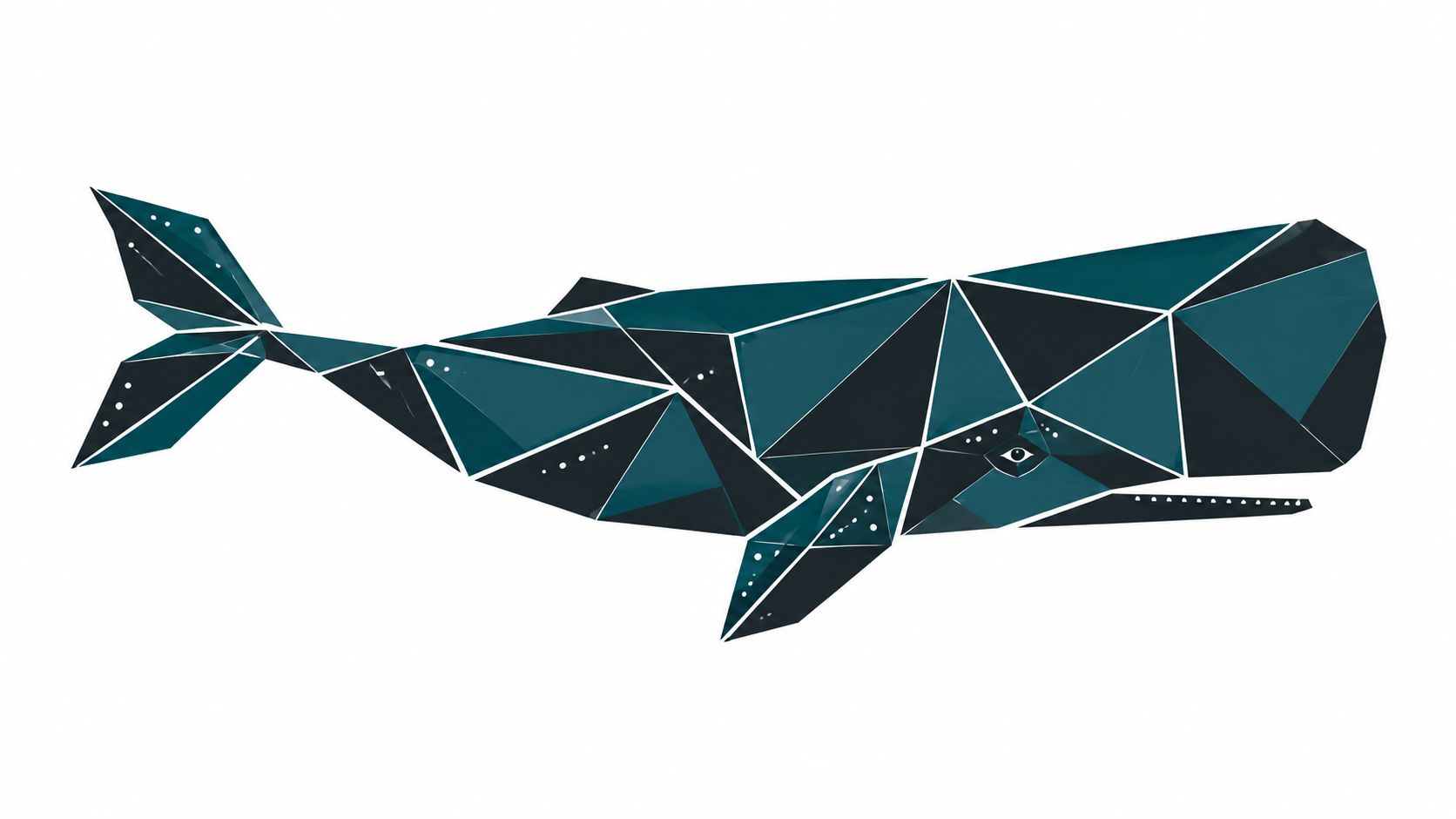
3. Geometric and Abstract Sperm Whale Tattoo
A geometric sperm whale replaces naturalistic texture with structure. Triangles, arcs, tessellations, broken planes, and circular forms can assemble into a whale that feels analytical rather than illustrative. That makes the style a strong fit for someone who connects marine biology with mathematics, architecture, technology, design, or an interest in order beneath the surface.
The silhouette still matters. If every part of the whale is fragmented equally, the head may disappear into the pattern. A stronger composition usually gives the forehead, eye, and flukes clear visual priority, then uses geometry to build the body and surrounding atmosphere.
Decide whether the geometry supports or replaces anatomy
Try two prompt directions in TattoosAI. The first can request a recognizable sperm whale formed from clean polygons and restrained negative space. The second can push further toward abstraction, using the whale as a partial silhouette emerging from intersecting circles or a mandala structure. Comparing them will show whether you want the design to read immediately or reveal itself gradually.
Larger placements give the geometry room to breathe. A thigh, back, or calf can accommodate a complete whale with surrounding forms, while a sleeve can use the body's movement to connect separate geometric sections. Symmetry is another major choice. A centered composition feels formal and emblematic. An asymmetrical design feels more dynamic and can follow the body's contours naturally.
A geometric tattoo succeeds when the pattern creates movement, not when it simply fills space.
Dotwork can soften hard geometric edges and build a deeper-ocean atmosphere without introducing conventional shading. Ask the tattooist to explain how circles, angles, and negative space will translate into a stencil. An artist experienced in geometric work can also identify where symmetry needs to bend around anatomy, especially on a calf, shoulder, or curved back.
4. Watercolor and Splash Sperm Whale Tattoo
Watercolor sperm whale tattoos prioritize movement, emotion, and color over strict anatomical rendering. Washes of blue can dissolve into the surrounding skin, while splashes and bleeding edges make the whale appear to travel through water rather than sit inside a hard outline. The style suits an expressive ocean lover, a painter, or anyone who wants the piece to feel fluid and atmospheric.
Color sets the emotional direction. Cool blues and blue-green washes reinforce depth and calm. Warm sunset tones can make the whale feel reflective, personal, or connected to a particular memory. A mostly monochrome whale with a concentrated splash around the head may feel more controlled than a design where color spreads across the entire composition.
Control the splash before it controls the whale
Use TattoosAI's watercolor setting to generate several variations with different palette and abstraction instructions. Ask for a clear sperm whale silhouette, a specific swimming direction, and a defined splash intensity. You can then compare whether the color frames the animal or obscures it.
The broad body silhouette is useful here because it can hold gradients and washes without becoming visually crowded. Neutral tattoo references also describe watercolor, realism, dotwork, and 3D as suitable approaches for whale designs, while larger areas such as the back, thigh, or calf provide more room for composition. This guide to how watercolor tattoos work can help you understand why the visual effect depends on both pigment placement and the artist's technique.
- Protect the silhouette: Keep the head and flukes readable through enough contrast.
- Choose a specialist: Review healed watercolor work, not only fresh studio photographs.
- Discuss maintenance: Ask how the artist expects the chosen palette and soft edges to change over time.
- Plan the surrounding skin: Decide whether splashes should fade softly or stop at a deliberate boundary.
5. Japanese Irezumi Sperm Whale Tattoo
A Japanese-inspired sperm whale design places the animal inside a larger visual narrative. Waves, wind bars, clouds, rocks, and selective color can turn the whale from an isolated subject into part of a composed marine scene. The approach favors strong movement and clear shapes, so it can work especially well in a back piece, chest composition, or sleeve where the body itself becomes part of the image.
Indigo, red, and black create a restrained palette with a classical print-like character. The waves can frame the whale's head, run beneath its body, or carry the eye toward another image in a sleeve. A diving whale feels more dramatic and vertical. A side profile moving across the body can create a calmer, horizontal rhythm.
Treat cultural reference as more than decoration
Use TattoosAI's Japanese or Asian art settings to test composition, then describe the wave structure and palette rather than asking for a vague “traditional” effect. This guide to Japanese tattoo styles can help you distinguish broad visual inspiration from the specific conventions an artist may use.
The artist's training matters more here than a prompt alone. Look for a portfolio that demonstrates confident wave anatomy, balanced background elements, and a consistent approach to Japanese composition. Discuss whether you want a traditional-inspired piece or a work rooted in a specific Irezumi practice, and avoid adding kanji, religious symbols, or cultural motifs just because they look attractive.
A whale can also carry maritime and conservation meanings. Commercial whaling shaped the historical relationship between humans and sperm whales, while later conservation movements changed whale imagery into a symbol of environmental protection. Those layers can inform the story, but they shouldn't be reduced to decorative shorthand.
Respectful collaboration means naming the tradition you're referencing, learning what its symbols mean, and letting a qualified artist guide the final composition.
6. Blackwork and Tribal Sperm Whale Tattoo
Could a sperm whale remain readable as a bold silhouette without borrowing cultural symbols? Blackwork answers with solid fills, strong contours, and controlled negative space. A clean profile can read across a room, while patterned interiors add texture. These choices may suggest strength, mystery, spiritual depth, or commitment to ocean conservation, depending on the surrounding imagery.
The word “tribal” requires precision. Indigenous tattoo traditions belong to particular peoples, histories, and communities. A generic pattern copied from online motifs can reduce those traditions to decoration, especially without a personal connection to the culture referenced.
Separate bold blackwork from borrowed symbolism
Ask TattoosAI to compare a solid silhouette, a version with heavy negative space, and a design using contemporary geometric patterning. Avoid assigning the prompt to a specific Indigenous tradition unless that context is genuinely yours to reference. Place the options side by side. Internal marks should clarify the whale's anatomy, not turn the body into visual noise.
Shoulder, calf, and forearm placements support compact designs because their contours can reinforce a clear outer shape. A sleeve can connect the whale with other marine creatures through consistent line weight and repeated open-skin intervals. On the back, waves or abstract currents can surround a larger whale, but solid areas need planned spacing so the tattoo does not become one dense block.
- Confirm cultural context: Research any named pattern tradition before using it.
- Prioritize contrast: Ask how solid fills and exposed skin will balance after healing.
- Choose the right specialist: Review healed blackwork, particularly designs with large filled areas.
- Protect readability: Keep the head, blowhole, eye, and flukes distinct.
A strong blackwork brief names the visual language, scale, and contrast. It does not use “tribal” as a substitute for cultural research.
The whale's teeth can introduce a scrimshaw reference. Scrimshaw is an engraved or carved linework language associated with maritime objects. Use that influence as surface texture, such as etched grooves inside the head or along the body, while discussing with the artist how to avoid romanticizing exploitation. NOAA's sperm whale background is not needed here. A tattooist can translate the reference into controlled marks without turning historical violence into decoration.
7. Dotwork and Stipple Sperm Whale Tattoo
Dotwork builds the whale slowly through concentration and spacing. Dense points can establish the shadow beneath the head, while lighter clusters can suggest reflected light across the body. Instead of relying on broad washes or solid fills, the design creates depth through thousands of small decisions, producing a meditative and finely textured surface.
This technique suits collectors who appreciate process as much as the final image. It also pairs naturally with geometric framing, constellation motifs, or deep-ocean gradients translated into stippled density. A sperm whale's wrinkled skin can become a field of controlled marks, but the artist must keep the overall silhouette legible.
Use density as your shading map
Ask TattoosAI to generate a pure stipple version and a hybrid design that combines dotwork with geometric lines. Request visible differences between light, middle, and dark dot density. These variations can help you discuss how much texture you want before the tattooist converts the concept into a workable stencil.
Larger placements, such as the back, thigh, or chest, give the artist more room to separate tonal zones. A smaller forearm piece can still work, but the prompt should request simplified texture and a strong outer contour. A dotwork specialist will also help you decide whether the whale should face upward, dive diagonally, or travel horizontally across the body.
For a collector planning a detailed sleeve, the important question isn't only how intricate the design looks on a screen. Ask how the dot spacing will remain readable after healing and natural ink softening. Your artist may remove delicate clusters, enlarge the eye, or open the negative space around the flukes. Those changes protect the visual hierarchy without abandoning the stippled character.
8. 3D and Shadow Sperm Whale Tattoo
A 3D sperm whale tattoo uses perspective and shadow to create the illusion that the animal is moving through or beyond the skin. A whale approaching the viewer can make the block-shaped head feel monumental. A diving pose can use the body's diagonal line to create motion. A whale swimming past the viewer can produce a more cinematic effect, with shadow separating it from the surrounding skin.
The concept depends on a convincing light source. If the highlights, cast shadow, and body shading point in different directions, the illusion breaks. That's why a 3D design needs more than a request for “realistic depth.” It needs a defined viewing angle, lighting direction, background treatment, and relationship to the body's curve.
Test the illusion from more than one angle
Use TattoosAI's 3D setting to generate approaching, diving, and side-passing versions. Then request variations with softer and stronger shadows. Compare them at the intended placement rather than judging only the flat digital image. A chest, back, or thigh can support a large illusion, while a curved shoulder may change how the whale appears as the wearer moves.
Discuss the design with an artist who specializes in realism and dimensional shadow work. Ask how the tattoo will look while standing, sitting, and viewed from the side. The artist may adjust the whale's proportions, shadow edge, or background so the effect works with your anatomy instead of fighting it.
A sperm whale also supports a more meaningful 3D narrative than a generic ocean scene. Its history connects maritime commerce, whaling, survival, and conservation, while Pacific cultural contexts give its teeth significance as prestige objects and gifts. This discussion of whale symbolism describes those cultural associations, including rei puta in New Zealand and tabua in Fiji. If you draw on such references, name the connection accurately and avoid treating living traditions as visual props.
8-Style Sperm Whale Tattoo Comparison
| Style | Implementation Complexity 🔄 | Resource Requirements ⚡ | Expected Outcomes ⭐📊 | Ideal Use Cases 💡 | Key Advantages ⭐ |
|---|---|---|---|---|---|
| Realistic Portrait Sperm Whale Tattoo | 🔄 High, advanced realism, long sessions | ⚡ High, elite realism artist, large placement, higher cost | ⭐📊 Photorealistic detail; dramatic visual impact; risk of some blur with aging | Back, chest, full sleeves; statement pieces | ⭐ Stunning detail and presence; readable at distance |
| Minimalist Line Art Sperm Whale Tattoo | 🔄 Low, simple, precise linework | ⚡ Low, small sessions, minimal ink, affordable | ⭐📊 Clean, timeless, subtle visual impact; less dramatic detail | Wrists, forearms, ankles, ribs; first-timers | ⭐ Fast healing; scalable; affordable |
| Geometric & Abstract Sperm Whale Tattoo | 🔄 Moderate–High, precise geometry and symmetry | ⚡ Medium, design time, skilled geometric artist | ⭐📊 Original, modern, visually striking; may be less immediately recognizable | Sleeves, thighs, calves; creative/design-savvy clients | ⭐ Unique aesthetic; versatile sizing; highly customizable |
| Watercolor & Splash Sperm Whale Tattoo | 🔄 High, painterly technique, color blending | ⚡ High, specialist color artist, careful aftercare | ⭐📊 Vibrant, emotional, painterly results; colors may fade unevenly | Larger placements (back, thigh, calf); artistic individuals | ⭐ Eye-catching, one-of-a-kind color expression |
| Japanese Irezumi Sperm Whale Tattoo | 🔄 High, traditional composition and linework | ⚡ High, Irezumi-trained artist, larger canvas, cultural research | ⭐📊 Timeless narrative pieces with strong compositional balance | Back pieces, full sleeves, chest; cultural art enthusiasts | ⭐ Rich storytelling and cultural aesthetic; ages gracefully |
| Blackwork & Tribal Sperm Whale Tattoo | 🔄 Medium, bold solid fills, precise negative space | ⚡ Medium, heavy black ink, skilled blackwork artist | ⭐📊 Extremely bold, high-contrast, long-lasting visibility | Shoulders, calves, sleeves, forearms; statement seekers | ⭐ Excellent longevity and visibility across skin tones |
| Dotwork & Stipple Sperm Whale Tattoo | 🔄 Very High, meticulous pointillist technique | ⚡ High, many sessions, specialist dotwork artist | ⭐📊 Fine tonal depth and dimensionality; very refined result | Large placements; patient collectors and design professionals | ⭐ Exceptional depth and elegant texture; long-lasting detail |
| 3D & Shadow Sperm Whale Tattoo | 🔄 Very High, advanced perspective and foreshortening | ⚡ Very High, elite 3D artist, long sessions, premium cost | ⭐📊 Genuinely three-dimensional illusion; high wow factor | Back, large chest pieces, thighs; ambitious premium clients | ⭐ Jaw-dropping realism and technical showcase |
Turn a Whale Motif Into a Tattoo-Ready Brief
Choosing one direction is more useful than combining every style in a single prompt. A realistic portrait, watercolor wash, Japanese wave composition, blackwork silhouette, and geometric mandala may all look appealing separately, but forcing them together can weaken the sperm whale's shape and leave the artist with an unfocused brief.
Start with the story. Do you want the whale to represent maritime history, conservation, mystery, navigation, personal resilience, lineage, or cultural heritage? Historical context can add depth, but it needs care. Sperm whales were commercially hunted across their global range from the nineteenth century until the 1980s, and their spermaceti oil made them valuable in American commerce, as NOAA's species overview explains. Later conservation-era whale imagery changed that relationship, while Pacific traditions give sperm whale teeth their own cultural significance.
Then choose the visual limits:
- Realism or abstraction: Decide whether anatomy should lead or whether shape, pattern, and color should carry the meaning.
- Small or large scale: Match the intended viewing distance to the amount of detail you want.
- Black ink or color: Consider contrast, palette, skin tone, and how the artist handles the chosen medium.
- Detail density: Protect the head, eye, body contour, and flukes before adding texture.
- Placement: Let the whale's swimming direction follow the body instead of forcing a flat image onto a curved area.
- Cultural care: Research any Indigenous, Japanese, Pacific, or religious reference before including it.
- Technical specialty: Choose a tattooist whose healed portfolio matches your selected style.
A repeatable TattoosAI workflow keeps the idea focused. First, describe the whale's anatomy and pose, such as “side-profile sperm whale with a clearly block-shaped head, gently diving.” Next, name one primary style, such as dotwork, watercolor, Japanese-inspired, minimalist line art, blackwork, geometric, realism, or 3D. Add only a few supporting elements, perhaps negative space, stars, waves, constellation marks, or a restrained deep-ocean background.
Specify the mood and palette in plain terms. “Quiet, mysterious, grayscale, strong negative space” will guide the concept more effectively than a list of unrelated styles. Generate several variations, compare them at the intended scale, and select the version whose silhouette remains clear without explanation.
The strongest AI concept is a conversation starter. Your tattooist turns it into a stencil that fits your skin, placement, movement, and long-term readability.
Bring the selected concept to a professional consultation, along with reference images and a short explanation of what the whale means to you. Ask the artist to revise proportions, simplify detail, choose line weights, set the lighting, and explain how the design may age. If you're still weighing permanence or placement, EradiTatt's tattoo removal insights can add another practical perspective before you commit.
A personal sperm whale tattoo doesn't need every available symbol. It needs a recognizable subject, one coherent visual language, an appropriate scale, and a story you can explain. A focused prompt and an informed artist consultation turn inspiration into a design that works on your body.
Use TattoosAI to describe your sperm whale's pose, style, mood, color, and placement direction, then compare original concepts before your studio appointment. Generate a focused starting point, take the strongest version to a professional tattooist, and use their expertise to adapt it for your skin and long-term readability.