TattoosAI
Blackwork looks simple because it removes color from the equation. In practice, that restriction makes every decision more visible. A misplaced edge, uneven fill, or poorly planned gap has nowhere to hide, because contrast, rather than blended color, creates the entire image hierarchy. The style also reaches much further back than modern tattoo culture, with the earliest confirmed human tattoos dating to about 5,300 years ago and appearing as black geometric marks on Ötzi the Iceman, as documented in this history of blackwork tattooing.
For a client, learning tattoo styles blackwork means learning to judge more than a reference image. You need to understand how black pigment behaves in skin, how negative space protects readability, why the artist's healed portfolio matters, and whether a bold cover-up will leave room for future work. The right design can look graphic, balanced, and timeless. The wrong one can become a dense commitment you'll struggle to modify later.
Table of Contents
- Defining the Core Concept of Blackwork
- The Ancient Roots and Modern Revival
- Exploring the Major Blackwork Substyles
- Technical Execution and Skin Trauma Considerations
- How to Choose the Right Blackwork Artist
- Visualizing Your Concept with AI Before Inking
- Long-Term Commitment and Future Modifications
Defining the Core Concept of Blackwork
Blackwork is often described as the foundation of tattooing, not because every tattoo belongs to the style, but because black pigment and untouched skin form one of the oldest visual languages in body art. Before artists had modern machines, they still created marks by placing dark pigment into skin. Contemporary blackwork turns that basic contrast into a deliberate design system.
Technically, blackwork uses black pigment exclusively. Its structure comes from thick outlines, solid black fills, and intentional negative space, as explained in this guide to blackwork's defining features. Negative space means the skin left uninked on purpose. It isn't empty by accident. It can separate motifs, create highlights, shape a figure, or allow a pattern to breathe across a curved body part.
Contrast does the work
Color tattooing can use hue, saturation, and blended transitions to guide the eye. Blackwork has fewer tools, so the artist must control the relationship between inked areas and exposed skin. A dark shape beside a clean gap reads immediately. A narrow skin channel can turn a mass of black into a recognizable leaf, face, animal, or geometric structure.
This is why two designs with the same subject can feel completely different. A blackwork wolf might use a solid silhouette with sharp skin breaks, while an illustrative version may combine thick contouring with carefully reserved highlights. Neither approach depends on soft color blending. Both depend on deciding where the eye should stop, move, and rest.
Practical rule: In blackwork, negative space isn't leftover skin. It's part of the drawing.
The term also covers a broad range of work. A small graphic symbol, a dense ornamental panel, a geometric sleeve, and a large illustrative composition can all qualify if black pigment and contrast control the visual language. That breadth sometimes causes confusion with blackout tattooing. Blackwork generally uses black as imagery, pattern, and structure, while blackout work focuses on covering an area with near-uniform saturation.
For your consultation, don't describe the style only as “a black tattoo.” Explain whether you want crisp geometry, flowing ornamental shapes, a bold silhouette, or a scene built from graphic marks. That vocabulary gives the artist useful direction and helps preserve the negative space that makes the piece readable.
The Ancient Roots and Modern Revival
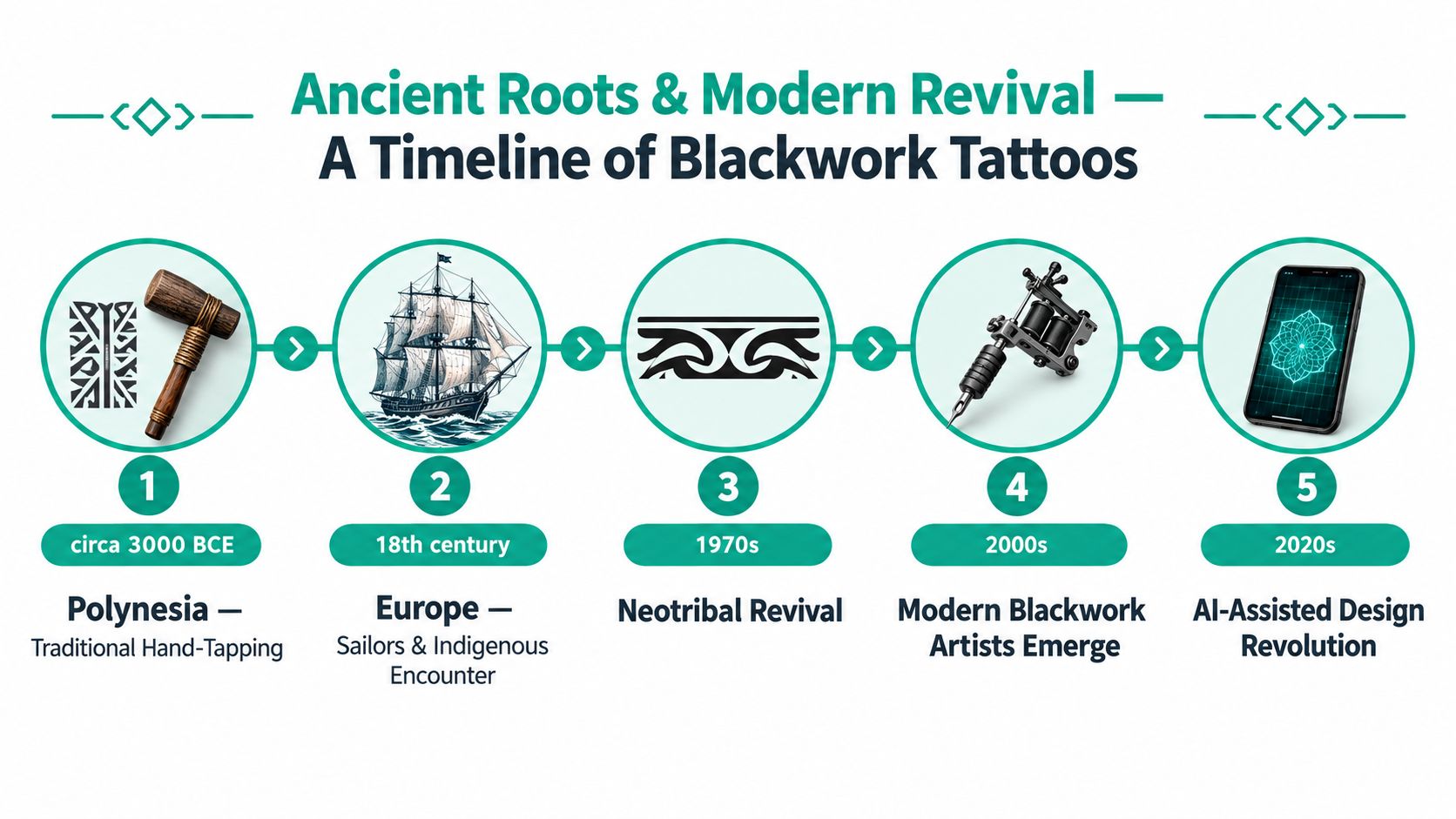
Blackwork is older than the modern tattoo category, but its present identity is a recent reorganization of older practices. Ötzi the Iceman, whose remains preserve the earliest confirmed human tattoos, carried marks dating to about 5,300 years ago. Made entirely with black pigment, those simple geometric lines and marks establish an early reference point for black-only body marking.
Pigment carried meaning
Black-only tattooing developed across many regions. Historical accounts connect solid black pigment with traditions in Polynesia, ancient Egypt, pre-colonial Southeast Asia, and Indigenous North America. Their methods, designs, and meanings were different, so grouping them under one modern label can hide important cultural distinctions.
Polynesian tattooing strongly influenced later blackwork aesthetics. Its repeated motifs, bold bands, and organized geometry could follow the body while communicating lineage, status, religion, or rites of passage. For an artist, the lesson is structural as much as visual: rhythm, symmetry, and contouring can make a dense design feel integrated with anatomy. Those principles came from living cultures, not an anonymous design library, so borrowing them requires context and respect.
Black pigment also appeared in European body art before the modern revival. Historical accounts describe tattoos among sailors and coal miners by the 1770s. The later blackwork movement therefore did not invent black tattooing. It arranged older ideas into a more graphic language, with heavy saturation and deliberate skin breaks shaping the composition.
That history matters during a consultation. A design built from large black fields is a long-term commitment, because saturated pigment leaves fewer options for later changes than lighter, more open work. Before booking, an artist may use an AI concept tool to test how complex negative-space channels, bands, or silhouettes could read on the body. The preview cannot predict healed texture or replace a stencil, but it can expose crowded areas before the needle touches skin.
The modern movement takes shape
Recognizable Western blackwork emerged much later. A major revival developed during the 1970s and 1980s, followed by a neo-tribal crystallization in California in the early 1980s, according to this history of the modern blackwork movement. That account commonly credits Filipino-American tattooer Leo Zulueta and publisher Don Ed Hardy with helping reframe Indigenous and Polynesian graphic vocabularies for contemporary Western tattoo culture.
As tattooing expanded beyond small flash designs, artists began producing larger, more graphic pieces. Solid black fills and strong contrast could remain readable from a distance while responding to the body's curves. Today, blackwork includes tribal, geometric, ornamental, illustrative, and full-sleeve compositions. Across those forms, its history remains visible in the relationship between dark pigment, structure, and exposed skin.
Exploring the Major Blackwork Substyles
Blackwork isn't one fixed look. It's an umbrella term, and the most useful way to narrow it down is to identify the visual behavior you want. Do you prefer shapes that flow with the body, patterns that feel architectural, details that resemble an illustration, or ornament that looks almost textile-like?
| Substyle | Visual Characteristics | Ideal Placement |
|---|---|---|
| Tribal and neo-tribal | Bold bands, sweeping curves, tapered points, repeated symbols, and forms designed to follow anatomy | Shoulders, upper arms, calves, chest, and areas suited to flowing bands |
| Ornamental | Lace-like patterning, filigree, mandala-inspired structures, decorative symmetry, and fine internal spacing | Sternum, back, thighs, ribs, forearms, and areas where framing works well |
| Geometric | Grids, polygons, symmetry, sacred-geometry-inspired structures, repeated angles, and measured negative space | Forearms, upper arms, chest, back, knees, and other relatively stable surfaces |
| Illustrative | Recognizable subjects rendered with bold contours, silhouettes, graphic textures, and selective solid fills | Forearms, thighs, upper arms, calves, and larger surfaces that support storytelling |
Tribal and neo-tribal work
Traditional tribal references can carry cultural meaning that shouldn't be copied casually. Neo-tribal blackwork takes inspiration from bold, organic structure while developing a contemporary visual identity. The best designs don't place thick black shapes on the body. They use tapers, curves, and open channels to make the anatomy part of the composition.
Ornamental designs
Ornamental blackwork suits clients who want decoration rather than a single central subject. The pattern may frame the sternum, follow the spine, or create a cuff-like structure around a limb. Small gaps matter here. If the internal spacing is too tight, the design can lose its lace-like character and become a dark block.
Geometric compositions
Geometric work demands close attention to alignment and placement. A circle or grid that looks balanced on a flat screen may need adjustment when it crosses a joint or wraps around a limb. If you're drawn to this category, this geometric blackwork tattoo guide can help you think through motifs, composition, and placement before your consultation.
Illustrative blackwork
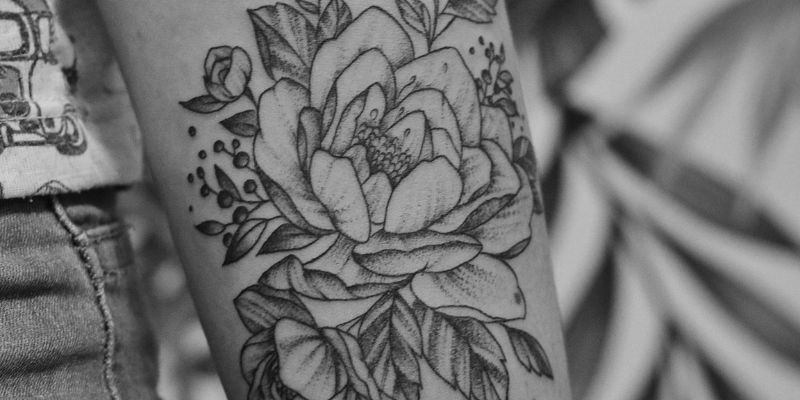
Illustrative blackwork offers the most direct storytelling. An animal, botanical subject, mythic figure, or object can be built from outlines, silhouettes, hatching, and controlled black areas. It may feel more expressive than geometric work, but it still depends on the same discipline. The artist must decide which details deserve ink and which should remain skin so the subject stays legible after healing.
Bring references from the substyle you want, not just images that happen to use black ink. An artist can then translate your subject into a composition that suits your body and preserves enough contrast to remain clear.
Technical Execution and Skin Trauma Considerations
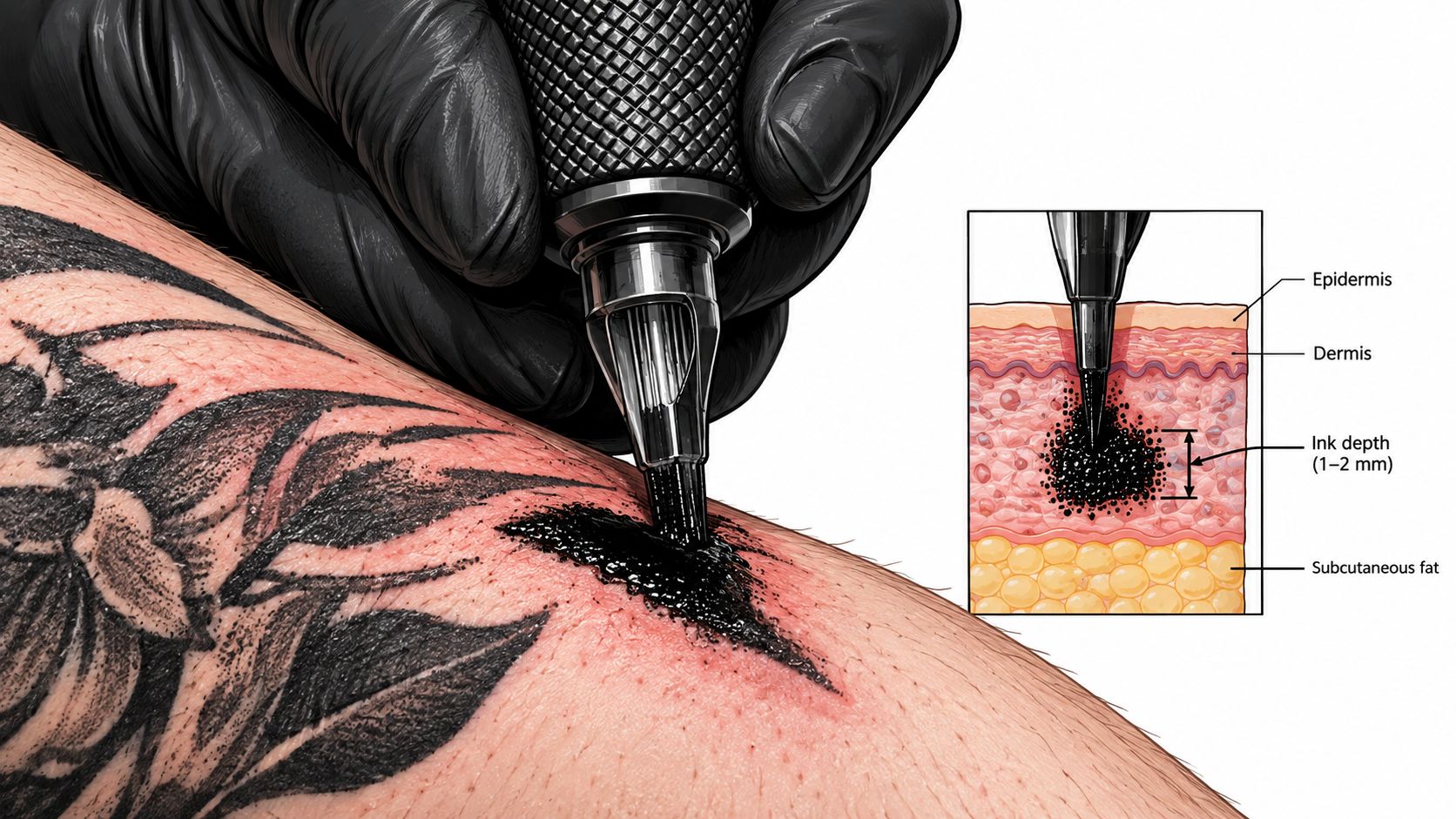
A blackwork design can appear straightforward on a screen while being demanding to apply. Dense black areas create a saturation problem, because the artist must place enough pigment evenly without repeatedly traumatizing the skin. Expert guidance on blackwork saturation and technique emphasizes that opaque fills often require multiple passes and careful control of machine pressure and speed.
Why packing black takes control
An artist can't safely force full density in a single aggressive pass. Excessive pressure, speed, or repeated work over already irritated skin can overwork the dermis. That raises the risk of scarring, patchiness, and blowouts, where pigment spreads beyond the intended boundary.
Good saturation comes from controlled technique rather than brute force. The artist manages hand speed, machine behavior, skin tension, needle movement, and the condition of the tissue throughout the appointment. Large solid areas may need patience, breaks, or more than one session, depending on the design and how the skin responds.
A client should also understand that fresh blackwork isn't the final result. Swelling, plasma, redness, and surface irritation can make the tattoo look darker, shinier, or less even than it will after recovery. Follow the studio's aftercare instructions, avoid picking at flakes or scabs, and contact the artist if the healing process seems abnormal.
A properly healed black fill should look matte and uniform. A persistent shiny or gray-brown appearance can indicate ongoing trauma or insufficient packing, so ask the artist to assess it rather than guessing.
Judge the healed surface
Healed work reveals whether the artist controlled saturation successfully. Look for an even black field, clean borders, and skin breaks that remain intentional rather than blurred. A small amount of variation can occur as skin heals, but obvious patchiness, raised scarring, or pigment pushed beyond the edge deserves a conversation with the artist.
Blackwork can also incorporate dot-based texture and transitions. If that appeals to you, compare it with dotwork tattoo style, but don't assume dots make a piece easier. Every mark still needs spacing, rhythm, and a clear relationship to the surrounding solid areas.
How to Choose the Right Blackwork Artist
Not every tattooer who produces black tattoos specializes in heavy blackwork. The portfolio should answer a practical question: can this artist control both the ink and the skin over the entire design?
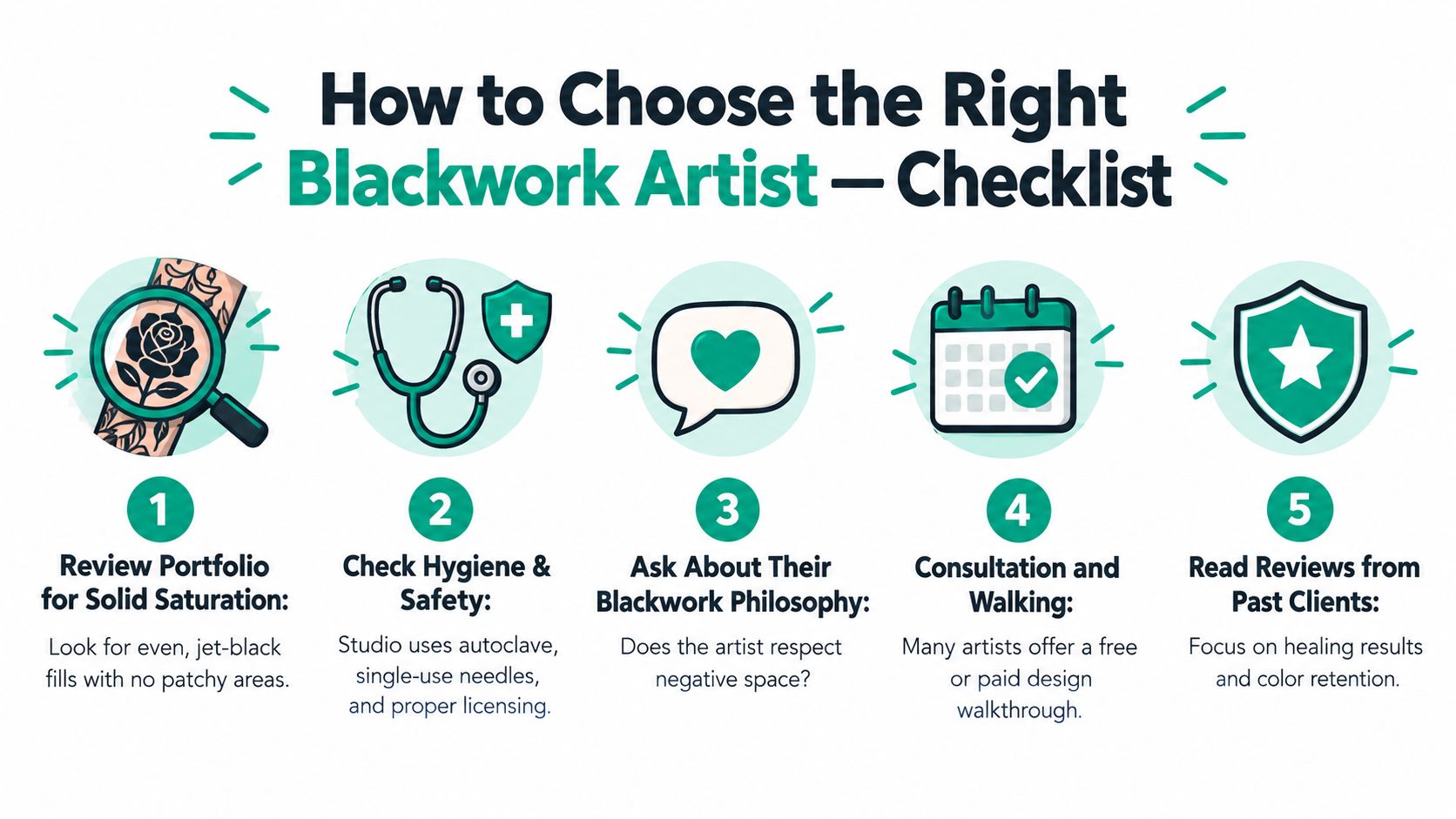
Start with healed photographs. Fresh tattoos can look dramatic because the surface is swollen and the pigment is newly deposited. Healed examples let you inspect whether the black remains even, whether lines retain their intended weight, and whether negative-space channels still separate the forms.
What to inspect in a portfolio
- Solid saturation: Look for black areas that appear consistent rather than mottled or visibly patchy.
- Edge control: Follow the outside borders of bands, silhouettes, and geometric forms. They should look intentional and clean.
- Negative-space planning: Check whether open skin remains readable and balanced as the design wraps around the body.
- Healing quality: Watch for raised areas, heavy scarring, or pigment that has migrated outside the intended lines.
- Style fit: An artist may be excellent at fine-line work or realism without being the right choice for dense graphic compositions.
Ask how the artist approaches large black areas. You don't need to demand machine settings or technical jargon. You do need to hear a clear explanation of pacing, skin response, healing expectations, and whether the design should be divided across appointments.
Questions that reveal experience
Ask to see work similar in scale and density to your idea. Ask how the artist would preserve the negative space around your chosen motif. If you're considering a cover-up, show the old tattoo without editing and ask what design limitations it creates.
You should also ask about studio hygiene, single-use needles, sterilization practices, licensing where applicable, and aftercare. A polished portfolio doesn't replace safe procedure. The consultation should feel collaborative, especially when the artist recommends changing a shape, enlarging a gap, or simplifying detail to protect long-term clarity.
Use this blackwork artist selection video as another visual reference while comparing portfolios and consultation approaches.
A strong artist won't promise that every online reference can be reproduced exactly. They'll explain what must change for your skin, placement, size, and future plans.
Visualizing Your Concept with AI Before Inking
Blackwork benefits from planning because the design's empty areas carry as much responsibility as its dark ones. A concept that looks balanced on a white screen may become crowded when wrapped around an arm, interrupted by a joint, or enlarged into a sleeve. Digital exploration can help you identify those problems before the appointment, but the output should support a tattooer's judgment, not replace it.
Write prompts that describe structure
A vague prompt such as “blackwork wolf” leaves too many decisions unresolved. Specify the subject, mood, substyle, placement, density, and the role of negative space.
For example, you might request a blackwork wolf profile, bold angular silhouette, ornamental line breaks, open skin around the eyes and jaw, no color, no background clutter, and a composition suited to the outer forearm. If you want geometry, name the structure. Ask for radial symmetry, repeating polygons, a central motif, or a controlled pattern that can wrap around the limb.
Detailed prompts help because they give the generator constraints to interpret. They also make your own preferences clearer. You may discover that you like illustrative contours but not a fully saturated background, or that a pattern needs wider skin channels to remain readable.
Iterate with a tattoo appointment in mind
Generate several directions, then compare them for practical qualities:
- Silhouette: Does the subject remain recognizable without relying on color?
- Spacing: Are the negative-space gaps wide and purposeful?
- Flow: Could the design follow the body instead of sitting like a sticker?
- Density: Are the solid areas balanced, or does one region dominate?
- Translation: Can an artist redraw it as a tattoo rather than copying fragile digital detail?
TattoosAI can generate blackwork concepts from detailed descriptions and lets users explore multiple tattoo styles, including blackwork, geometric, and dotwork. Treat the result as a conversation starter. Take your preferred concepts to the artist, explain what you like in each, and accept technical revisions that improve the design's fit and longevity.
Long-Term Commitment and Future Modifications
Blackwork can hide an older tattoo effectively, but a successful cover-up isn't automatically a flexible one. Dense black pigment is difficult to remove with laser treatment, and a heavy design can restrict later partial rework, as discussed in this guide to blackwork's permanence and cover-up trade-offs.
That doesn't make blackwork a poor choice. It means you should decide whether concealment, visual impact, and future adaptability point in the same direction. Preserving selected negative-space areas can give an artist room to extend the composition later. Filling every available gap may produce a striking result now while leaving fewer options for additions, adjustments, or partial redesign.
Ask your artist to show you how the proposed piece will occupy the body, not just how the central motif will look. Consider adjacent tattoos, possible sleeve development, and whether you might want a different style nearby. For broader discussion about how tattoo decisions interact with skin care and long-term skin appearance, explore Skin Perfection vs tattoos as a complementary resource.
Long-term question: If you changed your mind about part of this design, which areas could an artist realistically modify without adding more solid black?
Take time before approving a blackout-style cover-up or a large saturated panel. A well-planned blackwork tattoo can remain powerful for years, but the strongest commitment is the one you understand before the needle starts.
TattoosAI lets you turn detailed ideas into blackwork concepts, compare substyles, and refine negative-space directions before your studio consultation. Visit TattoosAI to generate references you can discuss with your tattoo artist and arrive with a clearer, more practical vision.