TattoosAI
You're standing in a tattoo studio, studying a sheet of stars between anchors and swallows. One catches your eye: sharp points, dark panels, a little color, nothing fussy. You can imagine wearing it, but you're less sure what you'd be wearing besides the design.
Table of Contents
- A First-Timer Standing in Front of the Flash Wall
- Sailor Roots and the Road to Western Flash
- Anatomy of an Authentic Traditional Star
- Variations, Placements, and What Each One Says
- The Meanings Most Guides Quietly Omit
- Designing for Skin That Will Hold the Line
- Prompts for an Authentic Traditional Star in TattoosAI
- Quick Answers and What to Carry Into the Studio
A First-Timer Standing in Front of the Flash Wall
Your finger stops over a nautical star. It looks straightforward enough to be a first tattoo, yet more deliberate than the plain star you might draw in a notebook. Before choosing it, you want to know whether it means finding your way, belonging to a particular community, or liking an old-school design.
Those questions deserve separate answers. Visual style, historical association, and personal meaning aren't the same thing. You can choose a design with maritime roots without claiming to be a sailor, just as you can appreciate its geometry without assigning it a life-changing story.
Look beyond the silhouette
At the flash wall, start by comparing the stars rather than choosing the first appealing outline. Does the artist divide each point into contrasting panels? Is the star an isolated emblem, or does a banner, anchor, or other image change how you read it?
- Notice the construction. A flat silhouette and a segmented nautical star may share an outline while looking quite different.
- Name your attraction. Perhaps you like the balanced shape, the restrained palette, or the association with direction.
- Separate intention from interpretation. What you want the tattoo to mean won't necessarily be what every stranger sees.
A useful consultation begins with something concrete: you like the paneling, you want the design to feel nautical, and you don't want an elaborate celestial scene. That gives an artist more to work with than asking for a meaningful star.
You don't need a dramatic personal story to justify a tattoo. You do need to understand the design you're choosing.
Treat the flash sheet as a collection of design decisions, not a menu of fixed definitions. A traditional star tattoo becomes easier to choose when you can describe both its appearance and your reasons for wearing it.
Sailor Roots and the Road to Western Flash
The nautical star belongs to a maritime visual lineage associated with navigation, guidance, and the hope of returning safely home. Its history shouldn't be compressed into a confident claim that someone invented it on a particular date. There isn't a single universally accepted origin date for the five-pointed nautical star.
The broader social setting matters too. Tattoos in the United States were once strongly associated with sailors, soldiers, prisoners, and other subcultures before becoming more mainstream. A 2004 survey of 500 adults aged 18–50 found that 24% had a tattoo and 21% had considered getting one, illustrating that broader adoption in Northwestern's account of the tattoo survey.
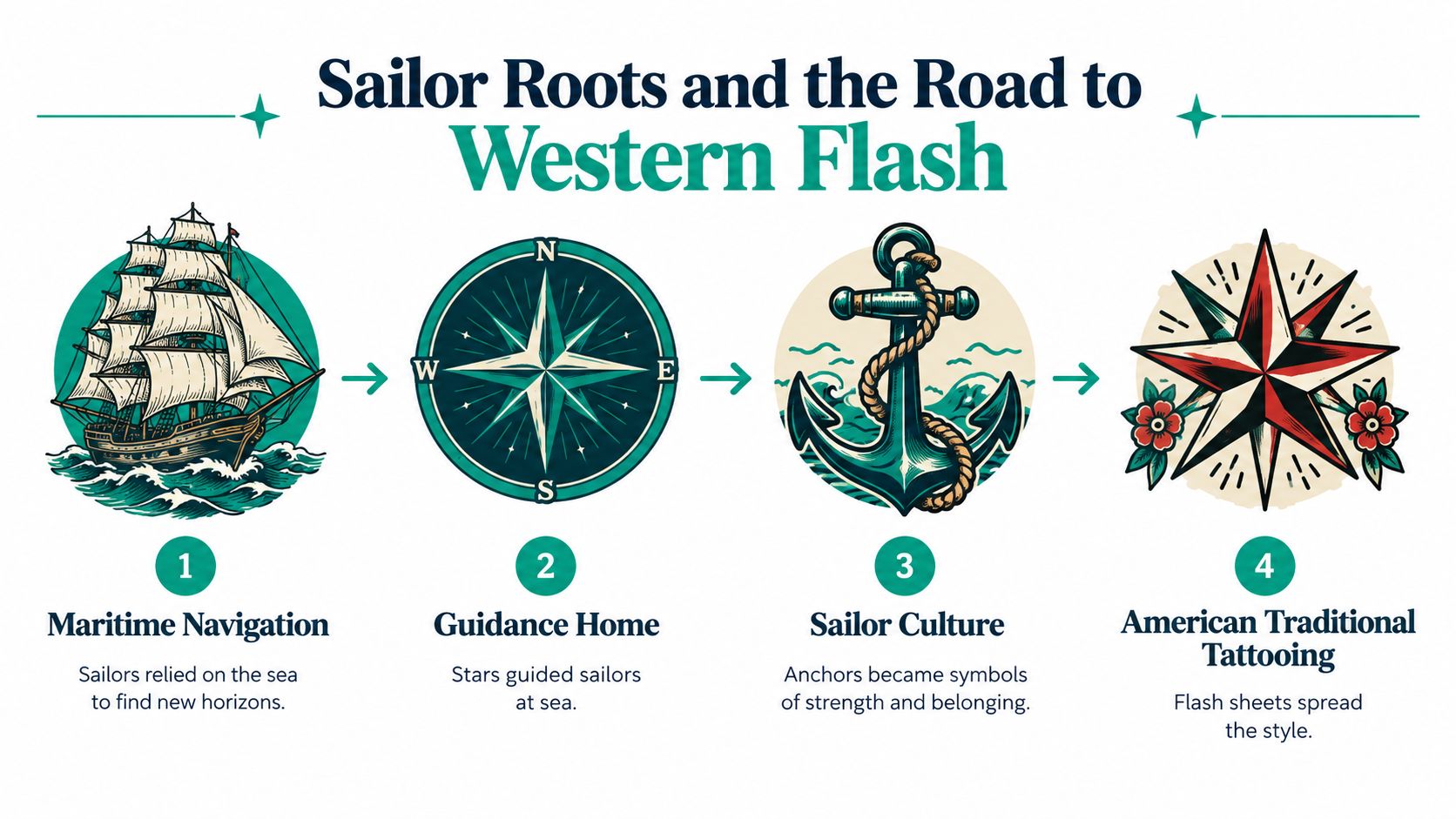
Key Milestones in the Star Tattoo's Path to Mainstream
| Era | Who Carried the Motif | Design Consequence Today |
|---|---|---|
| Maritime roots | Sailors and maritime communities | Navigation remains central to the nautical reading |
| Growth of professional Western tattooing | Sailors and other travelers | Recognizable star designs circulated beyond individual wearers |
| Broader tattoo adoption | Clients outside those occupational subcultures | Heritage designs became available for more personal interpretations |
The distinction between a symbol and a flash design is useful here. A symbol is an idea expressed through an image; flash is prepared tattoo artwork a client can choose or discuss with an artist. The publisher's explanation of what tattoo flash is offers practical context for reading the studio wall.
“Traditional” therefore shouldn't mean merely old-looking. For your design brief, use it to identify a visual lineage, then describe the actual features you want. A weathered paper background might make an image look vintage, but it doesn't establish that the star itself follows traditional construction.
History gives the design context. The artist's drawing determines whether that context is visible in the finished piece.
Anatomy of an Authentic Traditional Star
A nautical star isn't a solid star with shading added afterward. Its defining feature is alternating light and dark panels, with each point divided lengthwise. Black commonly pairs with red, yellow, or blue, producing the faceted, pinwheel-like appearance described in this account of nautical-star construction and symbolism.
Look at the center and follow the divisions outward. Rather than rendering a realistic object under a light source, the artist repeats a controlled dark-light arrangement around the shape. That repetition gives the star dimension without requiring smooth gradients.
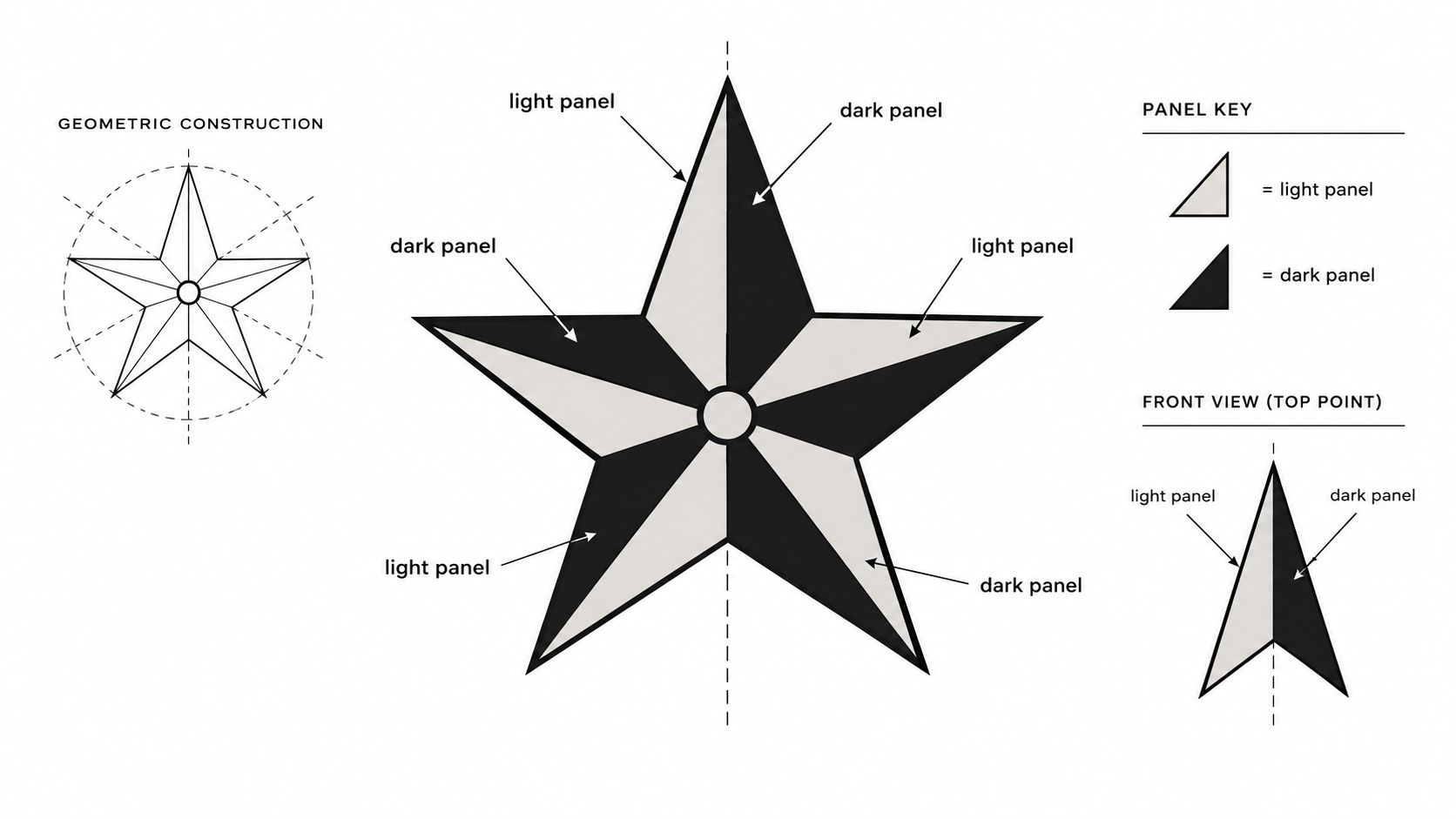
Read the drawing from outside inward
The outer contour establishes the silhouette. The interior divisions organize the panels, while a controlled center prevents the meeting point from becoming a confusing knot of lines.
- Point count. Specify a five-point nautical star when that's the form you want, rather than leaving “star” open to interpretation.
- Contour. Ask for a bold, consistent outer boundary rather than a delicate sketch.
- Panel arrangement. Request alternating black and color fields within the points, not random patches of shading.
- Center. Ask the artist to resolve the convergence clearly, with intentional negative space where appropriate.
A useful test is to describe the image without mentioning its background. If the only traditional-looking feature is yellowed paper, you haven't yet specified the tattoo's structure.
Drawing check: Follow the dark panels around the center. They should form an intentional repeated arrangement, not a collection of unrelated shadows.
The limited palette also gives you a clear decision to make. Black paired with red looks different from black paired with yellow, but both can preserve the panel logic. Adding more colors isn't automatically an improvement if it makes those divisions harder to recognize.
For a first consultation, bring a reference showing the structure you like and explain which features matter. You're not asking the artist to trace an image blindly. You're identifying the visual grammar they should preserve while adapting the design.
Variations, Placements, and What Each One Says
Choosing a variation is easier if you separate shape, body surface, and intended meaning. Don't ask a single label, such as “North Star,” to settle all those decisions for you.
A compass-inspired design might express direction in your personal brief, while a shooting star might suggest movement or ambition. Those are useful creative interpretations, not universal definitions. The same caution applies to constellation layouts: you can use a group of stars to represent people or memories without claiming that every cluster means that.
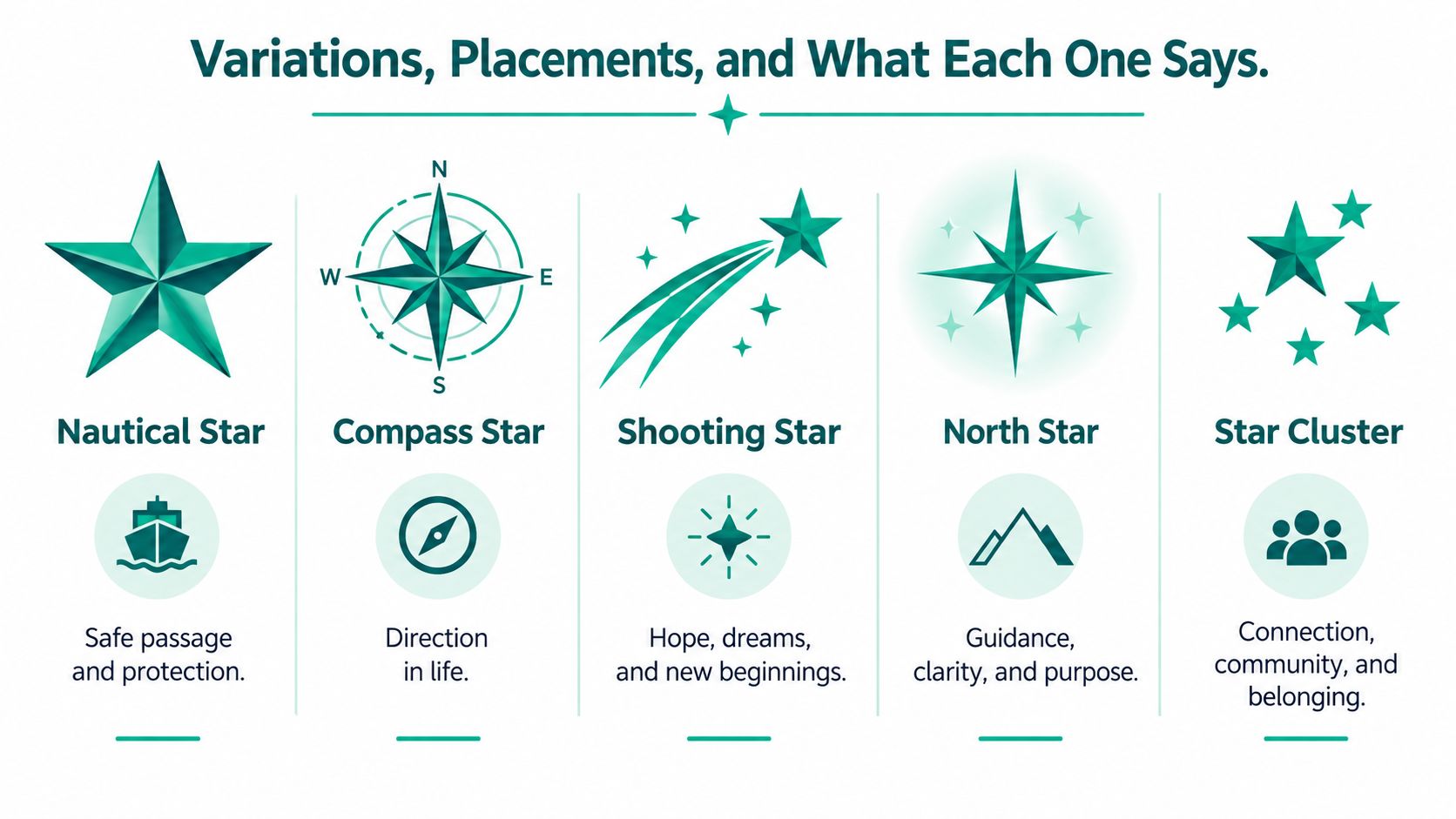
Traditional Star Variations and Where They Work Best
The placements below are starting points for consultation, not promises about healing or longevity. An artist should assess the actual drawing on your body.
| Variation | Best Placements | Typical Reading |
|---|---|---|
| Five-point nautical star | Forearm, shoulder, biceps, chest | Maritime guidance or safe passage |
| Compass-inspired star | Forearm or chest for a directional composition | Personal orientation or travel |
| Shooting star | Forearm or shoulder where the trail can fit | Movement, change, or ambition |
| North-Star-inspired design | Shoulder or chest for an isolated focal image | Guidance or a personal constant |
| Star cluster | Forearm or shoulder with room between elements | Connection, remembrance, or visual rhythm |
Choose color without inventing a code
You might select red because it feels energetic, blue because you associate it with the sea, or yellow because it feels optimistic. Say those are your associations, rather than presenting them as established tattoo rules. Black-only can be an aesthetic choice, not proof of a collector identity.
Surrounding imagery deserves the same care. A banner can state something explicitly; an anchor or swallow can make the composition feel more maritime. Ask whether each addition strengthens your intended reading or merely fills space.
Placement can also affect interpretation, particularly when a design has a subcultural history. Don't choose a tiny wrist star solely because it looks convenient in a photograph. Consider both the symbolism and whether your artist can preserve the detail you want at that scale.
The Meanings Most Guides Quietly Omit
A star tattoo doesn't function as a universal identity code. The familiar guidance-and-protection explanation is part of the picture, but it's not the whole picture.
A tattoo-history account describes star motifs in punk and alternative communities and notes a late-1950s association between a small wrist star and lesbian bar culture. That's a specific historical association, not a rule for identifying contemporary wearers, as discussed in Bright Hub's account of star tattoo meanings.
Historical association isn't present-day identification
A person might deliberately reference queer history through a wrist star. Another person might choose a similar shape because it reminds them of someone, or because they like the drawing. You can't responsibly infer their sexuality, politics, military service, or community membership from the motif alone.
The maritime reading has limits too. Navigation symbolism may explain the design's heritage, but it doesn't tell you why an individual chose it. Personal meanings can sit alongside historical ones without replacing or erasing them.
A symbol can carry history without making every wearer a representative of that history.
Give your artist a clear intention
Instead of requesting a star that means resilience, explain what resilience looks like in your brief. You might want a solitary, balanced emblem with no text, or a star beside a banner carrying a personal phrase.
- For nautical heritage, ask to preserve the recognizable sailor-style form.
- For a historical reference, identify the context you're intentionally acknowledging.
- For personal symbolism, explain the association rather than expecting the motif to communicate it automatically.
- For visual appeal, say that plainly. Meaning doesn't need to be manufactured.
If you're worried about unintentionally signaling an identity, discuss the complete composition with your artist. Placement, point count, palette, and neighboring motifs all deserve attention. The responsible answer isn't that the star means nothing, or that it means one thing forever, but that interpretation depends on context.
Designing for Skin That Will Hold the Line
A clean digital drawing isn't evidence that a design will translate cleanly to skin. Tattoo pigment is deposited in the dermis, where cells including fibroblasts and macrophages take up pigment particles. Remaining pigment can persist and gradually migrate within deeper tissue, as explained in this medical review of tattoo pigment behavior.
That makes spacing a design issue, not merely a stylistic preference. Heavy outlines and larger contrasting fields generally remain easier to read than hairline detail, but tightly crowded divisions or excessive packing can create visual muddiness. Your artist needs room to adapt the concept rather than preserve every digital line.
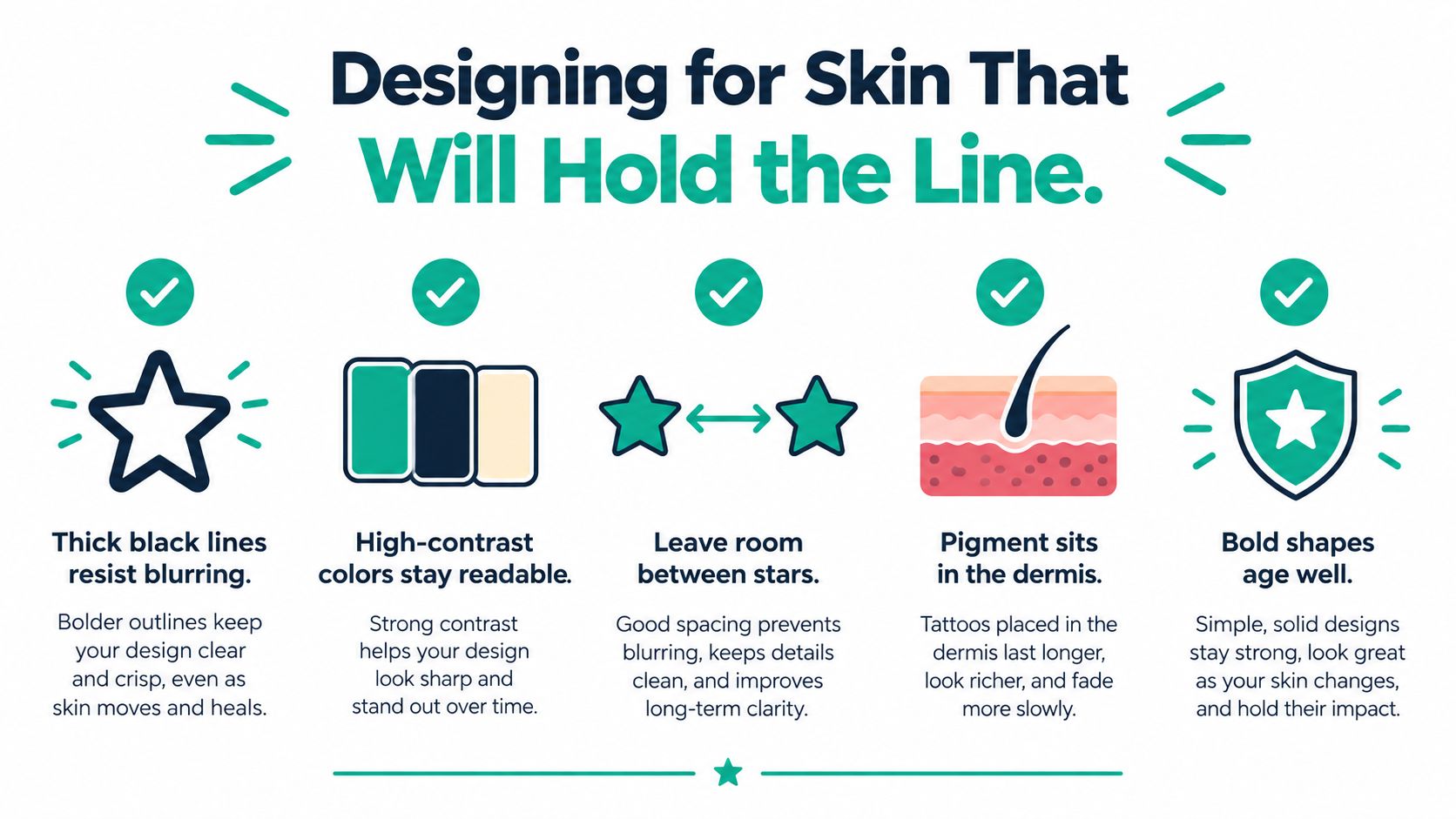
Readability and medical risk are different questions
Reported complications include irritation, infection, delayed healing, hypersensitivity reactions, scarring, and granulomatous inflammation. In a retrospective review summarized in the literature, allergic reactions represented 52.6% of 308 reported complications, while red pigments are repeatedly highlighted as a concern in this medical review of tattoo complications.
That percentage describes a collection of reported complications. It isn't the probability that your tattoo will cause an allergic reaction. Nor does choosing a different color guarantee a complication-free experience.
Use the design consultation to discuss scale and line separation, and the studio consultation to discuss hygiene, pigments, and aftercare. The guide to tattoo design rules can help organize the visual questions, but it doesn't replace professional assessment.
Take a consultation checklist
- Ask about scale. Can the artist keep the panels distinct at your preferred size?
- Check the studio. Choose a reputable studio that follows applicable licensing and regulatory requirements.
- Discuss ink. Ask about the proposed pigments and mention any relevant skin conditions or previous reactions.
- Request aftercare instructions. Follow the artist's plan rather than improvising from unrelated online advice.
- Arrange medical assessment when needed. Don't dismiss suspected infection, a persistent reaction, or healing that concerns you as part of getting tattooed.
An AI-generated concept is a planning aid, not an application protocol. Let a qualified tattoo professional assess your skin, placement, pigment choices, and the drawing's practical limits before you commit.
Prompts for an Authentic Traditional Star in TattoosAI
Use TattoosAI as one concept-generation option alongside drawing your own brief or commissioning an artist's sketch. Describe the star's construction, select traditional in the style picker, and compare the results against the visual requirements you've chosen. A style label alone leaves too much room for a generic celestial image.
For broader practice in describing subject, appearance, and exclusions, Veo3 AI's generative video prompt strategies are an adjacent resource. Video generation is a different medium, so treat it as prompting context, not guidance on tattoo construction or safety.
A reusable prompt skeleton
Copy this and replace the bracketed descriptions:
American-traditional tattoo flash of [star variation], [point arrangement], bold black outer contour, clearly separated dark and light panels where appropriate, limited palette of [colors], intentional skin breaks, balanced silhouette, isolated design on a plain white background. No photorealism, metallic rendering, fine-line detail, soft gradients, lettering, or decorative background.
Keep the exclusions relevant. If you want a banner, remove the lettering restriction and explain its position, but have your artist review any generated text.
Classic nautical star
American-traditional flash of a five-point nautical star. Divide every point lengthwise into alternating black and red panels, arranged consistently around the center. Bold black contour, flat color fields, clearly resolved center, balanced radial geometry, plain white background. No gradients, realistic lighting, metallic surfaces, extra points, or surrounding symbols.
Check the panel arrangement before judging the color. If the output looks like a shaded solid star, reinforce “split panels” and remove any language suggesting realistic depth.
North-Star-inspired emblem
North-Star-inspired tattoo in American-traditional flash style, a clear upright star with an emphasized vertical axis, bold black outline, black and yellow flat fills, generous open space around the silhouette. Isolated emblem on white. No realistic night sky, tiny sparkles, lens flare, or fine-line ornament.
This asks for a traditional-style reinterpretation, not a historical nautical replica. If the output becomes a delicate celestial illustration, strengthen the flat-fill and bold-contour instructions.
Shooting star with a compact trail
American-traditional shooting-star tattoo flash, a bold star followed by a short curved trail made of broad separated shapes. Black outline, restrained red and yellow palette, readable silhouette, visible white gaps between trail elements. Plain white background, no smoky effects, gradients, glitter, or realistic fire.
Inspect the trail independently. If it looks crowded, request fewer decorative elements rather than shrinking everything.
A spaced star cluster
A compact star cluster rendered as American-traditional tattoo flash, with a dominant segmented nautical star and simpler supporting stars. Bold contours, black and blue palette, distinct silhouettes, generous gaps between stars. No hairline constellation connectors, astronomical labels, tiny dots, or background scene.
Compare the hierarchy: the main star should be obvious without swallowing the smaller elements. Save a promising concept, identify what still needs changing, and let the tattooist redraw it for placement.
Quick Answers and What to Carry Into the Studio
Is a nautical star the same as a compass star?
Not necessarily. A nautical star uses the split-panel construction described earlier; “compass star” can refer to a more directional composition. Bring a reference instead of relying on the name alone.
Does color change the meaning?
It can change your personal reading and the overall appearance. It doesn't establish a universal code, so explain your intention in the consultation.
Does widespread tattooing prove stars are popular?
No. Ipsos reported that U.S. adults with tattoos rose from 21% in 2012 to 30% in 2019, but its tattoo survey results don't measure star tattoos specifically.
What should I ask before committing?
Ask whether the design needs resizing, which pigments the artist proposes, and how they'll handle the crowded center. If you're treating removal as an easy backup, consider Yoyime Clinic's discussion of the side effects of tattoo removal and seek qualified medical advice.
Carry a short written brief:
- Drawing requirements. Bold contour, limited palette, and intentional skin breaks.
- Personal intention. The meaning you want, without assuming everyone will read it identically.
- Studio questions. Regulatory compliance, ink choices, and the artist's aftercare plan.
- Concept status. Your generated image is a reference for professional revision, not an instruction to copy every detail.
TattoosAI offers a way to turn a written star brief into multiple visual concepts before your consultation. Visit TattoosAI, try a prompt above with the traditional style selected, and bring your preferred result to an artist for a skin-ready revision.