TattoosAI
Two clients walk into the same studio with the exact same request. Both want a wolf head. One wants a lifelike tribute to a wild wolf she watched in Alaska, packed with fine fur and piercing eyes. The other wants a single continuous line he can tuck neatly beneath a shirt sleeve.
The animal hasn't changed, yet nearly every technical decision has. Wolf head tattoo designs succeed or fail based on three practical factors: what the expression communicates, how the anatomy sits on moving skin, and which details survive long-term healing. Humans have wrestled with how to render wolves for tens of thousands of years. A Cambridge University Press scholarly chapter on wolves in human culture identifies prehistoric wolf representations in at least three European cave sites, Altxerri Cave in Spain plus Font-de-Gaume and La Grotte de la Vache in France, including a bone carving of two wolves interacting, while a separate European Paleolithic review retains only 9 surviving depictions safely confirmed as wolves.
That long visual history gives modern artists enormous range, from stark silhouettes to museum-grade portraits. Every style below comes with real trade-offs in healing, cost, size, and detail retention, so you can match the right look to your skin before booking a chair.
Table of Contents
- 1. Realistic Wolf Head Portrait
- 2. Minimalist Line-Art Wolf Head
- 3. Traditional American Wolf Head
- 4. Japanese Irezumi-Style Wolf Head
- 5. Geometric Wolf Head
- 6. Watercolor Wolf Head
- 7. Blackwork Wolf Head with Dotwork Shading
- 8. Wolf Head with Moon and Celestial Elements
- Wolf Head Tattoo Styles at a Glance
- Choosing Your Wolf from Inspiration to the Studio Chair
1. Realistic Wolf Head Portrait
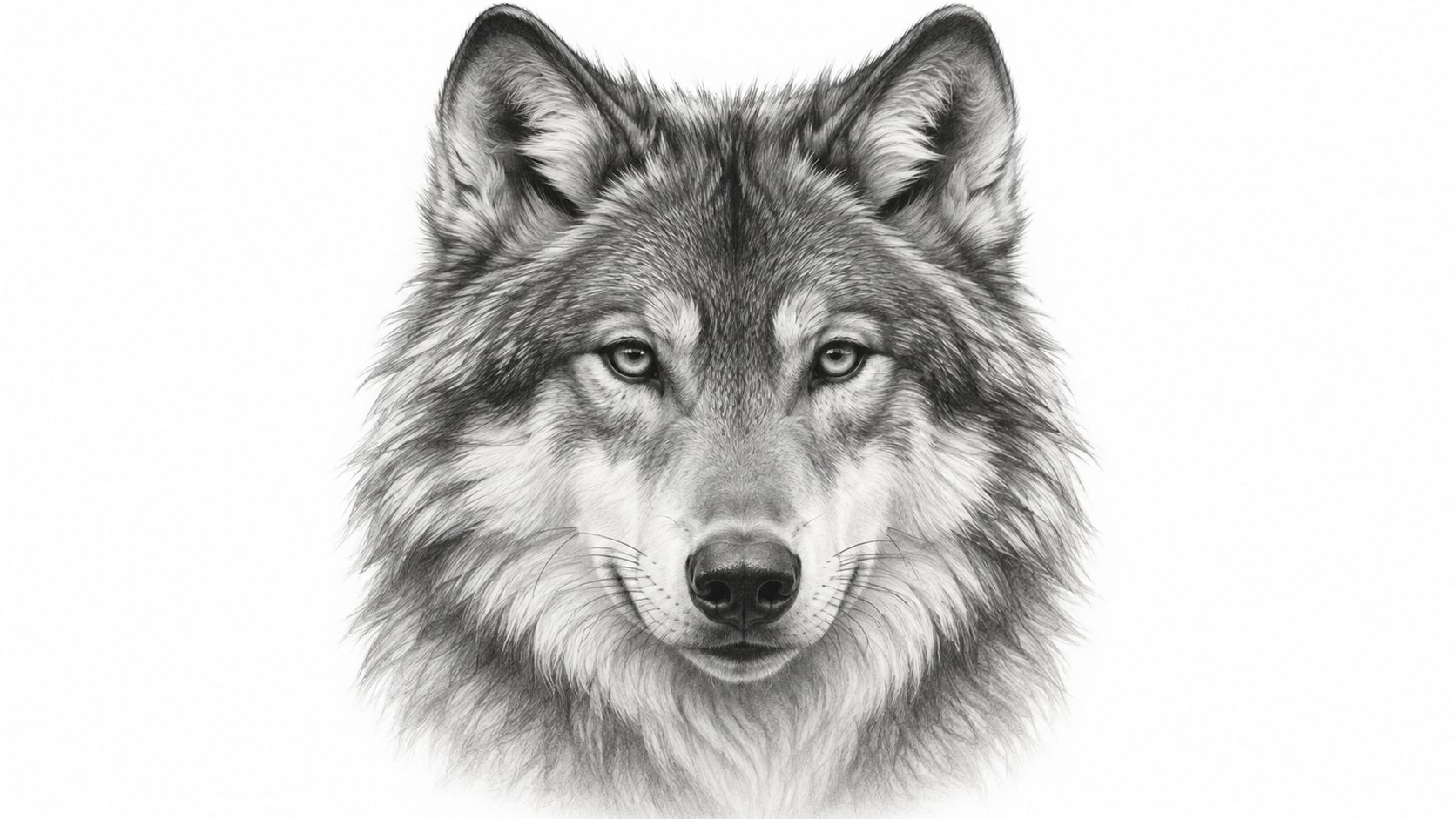
Realistic portraits demand large skin real estate, high hourly budgets, and serious patience during long sessions. Shrink a photorealistic wolf down to palm size, and the micro-fur turns into a muddy gray blur within a few years. Once you give the design room to breathe on an upper arm, thigh, or calf, however, nothing matches its emotional impact for a memorial piece or lifelike wildlife study.
A strong portrait works through tonal shading rather than heavy black outlines. The artist builds depth around the eyes, wet nose, and overlapping cheek fur using smooth black-and-gray gradients. Here is a reference sketch showing the crisp facial planes and directional fur contrast a realism specialist looks for before drawing on skin.
Managing Contrast and Skin Longevity
Dense shading requires deliberate separation between dark zones and lighter fur masses. If the artist packs the inner ears, eye sockets, nose, and lower jaw too closely without bright skin breaks, the face loses readability as ink settles. Clinical reports also support tracking what goes into heavily shaded black-and-gray work. A clinical review on PubMed Central describes tattoo-related MRI reactions as rare and generally transient, noting that earlier cases linked reactions to iron oxide pigments, dense black ink, and closely packed shapes. Tattoos don't prevent you from getting an MRI, though documenting your artist's ink brand and disclosing tattoos before a scan is smart practice.
Say a client wants a memorial portrait of a wolf-like malamute on the outer calf. Getting that piece to age gracefully takes specific preparation before appointment day.
- Source a sharp photo: Bring a high-resolution image with clear catchlights in the eyes and visible fur direction, never a dark or heavily filtered snapshot.
- Verify healed portfolios: Ask to see photos of the artist's healed realism pieces from at least a year prior, since fresh portraits always look crisper than settled skin.
- Limit color accents: Keep the portrait black and gray and reserve saturated colors, such as icy blue eyes, for tight focal points instead of broad fur fields.
- Plan for touch-ups: Confirm the studio's policy on minor contrast touch-ups once the fine highlights finish healing.
2. Minimalist Line-Art Wolf Head
Minimalist fine-line work has zero margin for shaky execution and loses crispness faster than bold styles on high-friction skin. Because ink naturally spreads slightly in the dermis over time, hair-thin lines packed tightly together will eventually bleed into each other. If you respect line spacing and pick low-friction skin, though, a minimalist wolf delivers a discreet, modern symbol with shorter sessions, lower cost, and quick healing.
Consider someone placing a continuous single-line wolf profile along the inner forearm or a compact silhouette behind the ear. The piece communicates quiet independence without dominating an arm or clashing with workplace dress codes. What happens underneath the surface explains why restraint beats cramming extra strokes into a small frame. A dermal pigment study on PubMed Central explains that while surface tattoo pigment gradually washes out, ink particles can remain in the deep dermis and local lymph nodes more than 40 years after tattooing.
Restraint creates durability at small sizes. Three confident strokes that define an ear, brow, and muzzle will still read as a wolf a decade from now, while twenty tiny whisker lines will fuse into a smudge.
Placement and Line Spacing Rules
A minimalist wolf survives aging when the silhouette does the heavy lifting. Skip intricate inner fur textures and focus strictly on the ear angle, snout taper, and a single clean eye shape. Leave at least a few millimeters of open skin between parallel lines so normal pigment diffusion never closes the gap.
Before locking in a full forearm piece, I recommend asking your artist for a quick sizing check using a printed stencil at the exact dimensions you plan to wear. Choose flatter, sheltered areas like the inner forearm, upper rib, or ankle rather than the sides of fingers or outer wrists, where sun and constant rubbing break down fine lines quickly.
3. Traditional American Wolf Head
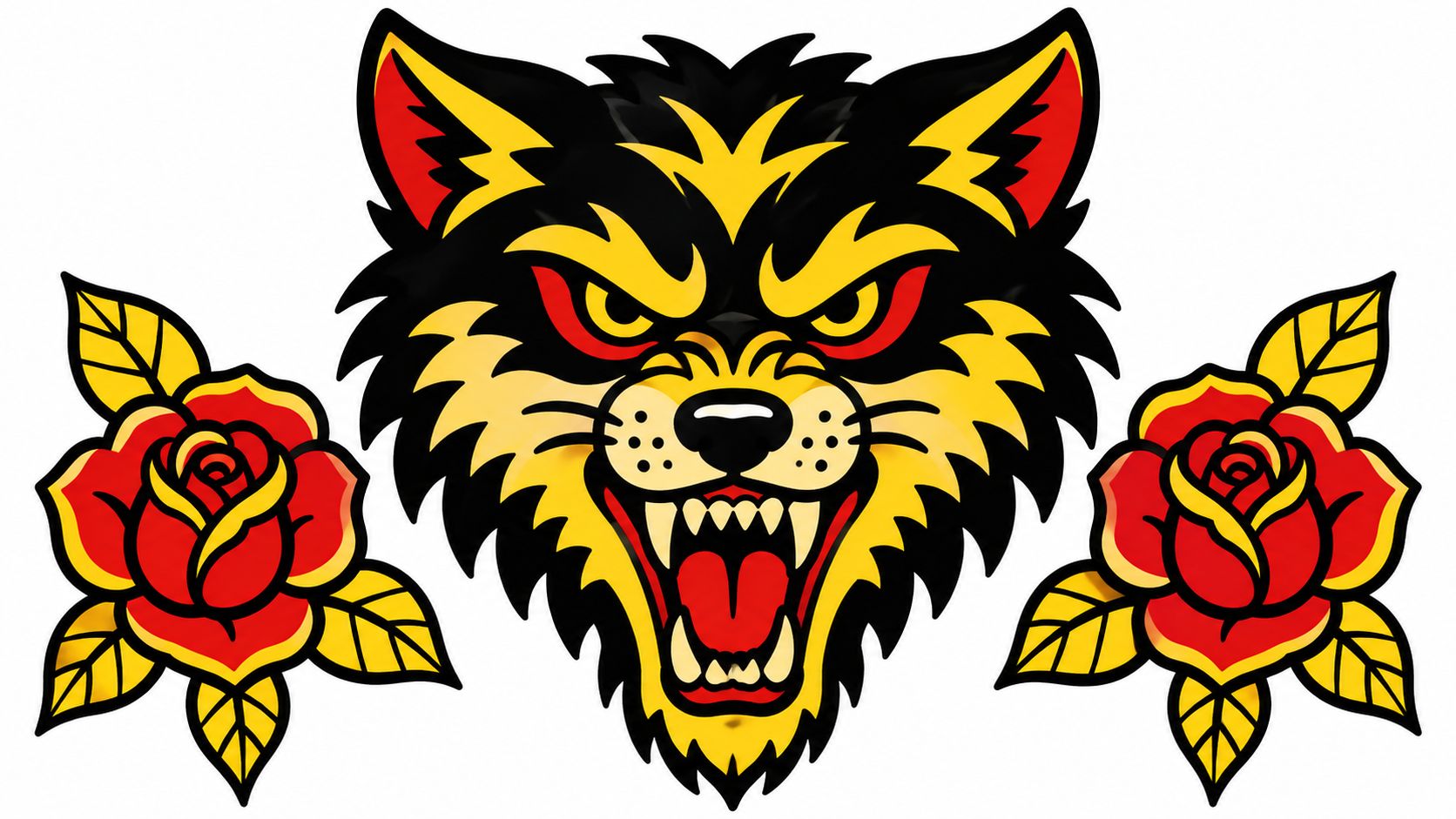
Traditional American tattoos won't satisfy anyone looking for soft delicacy or subtle shading. The heavy black outlines, punchy primary fills, and flat graphic styling look unapologetically loud and vintage. That bold structure is precisely why traditional flash remains the undisputed durability champion of tattooing, staying sharp and readable from across a room for decades.
Historically, wolves have never meant just one thing. An Encyclopedia.com overview of wolf symbolism notes that wolves represented both good and evil in human nature, symbolized transition and warrior-hero guardians in ancient Egypt, Greece, and Rome, and later shifted from dark figures in Aesop's fables and early Christian imagery into emblems of freedom forged through persecution. Traditional American flash leans straight into that fierce guardian energy, pairing bared fangs and narrowed eyes with classic motifs like daggers or blooming roses. Below is a color-rich neo-traditional take showing how dark outlines and framing roses lock a snarling wolf head into a tight, legible composition.
Flash Proportions and Color Care
A classic upper arm or chest flash piece relies on a tight palette of black, red, yellow, and green backed by generous skin breaks. Those thick black walls act like containment lines, keeping bright pigments visually distinct as the years pass.
- Review the stencil outline first: Make sure the wolf's silhouette looks instantly fierce and balanced in plain black linework before any color decisions happen.
- Respect the limited palette: Adding too many pastel tints muddies the bold contrast that gives old-school flash its punch.
- Commit to sunscreen: Ultraviolet light breaks down yellow and red pigments faster than black ink, so daily broad-spectrum sunscreen keeps roses and eyes vivid.
- Size for the muscle group: Give a traditional wolf with flanking roses enough width on the deltoid, bicep, or chest panel so the teeth and petals stay open.
4. Japanese Irezumi-Style Wolf Head
Irezumi demands a serious commitment of both skin space and money. You can't shrink traditional Japanese composition onto a tiny wrist patch without destroying the flow that makes the art form work. Expect multiple multi-hour sessions, heavy background saturation, and higher total studio fees, in exchange for one of the most cohesive, mythic large-scale tattoos in existence.
In Japanese folklore, the wolf (ōkami) carries deep spiritual roots as a protective guardian of forests, shrines, and harvests rather than a simple movie villain. Exploring traditional Japanese tattoo styles helps clarify how background elements like wind bars (mikiri), rolling clouds, maple leaves, or mountain mist frame the wolf's head and tie the composition to your muscle anatomy. Watch how a master composition balances bold line weights with dramatic background motion in this studio breakdown.
Flow and Composition on Large Areas
Say a client wants a wolf emerging from storm clouds across a full thigh or half-sleeve. The wolf's gaze should always face inward toward the centerline of the body so the posture feels natural as you stand and move. Thick outlines anchor the fangs and flowing mane, while deep smoky background shading pushes the brightly colored face forward.
Research the specific cultural context of the ōkami before your consultation so your chosen companion elements make sense together. Avoid mixing random seasonal flowers or mismatched folklore creatures onto the same sleeve. Bring rough layout references to an artist who specializes in Japanese work, and let them freehand the wind bars directly onto your skin so the tattoo bends smoothly with your joints.
5. Geometric Wolf Head
Geometric tattoos punish body distortion and sloppy needle control mercilessly. Place a strictly symmetrical wolf across a heavily muscled bicep or twisted shoulder blade, and every time you reach for a coffee cup, the straight triangles warp into crooked curves. On a flat, balanced canvas, though, a polygonal wolf creates crisp modern artistry that signals precision, order, and control.
Artists construct these designs from clean facets, intersecting triangles, and fine dotwork shading inside select shapes. Look at how the structured linework below breaks the wolf's fur and brow into sharp architectural planes without losing the animal's intensity.
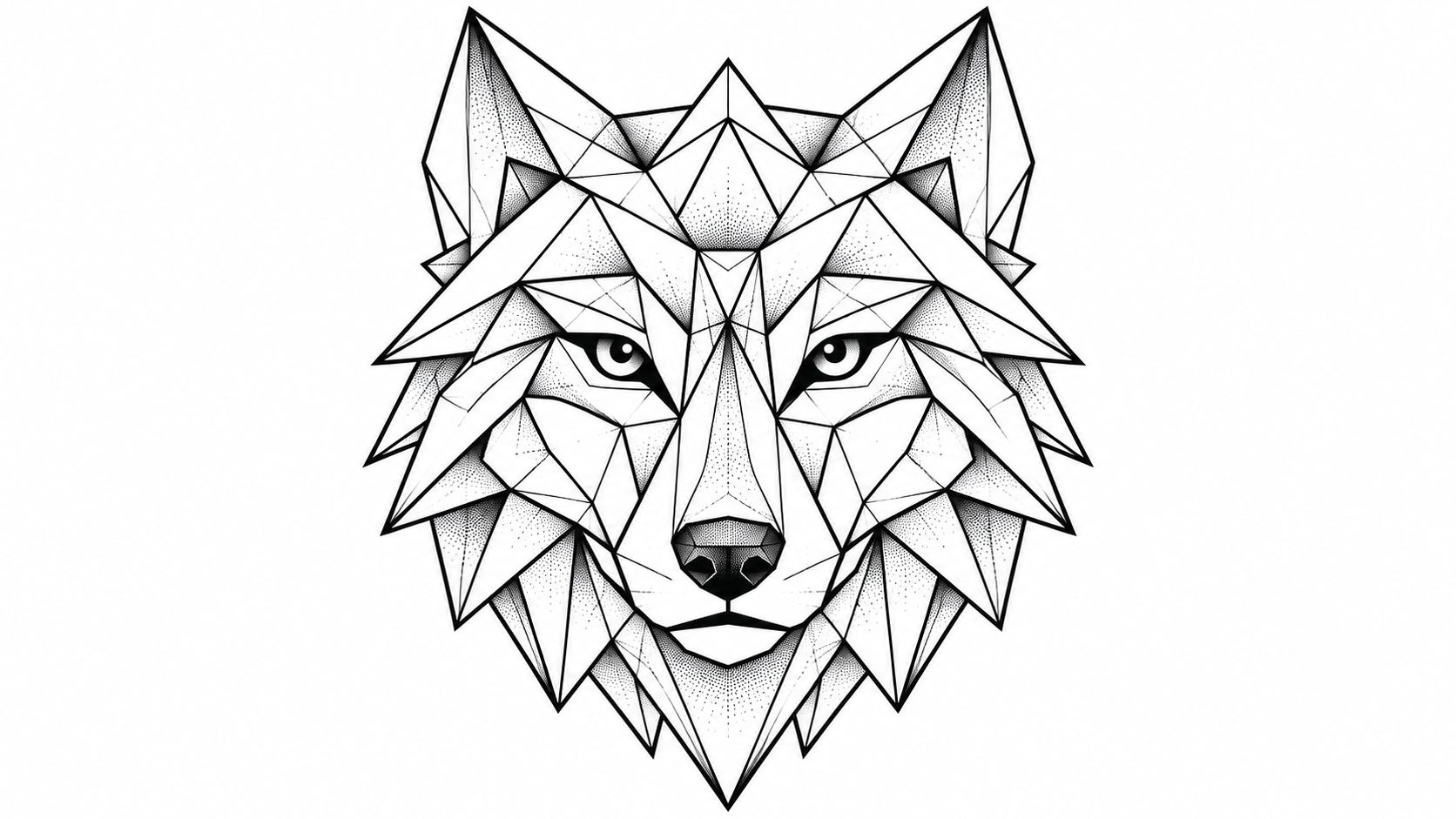
Consultant check: Stand relaxed in front of a mirror after the artist applies the stencil. Raise your arm, twist your torso, and check whether the central nose line stays straight before a single needle touches your skin.
Making Symmetry Work on Real Anatomy
A polygonal wolf shines on the sternum, upper chest, center back, or the flat expanse of the inner forearm. A frequent setup places a half-realistic, half-geometric wolf vertically down the forearm, letting organic fur transition into razor-sharp triangles.
- Supply vector-clean references: Bring crisp line illustrations rather than blurry screenshots so your artist can verify exact angles and mirrored vertices.
- Choose a geometry specialist: Pulling ruler-straight lines on elastic skin requires steady hand speed and specific single-needle or tight-liner groupings.
- Use dotwork for depth: Stippled shading inside alternating polygons creates three-dimensional facets without crowding the sharp borders.
- Avoid tiny micro-facets: Keep individual triangles large enough that normal skin aging won't collapse thin internal gaps.
6. Watercolor Wolf Head
Watercolor is the highest-maintenance style on this entire list. Pure lineless color washes have no black structural borders to slow down visual softening, which means pale pastels and feathered edges can fade into vague bruises within a few years of sun exposure. If you accept that trade-off and build smart structural anchors underneath, you get an expressive, painterly piece that looks unlike standard tattoo flash.
Picture a howling wolf head on the upper arm or shoulder blade where deep cobalt, violet, and teal splashes sweep behind crisp ink contours. This approach communicates raw creativity and artistic freedom rather than traditional toughness. Because soft washes depend entirely on skin contrast, lighter skin tones typically hold translucent watercolor shifts longer, while richer skin tones need bolder jewel pigments and stronger black linework to keep the wolf readable.
Anchor Lines and Saturation Choices
Never let a watercolor wolf float without dark structure. Pairing loose color drips with a solid black sketch outline around the eyes, nose, and ear tips keeps the animal recognizable even if the outer paint splatters lighten over time.
- Pick saturated hues: Deep blues, rich purples, and bold magentas outlast pale yellows, soft pinks, and wispy mint greens by years.
- Test multiple color palettes: Compare cool night-sky tones against fiery amber and crimson splashes before booking so the colors match your undertone.
- Budget for future touch-ups: Ask your artist upfront what color refreshes typically cost after three to five years of natural wear.
- Guard against UV rays: Watercolor loses vibrancy faster under direct sunlight than blackwork, making clothing coverage and daily sunscreen essential.
7. Blackwork Wolf Head with Dotwork Shading
Heavy blackwork feels rougher during healing than delicate line art. Packing large solid black zones causes heavier swelling, thicker scabbing, and slightly longer surface recovery, and you can't easily cover it up later if you change your mind. In return, you get unmatched graphic impact and contrast that holds up brilliantly across every skin tone.
Blackwork relies on saturated black fills paired with generous negative space, while stippled dotwork tattoo style builds fur volume and cheek contours through tiny spaced dots instead of grey wash. Clients looking at heavy black ink sometimes worry about medical imaging down the road. Fortunately, a prospective 3-tesla MRI study in the New England Journal of Medicine reported only transient tattoo-related sensations and no other adverse reactions under the study conditions, offering solid peace of mind for heavy blackwork wearers.
Passing the Five-Centimeter Stencil Test
Before committing to a blackwork wolf on the upper arm or back of the shoulder, run a simple readability check. Shrink the linework and black-fill stencil down to 5 to 8 cm on a screen without any shading. If the wolf's eyes, muzzle planes, and ear contours aren't immediately obvious at thumbnail scale, the composition needs stronger negative space around the cheekbones and jaw.
Say a client wants a graphic blackwork wolf on the back of the shoulder with dotwork fur tapering toward the ribs. Provide your tattooist with clear separation between solid fills and stippled gradients, and pick a spot with even skin texture rather than bony, stretchy joints where dense dots heal unevenly.
"If a wolf head isn't recognizable as a stark black-and-white silhouette without shading, extra texture won't save it five years later."
8. Wolf Head with Moon and Celestial Elements
Adding extra motifs to a wolf head introduces an immediate layout risk. Crowd a crescent moon, star clusters, constellations, and pine trees around a small face, and the whole piece collapses into visual clutter. Keep the supporting cast restrained, however, and you create a personal design rooted in mystery, intuition, and natural cycles.
This concept adapts cleanly across blackwork, fine line, realism, or watercolor. A frequent request pairs a howling wolf silhouette with a crisp crescent moon along the calf or splits a wolf's face beside lunar phases down the forearm to represent life's changing seasons. When clients chase a "spiritual" wolf look, they sometimes drift toward borrowed cultural motifs without realizing the harm. The Tattoo Symbolism guide to wolf tattoo meaning cautions that combining a wolf with a generic Indigenous war bonnet or ceremonial headdress can be culturally insensitive. If you don't belong to a specific community, skip sacred regalia as decoration and lean into nature-based symbolism like moons, mountains, forests, or stars instead.
Keeping the Wolf as the Focal Point
Successful celestial wolf pieces treat the night sky as a quiet frame rather than a competing subject. Keep the wolf's head taking up the clear majority of the stencil area so your eye lands on the animal first.
- Cap your secondary elements: Stick to one primary anchor, such as a single full moon or crescent arc, plus a handful of clean dots or four-point stars.
- Scale up for layered scenes: Combining a detailed wolf head with a patterned moon surface requires a medium-to-large zone like the calf, thigh, or upper back.
- Use negative space for light: Leave bare skin inside the crescent moon or star highlights instead of relying solely on white ink, which tends to yellow over time.
- Match the wolf's expression: A calm gaze or upward howl fits celestial themes naturally, while an aggressive snarl often clashes with tranquil night-sky imagery.
Wolf Head Tattoo Styles at a Glance
Use this table to match a style to your meaning, your placement, and how much detail your skin can hold over time. High-detail rows share one cost: they need a bigger canvas to stay readable.
| Item | Best for | Common placements | Detail level | Healing and aging |
|---|---|---|---|---|
| Realistic Wolf Head Portrait | Lifelike portraits and personal tributes | Upper arm, calf, back of shoulder | High, with detailed fur and eyes | Fine details may blur over time, especially at small sizes |
| Minimalist Line-Art Wolf Head | A discreet, modern wolf symbol | Inner forearm, behind the ear, ankle, collarbone | Low, focused on clean outlines | Fine lines may soften or spread over time; placement affects longevity |
| Traditional American Wolf Head | Bold, classic designs with strong readability | Upper arm, chest, forearm | Medium, with simplified shapes and solid fills | Holds up well over decades; sun exposure can fade color |
| Japanese Irezumi-Style Wolf Head | Large, dramatic designs with traditional symbolism | Back, full sleeve, thigh | High, with flowing backgrounds and rich color | Often takes multiple sessions; aging guidance depends on the design and artist |
| Geometric Wolf Head | Modern, precise, symmetrical designs | Sternum, forearm, calf | Medium to high, with crisp facets and lines | Sharp angles may lose clarity as skin ages |
| Watercolor Wolf Head | Expressive, painterly color designs | Upper arm, shoulder, back | Medium, with soft washes and splashes | Colors may soften or fade faster than solid black work |
| Blackwork Wolf Head with Dotwork Shading | High-contrast, graphic designs | Upper arm, shoulder, thigh | High, with solid fills and stippled texture | Solid black areas take longer to heal; strong contrast supports lasting readability |
| Wolf Head with Moon and Celestial Elements | Symbolic, night-themed compositions | Calf, upper arm, back | Medium to high; a patterned moon or layered sky raises it further | Heals like the base style beneath it; small star and moon details lose definition faster than the wolf's outline |
Read the last column as the deciding factor. Realism, irezumi, and layered celestial scenes pay off only at medium-to-large sizes, while line art and watercolor trade longevity for subtlety and color.
Choosing Your Wolf from Inspiration to the Studio Chair
Narrow your favorites down to just two styles before reaching out to any tattooist. Decide what emotional message comes first, whether that's quiet loyalty, protective strength, artistic color, or a personal memorial. Match that meaning to a body placement that fits both your daily visibility preferences and the minimum size the style needs to age cleanly.
Skin moves, stretches, and catches sun every single day. Always judge prospective artists by their healed photos rather than freshly wiped studio shots gleaming under ring lights. Ask direct questions during your consultation about how specific fur lines, colors, or negative-space gaps will settle on your exact skin tone over the next decade.
Preparing Reference Artwork for Your Consultation
Walking into a consultation with vague verbal descriptions wastes both your time and your artist's. Bringing focused visual references lets the tattooist spend their energy refining anatomy, line weight, and body flow instead of guessing what you pictured.
- Lock in the angle: Specify whether you want a front-facing gaze, a three-quarter turn, or a howling side profile before sketching starts.
- Define the facial expression: State clearly whether you want bared teeth, a calm watchful stare, or a stylized geometric mask.
- Measure the placement area: Use a soft tape measure on the exact arm, calf, or chest zone so your concept matches real dimensions.
- Treat digital concepts as references: Never hand an artist a generated image and demand an exact photocopy, since a licensed tattooist must redraw line weights and shading to fit your body curvature and healing needs.
At TattoosAI, we help bridge that blank-page gap before you ever step into a shop. You can explore 19 tattoo styles across realistic, minimalist, geometric, watercolor, Japanese, dotwork, and blackwork looks, browse our library of 26,000 tattoo ideas across 13 body placements, or check practical planning specs with our free size chart, pain chart, and stencil maker. Every image is generated fresh for your prompt rather than pulled from another artist's portfolio, though we don't currently offer a live on-body preview. Treat what you create as a clean starting reference, take it to a tattooist you trust, and let them adapt the final wolf head to your skin.
Ready to test how your favorite wolf concept looks in different styles before booking your studio consultation? Describe your pose, expression, and palette in three quick steps on TattoosAI to generate original wolf head concepts you can take straight to your tattoo artist.