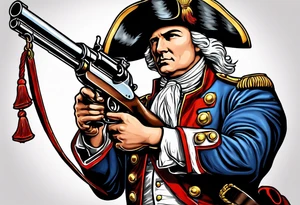
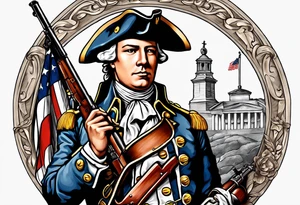
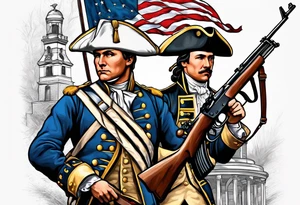
Ar15 Tattoo Ideas — 9 designs

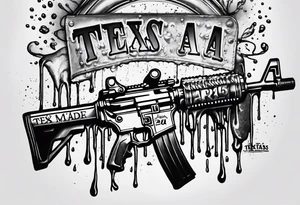
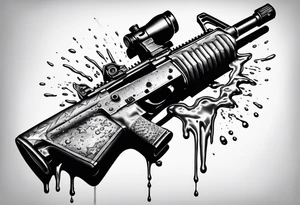
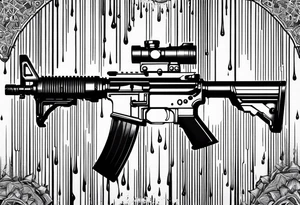
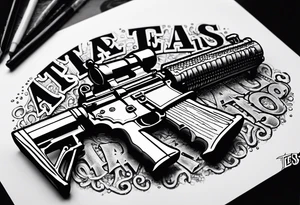
AR-15 tattoos typically symbolize a love for firearms and gun ownership. They can represent a passion for shooting sports and marksmanship or serve as a way to show support for the Second Amendment. Some people may get an AR-15 tattoo to express their pride in military service or to commemorate their experiences in combat. The location for this type of tattoo is often a personal choice, but popular options include the upper arm or shoulder, symbolizing strength and patriotism, or the back, allowing for a larger, more detailed design. Below you will find a collection of ar15 tattoo design ideas for you to browse and get inspired by.

Join 9,635 happy customers.

What an AR-15 Tattoo Actually Says

Beyond a general love of firearms, the AR-15 carries layers that other gun tattoos don't. For some wearers it stands for self-reliance and the right to defend a home or family. For veterans and law enforcement, the platform is simply the rifle they carried for years, and the tattoo functions like a tool mark: the object that was in their hands during a defining stretch of life. For others it's political shorthand, a visible statement about the Second Amendment and government overreach. Sport shooters and competitive marksmen read it differently again, as a nod to precision and discipline. Because the same outline can mean any of these, most people pair it with something that narrows the message: a unit patch, a flag, a date, a phrase, or a family name.
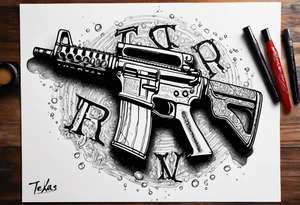
Where the Symbol Comes From

The AR-15 is a specific rifle design that entered the American civilian market in the late 1950s and became the basis for the military M16 family. "AR" refers to the original manufacturer, ArmaLite — not "assault rifle," a point many wearers care about. Its modular build, with interchangeable uppers, rails, stocks and optics, made it the platform enthusiasts customise most, and that customising culture is part of why it appears in tattoos at all: the rifle a person builds becomes personal. In the last two decades the AR-15 has also become the centre of American gun policy debate, which loaded the silhouette with political meaning it did not originally carry. Anyone wearing it is wearing that debate too, whether they intend to or not.

Style, Placement and Things Worth Weighing First

The rifle is a long, narrow subject, so it suits the forearm, outer bicep, calf, ribs and spine, running lengthwise. Fine-line and single-needle work handles the technical detail — charging handle, rail slots, magazine well — while blackwork and heavy linework read better small or from a distance, since thin internal detail can blur as it settles. Some artists build the shape from other elements: flags, roses, text, an American eagle. Before committing, consider that this is a highly legible image with strong political associations, and it will be read by employers, clients and strangers. Placements that can be covered give you control over when that conversation happens. It's also worth checking that your artist is comfortable with the subject before you book.

Ar15 tattoos — common questions

Does an AR-15 tattoo have to be political?

No, but it will often be read that way. Many wearers mean military service, sport shooting, or a personal build they're proud of. If that's your intent, adding context — a deployment date, unit insignia, competition reference, or a family name — helps the tattoo say what you actually mean rather than leaving it open to interpretation.

What size does an AR-15 tattoo need to be?

Anything with mechanical detail benefits from length. A recognisable, detailed rifle usually needs a forearm, calf or ribcage's worth of space. Smaller versions still work, but the artist will simplify — dropping internal linework in favour of a clean silhouette — so the design stays readable as it ages.

Where's the best placement if I want it coverable?

The inner bicep, upper back, ribs, chest and thigh all sit under normal clothing while still offering enough room for a lengthwise design. Forearms and hands are the most visible options. Since this image draws strong reactions from some viewers, a coverable placement lets you decide when it's seen.