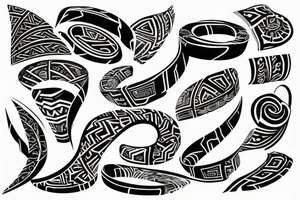
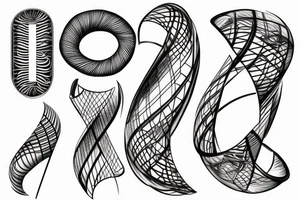
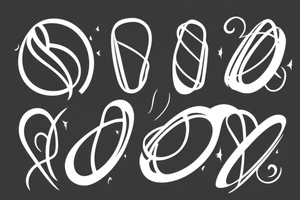
Mobius Tattoo Ideas

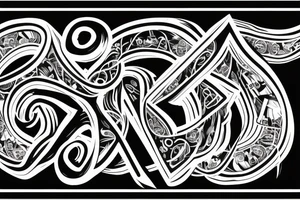
A Mobius tattoo represents infinity or the endless nature of life and the universe, with its characteristic looping and twisting shape that has no apparent beginning or end. It can also symbolize the interconnectedness of all things, as the surface of the Mobius strip is a single continuous surface. Additionally, a Mobius tattoo may represent balance and harmony, as the strip has only one surface and one edge, merging both sides seamlessly. It can also suggest the concept of duality and the integration of opposites, as the strip can be seen as both inside and outside at the same time. A Mobius tattoo is best placed on a wrist or forearm due to its curved shape and ability to wrap around the body, enhancing the symbolism of continuity and unity. Below you will find a collection of mobius tattoo design ideas for you to browse and get inspired by.

Join 9,635 happy customers.

The Mathematics Behind the Symbol

The Möbius strip was described independently by two German mathematicians, August Ferdinand Möbius and Johann Benedict Listing, in the 1850s. Its appeal is that it is a real object with a strange property: take a strip of paper, half-twist it, join the ends, and you have a surface with one side and one edge. Draw a line along it without lifting your pen and you return to your starting point having covered what looked like both faces. That is why the shape carries meaning honestly rather than decoratively — the paradox is not a metaphor imposed on it, it is a demonstrable fact about the object. For many wearers, that verifiability is the point: a symbol of unity that can be tested with scissors and tape.
Personal Meanings People Attach to It

Beyond infinity, the Möbius strip tends to be chosen for specific, quieter reasons. Some read it as a statement about recovery or cyclical struggle — the loop returns, but you are on the other side of the surface each time. Others use it for relationships and family: two apparent sides that are actually one continuous thing. It also appears as a tattoo about non-duality, echoing ideas found in Buddhist and Advaita thought about the illusion of separation, though the strip itself carries no religious lineage and belongs to no tradition. Scientists, engineers, mathematicians and physicists often pick it simply as a marker of intellectual identity. Because the shape has no fixed cultural script, the meaning you assign to it is genuinely yours.

How It Is Usually Drawn

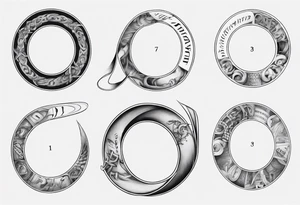
Most Möbius tattoos take one of three approaches. The clean geometric version uses fine, even linework with the half-twist clearly visible — it reads best at a reasonable size, since a very small strip loses the twist and just looks like a ring. The illustrative version treats the strip as a physical ribbon with shading and highlights so the surface change is unmistakable. The third approach fills the band with content: ants or figures walking the loop, an EKG line, DNA rungs, text that runs continuously, or a landscape that shifts from day to night as it turns. Ask your artist to mock the twist onto your actual limb first — the placement determines which part of the loop faces outward.

Mobius tattoos — common questions

Is a Möbius tattoo the same as an infinity symbol?

No. The infinity symbol is a flat figure-eight and a purely abstract sign. A Möbius strip is a three-dimensional surface with a real, testable property — one side and one edge. The Möbius reads as more technical and specific, and it takes up more space on the skin to render clearly.

How small can a Möbius tattoo be?

The twist is the whole point, so it needs enough room to be legible. Once the strip shrinks past a certain size, the half-turn collapses visually and it reads as a plain band or oval. If you want something tiny, discuss with your artist whether a simplified or partially open design keeps the twist readable.

Does the Möbius strip have religious significance?

Not inherently. It is a mathematical object from the 19th century with no scriptural or ritual history. Some people connect it to non-dualist ideas in Buddhist or Hindu philosophy, or to Christian notions of eternity, but those readings are personal interpretations rather than established traditional symbolism.