TattoosAI
What if the photo that sold you on an armband is the least honest version of it you'll ever see? Fresh ink is dark, tight, and photographed at the best angle. Healed ink lives on a curved, moving arm, stretches when you flex, fades where sleeves rub, and softens where the ends meet. That gap is where good Armband Tattoos for Women are decided.
An armband works because it follows the body's natural cylinder. A single line can stay discreet, solid blackwork carries more impact, and a high upper-arm placement can sit under a short sleeve on demand. Each choice changes how visible the band is and where friction or stretch affects it after healing.
Tattoos are now common among American women, especially younger adults, according to YouGov's reporting on U.S. tattoo attitudes. That makes reference photos easy to find and easy to overtrust.
The eight styles below are judged on how they age, where they fail, and how to brief an artist or generator before those lessons land on your skin. Use the fresh photo to choose the mood. Use the healed view to choose line weight, spacing, placement, and the way the band closes around the arm.
Table of Contents
- 1. Polynesian-Inspired Tribal Armband
- 2. Fine-Line Botanical Vine Armband
- 3. Dotwork Mandala Armband
- 4. Japanese Irezumi-Style Cherry Blossom Armband
- 5. Celtic Knotwork Armband
- 6. Serpent Wrap Armband
- 7. Minimalist Single-Line Ring Armband
- 8. Watercolor Floral Armband
- Armband Tattoo Styles for Women at a Glance
- From Idea to Ink: Designing Your Armband Before You Book a Studio
1. Polynesian-Inspired Tribal Armband
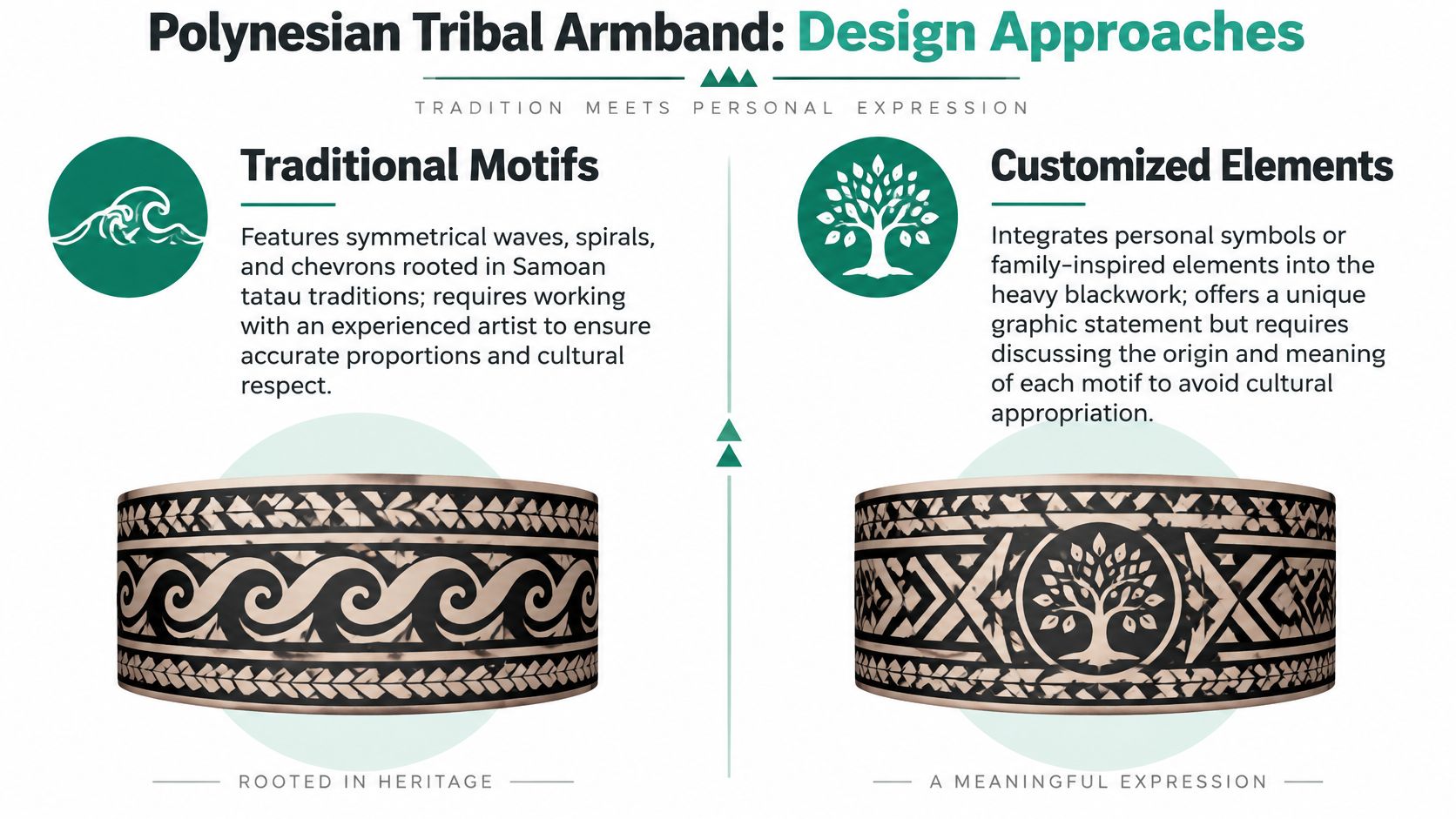
Solid black, high contrast, and built to wrap, this is the armband that many people picture first. Flowing points, repeated triangles, and curved koru-like forms sit around the upper arm and read clearly from across a room. Angelina Jolie's widely covered tribal-style upper-arm and shoulder pieces helped push the look into the mainstream in the early 2000s, but the roots are in Polynesian and Samoan tatau, where motifs can reference family, genealogy, protection, and status.
That cultural weight is the trade-off. Copying a random flash sheet because the shapes look sharp can land you with symbols that aren't yours to claim, or a pattern an experienced artist would never combine. If meaning matters, ask what each motif represents before you approve the stencil.
How It Ages and How to Brief It
Bold black ages better than almost anything else here. Edges soften, but the silhouette survives because there's contrast and negative space between shapes. The risk is overpacking. Tight points placed too close on the inner arm will merge as ink spreads.
- Width first: Wider bands flatter longer upper arms. Narrower bands suit shorter arms and leave room to extend later.
- Artist fit: Choose someone fluent in Polynesian or Samoan proportion, not a generalist copying a screenshot.
- Prompt to try: "Polynesian-inspired tribal armband, solid black, symmetrical wrap for upper arm, clear negative space between points, no text."
- Session plan: Solid fills take time and swell more. Don't book a sleeveless event the same week.
For a smaller test of the language, compare proportions in wrist tribal tattoo ideas before committing to upper-arm scale. Say you want strength without a full sleeve. This is your strongest candidate, provided you treat the source culture with respect.
2. Fine-Line Botanical Vine Armband
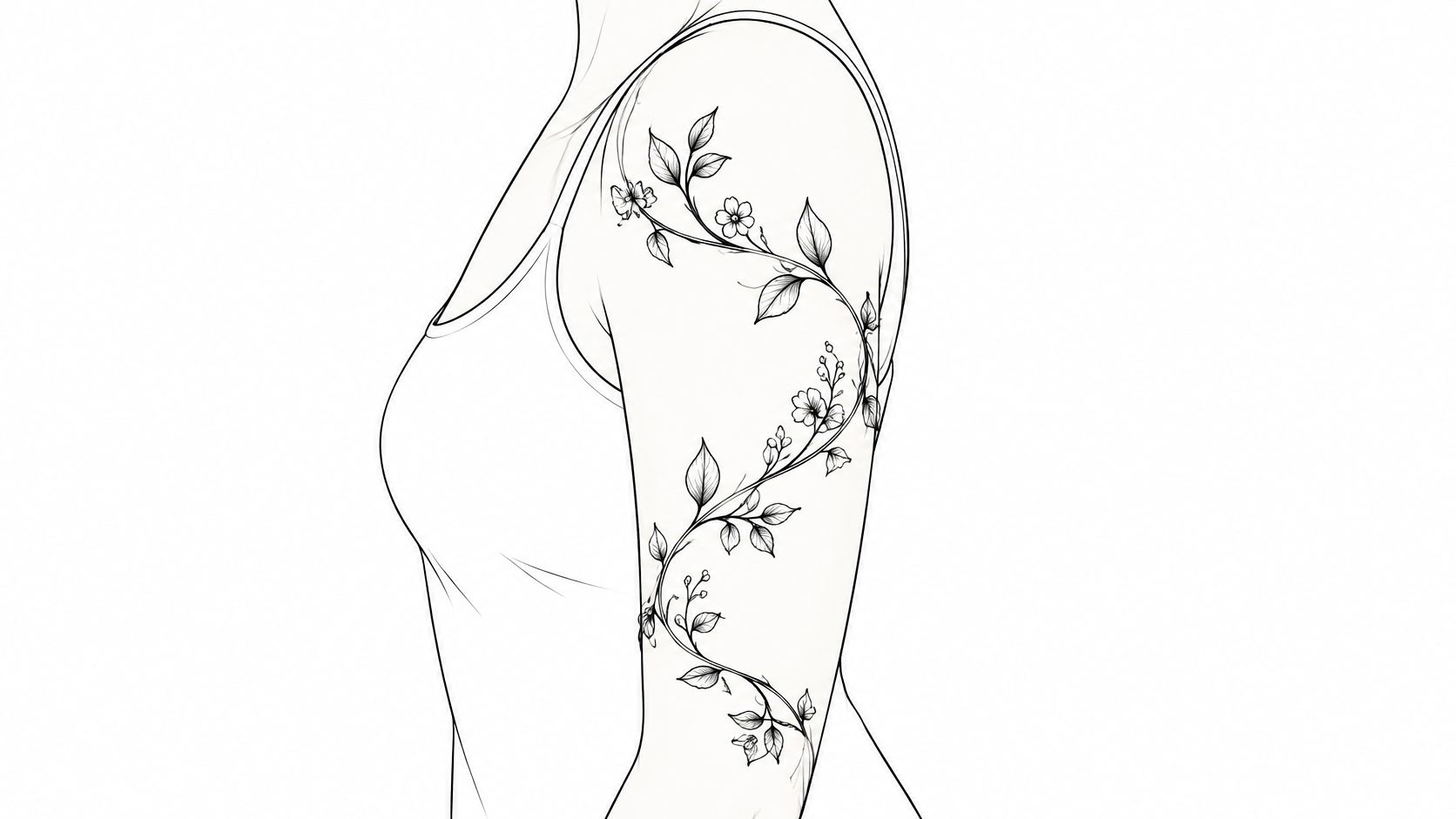
A vine doesn't need to shout. Thin stems, small leaves, and tiny blooms trace the upper arm or forearm, turning the band into jewelry rather than armor. Olive branches suggest peace, laurel suggests achievement, and eucalyptus keeps the palette soft and modern. It's the style social media made famous, and also the one most likely to disappoint if you only judge fresh photos.
Placement changes everything. One Turkish dermatology study reported tattoos among 31% of women versus 27% of men, and found that wrists and ankles were significantly more common tattoo locations among women, as detailed in the Turkish dermatology study on tattoo attitudes. That matters here because a wrist-to-forearm vine lives on a curved, high-movement surface. What looks airy flat can compress on the inner wrist.
The Healed Version Is the Real Design
Ask for healed portfolio photos, not fresh ones. A good fine-line specialist will show work that's settled, with lines still separate. I'd specify a 3RL or 5RL grouping for detail, but I'd let the artist adjust if your skin or scale needs a slightly bolder line.
Fine lines don't fail because they're delicate. They fail because they're drawn too close together for skin that will change.
Keep spacing between leaves and parallel stems so the vine stays legible. Plan a touch-up after the first few months, especially where the band crosses the inner arm. Explore spacing options in vine tattoo designs, then use a prompt like "fine-line botanical vine armband wrapping the upper arm, eucalyptus, small white blooms, generous spacing, open join on inner arm."
Say you want a first tattoo you can hide under a sleeve at work. Choose the upper arm, keep blooms larger than you think you need, and skip micro-leaves at the seam.
3. Dotwork Mandala Armband
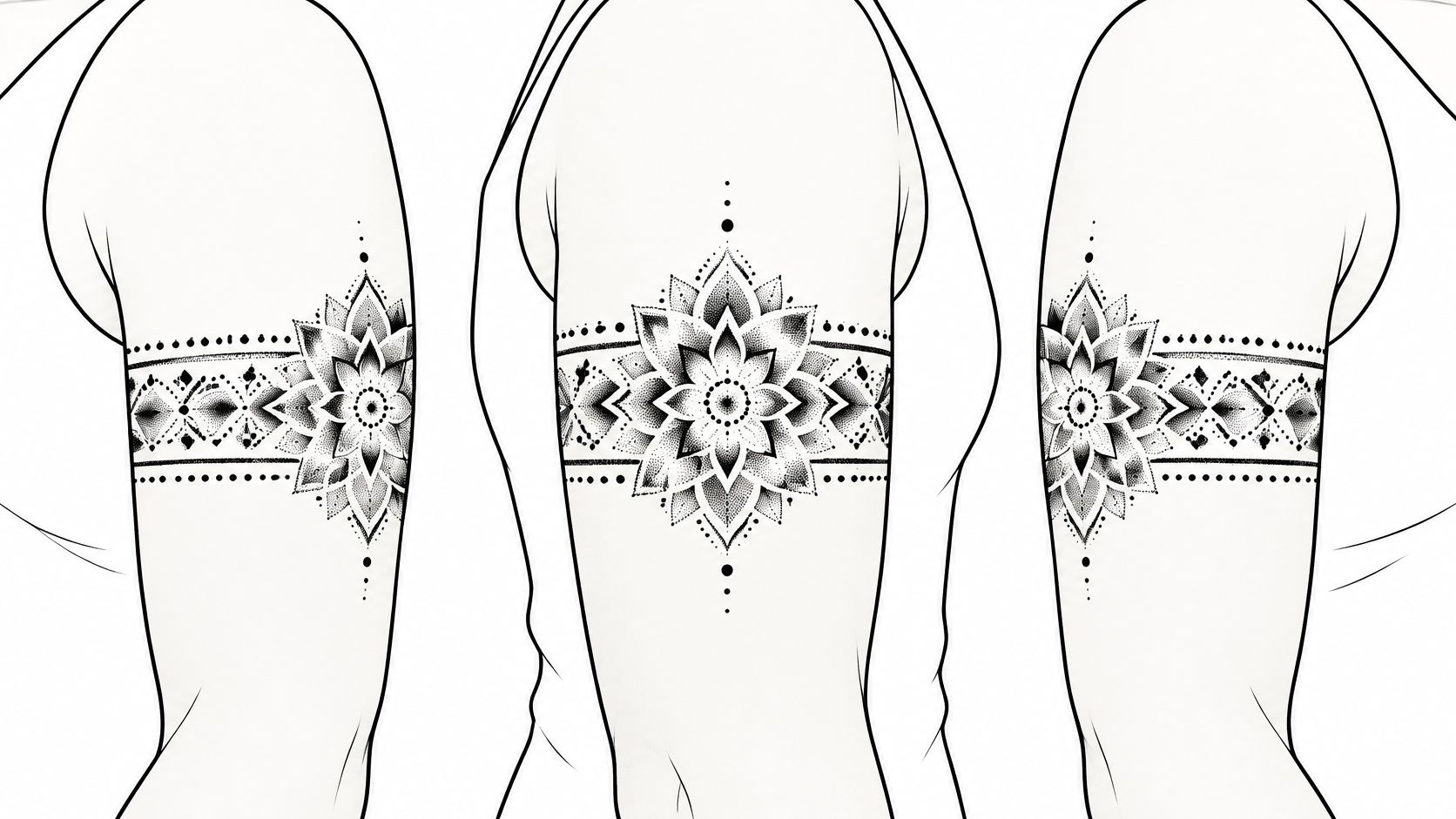
Thousands of dots. No solid fill. That's the appeal and the workload. A dotwork mandala builds symmetry through stippled gradients, ornamental borders, and a central motif that repeats around the arm. Women often choose it for meditation, balance, or personal growth, or because geometry looks calm even at larger scale.
The arm isn't flat, so symmetry is a negotiation. The front-facing center can look perfect while the sides compress and the join drifts. Your artist should map the repeat to your circumference, not resize a perfect circle and hope it meets.
Size Protects the Dots
Technical execution should shape the concept early. Public health guidance notes tattoo needles puncture the epidermis roughly 100 times per second and deposit ink approximately 1.5 to 2 millimeters below the skin, in the dermis, according to Weld County ink guidance for industry. In plain terms, dots placed too tightly won't stay separate forever. They'll read as gray texture.
- Go bigger than your screenshot: A slightly wider band gives gradients room to breathe.
- Check healed dotwork: Fresh stippling looks crisp on everyone. Healed work shows control.
- Stencil from three angles: Front, outer arm, and inner join. Approve all three.
- Prompt to try: "Dotwork mandala armband, symmetrical repeat measured for upper arm wrap, ornamental border, floral center, spaced stipple gradient."
Say you want an intricate piece without heavy black. Dotwork gives depth with less visual weight, but budget for a slower session and an artist who'll redraw the repeat for your arm, not for a template.
4. Japanese Irezumi-Style Cherry Blossom Armband
Cherry blossom carries an obvious tension. It's soft to look at and built on a bold tradition. In a Japanese-inspired armband, sakura blossoms drift through wind bars, swirling clouds, or waves, using flow to carry the eye around the arm. Blossoms suggest transience and renewal, while water adds movement and a natural way to hide the seam.
Composition is where weak versions fall apart. A few pink flowers pasted onto a straight band doesn't create irezumi flow. Traditional work uses background elements to connect motifs, control contrast, and make the wrap feel continuous from every angle.
Color Needs Structure
Soft pink shading ages fastest when there's no darker structure under it. Stronger outlines, deeper background tones, and enough uninked skin keep blossoms readable after the pastel softens. Sunscreen isn't optional on color work. Upper arms get less sun than forearms, but sleeveless summers add up.
Practical rule: If the design only works in pale pink, it doesn't work yet. It should still read in black and gray.
Choose a specialist who understands Japanese styling, motif placement, and how waves or clouds turn a corner. Ask whether a full closed band suits your frame or whether a partial wrap that tapers at the inner arm will move better. A useful prompt is "Japanese irezumi-style cherry blossom armband, sakura with waves and wind bars, continuous upper-arm wrap, bold structure, soft pink accents."
Say you want color but hate patchy fading. Keep blossoms as accents inside a stronger wave background. You'll lose some delicacy on day one and keep the design for years.
5. Celtic Knotwork Armband
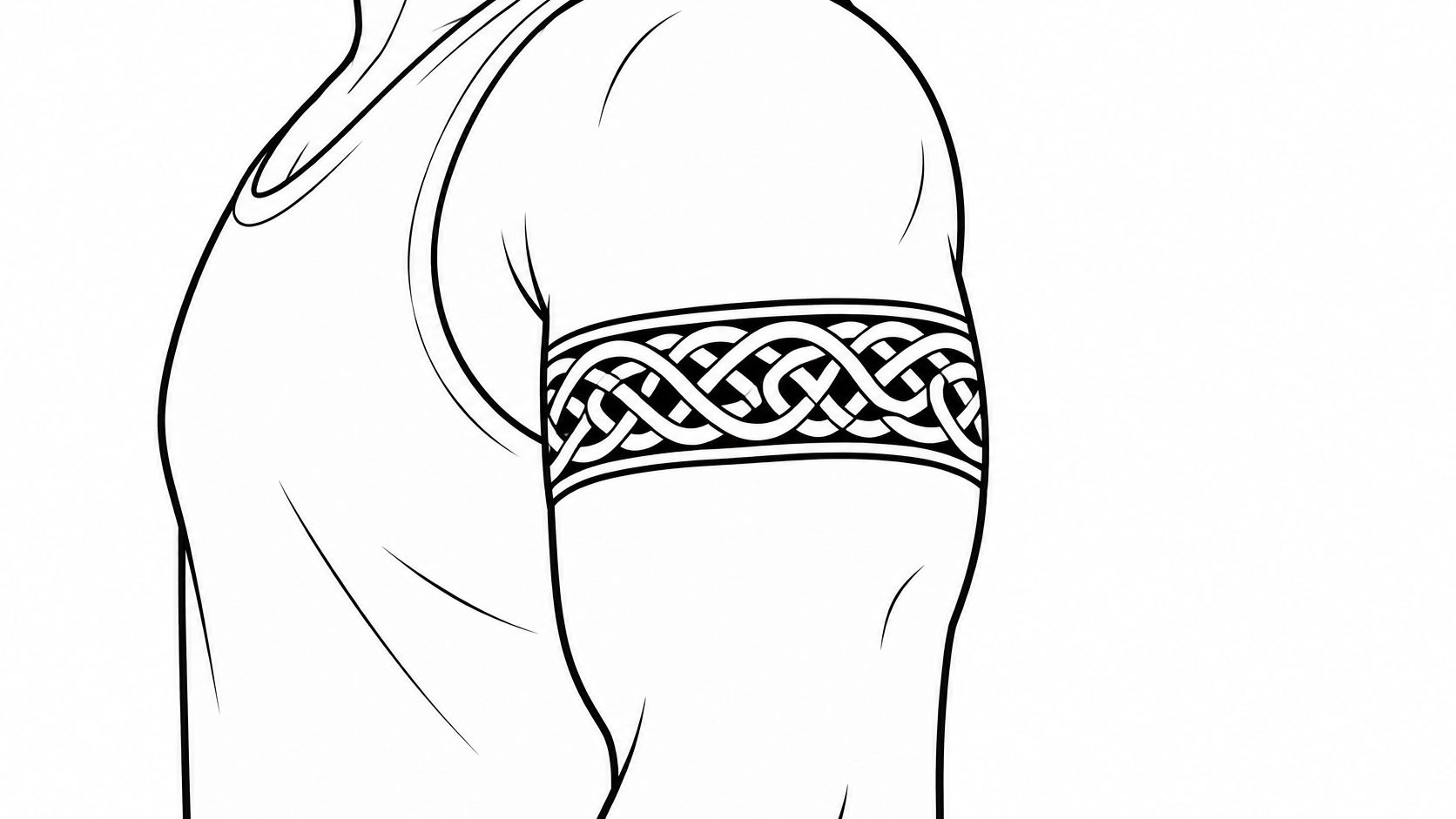
Endless line, no obvious start, no obvious finish. Celtic knotwork suits an armband because the format already wants continuity. Interlaced cords, braids, and triquetra or trinity-knot centers suggest eternity, connection, and continuity, and the black linework keeps the result timeless rather than trendy.
The difficulty is invisible in most reference photos. A knot has a path. It goes over, under, over, under, and that logic has to survive the full circumference of your arm. If the repeat doesn't divide cleanly into your measurement, the artist has to cheat somewhere. Better that cheat is planned at the inner arm than discovered halfway through.
Readability Beats Complexity
Ask the artist to draw the knot path at full size before tattooing. Then check the stencil while you bend and rotate your arm. Crossings that look clear when you're still can pinch when skin shifts.
- Spacing at crossings: Tight interlace blurs first. Wider gaps preserve the over-under pattern.
- Border lines: Simple rails above and below contain the knot and make future additions cleaner.
- Symbol check: Verify what a triquetra or specific knot means to you before you wear it permanently.
- Prompt to try: "Celtic knotwork armband, continuous interlaced braid for upper arm, triquetra center on outer arm, wide spacing, black linework with border lines."
Say you want heritage symbolism without color or heavy fill. Knotwork delivers, but only if you resist the most intricate version. A simpler braid that stays readable will age better than a dense puzzle nobody can follow in five years.
6. Serpent Wrap Armband
A snake solves the seam problem by turning it into anatomy. The body coils around the upper arm, the head rests near the shoulder or outer arm, and the tail tapers where the design needs to end. Across many traditions serpents suggest transformation, healing, and renewal, which is why the motif keeps returning as styles change.
Movement is the whole point. A serpent drawn straight and wrapped mechanically reads like a sticker. A good one follows the muscle, thickens and narrows through each coil, and sends the quieter stretch of body across the inner arm. That flow ages well too: a coil that bends with the bicep stays convincing as skin shifts, while a rigid wrap looks warped within a few years.
The video below is useful for judging flow in motion rather than in a still stencil.
Head Placement Makes or Breaks It
Decide where the head lands before you debate scales. The outer arm gives you a focal point people see. Up near the shoulder feels more dramatic but disappears under sleeves. Be honest about detail while you're at it: tiny scale patterns blur first at this width. Stylized blackwork or illustrative scale groupings hold their shape far longer than fine realistic shading, and they give a touch-up artist something solid to work back into.
Ask for a stencil preview with your arm relaxed and flexed. If the head warps into a different expression when you move, redraw it before anything goes under the needle. Plan touch-ups around the scale clusters and the tail tip.
A coiled serpent also behaves like a piece of jewelry, catching light and shifting as your arm moves, much like the charm inspiration from Bridle Up Hope Shop. Prompt for your artist or a generator: "serpent wrap armband coiling around upper arm, head on outer arm, tapered tail at inner arm, stylized blackwork scales, dynamic flow."
For a band with presence but no solid ring, the serpent earns its keep: gaps, movement, and a natural path to extend into a sleeve later.
7. Minimalist Single-Line Ring Armband
One line. That's the commitment and the risk. A thin continuous ring around the upper arm, sometimes with a dot or tiny symbol at the center, is often a first tattoo because it's quick, subtle, and easy to cover. It's also unforgiving. There's nowhere for a wobble, uneven join, or patchy heal to hide.
Placement data explains why the upper arm is such a reliable canvas. In a peer-reviewed study of 3,033 participants, the upper arm was the most common reported tattoo location at 41.5%, followed by the upper back or shoulder, as reported in the peer-reviewed study in PMC. Those figures describe reported locations, not armband market share, but they point to what artists know in practice. The outer upper arm is stable, comparatively forgiving, and easy to protect.
Thin Does Not Mean Fragile by Default
Choose a line weight that'll hold for years, not the thinnest line your artist can pull on a good day. Slightly bolder reads cleaner after healing and gives a touch-up somewhere to go. Test the height with a stencil or temporary version through a normal day of sleeves, bags, and workouts.
- Join on the inner arm: That's where a tiny overlap or break is least visible.
- Consider an open ring: A small gap can look intentional and avoids a forced join.
- Prompt to try: "Minimalist single-line ring armband for upper arm, medium fine line, small dot accent on outer arm, open join on inner arm."
- Touch-up expectation: Book it mentally from day one. Thin lines often need one pass after settling.
Say you want the least tattoo that still feels deliberate. This is it, provided you don't go so fine that it turns into a faint scratch by next summer.
8. Watercolor Floral Armband
Watercolor trades certainty for softness. Peonies, wildflowers, and loose foliage blend through pastel washes, splashes, and edges that fade into skin instead of ending in a hard outline. On the upper arm, it can look like paint moving with you. It's expressive, feminine, and the least predictable style on this list as it ages.
That doesn't make it a bad choice. It makes healed portfolios nonnegotiable. Fresh watercolor glows because pigment sits bright before skin settles over it. Healed work shows whether the artist left enough value contrast, darker anchors, and skin breaks to keep flowers from becoming a pastel bruise.
Build It So It Can Change
Future flexibility matters with soft work. A 2025 report said removal clinics were seeing a new group of clients associated with the rise of fine-line and detailed tattoos, while citing an estimated global tattoo-removal market of US$1.29 billion in 2025 and a forecast of US$4.87 billion by 2034, according to SBS News reporting on tattoo removal. Those are market estimates, not proof your piece will fail. They're a reminder to design for touch-ups, additions, or cover-up options instead of assuming clean reversal.
Limit the palette to a cohesive family, keep a few darker leaves or line accents for structure, and use sunscreen to protect saturation. Nature references help, including color stories like Fillaree's sunflower fields story. Try the prompt "watercolor floral armband wrapping upper arm, peonies with soft pastel washes, darker foliage anchors, skin breaks, painterly edges."
Say you want art first and permanence second, and you're happy to refresh color periodically. Choose watercolor with open eyes and a maintenance budget.
Armband Tattoo Styles for Women at a Glance
| Item | Style & Visual Weight | Symbolism | Best Placement | Aging & Maintenance |
|---|---|---|---|---|
| Polynesian-Inspired Tribal Armband | Bold, high-contrast blackwork with geometric, flowing motifs | Cultural heritage; customized motifs may reflect family or personal meaning | Upper arm, sometimes extending toward the shoulder | Bold lines age predictably; choose motifs with cultural respect |
| Fine-Line Botanical Vine Armband | Delicate, light fine-line vines, leaves, and blooms | Nature, peace, achievement, or birth-flower meanings | Upper arm or forearm | Fine lines may blur; spacing and occasional touch-ups help preserve clarity |
| Dotwork Mandala Armband | Intricate, symmetrical dots with shaded depth and ornamental borders | Balance, protection, inner peace, or personal growth | Upper arm, wrapped continuously around the arm | Dense dots can soften over time; allow enough size and spacing for detail |
| Japanese Irezumi-Style Cherry Blossom Armband | Bold outlines, flowing motifs, and color or grayscale shading | Cherry blossoms suggest transience and renewal | Upper arm, shaped to follow the arm's contours | Clear outlines are durable; protect color from sun and expect larger pieces to take multiple sessions |
| Celtic Knotwork Armband | Structured interlaced lines, usually in black ink | Eternity, connection, and continuity | Upper arm or forearm | Keep knot spacing open to reduce blurring; precise planning supports legibility |
| Serpent Wrap Armband | Dynamic coiling snake, from stylized blackwork to realistic shading | Transformation, healing, and renewal | Upper arm, with head and tail positioned for balance | Scale details may need touch-ups; account for muscle movement and distortion |
| Minimalist Single-Line Ring Armband | Thin, understated line or narrow band with optional small accents | Simple personal expression; meaning may be limited by minimal detail | Upper arm, forearm, or near the wrist | Thin lines may fade or blur; moderate line weight and touch-ups help maintain crispness |
| Watercolor Floral Armband | Expressive flowers with soft, blended color washes and little outlining | Personal expression and floral themes | Upper arm, following an organic wrap | Color may fade or blur; sunscreen and periodic touch-ups help retain vibrancy |
From Idea to Ink: Designing Your Armband Before You Book a Studio
Arrive with concepts an artist can measure. “Delicate but bold” gives no width, no spacing, and no join. A useful reference shows how wide the band sits on your arm, how dense the motif is, where the join lands, how much negative space stays open, and whether the band closes fully or leaves a small gap for flex. Generate variants, print the strongest ones at arm size, and check them under short sleeves, long sleeves, and movement before you book.
Design for healed skin, not for the first photo. Ask how line spacing will settle once swelling drops, whether tight coverage could make later rashes or skin changes harder to read, and whether a small break near the inner arm would age better than a hard seam. A dermatology review in PMC reports delayed allergic reactions and long-term fibrosis or granulomatous change among possible tattoo complications, and cites a 10-year clinical series with persistent complications in 6% of 405 tattooed patients. Most heal cleanly, but keep pigment details, a healed photo, and a clear sense of which symptoms deserve a dermatologist.
Put safety checks in the same conversation as style. Confirm licensed practice, sterile single-use needles, ink traceability, and real experience with continuous bands that must meet cleanly around the arm. Tell MRI staff about the tattoo instead of assuming it is automatically a problem; reactions are uncommon, and disclosure lets them prepare properly.
Test adaptability before the needle starts. Can the band extend into a sleeve later? Can a vine take a second stem without crowding? Can watercolor accept darker anchors if the soft edges fade? If regret already feels plausible, pause and read about help with a regretted tattoo before adding permanent ink. Removal is slow, costly, and incomplete as a reset.
TattoosAI fits the visualization stage. Describe an armband, choose from 19 styles including minimalist, dotwork, blackwork, Japanese, and fine line, and use the free 3-day trial to compare variants before a consult. You can get what you generate tattooed, then take the design to a tattooist you trust.
Bring one style, three widths, and two join options to TattoosAI, then ask your artist one direct question: how will this look healed on my arm in five years?