TattoosAI
By 2018, approximately 30% of US adults had at least one tattoo, a sharp rise that turned personal milestones into mainstream design subjects. A birth clock belongs to that shift. It doesn't just show a clock, it records one exact minute on skin, usually the minute a child arrived. That precision is the appeal, and it's also where people make permanent mistakes.
Table of Contents
- Why Birth Clock Tattoos Mark a Precise Moment
- What Birth Clock Tattoos Represent
- Translating a Birth Time Into Accurate Clock Hands
- Styling Options and Placement for Birth Clock Designs
- Using TattoosAI to Generate Birth Clock Concepts
- Common Pitfalls and Skin Safety Before You Book
- Your Next Step Toward a Birth Clock Design
Why Birth Clock Tattoos Mark a Precise Moment
A parent often remembers a birth time the way they remember a name or a date. It's repeated at the hospital, written on paperwork, and told to family in the first phone calls. Turning that minute into tattooed clock hands gives the memory a shape you can see at a glance.
That idea landed in a culture where tattoos had already become common. In the United States, a 2012 Harris Interactive estimate reported that 21.0% of adults had at least one tattoo, up from 14.0% in 2008. A later 2018 Harris Poll estimate placed adult prevalence at approximately 30%, with 47% of Millennials reporting at least one tattoo. Those figures don't isolate birth clock tattoos as a category, and you shouldn't read them as a ranking of this design. They show something simpler. A large share of adults, including many people in their childbearing years, already consider tattooing a normal way to mark identity.
A Popular Format Meets a Private Fact
Think of the design as a public shape holding private information. Anyone who sees a clock understands the general subject, time. Only people who know the story understand why the hands stop where they do.
That balance explains much of the appeal. A forearm clock can look classic from across a room. Up close, it can carry a child's name, a date, and a time that matters to one family.
Some parents explore the same birth details from another angle before committing them to a design. If you're comparing how birth date and time are interpreted in other traditions, you might get a Vedic astrology reading as background research, then return to the tattoo decision with a clearer sense of which details you want recorded. The tattoo itself stays a design choice, not a proof of anything.
What You're Actually Deciding
By the time you book, you'll need to settle five things. You'll confirm the time and how it's written, choose what the clock means to you, set the hands at geometrically correct angles, pick a style and size that stay readable, and check skin safety with a regulated studio. If you can answer those five points on paper, you're ready to talk to an artist.
A birth clock works best when you can state the time, the date, and the reason in one short sentence without guessing.
That sentence sounds easy. The rest of this guide is about why it often isn't, and how to check each part before the needle makes it permanent.
What Birth Clock Tattoos Represent
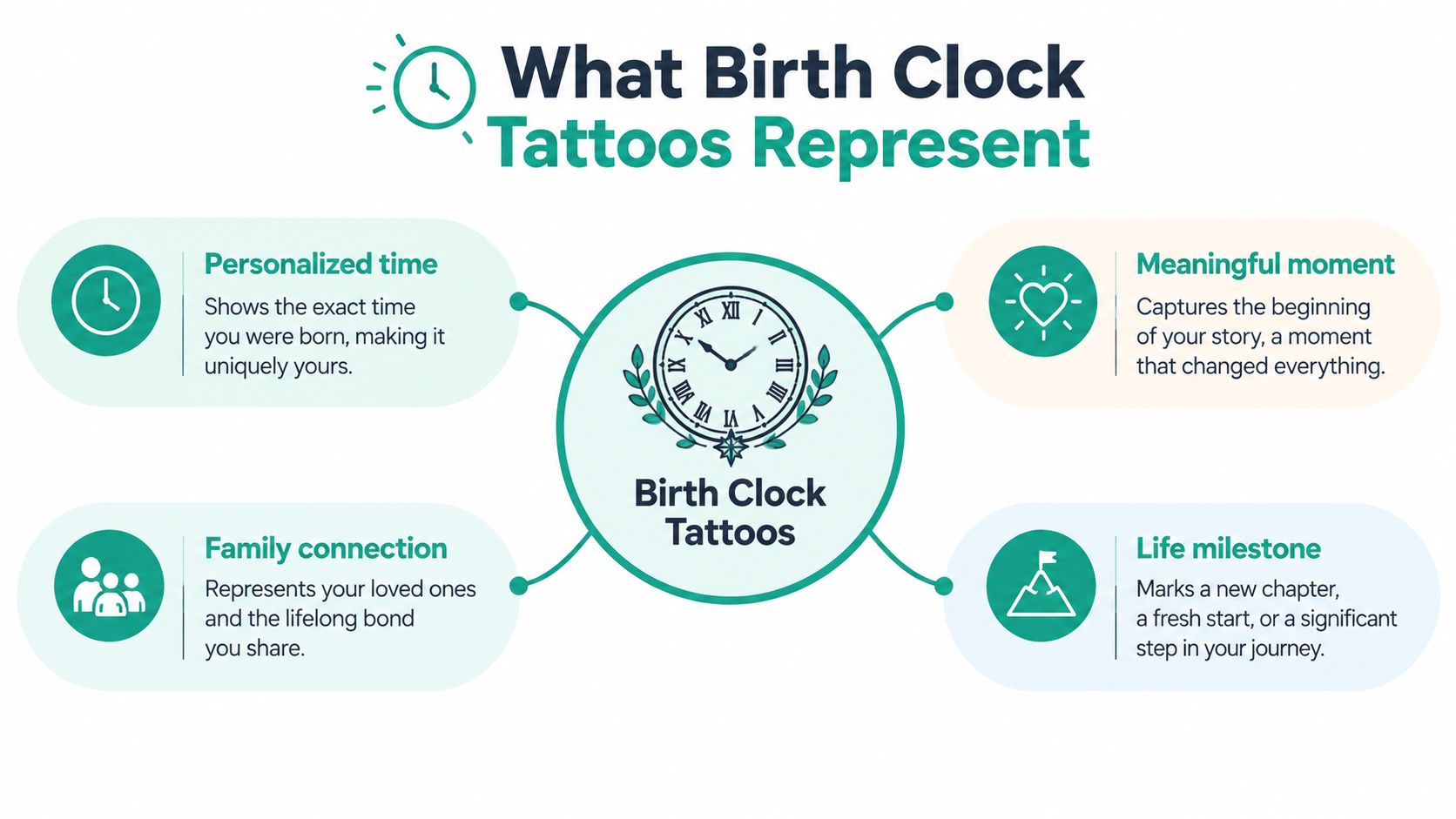
A standard clock tattoo shows time in general. A birth clock narrows that idea to a single, named event. Birth clock tattoos personalize the broader clock-tattoo tradition because the hands are set to a meaningful time, most commonly a child's birth time, while surrounding imagery may add a name, date, flowers, Roman numerals, or a portrait.
Use this analogy. A family history is a long book, and the clock hands are a bookmark pressed into one page. The bookmark doesn't retell the whole book. It tells you exactly where to reopen it.
The Parts and What Each Part Does
The design breaks into four connected elements. Each one carries a different job, and confusion usually starts when people expect one element to do everything.
- The clock face: This supplies the language of measured time, hours, minutes, and order. Roman numerals, tick marks, or a bare circle all change the tone, but the face still says this moment can be located.
- The fixed hands: These carry the specific fact. They stop the clock at a birth, rather than letting it run like an ordinary timepiece.
- The personal text: A name or date identifies whose moment this is. Without it, viewers see a time but don't know whose time it is.
- The surrounding imagery: Flowers, wings, or a portrait add emotional context. If flowers interest you as a softer frame, birth flower tattoo ideas show how floral elements can sit alongside a time based design.
Two Older Meanings Sit Underneath
Clock imagery has older roots in European mechanical timekeeping, which emerged during the medieval period, and by the 14th century mechanical clocks had made measured hours a major social technology. Tattoo symbolism draws two foundational interpretations from that history. The first is time's passage and mortality, often linked to the memento mori tradition, which reminds viewers that life is finite. The second is the preservation of a personally significant moment, holding one point still while everything else moves on.
A birth clock leans toward the second meaning, but the first never fully disappears. A parent marking a child's first minute is also marking how quickly that child will grow. That's why the image can feel joyful and a little wistful at the same time.
Contemporary tattoo references identify birth and death as common reasons for fixing clock hands at a particular time. That makes the birth clock a visual record of family history, not just a decorative timepiece. You're not tattooing a clock because you like clocks. You're tattooing the minute your family changed.
Translating a Birth Time Into Accurate Clock Hands
This is the step most concept images get wrong. A real analog clock doesn't snap its hour hand from numeral to numeral. Both hands move continuously, and your tattoo should copy that movement if you want a technically correct clock.
Here's the rule in plain language. The short hour hand crawls. The long minute hand travels the full circle each hour. Because the hour hand keeps crawling as minutes pass, it rarely points exactly at a numeral, except precisely on the hour.
The Two Movement Rules
You only need two numbers to check any design. The minute hand advances 6 degrees per minute, while the hour hand advances 0.5 degrees per minute and also shifts continuously with the minutes. Multiply the minutes by each rate, then add the hour hand's starting position for the hour.
Watch collectors care about this kind of continuous, correct movement for mechanical reasons, and if that side interests you, Rolex precision explained for watch collectors gives useful background. For a tattoo, the point is simpler. The geometry has to match the time you claim the clock shows.
| Clock element | Movement rule | Position at 10:30 |
|---|---|---|
| Minute hand | 6 degrees per minute | 180 degrees, pointing straight down at the 30 minute mark |
| Hour hand | 0.5 degrees per minute, shifting continuously | 315 degrees, halfway between 10 and 11 |
| Clock face | Fixed reference for both hands | Numerals and tick marks stay still while hands are placed against them |
Work Through 10:30 Slowly
At 10:30, the minute hand points at 180 degrees and the hour hand at 315 degrees, not exactly at 10. Many people expect the hour hand to sit on the 10 because the hour is still 10. That expectation is the common error.
Think of the hour hand as a traveler walking from 10 toward 11. At 10:30, the traveler is halfway there. At 10:45, they'd be three quarters of the way. A clock that shows the hour hand parked on 10 at 10:45 is showing a position no working clock would hold.
Give Your Artist a Labeled Reference
Don't hand over a loose image and say the time out loud once. Write the birth time in both 12 hour and 24 hour formats, note the date, and label which hand is which on your reference. Then ask for a stencil or digital mock up at the intended physical diameter and check the hour hand position yourself before tattooing.
Practical rule: If the minutes are past zero and the hour hand sits exactly on a numeral, the drawing is probably wrong.
That one check catches most inaccurate concepts in seconds.
Styling Options and Placement for Birth Clock Designs
Accuracy tells you where the hands go. Style tells you how much else the skin can hold around them. The image below shows how delicate versions use open space to keep a small clock readable.
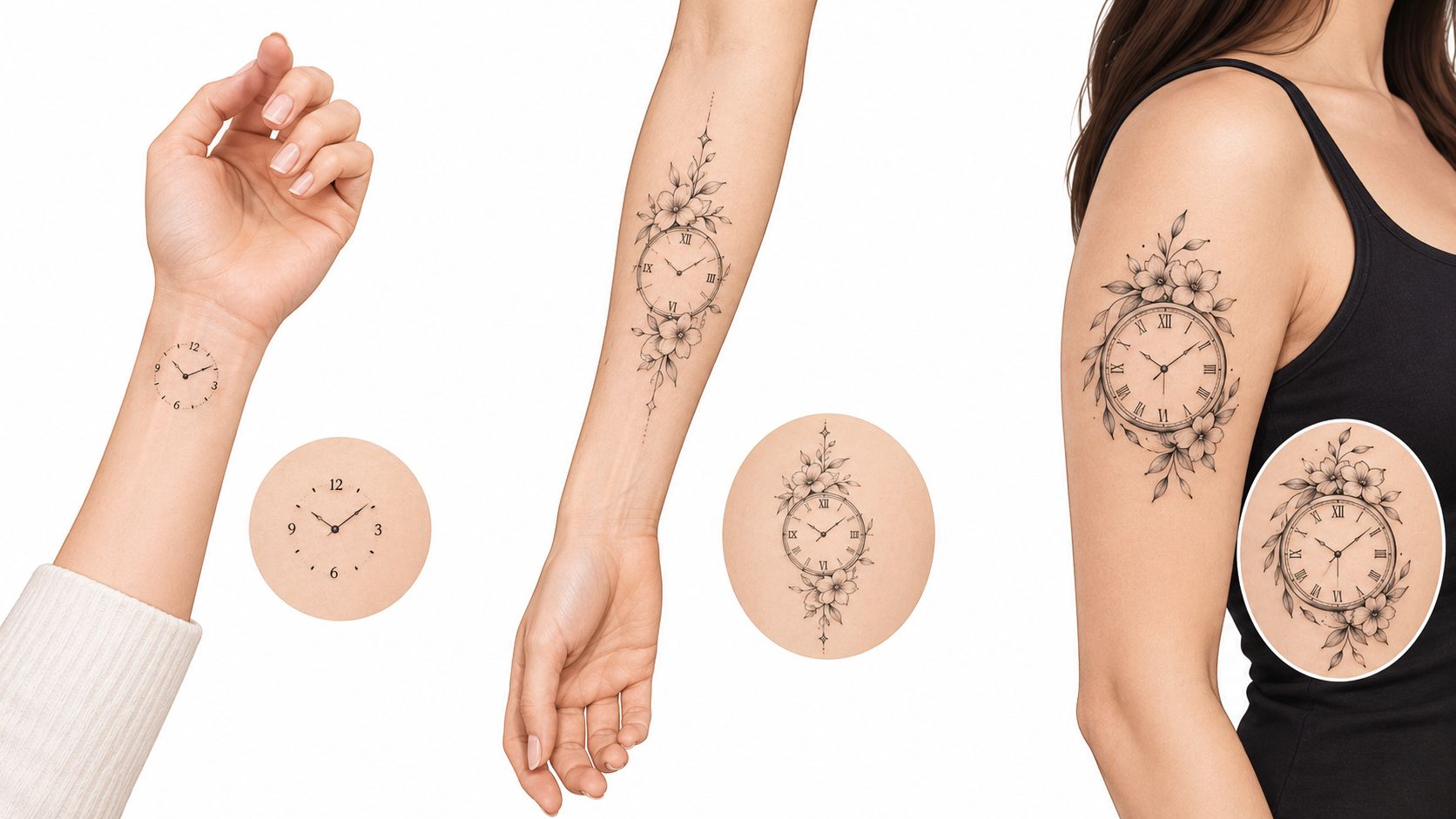
A minimalist clock strips the face down to a circle, simple ticks, and two hands. It reads clearly at a smaller size because there's less competing detail. The tradeoff is that a name, date, or second hand may have to sit outside the face or be left out.
A fine line design adds thin Roman numerals, delicate florals, or script. It can look elegant on screen. On skin, it needs room, because pigment gradually redistributes in the dermis and ultraviolet exposure contributes to fading and visual blur over time. Lines that start close together can look merged years later.
An ornamental design goes further, with a pocket watch frame, shading, wings, or a portrait. This direction gives the artist more storytelling space. It also demands the largest placement, since every added element competes with the numerals and hands.
Size Is a Legibility Decision
A larger clock face generally gives the artist more room to maintain legibility, especially with Roman numerals, a second hand, a birth date, or fine floral detail. For small placements, preserve enough negative space between numerals, hands, and ornamentation. Negative space isn't wasted space. It's the breathing room that keeps the time readable.
If you're also drawn to number based symbolism around a birth date, browsing spiritual tattoo inspiration for 2026 can help you decide whether extra numbers belong in the piece or would crowd it. More meaning doesn't help if viewers can't read the clock.
The short video below is useful for watching how placement changes the way a design sits on a moving body.
Placement Changes What Fits
A forearm offers a flatter, visible surface and suits a medium clock with text below it, which is why many people start by reviewing clock tattoo forearm designs before sizing up. Ribs follow body curves and can distort a perfect circle if the stencil isn't placed carefully while you're in a natural posture. The back or thigh allows a larger diameter, which helps if you want numerals, florals, and a name together.
Choose placement and diameter together, not one after the other. A design that works on a back can fail on a wrist, even if the artwork itself is beautiful.
Using TattoosAI to Generate Birth Clock Concepts
TattoosAI is an AI powered tattoo generator that works in three steps. You describe your idea, choose from 18+ styles such as minimalist, dotwork, Japanese, watercolor, geometric, and blackwork, and receive multiple original concepts suited to those preferences. You can also use color options to refine results. Treat the outputs as reference artwork for discussion with a tattooist, or as artwork to develop further. Pro plans enable private designs, which matters when a concept includes a child's name and birth details.
Build a Prompt That States the Fact First
A vague prompt gives you a generic clock. A specific prompt gives you your clock. State the exact time, the format, the style, and the intended size before you describe decoration.
Try prompts shaped like these examples:
- Minimalist example: Minimalist birth clock tattoo, hands set to 4:17 AM, written as 04:17, thin black circle, simple tick marks, no numerals, name in small script below, designed for a small forearm placement.
- Fine line example: Fine line birth clock tattoo with Roman numerals, hands set to 10:30 PM, written as 22:30, hour hand between 10 and 11, soft floral frame, birth date curved under the face, medium shoulder placement.
- Blackwork example: Blackwork pocket watch birth clock, hands set to 7:05 AM, clear space between numerals and hands, bold contrast, no second hand, large upper arm placement.
Notice what each prompt does. It names the time twice, in 12 hour and 24 hour forms. It also tells the generator where the hour hand belongs in the 10:30 example, instead of hoping the image works it out.
Change One Detail at a Time
Small wording changes alter the output in visible ways. Swapping "Roman numerals" for "simple tick marks" opens space inside the face. Adding "second hand" adds a third line that needs its own angle and can crowd a small design. Adding "watercolor" introduces color areas that your artist will need to translate into pigment choices.
Change one element, generate again, and compare. If you change the style, size, and decoration in the same step, you won't know which change improved or hurt the result.
Evaluate the Image Against Your Verified Time
Don't trust an attractive image on sight. Check it like you'd check a form before signing it.
- Read the hands: Convert the minute hand first, then confirm the hour hand has moved past its numeral by the right amount.
- Read the text: Check every letter of the name and every digit of the date. Generated lettering can look fluent while spelling something wrong.
- Check the spacing: Look for numerals, hands, and florals that nearly touch. At tattoo size, near touching often becomes touching.
- Check the diameter: Shrink the concept on your screen to the physical size you plan to wear. If you can't read the time at that size, the design needs simplification or a larger placement.
A generated concept is a draft with a good memory for style and a weak memory for facts. You supply the fact checking.
Save the strongest two or three concepts, write your verified time on each file or printout, and bring that labeled set to your artist. Your artist's needle grouping, line weight choices, and read of your skin texture will shape the final stencil. The concept starts that conversation. It doesn't finish it.
Common Pitfalls and Skin Safety Before You Book
Most birth clock problems aren't artistic. They're record problems, size problems, or skin problems that nobody checked early enough. Start by questioning a popular assumption. More precision doesn't always mean more meaning.
If you only know the birth hour, or family memories conflict, an intentionally simplified clock, a digital style display, or an approximate time may be the more honest choice. It can also protect privacy. A precise time plus a full name and date is identifying information worn in public, and some parents prefer to keep one of those details off the skin.

Check the Record Before You Check the Artwork
Confirm the time from the original birth certificate or hospital record where you can. Write it in both 12 hour and 24 hour formats so 7:05 AM doesn't become 19:05 by mistake. Pay special attention if the birth was close to midnight, since a small notation error can shift the recorded date. Time zone and daylight saving differences matter too if you're converting a birth abroad into your current local time. For a tattoo, the local birth time on the record is usually the meaningful fact, so don't convert it unless you have a deliberate reason.
Treat the Tattoo as a Skin Decision
A birth clock is a permanent dermal injury as well as a symbolic design. Clinical reviews document possible acute inflammation, infection, allergic reactions, granulomatous reactions, lichenoid reactions, scarring, and pigmentary changes. Colored tattoos appear more frequently involved in reported cutaneous complications, and red pigments are repeatedly associated with delayed inflammatory or allergic reactions.
That matters for design choices. A red second hand or colored watercolor florals add pigment colors to consider. Black or gray linework can reduce the number of pigment colors while preserving contrast, although that choice isn't risk free.
Use a reputable, regulated studio, verify sterile single use needles and appropriate ink handling, and disclose allergies, keloid tendency, psoriasis, eczema, or immune conditions before booking. Follow your artist's aftercare instructions afterward. Persistent swelling, spreading redness, worsening pain, pus, fever, or a raised itchy plaque warrants medical assessment rather than repeated home treatment.
Emotional value doesn't lower biological risk. A careful studio conversation protects both the design and the skin carrying it.
Your Next Step Toward a Birth Clock Design
You now have four decisions to make in order, and the order matters. Fact first, meaning second, artwork third, booking last. Reversing that order is how a beautiful clock ends up showing the wrong minute.
A Short Sequence You Can Follow This Week
- Verify the time: Find the original record, write the time in 12 hour and 24 hour formats, and note whether it falls near midnight.
- Decide on disclosure: Choose whether the design will show the exact time, the full name, and the full date, or whether you'll simplify one detail for privacy or uncertainty.
- Set the hands: Work out the hand positions using the movement rules from the earlier section, and write the expected positions on your reference.
- Pick size with style: Match the diameter and placement to the amount of detail. If you want numerals, florals, and text, plan for more room.
- Generate and check concepts: Build a detailed prompt, generate a few options, and reject any image whose hands or lettering don't match your verified details.
- Book a consultation: Bring the strongest labeled reference to a regulated studio and ask for a stencil or digital mock up at the intended diameter.
Keep one final distinction clear. Your chosen concept is reference artwork, not a fixed production file. Needle grouping, skin texture, placement, and your artist's line weight choices determine the permanent result, so leave room for professional adjustments that improve legibility.
Before you book: Read your design aloud as a stranger would, time, name, and date. If any part makes you pause, pause the booking too.
Your concrete next step is simple. Verify the time today, generate a small set of concepts from one precise prompt, check each clock by hand, and take only the accurate ones to an artist.
Turn your verified birth time, chosen style, and intended placement into a set of original birth clock concepts you can check hand by hand before any studio visit. Visit TattoosAI to describe your exact time and design details, compare multiple personalized options, and bring the strongest accurate reference to your tattooist.