TattoosAI
You've saved a dozen references, opened an AI design app, and still can't decide whether a cheetah-print tattoo belongs on your ankle, arm, or across your thigh. One image has neat black spots, another has soft watercolor shading, and a third looks almost like fabric. The hard part isn't finding inspiration. It's knowing which idea will still look intentional after the tattoo heals, moves with your body, and meets real studio constraints.
A strong design begins with more than a striking pattern. You need to understand what cheetah rosettes mean, how different styles behave, which placements support the shape, how to write useful AI prompts, and what to ask a tattooist to change before the needle starts. This guide takes you from saved reference images to a practical, personal, and better-prepared tattoo decision.
Table of Contents
- What This Guide Covers and Why It Matters Now
- The Symbolism and Meaning Behind Cheetah Print Tattoos
- Popular Cheetah Print Tattoo Styles Explained
- Best Placement Options and How the Pattern Holds Up
- AI Prompts You Can Use for Cheetah Print Designs
- Working With a Tattooist to Finalize Your Design
- Care, Longevity, and What to Expect Long Term
What This Guide Covers and Why It Matters Now
A cheetah-print tattoo can look simple on a screen. A few curved spots, some open space, perhaps a wash of ochre. On skin, however, those marks become a permanent composition that has to follow muscle, bend around joints, and remain readable as pigment settles. A tiny ankle design and a sweeping thigh panel may use the same motif, but they need completely different decisions about scale, spacing, and detail.
That's why inspiration alone can leave first-timers stuck. Digital galleries and AI design tools make it easy to produce variations, but they don't automatically tell you whether a rosette is too small, whether a curved placement will distort it, or whether a delicate effect will lose contrast over time.
From inspiration to a workable concept
Think of the process as a translation exercise. You start with a visual idea, such as “confident, fast, and slightly rebellious,” then convert it into choices a tattooist can use:
- Pattern: open rosettes, solid spots, mixed shapes, or a repeating textile-like print.
- Style: realistic black and grey, minimalist linework, watercolor, geometric, or traditional.
- Scale: small isolated marks or a larger field of pattern.
- Placement: a visible accent, a concealed piece, or a design that follows a broad body plane.
- Longevity: bold contrast and enough breathing room for the pattern to remain legible.
You'll also see how historical associations influence the motif. Cheetahs have been treated as prestige symbols in royal contexts, and the print became associated with liberation and rebellion in fashion during the 1920s, according to this overview of cheetah-print tattoo symbolism. Those associations can inform your concept without dictating what the tattoo has to mean.
The practical result should be a brief you can hand to a professional. You won't just know what looks appealing. You'll know what you're asking for, what needs testing, and where your first idea may need to become simpler.
The Symbolism and Meaning Behind Cheetah Print Tattoos
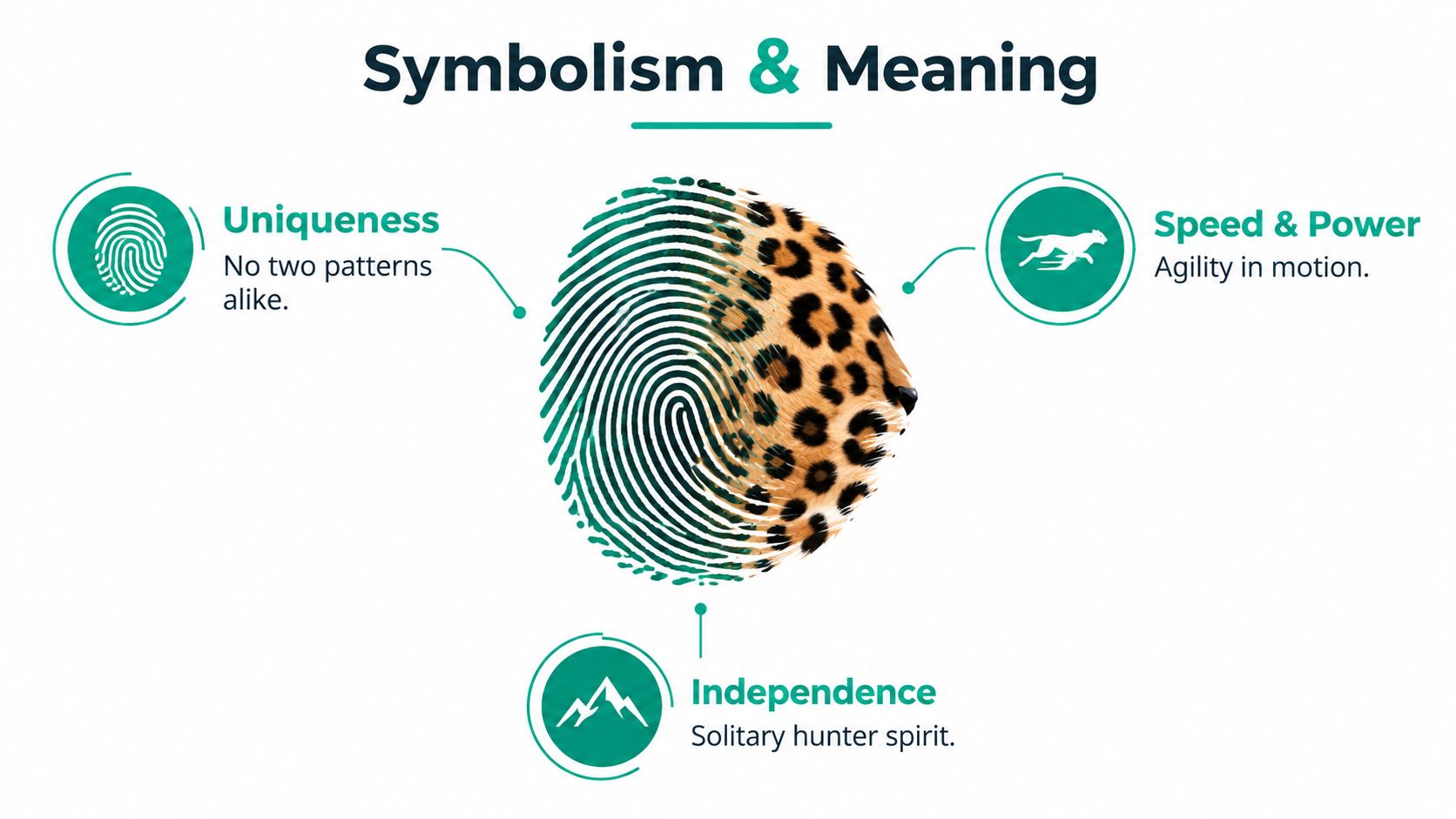
A cheetah's coat is a useful starting analogy because its pattern works a little like a fingerprint. The spots cluster into distinctive forms, and the irregularity keeps the surface from looking mechanically repeated. A cheetah-print tattoo borrows that visual language, usually through solid or open spots arranged in loose rosettes rather than through a literal portrait of the animal.
What the animal suggests
Modern tattoo writing commonly connects the cheetah motif with speed, agility, strength, and confidence. Those meanings make sense visually. The pattern feels active even when it's still, especially when the spots follow the direction of a thigh, shoulder, or forearm.
The cheetah can also suggest focus and independence. Unlike a design built around a group or a social symbol, a single animal-print motif can communicate self-direction and quiet confidence. Some people choose it after a difficult period as a reminder that personal power doesn't always need to look loud. Others connect it with athletic movement, a demanding career, or the feeling of moving quickly toward a new life.
Historical context adds another layer. One account notes that Sumerians kept cheetahs as royal pets more than 5,000 years ago, while later traditions in ancient Egypt and among Ethiopian royalty treated the animal as a prestige symbol. The print's fashion history also matters. It became popularized during the 1920s as a visual sign of liberation and rebellion, which helps explain why the pattern later transferred naturally into clothing, accessories, and body art. These details appear in the historical and symbolic background to cheetah-print tattoos.
Meanings you can make personal
You don't need to choose one official interpretation. Use symbolism as a prompt for your own story:
- Uniqueness: irregular rosettes can represent a personal identity that isn't meant to look mass-produced.
- Speed and power: the pattern can mark momentum, athletic drive, or a period of decisive change.
- Independence: the solitary hunter image may fit someone who values self-reliance.
- Reclamation: a bold animal print can help someone take ownership of their body or confidence.
- Style and play: the tattoo may celebrate a fashion language with a long history of boldness.
A leopard-print tattoo and a cheetah-print tattoo can look similar at a glance, so clarify what you want the pattern to communicate. If the animal symbolism matters, tell your tattooist whether you want a recognizable cheetah influence or an abstract print inspired mainly by fashion. The meaning belongs to the wearer, not to a fixed symbolism dictionary.
Popular Cheetah Print Tattoo Styles Explained
The same rosette pattern can feel delicate, dramatic, playful, or architectural depending on the treatment. Start by choosing the visual behavior you want, then match it to the placement and the amount of detail your skin can comfortably hold.
| Style | Visual Feel | Best Placement | Best For |
|---|---|---|---|
| Realistic black and grey | Soft shading, dimensional spots, and a fur-inspired finish | Outer thigh, back, or another broad area | A dramatic piece with a natural-animal quality |
| Minimalist linework | Clean outlines, restrained detail, and visible negative space | Wrist, ankle, or behind the ear | A subtle accent and first-time tattoo |
| Watercolor | Loose color washes surrounding or passing through the spots | Shoulder blade or upper arm | Wearers who want an expressive, painterly effect |
| Geometric | Fragmented rosettes, structured angles, and controlled repetition | Forearm, calf, or thigh | A modern design with an ordered feel |
| Traditional or neo-traditional | Bold outlines, saturated color, and illustrative weight | Upper arm, thigh, or calf | A statement tattoo influenced by flash design |
Choosing by personality and maintenance
Realistic black and grey works well when you want the pattern to resemble a coat rather than a fabric print. It needs enough surface area for tonal transitions and readable rosettes. A miniature version can lose the soft separation that makes the style convincing.
Minimalist linework is quieter, but “minimalist” doesn't mean infinitely small. A tattooist may simplify the number of spots and open up the gaps so the design doesn't become a dense dark mark. It suits someone who wants the motif to appear as a detail rather than dominate an outfit.
Watercolor brings energy through translucent washes and uneven edges. It can be beautiful, but the color effect is more dependent on contrast and disciplined aftercare than a bold black design. Geometric work takes the opposite path. It replaces some organic irregularity with triangles, hexagons, sharp contours, or repeated visual rhythm.
Traditional and neo-traditional versions use stronger outlines and more saturated color. They're a good match if you want the cheetah print to read from a distance and hold its place among other bold tattoos. For clothing inspiration before you commit to a palette, you can look at Cedar & Lily Clothier's new arrivals tops, especially if you're deciding whether your concept should feel earthy, high-contrast, or fashion-forward.
Ask yourself one useful question: do you want the tattoo to look like animal skin, painted color, graphic design, or clothing print? That answer will narrow the style more effectively than choosing from every reference you've saved.
Best Placement Options and How the Pattern Holds Up
Placement affects more than visibility. It changes how much the design moves, how much sunlight reaches it, how it rubs against clothing or footwear, and how a curved surface interrupts the rosettes. A flat outer thigh gives a tattooist more room to preserve a pattern than a narrow ankle or a constantly flexing rib area.
| Placement | Visibility | Pain Level | Sun Exposure | Pattern Hold Over Time |
|---|---|---|---|---|
| Outer thigh | Easy to show or conceal | Often manageable, but varies by person | Usually moderate and controllable | Broad, relatively stable surface supports larger spots |
| Arm | Frequently visible | Varies around the inner arm and elbow | Can be high on exposed areas | Good when the design avoids heavy joint movement |
| Back | Easy to conceal | Can vary near the spine and shoulder blades | Often lower when covered | Broad areas can preserve a large composition well |
| Ribs | Easy to conceal | Often feels more sensitive | Usually lower when covered | Movement and curvature can make fine spacing less forgiving |
| Ankle | Highly visible as a small accent | Can feel intense over bony areas | Moderate, depending on footwear and clothing | Friction and a small curved surface can challenge crisp detail |
Match the spot to the surface
Use a simple mental shortcut: the larger the curve, the larger and cleaner the spot shapes should be. A broad thigh can support a sweeping field of rosettes, while an ankle may need a few deliberate marks rather than a miniature full-coat effect. On ribs, a tattooist may rotate or stretch the composition so the spots follow the body instead of fighting it.
Pain is personal, so treat placement charts as planning aids rather than promises. Bony areas, thin skin, and places that move or rub can feel more demanding, but your artist can help you choose a manageable session plan.
Sunlight is another practical variable. Ultraviolet exposure breaks down tattoo pigment and reduces contrast over time, so a frequently exposed arm needs more consistent sun protection than a covered back or thigh. Friction matters too. An ankle design can encounter socks, shoes, and repeated rubbing, while a back tattoo is generally less disturbed by daily contact.
For a broader explanation of how body areas affect tattoo decisions, use this tattoo placement guide. Before booking, place a paper mock-up on the intended area and move naturally. Sit, bend, walk, and check it in a mirror. If the rosettes look crowded when your skin folds, the stencil needs more space or fewer marks.
AI Prompts You Can Use for Cheetah Print Designs
An AI prompt works better when it describes a tattoo brief rather than a general animal illustration. Give the tool five ingredients: subject, style, placement, mood, and detail level. “Cheetah tattoo” is a starting label. “Open black rosettes flowing diagonally across the outer thigh, soft black shading, generous negative space, elegant but powerful, designed as clean tattoo stencil art” gives the generator a direction.
Build the prompt in layers
Start with the subject and pattern. Say whether you want scattered spots, clustered rosettes, a partial print, or a design wrapped around the body. Then name the visual style and color approach. “Black ink only” produces a different concept from “warm ochre washes with black outlines.”
Placement words help the composition. Include the body area, orientation, and approximate scale in qualitative terms such as narrow, vertical, sweeping, compact, or panel-like. Finish with constraints. Ask for clear negative space, readable shapes, no background scenery, and a design suitable for a tattooist to redraw.
These three prompts show how small changes affect the result:
Realistic thigh concept:
A sweeping cheetah-print tattoo for the outer thigh, natural open rosettes with varied shapes and spacing, soft black and grey shading, subtle fur-inspired texture, elegant movement following the leg, strong contrast, clean tattoo concept, no text, no background.Minimalist geometric wrist concept:
A compact geometric cheetah-print tattoo for the inner wrist, simplified angular rosettes built from clean lines, generous negative space, black ink only, balanced vertical composition, subtle and modern, stencil-friendly, no shading, no text.Watercolor shoulder-blade concept:
An expressive cheetah-print tattoo for the shoulder blade, loose black rosettes surrounded by warm watercolor bleed, transparent ochre and rust washes, irregular painted edges, airy negative space, graceful diagonal flow, tattoo reference design, no realistic animal portrait.
The first prompt emphasizes soft shading because realism needs tonal depth. The second uses negative space to stop a small design from becoming crowded. The third names watercolor bleed so the model doesn't return a solid, flat fill.
For more guidance on ordering and refining prompt details, consult these prompt-engineering best practices for tattoo concepts. Avoid stacking too many unrelated instructions into one sentence, and don't use a living artist's name as a shortcut for style. Describe the visible qualities instead, such as bold contour, broken line, stippling, or saturated color. Treat the output as a conversation starter, not a stencil ready for immediate use.
Working With a Tattooist to Finalize Your Design
Bring your AI-generated concept or sketch to a tattooist as a direction, not a demand. The right artist will look at the pattern, your chosen body area, and the amount of detail, then redraw the idea so it fits the skin in front of them.
Start with portfolios. Look for healed work when it's available, and pay attention to artists who already handle animal patterns, bold blackwork, fine line, geometric composition, or the color approach you prefer. An artist who makes beautiful portraits may not be the best match for a repeating print, and an artist known for strong traditional lines may simplify a delicate watercolor concept.
Explain what you like without asking for a copy
Instead of saying, “I want this exact tattoo,” identify the ingredients:
- “I like the uneven open rosettes.”
- “I want the pattern to feel light, not like a solid sleeve.”
- “I prefer black ink, but I'm open to a muted warm accent.”
- “I want the design to follow the curve of my outer thigh.”
- “I don't want a literal cheetah face or a dense fur texture.”
Reference etiquette protects both your idea and the artist's work. Show several images to communicate a direction, then ask for an original composition. Your tattooist can combine the spacing from one reference, the line quality from another, and your placement requirements into something new.
Ask for decisions before the appointment
Before booking or paying a deposit, ask whether the artist can provide a rough layout or discuss the likely stencil size. You can also ask how they'd adapt the spots around a curve and whether they recommend open rosettes, solid marks, or a mixture.
During the consultation, discuss:
- Stencil scale: A small pattern may need fewer, larger spots.
- Density: Crowded marks can create a heavy block, while excessive gaps may weaken the print effect.
- Color: Black-only ink creates a clear graphic result. Ochre or brown accents change the mood and may need a different maintenance plan.
- Edges: Bold outlines read clearly, while soft shading creates a gentler finish.
- Body movement: The artist may rotate or elongate rosettes to make them sit naturally.
Practical rule: Ask your tattooist to show you the stencil on your actual body, then judge the design while standing and moving, not only while looking at a flat drawing.
Your artist's job isn't to reproduce an AI image pixel for pixel. It's to translate the idea into a tattoo that suits your anatomy, technical preferences, and long-term expectations. Good feedback focuses on what the design should feel like, while leaving room for professional adjustments.
Care, Longevity, and What to Expect Long Term
Aftercare begins before the appointment because design choices determine how forgiving the finished tattoo will be. Bold, high-contrast spots generally give a cheetah-print tattoo more visual stability than ultra-fine micro-spot detail. Pigment sits in the dermis, where macrophages continually recapture pigment and help keep it visible, but ultraviolet exposure still breaks down pigment and reduces contrast, as described in this medical review of tattoo pigment behavior and skin mechanics.
That creates a practical design rule: use larger, cleaner shapes, leave enough space between important marks, and choose a lower-sun area if you want to slow fading and edge softening. Your artist may also recommend simplifying a design that looks beautiful on a phone but would be too dense at the proposed size.
The healing period
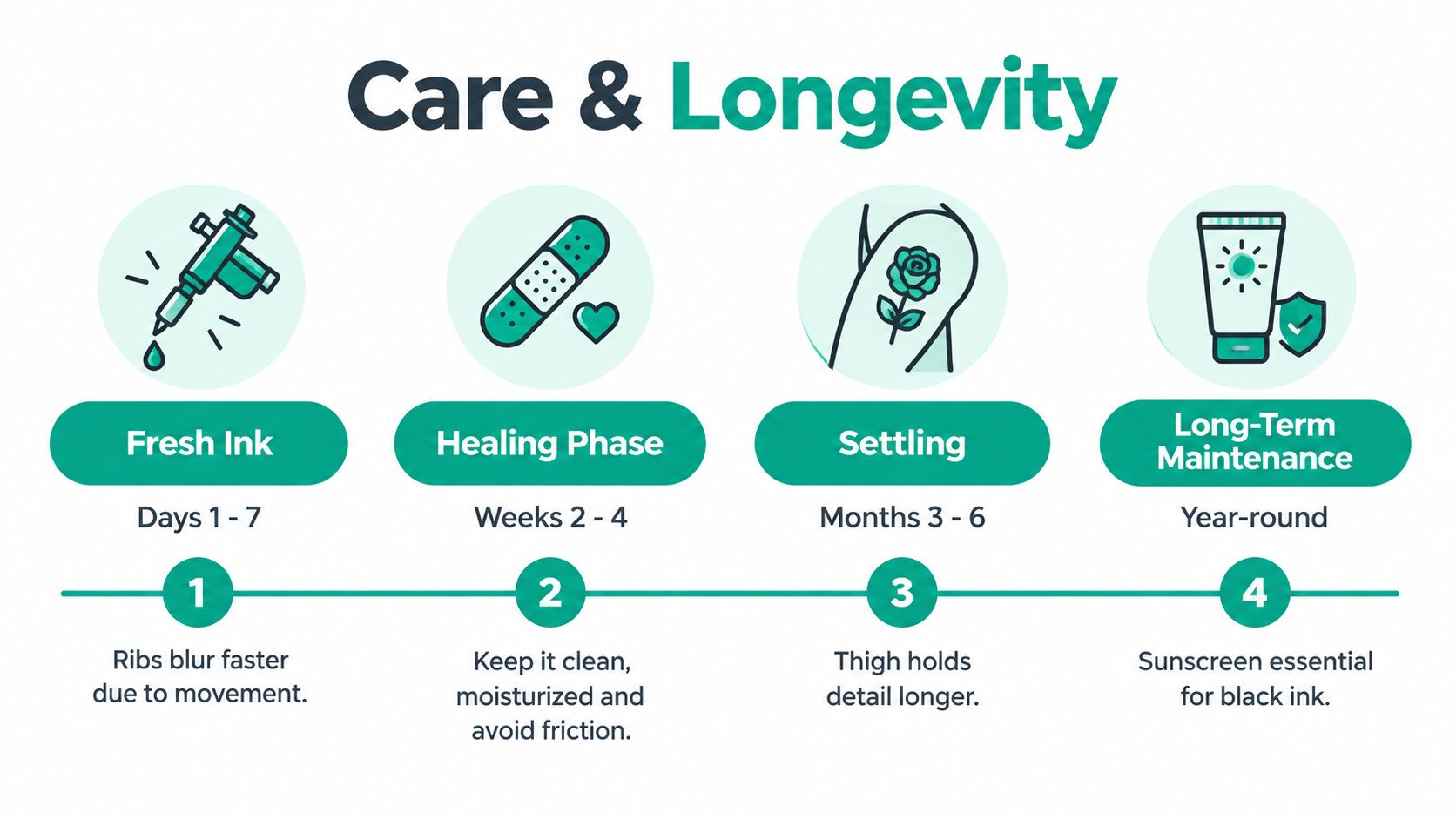
For the first several days, follow the studio's exact instructions. Keep the area clean, use only the recommended aftercare product, keep coverings in place for the advised period, and avoid soaking the tattoo. A breathable covering can protect fresh work, but it doesn't replace careful cleaning or professional guidance.
During the early healing weeks, itching and flaking can happen. Don't pick at peeling skin or scratch across the rosettes, even if the surface looks uneven. The tattoo may appear dull or cloudy before it settles, so judge the final pattern only after the skin has fully healed.
The maintenance years
Once healed, moisturized skin can make the pattern look clearer, but sunscreen does more for preservation than relying on moisturizer alone. Protect exposed placements whenever they're in the sun, especially if your design uses delicate shading or pale color. Ribs may show more apparent change as the design moves with the body, while a stable thigh can offer a more forgiving canvas, but every tattoo changes gradually.
Temporary or test-run versions can help you judge visibility and placement before committing, yet they don't answer every longevity question. Existing guidance on temporary cheetah-print tattoos often focuses on short wear periods and popular placement ideas, while leaving practical questions about removal, ink durability, and curved surfaces unanswered, as noted in this discussion of the current information gap.
Plan to assess the tattoo after it has healed rather than reacting to the fresh version. A touch-up may be appropriate if a small area heals unevenly, but timing and necessity depend on the artist's assessment. Over a five- to ten-year horizon, expect some softening rather than permanent sharpness. The best protection is a sensible original design, appropriate spacing, professional application, and consistent sun care.
Use TattoosAI to generate multiple cheetah-print concepts across styles such as minimalist, watercolor, geometric, and blackwork, then bring the most useful direction to your tattooist for refinement. Start with the placement, mood, and spot structure you want, compare the results, and book your consultation with a clear visual brief instead of a folder of disconnected references.