TattoosAI
Could a geometric hand tattoo be chosen from a gallery alone, or does the geometry need to respond to the hand itself? A design can look perfectly balanced on a screen and still need changes once it meets knuckles, joints, skin movement, washing, friction, and everyday sun exposure. The strongest choice balances motif, scale, line weight, negative space, dotwork or solid fill, placement, symbolism, and maintenance before the needle touches skin.
Geometric tattooing also has a deeper history than current fashion suggests. Archaeological evidence places tattooing at more than 5,000 years old, and Ötzi, discovered in the Ötztaler Alps in 1991, had markings made largely from lines and geometric forms. Repeated lines, dots, and patterns in Polynesian tatau also influenced Western tattoo design during cultural exchange from the mid-1700s through the early 1900s, as documented in this historical overview of tattooing and geometric pattern traditions.
The eight ideas below work as a design decision guide, not just a gallery. Each one connects visual structure and symbolism with practical choices for the back of the hand, fingers, knuckles, palm, or side of the hand. You can use TattoosAI to generate and compare bespoke concepts before your consultation, then let a professional tattooist adapt the final artwork to your anatomy and skin.
If you like the idea of hand adornment with symbolic meaning, you might also shop the Hamsa Charm while you refine the visual language you want your tattoo to express.
Table of Contents
- 1. Sacred Geometry Mandala Hand Tattoo
- 2. Linear Triangle Hand Tattoo
- 3. Hexagonal Honeycomb Hand Tattoo
- 4. Sacred Geometry Platonic Solids Hand Tattoo
- 5. Geometric Circle and Line Hand Tattoo
- 6. Dot Work Geometric Flower Hand Tattoo
- 7. Geometric Fingerprint Hand Tattoo
- 8. Geometric Wolf Head or Animal Face Hand Tattoo
- 8-Design Comparison: Geometric Hand Tattoos
- Turn Inspiration Into a Tattooist-Ready Concept
1. Sacred Geometry Mandala Hand Tattoo
A mandala gives geometric hand tattoos an immediate center of gravity. Concentric circles, repeated petals, interlocking shapes, and carefully measured symmetry can create a design that feels both mathematical and personal. The circular structure also works naturally with the rounded visual movement of the hand, especially when the design is centered on the back of the hand.
The back of the hand is usually the more practical starting point for a detailed mandala. It offers a clearer viewing surface than the palm and gives the artist more room to preserve negative space between rings and repeated elements. A palm mandala can be striking, but palm placement deserves a more cautious conversation about healing, pigment retention, and future touch-ups.
Practical rule: A mandala should be designed at the size your hand can support, not enlarged or reduced after the artwork is finished.
A highly detailed digital design may need simplification. Tight parallel lines can visually merge as pigment settles and edges soften, while generously spaced rings and stronger outer contours tend to remain easier to read. The artist should also assess how the design changes when you flex your fingers or rotate your wrist.
Build a mandala that belongs to you
Start with the meaning you want the mandala to carry. You might use balanced repetition to represent harmony, a central symbol for faith or protection, or a custom arrangement of shapes connected to a personal ritual. If you're drawn to protective symbolism, decide whether the design should remain abstract or include a recognizable element.
Use the sacred geometry tattoo ideas available through TattoosAI as a starting point, then generate variations with different ring counts, line weights, and levels of dotwork. Bring the strongest references to your tattooist rather than treating the AI image as a stencil. A professional can redraw the mandala around your knuckles, tendons, and natural hand proportions.
2. Linear Triangle Hand Tattoo
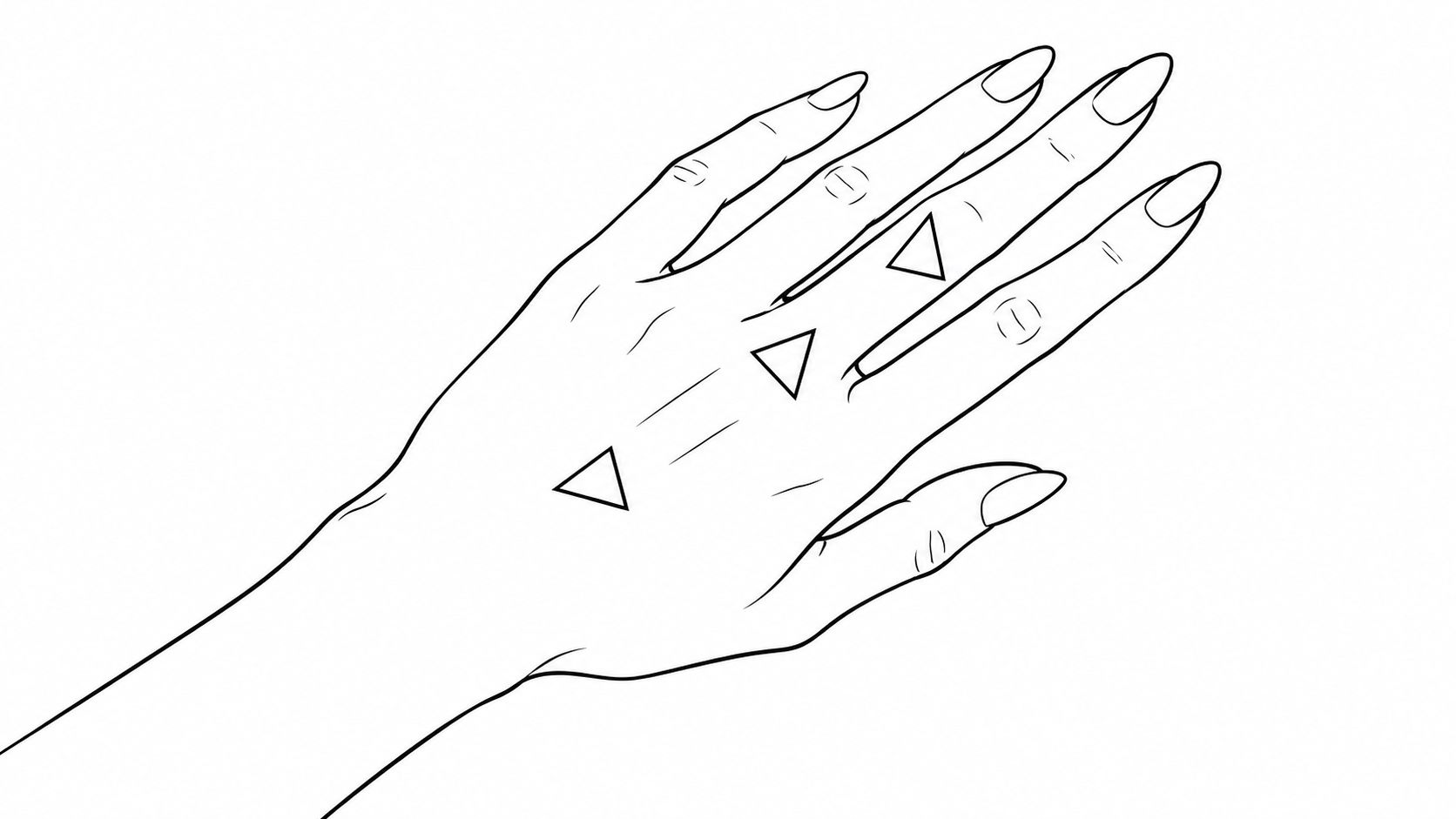
Triangles suit people who want geometric hand tattoos with a quieter visual footprint. A single triangle can suggest balance, direction, or simplicity. Nested triangles, open triangles, and scattered triangular marks create more movement without requiring a large solid composition.
The hand gives you several ways to distribute this motif. One small triangle on each finger can create a deliberate rhythm, while a line of triangles across the back of the hand can act as a central visual path. A single open triangle near the thumb may feel more discreet, although it still remains highly visible because of the placement.
Fine lines can look elegant in a fresh tattoo, but geometric clarity depends on more than initial delicacy. Pigment placed too superficially may fade as the epidermis sheds, while pigment placed too deep can migrate and blur the edge. The medical discussion of tattoo placement and pigment behavior in this clinical review of tattoo complications supports a conservative approach to line work and spacing.
Choose rhythm over clutter
Ask yourself whether the triangles should feel connected or independent. A connected pattern needs consistent spacing and careful alignment across moving surfaces. Independent marks allow more flexibility if the design later expands into a sleeve or connects with existing symbols.
- For a subtle result: Use open triangles with generous skin between each form.
- For stronger contrast: Combine a bold outer triangle with a smaller negative-space triangle inside it.
- For future expansion: Leave clear visual pauses so the pattern can connect to wrist or forearm work later.
TattoosAI can help you compare triangle arrangements in a minimalist geometric style. Generate concepts that specify the exact placement, such as “small open triangles across the back of the hand” or “one bold triangle per finger.” Then ask your artist to show the proposed size on your actual hand and to explain which line weight is most realistic for that location.
3. Hexagonal Honeycomb Hand Tattoo
A honeycomb pattern turns the hand into a connected network. Hexagons suggest order, cooperation, and natural efficiency, while their repeated six-sided structure gives the tattoo enough complexity to feel architectural. The motif can cover a small section of the back of the hand or flow across several fingers and toward the wrist.
The main decision is density. A sparse group of hexagons leaves visible skin between cells and usually gives the design more breathing room. A dense arrangement creates a stronger blackwork effect, but the artist must preserve the boundaries between cells so they don't become an indistinct mass over time.
Map the pattern before committing
The back of the hand is a useful placement for honeycomb geometry because the artist can establish a clear central cluster and adapt the outer cells to the hand's contours. Finger placement is more demanding. Each joint bends, stretches, and receives friction, so a tiny hexagon may need to become a simpler mark or a partial cell rather than a miniature technical drawing.
Ask your tattooist to apply a temporary map or stencil before starting. Look at the design with your hand relaxed, open, and closed. A pattern that aligns beautifully with an open hand may compress across the knuckles when you make a fist.
TattoosAI is useful here because you can compare versions with different cell sizes and levels of repetition before the consultation. Try an outline-only version, a design with selected solid cells, and a version that gradually becomes less dense toward the fingers. If you're considering color, compare it separately from the black-line version so you can judge whether color improves the structure or competes with it.
Leave room for the pattern to breathe. Negative space isn't an unused area. It keeps each hexagon legible.
A honeycomb tattoo also offers a clear customization path. You can make one cell the focal point, replace selected cells with initials or symbols, or allow the design to dissolve into individual geometric marks near the wrist. Keep the overall system consistent so the personalization feels intentional rather than added afterward.
4. Sacred Geometry Platonic Solids Hand Tattoo
A Platonic solid brings three-dimensional structure to the hand. A tetrahedron, cube, octahedron, dodecahedron, or icosahedron can be rendered as a precise network of lines, creating the impression of an object suspended on the skin. For someone drawn to mathematics, philosophy, science, or spiritual symbolism, the form can carry meaning without relying on a figurative image.
One solid may work better than a collection of competing forms. A cube centered on the back of the hand can act as a strong focal point, while a smaller octahedron on a finger can become a discreet companion. If you want several solids, give each one enough separation to preserve its three-dimensional reading.
Perspective matters more here than in a flat triangle or circle design. Ask for an isometric or deliberately constructed viewpoint, but remember that the artist must adapt that perspective to the hand's curved surface. Lines that appear parallel on paper may need slight changes to look balanced when they cross a tendon or approach a knuckle.
Make the object readable at real size
A digital preview can support intricate internal lines, but the hand may not support every detail indefinitely. Conservative line weight, clear corners, and open interior spaces will help the solid remain recognizable after healing. The artist should review the design once the hand is in its natural position rather than relying only on a flat reference image.
You can use TattoosAI's geometric or three-dimensional style to explore variations in the solid, viewpoint, and level of shading. Generate a clean line-art version alongside a design with selective solid fill. This comparison will show whether the form depends on shading that may be difficult to preserve or whether its silhouette carries enough visual strength by itself.
A professional tattooist should redraw the final concept. They can decide whether the solid belongs on the back of the hand, along the side of the hand, or on a finger, and can adjust the internal geometry to suit the available surface. Treat the AI concept as a visual brief with clear preferences, not as a finished technical template.
5. Geometric Circle and Line Hand Tattoo
Circles and lines create a flexible abstract composition for people who want structure without a dense symbol. A circle can suggest continuity or connection, while a line can divide, direct, or link separate parts of the design. Together, they can produce a tattoo that feels balanced even when the arrangement isn't perfectly symmetrical.
This motif adapts well to several hand placements. A circle on the back of the hand can anchor lines that extend toward the fingers. A small circle on an outer finger can pair with a line running along the hand's natural direction. You can also use interrupted lines and negative space to avoid making the design feel like a solid diagram.
The challenge is precision. Circles reveal irregularity quickly, especially when placed near joints or on a surface that changes shape as you move. Ask the artist how they create and transfer clean circular forms, and request a mock-up that shows the design on your hand rather than on a generic outline.
Compare composition before choosing detail
TattoosAI can generate several circle-and-line arrangements, each with a different center, balance, and amount of open skin. Describe the intended placement in the prompt. “Abstract circle and line design on the back of the hand” will produce a more useful starting point than a general request for geometric tattoo ideas.
Compare these decisions side by side:
- Circle size: A larger circle can become the focal point, while smaller circles create a constellation-like rhythm.
- Line behavior: Straight lines feel architectural, while curved connections soften the composition.
- Fill treatment: Outline-only work preserves lightness, while selected solid sections create stronger contrast.
- Hand relationship: A design that follows the wrist and finger direction may feel more integrated than one placed at a rigid angle.
The back of the hand and outer fingers are often the most practical places to discuss for visibility and design clarity, but your artist still needs to assess your skin and daily activities. Hands receive movement, friction, washing, and sun exposure, so the design should remain readable without depending on ultra-fine spacing.
6. Dot Work Geometric Flower Hand Tattoo
A dotwork flower sits between organic imagery and geometric order. The petals can follow a symmetrical structure, while carefully varied dot density creates shading, depth, and texture. Instead of using solid gradients, the artist builds the flower from individual marks that become lighter or darker according to their spacing.
This approach can feel softer than solid blackwork, but it isn't automatically lower maintenance. The hand is an exposed, active location, and delicate dots can lose visual separation if the design is too dense or the spacing is too tight. A strong concept includes clear zones of negative space between petals, rings, and supporting geometric elements.
Place a larger floral composition on the back of the hand if you want the petals and dot transitions to remain visible. A finger or side-of-hand version should be simplified, with fewer internal layers and a stronger outer silhouette. Let the artist decide how much dot density the skin can support after examining the proposed size.
Choose a dotwork specialist
Dotwork requires control over spacing and pressure, particularly when the design combines geometric symmetry with gradual shading. Look for a tattooist whose healed work demonstrates consistent dots and clear transitions, not only fresh photographs. Ask how the artist would simplify the design for your hand and whether the composition should be completed in stages.
TattoosAI can help you test the visual direction before that conversation. Generate a geometric flower with instructions about petal symmetry, dotwork shading, and the intended hand placement. Then make a second version with less density. Comparing the two can reveal that the simpler concept communicates the flower more clearly.
A crisp preview is only the beginning. Judge the concept by how well its shapes and spaces are likely to remain distinguishable after healing and everyday wear.
This guide to dotwork tattoo style can help you identify the characteristics you want to discuss with your artist. You can also show a short reference video before the appointment, particularly if you need to understand how the artist builds texture through repeated marks.
7. Geometric Fingerprint Hand Tattoo
A fingerprint design makes geometric hand tattoos personal in a literal way. The artist can use a real fingerprint as the underlying structure, then introduce concentric circles, angular breaks, grids, or controlled spirals within the ridge pattern. The result can represent identity, memory, family, or an individual connection while still looking deliberate and abstract.
Authenticity is the central design decision. If you want the fingerprint to remain recognizable, provide a clear scan or ink impression and ask the artist to preserve its essential ridge flow. If you prefer a symbolic interpretation, the design can borrow the fingerprint's circular movement without reproducing every detail.
Protect the fingerprint's clarity
Line weight becomes especially important because fingerprint ridges are already close together. Excessive detail can turn the design into a dark blur, particularly on a small finger placement. A larger version on the back of the hand gives the artist more room to separate the ridges and integrate geometric elements.
Consider whether the tattoo should follow the natural orientation of the fingerprint or rotate it into a more graphic composition. The artist can also use selective solid fill to frame the fingerprint, but too much fill may compete with the feature that makes the tattoo personal.
TattoosAI can help you explore different interpretations before you ask an artist to redraw the work. Uploading personal biometric material may raise privacy questions, so decide what you're comfortable sharing and use a descriptive prompt when you don't want to provide the actual fingerprint. For example, you might request a circular fingerprint-inspired pattern with open geometric breaks, then bring the resulting concept and your real fingerprint separately to the consultation.
Ask the artist to show the design at its intended size. A concept that looks detailed on a large screen may need fewer ridges, wider gaps, or a stronger outer contour to remain recognizable on skin. The final result should respect both the personal source and the technical limits of the hand.
8. Geometric Wolf Head or Animal Face Hand Tattoo
An angular animal face gives the hand an immediate focal point. A wolf can suggest loyalty, independence, or instinct, while a fox, lion, or another animal can carry a different personal association. Geometric planes, triangles, sharp cheek lines, and controlled symmetry make the portrait feel constructed rather than realistic.
The back of the hand is usually the clearest place to establish the animal's eyes, muzzle, and overall silhouette. A design placed across the fingers may fragment the face as the joints bend, so the artist needs to map the portrait with your hand open and relaxed. The animal should still look intentional when your fingers move.
Start by choosing the animal for its meaning, not only its popularity. Then decide whether the face should look frontal, three-quarter, symmetrical, or partially abstract. A frontal wolf can create a powerful emblem, while a side profile may flow more naturally toward the wrist or thumb.
Keep the animal recognizable
Geometric abstraction works best when it preserves a few unmistakable features. For a wolf, those might include pointed ears, the relationship between the eyes, and the angular muzzle. If every surface becomes an equally strong triangle, the face can lose its expression.
Use TattoosAI to compare several animal interpretations with different levels of abstraction, line density, and color treatment. Generate a blackwork version first, then test a restrained color variation if color is part of your idea. The AI concept can help you explain the desired balance, but the tattooist should adapt the eyes, jawline, and outer silhouette to your hand.
A specialist in both geometric work and animal portraits can help you avoid a common problem: a design that looks impressive as an illustration but doesn't read clearly at tattoo size. Ask for healed examples and discuss how the artist will protect the negative space around the eyes and muzzle. Those open areas often carry more recognition than extra internal detail.
8-Design Comparison: Geometric Hand Tattoos
| Design | 🔄 Complexity | ⚡ Speed / Resource | ⭐ Expected outcome | 📊 Ideal use cases | 💡 Tips |
|---|---|---|---|---|---|
| Sacred Geometry Mandala Hand Tattoo | High, intricate symmetry; needs expert precision | Time-consuming; skilled artist; low color needs; touch-ups likely | High, balanced, spiritual, strong portfolio piece | Spiritual expression, back-of-hand statement, portfolio examples | Scale to hand proportions; prefer back-of-hand; confirm touch-up plan |
| Linear Triangle Hand Tattoo | Low, simple lines and placement precision | Very fast; minimal ink; often one session | Good, clean, minimalist, ages well | First-timers, subtle finger accents, minimalist looks | Discuss line thickness; test arrangements; coordinate with other hand tattoos |
| Hexagonal Honeycomb Hand Tattoo | Medium–High, precise interlocking needed | Moderate to long sessions; shading ups time/cost; skilled artist | High, distinctive, nature-inspired, visually engaging | Bold hand coverage, social-media-forward designs | Test density with mockups; ensure consistent line weight; map placement first |
| Sacred Geometry Platonic Solids Hand Tattoo | High, 3D perspective and isometric skill required | Longer sessions; artist experienced in perspective needed | High, intellectually striking, strong 3D effect | STEM/academic symbolism, thoughtful focal pieces | Request isometric rendering; use AI refs; plan placement for visibility |
| Geometric Circle and Line Hand Tattoo | Low–Medium, precision for perfect circles | Quick execution; minimal healing; scalable | Good, versatile, contemporary, clean | Modern minimalist placements, versatile sizes | Use stencil/compass for circles; generate multiple comps; choose durable placement |
| Dot Work Geometric Flower Hand Tattoo | Very High, extreme precision and patience | Very time-consuming; multiple sessions; specialized artist; higher cost | Very High, textured, detailed, ages well when done right | High-end custom work, gallery pieces, needlework showcases | Research dotwork specialists; plan 4–6 sessions; budget and pain tolerance |
| Geometric Fingerprint Hand Tattoo | Medium, requires adapting biometric detail to geometry | Relatively quick once designed; needs fingerprint reference | High, deeply personal, unique identity-driven result | Memorials, identity tattoos, finger/wrist placements | Provide clear fingerprint scan; discuss line weight and longevity |
| Geometric Wolf Head / Animal Face Hand Tattoo | Medium–High, balance abstraction with recognizability | Moderate sessions; skilled artist for representational geometry | High, striking focal piece with symbolic meaning | Back-of-hand focal points, animal-symbolism seekers | Generate multiple animal variations; preserve recognizable features; consider color choices |
Turn Inspiration Into a Tattooist-Ready Concept
A strong geometric hand tattoo starts with a motif that means something to you, but symbolism alone won't determine whether the finished piece works. Choose the image or pattern first, then test how its structure behaves at the size and placement you want. A mandala needs room for rings and repeated details. A honeycomb needs consistent cell spacing. A fingerprint needs enough separation to remain personal rather than becoming a dark texture. An animal face needs a readable silhouette.
Next, decide how much visual weight the tattoo should carry. Fine lines, bold outlines, dotwork, negative space, and solid fill create very different results even when they use the same motif. You don't need to choose the most detailed option. On hands, a simplified design with clear gaps can communicate more effectively than micro-geometry packed into a small area.
Placement should be evaluated in motion. Look at the concept with your hand open, relaxed, curled, and turned sideways. The back of the hand, fingers, knuckles, palm, and side of the hand each expose the design to different movement and friction. Hands also receive frequent washing and sunlight. Clinical tattoo guidance identifies fading, pigment migration, scarring, inflammatory reactions, and infection as recognized outcomes, and dermatology guidance recommends careful protection from friction and early sun exposure during healing. After healing, broad-spectrum sunscreen can help limit UV-related dulling. You can review this dermatology guidance on tattoo outcomes and aftercare before your appointment.
A visible tattoo also deserves an honest work and lifestyle discussion. Hands are among the body areas people commonly perceive as difficult to conceal, and workplace research has historically found mixed results that vary by industry. One review notes earlier hiring bias in research by Bekhor, Bekhor, and Gandrabur, while a later labor-market study found no employment, wage, or earnings penalties for tattooed workers in its U.S. sample. Read the review of workplace perceptions and tattoo-related employment research, then consider your own employer, clients, dress expectations, and local norms.
Use TattoosAI as a comparison tool
A practical TattoosAI workflow keeps the creative stage focused:
- Describe the motif: Name the animal, symbol, pattern, or personal meaning you want to express.
- Specify the placement: Say whether the design belongs on the back of the hand, a finger, knuckle, palm, or side of the hand.
- Choose a visual language: Select geometric, minimalist, dotwork, blackwork, three-dimensional, or another style that matches the concept.
- Generate variations: Compare different compositions instead of committing to the first attractive result.
- Test density and color: Look at outline-only, dotwork, selective solid fill, and restrained color options.
- Prepare the consultation: Bring the strongest references and explain what you want preserved, simplified, or removed.
The tool can reduce guesswork while you're deciding between a linear triangle, a mandala, or a more personal fingerprint or animal design. It doesn't replace an experienced tattooist. Placement previews may not perfectly represent your actual anatomy, and the artist must redraw the concept for your skin, hand movement, line stability, and professional technique.
Discuss health and permanence before booking
If you have eczema or another chronic skin condition, speak with a dermatologist before tattooing. Clinical reviews advise that people with chronic dermatoses discuss tattooing with a medical professional because the procedure can worsen an existing condition. A tendency toward keloids, frequent wet-work exposure, difficult healing, or workplace restrictions also changes the decision.
Removal deserves the same attention as design. Geometric blackwork may appear simple, but complete removal isn't guaranteed. Residual pigment or ghost images can remain, and laser treatment can cause hypo- or hyperpigmentation. You can also read this plain-language explanation of what removal discomfort feels like before treating a hand tattoo as an easily reversible experiment.
Bring this compact checklist to your consultation:
- Hand placement: Confirm how the design looks from every angle and during movement.
- Readable scale: Check that the motif's essential shapes have enough space.
- Line stability: Ask which line weight and spacing suit your skin and placement.
- Artist specialization: Review relevant healed hand, geometric, dotwork, or animal work.
- Healing plan: Get specific aftercare instructions for washing, friction, soaking, and sun.
- Maintenance willingness: Decide whether you're comfortable protecting the tattoo and discussing future touch-ups.
- Personal meaning: Make sure you want the motif itself, not only the version currently circulating online.
When you're ready, take your preferred concept to a professional tattooist for a final drawing, placement test, and honest discussion of trade-offs. The best geometric hand tattoo isn't the most complicated one. It's the design whose structure, meaning, scale, and care requirements you can live with confidently.
TattoosAI lets you describe a geometric hand tattoo, choose a suitable style, and compare multiple original concepts before your studio visit. Explore your motif, placement, line weight, and density at TattoosAI, then bring the strongest references to a professional tattooist for adaptation.