TattoosAI
You've saved a raven tattoo, a thorn-covered cross, and a sweeping black pattern, but you're not sure how they belong together. On your phone, every reference looks sharp. On your arm, the same details could compete until the whole piece reads as a dark patch.
A gothic tribal tattoo combines bold black geometry with gothic imagery. The strongest designs aren't collections of dark symbols. They're carefully arranged blackwork, with enough open skin to keep the image readable and a clear distinction between original ornament and culturally specific markings.
Table of Contents
- What Makes a Gothic Tribal Tattoo and Where It Came From
- Keeping Culture Out of Your Gothic Tribal Design
- Combining Motifs With Contrast Elements
- Scale, Line Weight and Skin Tone Limits
- Choosing Between Three Gothic Tribal Paths
- How to Build Concepts With TattoosAI
- Brief Your Tattooist and Book the Consultation
What Makes a Gothic Tribal Tattoo and Where It Came From
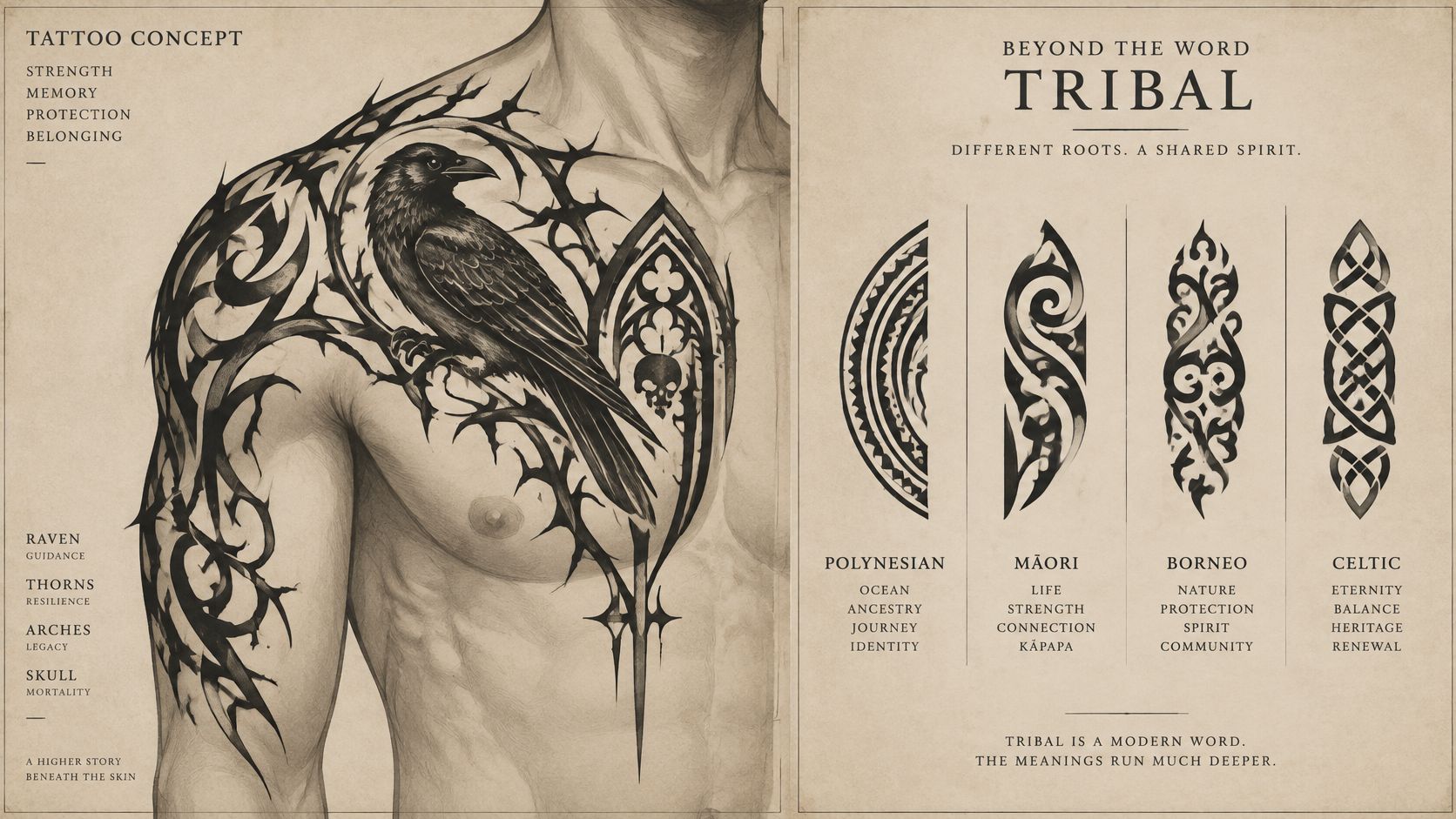
Say you want a raven framed by pointed arches on your upper arm. The raven supplies the subject, the arches establish the gothic mood, and sweeping black bands connect the composition to your shoulder. That relationship defines the hybrid: gothic imagery organized through bold, flowing geometry.
The word tribal needs more care than its use as a style filter suggests. The Tattooing Arts of Tribal Women describes distinct tattoo traditions across the Pacific, Arctic, Amazonia, Borneo, Africa, and Southeast Asia, while tracing the modern Western category to the late twentieth century. Those traditions could communicate ancestry, affiliation, status, achievements, spiritual beliefs, or rites of passage. They weren't interchangeable versions of the same decorative language.
Understand the visual ingredients
Western tattoo culture compressed many influences into a recognizable commercial look: solid black, pointed contours, spirals, flowing bands, and abstract symmetry. That label describes a broad appearance, not an authentic practice shared by every culture placed beneath it.
The gothic side supplies architectural and atmospheric references. Pointed arches, spires, gargoyles, and cathedral-like balance suggest Gothic architecture and its revival; dark ornament, ravens, bats, and dramatic lettering also connect with goth subculture. You can use that vocabulary without making every element a literal symbol.
Tribal, gothic and hybrid visual language compared
| Element | Tribal | Gothic | Gothic Tribal Hybrid |
|---|---|---|---|
| Core visuals | Bold black geometry, flowing bands, rhythmic symmetry | Pointed arches, spires, filigree, gothic lettering | Angular blackwork with cathedral-like symmetry and gothic symbols |
| Typical fill | Solid black, high saturation | Fine linework with selective dark fills | Solid black fields balanced by open negative space |
| Common motifs | Spirals, chevrons, waves, sunburst forms | Crosses, bats, ravens, thorns, gargoyles | Thorned spirals, arched frames, raven silhouettes in geometric bands |
| Historical roots | Distinct Indigenous traditions grouped under a Western commercial label | Gothic architecture, revival ornament, and goth subculture | Contemporary Western tattoo design combining those visual influences |
These are design tendencies, not strict definitions. A gothic tattoo can be heavily shaded, and a culturally specific tattoo tradition can contain far more than black geometry.
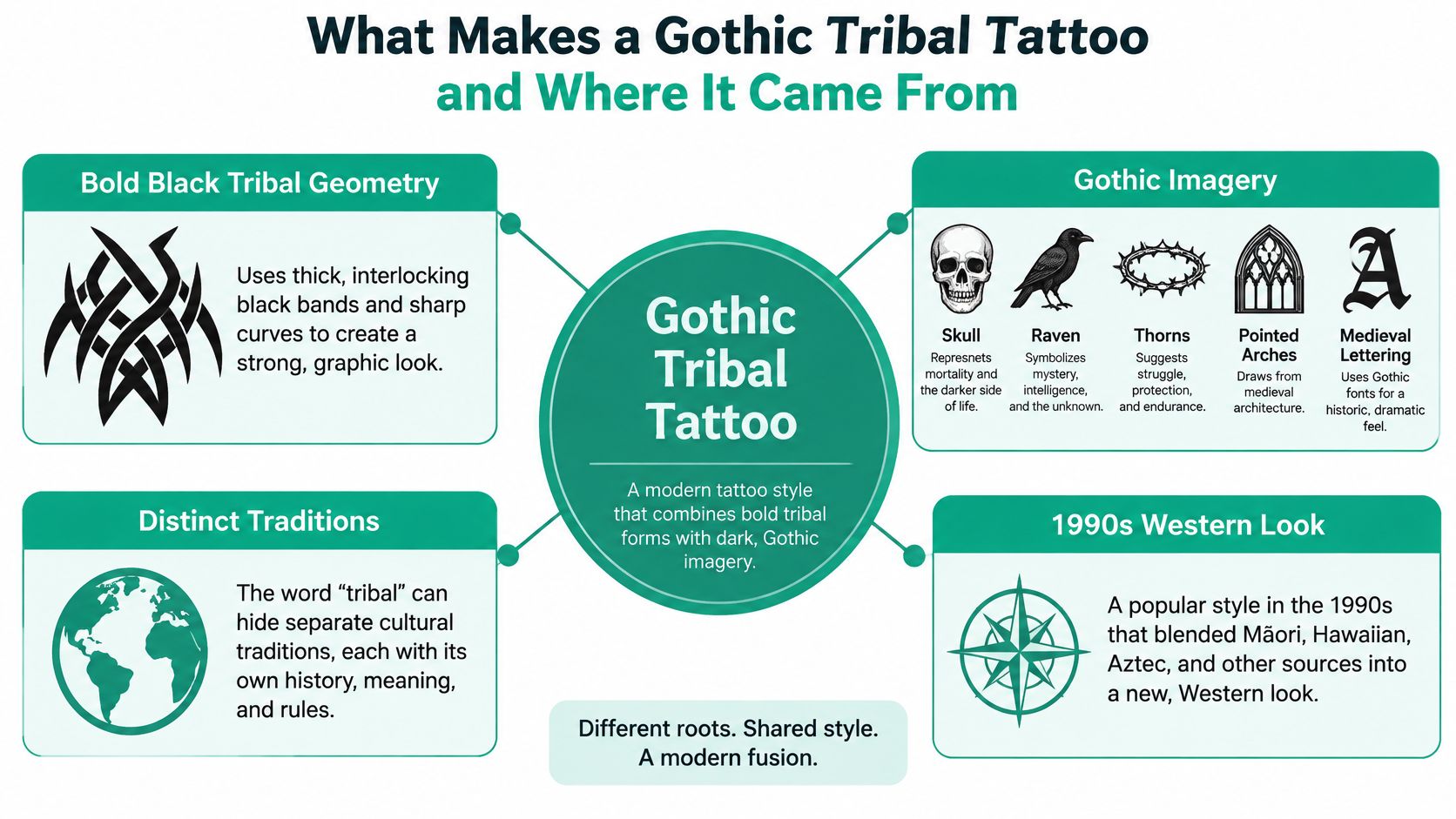
Design principle: Borrowing visual energy doesn't give a new pattern the history or meaning of a source tradition.
For the raven example, design the bands around the bird and your anatomy rather than copying an existing cultural pattern. The result can feel cohesive without claiming an inherited meaning it doesn't have.
Keeping Culture Out of Your Gothic Tribal Design
An abstract-looking pattern isn't automatically culturally neutral. A marking that looks like an attractive border to an outsider may identify ancestry, belonging, responsibility, or spiritual relationships to someone within its source community.
Lars Krutak's discussion of tattooing's roots in Tattoo Life describes the popular Western tribal look of the 1990s as a composite of Māori, Hawaiian, Aztec, and other sources with distinct meanings. Removing that context and treating the designs as interchangeable decoration is the central appropriation risk.
Separate geometry from identity-bearing imagery
You don't need to eliminate every historical influence. You need to distinguish general design tools from recognizable cultural markings before collecting references or writing prompts.
- Describe the shape: Ask for angular geometry, tapered spikes, flowing bands, filigree, or open channels.
- Identify the reference: Find out whether a copied marking belongs to a particular community or practice.
- Check appropriate use: Cultural familiarity isn't the same as permission. Consult someone qualified to explain any protocols.
- Drop unresolved symbols: If you can't establish what a motif means or whether it's appropriate, replace it with original ornament.
A useful brief describes gothic blackwork with cathedral-like arches, thorn forms, angular ornament, and generous negative space. It explicitly excludes copied Indigenous emblems and unidentified symbols. That gives the artist something concrete to draw without using a culture's name as shorthand for an atmosphere.
Verify meaning before attachment sets in
Use a tattoo meaning-verification checklist while you're still willing to change the concept. Ask where the reference came from, who identifies it, and whether its supposed meaning has a traceable explanation.
Crediting an influence is helpful, but credit alone doesn't resolve restricted use. An artist may recommend abandoning a reference rather than adapting it.
The word tribal isn't inappropriate. Treating unrelated traditions as a shared catalogue of mysterious symbols is the problem. For clients who want the appearance rather than a cultural practice, gothic ornamental blackwork often makes a clearer brief.
Combining Motifs With Contrast Elements
Think of the black geometric structure as the lead framework of a stained-glass window. The gothic motif is the story held inside it. If the framework overwhelms the subject, you lose the story; if the ornament ignores the framework, the composition falls apart.
That graphic foundation has a substantial commercial history. An industry estimate in Polynesian Tribal's history of tribal tattoos places broadly defined tribal work at approximately 40% of new tattoos in the American mass-market segment in 2004. That historical estimate helps explain the familiarity of the visual language, not its current popularity or cultural unity.
Contrast elements and how they shape the hybrid
| Contrast element | Role in the hybrid | Pairing rule |
|---|---|---|
| Ornamentation | Adds filigree and detail inside a dark mass | Contain ornament within a frame so it doesn't compete with the silhouette |
| Negative space | Separates adjacent shapes | Leave open channels around the main motif, not only inside it |
| Symmetry | Establishes cathedral-like balance | Align the main structure; use an asymmetric accent deliberately |
| Weight contrast | Separates structural shapes from lighter accents | Keep a limited, recognizable hierarchy of line weights |
| Motif pairing | Connects a gothic subject with geometric structure | Choose a dominant subject and keep supporting elements subordinate |
Give each element a job
A skull inside an arched frame works when the skull remains recognizable without every tooth. Raven wings can form a sweeping band if their outer edges establish the movement and simplified feather groups support it. A thorned cross suits a balanced filigree panel when the cross remains distinct from the surrounding branches.
Adding a bat, moon, dagger, lettering, and spiderweb won't necessarily make any of those designs more gothic. Each addition needs space and competes for attention. Choose what the viewer should recognize first, then keep only details that reinforce it.
Test the silhouette before decorating
- Flatten the concept. Temporarily remove shading and texture so you can judge the main black shapes.
- Check it at intended size. Print the drawing and view it at arm's length, rather than enlarging it on a screen.
- Restore detail selectively. Add internal features only where the main subject remains obvious.
- Inspect tight junctions. Simplify places where adjacent edges nearly touch or produce accidental dark knots.
The test works for a pencil sketch, a Procreate drawing, or an AI concept. It won't predict healing precisely, but it exposes weak composition before you become attached to surface detail.
Scale, Line Weight and Skin Tone Limits
Black ink needs space. In a predominantly solid-black design, you can't rely on different colours to separate overlapping elements. The artist has to establish hierarchy through filled areas, line-weight differences, and deliberately preserved skin.
Narrow gaps can become less distinct as a tattoo settles and ages. Treat spacing as a technical requirement, not leftover room after drawing. A tiny cathedral window may look convincing on a tablet while offering too little separation between its arches on skin.
Set scale before choosing fine detail
There's no universal minimum gap or needle configuration that makes every placement safe from visual merging. Use the table as a planning framework, then have the artist set actual dimensions after inspecting your skin and placement.
Size bands, line weight and minimum gaps
| Size band | Line weight | Minimum gap | Skin-tone note |
|---|---|---|---|
| Small placement, such as wrist or ankle | Simplified outlines with restrained accents | Artist-set spacing that preserves every essential opening | Check the silhouette on your skin; remove texture that adds little contrast |
| Medium placement, such as forearm or calf | Clear separation between structural lines and detail | Open corridors between the subject and surrounding bands | Ask to see healed work on a comparable skin tone |
| Large placement, such as sleeve or back panel | Broad fills with selective fine accents | Continuous channels that remain clear across curves and joins | Assess contrast across the whole area, not just a close-up |
A small tattoo doesn't automatically require single-needle work. Often, the more reliable response is to simplify the subject rather than make every line thinner. The blackwork tattoo-style guide can help you distinguish graphic blackwork from approaches that rely more heavily on shading.
Judge skin, placement, and healing together
Blackwork can work across skin tones. Don't assume that deeper skin requires heavier application, or that lighter skin guarantees crisp hairlines. Look for healed portfolio examples on comparable skin, and use a test stencil to assess placement and separation, not to predict healed ink colour.
Sortra's guide to tattoo style and healing notes that dense black areas can involve greater swelling, peeling, and itching than lightly saturated work. Discuss manageable sections, clothing friction, and written aftercare instructions before committing to large uninterrupted fills.
A stencil shows where the design will sit. It doesn't prove that every detail will age well.
The tattooist must adapt curves and intersections to your anatomy and choose the equipment and settings. A digital drawing is a concept, not an application prescription. If a detail and its neighbouring gap are both too small to distinguish comfortably, enlarge that area or remove the detail.
Choosing Between Three Gothic Tribal Paths
The choice is not just bold versus delicate. You're deciding which parts of the tattoo must remain recognizable, how much maintenance you're comfortable discussing, and how much room you want for future changes.
Allure's tattoo-trend coverage describes cybersigilism through thin lines, sharp angles, spiky details, and futuristic goth imagery. That gives the hybrid a different direction from broad, flowing black bands, but a trend label alone won't tell you whether a particular drawing suits your placement.
Three gothic tribal paths compared
| Factor | Bold traditional tribal | Fine-line cybersigilism | Negative-space blackout hybrid |
|---|---|---|---|
| Look | Heavy black bands and chunky geometry | Thin lines, sharp spikes, futuristic goth imagery | Large black masses surrounding uninked shapes |
| Readability over time | Strong when the main shapes remain separated | Delicate features are more vulnerable to softening or merging | Strong when open channels are generous |
| Touch-up difficulty | Broad forms may be straightforward to refresh | Closely spaced detail can be difficult to reinforce selectively | Large fills may require substantial reworking |
| Best placements | Upper arm, back, chest | Forearm or torso with enough room for the line network | Sleeve, thigh, back panel |
| Cover-up flexibility | Open areas may permit additions; solid bands constrain replacement | Sparse work may offer options; dense networks are harder to redirect | Heavy coverage limits redesign; preserved skin allows planned additions |
Choose the compromise you can live with
More black doesn't automatically mean more durable or versatile. A broad silhouette may remain recognizable after its internal details soften, but heavy saturation restricts what an artist can add later. Conversely, a sparse fine-line piece may leave room for reworking even if its original delicacy changes.
Don't treat touch-ups as a way to rescue an overcrowded drawing. Reinforcing a faded line adds pigment; it doesn't reopen a gap that has become visually crowded. Ask the artist which features they expect to remain distinct and which are decorative extras.
Turn the choice into a brief
For a forearm cybersigil concept, request a tapered vertical network with thorn-like branches and a clear focal junction. Mark the smallest features you'd be willing to lose, ask the artist to establish workable detail size, and review the stencil with your arm relaxed and rotated. Agree that tiny branches can be removed rather than packed closer together.
For a back-panel blackout hybrid, request a strong central arch with broad uninked channels extending toward the shoulders. Define where the design may expand and where skin must remain untouched. Have the artist agree on the fill boundary before adding ornament.
Choose by anatomy, acceptable visual aging, and future plans, not by which image looks most dramatic on a screen. Your brief should record the line hierarchy, essential openings, smallest meaningful detail, and intended expansion.
How to Build Concepts With TattoosAI
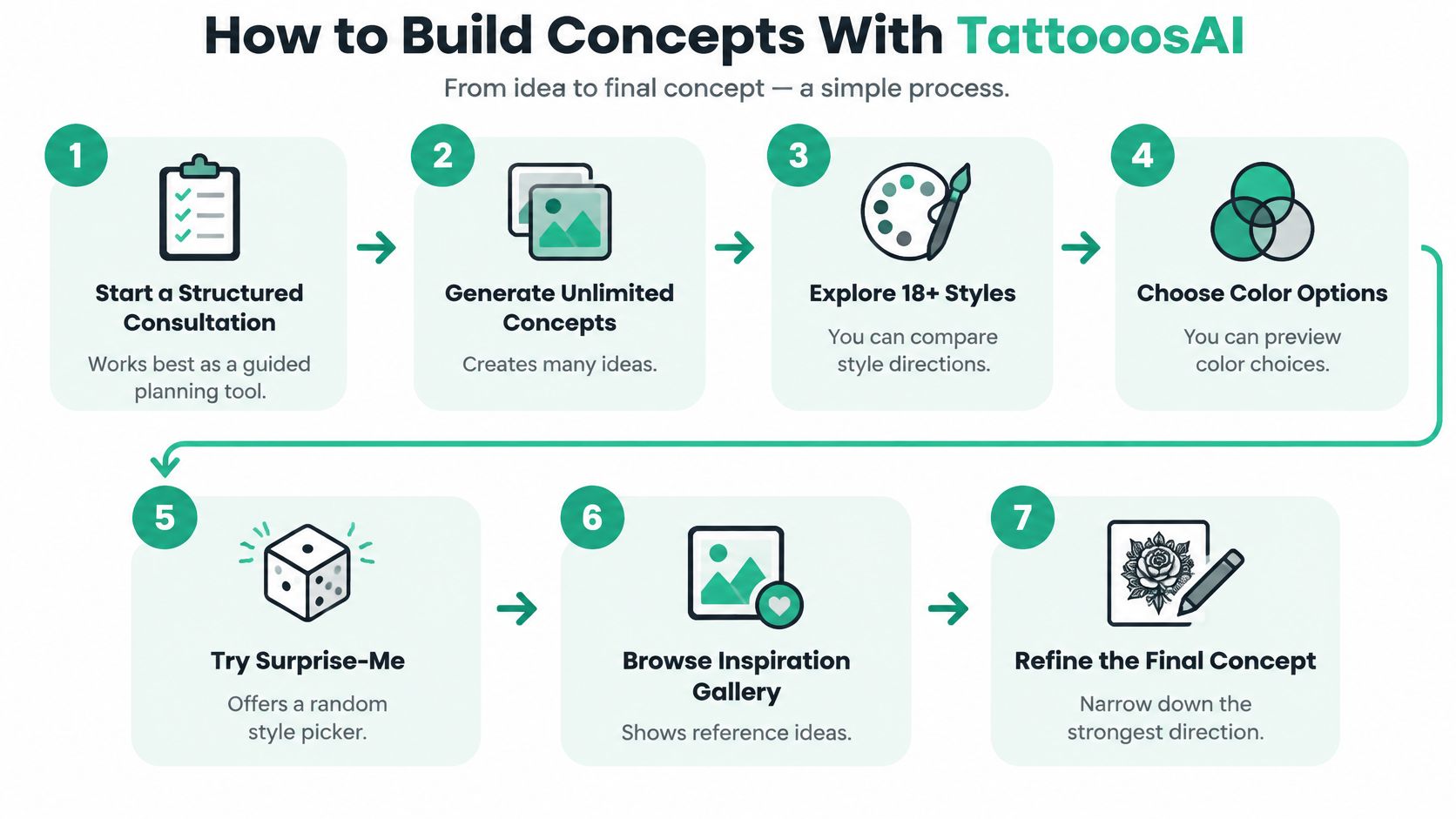
TattoosAI is an option for generating tattoo concept references alongside hand sketches, mood boards, and drawing tools such as Procreate. Use it to compare composition and communicate preferences, not to make clinical or technical decisions about tattooing.
A structured prompt is more useful than a string of style labels. It tells the generator what should dominate, where the design belongs, and what it must leave out.
Build the prompt around decisions
Start with atmosphere and placement. Describe the body area and mood, such as a solemn raven composition for the outer upper arm. State whether the piece should stand alone or connect to later work.
Describe contour and direction. Request an arch following the spine, a band wrapping the shoulder, or a vertical composition along the calf. This reduces the chance of receiving an attractive flat illustration with no useful body flow.
Set the dark-to-open balance. Ask for restrained black coverage or broad fills interrupted by continuous skin channels. If you want a numerical fill target, agree on it with your artist rather than assuming a percentage makes the design tattooable.
Define the hierarchy. Specify heavy structural shapes, lighter supporting ornament, and clear separation around the subject. Name the openings that must remain visible, such as the space between a raven's beak and its frame.
Exclude unresolved imagery. List copied cultural emblems, unidentified glyphs, unwanted religious symbols, and lettering you don't want. Exclusions won't guarantee a suitable result, so inspect the output rather than trusting the prompt.
Compare at physical scale. Print promising concepts at the intended dimensions and hold them against the placement. Don't rely on a screen mockup to judge how the composition wraps around a limb.
Refine a single variable at a time. Keep the subject fixed while changing the frame, then compare spacing or ornament. Save the strongest results with notes explaining what to retain and what the artist should redraw.
Write a usable concept request
A practical prompt might describe an outer-arm gothic blackwork composition featuring a raven beneath a pointed arch, sweeping angular bands, restrained thorn ornament, and open skin around the head and wings. Add that the design should avoid copied cultural markings and leave the lower edge suitable for a future extension.
Keep authorship clear: Bring generated images as references for an original tattoo, not instructions to reproduce every line.
Check current interface features and privacy terms before uploading personal photographs. Whatever tools you use, the useful deliverable is a focused reference set with clear decisions, not a claim that the artwork is ready to stencil.
Brief Your Tattooist and Book the Consultation
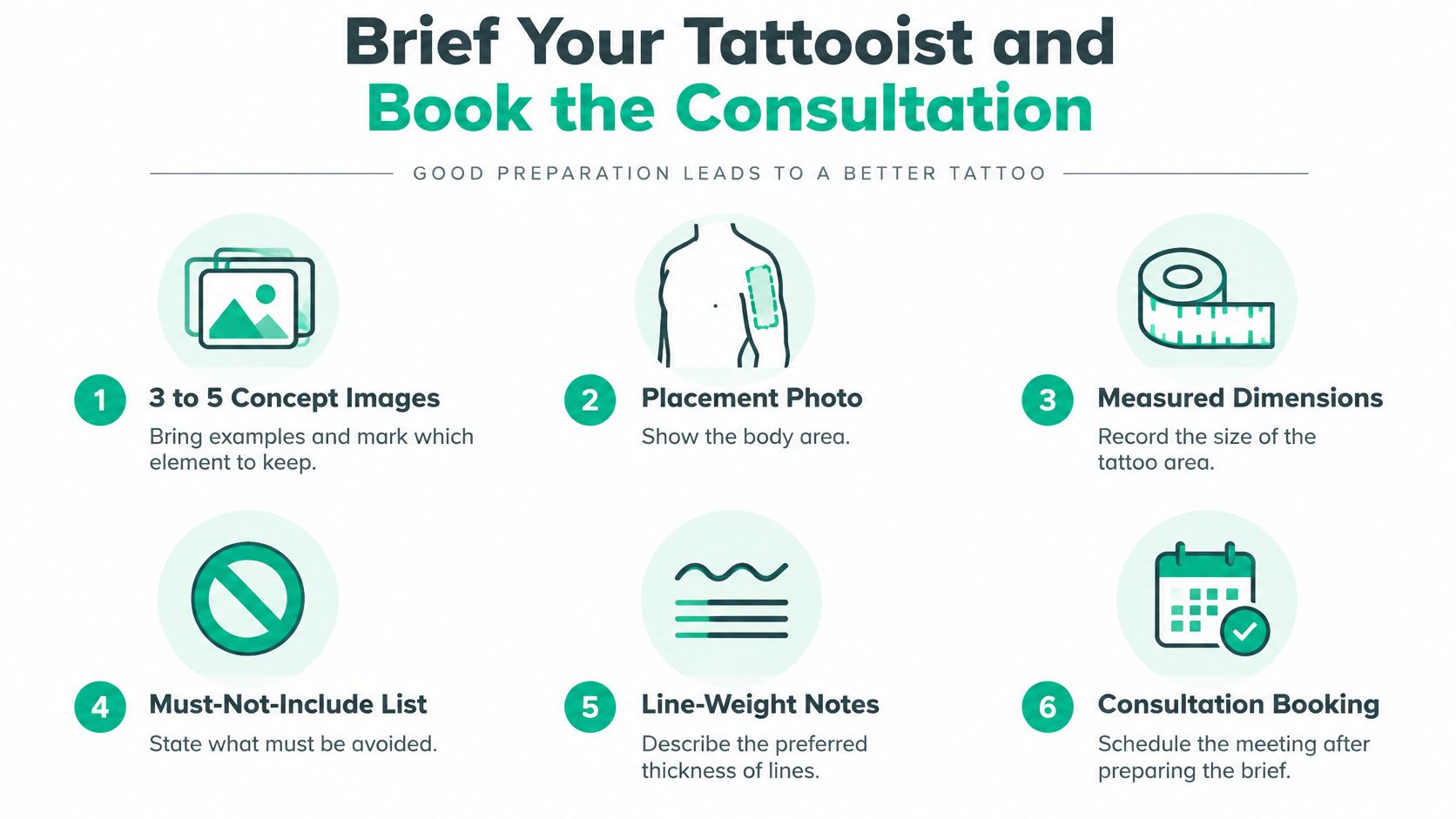
Bring enough information for the artist to assess the project without asking them to decipher an entire inspiration folder. Annotate your references so they can distinguish a favourite silhouette from a detail you don't want.
- Concept references: Mark the subject, frame, or movement you want to retain.
- Placement photo and dimensions: Show the usable area, nearby tattoos, and intended boundaries.
- Exclusions: Record unwanted symbols, cultural markings, lettering, and motifs.
- Technical priorities: Identify essential openings, preferred line hierarchy, and areas available for simplification.
- Context and care: Include researched influences and questions about healing, touch-ups, and future changes.
Ask for an assessment, not just approval
Ask whether the negative-space corridors are workable, how the artist would divide large fills, and what healing will require. Confirm that they'll redraw the composition for your anatomy and explain what future modifications might remain possible.
Abandon references containing symbols you can't explain or motifs whose origins you can't trace. A thoughtful artist should flag recognizable borrowed imagery and correct awkward joins rather than promise an exact copy.
Shortlist artists whose healed blackwork matches your chosen direction. Send the same focused brief to each, compare their reasoning, and book a consultation before committing to a stencil.
TattoosAI offers a way to turn a descriptive gothic blackwork idea into visual concept references. Visit TattoosAI to explore a raven, arch, or thorn-based composition, then bring your preferred direction to a tattooist for an original, anatomy-specific design.