TattoosAI
You're sitting with a favorite photograph, a date you can't forget, and no clear way to turn grief into a design that will still feel right years from now. Memorial angel wing tattoos can offer a starting point because wings carry familiar associations with protection, spiritual passage, hope, and an ongoing bond with someone who has died. They also leave space for details that belong only to your relationship.
The right design might be a single wing with initials, paired wings across the back, a religious tribute, or a quieter composition built around coordinates or flowers. This guide explains what each design can say about the person remembered, how to personalize it, where placement changes the experience, and which wording or portrait details deserve extra care. If you're also looking for emotional support while making decisions during grief, therapy for depression in Vernon may be a useful resource.
TattoosAI can help you generate starting concepts in different styles and compare layouts before your appointment. Treat those concepts as references, though. A professional tattooist should redraw and adapt the final design for your body, skin, stencil, and long-term legibility.
Table of Contents
- 1. Single Angel Wing with Dates or Initials
- 2. Paired Angel Wings for a Guardian Tribute
- 3. Angel Wings with Halo and Religious Symbols
- 4. Angel Wings with Portrait Integration
- 5. Feather-to-Birds Transformation
- 6. Minimalist Angel Wing with Coordinates or Location Names
- 7. Angel Wings with Birth and Death Flowers
- 8. 3D and Realistic Angel Wings with Shadow and Depth Effects
- 8-Point Comparison: Memorial Angel Wing Tattoos
- Turn Your Memory Into a Brief Your Artist Can Use
1. Single Angel Wing with Dates or Initials
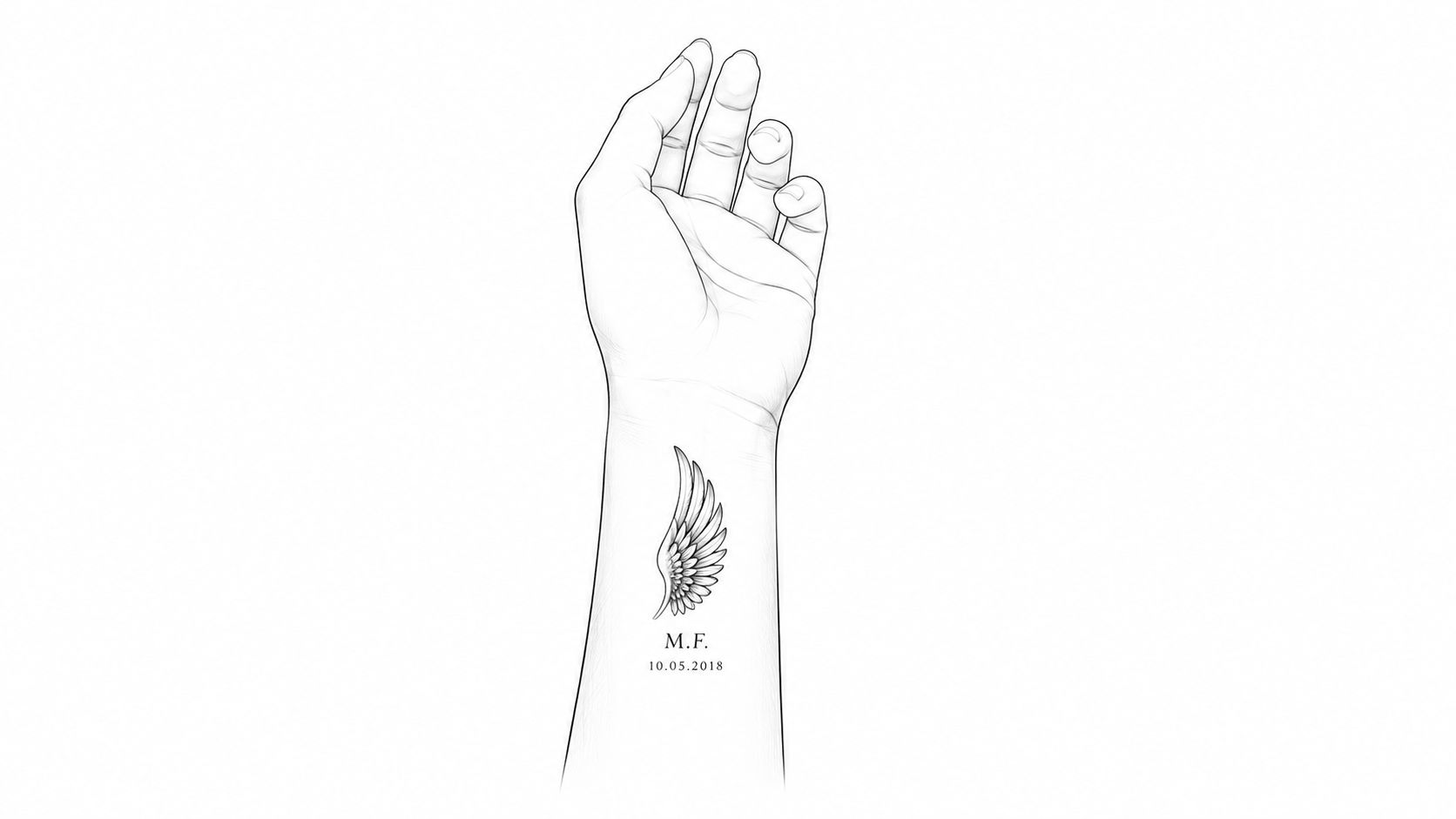
A single wing can say that one person remains part of your life. Its shape suggests protection or spiritual connection without showing a complete angel. Because the composition is focused, it leaves clear space for the person's initials, name, or meaningful dates.
Choose details that identify the relationship accurately. A parent may use a narrow wing with a child's initials below it. A partner's tribute might pair the wing with a birth date and death date in restrained lettering. If the person was known by a nickname, that name may feel more personal than a legal name. A short name or coordinates can also sit beside a minimalist wing, giving the tattoo a quiet meaning that is not immediately obvious to strangers.
Personalization and placement
Use TattoosAI to compare a fine-line silhouette with a more detailed feather treatment. Test the same initials in several fonts. Place the lettering below the wing, along its curve, and within the feather lines. Centered versions feel orderly, while an off-center layout can look more natural. Show the strongest options to your artist for an anatomical redraw.
- Wrist: Easy to see and suited to short initials or a date, but space is limited.
- Forearm: Provides more room for readable lettering and feather detail.
- Ankle: Keeps the tribute private while supporting a small, balanced design.
- Upper arm: Allows clearer feather separation and room for later additions.
A placement mockup helps you judge scale before the stencil is applied. Confirm every letter and number against an original document or trusted family source. One spelling error or reversed date can permanently change the tribute. Ask the artist to show exact spacing, line weight, and wording on the body mockup before tattooing.
2. Paired Angel Wings for a Guardian Tribute
Two symmetrical wings suggest balance, shelter, and a continuing protective presence. They can honor one person or make room for several loved ones. The space between the wings becomes important because it can hold a name, portrait, heart, cross, flower, or another private symbol.
A person remembering both parents might place their names between broad wings across the upper back. Someone honoring a partner could use shoulder-blade wings with a small heart at the center. A chest design with twin wings and a name between them feels more intimate, while a full-back composition creates a larger, more visible statement.
Scale, symmetry, and body movement
Symmetry looks simple, but it demands careful planning. The artist needs to account for the spine, shoulder blades, posture, and the way the wings move when the body changes position. An AI concept can show the intended direction, but it won't replace an artist's anatomical redraw.
Try several versions before the consultation:
- Broad wings: Create a strong guardian image and suit the upper back.
- Narrow wings: Feel lighter and may work better across the chest or shoulders.
- Dense feathers: Add realism but need enough room to remain distinct.
- Open negative space: Keeps the silhouette clearer as the tattoo ages.
Use black-and-gray concepts first if the main message is protection or remembrance. You can then compare a softer watercolor direction, but ask your artist how color, saturation, and skin tone will affect the final result. For a design honoring multiple people, decide whether each name should have equal visual weight. Giving one name larger lettering can unintentionally suggest a hierarchy you didn't intend.
3. Angel Wings with Halo and Religious Symbols
A halo, cross, scripture, praying hands, or another sacred symbol can make faith central to the tribute. This design often suits someone who wants the tattoo to express not only loss, but also belief in spiritual care, resurrection, heaven, or a relationship that continues beyond death. Wings provide the surrounding structure, while the religious element tells viewers how to understand the memorial.
A small wing with a halo and cross can fit the wrist or upper arm. A larger composition might place a scripture passage beneath the wings, with radiating lines behind the halo. Another option is a winged figure with praying hands and the deceased person's name in calligraphy.
Choose the wording with care
Religious language can feel comforting, but it should reflect the beliefs of the person remembered and the wearer. Don't choose a verse solely because it appears often in tattoo references. Read the full passage, check the translation, and confirm punctuation and spelling with someone who knows the tradition.
Consider these design decisions:
- Halo: A plain ring feels quiet, while radiating lines create a more luminous effect.
- Cross or sacred symbol: Keep it proportionate so it supports the memorial rather than overpowering it.
- Scripture: Use a short passage if readability matters more than fitting a long quotation.
- Name placement: Position the name below the main symbol if you want the religious message read first.
Ask the artist to test text at the actual intended size. Fine calligraphy can lose clarity when reduced, especially on areas that bend or move. If your interpretation of faith is personal rather than formal, abstract rays, a small halo, or a private symbol may communicate more accurately than a direct religious emblem.
4. Angel Wings with Portrait Integration
A portrait turns the memorial into an unmistakable representation of one person. Wings can frame the face, emerge behind the shoulders, or surround the portrait like a protective form. The result may feel powerful because the tattoo combines likeness with spiritual presence, but portrait work also leaves less room for approximation.
A realistic portrait of a child with wings rising behind the shoulders creates a direct remembrance. A grandmother's illustrated face with delicate wings may feel gentler than a photo-realistic treatment. A stylized portrait can work well when the available reference image isn't sharp enough for exact realism.
Reference quality matters
Choose a photograph with a clear view of the person's face and distinctive features. Avoid asking an artist to reconstruct details that aren't visible. The expression matters, too. A smiling image may communicate warmth, while a calm or thoughtful expression may feel more faithful to the relationship.
Generate several directions with portrait tattoo style guidance, such as realism, watercolor, and illustration. Compare wings that frame the face with wings that emerge from the shoulders. These variations can help you explain the emotional tone you want, but a portrait specialist should evaluate whether the reference image and placement can support the detail.
A portrait should be judged by resemblance, not by how impressive the reference image looks on a screen.
Before booking, review the artist's healed portrait work, not only fresh tattoos. Discuss face size, contrast, skin movement, and whether a softer illustrated approach would protect the person's likeness better. Don't add a halo, dates, flowers, and a long inscription just because there is empty space. The face should remain the visual priority.
5. Feather-to-Birds Transformation
A feather changing into birds gives the memorial a sense of movement. It can represent release, transformation, freedom, or a soul moving from earthly life toward another state. Unlike a static pair of wings, this design shows a process. The viewer's eye travels from the solid feather to the birds in flight.
One concept might begin with a large feather on the forearm and end with small birds rising toward the elbow. A back piece could show one angel wing dissolving into a flock. A quieter version might use a single feather with two or three birds emerging near the top, followed by the loved one's name in small lettering.
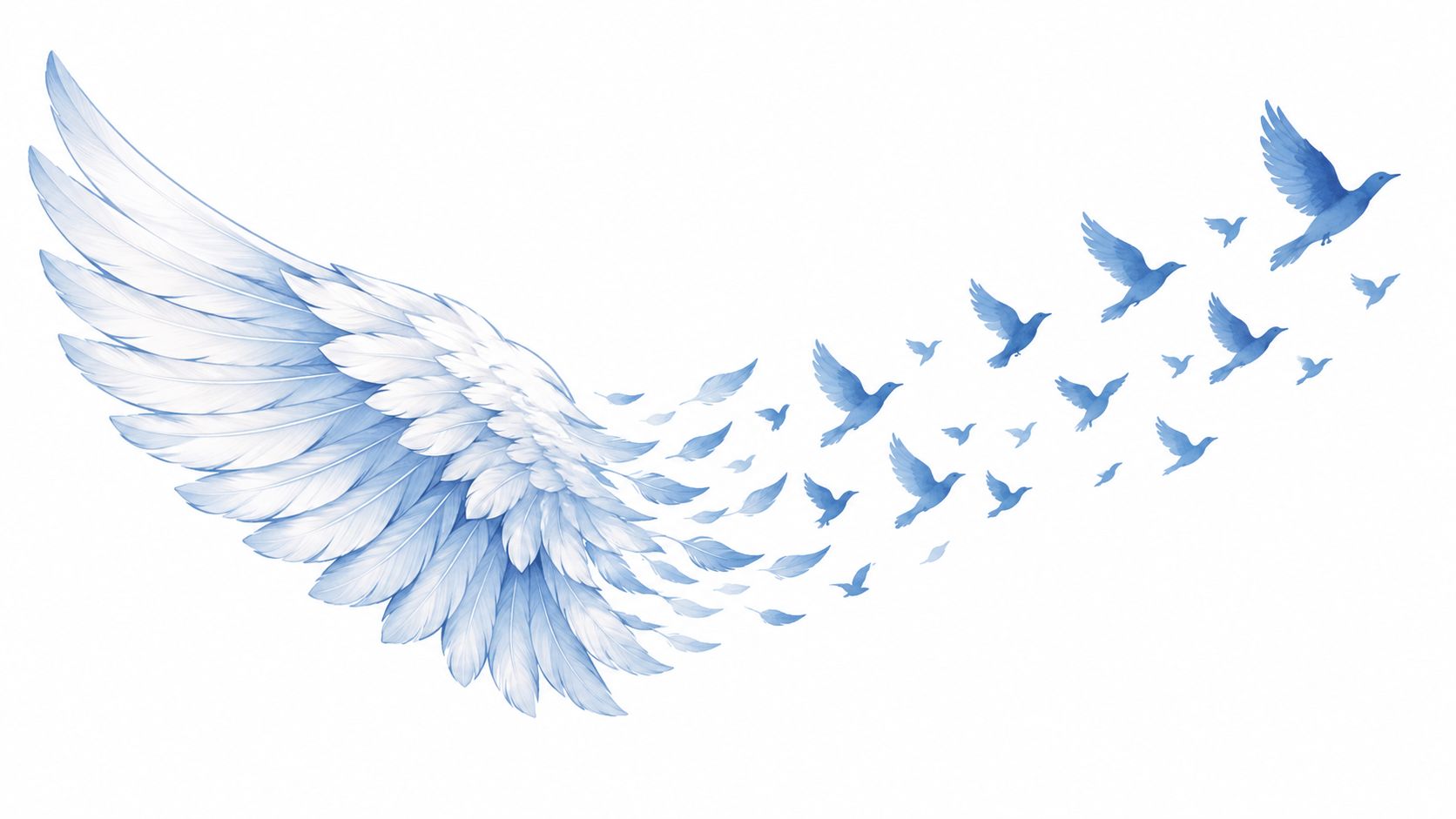
Build a clear visual journey
The transition needs to be gradual enough that the viewer understands what is happening. If the birds appear too abruptly, the design can look like a feather placed beside unrelated shapes. If every feather and bird is rendered with equal detail, the composition may become dense.
Use TattoosAI to test:
- Bird species: Doves can suggest peace, while generic birds keep the meaning open.
- Transition point: Birds can emerge from the tip, middle, or outer edge of the feather.
- Direction: Upward movement emphasizes ascent, while a horizontal flow can feel more expansive.
- Background: Open skin keeps the design clean, while clouds or stars add atmosphere.
Be careful with the number and size of birds. Tiny silhouettes may lose definition over time. Your artist can simplify the smallest shapes and preserve the main transition with stronger outlines or open space. If you include a name, place it away from the busiest part of the transformation so it remains readable.
6. Minimalist Angel Wing with Coordinates or Location Names
A place can show what the person meant to you, not just where they lived or died. It might be a birthplace, family home, favorite meeting place, or the setting of a final goodbye. A simple wing beside coordinates or a location name keeps that memory private, like a small address known mainly to you.
Start with the relationship behind the place. A childhood home may represent years together. A hospital may mark a final chapter. A vacation spot, workplace, or favorite park may capture a shared routine more clearly than a biographical location.
A few layout choices change the message:
- Below the wing: Clear to read and visually calm.
- Along the wing: More integrated, though curved lettering may be harder to read.
- Above the wing: Forms a compact emblem.
- Location name only: Easy for others to understand.
- Coordinates only: More private and visually minimal.
A small wrist wing can sit above a hometown's coordinates. An ankle piece can name the person's birthplace. On the forearm, a city name beneath a single-line wing gives the lettering more room. Smaller areas suit fewer characters, while longer place names may need a wider surface.
Use TattoosAI's fine-line or minimalist directions to compare fonts and layouts before speaking with an artist. Check every coordinate detail, including decimal points, direction letters, and spacing. Verify the location with a reliable map. Ask for the design at its intended size and placement. On a wrist or ankle, curved skin can make straight text appear uneven.
Keep wording accurate and personal. Use the place that tells the relationship's truth, and confirm the spelling before the appointment. A clean brief should name the location, coordinate format, wing style, text placement, and body area.
7. Angel Wings with Birth and Death Flowers
A birth flower can show when someone entered your life. A death-month flower can mark the time you lost them. A favorite bloom may say more about the person than a traditional symbol. Choose the flower for its connection to the relationship, then let the wings frame it, support it, or replace a few feather details with botanical forms.
A rose with a chrysanthemum can represent two meaningful months. Watercolor blooms soften a detailed wing, while black-and-gray flowers create a quieter memorial. A branch beneath the wings can connect the elements more naturally than two isolated flowers at the center.
Let the flowers identify the relationship
Flower meanings can guide your choice, but they do not set a rule. A bloom from the person's garden, a wedding bouquet, or a shared season may carry greater meaning than a general symbolism list. Use birth flower tattoo ideas to compare realistic, illustrated, and watercolor approaches.
Write the design brief around the memory:
- Flower choice: Identify whether each bloom represents birth, death, a favorite, or a shared experience.
- Color: Decide whether color carries meaning, or whether black-and-gray shading is enough.
- Placement: Flowers facing outward can feel open, upward-facing blooms can suggest remembrance, and inward-facing flowers can focus the design toward the center.
- Text: Add a name or date only when it remains easy to read beside the stems and petals.
A chest or upper-back design gives branches room to spread. A forearm allows a narrower wing with one flower below it. Small areas work better with one bloom and short wording. Check every name and date before the appointment. If a portrait is included beside the flowers, give the artist a clear reference and approve the likeness before finalizing the stencil.
For color accents, ask the studio about compliant, traceable pigments. In the European Union and European Economic Area, REACH restrictions cover more than 4,000 hazardous substances in tattoo inks, and compliant packaging must identify tattoo use, ingredients, and relevant safety statements according to the European Chemicals Agency.
8. 3D and Realistic Angel Wings with Shadow and Depth Effects
A realistic wing can say that the person remembered still feels present and protective. Perspective, feather detail, and cast shadows make the image look raised from the skin, like a sculpted form rather than a flat emblem. Choose this approach if the tribute should feel active, watchful, and physically close.
Start with the memory, then build the brief. Add the person's name, initials, or dates beneath the wing only if the lettering stays clear. A small portrait can identify them, but it needs a sharp reference photo and an honest discussion about likeness. Avoid wording that assigns a role the person did not hold. “Always with me” may fit a close relationship, while “In loving memory” keeps the message more general.
Placement changes the illusion. On the back, the wings can seem to rise from the shoulder blades and spread across a broad surface. On the shoulder, the body's curve can make feathers appear to emerge from the skin. An arm gives less room, so place initials or a small portrait below one wing and check how the image reads as the arm turns. Large designs allow more shadow, feather groups, and later additions. Smaller areas need a simpler silhouette.
Light direction must stay consistent. Shadows should support the wing's structure, not create competing depths. Ask the artist to test black-and-gray and color versions, then review:
- Perspective: Does the wing follow the body's curve?
- Contrast: Are the darkest areas limited to structural shadows?
- Feather spacing: Will feather groups remain distinct after healing?
- Skin movement: Will stretching or bending weaken the illusion?
- Future changes: Is there room for another name, date, or motif?
TattoosAI can generate a 3D reference, but the tattooist must redraw it for the stencil, anatomy, needle grouping, and your skin. Guidance on angel-wing tattoo planning also favors a clear silhouette, open negative space, and varied line weight over maximum detail. Review healed work from the artist, especially for large back, chest, or shoulder pieces.
8-Point Comparison: Memorial Angel Wing Tattoos
| Design | Implementation Complexity 🔄 | Resource Requirements ⚡ | Expected Outcomes ⭐📊 | Ideal Use Cases | Key Advantages 💡 |
|---|---|---|---|---|---|
| Single Angel Wing with Dates or Initials | Low, simple composition, fine-line detail possible | Low, short session, minimal healing | ⭐⭐, intimate, readable memorial 📊 subtle visual impact | First-time seekers; wrist, ankle, behind ear; small memorials | Highly personal, affordable, quick to execute |
| Paired Angel Wings (Guardian Wings) | Medium, requires precise symmetry and larger canvas | Medium–High, longer sessions, larger area, experienced artist | ⭐⭐⭐, strong visual centerpiece 📊 high impact when scaled | Honoring multiple people; back, chest, shoulders; centerpiece pieces | Balanced symbolism, versatile for added elements |
| Angel Wings with Halo and Religious Symbols | Medium, more elements to balance (halo, crosses, text) | Medium, detailed work; may need color/shading | ⭐⭐⭐, faith-driven, clearly symbolic 📊 meaningful religious tribute | Faith-based memorials; back/chest/shoulder blade | Deep spiritual meaning; recognizable sacred imagery |
| Angel Wings with Portrait Integration | High, complex composition and portrait accuracy required | High, lengthy sessions, top-tier portrait artist | ⭐⭐⭐⭐, powerful emotional impact 📊 highly recognizable tribute | Realistic memorials needing likeness; large canvas (back/arm) | Most personal and narrative-driven; lasting visual legacy |
| Feather-to-Birds Transformation | Medium, requires smooth morphing and flow | Medium, skilled artist for transitions; variable session time | ⭐⭐⭐, artistic, symbolic motion 📊 visually dynamic and unique | Symbolic ascension pieces; arm, leg, back; expressive memorials | Creative narrative of transformation; adaptable sizes/styles |
| Minimalist Angel Wing with Coordinates or Location Names | Low, clean lines with small, precise text | Low, quick session, minimal healing | ⭐⭐, subtle, location-based meaning 📊 discreet and professional | Compact, place-based tributes; wrists, collarbone, ankle | Clean, professional, highly personal via coordinates |
| Angel Wings with Birth and Death Flowers | Medium, combines floral and wing detail, color work | Medium–High, color and botanical detail increase session time | ⭐⭐⭐, layered symbolism and aesthetic appeal 📊 colorful and meaningful | Nature-loving memorials; thigh, shoulder, calf; sleeves | Rich symbolism, beautiful color options, versatile as sleeve |
| 3D/Realistic Angel Wings with Shadow and Depth Effects | High, advanced shading, perspective and realism skills | High, multiple sessions, top realism artist, higher cost | ⭐⭐⭐⭐, striking, modern, attention-grabbing 📊 strong long-term visual impact | High-end memorial pieces; prominent placements (back/arm) | Dramatic depth and realism; showcases artist mastery |
Turn Your Memory Into a Brief Your Artist Can Use
Inspiration becomes useful when you turn it into a short, specific brief. Start with the person's name or your relationship to them. Then state what you want the wings to communicate, such as protection, spiritual passage, freedom, faith, a continuing bond, or your own healing. Angel wings have a long visual history connected with divine presence and protection, but they don't carry only one religious meaning. Contemporary wearers also use them for remembrance, grief, survival, and emotional connection in this overview of angel symbolism.
Write down the exact details you want included. These might be initials, a full name, a birth date, a death date, coordinates, handwriting, a flower, a halo, or a meaningful object. If the design includes text, type it exactly as it should appear and verify every character. If it includes a portrait, choose the reference image carefully and explain which facial expression feels most like the person.
Then shortlist two or three directions from this list. You might compare a single minimalist wing, a floral paired-wing design, and a feather-to-birds composition. Generating several concepts with TattoosAI can help you see whether the same memory feels better in fine-line, black-and-gray, watercolor, geometric, or 3D treatment. Use the images to discuss preferences with an artist, not to bypass the artist's design process.
A small qualitative study found that 100% of participants said their memorial tattoos had symbolic significance, while 50% included the deceased person's name or initials and 36% included wing imagery in the memorial tattoo study. The figures don't prescribe a formula. They show why your design may need both a broad symbol and a detail that identifies the person.
Discuss permanence before the appointment
Grief can change shape. A name and date may feel right now, but a more flexible symbol might better reflect the relationship as your life develops. Abstract wings, a private flower, handwriting, coordinates, or a meaningful object can preserve the connection without forcing the tattoo to express only one stage of grief.
Think about health and future constraints, too. Allergic reactions can occur long after tattooing, people predisposed to keloids may develop raised scars, and tattooed skin can rarely burn or swell during an MRI or affect image quality as explained by the Mayo Clinic. Tell the artist about any keloid history and follow professional aftercare guidance. Seek medical advice if the tattoo doesn't heal, develops a rash, or comes with fever.
Before the stencil goes on, confirm three things on the body itself: text accuracy, symmetry, and placement readability. Ask the artist to redraw the AI concept for your anatomy, skin, and chosen technique. The final tattoo should be a collaboration, not a printed image transferred without thoughtful adjustment.
If you're creating a tribute for an animal companion, the same process applies. A guide to memorial ink for pet loss can help you consider names, dates, paw prints, favorite objects, and symbols that represent the bond rather than only the loss. Take your time. The best memorial design isn't the most elaborate one. It's the one that still feels truthful when you look at it in a different season of life.
TattoosAI lets you describe a memorial idea, choose from styles such as minimalist, watercolor, blackwork, geometric, or 3D, and generate multiple concepts for comparison. Visit TattoosAI to explore angel wing layouts and create references you can bring to a professional tattoo consultation.