TattoosAI
Why do some neo traditional sleeve tattoos read beautifully from across the room while others turn into visual noise? The difference usually isn't the choice of roses, wolves, or skulls. It's how your artist arranges those subjects around a moving, tapered arm, with a clear flow direction, distinct focal points, and controlled color.
A sleeve isn't a poster wrapped around your skin. The shoulder offers a broad curved surface, the forearm narrows toward the wrist, and the elbow interrupts whatever crosses it. A composition needs to work with your arm relaxed, bent, and rotated, not just in a carefully posed photograph.
Start by deciding what someone should notice first and where their eye should travel next. Then choose supporting motifs that connect those moments without filling every available gap. The concepts below offer different ways to solve that problem, from sweeping botanicals to structured portrait frames. Each includes practical layout choices and a prompt direction you can use to explore ideas before your tattooist develops the actual sleeve.
Table of Contents
- 1. Bold Floral Full Sleeve (Roses and Peonies)
- 2. Wolf and Forest Sleeve
- 3. Koi and Dragon Mythic Sleeve
- 4. Nautical and Americana Sleeve
- 5. Ornamental Portrait Frame Sleeve
- 6. Skull and Botanical Memento Mori Sleeve
- 7. Bird and Celestial Sleeve
- 7 Neo Traditional Sleeve Styles Compared
- Plan Your Sleeve Before You Sit in the Chair
1. Bold Floral Full Sleeve (Roses and Peonies)
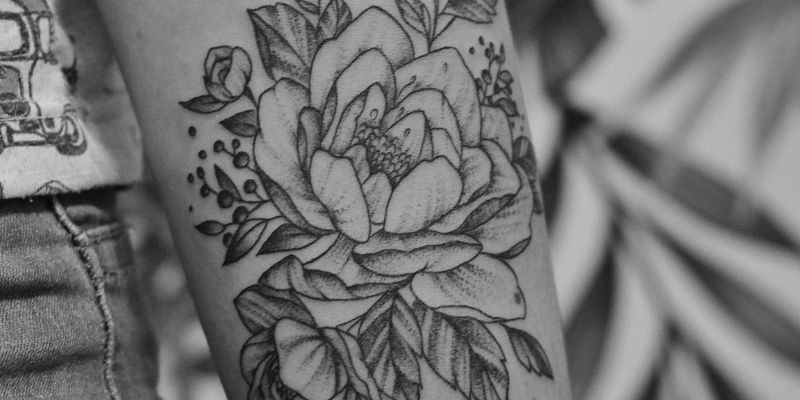
A large peony over the shoulder, a rose on the outer forearm, and leaves sweeping between them can create a complete sleeve without adding unrelated subjects. Vary the size and angle of the blooms so they don't resemble identical badges stacked down your arm.
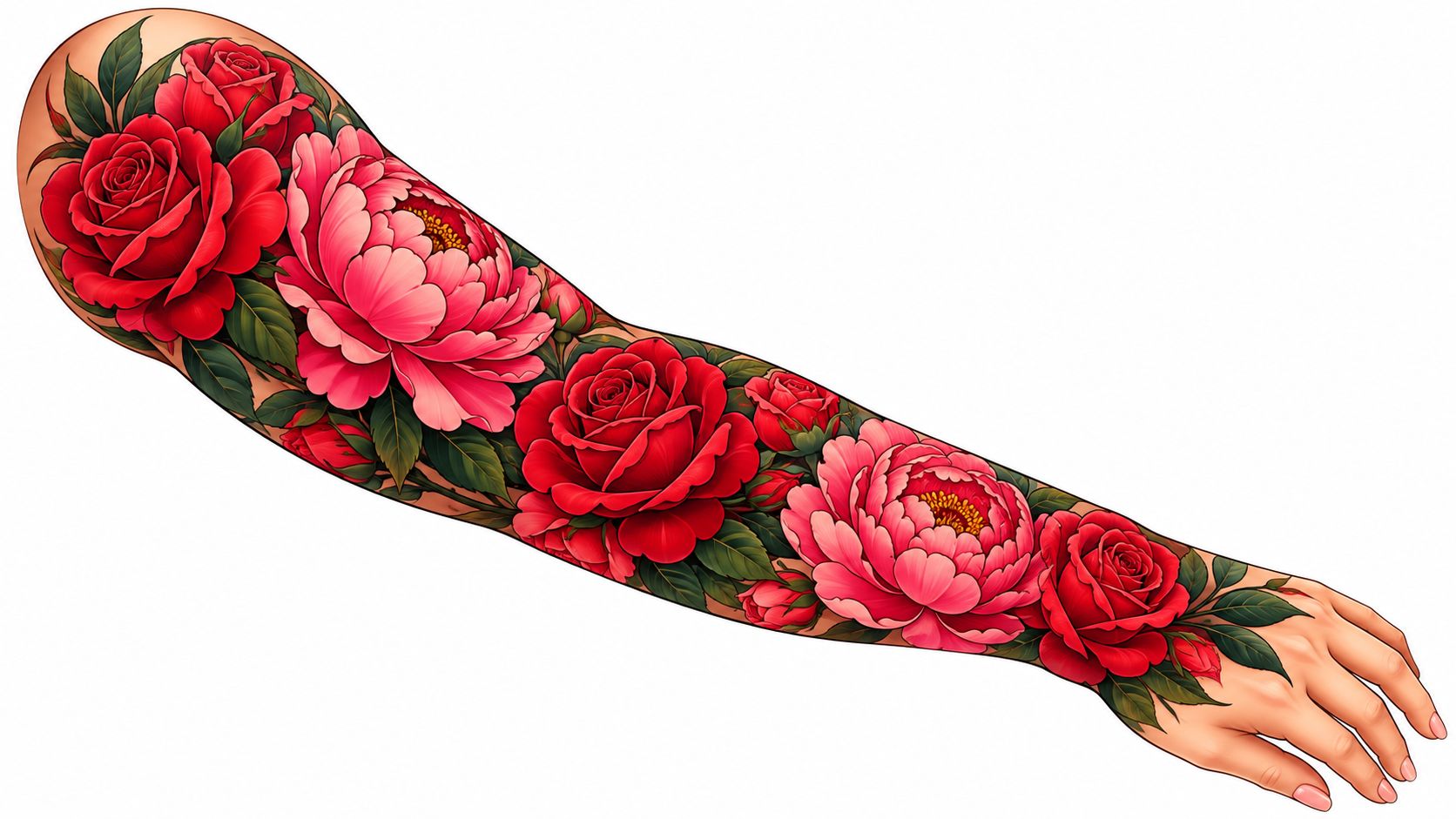
Neo-traditional tattooing develops American traditional structure through varied line weights, richer shading, and decorative influences including Art Nouveau, as described by the Tattoo History Atlas style guide. Flowers suit that combination because your artist can preserve a strong outer silhouette while adding dimensional petals inside it.
For a first sleeve, I'd choose broad, readable blooms over a dense collection of tiny wildflowers. Large petals give the artist room to separate highlights, color, and shadow. Smaller flowers can connect the anchors, but they shouldn't compete with them.
Make the stems establish direction
Ask your artist to sketch a sweeping route from shoulder to wrist before arranging individual flowers. Leaves should follow or gently counter that route, rather than point randomly into gaps.
- Anchor placement: Put the fullest bloom where the arm offers enough width, then use a narrower, angled flower farther down.
- Palette limit: Try burgundy and dusty pink flowers, muted green leaves, and restrained gold accents rather than a different color for every bloom.
- Stencil review: Check the layout with your arm hanging naturally and with your elbow bent.
Concept prompt: Neo-traditional floral sleeve, large shoulder peony, angled forearm rose, sweeping botanical connections, burgundy and muted green, bold silhouettes, open skin between blooms.
2. Wolf and Forest Sleeve
Keep the wolf's face on a readable plane. A detailed muzzle that wraps too far around the arm can disappear from the main viewing angle, leaving the forest more visible than the animal.
For a nature-themed sleeve, place a wolf in profile on the outer upper arm and use pine boughs to carry the composition toward the forearm. Turn its gaze along the sleeve's intended direction. A raised muzzle encourages an upward reading; a lowered head can connect naturally with foliage below.
The forest should frame the animal, not become a dark wall behind it. Use separated tree silhouettes, broken branches, and exposed skin around the ears and muzzle. If you also want an owl, make it clearly secondary rather than giving both faces equal size and contrast.
Practical rule: If the wolf's eyes aren't the first thing you notice in a reduced-size concept image, simplify the background before adding more fur detail.
Separate fur from foliage
Use broad shadow groups to describe the cheek, neck, and forehead. Fine fur marks belong inside those shapes, not everywhere along the outline. Ask to see healed animal tattoos in the artist's portfolio so you can judge whether their facial detail stays readable.
A charcoal, forest-green, and warm-ochre direction gives you color without making every section equally bright. Reserve the strongest accent for the face or a nearby moon, not both.
Concept prompt: Neo-traditional wolf sleeve, expressive profile on outer upper arm, pine branches sweeping toward wrist, sparse forest background, charcoal and muted green, warm facial accents, clear space around muzzle.
3. Koi and Dragon Mythic Sleeve
Choose a dominant creature and a shared current before adding waves, clouds, blossoms, or flames. A koi and dragon can occupy the same sleeve, but they shouldn't twist in unrelated directions or demand equal attention everywhere.
This comparison is useful for deciding whether you prefer the koi's compact curve or the dragon's longer spiral.
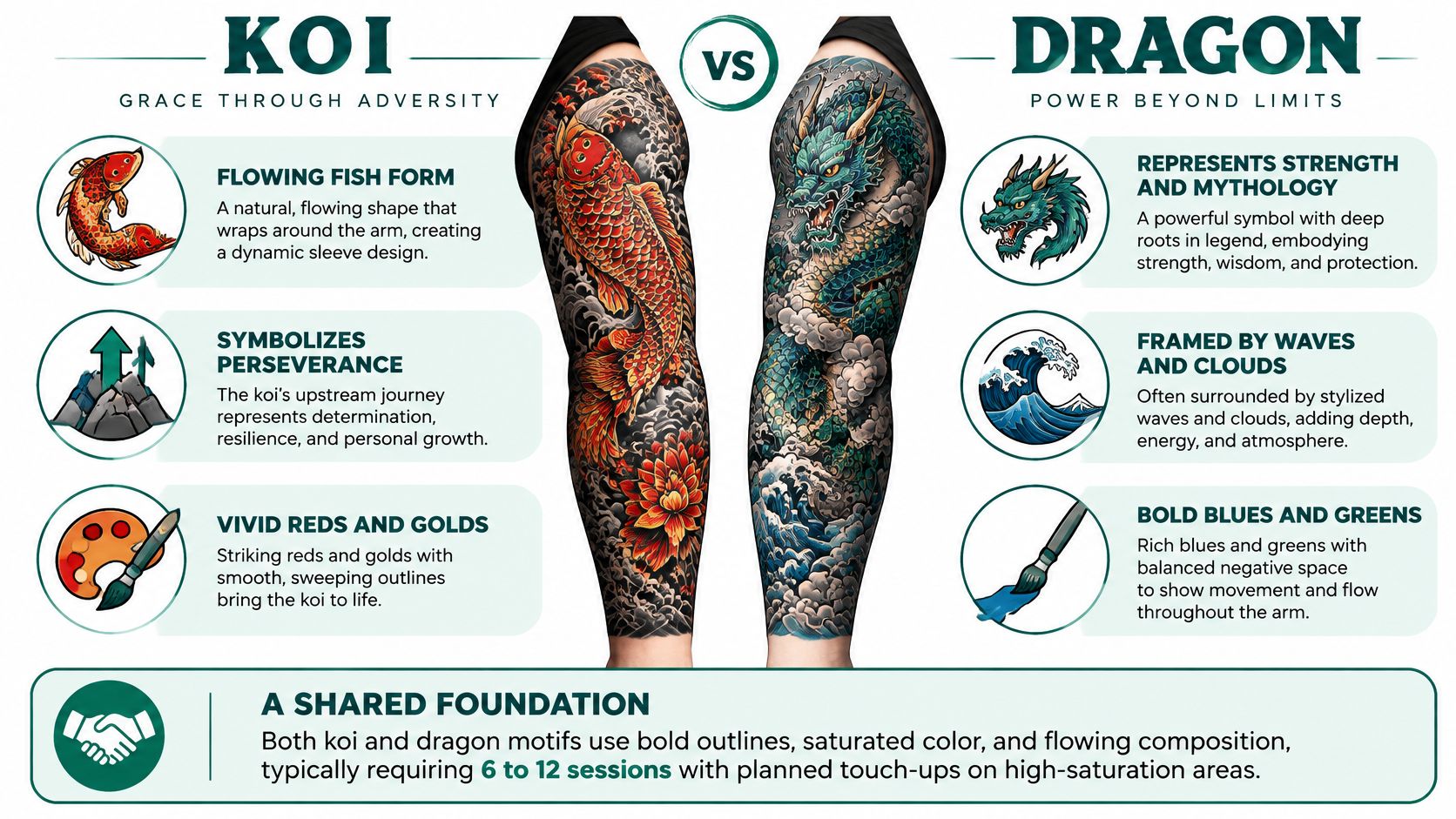
For example, a koi can turn around the forearm while a dragon's head anchors the upper arm. Connect them with background movement that follows the same broad sweep. Leave enough separation that scales, fins, claws, and wave crests don't merge into an uninterrupted texture.
Choose movement before ornament
A dragon offers length, but that length needs somewhere to go. Ask your artist to map the body around the arm before resolving individual scales, and avoid placing the most important facial features across the elbow.
- Warm-led palette: Use rust or orange on the creature, with cooler, quieter background shapes.
- Cool-led palette: Try blue-green creatures with restrained warm accents near the focal point.
- Cultural intent: Discuss the motifs and their intended meaning with an artist familiar with Japanese imagery rather than assuming every pairing is interchangeable.
Use the video as another visual reference, while judging your proposed sleeve by how it fits your own arm.
Concept prompt: Japanese-inspired neo-traditional sleeve, dominant upper-arm dragon, secondary forearm koi, continuous upward current, simplified waves, strong outlines, controlled warm-cool contrast.
4. Nautical and Americana Sleeve
A ship, compass, anchor, swallow, and banner can easily become a collection of separate tattoos. Choose a clear lead subject, then let rope, clouds, and restrained floral accents connect the rest.
Say you want a sleeve about travel rather than a literal maritime scene. Place a ship on the outer upper arm, angle a compass along the forearm, and use a swallow to redirect the eye around the side. Keep the ship's sails broad enough to read without needing every rigging line.
The useful planning principle is hierarchy. Skin Design Tattoo's sleeve-planning guide recommends approximately two to three anchor pieces, coordinated with shoulder-to-wrist flow and deliberate negative space. That approach keeps a nautical sleeve cohesive even when you complete it across separate appointments.
Use connectors, not filler everywhere
Rope works best when it establishes a route between anchors. If it loops around every object, it can divide the arm into small compartments instead of connecting the composition.
A traditional star tattoo can support the nautical direction, but keep stars subordinate to the ship or compass. Repeated stars at equal spacing can make the sleeve feel mechanically patterned.
Keep banner text short and give the lettering enough room. Ask your artist to check how the banner curves when your arm rests naturally, especially if the words cross toward the inner arm.
Concept prompt: Neo-traditional nautical sleeve, dominant sailing ship, angled forearm compass, sweeping rope connection, restrained swallow and star accents, navy and warm red, spacious banners, uncluttered sails.
5. Ornamental Portrait Frame Sleeve
The frame should make the face easier to see, not prove how much ornament fits around it. Reserve the strongest facial contrast for the eyes, nose, and mouth, then reduce competing contrast in nearby scrollwork.
For a memorial sleeve, a portrait on the outer upper arm can sit inside an elongated botanical frame. Flowers can extend toward the elbow and reappear on the forearm, connecting the portrait to the rest of the sleeve without requiring another face.
Bring clear, well-lit reference photographs and explain which features matter most to recognition. A stylized character portrait allows more exaggeration than a loved one's likeness. Decide which outcome you want before approving the drawing.
A beautiful frame can't rescue a portrait that's too small for its essential features.
Fit the face before decorating it
Ask the artist to establish portrait size and orientation first. A narrow frame may suit the arm's length, but squeezing the face into it can compromise the likeness. If space is tight, simplify the ornament rather than shrinking the portrait.
Use open skin or lighter shading immediately around the face, then place darker frame accents farther out. Repeating curved stems can soften the transition around the shoulder; more geometric ornament needs careful alignment so it doesn't look unintentionally tilted.
For color, try a restrained portrait treatment with deeper jewel tones in the surrounding flowers. Don't give every leaf, gem, ribbon, and facial feature a separate accent color.
Concept prompt: Neo-traditional memorial portrait sleeve, large readable upper-arm face, elongated botanical frame, subdued scrollwork, deep teal and burgundy accents, quiet background, floral continuation onto forearm.
6. Skull and Botanical Memento Mori Sleeve
A skull already contains strong dark shapes in the eye sockets, nose, and jaw. Adding black leaves, a shaded hourglass, and a dark background immediately beside it can make the whole sleeve look heavy.
Balance the skull with lighter botanical areas, not just brighter pigment. A saturated red rose still needs separation from the jaw if both have dense shadows.
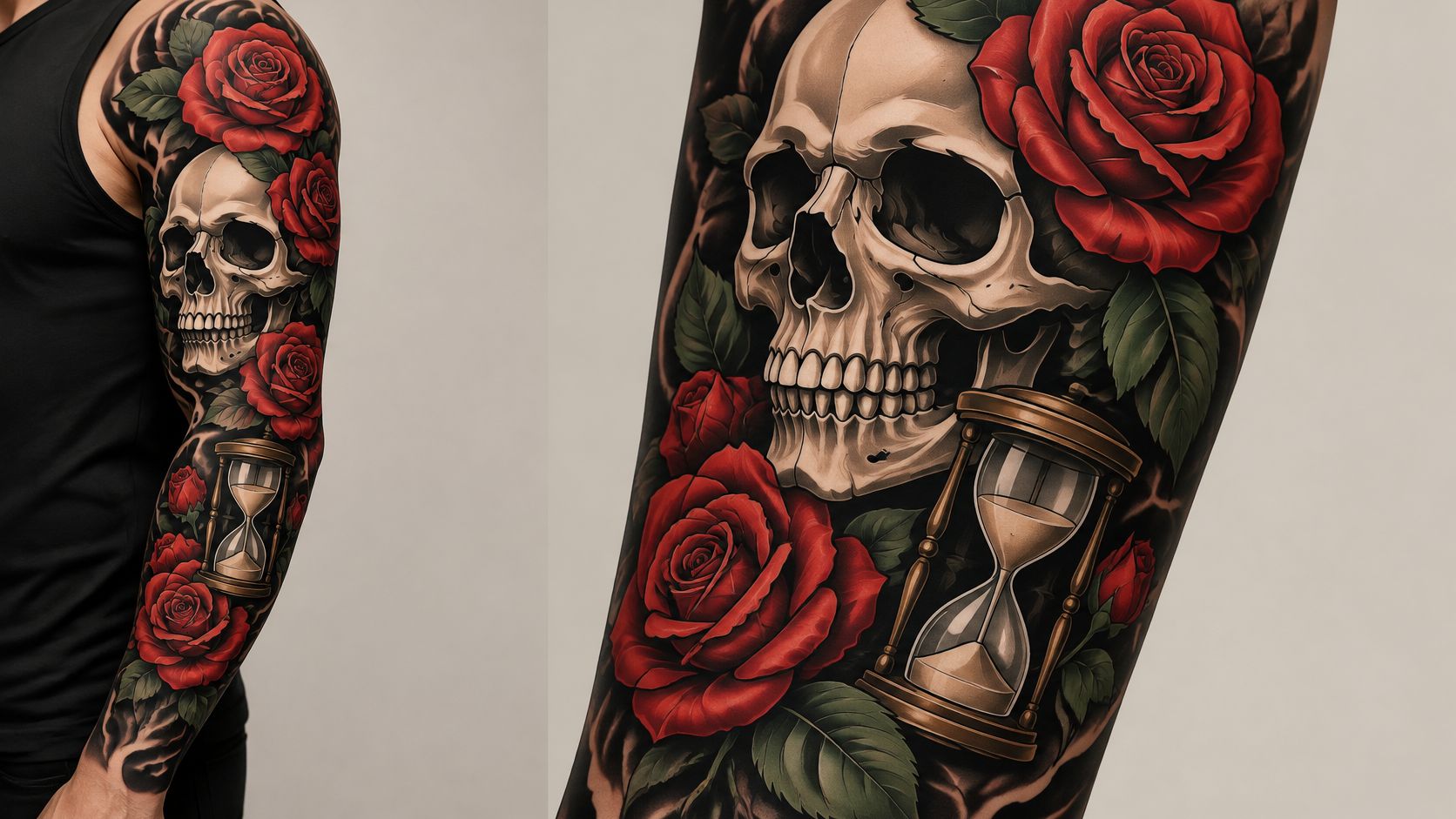
For a memento mori composition, place an angled skull above the elbow and a narrower hourglass along the forearm. Use stems to connect them, leaving exposed skin beside the skull's cheek and beneath selected petals. The skulls and roses design guide offers a related motif direction, but your sleeve still needs its own balance of solid and open areas.
Plan for a healed sleeve
A technical review of tattoo pigments and skin effects describes pigment changes through photodegradation and immune-cell transport. That makes strong silhouettes and deliberate spacing more useful than relying entirely on subtle color transitions.
- Skull treatment: Keep the main bone shapes broad, with selective cracks rather than uniform surface texture.
- Botanical balance: Let flowers overlap some edges without concealing the skull's recognizable outline.
- Long-term care: After complete healing, use high-SPF sunscreen on exposed tattooed skin and avoid tanning.
Concept prompt: Neo-traditional memento mori sleeve, angled skull above elbow, elongated forearm hourglass, burgundy roses, muted leaves, open skin beside cheekbone, strong black structure, restrained texture.
7. Bird and Celestial Sleeve
A bird sleeve feels airy only if you leave room around the wings. Filling every gap with stars, clouds, and feather fragments defeats that effect, even when the colors are pale.
For a phoenix concept, place the head and main wing mass on the upper arm, then draw the tail feathers diagonally toward the wrist. For an owl, use a more compact upper-arm anchor and carry the movement through branches or crescent shapes. Match the connectors to the bird's posture, rather than forcing every bird into the same spiral.
Let feathers establish the rhythm
Group feathers into clear overlapping sections. Describe the wing's overall shape first, then add selected internal lines. Narrow, repetitive feather marks shouldn't be the only thing separating the bird from the background.
A moon can provide a quiet frame behind the head, while sparse stars extend the theme without adding another large anchor. Ask your artist to show healed examples of similar light colors on skin tones comparable to yours.
Leave a deliberate open route through the sleeve. You don't need to tattoo every visible patch of skin to make the design feel complete.
Long-term skin changes and delayed complications are discussed in a clinical overview of tattoo complications. For planning, keep the distinction clear: an attractive fresh image isn't enough to judge either lasting readability or skin health.
Leave intentional transition areas near the shoulder or wrist if you might extend the work later. A crowded celestial border is harder to connect than an open-ended feather or branch.
Concept prompt: Neo-traditional phoenix sleeve, upper-arm wing anchor, diagonal tail flow, restrained moon and star accents, teal and amber, simplified feather groups, generous negative space, open wrist transition.
7 Neo Traditional Sleeve Styles Compared
| Theme | Best For | Estimated Sessions | Palette Character | Key Challenge |
|---|---|---|---|---|
| Bold Floral Full Sleeve (Roses and Peonies) | Clients wanting a colorful, cohesive sleeve with strong readability | 4 to 10 sessions | Saturated pinks, reds, teals, and deep greens | Avoiding crowded florals that blur over time |
| Wolf and Forest Sleeve | Outdoors enthusiasts seeking a symbolic, nature-based sleeve | 3 to 8 sessions | Dark forest tones with limited color accents | Making the wolf's face distinctive and keeping dark fills even |
| Koi and Dragon Mythic Sleeve | Clients seeking a dynamic, mythology-inspired full sleeve | 6 to 12 sessions | Vivid reds, golds, blues, and greens | Cultural research and planning for color touch-ups |
| Nautical and Americana Sleeve | Travelers and sailors wanting a nostalgic, story-driven sleeve | 3 to 7 sessions | Navy, red, mustard, and off-white | Keeping motifs original and banner text legible |
| Ornamental Portrait Frame Sleeve | Clients wanting a personal memorial or tribute sleeve | 5 to 10 sessions | Limited color focused on skin tones and accents | Achieving portrait accuracy and preserving facial detail |
| Skull and Botanical Memento Mori Sleeve | Clients seeking a symbolic sleeve balancing darkness and life | 4 to 8 sessions | Dark skull tones contrasted with vibrant florals | Balancing dark shading with bright color |
| Bird and Celestial Sleeve | Clients seeking a light, symbolic sleeve about freedom or transformation | 3 to 6 sessions | Vivid bird colors with airy celestial accents | Keeping feather detail clear and spacing uncluttered |
Plan Your Sleeve Before You Sit in the Chair
Choose your anchor motif, flow direction, and palette before collecting more supporting imagery. A useful brief explains what matters most, what can change, and where you want the sleeve to begin and end. Bring references for composition, color, and linework separately instead of asking an artist to reproduce another person's sleeve.
Compare concepts at a reduced size, then inspect the proposed details. If you can't identify the main subject without zooming in, simplify the layout. A flat concept can help you compare ideas, but only an on-arm layout can show how the design behaves around your elbow, shoulder, and inner arm.
Turn the concept into a workable brief
Our TattoosAI generator lets you describe an idea, select style and color, and compare generated references. Use those references to communicate priorities, not as stencils: your tattooist must adapt the composition to your body, skin, and how the design will age.
Before booking the work, discuss:
- Execution: Which details need enlarging, simplifying, or removing to suit the placement?
- Appointments: How will the artist stage the work while preserving the overall composition?
- Future additions: Where should the sleeve retain an open transition?
- Skin considerations: How will existing moles, scars, or sensitive areas affect placement?
Skin health belongs in that conversation. A toxicology review of tattoo-related adverse effects describes delayed reactions associated with sensitization to ink-degradation products. Don't dismiss persistent itching, raised areas, recurrent swelling, or a reaction confined to a particular color as merely an aesthetic problem; seek medical advice.
Follow your artist's aftercare instructions, and contact a clinician if symptoms persist, worsen, or recur. Discuss existing skin conditions or concerns with a dermatologist before committing to extensive coverage.
A neo traditional sleeve tattoo doesn't need the maximum possible detail. It needs a composition you can recognize, an artist who can translate it onto your arm, and enough space for the important elements to remain distinct.
Use TattoosAI to explore sleeve references from your chosen motifs, style, and color preferences. Compare a sweeping layout with a more open composition, then take your preferred reference to a tattooist you trust for an anatomy-aware redesign.