TattoosAI
A compelling octopus sleeve depends on more than choosing a sea creature. The tentacles must flow around the arm, the focal point must stay readable, and the style must match the level of detail, color, contrast, and long-term maintenance you want. That design logic has deep roots: octopus imagery appeared on Minoan pottery and palace frescoes around the 16th century BCE, while Japanese visual traditions have used the tako motif for centuries, and sailors later helped popularize marine tattoos in the West during the early 20th century (octopus tattoo history).
That history helps explain why octopus sleeve tattoos feel established rather than temporary. The animal also offers a natural full-arm structure, with eight tentacles creating multiple paths for motion, supporting imagery, and negative space (octopus tattoo symbolism and composition). Below are seven distinct systems for turning that structure into a tattoo brief. TattoosAI can help you generate multiple style and composition directions before a qualified artist adjusts the design to your anatomy.
Table of Contents
- 1. Realistic 3D Octopus Sleeve
- 2. Japanese Traditional Octopus Sleeve
- 3. Watercolor Octopus Sleeve
- 4. Geometric and Minimalist Octopus Sleeve
- 5. Dotwork and Stipple Octopus Sleeve
- 6. Blackwork Bold Octopus Sleeve
- 7. Neo-Traditional Octopus Sleeve
- 7-Style Octopus Sleeve Comparison
- Turn a Favorite Concept Into a Tattoo Brief
1. Realistic 3D Octopus Sleeve
A realistic 3D octopus should look as though it's gripping, crossing, or emerging from the arm. The illusion depends on more than shading. The artist needs convincing skin texture, carefully spaced suckers, directional highlights, and tentacles that follow the arm's cylindrical surface instead of sitting like separate stickers.
Place the body near the shoulder or upper arm if you want a clear visual anchor. From there, the tentacles can descend around the bicep, elbow, forearm, and wrist, with some overlapping to create depth. A tentacle that disappears behind the arm and reappears near the forearm will usually feel more dimensional than one that runs in a straight line.
Practical rule: Ask for a sleeve that reads clearly from a distance before adding microscopic texture. Detail should support the silhouette, not bury it.
Build depth before detail
Black-and-grey realism can emphasize suction cups, wet skin, and deep folds, while color realism can make the animal feel more alive through blue, red, purple, or muted marine tones. Generate both approaches before meeting the artist. A color preview may look impressive on screen, but your consultation should focus on how the artist will preserve contrast and separation as the tattoo ages.
Use TattoosAI prompts such as “hyper-realistic, photographic quality, octopus wrapping around the entire arm, dimensional tentacles, detailed suckers, natural shoulder-to-wrist flow.” Ask for several versions with different tentacle placements and color treatments. Treat those images as discussion tools, not as a final stencil.
The style is best suited to someone who wants the octopus to remain the dominant subject. Before booking, review portfolios from artists known for realism, including marine-focused work associated with artists such as Jason Butcher, Nikko Hurtado, or Stefano Alcantara. Their work can help you explain whether you want a living, tactile animal or a more illustrative interpretation.
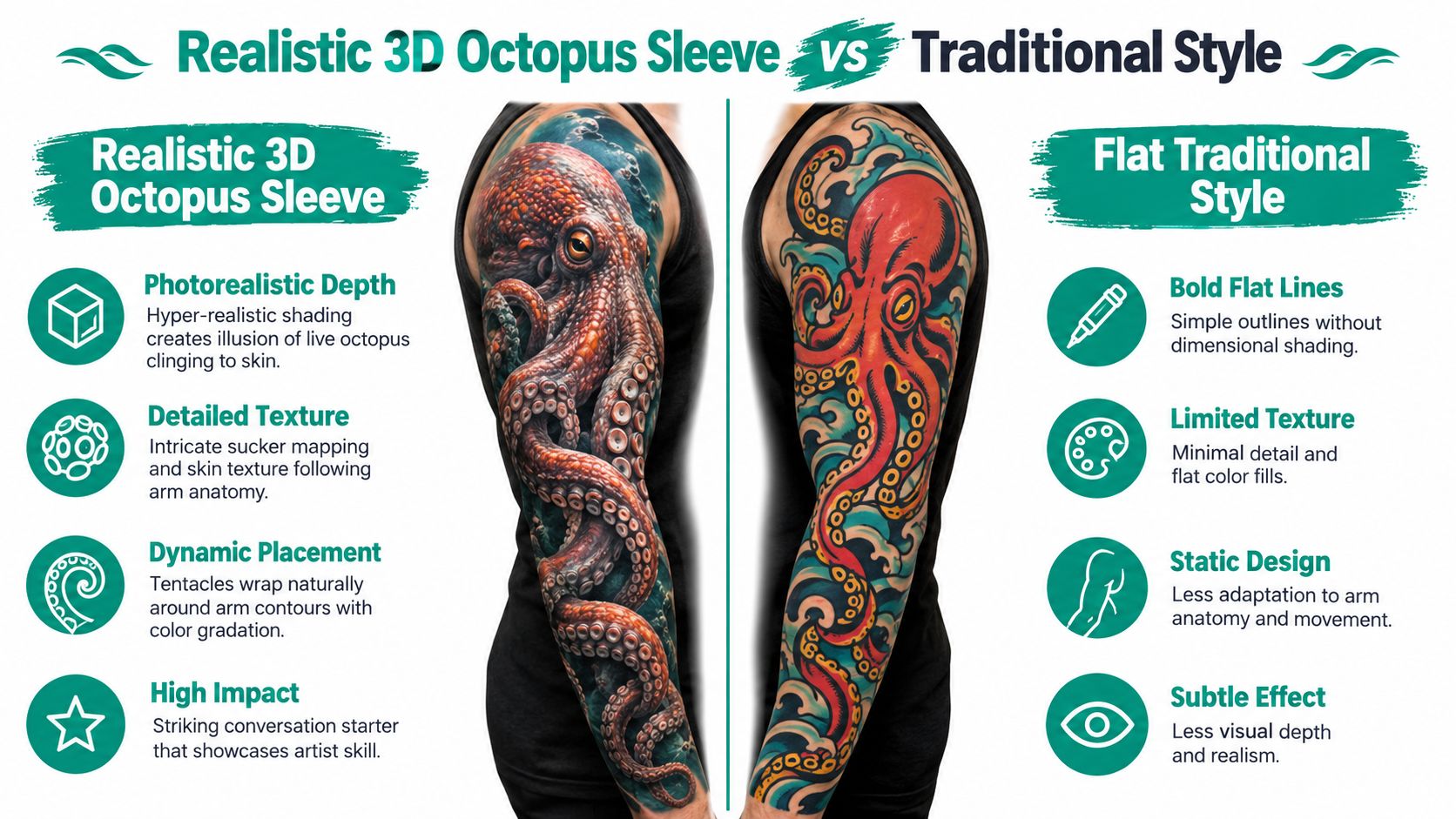
A video reference can also help you study how movement and shading change the impression of a marine sleeve.
2. Japanese Traditional Octopus Sleeve
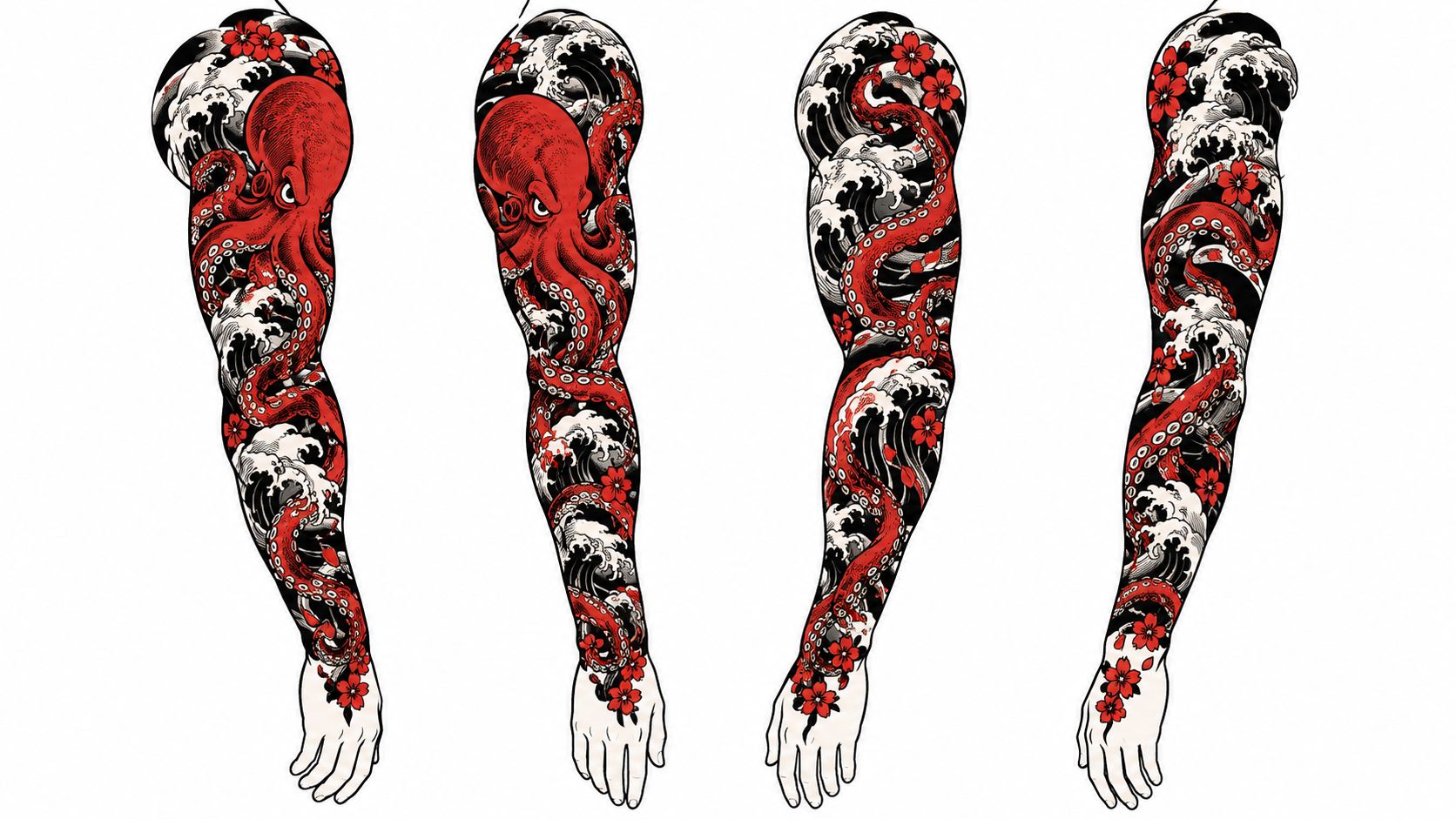
A Japanese-inspired octopus sleeve works best when the tentacles, waves, and background pattern belong to the same visual language. Bold outlines establish the main shapes, while wind bars, water movement, blossoms, and controlled background fills connect separate sections of the arm.
The body can sit high on the shoulder, with the tentacles curling through waves toward the forearm. Another option places the octopus lower on the arm and lets larger waves carry the eye upward. Neither arrangement is automatically better. The right choice depends on whether you want the face and body to be the first thing people notice or whether the sleeve should feel like one continuous marine scene.
Define the cultural direction
The word “Japanese” can mean several different things in a design conversation. If you want an irezumi-inspired result, describe the specific features you want, such as bold contour lines, controlled wave patterns, wind bars, limited background clutter, and a strong body-to-tentacle hierarchy. Avoid asking for a generic “Japanese octopus” without explaining the composition.
TattoosAI can help you compare monochrome and color directions. Try prompts that specify irezumi style, dynamic ocean waves, flowing tentacles, cherry blossoms, cohesive sleeve background, and clear negative space. Generate alternatives where the tentacles turn in different directions. That makes it easier to identify which flow feels natural on the arm.
Artists associated with Japanese sea-creature work, including Horiyoshi III and Gakkin, illustrate how the octopus can become part of a larger narrative rather than a standalone animal. When you consult an artist, discuss the cultural intention as well as the decorative elements. A sleeve that combines waves, nautical symbols, and unrelated marine creatures can quickly become a collage if the artist hasn't established a visual hierarchy.
3. Watercolor Octopus Sleeve
Watercolor octopus sleeves trade hard graphic structure for color movement. Soft washes can make the tentacles appear to dissolve into blue, teal, purple, coral, or jewel-toned splashes, creating an expressive result that feels closer to a painted illustration than a traditional tattoo.
That freedom still needs boundaries. If every tentacle has a different color and every edge dissolves at the same rate, the arm may lose a readable focal point. Keep the head, eyes, or central tentacle group more defined, then allow the surrounding washes to become looser toward the edges.
Use color as the navigation system
A watercolor design needs a deliberate coverage plan. One version might use concentrated color around the shoulder and let lighter splashes travel down the arm. Another might reserve the strongest tones for the forearm, creating a visual destination that differs from the usual shoulder-centered layout.
TattoosAI is useful for testing these choices quickly. Request a watercolor octopus sleeve with diffused edges, painted pigment washes, aquatic blues and purples, selective line definition, and flowing color from shoulder to wrist. Then generate variants with cool blues, warm coral accents, and darker jewel tones. Compare not only the palette but also the amount of skin left open between washes.
A real-world consultation should address durability expectations plainly. Screen-generated color can look smooth and saturated, while tattooed color must be placed in skin and balanced against the surrounding negative space. Bring the strongest concepts to an artist who has a portfolio of watercolor work. Aquil Lopez and Koray Karagozler are useful visual references for discussing how soft color, abstract edges, and recognizable animal anatomy can coexist.
A watercolor sleeve still needs a clear skeleton. Let the octopus remain identifiable before you soften its edges.
The most cohesive supporting elements are usually simple. Small bubbles, loose pigment shapes, coral-like marks, or restrained wave gestures can reinforce the aquatic theme without competing with the animal.
4. Geometric and Minimalist Octopus Sleeve
A geometric octopus reduces the subject to structure. Circles can suggest the head, polygons can define body planes, and clean lines can divide tentacles into controlled paths. The design may remain recognizable through silhouette alone, or it may become more abstract, with the octopus revealed through repeated forms and carefully placed gaps.
This style is especially dependent on anatomy. Straight lines that look balanced on a flat screen can bend awkwardly around the elbow or break when the arm rotates. Ask the artist to test the concept across the shoulder, inner arm, outer forearm, and wrist before deciding how much geometry belongs in each zone.
Decide how recognizable it should be
There's a useful difference between a geometric octopus and an octopus-inspired geometric sleeve. The first keeps the animal's head and tentacle arrangement obvious. The second may use spirals, intersecting polygons, and fragmented lines that communicate motion without showing every biological feature.
Generate both directions with TattoosAI. Request a black-only version, then a version with one restrained accent color. Ask for alternatives showing spread tentacles, curled tentacles, and a centralized body. These comparisons can reveal whether your idea depends on intricate internal detail or a strong outer silhouette.
Supporting elements should earn their space. A compass, mandala, orbit line, or abstract wave can reinforce the geometry, but adding too many symbols weakens the minimalist effect. The artist should also plan how open skin will separate adjacent forms. Negative space isn't leftover room. It's part of the design system, and it helps the sleeve breathe as the arm moves.
For a practical reference point, look at geometric animal work associated with Okan Uckun or Chaim Machlev. Their approaches can help you describe whether you prefer precise symmetry, controlled asymmetry, or a more fluid geometric construction.
5. Dotwork and Stipple Octopus Sleeve
Dotwork gives an octopus sleeve a grainy, tactile surface. Artists build shadow, volume, and texture through the density and spacing of individual marks rather than relying on smooth gradients. Dense stippling can define the body and deepest tentacle folds, while widely spaced dots can preserve highlights and open skin.
This technique changes the pace of the design conversation. You'll need to think about dot density, contrast, and the size of each important feature. Tiny suckers may look compelling in a concept image but become visually crowded if the artist doesn't leave enough separation between them.
Control density across the arm
A strong dotwork sleeve often uses a deliberate rhythm:
- Dense shadows: Place the heaviest dot concentration beneath overlapping tentacles and around the body to create depth.
- Open highlights: Preserve skin breaks on raised surfaces so the octopus doesn't become a uniformly dark mass.
- Simplified distance: Reduce small details in areas that need to read as background or transition.
- Consistent texture: Keep the dot language coherent when adding waves, shells, ornaments, or geometric accents.
Use TattoosAI's dotwork tattoo style guide while refining your prompt. Ask for black-and-grey stippling, varied dot density, textured octopus skin, readable tentacle silhouettes, and controlled negative space. Generate a fine-detail version and a bolder version. The comparison can show whether your preferred look depends on delicacy that may not translate well across a moving arm.
A real-world example might be a grayscale octopus whose head receives the darkest treatment, while the tentacles fade through increasingly open stippling toward the wrist. That arrangement gives the eye a clear anchor and prevents every section from competing equally.
Book an artist with substantial dotwork experience. Review healed examples where possible, ask how they handle large transitions, and discuss whether the design should be completed as a unified project or built in connected sections. The technique rewards patience, but planning matters just as much as precision.
6. Blackwork Bold Octopus Sleeve
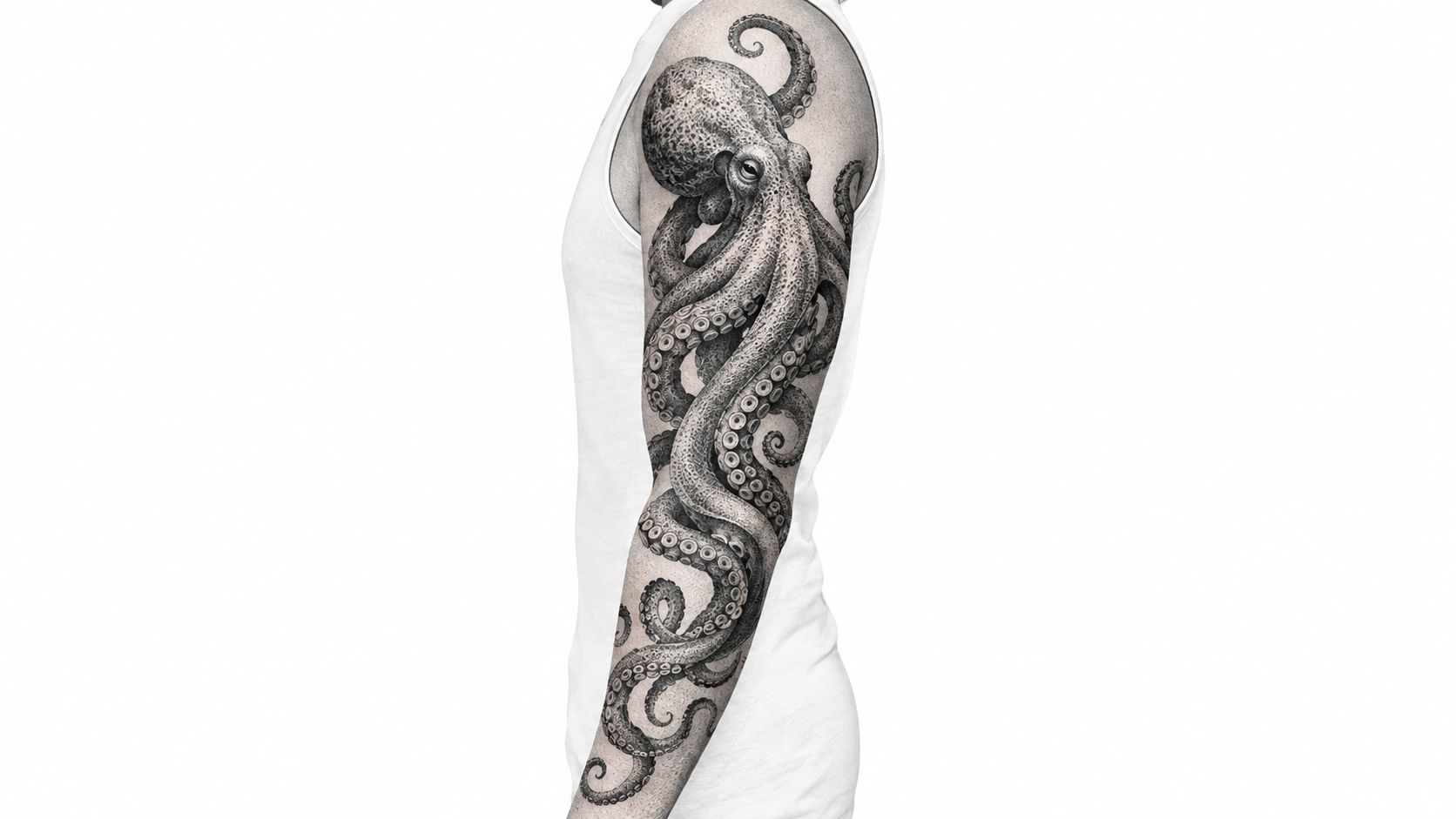
Blackwork makes the octopus graphic, immediate, and difficult to ignore. Heavy outlines, solid fills, and deliberate blocks of black can turn the tentacles into bold bands that wrap around the arm. The result may look ornamental, aggressive, or almost emblematic, depending on how much detail remains inside the shapes.
The central design problem is weight. A fully packed arm can lose visual breathing room, especially when several tentacles overlap near the elbow or inner forearm. Negative space needs to be planned before the black ink is added, not improvised afterward.
Balance mass with open skin
Use TattoosAI's blackwork tattoo style resource to develop prompts around solid black tentacle shapes, confident linework, ornamental accents, controlled negative space, and a readable shoulder-to-wrist silhouette. Generate versions with different tentacle thicknesses and flow patterns. Then test whether chains, geometric marks, shells, or decorative frames support the octopus or distract from it.
A useful scenario is a sleeve with one dominant tentacle crossing the outer forearm, two darker forms wrapping the upper arm, and open skin separating each major shape. From across a room, the silhouette reads first. Up close, smaller ornaments provide the second layer of interest.
Blackwork isn't simply “more ink.” It's a composition of dark mass and intentional light.
Consider your arm's proportions when reviewing concepts. Thick tentacles may look commanding on a broad upper arm but overwhelm a narrower wrist. A qualified artist can modify the width, taper, and placement while preserving the style. Discuss how the tattoo will connect around the elbow, where folds and movement can interrupt lines and large fills.
Blackwork references from artists such as Adam McDade or Fredão Oliveira can help you explain whether you want a dense, near-solid approach or a lighter design that uses black accents as punctuation. The distinction affects how dramatic the sleeve feels and how much skin remains visible.
7. Neo-Traditional Octopus Sleeve
Neo-traditional octopus sleeves combine bold outlines with richer shading, layered colors, and more dimensional modeling than a strictly traditional design. The octopus remains legible because the contour is strong, but highlights, gradients, and selective texture can make the body feel more rounded and expressive.
This style gives you room to create a character. A calm octopus with jewel-toned skin and restrained waves will feel different from a dramatic creature surrounded by coral, daggers, chains, or ornamental framing. Supporting imagery should reinforce the mood, not fill every available area.
Choose the hierarchy before the palette
Start with three decisions. Where does the octopus face? Which tentacle forms the strongest path through the arm? Which supporting element carries the story? Once those choices are clear, color becomes a tool for emphasis rather than decoration.
TattoosAI can generate neo-traditional or new-school directions with prompts such as bold black outlines, dimensional octopus, layered jewel tones, selective highlights, decorative ocean elements, and cohesive full-arm flow. Request versions with bold color, subdued color, and a mostly black design with isolated accents. Compare the placement of highlights as carefully as the colors themselves. A bright accent near the face can establish the focal point, while repeated bright accents across every tentacle flatten the hierarchy.
A practical example might place the octopus on the shoulder, use dark blue and burgundy across the body, and reserve pale highlights for the eyes and raised suckers. Waves can frame the lower arm, while a small ornamental element closes the composition near the wrist.
Look for an artist whose portfolio consistently shows neo-traditional line control and color packing. Names such as Megan Massacre and Shaun Touhey can serve as reference points when you're explaining the balance you want between classic graphic clarity and modern depth.
7-Style Octopus Sleeve Comparison
| Style | Implementation Complexity 🔄 | Resource Requirements ⚡ | Expected Outcomes 📊⭐ | Ideal Use Cases 💡 | Key Advantages ⭐ |
|---|---|---|---|---|---|
| Realistic 3D Octopus Sleeve | Very high, advanced 3D shading, anatomical wrap, multi-session | Very high, expert artist, long sessions (6–8+ hrs), higher cost | Photorealistic 3D illusion with strong visual impact | Statement sleeves, collectors, photorealism seekers | ⭐ Hyper-realism; customizable backgrounds; ages well with quality linework |
| Japanese Traditional Octopus (Irezumi) | High, requires mastery of traditional techniques and composition | High, specialist artist, multiple sessions, mainly black ink | Bold, balanced full-sleeve with cultural symbolism and longevity | Cultural pieces, cohesive full-sleeves, traditional enthusiasts | ⭐ Durable bold lines; deep symbolism; distinctive aesthetic |
| Watercolor Octopus Sleeve | Medium–high, skillful color blending, soft edges require control | Medium, fewer sessions than realism but skilled artist; frequent touch-ups | Painterly, vibrant, soft-edged sleeve with artistic expression | Creative/first-time seekers, color-focused designs, art-forward clients | ⭐ Unique painterly look; highly customizable color palettes |
| Geometric & Minimalist Octopus Sleeve | Medium, precision and layout matter but simpler execution | Low–Medium, shorter sessions (2–3 hrs), lower cost | Clean, modern, durable sleeve emphasizing form over detail | Design-conscious clients, budget-limited, minimalists | ⭐ Quick sessions; strong longevity; scalable and versatile |
| Dotwork & Stipple Octopus Sleeve | Very high, meticulous stippling, extreme patience and precision | Very high, long sessions (8–12+ hrs), specialized artist, higher cost | Intricate grayscale texture and depth with meditative detail | Technical enthusiasts, high-detail grayscale collectors | ⭐ Exceptional texture; technical showcase; excellent aging |
| Blackwork Bold Octopus Sleeve | Medium–high, requires balance of large solid areas and negative space | Medium, substantial ink use but fewer sessions than stipple/realism | Dramatic, high-contrast sleeve with strong visual dominance | Bold statement pieces, durability-focused clients | ⭐ Maximum contrast and longevity; low touch-up needs |
| Neo-Traditional Octopus Sleeve | High, blends traditional outlines with modern shading and color | High, versatile artist, multiple sessions, color and shading work | Bold classic base with modern depth and vibrant color | Those wanting classic appeal with contemporary flair | ⭐ Balanced longevity and color vibrancy; broadly appealing |
Turn a Favorite Concept Into a Tattoo Brief
Choosing among octopus sleeve tattoos becomes easier when you compare systems instead of isolated pictures. Start with the style. Realism prioritizes texture and depth, Japanese-inspired work prioritizes a unified visual tradition and flowing background, watercolor prioritizes pigment movement, geometric work prioritizes structure, dotwork prioritizes texture through density, blackwork prioritizes dark mass, and neo-traditional work balances bold contours with layered color.
Next, map the tentacle flow. Decide whether the body belongs on the shoulder, upper arm, or forearm. Identify the tentacle that should lead the eye, then mark where other tentacles disappear, overlap, or leave open skin. A full-arm composition should work from more than one viewing angle, because the arm rotates and bends throughout the day.
Write the brief in practical language
Your artist needs more than a style label. Include:
- Focal placement: State where the head and body should sit.
- Movement: Describe whether tentacles should spiral, reach, curl, or wrap horizontally.
- Supporting elements: List waves, blossoms, coral, ornaments, chains, or geometric forms that belong.
- Ink strategy: Specify full color, limited accents, black-and-grey, or predominantly black ink.
- Negative space: Explain where you want open skin to separate major shapes.
- Mood: Use words such as calm, mysterious, protective, energetic, or aggressive.
The octopus has broad symbolic associations with intelligence, adaptability, protection, mystery, resilience, and transformation (modern octopus tattoo meanings). You don't need to force every meaning into the sleeve. Choose the idea that matters most and let the composition express it through posture, motion, and surrounding imagery.
Use TattoosAI to generate several alternatives, then refine the prompts instead of accepting the first attractive result. Compare tentacle-only compositions with full-bodied designs. A tentacle-only sleeve may suit someone who wants more open skin and abstract movement, while a full-bodied octopus creates a clearer focal point and stronger character.
Bring the best references, prompt wording, and rejected alternatives to a qualified tattooist. The artist can adjust scale, line weight, transitions, and placement for your anatomy, while also explaining what will remain feasible over a long project. Large octopus compositions are commonly planned across multiple sessions, and Japanese-style examples at sleeve scale are described as requiring four to eight sessions (octopus sleeve planning guidance). Treat that timeline as a planning reference, not a fixed promise. Your artist's technique, schedule, design complexity, and skin will shape the actual process.
Aftercare deserves the same attention as design. Clinical tattoo-healing research reported that redness and edema were absent by day 14 for all subjects in the study, while crusts had fallen to 68% absence by that point, and artists and clients rated skin repair and aesthetic outcomes very good to excellent (clinical tattoo aftercare research). Follow your artist's instructions, avoid picking at healing skin, and ask questions if the area becomes unusually painful or changes in a concerning way.
The final decision should connect visual preference with artist fit. Review healed work, confirm that the artist understands your cultural and stylistic references, and ask for anatomy-aware adjustments before the needle starts. A generated image can open the conversation, but the tattooist should approve the final composition.
Use TattoosAI to explore octopus sleeve concepts across realism, Japanese, watercolor, geometric, dotwork, blackwork, and neo-traditional styles, then bring your strongest prompts and references to your tattooist. Visit TattoosAI to generate multiple directions and turn your preferred idea into a more focused studio consultation.