TattoosAI
You know you want a dragon. What you don't have yet is a design, and the references you've saved don't agree with each other. One is a black-and-grey coil down a forearm. One is a red imperial dragon chasing a pearl. One is a single eye with a slit pupil and a heavy brow ridge. They're all dragons, and none of them is the same tattoo.
A lifelike dragon tattoo that works on your body depends on five decisions made before a needle touches skin: pose, placement, scale texture, colour approach, and the story the animal is telling. Get those wrong and no amount of rendering skill rescues the piece. Get them right and a simpler design will look more convincing healed than a hyper-detailed one that softens into grey mush in two years.
Treat each idea below as a design brief. For every concept you get the details worth specifying, the questions to put to your artist, and an honest read on how it ages. Use a generated concept as a reference to argue with, not a stencil to copy. Your artist still has to fit it to a curved, moving, sun-exposed surface.
Table of Contents
- 1. Realistic Coiled Dragon Sleeve
- 2. Realistic Chinese Imperial Dragon (Long)
- 3. Realistic Japanese Irezumi Dragon
- 4. Realistic Dragon Eye Portrait
- 5. Realistic Dragon Wrapping a Sword or Dagger
- 6. Realistic Flying Dragon Back Piece
- 7. Realistic Dragon Skull or Skeletal Dragon
- 8. Realistic Dragon with Floral Accents
- How the 8 Realistic Dragon Tattoo Concepts Compare by Placement and Best Use
- Turn Your Favourite Dragon Into a Brief Your Artist Can Use
1. Realistic Coiled Dragon Sleeve
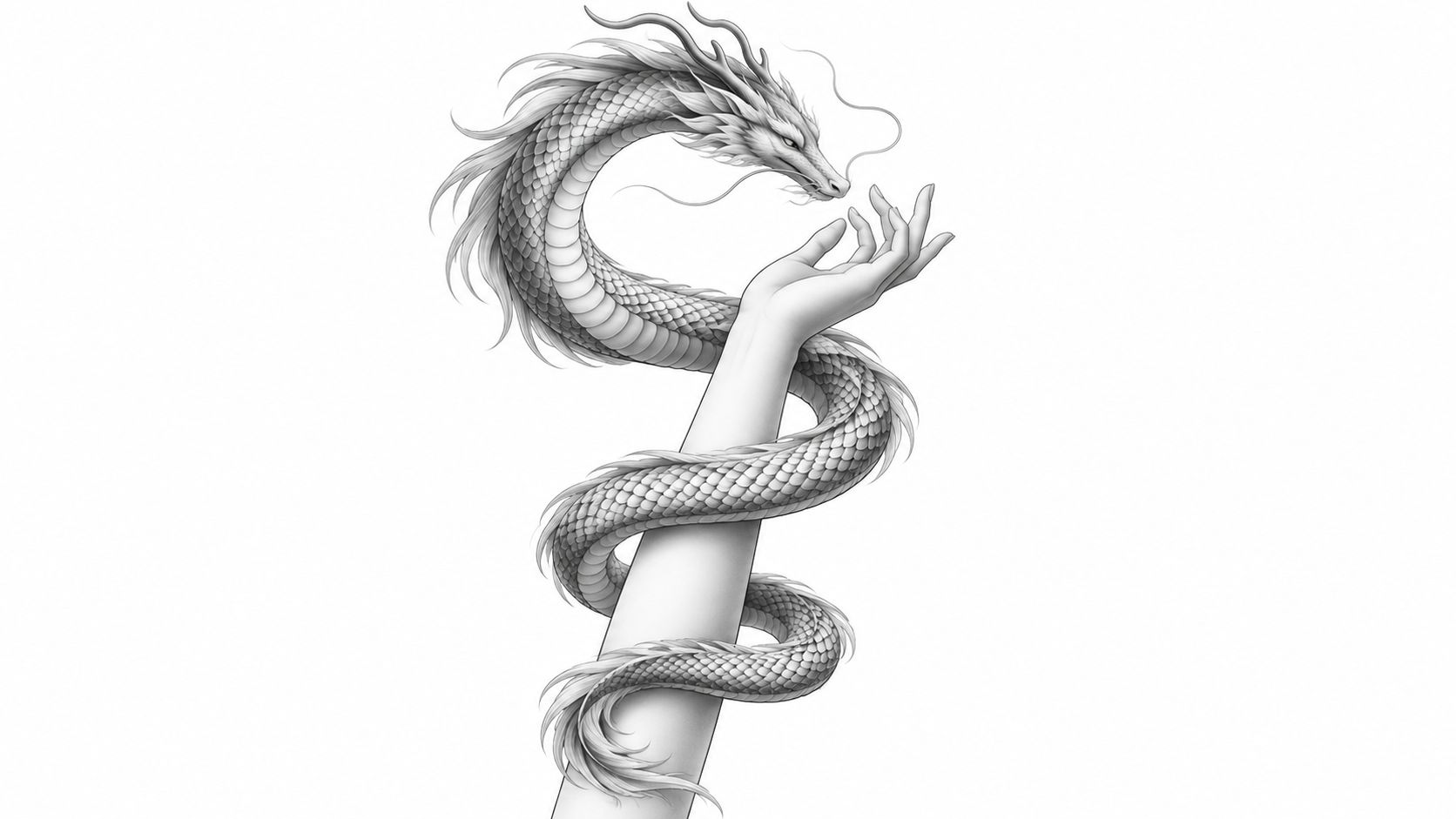
The arm suits a dragon better than any other placement, because the limb's curve does work a flat drawing can't. A coiled sleeve spirals the body around the forearm or upper arm, with the head resting near the shoulder, wrist, or the back of the hand. The rendering lives in muscle definition, individual scales, and light falloff, so the animal reads as part of the limb rather than a decal on it.
Demand for this kind of work isn't niche. A 2025 statistical bulletin citing cross-country observations reported tattoo prevalence of 32.0% in the United States and 26.0% in the United Kingdom (2025 tattoo prevalence bulletin). Plenty of those people now know what a healed tattoo looks like in daylight, which is exactly why flat, over-detailed concepts get sent back at the consultation.
Coil direction is the brief
Decide clockwise or counter-clockwise before you generate anything, then fix where the head sits and what it's looking toward. A head that lands on the inner wrist vanishes when your arms hang at your sides. A head that finishes on the outer forearm stays visible in short sleeves.
A sleeve at this scale is a commitment. Dragon Tattoo Generator IQ's sleeve guide estimated in 2025 that a high-quality dragon sleeve takes 15 to 35 hours of tattooing and costs roughly $2,000 to $8,000 or more, so settle the coil layout before you book, not during the third session.
Practical rule: Ask for a stencil test on your own arm at the intended length before you commit. Two extra inches of coil changes where the head lands, and that changes the whole composition.
2. Realistic Chinese Imperial Dragon (Long)
The Long works best as a design brief, not a generic dragon picture. A Chinese dragon has a long serpentine body on four legs, flowing whiskers, a mane, horns, and often a pearl or flame just out of reach. Realistic versions keep that anatomy and apply photographic shading to the scales, horns, and mane. Treat it as a back or chest composition because the body needs length to travel through clouds without feeling cramped.
Read the motif before you book
The pearl, the cloud formations, and the claw count all carry meaning inside the tradition, so decide them deliberately rather than letting a generator fill the space. A dragon chasing a pearl reads as pursuit and fortune. A dragon emerging from waves reads as water power. Same animal, different story, different brief. Chinese dragon tattoo symbolism explains the pearl and cloud vocabulary in plain terms. Use that vocabulary to keep the concept focused.
A useful generator prompt should name the rendering, the anatomy, and the focal point together. Generic “Chinese dragon” pulls both traditional and realistic language, which leaves too many decisions to the artist at the consultation.
- Specify the rendering: say “photorealistic scales, natural anatomy” or “traditional rendering, bold outline” in the prompt.
- Bring the mane and whisker reference: these are the details that make the dragon read as Chinese rather than a winged Western beast.
- Fix the pearl position: in front of the head, under a claw, or held in the mouth. Each one changes the composition.
- Set the body length: decide whether the coil finishes across the shoulder blade, chest, ribs, or hip before the stencil is drawn.
Ask the artist how the design will age at the scale you choose. Fine scale texture and whisker work can hold interest, but tight details may blur if they sit too close together. A long body with clear directional flow gives the artist more room to keep the main forms readable.
Motif research also rewards the same care people give pricing zodiac charms for resale before buying a charm. A symbol you wear for thirty years deserves a brief with the story, placement, and details settled.
A worked example: say you want a half back piece. Put the head at the top of the shoulder blade, run the body diagonally to the opposite hip, and let the pearl sit near the spine. That gives the artist a clear line of travel and a single focal point.
3. Realistic Japanese Irezumi Dragon
Dragon imagery has a long paper trail in Japanese art. Woodblock-print series of Water Margin heroes often showed tattooed bodies decorated with dragons, koi, and peonies, so the tattoo tradition drew on a visual language that was already centuries old. It never invented the dragon. It inherited one.
Where realism and tradition collide
An irezumi dragon has bold outer outlines, wind bars, stylised waves, and packed colour. A realistic interpretation keeps that composition and swaps in natural anatomy and scale texture. The result can be excellent, but only if you decide which half wins.
Ask your artist one question early: how do you handle scales inside a traditional outline? Some artists soften the outline and lose the irezumi feel. Others keep the line and flatten the realism. Neither is wrong. You just need to know which one you're buying.
The aging trade-off is real here. Packed colour inside a heavy outline holds its shape for decades because the line does the structural work. Soft realistic shading without that outline relies on contrast, and contrast fades first. If you want the piece readable in twenty years, keep more of the traditional skeleton than your eye initially wants.
Specify these in the brief before you generate anything:
- Wave and wind motifs: these are what make the design read as Japanese rather than a dragon floating on blank skin. Say how many bars and where they break.
- Coil direction and length: irezumi compositions follow the body's long lines. State whether the dragon travels up the leg or wraps it, and how much of the calf or thigh it covers.
- Palette: traditional reds, blacks, and indigos behave differently from a muted black-and-grey approach, and colour packing affects session count. Name the palette in the prompt.
- The outline itself: putting "bold outline, traditional composition, realistic interior shading" into the prompt shows you the middle ground before you commit. Treat the output as a reference for your artist to adapt to your body and skin, not a finished stencil.
A dragon curling around the calf is the cheapest way to test this style. It's a contained piece, the leg takes the curve well, and you learn how your artist handles waves before commissioning a full back.
4. Realistic Dragon Eye Portrait
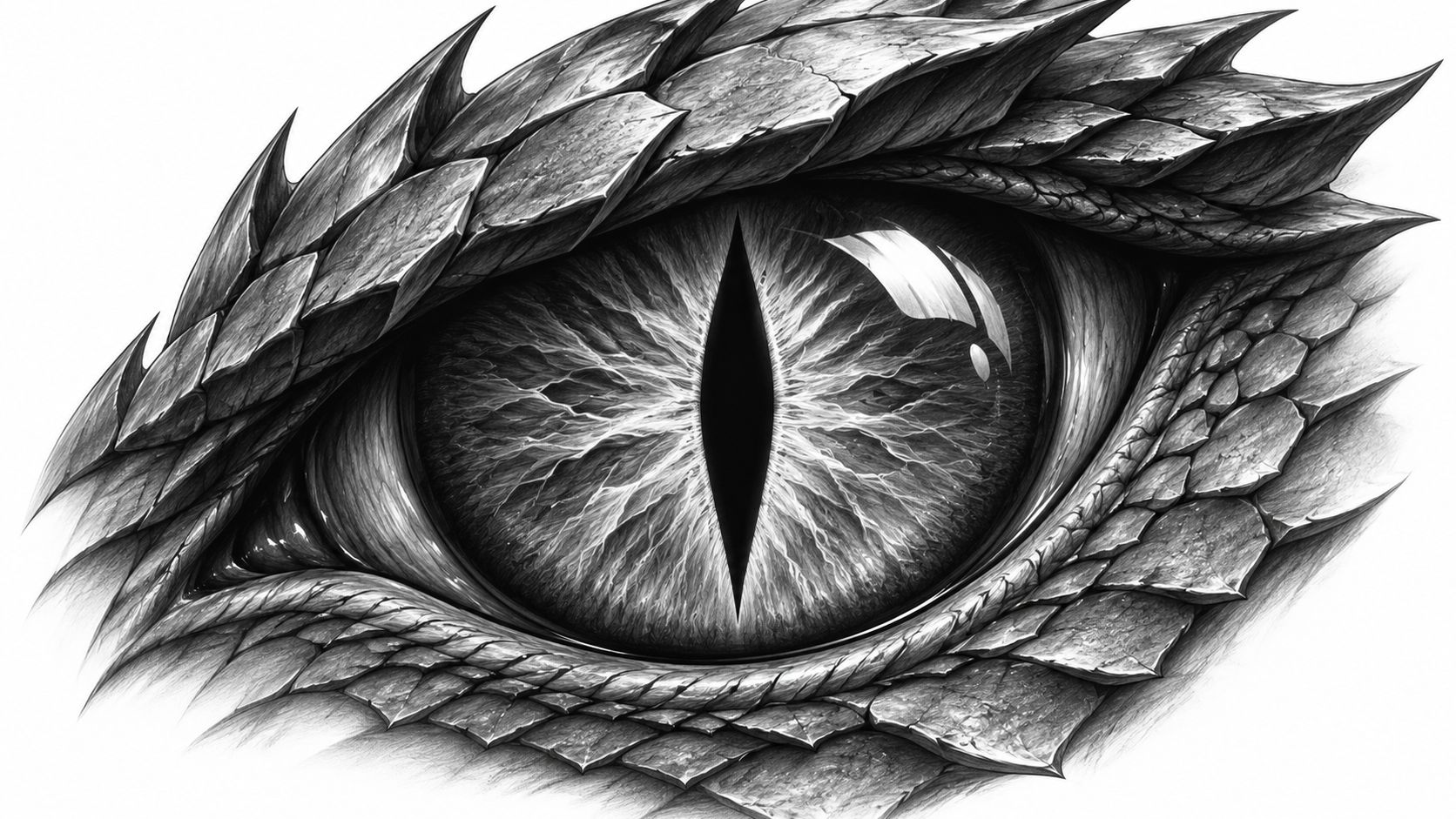
A dragon eye is the smallest honest test of a realism artist. Slit pupil, textured brow ridge, a few surrounding scales, and nothing else. At three to five inches it reads clearly across a room, and it doesn't need a decade of sessions to finish.
Build it on three values
Realism survives on structure, not surface detail. Black-and-grey work uses carbon-black pigments known for intense opacity, and tattoo particles stay concentrated and relatively stable in the dermis, which is what holds long-term contrast, as described in research on tattoo pigment behaviour in skin. Plan deep blacks for the pupil and socket, midtones for the brow and scale volume, and deliberate skin breaks for the highlight on the eye itself.
The highlight is the load-bearing detail. If it blurs, the eye goes flat.
"realistic dragon, three-quarter pose, single directional light, black-and-gray foundation, high-contrast head, controlled scale detail, uncluttered negative space, tattoo-readable composition"
This prompt structure works for an eye as well as a full head, and it asks for light direction, a focal area, and restraint. A small piece has less room for error than a sleeve, so the light source matters more here, not less. One direction, one highlight, everything else supporting it.
Specify these before you sit down:
- Pupil shape: slit for a reptile read, round for something older and stranger.
- Brow texture: smooth plate or cracked scale ridge. This decides how the piece ages, because a cracked ridge is built from fine lines that soften first.
- Eye colour: amber and gold hold up well. Pale blues and greens soften fastest.
- Placement length: a flat area like the outer forearm or calf keeps the iris undistorted. Wrapping the eye around a curve bends the pupil.
Ask to see healed eye work, not fresh. A fresh eye photograph tells you almost nothing about how the highlight and the iris will sit after a year. Treat whatever reference you bring as a starting point for your artist, not a finished stencil. They still need to adapt it to your skin, your placement, and how fine detail ages on you.
5. Realistic Dragon Wrapping a Sword or Dagger
A dragon around a blade gives the design a spine. The weapon supplies a straight vertical axis and a narrative, and the dragon supplies movement around it. It's the strongest option for anyone who wants a dragon that means something specific rather than a large animal on a limb.
Decide the weapon first
Sword, dagger, or spear changes everything downstream. A longsword needs a forearm-to-shoulder run or a calf. A dagger fits a forearm. A spear wants a vertical placement where the shaft can disappear off the edge of the design instead of stopping awkwardly in the middle of the skin.
Then specify the hilt: cross guard or basket, plain or engraved, wrapped grip. The hilt is where the eye lands second, after the dragon's head, so a vague hilt makes the whole piece look unfinished.
- Blade length: measure the placement and give the artist a number. A blade that ends two inches above the wrist looks accidental.
- Coil tension: does the dragon grip the blade tight, or does it hover with claws just touching? Tight reads as protection. Loose reads as threat.
- Which way the head faces: toward the point of the blade is the classic choice, and it gives the composition a direction.
A worked example: a dagger down the inner forearm with the point toward the wrist, the dragon's head near the elbow, and the tail wrapping the hilt twice. It reads top to bottom, it fits a narrow space, and it survives being covered by a sleeve at work.
Pain is a factor here. Inner forearm work is manageable, but the wrist end of the blade is where clients start bargaining with themselves.
6. Realistic Flying Dragon Back Piece
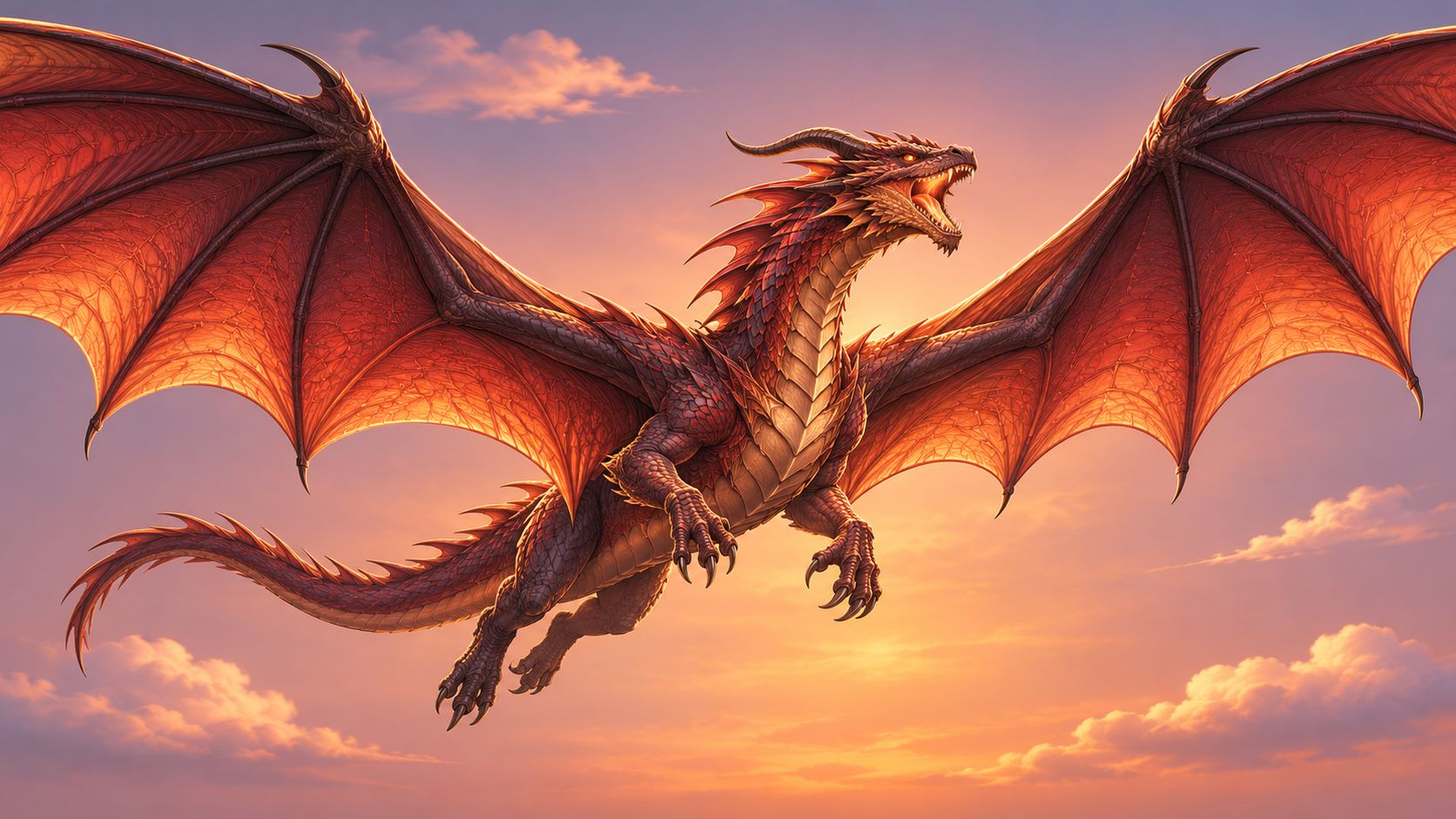
The back is the only surface wide enough for wings. A flying dragon across the shoulder blades, head rising toward the neck, uses the body's natural width to sell scale. The rendering work goes into wing membrane texture, chest and shoulder musculature, and dramatic single-source lighting.
Design for the healed version
Flat concepts lie about backs. A design that looks magnificent on screen can turn muddy once it wraps over the shoulder blades and the spine. That's why the concept needs to be planned as panels that read correctly from more than one angle, not as a single flat image.
Dermatology sources list inflammatory, allergic, photo-aggravated, granulomatous, and lichenoid reactions to tattoo pigment, as set out in DermNet's overview of tattoo-associated skin reactions. Large coverage means more pigment over more skin. Mention any history of skin sensitivity or metal allergy at the consultation, before the stencil goes on.
- Wing span against shoulder width: measure both. Wings that run past the deltoid look clipped rather than powerful.
- Spine proximity: ask directly how close the artist will work to the spine and what that feels like at hour four.
- Body-type-matched reference: generate the concept on a similar build, or expect the artist to redraw the wing angles.
More detail is not more realistic. Controlled simplification is what makes a healed dragon convincing.
For broader composition options before you commit to a back piece, browse dragon tattoo design directions and note which poses hold up at full width.
7. Realistic Dragon Skull or Skeletal Dragon
A dragon skull is realism with the soft tissue removed, which is precisely why it works at smaller sizes. Bone has hard edges, deep sockets, and clear silhouette. Cracks and weathering give the artist texture to shade instead of hundreds of tiny scales competing for attention.
Decide skull or skeleton
A skull alone is a compact piece that fits a forearm, a knee, or the top of the shoulder. A partial skeleton wrapped around a central motif is a chest or rib design and needs far more planning, because ribs curve hard and the bones have to follow the body, not a flat drawing.
Specify the bone condition in your prompt. Fresh bone is pale and smooth. Weathered bone is stained, pitted, and cracked. Fossilised bone reads older and darker. Each one changes the value structure and how much black the artist needs.
- Tooth detail: individual teeth or a fused jaw line. Individual teeth hold detail at four inches; fused reads better at two.
- Organic balance: vines, smoke, or dried branches stop the design reading as purely grim.
- Value contrast: without a mid-tone between bone and background, the skull flattens into a pale blob.
Cost is worth pinning down early. Peachy Tattoos' dragon tattoo cost guide priced a Western fantasy dragon tattoo in realism at approximately $1,200 to $4,500 in 2026, which shows how wide the range runs once size and detail change. A skull piece sits at the lower end. A full skeletal wrap does not.
8. Realistic Dragon with Floral Accents
You sit down with a dragon tangled in flowers, and the artist asks which way the body coils, what the pupil looks like, how fine the scales are, and how far the piece runs. Vague answers turn the flowers into filler.
Flowers fix a hard-edge problem. A realistic dragon is scales, claws, and ridges. Across a forearm or upper arm that texture gets monotonous. One bloom breaks it, adds colour, and gives the eye a soft stop.
Choose one dominant flower
Two floral types in one design is clutter. Peony gives a dense, rounded mass against scales. Cherry blossom stays light and scattered, which suits a shoulder or upper arm. Lotus keeps a water connection visible if that is part of the idea.
Dragon tattoos remain a popular choice for flower pairings. One flower uses that pairing. A second species usually just crowds the scales.
Coil direction comes first: clockwise or counterclockwise, and whether the body wraps the bloom or passes behind it. Pupil shape is next. Slit, round, or nearly closed, the eye should still be the first thing someone finds. Scale texture needs a plan too. Fine scales near the head, larger and simpler where the body meets petals, so the two surfaces do not compete. Placement length decides the rest. Outer forearm, upper arm, or a short panel on the back. A short run holds one bloom. A longer run can carry a stem and a few smaller blossoms of the same flower.
Ask whether the stem follows the muscle or lies flat. Ask where the tail exits so it does not crash into the petals. Ask which lines stay black so the flower still reads after the colour softens.
Colour that survives
Floral colour is where these designs age fastest. Human in-vivo imaging has identified tattoo pigment in both the epidermis and the dermis, including in tattoos more than three years old. Research on tattoo pigment aging reports that sunlight exposure can cause pigment particles to de-agglomerate and release soluble compounds. Forearms and lower legs take that sun, so keep the palette conservative there.
Deep reds and magentas hold longer than pale pinks and yellows. Keep the flower subordinate to the head. Intentional skin breaks beat white ink for highlights. White fades. A gap does not.
A worked example: a dragon coiled around a single peony on the outer forearm, black and grey through the body, colour confined to the bloom. It costs less than a full-colour piece, it heals cleaner, and the soft petal still contrasts with hard scale.
How the 8 Realistic Dragon Tattoo Concepts Compare by Placement and Best Use
| Item | Placement | Best For |
|---|---|---|
| Realistic Coiled Dragon Sleeve | Upper arm to forearm, full sleeve | Clients seeking a dramatic, long-term sleeve project |
| Realistic Chinese Imperial Dragon (Long) | Back, chest, or full sleeve | Clients drawn to cultural symbolism and large-scale pieces |
| Realistic Japanese Irezumi Dragon | Back, chest, or leg | Clients who want bold, traditional-inspired art with realistic detail |
| Realistic Dragon Eye Portrait | Forearm, shoulder, calf, or rib | Clients who want a single striking focal point |
| Realistic Dragon Wrapping a Sword or Dagger | Forearm, upper arm, or calf | Clients who want a symbolic, narrative design |
| Realistic Flying Dragon Back Piece | Full back, from shoulder blades to lower back | Clients who want a large, dramatic statement piece |
| Realistic Dragon Skull or Skeletal Dragon | Forearm, calf, or chest | Clients who prefer dark, mythic aesthetics |
| Realistic Dragon with Floral Accents | Forearm, upper arm, or back | Clients who want colour and symbolic balance |
Turn Your Favourite Dragon Into a Brief Your Artist Can Use
Pick two or three concepts from this list that match your placement, your tolerance for pain, and the time you can realistically commit. A coiled sleeve and a dragon eye are both realistic dragon tattoos. One is fifteen to thirty-five hours. The other is an afternoon. Being honest about that gap before you book saves everyone a difficult conversation.
Then write the brief. Name the pose, the coil direction, the scale texture, the light direction, the colour approach, and any symbolic elements you want carried. Generate variations until one feels right, and keep the ones you rejected. Your artist learns as much from what you dislike as from what you chose.
A generated concept is a reference, not a stencil. The artist's job is adapting it to your body, your skin, and how the design will age.
On the day, arrive with questions rather than instructions. Ask how the artist plans to simplify the concept for the size you want. Ask what happens to the finest details in five years. Ask whether the placement will distort the face when you move. Ask about pigment choices if you have any history of skin reactions. A good artist will redraw parts of your reference, and that's the sign you picked the right one.
If you're using a concept generator to explore options, TattoosAI is one relevant place to start: describe the dragon, choose a lifelike style, and compare several layouts before you pay a deposit. The output is a starting point for the studio conversation, not a finished design.
Realism is a promise about how something looks after it heals, not how it looks on a screen. Build the brief around structure, keep the detail honest for the size, and the dragon will still read clearly in ten years.
Ready to stop scrolling reference folders and start with a design that's actually yours? TattoosAI works in three steps: you describe the dragon, choose a style such as Realistic or Japanese, and get multiple original concepts generated for your request. You can explore 26,000 tattoo ideas, refine the pose and colour, and take the strongest reference to a tattooist you trust, who will adapt it to your body and how it will age. Start your realistic dragon concept at TattoosAI and walk into the studio with a brief instead of a mood board.