TattoosAI
You're scrolling past a glowing, translucent jellyfish tattoo, then zooming in to work out whether that luminous bell could actually look that good on your skin. The image is convincing. What's harder to judge is whether the pale highlights, delicate tentacles, and dark background will still make sense after healing.
A realistic jellyfish tattoo needs more than a beautiful reference. Your tattooist needs a readable silhouette, enough room for the internal shading, and a composition that fits your body rather than a rectangular screen.
The strongest approach is to choose a clear visual priority: a glowing bell, recognizable species anatomy, dramatic tentacle movement, or an ocean setting. Then brief the palette, placement, scale, and details you're willing to simplify. These designs give you practical starting points, including prompt-ready language you can adapt for an artist consultation or an AI design tool.
Table of Contents
- 1. Bioluminescent Jellyfish Bell in Realistic Color
- 2. Moon Jellyfish (Aurelia aurita) Grayscale Realism
- 3. Lion's Mane Jellyfish (Cyanea capillata) Sleeve Design
- 4. Jellyfish with Ocean Wave Backdrop
- 5. Jellyfish Combined with Floral Elements
- 6. Pacific Sea Nettle (Chrysaora fuscescens) Color Realism
- 7. Jellyfish Tentacles Wrapping a Limb
- Realistic Jellyfish Tattoo Styles at a Glance
- Turn Inspiration Into Ink, Your Next Step
1. Bioluminescent Jellyfish Bell in Realistic Color
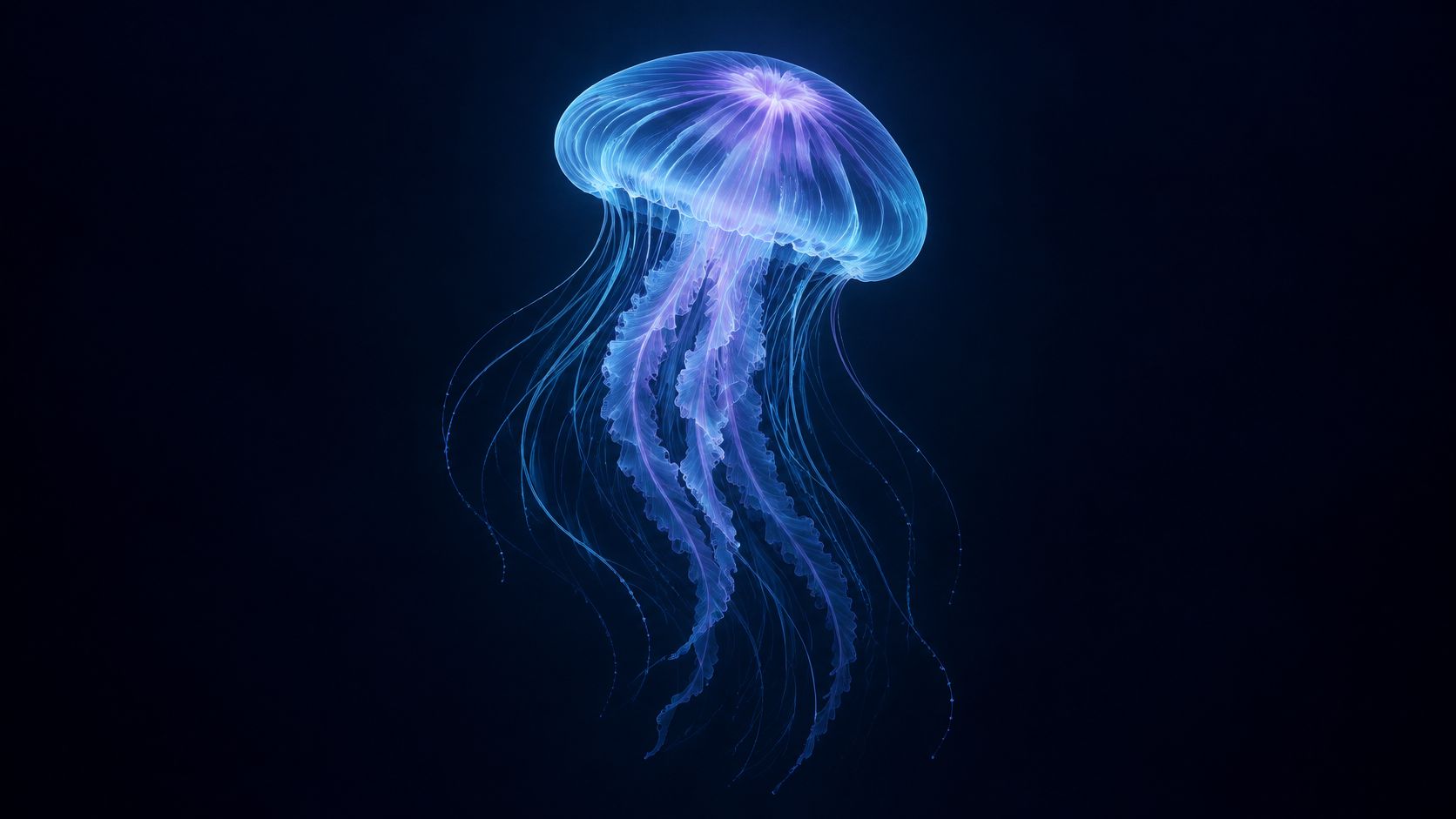
Glow is a contrast decision, not a special ink effect. A convincing piece uses a restrained bright area against deeper surrounding values, with skin breaks helping the bell appear translucent. Cover everything in equally bright cyan and you lose the illusion of light coming from within.
The Smithsonian's jellyfish guide describes light production in some species and distinguishes the bell, oral arms, and tentacles. Keep those structures separate in the artwork; otherwise, the result can resemble a glowing mushroom with strings attached.
Brief the light before the color
- Palette: Use cyan and blue for the luminous focal point, with violet in the shadows. Treat pink as an artistic interpretation unless your species reference supports it.
- Placement: An outer upper arm or calf gives the artist room for a rounded bell and a trailing composition. Neither placement guarantees better pigment retention.
- Sizing: Make the bell large enough to contain distinct shadow, midtone, and untouched-skin areas. If those zones collapse in the stencil, enlarge or simplify it.
For a calf piece, place the brightest rim toward the outside and let a dark water wash sit behind only part of the bell. A solid black rectangle around the entire animal can make the composition unnecessarily heavy.
Prompt-ready brief: Create a realistic translucent jellyfish for the outer calf, cyan bell-edge highlights, violet internal shading, selective dark ocean background, distinct oral arms, and separated tapering tentacles. Preserve open skin instead of covering every surface with glow.
2. Moon Jellyfish (Aurelia aurita) Grayscale Realism
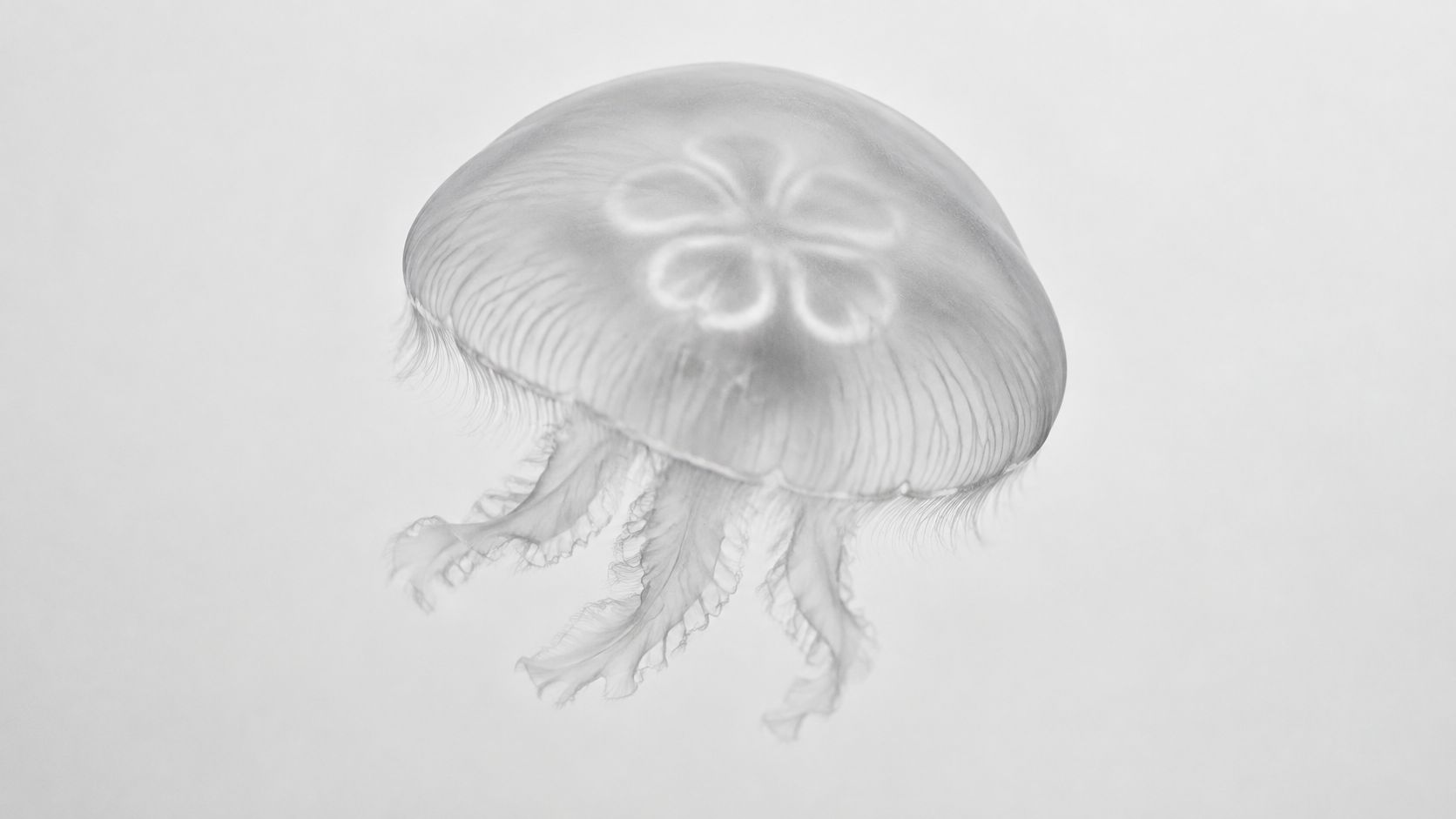
A moon jelly works when you want realism without a dense, dramatic background. For an inner-forearm design, a softly shaded bell with readable internal shapes can look deliberate and quiet rather than unfinished.
The difficulty is making pale anatomy readable without outlining everything. Use a clear photographic reference for Aurelia aurita, then ask your artist which internal shapes can survive at the proposed scale. The short marginal tentacles shouldn't become an exaggerated curtain because a generated image adds them.
Compare other realistic tattoo designs for their use of contrast, not just their apparent detail. A strong reference should explain the form even when you stop zooming in.
Practical rule: If the bell's identifying structures disappear when the concept is viewed at actual tattoo size, the design needs more room or fewer details.
Keep the brief light, not faint
Palette and placement: Ask for black-and-gray shading with reserved skin highlights on the inner forearm. A rib placement is possible, but the composition needs checking against the torso's curve rather than copying a flat layout.
Sizing: Let the internal bell pattern determine the minimum workable size. Don't force it into a tiny wrist gap and expect the same information.
Prompt-ready brief: Anatomically referenced moon jellyfish, Aurelia aurita, black-and-gray realism, translucent dome, visible internal structures, short delicate marginal tentacles, restrained contrast, no heavy enclosing outline, vertical inner-forearm composition.
3. Lion's Mane Jellyfish (Cyanea capillata) Sleeve Design
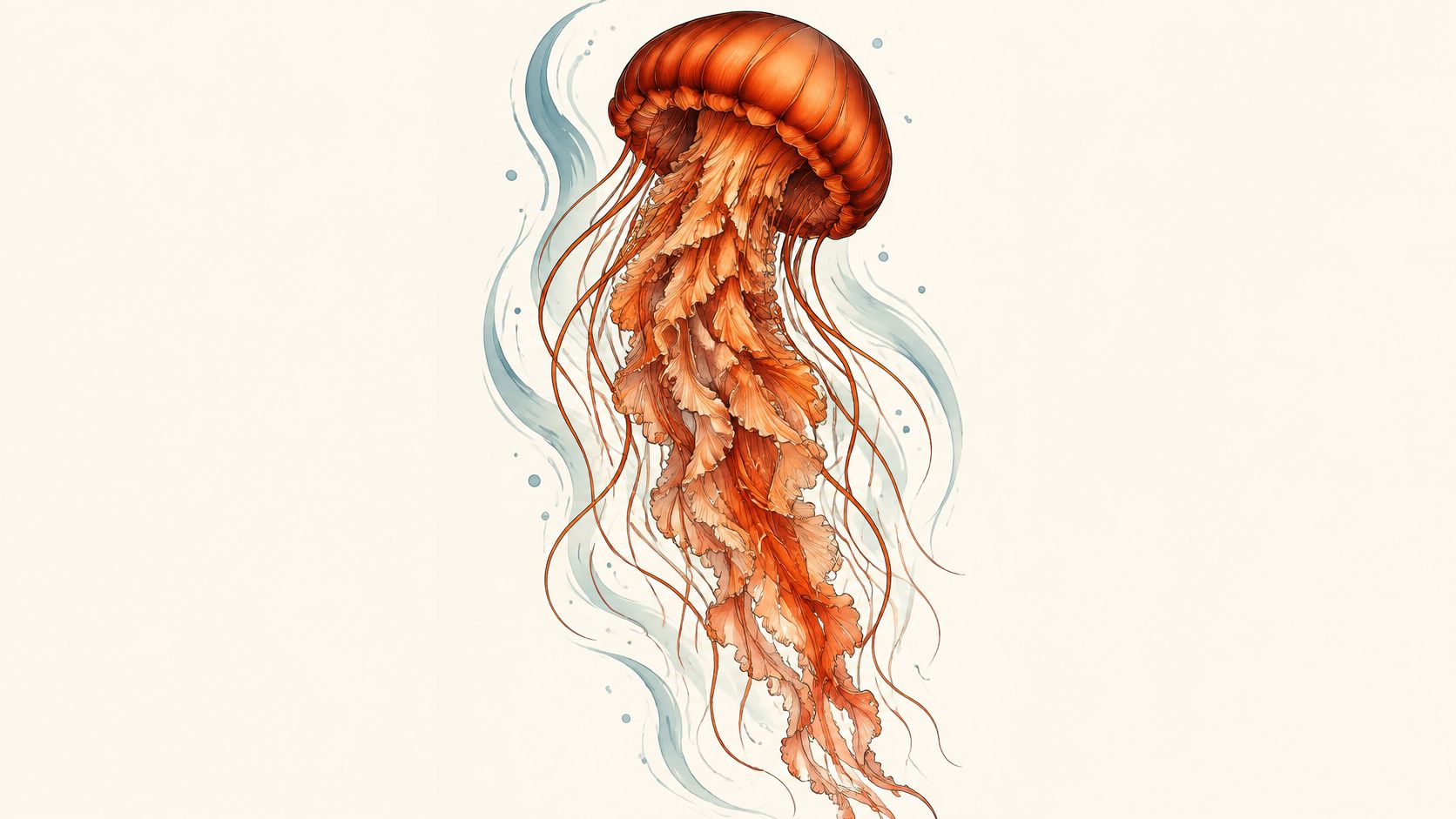
Put the bell on the shoulder and let the tentacles travel down the arm. That's a workable starting point for a lion's mane sleeve, but drawing every strand isn't the same as creating convincing complexity.
A crowded bundle of equally dark lines can turn into visual noise. Ask the artist to organize the tentacles into dominant flowing groups, lighter secondary strands, and deliberate empty channels. The viewer should recognize the animal before noticing the individual marks.
Build the sleeve around movement
- Palette: Rust, amber, muted orange, and brown-black shadows can establish a warm focal point. Ask to see healed work in comparable colors rather than choosing from fresh photographs alone.
- Placement: Position the bell where its lobed silhouette can remain readable, often across the outer shoulder or upper arm.
- Sizing: Treat this as a large composition. If you only want an upper-arm piece, shorten the composition rather than compressing a sleeve's worth of strands.
For an ocean sleeve with kelp, keep the plants darker and visually separate from the tentacles. Otherwise, the background and animal become difficult to distinguish, especially around the elbow.
Prompt-ready brief: Large lion's mane jellyfish, Cyanea capillata, realistic lobed amber bell on the outer shoulder, tentacle groups flowing toward the wrist, open channels between strands, subdued kelp background, arm-shaped vertical composition.
Ask your tattooist to map the sleeve with your arm relaxed and bent. A beautiful straight-arm drawing still needs to work when the elbow folds and the forearm rotates.
4. Jellyfish with Ocean Wave Backdrop
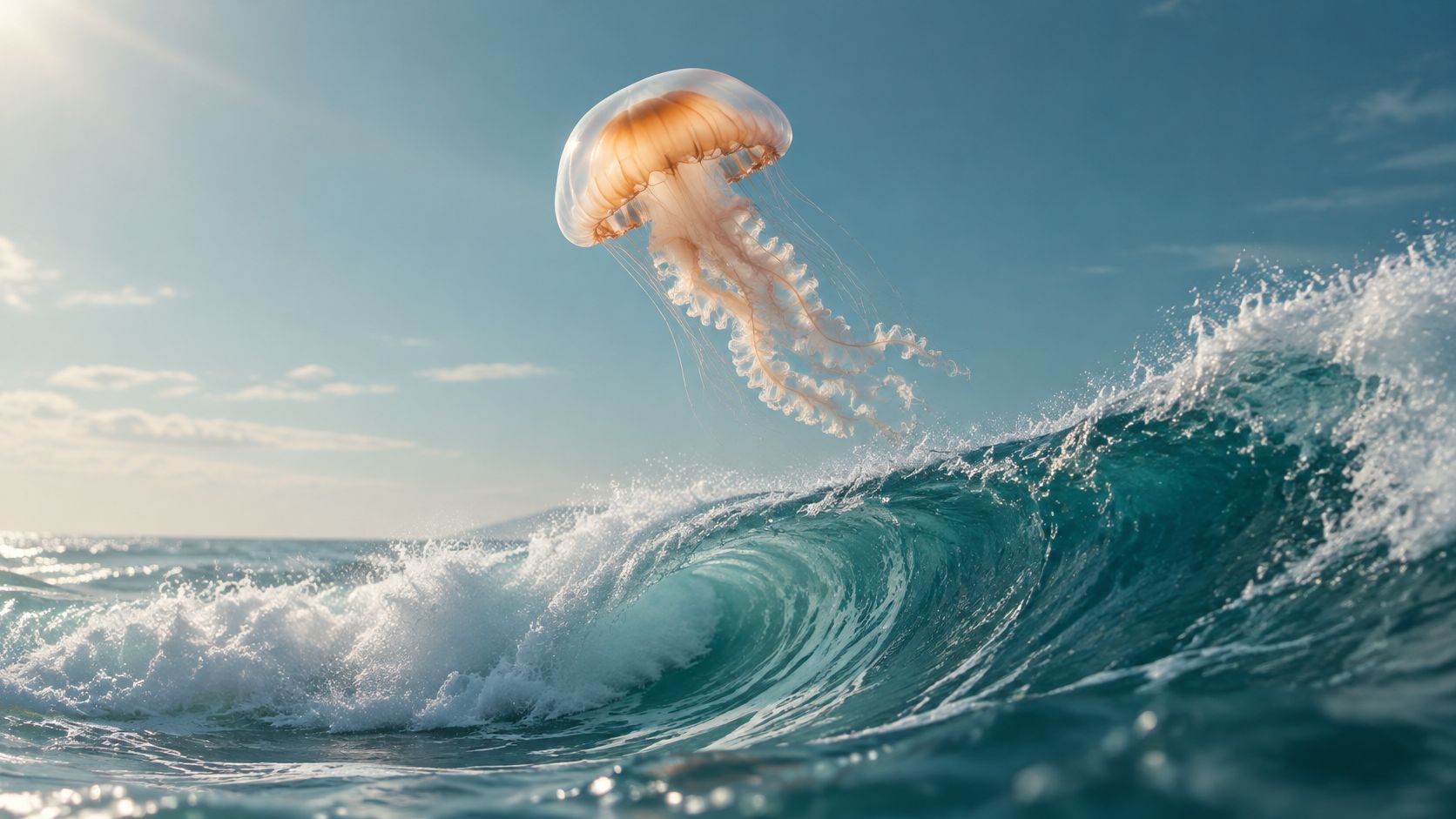
Decide whether you want an underwater scene or a surreal composition. A jellyfish floating above a crashing surface wave can make an effective tattoo, but it isn't a natural-history scene. Calling that choice intentional gives your artist a clearer brief than asking for absolute realism while supplying impossible scenery.
For an outer-thigh piece, place the bell above a curling wave and keep the water's busiest foam away from the tentacles. On the upper back, a wider wave can support the composition without forcing the jellyfish itself into an unnaturally broad shape.
Separate subject from scenery
Use muted teal and blue-gray water behind a pale or warm-toned jellyfish. If both elements have bright rims, crisp edges, and dense texture, they'll compete instead of forming a readable scene.
For an ocean-trip theme, references such as manta rays and other Hawaiian rays can help you decide whether you want a wider marine composition. Don't add extra animals unless the placement has room to give each a distinct silhouette.
Keep the sharpest edges and clearest contrast on the jellyfish. The wave can be convincing without every droplet being individually rendered.
Sizing: Choose a broad placement if you want both water movement and detailed anatomy. For a narrower forearm, reduce the wave to a supporting wash.
Prompt-ready brief: Realistic translucent jellyfish above a stylized curling ocean wave, outer-thigh composition, subdued turquoise water, clear separation between foam and tentacles, dominant jellyfish bell, intentional surreal setting.
5. Jellyfish Combined with Floral Elements
A pale jellyfish above a peony cluster can work beautifully on the ribs, provided the flowers don't swallow the animal's outline. Choose the dominant subject before choosing the flowers. If the jellyfish is the reason for the tattoo, its bell needs the clearest uninterrupted space.
For a forearm version, place a rose beside the lower oral arms rather than attaching blossoms to every tentacle. That keeps the botanical addition intentional without turning the anatomy into an unreadable tangle.
- Palette: Pair a cool gray jellyfish with muted blush flowers, or use black-and-gray throughout with different value ranges for each subject.
- Placement: The ribs suit a curved, descending arrangement; the outer forearm suits a narrower stack with flowers offset to one side.
- Sizing: Budget space for both recognizable petals and separated tentacles. If the available area is small, reduce the flower cluster rather than shrinking everything equally.
Keep the overlap selective
Let some tentacles pass behind the flowers and others remain completely visible. Avoid placing the darkest petal folds directly against the darkest oral-arm shadows.
There's also an important distinction between visual planning and medical certainty. A review in Contact Dermatitis explains limitations in diagnosing tattoo allergy with standard patch testing, so a test can't promise that a colored floral addition will never react.
Prompt-ready brief: Realistic translucent jellyfish with an offset peony cluster, descending rib composition, cool gray bell, muted blush petals, selective overlap, visible oral arms, generous negative space, jellyfish as the dominant subject.
6. Pacific Sea Nettle (Chrysaora fuscescens) Color Realism
Species-led realism starts with the photograph, not the color name. For a Pacific sea nettle, ask your artist to work from a clearly identified Chrysaora fuscescens reference rather than mixing a striped bell from one animal with the arms of another.
That distinction matters because jellyfish aren't interchangeable silhouettes. NOAA's jellyfish explainer describes substantial species diversity and a Chesapeake Bay sea nettle recognized as distinct from its open-ocean relatives.
Let the reference control the pattern
A warm sea nettle on the upper arm gives the artist space to separate the bell markings from the folds beneath it. Cream, amber, and reddish-brown can create depth without requiring every shadow to become saturated red.
- Palette: Sample the reference's warm and neutral areas separately. Preserve pale sections instead of filling the entire bell with orange.
- Placement: Use the outer upper arm for a contained piece, or the back for a wider bell with a longer trailing composition.
- Sizing: Give radial markings enough separation to remain distinct. Simplify minor surface texture before sacrificing the overall pattern.
Prompt-ready brief: Pacific sea nettle, Chrysaora fuscescens, species-reference color realism, warm cream and amber bell, anatomically consistent markings, distinct folded oral arms, fine separated tentacles, restrained dark-water background.
Ask about healed-color expectations and how the artist would adjust the palette for your skin. For persistent itching, scaling, or inflammation, seek medical advice rather than assuming it's routine healing; DermNet's tattoo-reaction guidance describes allergic and other tattoo-associated skin reactions.
7. Jellyfish Tentacles Wrapping a Limb
A wraparound design succeeds in the fitting, not just the illustration. The bell might sit on the outer calf while tentacles curve around the sides, or it might occupy the shoulder with strands descending around the upper arm.
Keep the bell readable from a main viewing angle. Let the tentacles provide the wrap rather than splitting the central subject across opposite sides of the limb.
Check the wrap on a moving body
Ask your artist to check the stencil with the limb relaxed, rotated, and bent. Mark where the dominant strands cross the front and sides so the composition doesn't become a collection of disconnected lines from the angle you'll usually see.
The placement principles behind octopus sleeve tattoos offer useful inspiration for directional movement. Keep the anatomy distinct, though: jellyfish tentacles shouldn't acquire the thickness or suction-cup structure of octopus arms.
Healing priority: Protect the open space between strands. Adding more lines isn't an improvement if it makes the healed design harder to read.
Palette and sizing: Black-and-gray suits a restrained wrap, while a colored bell can anchor otherwise neutral tentacles. Size the bell first, then extend the strands around the available surface instead of squeezing the subject into a narrow band.
Prompt-ready brief: Realistic jellyfish with bell on the outer calf, asymmetrical tentacle groups curving around the limb, clear front-facing focal point, open skin between strands, no closed bracelet effect.
After healing, sun protection belongs in the maintenance plan. An exploratory tattoo-aftercare study examined daily SPF50+ care, but that doesn't make sunscreen appropriate for a fresh wound; follow your tattooist's healing instructions and protect fresh work from sun exposure.
Realistic Jellyfish Tattoo Styles at a Glance
| Style | Difficulty | Best Placements | Color Approach | Ideal Size |
|---|---|---|---|---|
| Bioluminescent jellyfish realism | Intermediate to advanced | Forearm, calf, shoulder, upper back | Glowing cyan, violet, or pink with deep shadows | Medium, with room for fine tentacles |
| Moon jellyfish grayscale realism | Intermediate | Inner forearm, ribs, upper arm, back of shoulder | Soft grayscale or black-and-gray shading | Medium, to keep the central pattern legible |
| Lion's mane jellyfish sleeve | Advanced | Outer arm sleeve, thigh, back, calf | Warm rust, orange, or red bell tones | Large, for flowing tentacles and detail |
| Jellyfish with ocean wave backdrop | Advanced | Thigh, upper back, outer arm, chest | Cool blue, teal, or gray waves framing the jellyfish | Medium to large, for clear depth and detail |
| Jellyfish with floral elements | Intermediate to advanced | Forearm, ribs, shoulder, calf | Soft pastels or muted tones | Flexible, with space to balance both subjects |
| Pacific sea nettle color realism | Advanced | Upper arm, back, thigh, forearm | Warm reds, browns, or oranges with a pale striped bell | Medium to large, for precise radial stripes |
| Jellyfish tentacles wrapping a limb | Intermediate to advanced | Upper arm, forearm, calf, thigh | Realistic shading shaped to the limb | Flexible, spanning the limb for a flowing wrap |
Turn Inspiration Into Ink, Your Next Step
The strongest realistic jellyfish tattoo brief makes decisions instead of collecting effects. Choose a dominant element, match the downward flow to your placement, and give fine anatomy enough space to remain readable. Ask about healed-color expectations before committing to a luminous palette or dense warm shading.
Bring a species photograph, a preferred composition, and a clear statement of what matters most. That might be the moon jelly's translucent bell, a lion's mane's trailing movement, or a sea nettle's warm coloration. Tell your artist what can change, too, including background density, minor tentacles, or flower placement.
Make the reference useful
A detailed prompt should describe subject, palette, placement, scale, and exclusions. Request separated tentacle groups, reserved skin highlights, and a clear bell silhouette instead of only asking for extreme detail. If an ocean memory drives the design, resources such as Kona Snorkel Trips on snorkeling tattoos can help you connect the imagery to a specific experience without overloading the composition.
Our generator at TattoosAI includes a dedicated Realistic style among its 19 styles, allowing you to explore palette and composition variations. Each generated image is created for your request, not copied from an existing tattoo or another artist's portfolio.
The result is a reference, not a stencil. Your tattooist must adapt it to your body, skin, and the way the design will age; a convincing screen image can still need substantial simplification.
Before booking, narrow your references to a clear direction and ask the artist what they'd remove. A well-planned jellyfish doesn't need every strand or highlight. It needs enough structure to look intentional after the fresh shine has gone.
TattoosAI turns detailed tattoo ideas into personalized visual concepts you can take to a tattooist. Visit TattoosAI to explore your jellyfish's palette and composition, then bring your preferred reference to an artist who can adapt it for your placement and skin.