TattoosAI
What makes a skull tattoo feel personal rather than familiar? Realism is only the foundation. The design becomes distinctive through its surrounding motifs, tonal treatment, scale, and placement. A skull with roses communicates something different from a geometric skull, a smoke-filled composition, or a classical vanitas scene, even when every option uses detailed shading.
This guide presents eight realistic skull tattoo designs, from anatomically precise black-and-grey work to full-color compositions with chromatic effects. Each concept is evaluated through four practical questions: What gives it visual identity? What symbolism does it carry? What does the placement demand? How can you customize it without weakening the image?
You'll also see a repeatable TattoosAI workflow for generating variations before you meet your tattooist. Treat those concepts as visual references, not automatic stencils. The final artist still needs to refine anatomy, adapt the design to your body, and plan how the tattoo will heal and age. If a lyric, phrase, or piece of music is part of your inspiration, you can also explore song lyric ideas for tattoos before settling on the visual language.
Table of Contents
- 1. Anatomically Detailed Realistic Skull
- 2. Floral Integrated Skull Design
- 3. Geometric Skull with Sacred Geometry
- 4. Monochrome Watercolor Skull
- 5. Skull with Smoke and Mist Effects
- 6. Skull with Jewels and Ornamental Details
- 7. Memento Mori Skull with Symbolic Elements
- 8. Full-Color Realistic Skull with Chromatic Elements
- 8-Design Comparison: Realistic Skull Tattoos
- Turn a Strong Concept Into a Tattoo-Ready Brief
1. Anatomically Detailed Realistic Skull
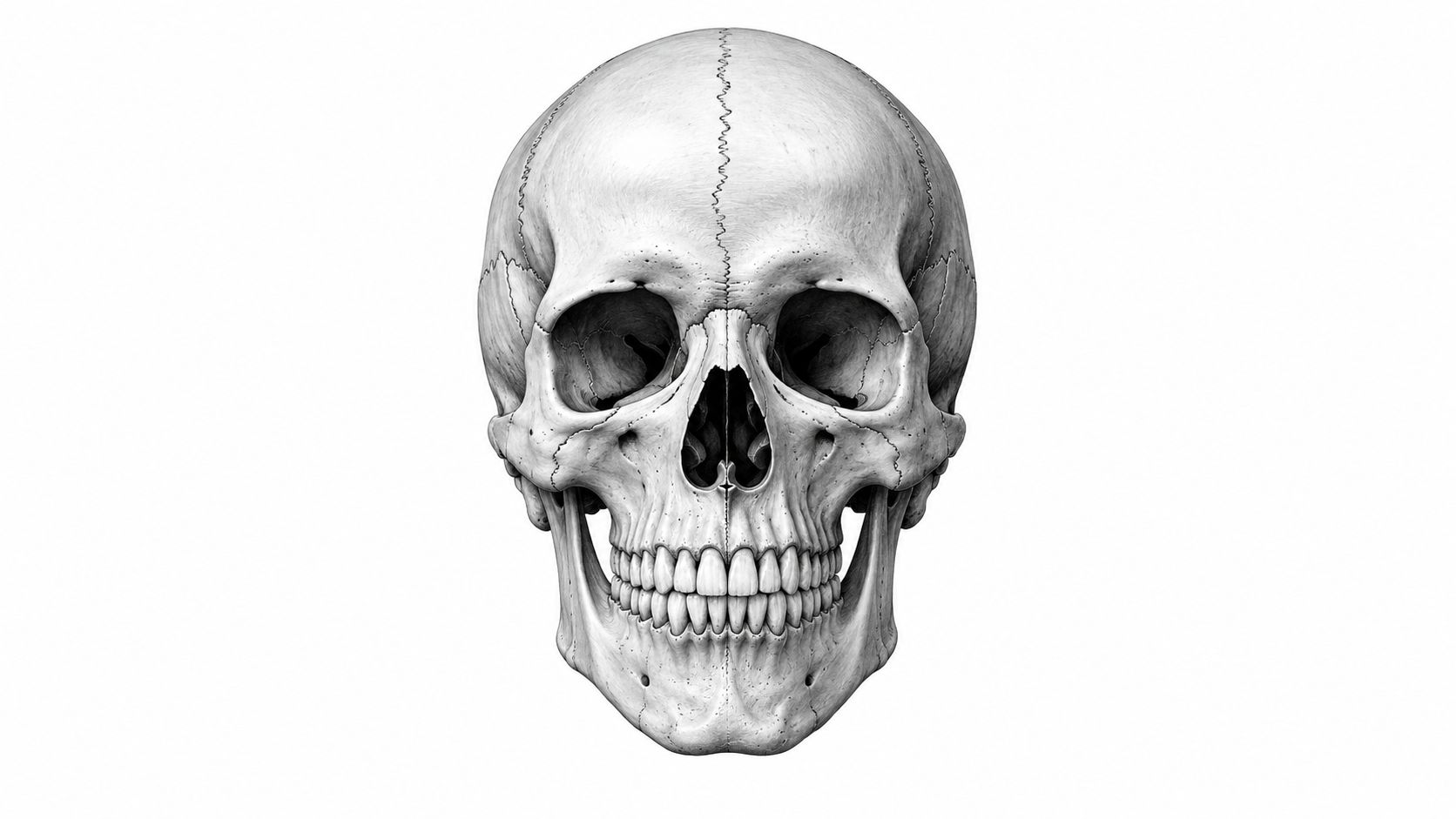
An anatomically detailed skull is the clearest expression of realism. It focuses on accurate bone structure, visible sutures, individual teeth, a properly aligned jaw, and shadows that make the cranium appear solid rather than illustrated. The result can feel like an anatomy reference transformed into body art, which suits clients who value technical precision more than decorative excess.
The strongest versions usually rely on value control instead of heavy outlines. Artists establish the deepest blacks inside the eye sockets, nasal cavity, and under-cheek recesses, then build midtones across the forehead, cheekbones, and jaw. Layered graywash and untouched skin highlights can create convincing depth. Guidance on realism technique commonly recommends consistent needle depth in the dermis at roughly 1 to 2 mm, with hand speed and angle controlling saturation rather than repeated depth changes. You can review the technical explanation in this realism shading guide.
Make the anatomy the subject
A frontal skull creates symmetry and immediate recognition. A three-quarter view feels more sculptural and gives the artist room to deepen one side with shadow. A side profile can work well with lettering, dates, or a narrow placement, but it depends heavily on accurate jaw and tooth structure.
Use TattoosAI's 3D or hyperrealistic settings to compare frontal, three-quarter, and profile versions. Ask for high-resolution concepts with visible sutures, natural tooth spacing, deep eye-socket shadows, and restrained highlights. Large areas such as the chest, back, and thigh give the artist more room to preserve detail.
Practical rule: A realistic skull needs enough scale for its shadows and anatomical details to remain separate after healing.
For an artist reference, the work of Nikko Hurtado, Paul Booth's dark realism portfolio, and Dmitriy Samohin's photorealistic approach can help you identify how different artists handle depth, texture, and darkness. Discuss long-term maintenance with your artist rather than assuming every gray detail will remain equally crisp.
2. Floral Integrated Skull Design
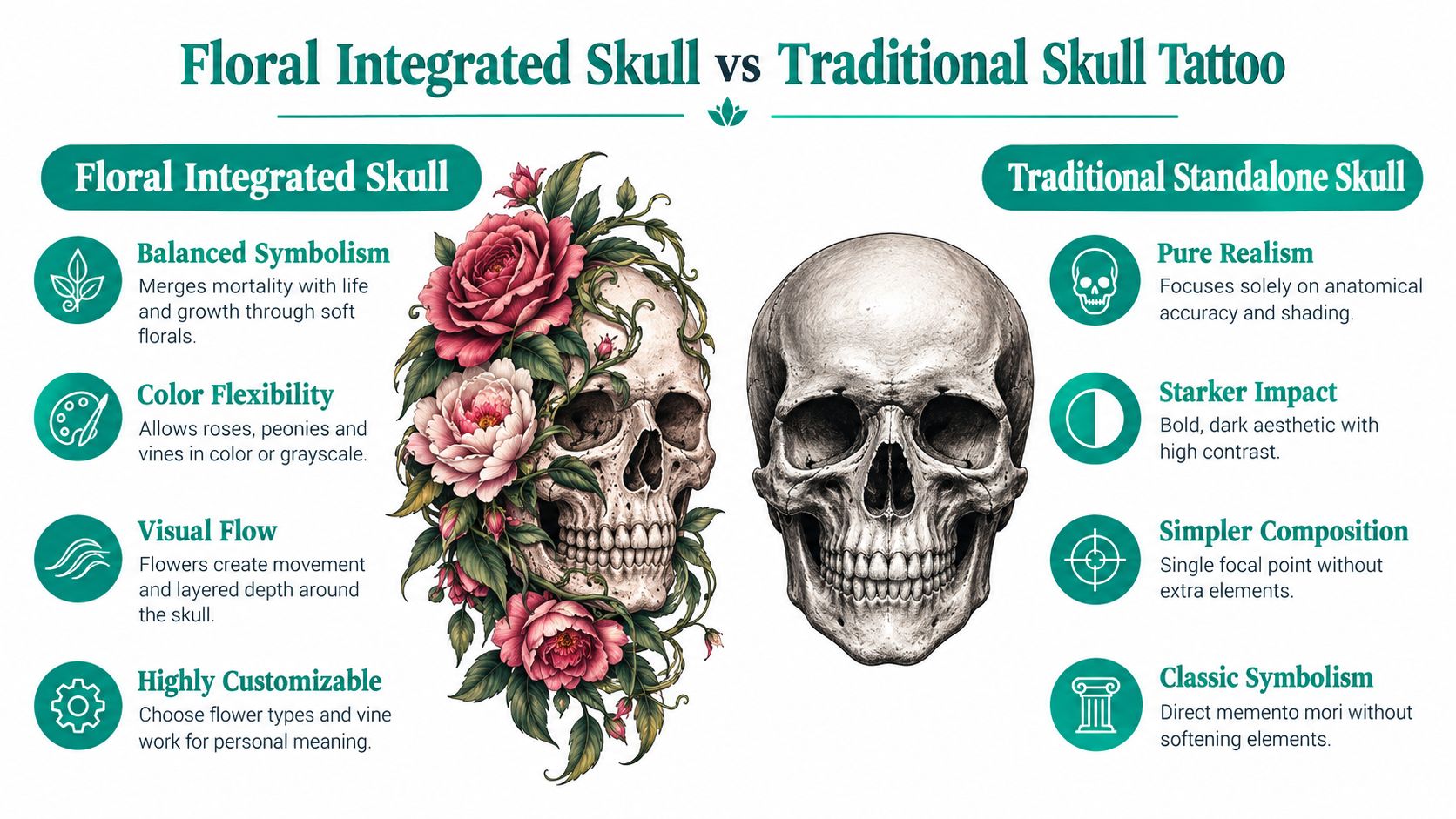
A floral skull creates its identity through contrast. The skull supplies hard planes, cavities, teeth, and aged bone texture, while roses, vines, cherry blossoms, or wildflowers introduce softness, movement, and color. That opposition makes the design less clinical than a standalone skull and less purely dark than a horror-focused composition.
The symbolism can remain open-ended. A rose may suggest love beside mortality, while blossoms can point toward impermanence, renewal, or memory. The flowers might grow from the eye socket, wrap around the jaw, sit behind the cranium, or form a frame that separates the skull from the surrounding skin. Each choice changes the visual emphasis. Flowers emerging from the skull feel symbolic, while a floral border keeps the skull dominant.
Balance realism and botanical detail
The most common design problem is letting the flowers overpower the skull. Keep the bone structure darker and more sharply modeled if the skull is meant to lead. Use softer petals, selective color, or lighter negative space to make the botanical elements support the central form.
A TattoosAI prompt might specify “realistic human skull with roses growing through the eye socket, black-and-grey skull, muted red petals, balanced composition.” Generate alternate versions with roses, cherry blossoms, and wildflowers, then compare how each plant changes the mood. You can explore the symbolism and composition of a skull and roses tattoo before choosing a direction.
- Choose the flower deliberately: Pick a species with personal meaning or a shape that fits the available body area.
- Protect the focal point: Ask for the skull to remain the highest-contrast element.
- Plan the flow: Let stems and leaves follow the chest, shoulder, or thigh instead of forming an awkward isolated cluster.
- Test color restraint: Compare monochrome, muted color, and fuller color versions against your intended skin tone.
A chest or shoulder can support a composition that expands outward, while a thigh offers room for a vertical skull-and-botanical arrangement. A smaller design may need fewer petals and simpler leaves so the image doesn't become visually congested.
3. Geometric Skull with Sacred Geometry
A geometric skull works when two visual systems meet without competing. The skull depends on organic curves, irregular bone texture, and gradual shading. Sacred geometry contributes symmetry, circles, straight lines, mandalas, fractal structures, or repeating forms. The tension between those systems gives the tattoo a contemporary identity.
You can keep the skull whole and place geometry behind it, divide the cranium into geometric planes, or let one half dissolve into lines and shapes. A complete skull with a mandala halo reads as a realistic portrait with structure around it. A deconstructed version feels more conceptual and gives the artist greater freedom to blend realism into line work.
Decide the visual ratio before generating
A prompt should state whether realism or geometry leads. If you want the skull to remain dominant, describe a realistic skull with restrained geometric framing. If the geometry carries personal spiritual meaning, ask for a balanced composition where the lines actively intersect or replace parts of the cranium.
Use TattoosAI's Geometric style setting to generate variations with mandalas, sacred geometry, or a flower-of-life pattern. The sacred geometry tattoo ideas guide can help you identify symbols before you write the prompt. Generate symmetrical and asymmetrical options, because perfect balance can feel ceremonial while controlled imbalance can feel more dynamic.
Placement affects the geometry as much as the skull. The forearm can showcase vertical symmetry, while the chest can accommodate a centered mandala. Curved body areas may distort circles and straight lines, so the tattooist should redraw the design over the body's natural contour.
Geometry should support the skull's silhouette, not turn every open area into decoration.
Ask your artist how much line work the skin can comfortably carry beside the graywash. Fine lines, solid blacks, and realistic shading age differently, so the final composition needs enough breathing room to remain readable.
4. Monochrome Watercolor Skull
A monochrome watercolor skull keeps the bone structure recognizable but surrounds it with bleeding washes, diffused edges, splattered texture, and loose tonal movement. Unlike a clinical anatomical skull, it feels more like an atmospheric artwork. The skull may emerge from a gray cloud, dissolve into brush-like marks, or remain sharply rendered at the center while the outer edges become abstract.
This approach suits someone who wants realism without a rigid, photograph-like finish. It can also create a more reflective mood, especially when the wash suggests fading memory, emotional change, or impermanence. Because the design uses only a narrow tonal family, the artist must control contrast carefully. If every area has the same soft value, the skull can lose its focal structure.
Keep the center readable
Ask TattoosAI for several monochrome watercolor variations rather than accepting the first attractive wash. Useful prompts can describe a realistic skull with diffused gray ink, soft splatter, controlled negative space, and a clean anatomical face. Compare versions where the watercolor flows upward, sideways, or around the jaw.
The artist's portfolio matters more here than a generic style label. Ask to see healed watercolor work, not just fresh photographs. Discuss which sections should stay realistic and which can become abstract. You might keep the eye sockets, teeth, and cheekbones sharply defined while allowing the crown and background to dissolve.
A larger placement gives the washes room to spread visually. The upper arm, thigh, shoulder blade, and back can support this type of movement better than a cramped area. The final tattoo may need maintenance as softer effects change with healing and exposure, so ask the artist what kind of future refinement the design may require.
For a first-time client, the safest prompt separates structure from atmosphere: specify a clearly modeled skull first, then describe the watercolor effect as a secondary layer. That prevents the AI concept from becoming an attractive but unreadable gray cloud.
5. Skull with Smoke and Mist Effects
Smoke and mist turn a static skull into a moving composition. Wisps can rise from the eye sockets, curl around the jaw, or spread behind the cranium like a veil. The skull remains the visual anchor, while the atmospheric elements create mystery, transformation, and a sense of transience.
Direction matters. Upward smoke can suggest release or spiritual movement. Sideways smoke creates flow across an arm or rib area. Dense mist feels ominous, while thin vapor keeps the skull visible and gives the tattoo more negative space. The most successful designs don't fill every gap. They use fading edges to make the smoke appear to disappear into the skin.
Prompt movement, not just mood
A useful TattoosAI prompt might read, “hyperrealistic black-and-gray skull with upward flowing smoke from both eye sockets, soft mist around the jaw, strong facial shadows, open negative space.” Generate alternatives with different smoke density and flow direction. Ask for one version where the smoke frames the skull and another where it partially obscures the cheekbones.
Expert realism guidance favors whip or pendulum-style passes for soft gradients rather than circular packing. Curved magnums can help establish broad tonal fields, while untouched skin often works better than excessive white ink for preserving highlights. A realism tutorial gives a benchmark of roughly 1 to 1.5 mm of needle hang, a stable low voltage, and a machine angle around 45 to 50 degrees for controlled graywash blending. Read the full technical breakdown in this realism tattoo shading resource.
A sleeve, upper back, or large side panel can give the smoke enough room to travel. The artist should adapt the flow to muscle direction and joint movement. A smoke effect that looks natural on a flat reference may need significant reshaping around an elbow or shoulder.
6. Skull with Jewels and Ornamental Details
Jewels create a deliberate clash between mortality and luxury. A realistic skull may carry a crown, metal filigree, gem-studded teeth, an emerald in an eye socket, or ornamental pieces embedded along the jaw. The design can suggest power, transformation, excess, or the classic memento mori idea that wealth cannot overcome death.
The detail needs hierarchy. If every tooth, jewel, chain, and metal edge receives the same emphasis, the composition becomes noisy. Choose one primary ornament, then use smaller details to reinforce it. A crown makes the skull feel regal. Gemmed eye sockets create a more theatrical effect. Filigree around the temples can produce a refined, ornamental frame without changing the skull's expression.
Build a material contrast
Bone, metal, and gemstones need different rendering treatments. Bone depends on porous texture and soft value transitions. Metal requires sharper reflected highlights. A jewel needs a clear internal highlight and surrounding shadow so it doesn't look like a flat colored dot.
TattoosAI can help you test these material relationships with Color Realism or Hyperrealistic settings. Use prompts such as “realistic skull with emerald eye gems and ornate silver crown” or “black-and-gray skull with ruby teeth and engraved metal filigree.” Generate alternatives that change jewel placement, crown shape, and color intensity.
A larger chest, thigh, upper arm, or back placement gives the artist space to separate tiny ornamental components. Color and grayscale also need a maintenance conversation. A muted jewel palette may integrate better with black-and-gray shading, while saturated gems become the focal point and may require future color refinement.
Bring your strongest concepts to the artist as references, but stay open to simplification. A tattooist may remove tiny stones, enlarge the crown, or reduce filigree so the final piece remains legible rather than merely detailed on screen.
7. Memento Mori Skull with Symbolic Elements
A memento mori skull connects contemporary tattooing with a long artistic tradition. In European Renaissance art, the skull became a reminder of mortality and the limits of human life. Later, modern tattoo histories carried related symbolism into twentieth-century counterculture, where biker, punk, and other subcultural groups used skull imagery to express rebellion and existential awareness. You can read more about this history in the meaning behind skull tattoos.
The design often pairs the skull with an hourglass, candle, dying flower, clock, calendar, or other vanitas object. These symbols shouldn't be chosen only because they look familiar. Ask what idea you want the composition to carry. An hourglass emphasizes passing time. A candle suggests a limited life or fading light. A wilting flower brings growth and decline into the same frame.
Let symbolism control the composition
A skull with an hourglass needs enough space for both forms to remain readable. A candle can sit beside the jaw or behind the cranium. A clock face may replace part of the forehead, but that choice shifts the design from anatomical realism toward symbolic fusion.
TattoosAI's Black and Gray or Hyperrealistic settings can generate a starting point from prompts such as “memento mori skull with hourglass and wilting rose” or “realistic skull with candle, clock face, and vanitas still-life arrangement.” More recent style guidance describes realistic skulls as detailed, photographic-rendering pieces that often use candles, flowers, fabric, and still-life objects to create a vanitas effect. This realistic skull style guide offers additional visual context.
Use classical paintings by Johannes Moreelse and Caravaggio as mood references, but don't copy a historical artwork directly without discussing it with your artist. A chest, back, or large sleeve can preserve the entire symbolic scene. If the placement is too narrow, select one strong object instead of compressing several symbols into a small panel.
8. Full-Color Realistic Skull with Chromatic Elements
Full-color realism changes the emotional temperature of a skull. Instead of relying only on black, gray, and skin breaks, the artist can introduce iridescent blue, magenta, green, rainbow gradients, or unexpected color around the bone. The skull remains anatomically recognizable, but the chromatic treatment adds energy, surrealism, or a contrast between mortality and vitality.
Color doesn't automatically make the design more distinctive. It needs a clear role. A blue iridescent sheen across the forehead can feel subtle and futuristic. A saturated gradient flowing through the eye sockets creates a stronger surreal effect. Colorful smoke, flowers, flames, or liquid surrounding the skull can preserve the bone's neutral tones while making the composition more vivid.
Test the palette before committing
Use TattoosAI's Watercolor, Color Realism, or Hyperrealistic settings to compare color directions. Prompt examples include “realistic skull with iridescent blue highlights,” “photorealistic skull with a restrained rainbow gradient,” or “black-and-gray skull with vibrant chromatic smoke.” Generate variations with subtle and intense color so you can see whether the palette supports the anatomy or overwhelms it.
Skin tone and placement affect the final result. Ask your tattooist which hues will create sufficient contrast and how the selected pigments may age. Share your strongest references, then let the artist adjust saturation, highlight placement, and color transitions for the skin.
A hybrid approach can be more practical than full saturation. Keep the skull in black and gray, then reserve color for the eyes, flowers, smoke, or ornamental details. That preserves realism foundation while giving the tattoo a distinct focal point.
Black-and-gray realism remains a core base for skull work, but current style discussions increasingly pair it with snakes, butterflies, geometric structure, fine-line accents, and trash-polka-like energy. The broader lesson is useful: selective stylization can improve readability and personal meaning, especially when extreme micro-detail would crowd a sleeve or larger panel.
8-Design Comparison: Realistic Skull Tattoos
| Design | 🔄 Complexity | ⚡ Resources & Time | ⭐ Expected Outcome | 📊 Key Advantages | 💡 Ideal Use Cases |
|---|---|---|---|---|---|
| Anatomically Detailed Realistic Skull | Very high, photorealism, fine sutures & anatomy; master realism required | High, 4–6+ hrs, large canvas, premium inks; higher cost | ⭐⭐⭐⭐⭐, museum-quality realism, lasting definition | Dramatic realism; showcases technical skill; ages well | Medical/scientific aesthetic, chest/back/thigh; collectors |
| Floral Integrated Skull Design | High, combines realistic skull with botanical composition | High, color work or layered grayscale; extra layout time | ⭐⭐⭐⭐, balanced symbolism with photogenic appeal | Balances dark/light; customizable; flow across body | Clients wanting symbolic beauty with softness; shoulder/chest/thigh |
| Geometric Skull with Sacred Geometry | High, precise geometry + realism; symmetry-critical | High, meticulous line work and alignment; steady hand needed | ⭐⭐⭐⭐, unique contemporary fusion; holds definition | Original fusion; spiritual/intellectual depth; durable lines | Spiritually/mathematically minded clients; forearm/back |
| Monochrome Watercolor Skull | Medium–high, watercolor diffusion layered over realism | Medium, watercolor technique, larger area preferred | ⭐⭐⭐⭐, artistic, gallery-quality with unique aging | Soft abstraction; hides minor imperfections; one-of-a-kind | Artistic clients seeking fine‑art feel; large placements |
| Skull with Smoke and Mist Effects | High, realistic skull plus atmospheric blending | High, detailed grayscale blending; long session times | ⭐⭐⭐⭐, dramatic movement and narrative impact | Strong atmosphere; dynamic composition; photographic | Story-driven pieces; sleeves or full-back work |
| Skull with Jewels and Ornamental Details | Very high, reflective gems, metallic shading, intricate ornament | Very high, 6–8+ hrs, premium pigments, higher cost | ⭐⭐⭐⭐⭐, luxurious, distinctive, high visual richness | Opulent aesthetic; highly customizable; conversation starter | Clients wanting luxury symbolism; large, visible placements |
| Memento Mori Skull with Symbolic Elements | High, complex composition with multiple classical symbols | High, planning/composition time; multiple elements add sessions | ⭐⭐⭐⭐, timeless, philosophically rich outcome | Deep historical/philosophical context; highly personal | Philosophically-minded clients; chest/back; collectors |
| Full-Color Realistic Skull with Chromatic Elements | Very high, color photorealism plus iridescent/gradient effects | Very high, color blending, frequent touch-ups (1–2 yrs); costly | ⭐⭐⭐⭐⭐, striking contemporary impact; vibrant longevity with care | Modern visual tension; extensive color customization | Modern aesthetic seekers; clients committed to color maintenance |
Turn a Strong Concept Into a Tattoo-Ready Brief
The best choice among these eight designs depends less on the skull itself than on the decisions surrounding it. Start with the realism-to-decoration balance. An anatomical skull places nearly all attention on bone structure. A floral, geometric, jeweled, or smoke-based design distributes attention between the skull and its supporting elements. If you want the face to remain instantly dominant, use decoration as a frame. If the surrounding motif carries the deeper meaning, allow it to intersect with or partially transform the skull.
Next, choose between grayscale and color. Black-and-gray emphasizes value, shadow, and anatomical depth. Color can create stronger emotional contrast, but it also introduces more variables for the artist to manage. A restrained palette may integrate better than several competing hues. Ask your tattooist to explain how the chosen colors will work with your skin and how the design may look after healing.
Then consider body surface and scale. Realistic skulls often need at least a fist-sized canvas because broad shading holds up more reliably than crowded micro-details. Larger areas give the artist room to separate the eye sockets, teeth, bone texture, smoke, petals, geometry, or ornaments. Exposed, high-movement areas deserve extra caution. Independent tattoo guidance notes that hand and neck tattoos can fade toward a gray wash in about five years without daily SPF, as discussed in this skull tattoo placement guidance. Ask whether the placement suits the design's detail level, sun exposure, movement, and your willingness to protect it.
Finally, decide how much future maintenance you accept. A simplified high-contrast skull may stay clearer than an overworked design packed with tiny transitions. Your artist can explain which details should be enlarged, removed, darkened, or left as negative space. That conversation matters more than choosing a concept solely because it looks impressive in a digital gallery.
A repeatable TattoosAI workflow
- Describe the skull: State frontal, profile, or three-quarter view, along with anatomical realism, bone texture, expression, and tonal direction.
- Add the motif: Name the roses, geometry, smoke, jewels, vanitas objects, or chromatic effect you want.
- Define the composition: Specify framing, movement, symmetry, negative space, and the intended body area.
- Choose a compatible style: Try realistic, hyperrealistic, black-and-gray, geometric, watercolor, or color realism settings.
- Generate several variations: Compare structure, contrast, motif scale, and how easily each concept could adapt to skin.
- Prepare an artist brief: Bring the strongest references to your tattooist for anatomical refinement, placement adjustment, and final stencil planning.
TattoosAI can generate original tattoo concepts from detailed prompts and offer multiple style and color directions for exploration. Use the output as a visual starting point for collaboration, much like assembling references for fine art commissions, rather than assuming an AI image accounts for every requirement of healed skin.
Choose the concept that still communicates clearly after you remove unnecessary detail. A realistic skull should have a strong silhouette, controlled values, and a surrounding motif that says something about you. Once those foundations are settled, the artist can turn the screen concept into a tattoo that belongs to your body rather than merely resembling an image.
Use TattoosAI to generate realistic skull tattoo variations with different motifs, placements, and black-and-gray or color treatments. Create a small set of focused references, then take your strongest concepts to a tattooist for professional refinement and a tattoo-ready plan.