TattoosAI
You've got a folder of screenshots on your phone. A red rose with a swallowtail across a forearm. A single-line sketch behind an ear. A watercolor wash on a shoulder blade. A blackwork half-sleeve you saved at midnight and can't quite explain. Somewhere in that pile is the rose and butterfly tattoo you want, and every version looks like a completely different tattoo, because it is.
That's the trap with this motif. A rose is a compact, readable shape and a butterfly is a symmetrical one, so both survive almost any treatment: bold American traditional flash, photorealistic black and grey, three loose watercolor splashes, or a near-invisible single-needle line. What changes is everything you'll live with. Style sets the minimum size, the placement that suits it, the hours you'll sit for, the price, and how the piece looks at ten years rather than ten weeks.
The eight directions below are judged on a single question: how do the same two elements behave when the style, scale and placement change? Each entry gives you the placement that suits it, the trade-off you're accepting, and a brief you can hand an artist across the table.
Table of Contents
- 1. Traditional American Rose with Butterfly
- 2. Realistic Rose and Butterfly
- 3. Watercolor Rose and Butterfly
- 4. Minimalist Line Art Rose and Butterfly
- 5. Japanese Irezumi-Style Rose and Butterfly
- 6. Neo-Traditional Rose and Butterfly
- 7. Blackwork and Geometric Rose and Butterfly
- 8. Dotwork Rose and Butterfly
- How the Eight Rose and Butterfly Tattoo Styles Compare
- Turning Your Favorite Rose and Butterfly Concept into Ink
1. Traditional American Rose with Butterfly
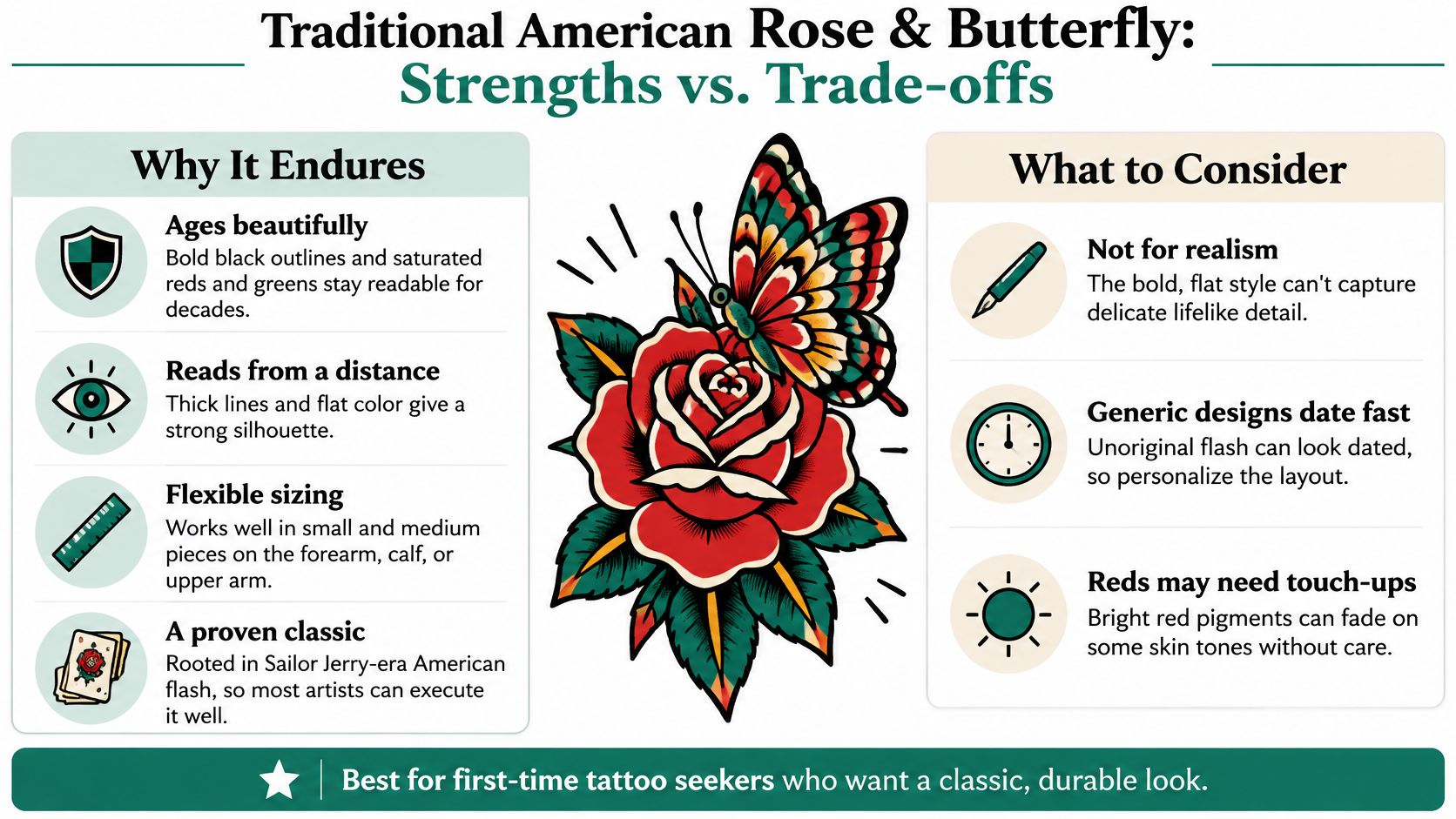
Start with the outline. American traditional work is built on a thick black contour, flat color packed inside it, and a palette kept tight: red, yellow, green, black, sometimes a small blue accent. A rose in this style is a bold bloom with heavy petal breaks. The butterfly is reduced to a few wing segments with a silhouette that reads from across a room. Nothing feathers into a gradient.
The pairing carries two long histories. The butterfly's symbolism traces back to the ancient Greek word psyche, which named both the butterfly and the soul, and the caterpillar-to-wing cycle later stood for resurrection in Christian and European art. Put that beside a rose, long associated with love, beauty, mourning, and remembrance, and the design becomes a compact story of beauty changing form. That's part of why the flat-color version still makes a strong first tattoo.
Best placements are the outer forearm, calf, and upper arm. All three are relatively flat, visible when you want them, and easy to heal. The trade-off is the least delicate detail in tattooing. Fine wing veins and soft petal gradients don't survive this style, and asking for them defeats the point. What you buy is readability at twenty years, not realism at twenty centimetres.
The brief to bring: a red rose with a swallowtail butterfly rising above it, thick black outline, four or five flat colors, no shading beyond one black whip line.
A worked example: on a forearm, ask the artist to keep the butterfly's wings slightly wider than the rose bloom so the silhouette still holds up from across a table. If you generate references before the consultation, a short prompt such as "American traditional rose and butterfly, thick black outline, flat red and green" is enough to start the conversation. The artist will redraw it for your arm regardless.
2. Realistic Rose and Butterfly
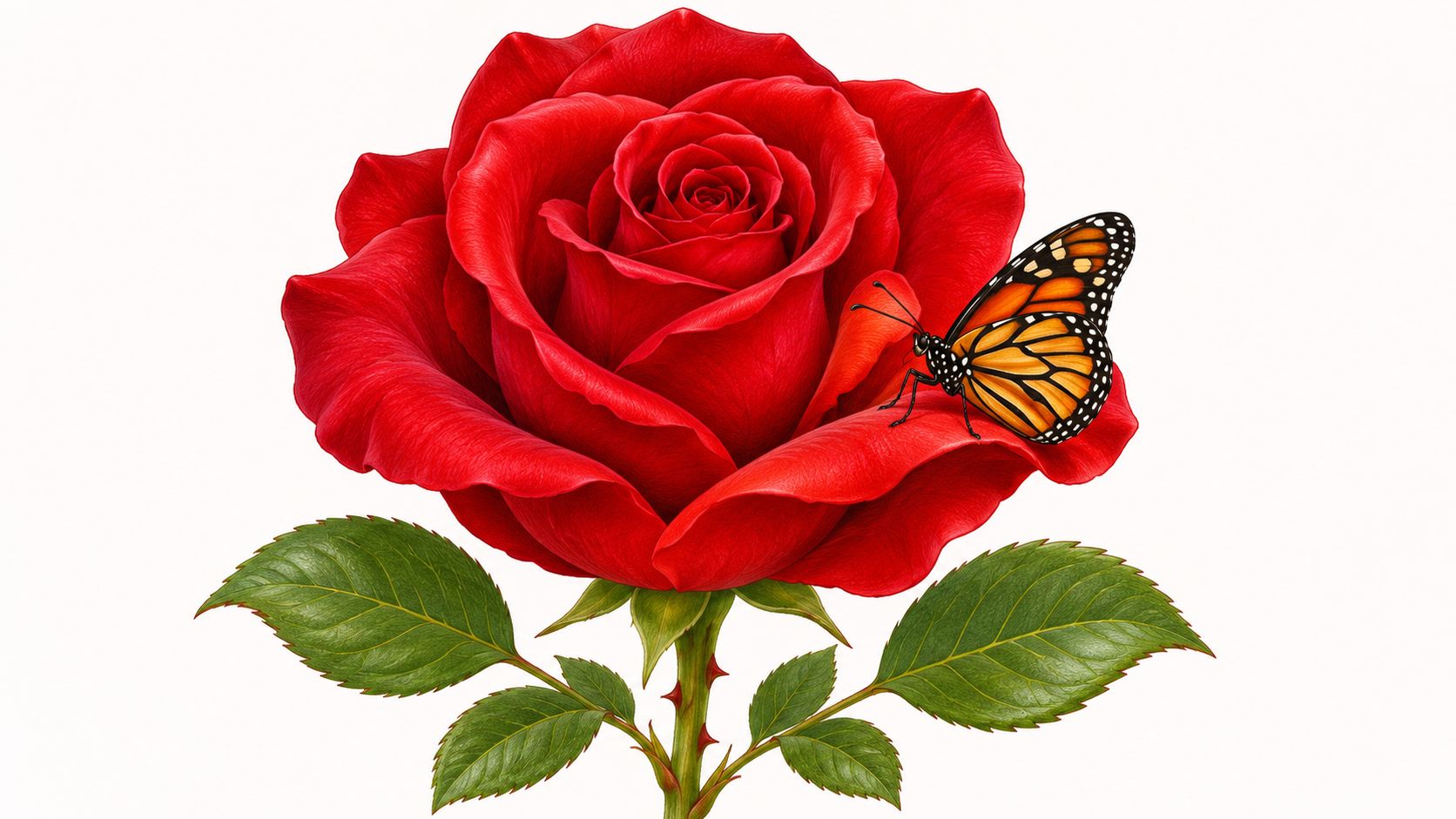
Most realistic rose and butterfly pieces begin as memorials. Someone brings a photograph of a garden rose from a grandmother's yard and a monarch seen on a particular morning, and wants both rendered close to life. That's a different job from a decorative floral, and it changes how the artist works.
Realism here means smooth gradients across the petals, individual wing scales, a soft shadow where the butterfly's body meets the petal, and edges that dissolve rather than stop. The butterfly usually lands on a petal. Contact gives the eye a resting point and makes the two elements read as one object instead of two stickers placed near each other.
Size decides everything
A realistic piece needs room. Put a photoreal rose and monarch into a 4 cm gap and the gradients collapse into grey mush, because the artist can't place enough dots of ink to build the transitions. On an inner forearm or a half-sleeve, the detail has somewhere to live. A worked example: a memorial half-sleeve with the rose filling the inner forearm and the monarch landing at the wrist end, so the client can see the butterfly while working with their hands.
The trade-off is time, money, and light. Realistic work usually means more hours in the chair and a higher rate, and soft black-and-grey contrast fades first under sun, so the piece needs sunscreen for its whole life. The audience is large: Pew Research Center reported in 2023 that 32% of U.S. adults had at least one tattoo and 22% had more than one, and the second or third piece is usually where people stop choosing flash and start commissioning custom realism.
- Bring photographs, not tattoo photos: a real rose and a real butterfly give the artist structure to copy, while another person's tattoo gives them someone else's compromises.
- Ask about minimum size before the stencil: the answer depends on your skin and the artist's hand, and it's easier to hear at consultation than on the day.
- Look at healed black and grey: fresh realism looks photographic for six weeks. Healed work tells you how that artist's gradients settle.
3. Watercolor Rose and Butterfly
Watercolor is the friendliest style in the folder and the hardest to keep clean. Soft color bleeds, splashes that thin into nothing, petals that blend instead of outline. It is a painterly effect built from tattoo ink, and it fails in a specific way. Use too many hues and every edge reads as a bruise after a few months.
What works is a tight core of saturated color through the bloom and one wing, with the splashes travelling outward and thinning to bare skin. Give the butterfly the lighter treatment, translucent wings with a feathered edge, so it reads as airborne instead of pinned to the rose.
Pick three colors before you pick an artist
Decide the palette first, because the color count forces the composition. Three or four related hues hold together. Six competing ones go muddy on a forearm, and no amount of skill brings them back. A blush pink, a magenta, and a soft violet will do more than a rainbow ever could.
Then vet the artist for watercolor specifically. Fresh watercolor always looks impressive. Ask to see pieces healed at least a year, because the blur that makes the style is the same blur that can swallow the shape. If the wings in their healed photos still show a clear silhouette, that artist understands how far the pigment will drift.
Demand for the motif is not the problem. Butterfly tattoos sit among the most searched designs worldwide in Tattoos.co.uk's roundup of 2025 ink trends, which means most experienced artists have drawn plenty of wings and hold firm views on how they should be drawn. Listen to those views. An artist who pushes the butterfly larger or simplifies the wing pattern is usually protecting you from a blur problem two years down the line.
For rose colorways, our guide to colorful rose tattoos covers how palettes behave on different skin tones, the variable that decides whether a soft pink survives as a soft pink. A worked example: a shoulder blade piece with a blush-to-magenta rose and a pale blue butterfly, splashes escaping toward the spine so the composition moves with the shoulder rather than sitting flat on it. Ask your artist to keep the strongest saturation in the rose's center, since that is the anchor the eye returns to once the outer splashes soften.
A watercolor piece is the hardest style to extend later, because new ink has to match a blend that has already settled into your skin.
Best placements: shoulder blade, thigh, upper back, ankle. All four give the splashes room to fade into open skin, which is where the style earns its effect. Small wrist versions lose the bleed entirely and end up looking like a faded sticker. If you want the motif on your wrist, this is the wrong style for it, and a good artist will tell you so before taking the booking.
4. Minimalist Line Art Rose and Butterfly
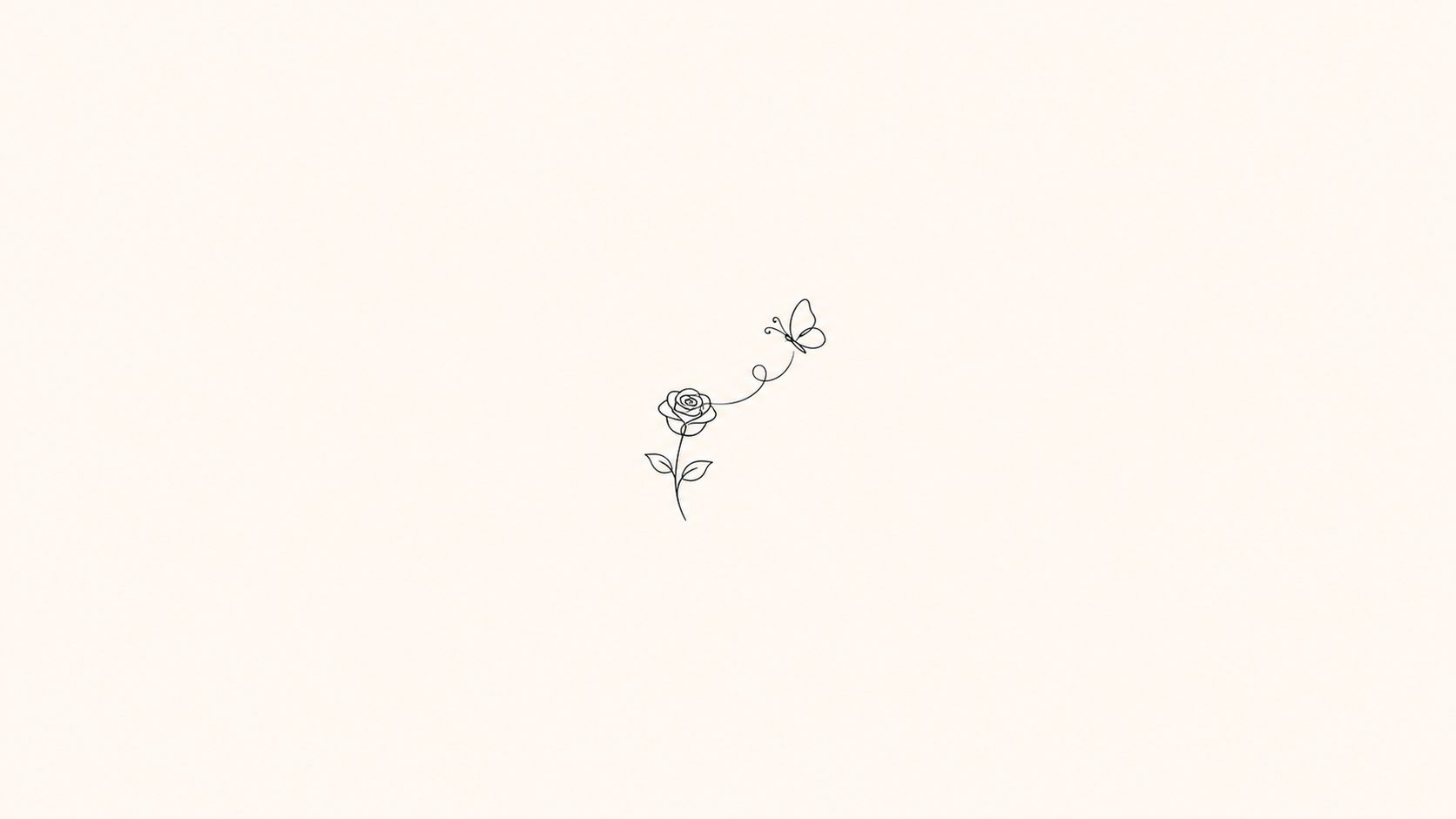
A minimalist rose and butterfly is a drawing reduced until one more deletion would break it. Fine line or single needle, generous bare skin, a suggestion of a bloom rather than a diagram of one. Done well it looks like a pen sketch that happens to be permanent.
Six to eight lines is the honest budget
Past that, lines sit so close they heal into each other. Ask for 3 to 5 cm with clean spacing between strokes, and expect the artist to remove petals you were attached to. The trade-off is longevity: thin lines blur toward grey over years, and hands, fingers, and feet blur fastest because the skin renews there constantly. A worked example: a single-line rose with one thorn and a two-stroke butterfly on the inner wrist, small enough to hide under a watch and still legible.
Botanical reference still matters at this scale. The Royal Horticultural Society's guide to botanical tattoos notes that tattoo historian Matt Lodder reads floral work as both decorative and allegorical, tying the rose to softness, scent, danger, and thorns. That's useful even in six lines: a single thorn stroke under the butterfly carries more meaning than paragraphs of symbolism, and it costs you one mark.
That guide also makes the practical point that small placements need bold outer contours and simplified petal groups, because dense micro-detail collapses as a tattoo ages. So the minimal brief isn't "less detail". It's fewer, stronger shapes.
- Test the placement with a stencil: wear it for a day at work before committing, especially behind the ear or on a finger.
- Ask for one line weight: mixed weights read as noise at this size.
- Leave room to add: a minimal piece on the inner forearm can gain a stem, a second butterfly, or lettering later.
If you want the butterfly larger and the rose reduced, our guide to a butterfly tattoo on the forearm covers scale and flow for that area.
5. Japanese Irezumi-Style Rose and Butterfly
Most lists skip the trade-off that matters here. The rose isn't a native motif in traditional Japanese tattooing. Peonies, chrysanthemums, and cherry blossoms fill that role. A rose in an irezumi composition is usually an adaptation, drawn with Western fullness and then fitted into a Japanese frame of wind bars, water, clouds, or falling petals.
That adaptation is exactly why this style needs the most planning and delivers the most impressive result. The butterfly belongs in Japanese work. The rose is a guest, and a skilled artist places it deliberately, often lower or further back, while the butterfly carries the movement across the panel.
Compose the whole area, not the motif
Irezumi isn't designed as a floating image. It's designed as a panel, with the shape of the body as the frame. On a sleeve or a back piece, settle where the wind bars flow and where bare skin stays open before either flower gets drawn.
Custom work is the norm, which suits this style. An industry compilation of tattoo statistics reports that about 60% of tattoo customers prefer custom designs over flash, a figure worth treating as directional rather than a benchmark, and irezumi sits at the extreme end of that preference. Nothing comes off a wall.
Inspiration isn't the constraint either. A 2024 roundup on HBTat2 listed 139 rose and butterfly designs, and none of them answer the question that matters here: how the motif fits a body panel that curves.
Ask any irezumi artist two questions before booking: which direction the composition flows, and which background element ties the rose to the butterfly.
A worked example: on a half-sleeve, a rose anchored near the elbow with wind bars rising toward the shoulder and a butterfly turning at the deltoid gives the piece movement instead of a stacked pair of images. That's a composition decision, not a flower decision.
- Learn the background symbolism first: waves, wind, and clouds each carry associations, and adding one by accident changes the story.
- Plan the sessions: a full sleeve is a project over months, not a single booking.
- Check Japanese-specific experience: ask to see healed panels, not isolated flowers.
6. Neo-Traditional Rose and Butterfly
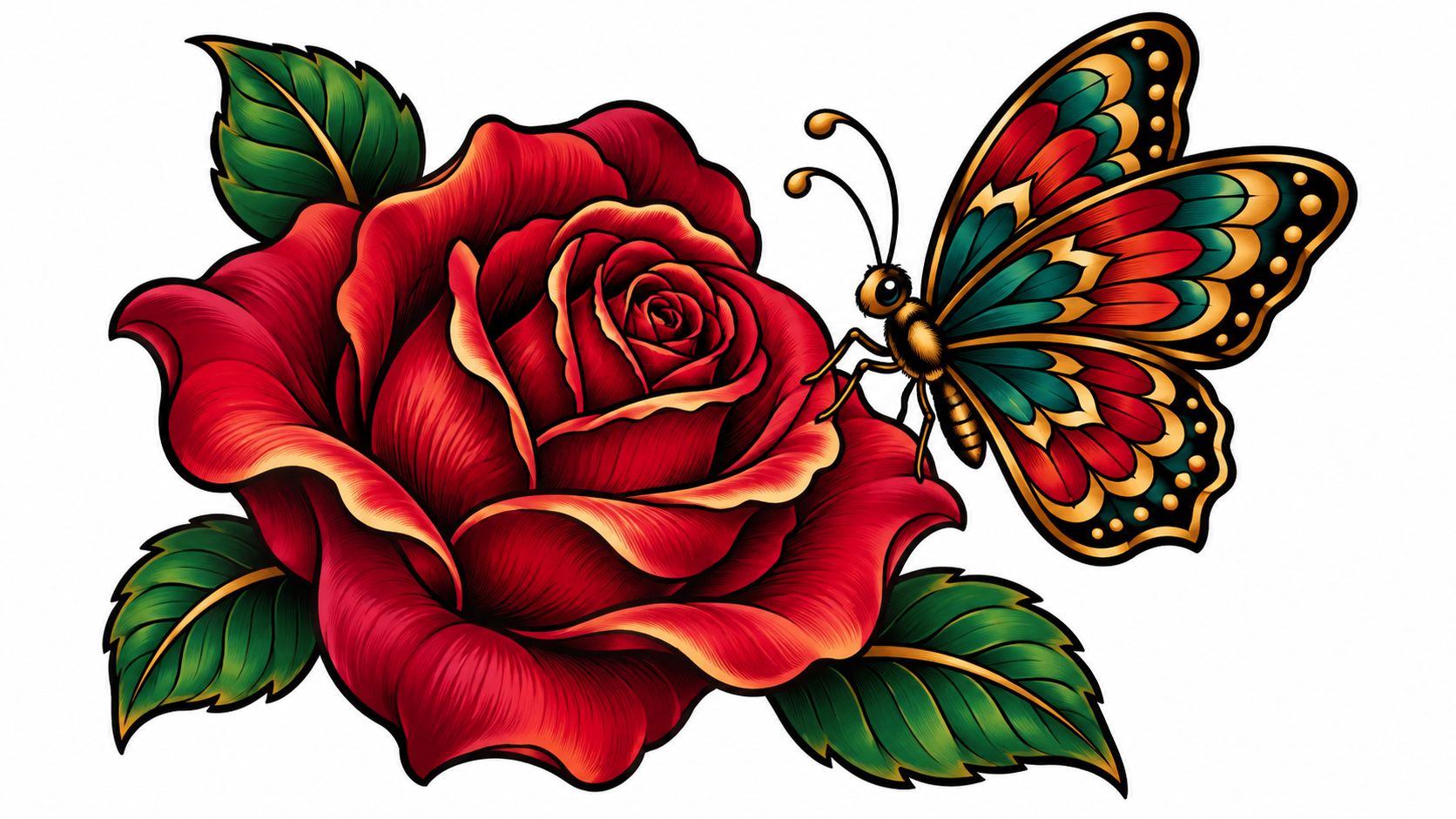
Traditional work pares the rose down. Neo-traditional builds it back up, keeping the bold contour and readable silhouette while adding depth: richer color, layered shading inside the petals, ornamental leaves, filigree, or a patterned wing instead of a flat one.
The butterfly is where this style earns its money. Patterned wings, a metallic hint, decorative dots along the edge, all of it holds because the outline still does the structural work that stops the piece turning into a blur.
Balance is the craft, not the color
The failure mode is bold outside and fuzzy inside, with soft interior shading fighting a heavy contour. Ask the artist where the detail will live. Usually it's the rose centre, one wing, and a single ornamental leaf, while everything else stays flatter. A worked example: an upper-arm piece with a full bloom at the shoulder, leaves wrapping the deltoid, and a patterned butterfly angled away from the body, which reads as one badge from across a room and gains depth up close.
Color longevity is the main risk. Saturated neo-traditional color dulls over a decade, and reds and purples shift first. Look at healed work three or four years out, not a fresh portfolio shot taken under studio light.
- Name the one fully rendered area: a piece with three focal points has none.
- Review healed color at least three years old: fresh portfolios hide fading.
- Compare palette versions before booking: generating two or three colorways of the same composition makes the choice concrete.
7. Blackwork and Geometric Rose and Butterfly
Blackwork solves a problem color can't: it covers. Solid black fills and precise negative space read as a rose and a butterfly from across a room, and they sit over old ink more convincingly than a soft watercolor bloom ever will.
Geometric treatment pushes further, breaking the bloom and the wings into segments, arcs, and symmetry. The risk here is precision, not taste. A circle that's slightly off reads as a mistake rather than a style choice, and misjudged symmetry never stops bothering you.
Flat surfaces and honest symmetry
Placement matters more in this style than in any other on this list. Sternum, upper arm, shoulder blade, thigh: surfaces that don't twist much under the needle or after healing. A geometric panel on a moving joint distorts, and no drawing skill fixes that after the fact.
Reversibility is worth pricing in. A rose and butterfly design roundup on StyleCraze cites a U.S. adult study in which 18.2% of tattooed participants regretted at least one tattoo and 52.1% were interested in removing, covering, or revising one. Bold black shapes are easier to cover or laser than fine color detail, which makes blackwork the most forgiving choice if you're not certain yet.
Design rule: if a composition still works as solid black at half the size, it will work at the size you actually want.
A worked example: a blackwork rose on the upper arm with the butterfly's wing rebuilt as a fan of geometric segments leaves the outer contour intact, so the piece reads at a distance while the interior gives the artist room to open up negative space.
- Balance solid and open areas: all black reads as a block from far away.
- Choose a flat surface: line accuracy drops on curved, moving skin.
- Compare symmetry options: two or three geometric variations side by side expose the weak one fast.
8. Dotwork Rose and Butterfly
Dotwork is the slowest style here and the one that ages best. Shading comes from dots grouped by density, so a petal fades from dark to light without a solid gradient stroke, and a butterfly reads as texture instead of line.
The catch is size. Dots need room to separate. Squeeze a stippled rose and a dotted butterfly into a 5 cm wrist gap and the texture merges into grey smudge within a couple of years. Ask for enough space for the dot density to stay legible, usually a palm-sized piece or larger.
Healing and honesty
Healing deserves real attention here. A study indexed on PubMed reported itchy tattoos in 21.2% of respondents and histories of infected tattoos in 3.2%, so dense dotwork belongs in the category that needs clean aftercare, no picking, and no sun for the first weeks.
Ask for healed examples two years old. Fresh dotwork looks crisp because the dots are still sharply separated. Healed dotwork tells you whether the density held or closed up into a flat grey.
A worked example: a forearm piece with a stippled rose at the centre, a dotted mandala arc behind it, and a small butterfly set slightly off-axis, which gives the eye one clear focal point and a reason to look twice.
- Confirm healed dotwork: two years or older, not a fresh sleeve.
- Size up rather than down: palm-sized and larger keeps the dots apart.
- Book longer sessions: dot density costs hours, and rushing it flattens the gradient.
How the Eight Rose and Butterfly Tattoo Styles Compare
The same motif, a rose with a butterfly, turns into eight different tattoos depending on style. Size, placement, and how the piece ages all shift with it. Use this table to narrow the field before you test anything on skin.
| Item | Best For | Typical Placement | Detail Level | Longevity Notes |
|---|---|---|---|---|
| Traditional American Rose with Butterfly | First-time tattoo seekers wanting a classic, durable look | Forearm, calf, upper arm, shoulder | Bold outlines, flat color, simple shapes | Bold lines and saturated colors age well; bright reds may need touch-ups |
| Realistic Rose and Butterfly | Tattoo enthusiasts planning a detailed, personal piece | Upper arm, sleeve, back of shoulder, thigh | High detail with realistic shading and textures | Fine details can blur over time; sun protection and maintenance help preserve contrast |
| Watercolor Rose and Butterfly | Design-savvy creatives seeking expressive color | Shoulder blade, thigh, upper back, ankle | Soft blends, splashes, and minimal outlines | Colors may blur or fade faster; touch-ups may help maintain vibrancy |
| Minimalist Line Art Rose and Butterfly | First-time seekers wanting a small, low-commitment piece | Inner wrist, behind the ear, finger, collarbone | Simple fine lines with little or no shading | Fine lines can spread or blur over the years |
| Japanese Irezumi-Style Rose and Butterfly | Tattoo enthusiasts planning a sleeve or back piece | Full sleeve, back, chest, thigh | Large, flowing composition with bold outlines and supporting motifs | Bold outlines and shading support durability; large compositions may require multiple sessions |
| Neo-Traditional Rose and Butterfly | Tattoo enthusiasts wanting a bold but detailed look | Upper arm, forearm, thigh, calf | Rich color, detailed shading, and decorative elements | Detail may need touch-ups; healed artist work can indicate color longevity |
| Blackwork and Geometric Rose and Butterfly | Design-savvy creatives who prefer a graphic, modern look | Chest, upper arm, back, forearm | High-contrast shapes, solid fills, and geometric patterns | Strong contrast holds up well; large solid fills take longer to heal |
| Dotwork Rose and Butterfly | Tattoo enthusiasts who value texture and symbolic meaning | Forearm, upper arm, back, ankle | Stippled shading and detailed dot patterns | Dots can fade or spread; adequate size and skilled execution help preserve clarity |
Read the table as a set of trade-offs, not a ranking. Styles with bold outlines, traditional, Irezumi, blackwork, tolerate smaller sizes because the outline does the work. Styles built on soft transitions, realism, watercolor, need room and commit you to sun protection and occasional touch-ups. Watercolor earns its own caution: the bleed effect depends on open space, so it belongs on the shoulder blade, thigh, upper back, or ankle rather than cramped spots.
One test works across all eight. Print your reference at the actual size you plan, tape it to the placement, and wear it for a day. If the butterfly reads as a smudge at arm's length, scale up or simplify before you book.
Whichever row you land on, treat any reference image as a starting point for the artist, not a finished stencil. Ask the artist to redraw it for your body, your skin, and how that placement ages.
Turning Your Favorite Rose and Butterfly Concept into Ink
By now the field should be narrower than it was an hour ago. The style you pick sets the minimum size, the placement that suits it, and how the piece looks after a decade of sun and skin changes. Bold traditional and blackwork survive at smaller sizes because the outline carries them. Realism and dotwork need room or they collapse into grey. Minimalism buys you subtlety and speed, and pays for it on hands, fingers, and feet where thin lines blur fastest.
Three decisions do most of the work:
- Detail against longevity: the finest version of any concept is rarely the version that ages best. Decide which one you want before you fall in love with a reference image.
- Placement against expansion: a forearm piece is easy to extend into a sleeve. A wrist piece usually isn't, and a sternum piece changes shape with your body over time.
- Symbolism against structure: thorn direction, wing position, open or closed bloom, negative space. These choices say more than a paragraph of meaning ever will.
A generated concept is a reference for the tattooist, not a stencil. The artist redraws it for your body, your muscle structure, your skin tone, and how that area ages. A rose that sits perfectly on a flat reference drawing still has to wrap a forearm. Treat the image as the start of the conversation, not the end of it.
If you're planning words alongside the flower, the same scale logic applies to text, and this roundup of best song lyrics for tattoos is a useful cross-check before you commit to lettering near a detailed wing.
The practical next step: generate two or three variations of the same idea in different styles, put them side by side, and notice which one you keep returning to. Then take the strongest to a tattooist you trust, with the placement and a rough size in centimetres. A generator like TattoosAI can produce those side-by-side options in nineteen styles, including realistic, blackwork, japanese, and fine line, and you can refine color before the consultation. What you get is artwork to discuss, not a finished stencil, and that conversation is where a good tattoo starts.
TattoosAI turns a written idea into tattoo concepts you can judge properly: describe your rose and butterfly, choose from nineteen styles such as realistic, watercolor, blackwork, or Japanese, and get several distinct designs in one session instead of a folder of screenshots. Compare composition, color, and scale before you book, then take the strongest version to the tattooist you trust. Start with your idea at TattoosAI and walk into the consultation already knowing what you want.