TattoosAI
A rose is one of the oldest symbols in tattoo culture, with associations reaching back to ancient Greece and Rome, where it was linked to Aphrodite and Venus as an emblem of love, beauty, and fertility. The motif later became especially prominent in American traditional tattooing, while floral tattoos were already fashionable in Edwardian London by the turn of the twentieth century, giving the rose a history that spans roughly 2,000+ years of symbolism and visual culture (Harvard's history of rose tattoo meaning). Tribal tattooing brings a very different visual language. Bold shapes, directional lines, repeated geometry, and dense blackwork can give the composition structure and movement.
That contrast explains why rose and tribal tattoos remain so compelling. The rose supplies softness, emotion, and an instantly recognizable focal point. Tribal-inspired geometry adds visual weight, framing, rhythm, and flow. The strongest designs don't treat these elements as interchangeable decorations. They decide which feature leads, how much skin remains open, how the design will age, and what cultural reference the pattern draws from.
The eight directions below move from classic framing and full-sleeve flow to watercolor, minimalist, dimensional, blackwork, Japanese-inspired, and geometric treatments. Before choosing one, identify the specific tradition or visual reference you want. Polynesian, Māori, Samoan, Celtic, contemporary tribal, and cyber-sigilism-inspired work aren't the same thing, so discuss the reference with an artist who can interpret it respectfully and explain what can be adapted.
Table of Contents
- 1. Classic Rose with Tribal Wrap
- 2. Tribal Rose Sleeve Design
- 3. Watercolor Rose with Tribal Outline
- 4. Minimalist Rose with Negative Space Tribal
- 5. 3D Rose with Tribal Shadow Effects
- 6. Blackwork Rose and Tribal Fusion
- 7. Japanese Inspired Rose with Traditional Tribal
- 8. Geometric Rose with Tribal Polygon Pattern
- 8-Style Rose & Tribal Tattoo Comparison
- Turn a Strong Concept into Cohesive Ink
1. Classic Rose with Tribal Wrap
A classic rose with a tribal wrap gives the flower a strong architectural frame. The rose can be realistic, illustrative, or simplified, while bold bands and pointed curves encircle the stem, cross behind the petals, or follow the shape of the limb. The result works because the two elements perform different jobs. The rose creates the emotional center, and the tribal-inspired pattern controls the outline and direction.
A forearm design might place a shaded red rose near the center, with black Polynesian-inspired bands wrapping around the arm above and below it. A chest piece could use a rose as the focal point, then surround it with Māori-inspired spirals or geometric borders. On the shoulder, the flower might sit inside angular framing that follows the deltoid instead of forcing the pattern into a flat rectangle.
Make the contrast intentional
Color can separate the motifs immediately. A red, pink, or white rose against black patterning creates a clear focal point, while a black-and-gray rose produces a quieter, more unified result. If you're uncertain, ask your artist to show the same composition in both versions before deciding.
Negative space matters just as much as ink. Solid tribal shapes placed too close to detailed petals can make the design feel crowded, especially on a curved area such as the upper arm.
Practical rule: Bring specific references for the tribal influence, not just a request for “tribal lines.” The pattern's cultural source should be part of the conversation.
You can use TattoosAI's rose tattoo meaning guide to clarify the emotional direction before creating visual references. Generate several arrangements, then show your artist the concepts as discussion material rather than treating an AI image as a stencil. Start small if you want to test how the flower and pattern feel together, but remember that a small design may require simpler petals and fewer internal details.
2. Tribal Rose Sleeve Design
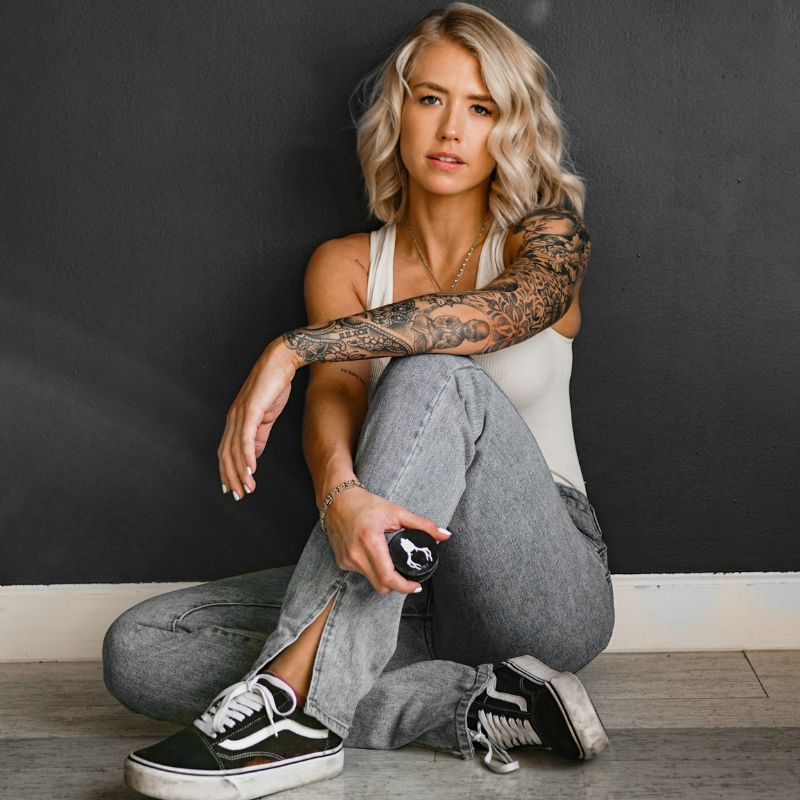
A sleeve succeeds or fails through flow. Several roses can look disconnected if each flower is designed as an isolated sticker. Tribal-inspired bands, tapered shapes, and linking lines can act as the connective tissue, carrying the eye from the shoulder toward the wrist and giving separate motifs a shared rhythm.
A half-sleeve might place three or four roses at different angles, with Samoan-inspired patterning filling the spaces between them. Another approach could combine photorealistic roses with bold geometric linework. A full arm could use a larger rose near the shoulder, smaller blooms along the outer arm, and bands that change direction around the elbow without interrupting the overall movement.
Plan the arm before booking sessions
A sleeve should be mapped on the body, not planned only on a flat page. Ask the artist to consider how the design looks with the arm relaxed, bent, and viewed from the front, side, and back. Clothing, workplace visibility, and the possibility of adding future work also deserve attention.
Use digital concepts to compare different ratios of flower to pattern. One version might make the roses dominant, while another might let black geometry occupy more of the arm. The intermediate stages matter too. If the sleeve will be completed across multiple appointments, you should know whether each stage looks deliberate on its own.
A practical planning sequence:
- Define the focal area: Decide which rose viewers should notice first.
- Map the movement: Trace how bands and negative spaces travel around the arm.
- Reserve breathing room: Leave open skin where petals, joints, or future additions need clarity.
- Test visibility: Review the sleeve with short sleeves, long sleeves, and the arm in motion.
- Discuss completion stages: Confirm how partial work will connect between appointments.

A video can help you think about the design process, but your consultation should focus on your anatomy, reference material, and the artist's own approach.
3. Watercolor Rose with Tribal Outline
Watercolor treatment changes the emotional temperature of the design. Soft washes in pink, red, or purple can make the rose feel atmospheric and expressive, while black tribal-inspired outlines supply a firm visual boundary. The tension is appealing, but it needs careful control. Loose color should look intentional, not like it was added after the structure was finished.
A forearm piece could feature a blooming watercolor rose contained by angular black bands. Another design might reduce the flower to a geometric silhouette, then place translucent color inside it and use a sharp outline to define the edges. On a smaller area, a restrained wash behind the petals may work better than a large halo that competes with the pattern.
Protect the hierarchy
The rose should remain legible from a normal viewing distance. Ask the artist how the color transitions will be built and which lines will carry the image if the softer pigment loses intensity over time. Placement also matters. Areas with less direct sun exposure may help preserve the appearance of color, but your artist should explain the practical expectations for your skin and lifestyle.
Watercolor work isn't a good match for every tattooer. Look for healed examples, not only fresh photographs. A portfolio should show whether the artist can combine soft color, crisp linework, and enough contrast to keep the rose recognizable.
Before the appointment, compare several versions:
- Warm palette: Red and pink can keep the flower close to traditional rose imagery.
- Cool palette: Purple can make the composition feel more unusual and dreamlike.
- Limited palette: One or two colors may preserve clarity beside dense black patterning.
- Minimal wash: A controlled accent can keep the tribal outline in charge.

4. Minimalist Rose with Negative Space Tribal
Minimalist rose and tribal tattoos depend on restraint. A single-line or fine-line rose can provide the recognizable image, while the tribal influence appears through the skin left untouched around and between the marks. Instead of relying on solid black fills, the artist uses boundaries, spacing, and repetition to suggest a geometric framework.
A wrist design might pair a simple rose with a diamond-shaped negative-space structure. An ankle piece could use a few angular lines to guide the eye around the flower without enclosing it completely. Finger and hand placements can be visually effective, but they also demand a realistic conversation about visibility, movement, and how small details will behave in a high-use area.
Give fine lines enough room
Small does not automatically mean easy. A minimalist tattoo needs enough scale for the petals, stem, and surrounding geometry to remain distinct. Lines that are too delicate can lose clarity, while tightly packed shapes can blur into an indistinct mark.
Ask for a version with slightly stronger lines than your first instinct. The goal isn't to make the tattoo heavy. It's to preserve the visual relationship between the rose and the open skin as the work settles.
Choose an artist who regularly produces fine-line and negative-space work. Review healed examples and ask how the design has been simplified for the chosen placement. TattoosAI's minimalist and line-work options can help you compare a single-line flower, a restrained outline, and a more graphic rose before presenting a focused request to the artist.
The empty skin isn't leftover space. In this style, it carries the pattern.
For a practical prompt, describe the flower first, then specify the pattern density, body area, line strength, and whether the tribal influence should frame the rose or pass behind it. That gives the artist useful decisions instead of a vague request for something “simple.”
5. 3D Rose with Tribal Shadow Effects
A 3D rose can make the tribal pattern behave like a surface behind the flower. The bloom may rise above it, overlap its edges, or cast a defined shadow across the design. Shading creates the depth, while contrast and clean edges keep the rose separate from the graphic background. The artist therefore needs control of both realistic petals and structured tribal forms.
On the shoulder, a realistic rose can appear to lift from dark angular shapes beneath it. On the upper arm, tribal points may fade as they approach the petals, creating a gradual transition instead of a hard collision. A geometric background can sit farther back when the artist leaves a clear edge around the bloom. These choices give the tattoo a visual order the eye can follow.
Depth needs a readable structure
Choose the foreground before adding detail. If the rose leads, give its petals the sharpest edges and strongest contrast. If the tribal pattern leads, let the flower use softer shading and fewer competing highlights. Equal contrast across both layers can flatten the illusion because the eye has no clear resting point.
Ask for a high-resolution sketch showing the light direction. A rose lit from the upper left should cast shadows consistently, and the background should support that direction rather than contradict it. Placement also changes the effect. The rounded shoulder can support a fuller illusion, while a narrow wrist usually needs simpler shadows and fewer overlapping shapes.
Small adjustments matter.
TattoosAI's 3D style options can help you compare a strong cast shadow, a carved effect, and a rose embedded in the tribal pattern. Bring the preferred relationship to the tattoo artist, then ask how it should change for skin, scale, and technique.
Ask which shadows need the highest contrast to remain legible and where the artist expects soft shading to lighten first. Confirm whether the placement will need a later touch-up to restore separation between the rose and tribal background. This discussion helps preserve the depth effect without forcing every detail to remain equally dark.
6. Blackwork Rose and Tribal Fusion
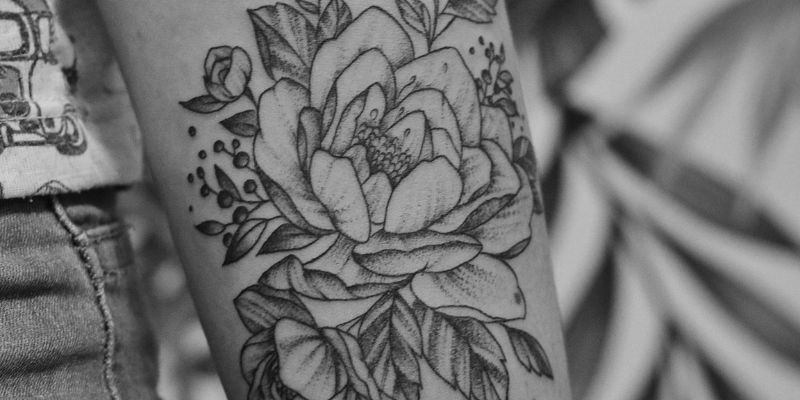
Blackwork creates the most forceful version of this pairing. Solid black shapes can merge the rose and tribal elements into a single composition, while carefully planned skin breaks keep the flower readable. The rose might appear as a black silhouette, a line-detailed bloom surrounded by dark fills, or a negative-space shape cut out of a larger field.
A back or chest piece can use a broad tribal-inspired background with the rose emerging as the visual anchor. An arm band might turn the flower into a silhouette inside a continuous black structure. On a smaller placement, a limited blackwork rose with a few open petal shapes may be more successful than a dense miniature composition.
Control visual weight
Black ink attracts attention and can make a design feel heavier than expected. The artist should assess the body area, surrounding tattoos, and the amount of open skin available. A large saturated section may need deliberate edges and breathing room so it doesn't become a solid visual block.
Negative space is the separating tool. It can define the outer petals, reveal the stem, or create a clean border between the rose and the pattern. If those gaps are too narrow, the elements may merge after the tattoo settles.
Use a blackwork or bold-line portfolio to evaluate the artist's control. Fresh saturation alone doesn't prove that the composition will remain legible. Ask how the artist plans the fills, what lines will remain visible, and which details should be removed before tattooing.
Before choosing this direction, check:
- Contrast: Can you identify the rose without relying on color?
- Spacing: Are the open areas wide enough to separate major forms?
- Placement: Does the body area support the design's visual density?
- Commitment: Are you comfortable with a composition that may be difficult to lighten or cover?
- Consistency: Does the artist show healed blackwork with clean edges?
TattoosAI's blackwork and bold-line styles can help you compare a silhouette-led design with a more detailed rose inside a dark framework.
7. Japanese Inspired Rose with Traditional Tribal
This fusion combines several visual traditions, so research and communication are essential. A Japanese-inspired rose may use flowing petals, strong outlines, and a composition built around movement, while the surrounding work can include waves, wind bars, geometric framing, or a separate tribal reference. The design should make those influences clear rather than blending unrelated symbols into a generic “mixed culture” sleeve.
A chest piece might place a Japanese-style rose beside wave movement and a carefully identified geometric influence. A larger sleeve could use the rose as one element in a nature-based composition, with the pattern supporting the flow from shoulder to forearm. A smaller piece may need to choose one Japanese feature, such as wave structure, instead of trying to include every possible motif.
Respect comes before decoration
Japanese tattooing has its own history, visual grammar, and working methods. Indigenous and regional tribal traditions also carry distinct meanings and protocols. Treating these references as interchangeable graphics can produce a design that feels generic or culturally careless.
Start by naming the source you're drawn to. Ask the artist what can be adapted, what should remain specific, and whether they have training or experience with the tradition you're referencing. A tattooer who works in Japanese-inspired composition may not be the right person for a Polynesian or Māori-inspired pattern, and the reverse can also be true.
TattoosAI's Japanese style can help you explore broad compositional directions, but the artist should make the final decisions about cultural context, anatomy, linework, and execution. Bring several references and explain what attracts you to each one. Don't ask for a direct copy of an existing sleeve.
The rose can represent love, beauty, remembrance, or personal transformation, but symbolism won't repair a poorly chosen cultural reference. Meaning and visual responsibility need to develop together.
8. Geometric Rose with Tribal Polygon Pattern
A geometric rose replaces some natural softness with structure. Petals can be built from triangles, polygons, crystalline facets, or measured line segments, while the surrounding tribal-inspired pattern repeats those angular decisions. The rose remains recognizable because of its layered center, silhouette, and petal rhythm, even though it no longer imitates a natural bloom.
A shoulder design could use a crystalline rose inside a polygonal frame that follows the curve of the deltoid. A forearm composition might place a faceted flower beside hexagonal bands. Another version could use interconnected triangles to build both the rose and the surrounding pattern, creating a consistent visual system instead of two unrelated motifs.
Precision must meet anatomy
Geometric tattoos look unforgiving when lines drift or spacing changes unexpectedly. Ask the artist how they'll adapt the design to a curved, moving surface. A template that looks balanced on a screen may need adjustment around the wrist, elbow, or shoulder.
The best reference brief includes more than “geometric rose.” Specify whether you want sharp crystalline facets, soft symmetry, polygonal shading, or a mostly line-based design. Then explain how much tribal pattern you want and whether it should act as a border, background, or continuation of the flower.
Useful customization choices include:
- Rose structure: Choose a natural silhouette with angular shading or a fully deconstructed form.
- Pattern density: Decide whether the geometry stays open or uses solid black sections.
- Symmetry: Use mirrored framing for a formal look or varied shapes for movement.
- Scale: Give the artist room to preserve precise intersections and readable petals.
- Placement: Match the pattern's direction to the body's natural lines.
For early concept development, TattoosAI's geometric blackwork tattoo guide can help you compare polygonal roses with darker angular treatments. Generate multiple variations, then ask an experienced geometric tattoo artist to simplify, measure, and redraw the selected concept for your body.
8-Style Rose & Tribal Tattoo Comparison
| Design | 🔄 Implementation Complexity | ⚡ Resource Requirements (time / cost / skill) | ⭐ Expected Outcomes (quality / impact) | 📊 Ideal Use Cases | 💡 Key Advantages / Tips |
|---|---|---|---|---|---|
| Classic Rose with Tribal Wrap | Moderate, balancing organic rose and geometric tribal forms | Moderate time; skilled artist for clean lines; color optional | High visual clarity and versatility ⭐⭐⭐⭐ | Arm bands, forearms, chest, shoulders, sleeve integration | Versatile and scalable; discuss negative space and color contrast 💡 |
| Tribal Rose Sleeve Design | High, continuous flow and multi-element composition | High → 15–30+ hrs, multiple sessions, higher cost, expert artist | Very high statement piece, cohesive storytelling ⭐⭐⭐⭐⭐ | Full/half sleeves, large canvas, long-term commitments | Plan flow and sessions; use mockups and consult artist early 💡 |
| Watercolor Rose with Tribal Outline | High, requires control of watercolor bleed + crisp tribal lines | Medium–high; color expertise; more frequent touch-ups | Artistic, eye-catching, social-media friendly ⭐⭐⭐⭐ | Visible areas (forearm, shoulder), modern aesthetic seekers | Select experienced watercolor artist; minimize sun exposure; expect touch-ups 💡 |
| Minimalist Rose with Negative Space Tribal | Low–Moderate, precision fine-line work required | Low time/cost; fast sessions but needs fine-line specialist | Subtle, elegant, ages well if executed properly ⭐⭐⭐ | Wrist, fingers, ankle, professional settings, understated looks | Use slightly heavier lines for longevity; pick fine-line specialist 💡 |
| 3D Rose with Tribal Shadow Effects | Very high, advanced shading and dimensional techniques | High time/cost; top-tier realistic tattoo artist required | Extremely striking and dimensional when done right ⭐⭐⭐⭐⭐ | Chest, back, shoulders, thighs, larger placements preferred | Review 3D portfolio; request high-res sketches and shading plan 💡 |
| Black Work Rose and Tribal Fusion | Moderate–High, heavy black coverage needs balance | Moderate; dense black ink work; lower color maintenance | Bold, durable, long-lasting high contrast ⭐⭐⭐⭐ | Bold personalities, large placements, all skin tones | Ensure negative space planning to avoid overly heavy appearance 💡 |
| Japanese Inspired Rose with Traditional Tribal | High, requires knowledge of irezumi composition and motifs | High; specialist artist with cultural experience; larger canvas | Rich, symbolic, sophisticated results ⭐⭐⭐⭐ | Large sleeves, back/chest pieces, culturally informed projects | Research cultural meanings; choose an artist versed in Japanese tradition 💡 |
| Geometric Rose with Tribal Polygon Pattern | Moderate, precision geometry and symmetry required | Moderate; artist skilled in geometric measurement and templates | Contemporary, clean, design-forward results ⭐⭐⭐⭐ | Design-conscious clients, forearm/shoulder, social media portfolios | Request digital templates and precise measurements; vet geometric portfolio 💡 |
Turn a Strong Concept into Cohesive Ink
Choosing among these eight directions becomes easier when you separate style preference from practical constraints. Start with the visual priority. If the rose should lead, give it the clearest silhouette, strongest contrast, or most detailed rendering, then let the tribal-inspired elements frame and support it. If the pattern should lead, simplify the flower into a silhouette, outline, or restrained geometric form so the surrounding structure carries the composition.
The second decision concerns negative space. Open skin separates petals, bands, and filled shapes. It also prevents a dense composition from becoming visually muddy as the tattoo settles. Minimalist and geometric designs depend on spacing for clarity, while blackwork designs use negative space to carve the rose out of dark areas. Ask your artist to show where the skin will remain open, not just where ink will be placed.
Scale follows from detail. A realistic rose with layered shading needs more room than a simple outline. A sleeve needs enough surface area for flow around joints and between major motifs. A small wrist or ankle design may work best with one rose, a limited pattern, and fewer internal lines. Don't shrink a complex reference until every feature becomes cramped.
Placement also changes meaning and wearability. A shoulder can support a rounded composition. The forearm offers visibility and a strong vertical direction. The chest, back, and upper arm can carry broader framing and deeper pattern flow. Hands, fingers, and other high-use areas require especially careful expectations about visibility and long-term maintenance.
Cultural context belongs in the final design brief. “Tribal” is a broad label covering diverse traditions and modern adaptations. A global review describes tattoo prevalence in developed countries as ranging from 5.2% to 35.3%, showing how widespread tattooing has become across different populations, but popularity doesn't make every cultural borrowing appropriate (the global prevalence review discussed in this coverage). Ask what specific reference you're using, why it matters to you, and whether your artist can interpret it responsibly.
TattoosAI can help during the concept stage. Describe the rose, the tribal influence, the placement, the color treatment, and the preferred direction, then generate variations to compare. Use those results as conversation material with your tattooist, not as a demand for an exact copy. The tool supports styles including minimalist, Japanese, watercolor, geometric, 3D, and blackwork, which makes it useful for testing how one subject changes across visual languages.
Before booking, confirm the following:
- Cultural reference: Name the tradition or contemporary influence you want.
- Artist portfolio: Review relevant healed work and ask about the techniques involved.
- Long-term aging: Discuss line thickness, color, saturation, contrast, and potential touch-ups.
- Scale: Make sure the design has enough room for its most important details.
- Visibility: Consider work, clothing, family expectations, and whether you want the tattoo easily seen.
- Customization: Bring references, but ask for an original composition built around your anatomy.
- Final consultation: Approve the placement, proportions, pattern language, and stencil before tattooing begins.
The most successful rose and tribal tattoos aren't assembled from attractive parts alone. They have a clear hierarchy, enough open skin, a realistic scale, and a cultural reference the wearer can explain. Give your artist a focused brief and enough freedom to translate it into work that belongs on your body.
Describe your rose, tribal influence, placement, color preferences, and desired style in TattoosAI, then generate variations you can compare before your studio visit. Use the concepts to make your consultation more focused and invite your tattoo artist to refine the final design for your anatomy, skin, and long-term goals.