TattoosAI
You're holding a rough sketch of seven overlapping circles, trying to picture it on your forearm, ribs, or ankle. On paper, the geometry looks fixed. On skin, it changes quickly. Line weight, dot density, contrast, color, scale, and body movement all affect whether the pattern feels delicate, architectural, organic, or bold.
The most useful question isn't only what a Seed of Life means. It's how you want the design to behave after the appointment. This list compares practical execution across geometric, dotwork, blackwork, and watercolor approaches, then pairs each style with placements and consult-ready decisions. Historical claims about the symbol also need care. The seven-circle form is often discussed alongside the larger Flower of Life, while meanings such as creation, renewal, or potential are modern interpretations rather than universally fixed facts. If you're comparing symbolic motifs, this guide to what arrows really mean is a useful reminder that visual meaning depends on context.
Table of Contents
- 1. TattoosAI
- 2. Okan Uckun
- 3. Dillon Forte Tattoo
- 4. Black Serum Tattoo
- 5. 2Spirit Tattoo, ROXX
- 6. Raúl Wesche
- 7. DotsToLines, Chaim Machlev
- Seed of Life Tattoo, 7-Artist Comparison
- Turn These Seed of Life Ideas Into a Consult-Ready Brief
1. TattoosAI
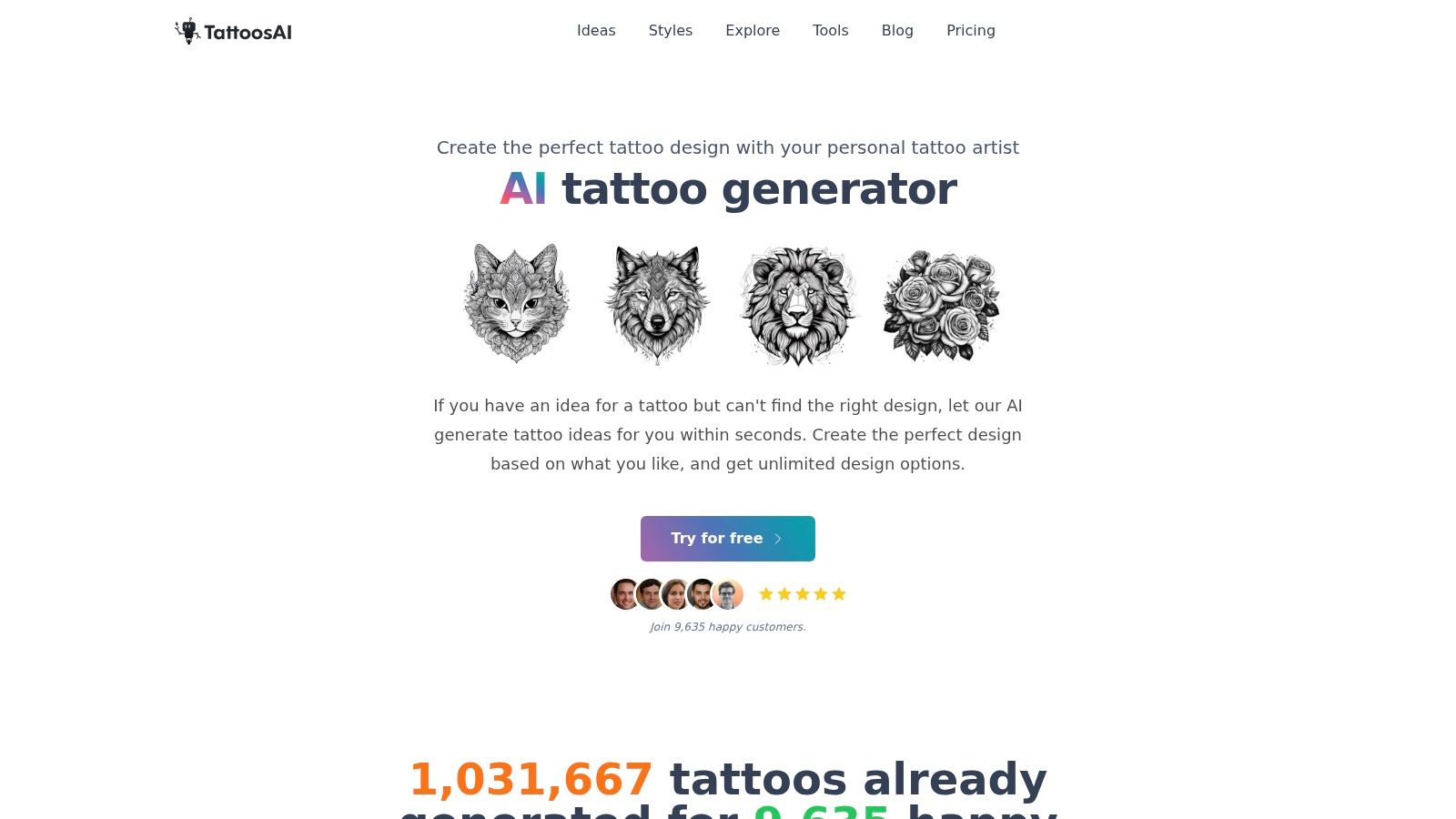
A Seed of Life tattoo starts as an idea, but most first sketches don't show how the design will sit on a curved body part. TattoosAI is useful at that early stage because it lets you compare the same seven-circle structure in different treatments before you book an artist. You can request geometric, dotwork, blackwork, minimalist, color, or black-and-white versions and assess which direction fits your placement.
The strongest use is rapid comparison, not replacing a tattooist. Generate a clean fine-line version, a heavier geometric version, and a softer dotwork or watercolor concept. Put them side by side. You'll see whether the intersections remain open, whether the outer ring needs more breathing room, and whether the intended size can support the amount of detail.
Use it to prepare, not to stencil
TattoosAI provides an inspiration gallery, saved designs, and print-ready references for a studio consultation. Pro users can create unlimited designs, which makes it practical to test variations rather than settling for the first attractive result. The output still needs professional adaptation. An artist may adjust circle spacing, simplify enclosed gaps, or increase line weight so the design remains readable as the skin changes over time.
A body-placement preview isn't available yet, and a virtual simulator is in development. Bring printed references and describe the actual body location instead of assuming a digital image predicts the final result.
Best brief: “Seven equal overlapping circles, black geometric linework, open intersections, moderate line weight, centered on the inner forearm, no added spiritual symbols.”
TattoosAI works best when you need clarity before a consult. It doesn't replace an experienced artist's judgment about skin, movement, healing, or long-term legibility. Visit TattoosAI to compare several Seed of Life directions quickly.
2. Okan Uckun
For a minimalist Seed of Life tattoo, the consultation should start with placement and line weight, not decoration. Okan Uckun's architecturally informed approach suits clients who want exact circles, measured spacing, and a restrained composition. His work is associated with sacred geometry subjects including the Seed of Life, Flower of Life, and other mathematically structured forms. The result can read almost like a diagram, with each intersection carrying visual responsibility.
The inner forearm, upper arm, sternum, and upper back provide enough stable surface for a centered motif. A small ankle or wrist design may look clear in a reference image, then lose definition on the body if the lines are too fine or the enclosed spaces are too narrow. Ask the artist to recommend a workable size for the chosen placement. The preferred diameter alone does not determine whether the pattern will age well.
Precision needs a realistic brief
Minimalist geometry leaves little room for uneven spacing. Small changes in circle width, alignment, or the outer boundary can make the pattern appear distorted. Bring a brief that specifies the center point, overall boundary, line weight, and whether the Seed of Life should remain a standalone emblem or connect to a larger composition.
Fine lines leave no room for sloppy healing. A blurred line at a light weight cannot be corrected by adding detail later. Follow the artist's dressing and cleaning instructions, avoid picking at peeling skin, and delay exfoliation until the skin has settled. A clinical evaluation of tattoo aftercare reported artist-assessed skin repair rated good to excellent in 88% of participants by day 14, while participants rated repair at 100%. Those findings were not specific to Seed of Life tattoos, so use them as a care benchmark rather than a promise for every piece. See the clinical evaluation of tattoo aftercare for the full context.
Ask before booking: “What line weight will keep the intersections open on my skin and at this placement?”
Okan Uckun is a strong fit for a mathematically controlled, quiet tattoo. Choose another direction if you want painterly color, loose texture, or a heavily ornamental frame.
3. Dillon Forte Tattoo
Dotwork changes the Seed of Life from a technical diagram into a surface with rhythm. Dillon Forte Tattoo is a natural option for clients who want sacred geometry with controlled stippling, mandala structure, and larger pattern flow. The key advantage isn't that dots look softer. It's that dot density can create hierarchy. Darker centers can anchor the design, while lighter outer areas keep the seven-circle structure from becoming a solid block.
This approach works especially well on the upper arm, shoulder, chest, back, or thigh, where the artist has room to build a gradual fade. A small wrist piece can still use dotwork, but it needs restraint. Too many dots in a compact design can close the negative spaces and make the intersections difficult to read.
Dot density controls the final weight
A good brief should identify whether you want crisp circle outlines with dot shading inside, a stippled halo around the motif, or a full mandala treatment that extends beyond the seven circles. Don't describe the style only as “sacred geometry.” Bring a reference that shows the balance between line and dot.
The history also deserves precise wording. The Seed of Life is made from seven equal circles, with one central circle surrounded by six arranged with sixfold symmetry. A frequently cited example appears on granite columns associated with the Temple of Osiris at Abydos, but the temple's construction during the reign of Seti I, approximately 1294 to 1279 BCE, doesn't establish that the markings were made at the same time. Stylistic and contextual analysis places the markings potentially between the 1st century BCE and 1st century CE. The historical overview of the Seed of Life explains why those dates shouldn't be merged.
Practical rule: Let dot density support the geometry. It shouldn't bury the intersections.
Dillon Forte Tattoo suits a client who wants the Seed of Life to feel integrated into a broader geometric language. Expect limited availability and possible travel depending on current booking arrangements. For more planning references, explore these sacred geometry tattoo ideas.
4. Black Serum Tattoo
Black Serum Tattoo makes sense when you want studio choice rather than a single-artist style. The San Francisco studio works with multiple resident and visiting artists across blackwork, fineline, dotwork, and geometric tattooing. That gives you room to compare a crisp outline, a stippled version, and a heavier blackwork interpretation without changing studios.
A black-and-grey Seed of Life can suit the forearm, calf, shoulder blade, or rib area. The placement determines how much contrast you need. On the forearm, a centered design can read clearly from a distance. On the ribs, the artist may need to adjust the circle alignment so the motif doesn't look compressed when your body moves.
Compare artists, not just the studio
A multi-artist studio gives you flexibility, but the work won't be identical from one artist to another. Review healed examples where available. Look for consistent circles, clean negative spaces, and gradients that remain intentional rather than muddy. Ask who would execute your design and whether that artist has experience with small, precise geometry.
Color requires a separate conversation. Dermatology reviews report that tattoo reactions can occur with any pigment, with red pigments more frequently implicated in reported reactions. Documented responses include allergic contact dermatitis, chronic inflammation, swelling, and occasional MRI-related irritation or burning. Tattoos generally aren't a contraindication to MRI, but some metallic or iron-containing pigments can create artifacts or heat-related symptoms. Read the dermatology review of tattoo reactions before choosing a color-heavy version.
- Choose black and grey if contrast and restrained geometry matter most.
- Ask about pigment ingredients if you have known allergies or previous reactions.
- Tell medical staff about your tattoos before an MRI, especially if you've experienced irritation during imaging.
Black Serum Tattoo is a practical option if you want several artist directions and a black-focused result. Get an artist-specific quote because pricing and execution vary.
5. 2Spirit Tattoo, ROXX
A bold Seed of Life tattoo needs a different construction from a fine-line version. At 2Spirit Tattoo, ROXX's studio is associated with blackwork, dotwork, ornamental geometry, and strong contrast. This direction suits clients who want the motif to remain visible from across a room, rather than read as a delicate technical drawing at close range.
Blackwork works well on the outer forearm, upper arm, calf, shoulder, or thigh. These areas can support a stronger silhouette and give the artist enough room to balance filled sections with untouched skin. A small ankle design can become visually heavy if the circles are filled too aggressively, so ask for a scaled version before committing.
Choose contrast over excessive detail
The studio's blackwork emphasis is an advantage when you want a timeless, graphic result. It's less suitable for pastel washes or vivid watercolor overlays. A blackwork Seed of Life can include dot gradients, ornamental borders, radial rays, or a larger mandala structure, but each addition changes the message and the space required.
Think carefully about symbolism too. The current name and spiritual framework are modern developments, and interpretations such as creation, beginnings, family, fertility, or renewal are choices rather than fixed historical meanings. If you want the tattoo to represent recovery or family connection, say that directly. The artist can then shape the framing, scale, and surrounding elements around your intent instead of relying on generic sacred-geometry language.
A strong blackwork brief names the feeling and the structure: “Bold seven-circle geometry, open negative spaces, black dot shading, no text, designed for the outer forearm.”
2Spirit Tattoo, ROXX is a fit for confident blackwork and dot-oriented geometry. Plan ahead if you want a specific artist, and confirm whether the studio can accommodate the size and surrounding composition you have in mind.
6. Raúl Wesche
A standalone Seed of Life is only one use for the motif. Raúl Wesche is better suited to clients who want the geometry to become part of a sleeve, back piece, chest composition, or large-format mandala. His practice centers on sacred geometry and mathematical patterning, with work that includes Platonic solids, mandalas, and body-spanning arrangements.
Large tattoos need a different planning process. The artist has to account for muscle direction, joints, tapering, and how one pattern leads into the next. A Seed of Life on the upper arm may need to rotate slightly so it follows the shoulder. On the back, the central axis can support a more symmetrical design. On a sleeve, the circles may become a visual anchor surrounded by lines, solids, or organic forms.
Let the body set the geometry
Bring a clear brief, but don't arrive with every line locked. For large work, the most important decisions are the focal point, overall flow, preferred contrast, and whether the piece should remain black and grey. Ask how the design will look when your arm rests naturally, not only when it's held straight for a photograph.
Raúl Wesche's work is primarily black and grey, so confirm your expectations if you want color accents. Multi-session projects also require planning around healing, scheduling, and how each completed section connects with the next.
A large-format Seed of Life can carry personal meaning without making an unsupported historical claim. You might use it as a visual starting point for a new chapter, a family marker, or a recovery symbol. Those meanings belong to you. The geometry provides structure, while the surrounding composition makes the reference personal.
This is a strong choice when body flow matters more than having a small, isolated emblem. It's not the efficient route for someone who wants a discreet ankle tattoo completed with minimal design development.
7. DotsToLines, Chaim Machlev
Some Seed of Life tattoos should follow the body instead of sitting inside a rigid circle. DotsToLines, led by Chaim Machlev, is known for continuous-line geometry, flowing mandalas, and designs mapped to anatomy. That makes the studio appealing if you want the seven-circle motif integrated into a larger composition across a limb or torso.
A body-mapped approach suits the spine, ribs, hip, thigh, shoulder, or full limb. The design may appear symmetrical in a sketch but shift subtly on the body so the lines follow movement. That isn't an error. It's the difference between placing a flat emblem on skin and designing with the anatomy.
Flow can matter more than perfect isolation
Ask whether the Seed of Life will remain the clear focal point or become one section of a continuous-line piece. A flowing design can connect the circles to mandala arcs, botanical forms, or other geometric structures. It can also make the tattoo feel less like a symbol copied from a chart.
Small gaps and fine lines need special attention. Dense micro-lines, tiny enclosed spaces, and complicated color treatments should receive a professional feasibility review before you treat a generated concept as tattoo-ready. A reference on dotwork tattoo style can help you describe whether you want soft stippling, structured gradients, or a more graphic dot pattern.
The private, design-led setting suits clients who want a highly curated result. It may involve travel and advance booking, and the artist may be selective about projects. Choose this direction when anatomy and composition are central to the idea, not when you only need a small, isolated seven-circle tattoo.
Seed of Life Tattoo, 7-Artist Comparison
| Name | Type & approach | Implementation complexity 🔄 | Resource requirements ⚡ | Expected outcomes ⭐ 📊 | Ideal use cases / Key advantages 💡 |
|---|---|---|---|---|---|
| TattoosAI | AI-powered generator for rapid Seed of Life concepts | Low 🔄, self-serve, instant iterations | Low ⚡, inexpensive; Pro for unlimited; printouts often needed | ⭐⭐⭐, strong concept visuals; 📊 high iteration speed | Concept exploration, pre-consult references / Rapid, budget-friendly idea testing |
| Okan Uckun | Architect-trained, fine-line sacred geometry | High 🔄, custom briefs, mathematical alignment | Moderate ⚡, by-appointment in NYC; plan for availability | ⭐⭐⭐⭐⭐, surgical precision; 📊 clean minimalist healed results | Precise, minimalist Seed of Life tattoos / Exceptional concentric accuracy |
| Dillon Forte Tattoo | High-profile sacred-geometry & dotwork specialist | High 🔄, detailed mandalas, dot-density control | High ⚡, long wait times, possible travel, multi-session | ⭐⭐⭐⭐⭐, consistent healed dotwork; 📊 strong pattern flow | Large-scale mandalas/Seed of Life with intricate dotwork / Mastery of line & density |
| Black Serum Tattoo | Gallery-style studio with multiple geometric artists | Medium 🔄, studio workflow with artist selection | Moderate ⚡, easier booking than single-artist; pricing varies | ⭐⭐⭐⭐, reliable line quality across roster; 📊 consistent results | Crisp Seed of Life work with scheduling flexibility / Multiple artist options |
| 2Spirit Tattoo, ROXX | Established blackwork/dotwork studio with bold focus | Medium-High 🔄, studio reputation, curated projects | Moderate-High ⚡, high demand; primarily blackwork | ⭐⭐⭐⭐, bold, high-contrast healed results; 📊 timeless blackwork | Bold, timeless Seed of Life and mandala pieces / Deep bench & museum-level recognition |
| Raúl Wesche | Sacred-geometry specialist for large-format work | High 🔄, multi-session large-format planning | High ⚡, multi-day projects; mainly black/grey; plan ahead | ⭐⭐⭐⭐, excellent body-flow integration; 📊 strong large-piece cohesion | Integrating Seed of Life into sleeves/backs / Geometry education and pattern flow expertise |
| DotsToLines, Chaim Machlev | Continuous-line, body-mapped geometry specialist | High 🔄, collaborative, anatomy-tailored design process | High ⚡, selective bookings; travel likely; limited availability | ⭐⭐⭐⭐⭐, exceptional anatomy integration; 📊 elegant flow across body | Anatomy-tailored Seed of Life integrated into larger compositions / Superior body flow and curated studio |
Turn These Seed of Life Ideas Into a Consult-Ready Brief
Start with one style and one placement. Don't ask an artist to solve every possible version at once. Decide whether you want precise geometric lines, soft dotwork, bold blackwork, or watercolor color, then choose the body area that supports that treatment. A fine geometric piece may need a stable, flatter surface. A large dotwork composition can use the shoulder, thigh, back, or upper arm. Watercolor needs enough space for color transitions and should be reviewed carefully for pigment suitability and long-term clarity.
Create two or three references before the appointment. An AI-generated concept, a hand sketch, and a portfolio example can all serve different purposes. Use the first to communicate the motif, the second to show your personal intent, and the third to show the artist what kind of finish you like. Printed references are still useful because they give the artist something concrete to mark up during the consultation.
Write down the details that affect execution:
- Motif: Seven equal overlapping circles, with or without an outer frame.
- Style: Geometric, dotwork, blackwork, watercolor, or a controlled combination.
- Placement: Name the exact body area and whether the design must follow a curve.
- Scale: Give your preferred size, then ask whether it leaves enough space between intersections.
- Line weight: Request the artist's recommendation for clean healing and future legibility.
- Meaning: Use your own language, such as new beginning, family, recovery, creativity, or non-spiritual geometry.
Ask the artist how the design will adapt to your skin, body curve, movement, and long-term wear before booking. Ask whether the circles need to be simplified, whether color changes the risk profile, and whether the proposed size is realistic. If you have pigment allergies or a history of reactions, disclose that early. Before medical imaging, tell the MRI technician about your tattoos, especially if you experience unusual warmth or irritation.
After the appointment, follow the artist's dressing instructions, avoid picking or premature exfoliation, and moisturize during recovery. One clinical report recommends daily moisturization for approximately two to three weeks until recovery is complete, as described in the tattoo aftercare research. A day-14 review can help identify blurred intersections, patchy saturation, unusual redness, or distorted symmetry, but any touch-up should wait until the skin has fully recovered.
Your final brief should make the artist's job easier, not dictate every technical choice. A useful design reference shows what you want. A useful consultation leaves room for the professional to make it work on your body. Protecting the healed result also matters. For future sun exposure, review practical guidance on tinted sun care for sensitive skin.
TattoosAI helps you compare Seed of Life concepts across geometric, dotwork, blackwork, minimalist, watercolor, and other treatments before your consultation. Generate a few variations, print the strongest references, and bring them to your tattoo artist by visiting TattoosAI.