TattoosAI
You've found a motif you'd be happy to wear, perhaps a dragon, wolf, clock, rose, or meaningful phrase, but one image doesn't make a sleeve. A successful arm piece needs a coherent visual language, clear focal points, transitions between sections, intentional negative space, and a plan for how the composition moves from shoulder to wrist. It also needs to work when your arm is relaxed, bent, or turned.
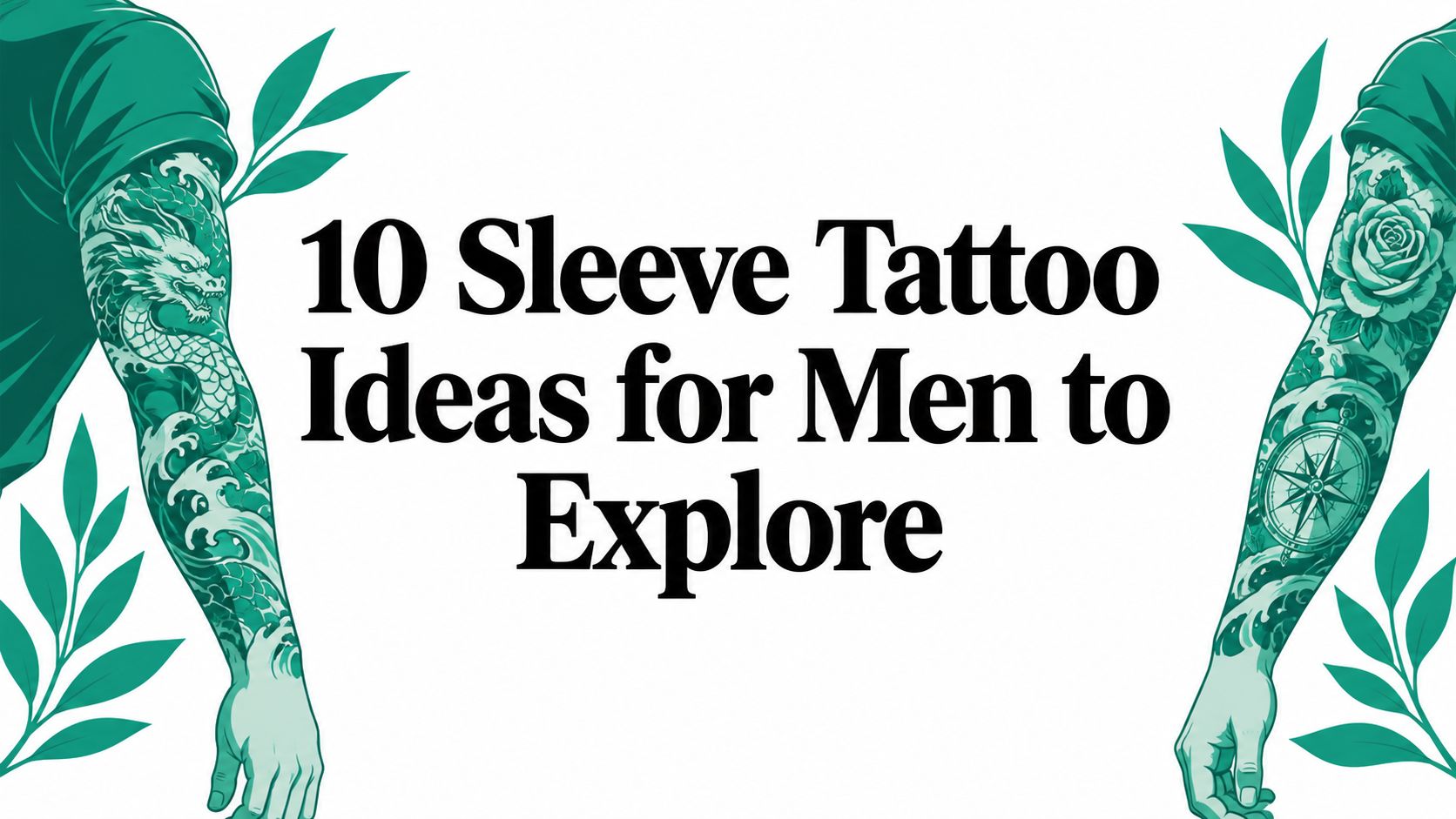
These sleeve tattoo ideas for men use ten distinct visual systems, from cultural narrative and geometry to realism, abstraction, lettering, and illusion. Each concept includes a practical TattoosAI prompt direction and a tattooist-ready way to discuss placement, scale, and flow. Use generated concepts to compare variations before your consultation, but remember that an AI image is a communication tool, not a final stencil. Your tattooist must adapt the design to your anatomy, skin, technique, and safe application.
Table of Contents
- 1. Japanese Traditional Irezumi Sleeve
- 2. Geometric and Mandala Sleeve
- 3. Realistic Portrait and Biomechanical Sleeve
- 4. Nature and Wildlife Full Sleeve
- 5. Watercolor and Abstract Splash Sleeve
- 6. Blackwork and Linework Sleeve
- 7. Sleeve with Lettering and Script Integration
- 8. Dragon and Mythological Creatures Sleeve
- 9. Sleeve Combining Multiple Art Styles
- 10. 3D Illusion and Hyperrealistic Sleeve
- Comparison of 10 Mens Sleeve Tattoo Styles
- Turn Inspiration Into a Tattooist-Ready Brief
1. Japanese Traditional Irezumi Sleeve
A Japanese traditional sleeve works best when it feels like one connected story rather than a collection of unrelated images. A dragon, koi, tiger, phoenix, or warrior can act as the main subject, while waves, wind bars, clouds, peonies, chrysanthemums, and maple leaves create movement around the arm. The background matters as much as the focal image because it carries the composition across the shoulder, elbow, forearm, and wrist.
Western sleeve tattoos developed partly from maritime and military traditions, where sailors and soldiers accumulated individual tattoos that gradually became fuller arm compositions. By the late twentieth century, visible sleeves had moved beyond associations with underground scenes and gained wider acceptance as personal expression, helping explain why maritime motifs, Japanese-inspired imagery, and custom narrative designs remain influential today. This history of tattoo sleeves offers useful context before you borrow symbols from the tradition.
Build the story before choosing the colors
Start with one dominant movement. A dragon can coil from the shoulder toward the forearm, while a koi travels upward through waves. Ask an artist experienced in Japanese tattooing to check whether the symbols, background, and direction work together rather than just placing attractive images side by side.
Try this TattoosAI prompt:
Full Japanese-inspired sleeve with a rising dragon, red koi fish, wind bars, crashing waves, peonies, bold outlines, shoulder-to-wrist flow, traditional composition, clear negative space around the elbow.
Generate traditional color, muted color, and black-and-grey versions. Bring the strongest references to your tattooist and mark what you want to retain, such as the dragon's pose or the wave rhythm. For more background and visual vocabulary, compare the composition principles in this guide to Japanese tattoo styles.
2. Geometric and Mandala Sleeve
Geometric sleeves depend on precision, repetition, and controlled symmetry. Mandalas can sit on the shoulder cap or outer forearm, while sacred geometry, interlocking circles, triangles, and tessellated bands travel around the arm. The result can feel spiritual, architectural, or subdued depending on the density of the lines and the amount of untouched skin.
The arm's curves create a technical challenge. A pattern that looks perfectly balanced on a flat screen may distort when it wraps around the bicep or crosses the elbow. A good artist will redraw the geometry for your specific arm instead of transferring a flat design without adjustment.
Choose the visual weight
A dense blackwork mandala has a very different presence from a fine-line geometric sleeve with wide areas of skin showing. Compare both before booking:
- Dense geometry: Creates a strong, graphic effect but leaves less visual breathing room.
- Open geometry: Keeps the sleeve lighter and lets individual patterns remain readable.
- Flowing bands: Connect separate shoulder, bicep, and forearm elements without forcing every shape into a grid.
- Limited color accents: Can highlight a central mandala while preserving the clarity of black linework.
A useful TattoosAI prompt might read:
Full arm geometric mandala sleeve, symmetrical shoulder centerpiece, sacred geometry bands around the bicep and forearm, precise linework, balanced negative space, pattern adapted to arm contours, black ink.
Then request a blackwork variation and a softer fine-line version. Research the symbolism before using religious or sacred forms, and show the artist how the pattern should behave when your arm turns. The principles discussed in these sacred geometry tattoo ideas can help you develop a more specific direction.
3. Realistic Portrait and Biomechanical Sleeve
A portrait and biomechanical sleeve combines human memory with mechanical structure. A face can emerge from gears, wires, pistons, circuit traces, or layered metal plates, creating a visual contrast between emotion and engineered form. This approach suits a sleeve built around a person, a personal milestone, a creative identity, or a fascination with technology.
Portrait work needs more than a recognizable face. The reference photograph should show the subject clearly, with lighting that gives the artist enough information for the eyes, nose, mouth, and bone structure. Mechanical elements should support the portrait instead of cutting through important facial features.
Give each section a job
Use the upper arm or shoulder for the portrait if you want it to function as the main focal point. Let the mechanical framework open around the bicep and continue into the forearm with cables, segmented plates, or circuit patterns. Keep the elbow area simpler so movement doesn't break the face or make the machinery look randomly interrupted.
Try:
Photorealistic portrait of a loved one merging into biomechanical gears and circuits, black and grey realism, portrait on outer upper arm, mechanical structure flowing toward forearm, dramatic but readable shading, clear transitions.
Generate a full-arm concept first, then separate portrait and machinery studies. Test a grayscale version before considering color. A tattooist should also redraw the mechanical parts so they follow the arm's anatomy rather than resembling a flat collage. This style requires close collaboration because small changes in scale, contrast, and placement can change the entire mood.
4. Nature and Wildlife Full Sleeve
A nature sleeve can tell a story about a scene, an animal, a journey, or a personal relationship with the outdoors. Instead of placing a wolf, mountain, river, and tree as separate stickers, connect them through an environment. Let water guide the eye, use branches to frame the shoulder, and reserve the strongest contrast for the primary animal.
A wolf may face outward on the upper arm while a mountain range recedes behind it. A bear can occupy the bicep, with forest textures moving toward the elbow and a river leading down the forearm. The subject combination should have a reason to exist together, even if the reason is just a memorable place.
The image above demonstrates how a large animal and environmental elements can share one sleeve concept, although your own brief should specify the animals, terrain, and mood you want.
Control detail and hierarchy
A fully realistic forest can become visually crowded if every tree receives equal attention. Ask for one primary focal animal, one secondary natural feature, and quieter textures between them.
Try this prompt:
Full nature sleeve with a wolf on the upper arm, mountains behind it, pine forest through the bicep, flowing river toward the wrist, black and grey realism, atmospheric depth, connected environmental scene, open areas around the elbow.
Generate dense and spacious versions. Compare realistic, illustrative, and stylized color treatments. Your artist can then simplify small details that won't remain clear at the intended size and design the background around existing tattoos.
5. Watercolor and Abstract Splash Sleeve
Watercolor sleeves replace hard visual boundaries with brush-like marks, splashes, translucent color, and expressive movement. A recognizable subject, such as a bird, flower, skull, or animal, can sit inside an abstract field, or the entire sleeve can focus on color and gesture rather than literal imagery.
This style suits someone who wants an artistic sleeve that feels less traditional and more like a painted composition. It also demands an honest conversation about how the chosen technique will translate to skin. The soft appearance of a digital watercolor image may require the tattooist to use linework, contrast, and carefully placed saturation to preserve readability.
Decide whether the subject stays identifiable
A figurative watercolor sleeve gives the eye an anchor. An abstract sleeve offers more freedom but can become difficult to brief unless you define the color relationships, movement, and areas of restraint.
Use two different prompt directions:
Full sleeve watercolor tattoo with a raven, abstract blue and crimson brushstrokes, fluid movement from shoulder to wrist, controlled splashes, readable subject, intentional skin breaks.
Or:
Abstract watercolor full sleeve, layered blue, red, and ochre brush marks, sweeping diagonal movement, soft edges, white negative space, no realistic objects, balanced arm composition.
Compare soft pastel, limited-color, and vivid versions. Ask your artist which details should receive permanent outlines and how the design will age visually. The most useful reference isn't the prettiest generated image. It's the one that clearly communicates the balance between pigment, skin, structure, and motion.
6. Blackwork and Linework Sleeve
Blackwork removes color from the decision-making process and makes composition, contrast, and negative space carry the design. It can include solid black shapes, fine lines, stippling, abstract curves, botanical forms, animals, or geometric patterns. A successful blackwork sleeve looks deliberate from a distance and rewards closer inspection without becoming a wall of dark ink.
Start by deciding whether the sleeve should feel graphic and bold or delicate and illustrative. Large black panels can frame a lighter central motif. Fine linework can create a manuscript-like effect, but it needs enough spacing to remain legible as the tattoo settles.
Use negative space as part of the subject
Bare skin isn't leftover space. It can separate dense sections, create highlights, and make the sleeve easier to read when viewed at a distance. Ask for variations that change the ratio of black to skin rather than only changing the central motif.
A practical prompt is:
Full sleeve blackwork linework with a raven, thorn branches, abstract flowing curves, varied line weights, bold shoulder section, open negative space around the inner forearm and elbow, high-contrast composition.
You can also request a geometric version and an organic version using the same amount of black. Take both to an artist known for clean black ink application. They'll need to assess how the design wraps, how solid areas will sit on the skin, and whether small gaps are wide enough to remain visible.
7. Sleeve with Lettering and Script Integration
Lettering becomes much stronger when it belongs to the composition instead of floating across it as an afterthought. A family name, short phrase, lyric, date, or personal word can follow the arm's length, curve through a banner, sit inside ornamental framing, or interact with flowers, architecture, flames, or geometric forms.
The first decision is readability. Choose whether the text should face you, face outward, wrap around the arm, or work as a more decorative mark. A phrase that looks balanced in a straight line may become difficult to read when it curves around the forearm.
Treat typography as a focal motif
Select the exact spelling before generating concepts. Don't ask an AI tool to invent the final lettering and assume every character is correct. Use the generated image to compare the overall mood, placement, and relationship between type and imagery, then have the tattooist produce the final lettering.
Try:
Full sleeve with the phrase “stay curious” integrated into flowing ornamental lines, clear traditional script, lettering on outer forearm, roses and subtle geometric framing, balanced negative space, black ink.
Request traditional, modern, decorative, and restrained versions. Generate the supporting imagery separately so you can see whether the text works on its own. Verify spelling, punctuation, language, and cultural meaning with care before making an appointment. A beautiful composition cannot rescue incorrect lettering.
8. Dragon and Mythological Creatures Sleeve
Mythological sleeves offer immediate drama, but the strongest examples give the creature a role in a larger narrative. A dragon can protect a figure, rise through clouds, coil around a mountain, or move through fire and water. A phoenix can travel upward from the wrist toward the shoulder, while a griffin or serpent can create a strong diagonal across the arm.
Cultural context matters. An Asian-inspired dragon and a Western fantasy dragon differ in anatomy, movement, symbolism, and surrounding imagery. Don't combine motifs casually if you want the sleeve to reflect a specific tradition.
Choose pose before decoration
The creature's body should establish the flow. A coiled dragon creates circular movement, a diving dragon creates a diagonal, and an ascending phoenix pulls the eye upward. Add clouds, flames, storm, water, or mountains only after the primary pose works.
Useful prompt variations include:
Full sleeve with an Asian-inspired dragon coiling from shoulder to wrist, waves and clouds, flowing body movement, bold linework, controlled red and black color palette.
Or:
Full sleeve with a Western fantasy dragon ascending through storm clouds and mountain peaks, detailed wings, dramatic shadows, dark illustrative style, clear arm-wide composition.
Generate fierce and graceful poses, then show the artist the alternatives. A specialist can correct anatomy, adjust the creature to your arm, and decide whether the surrounding background should be traditional, realistic, or deliberately contemporary.
Use the infographic as a planning reference for the relationship between creature, environment, direction, and supporting detail, not as a finished tattoo design.
9. Sleeve Combining Multiple Art Styles
Fusion sleeves let you combine visual systems that usually appear separately. Realistic portraiture can transition into geometric framing. Watercolor marks can sit behind precise linework. A traditional rose can share an arm with abstract shapes if the palette, scale, and transitions make the relationship intentional.
The danger is visual competition. If every section uses a different style, the sleeve may look like a portfolio pasted onto one arm. Choose a connecting principle before mixing techniques. That principle might be a limited palette, repeated line weight, consistent background texture, or one narrative subject.
Build the fusion in stages
Generate separate concepts first. Create a realism study, a geometric study, and an abstract transition. Then ask TattoosAI to combine them while specifying which style should dominate.
Try:
Full sleeve combining a realistic wolf portrait on the upper arm, fine geometric patterns around the elbow, and watercolor blue brushstrokes toward the forearm, unified black and blue palette, smooth transitions, deliberate negative space.
Mark the parts you want to keep, remove, or change. A tattooist should see not only the composite image but also the individual references that explain your intention. Choose an artist whose portfolio proves they can handle the relevant techniques. A specialist in one style may still be excellent, but they might recommend simplifying the fusion or involving another artist.
10. 3D Illusion and Hyperrealistic Sleeve
A 3D illusion sleeve uses perspective, shadow, highlights, and distorted forms to make objects appear to project from the skin or recede beneath it. Possible subjects include mechanical structures, cracked stone, an animal emerging through a surface, glass, chains, or architectural openings.
The illusion depends on viewing conditions. The arm's position, skin tone, natural curves, and lighting all affect whether the effect reads convincingly. A design that looks dimensional from one angle may flatten when the arm rotates, so the tattooist needs to plan the viewpoint rather than copy a digital mockup directly.
Test depth with simple variations
Begin with one subject and compare black-and-grey, color, and grayscale-with-accent versions. Ask for different angles and shadow directions. Too many competing objects can weaken the illusion, while one well-positioned opening or raised form may create a clearer result.
Use this prompt:
Photorealistic 3D full sleeve featuring a mechanical structure breaking through stone, dramatic side lighting, deep shadows, realistic perspective, black and grey shading, depth adapted to the arm's contours.
Bring the selected concepts to an artist with a proven 3D and hyperrealism portfolio. Discuss how the design will look when your arm hangs naturally, how large the focal illusion needs to be, and which details should remain simple. Watch the 3D tattoo demonstration for a visual reference, then treat your consultation as the point where the concept becomes anatomically workable.
Comparison of 10 Mens Sleeve Tattoo Styles
| Style | 🔄 Implementation Complexity | ⚡ Resource Requirements (time/cost) | ⭐ Expected Outcomes (quality/impact) | 📊 Ideal Use Cases | 💡 Key Advantages / Tips |
|---|---|---|---|---|---|
| Japanese Traditional (Irezumi) Sleeve | 🔄 Very high, mastery of traditional motifs and flow | ⚡ High, many sessions over months/years, specialist artist | ⭐⭐⭐⭐⭐ Iconic, cohesive, long‑lasting vibrancy | 📊 Cultural tributes, full‑arm narratives, collectors of traditional art | 💡 Timeless & anatomy‑friendly; work with an Irezumi specialist and research symbolism |
| Geometric & Mandala Sleeve | 🔄 High, strict symmetry and precision required | ⚡ Medium–High, precision line work, moderate sessions | ⭐⭐⭐⭐ Clean, striking, photographs well | 📊 Minimalist/spiritual designs, social media portfolios, meditative motifs | 💡 Test symmetry and spacing; choose an artist skilled in measured linework |
| Realistic Portrait & Biomechanical Sleeve | 🔄 Very high, portrait accuracy + seamless mechanical blending | ⚡ Very high, expert portrait/biomech artist, costly, many sessions | ⭐⭐⭐⭐⭐ Deeply personal, technically impressive, high emotional impact | 📊 Memorials, personal storytelling, tech/identity statements | 💡 Provide high‑quality photo refs; collaborate closely and expect touch‑ups |
| Nature & Wildlife Full Sleeve | 🔄 High, realistic anatomy and cohesive landscape flow | ⚡ High, color/detail intensive, multiple sessions | ⭐⭐⭐⭐ Meaningful, versatile, ages well if composed thoughtfully | 📊 Nature lovers, conservation themes, expandable sleeves | 💡 Plan major focal animals separately; test seasonal palettes and balance composition |
| Watercolor & Abstract Splash Sleeve | 🔄 Medium, color blending and painterly control | ⚡ Medium, color‑heavy, requires periodic refreshes | ⭐⭐⭐⭐ Artistic, expressive; appearance depends on color longevity | 📊 Creative/artistic statements, flexible AI experimentation | 💡 Generate many color variations; schedule touch‑ups every 1–2 years |
| Blackwork & Linework Sleeve | 🔄 Medium–High, precision line weight and spacing essential | ⚡ Low–Medium, no color but high skill required; generally fewer sessions | ⭐⭐⭐⭐⭐ Timeless, high‑contrast, photographs strongly | 📊 Minimalist, bold statements, easy to expand with monochrome pieces | 💡 Emphasize negative space and line hierarchy; choose an expert lineworker |
| Sleeve with Lettering & Script Integration | 🔄 Medium, typography, legibility and composition concerns | ⚡ Low–Medium, depends on calligraphy complexity | ⭐⭐⭐⭐ Deeply personal and communicative when executed well | 📊 Memorials, names/quotes, branding or identity expression | 💡 Double‑check spelling/meaning; test multiple scripts and placements |
| Dragon & Mythological Creatures Sleeve | 🔄 High, dynamic anatomy and dramatic composition needed | ⚡ High, detailed work, color options increase time/cost | ⭐⭐⭐⭐⭐ Powerful, timeless storytelling and visual impact | 📊 Fantasy enthusiasts, cultural mythology tributes, statement sleeves | 💡 Specify cultural style and poses; test environmental contexts and palettes |
| Sleeve Combining Multiple Art Styles (Fusion Style) | 🔄 Very high, seamless transitions between disparate styles required | ⚡ Very high, artist versatility, coordination, extended timeline | ⭐⭐⭐⭐ Unique and conversation‑starting but risks disjointedness | 📊 Artistic expression, multi‑interest personalities, gallery pieces | 💡 Prototype style mixes with AI; use transitional elements to unify sections |
| 3D Illusion & Hyperrealistic Sleeve | 🔄 Extremely high, elite perspective, shadow, and anatomy mastery | ⚡ Very high, expensive, 20+ sessions possible, few capable artists | ⭐⭐⭐⭐⭐ Jaw‑dropping, high social and technical impact | 📊 Showcase technical mastery, viral visuals, collectible commissions | 💡 Commission only proven 3D artists; test multiple perspectives and expect significant investment |
Turn Inspiration Into a Tattooist-Ready Brief
The best sleeve idea is the one you can explain clearly and live with as a complete composition. Start by choosing one primary visual system. You can add secondary influences later, but a sleeve built around Japanese composition, blackwork, realism, or geometry needs a dominant language to keep the arm from feeling accidental.
Next, choose one to three focal motifs. A focal motif might be a dragon, portrait, wolf, mandala, phrase, or scenic design. More subjects don't automatically create more meaning. They often create competition, especially when every image receives the same size, contrast, and detail.
Define the structure before the decoration
Decide whether the sleeve will run continuously from shoulder to wrist or develop in stages. A full composition can establish the major movement early. A staged sleeve needs anchor points and open areas that leave room for future additions without making the first tattoo look unfinished.
Write down:
- Primary style: Name the dominant system, such as Japanese traditional, blackwork, realism, or geometric.
- Focal motifs: List the main subjects and rank them by importance.
- Coverage: State whether you want the shoulder, upper arm, elbow, forearm, wrist, or the entire arm included.
- Flow: Describe the direction, such as upward, downward, circular, diagonal, or winding.
- Transitions: Mention waves, clouds, branches, smoke, geometry, machinery, ornamental bands, or open skin.
- Color approach: Choose black and grey, traditional color, limited accents, soft color, or a broader palette.
- Personal meaning: Explain the memory, value, place, person, or idea behind the imagery.
Use TattoosAI to explore several interpretations rather than searching for one perfect image. Change one variable at a time, such as the dragon's pose, the amount of negative space, the color palette, or the location of the main subject. Save the strongest versions and annotate each one with short notes: keep, remove, make larger, simplify, or move toward the outer arm.
Practical rule: Bring references that show both what you want and what you don't want. Artists make better decisions when they can see the boundaries of your taste.
Plan for the real process
A sleeve is a high-commitment project. One industry estimate places the global sleeve tattoo market at USD 0.6 billion in 2024, with a projection of USD 1.5 billion by 2032, while another market summary gives average sleeve project costs of USD 2,000 to USD 4,000. These figures are cited in industry coverage of sleeve tattoo design, but your actual quote will depend on the artist, location, design, session structure, and technical demands.
Plan appointments around healing, not impatience. Full sleeves commonly require multiple sessions over months, with healing blocks and sensitive areas such as the inner bicep, elbow ditch, and inner forearm requiring particular attention. This sleeve planning guide explains why session order, recovery, pain hotspots, and spacing deserve discussion before the first appointment.
A peer-reviewed self-tattoo study also found high satisfaction among surveyed Japanese tattoo participants, with 29 respondents satisfied and 28 very satisfied, while 8 reported being not at all satisfied and 10 not satisfied. The study is not a guarantee about any individual sleeve, but its findings support a useful planning principle: committed designs benefit from a coherent concept rather than rushed, disconnected decisions. Read the study details here.
Your tattooist must make the final design original and workable for your body. They'll adjust anatomy, line spacing, contrast, skin movement, cultural references, and technical execution in ways an AI image cannot. Current trend coverage points toward more personal sleeves, including nostalgic symbols, fine-line florals, microrealism, ornamental geometry, softer color, and doodle-like work, so men's sleeves don't need to follow an older narrow idea of masculinity to look intentional in 2026. Explore this 2026 sleeve trend discussion for contrasting directions, then choose the one that still feels like you beyond the trend cycle.
TattoosAI lets you describe a sleeve concept, explore styles such as Japanese, watercolor, geometric, 3D, and blackwork, and generate multiple references for comparison with your tattooist. Visit TattoosAI to turn your favorite motif into a more focused sleeve brief before your studio consultation.