TattoosAI
You walk into a studio knowing you want something psychedelic, but not much else. The tattooist asks what motif you mean, where it'll sit, and whether you want color or blackwork. You can't answer any of it clearly, so the consultation stalls before it starts.
These ten trippy tattoos designs fix that problem. Each one is framed as a brief you can hand to an artist, with a realistic placement, a clear longevity warning, and a prompt ready description you can test first. You'll find radial mandalas, warped checkerboards, melting faces, and quiet linework vortexes, because trippy doesn't always mean loud or rainbow saturated.
You're hardly alone in planning this. More than 30% of U.S. adults had at least one tattoo in 2024, according to DowneLink's compilation of tattoo industry statistics. That popularity helps you, since more artists now show healed psychedelic work in their portfolios, not just fresh photos.
Pick one direction that fits your body and your tolerance for touch ups. A dense, color heavy concept on your forearm makes very different demands than a bold black vortex on your calf. Read the placement and aging notes as seriously as the artwork itself, then bring your shortlist to a professional who'll adapt it to skin.
Table of Contents
- 1. Psychedelic Mandala
- 2. Sacred Geometry
- 3. Op Art Optical Illusion
- 4. Kaleidoscope Pattern
- 5. Psychedelic Dotwork
- 6. Surreal Melting Forms
- 7. Cosmic Galaxy Nebula
- 8. Psychedelic Third Eye
- 9. Psychedelic Mushroom and Botanical Hybrid
- 10. Linework Vortex and Abstract Waves
- How the 10 Trippy Tattoo Designs Compare at a Glance
- Pick One Direction, Then Brief Your Tattooist With Confidence
1. Psychedelic Mandala
A mandala builds outward from one center point. Repeating petals, rings, and dots create a pulsing rhythm, especially when you alternate saturated color fills with open skin. That structure suits rounded placements like the sternum, shoulder blade, and upper back, where the circle can sit without being squeezed into an oval.
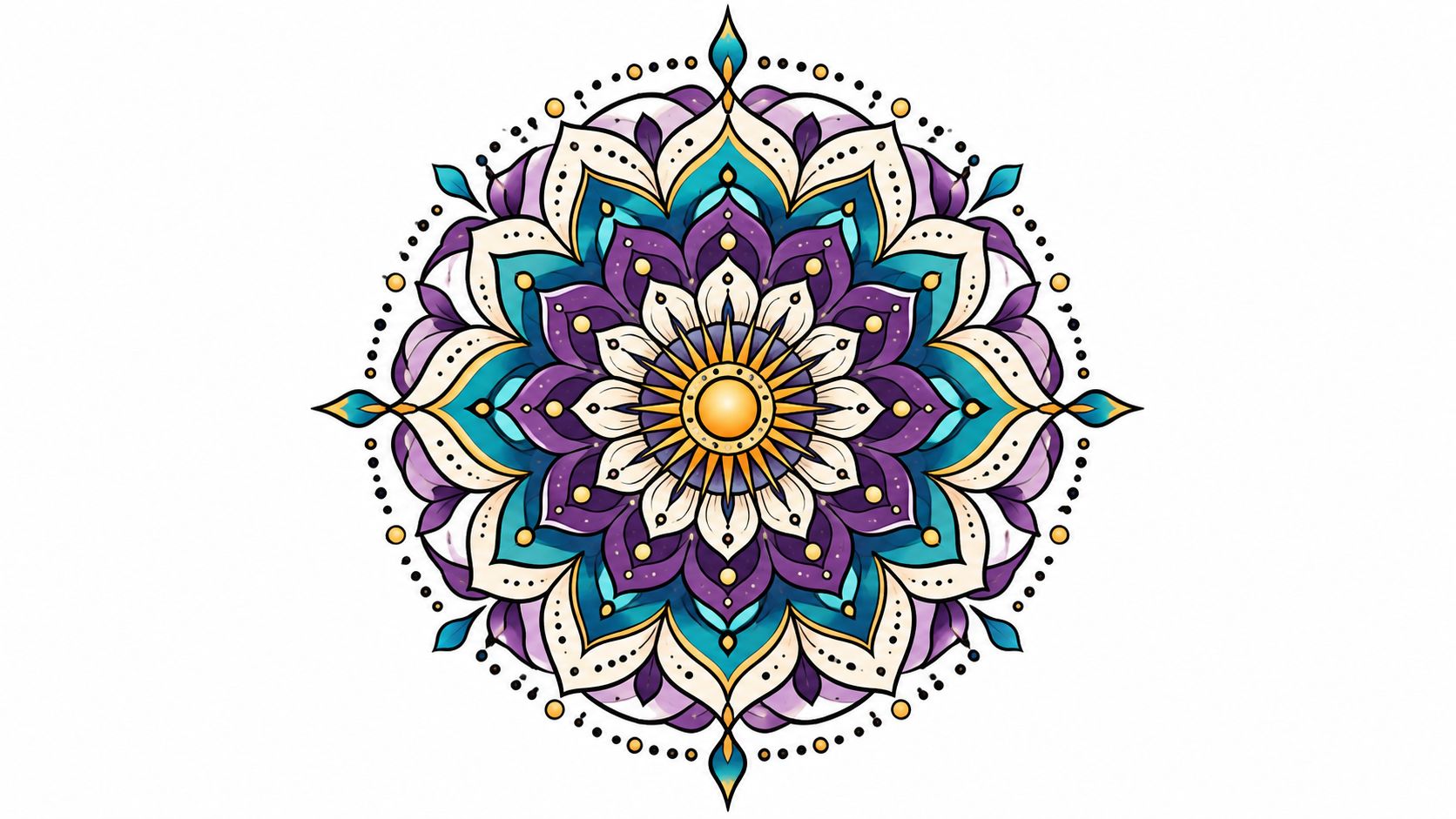
The visual language isn't random. The psychedelic poster format took shape in June 1965 with the Charlatans residency poster, and the style peaked around the 1967 Summer of Love, as outlined in the Hallie Ford Museum exhibition history. Mandalas also draw on Hindu and Buddhist meditation traditions, which is why they read as calm and intense at the same time.
For visionary reference beyond posters, look at the Ayahuasca gallery featuring Pablo Amaringo before you brief anyone. Notice how the detail stays organized around a focal point instead of filling every gap.
How to Brief It
- Stencil test first: Ask for the stencil on skin and check symmetry standing, sitting, and twisting slightly.
- Ring density: Generate several layouts and compare tight rings against wider spacing. Wider usually ages cleaner.
- Prompt to test: "Radial mandala, purple teal and gold, bold outer contour, open negative space between rings, shoulder blade placement."
Practical rule: If the mandala doesn't look balanced on the stencil, it won't look balanced healed.
2. Sacred Geometry
Precision is the whole effect here. Flower of Life, Metatron's Cube, Seed of Life, and Sri Yantra designs rely on overlapping circles and exact intersections. One drifting line breaks the pattern, and your eye finds it every time.
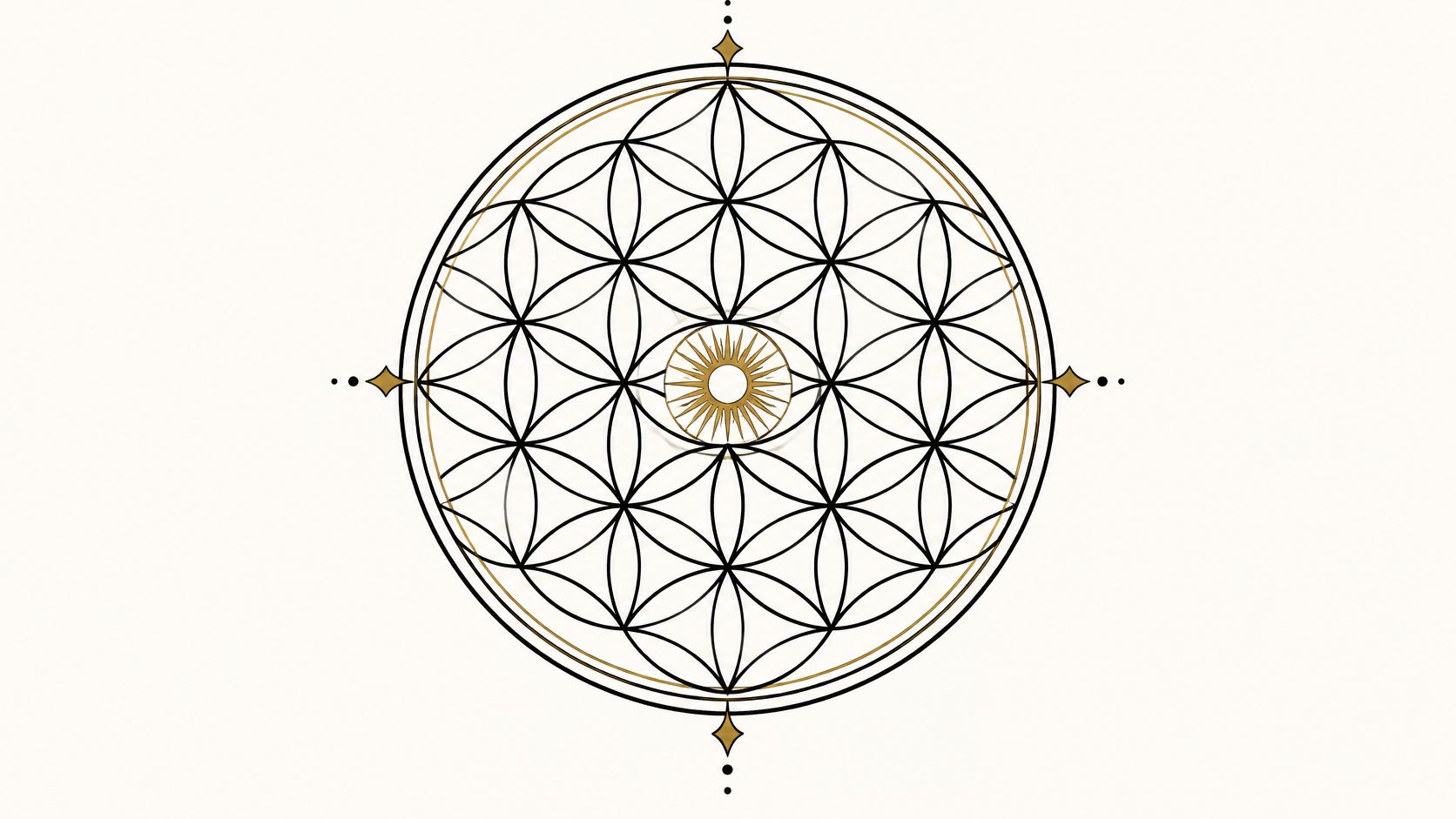
Forearms and ribs suit the Flower of Life because the repeating circles can wrap gently. Metatron's Cube needs more room, so chest and back placements work better, often with dotted accents softening the hard geometry. Browse our guide to sacred geometry tattoo ideas to see how scale changes the read.
Demand for this family is real. In 2024, more than 40% of new tattoos in selected APAC urban regions followed minimalist or geometric designs, according to the Asia-Pacific tattoo market report by Ken Research. That means plenty of reference exists, but it also means generic copies are everywhere.
Make yours specific. Add a small personal symbol at the center, or break one quadrant into dotwork so the precision has contrast.
Confirm your artist uses digital stencils and a straightedge, and settle line thickness before the appointment. Fine geometric lines packed too closely will spread into each other over time. I recommend fewer, bolder intersections over a dense web you can't read from arm's length.
Prompt to test: "Metatron's Cube in black and gold linework, bold primary lines, dotted outer ring, small sun symbol center, upper back."
3. Op Art Optical Illusion
Say you want your forearm to look like it's bending inward. A black and grey tunnel illusion does that with concentric warped grids, and it gets stronger when you rotate your arm. That's Op Art working as body art, not just pattern.
Flat or gently curved skin gives you the strongest effect. Forearms, calves, chest, and upper back hold grids well. Joints and high stretch areas distort the geometry in ways you didn't plan, and the illusion collapses into wavy stripes.
Spacing decides whether this ages well. Tattoo needles generally place ink approximately 1 to 2 mm into the dermis, according to the Oxford Journal of Law and the Biosciences technical review. Ink sits in living skin, so extremely tight lines lose separation as they heal and settle.
Pattern Choices That Hold
- Warped checkerboard: Strongest depth cues, needs the most space between squares.
- Concentric tunnel: Reads well on calves and forearms, forgiving if simplified.
- Radiating stripes: Creates vibration, but keep stripe gaps consistent.
Test two or three pattern densities before booking. The version that looks slightly too simple on screen is often the one that still reads clearly in five years.
Prompt to test: "Blackwork op art tunnel illusion, warped checkerboard receding to center, bold spacing, high contrast, forearm wrap."
4. Kaleidoscope Pattern
Start with one strong motif, then mirror it. A kaleidoscope tattoo repeats a central flower, butterfly, or animal form into symmetrical wedges, so the whole piece feels like it's turning even when you're standing still.
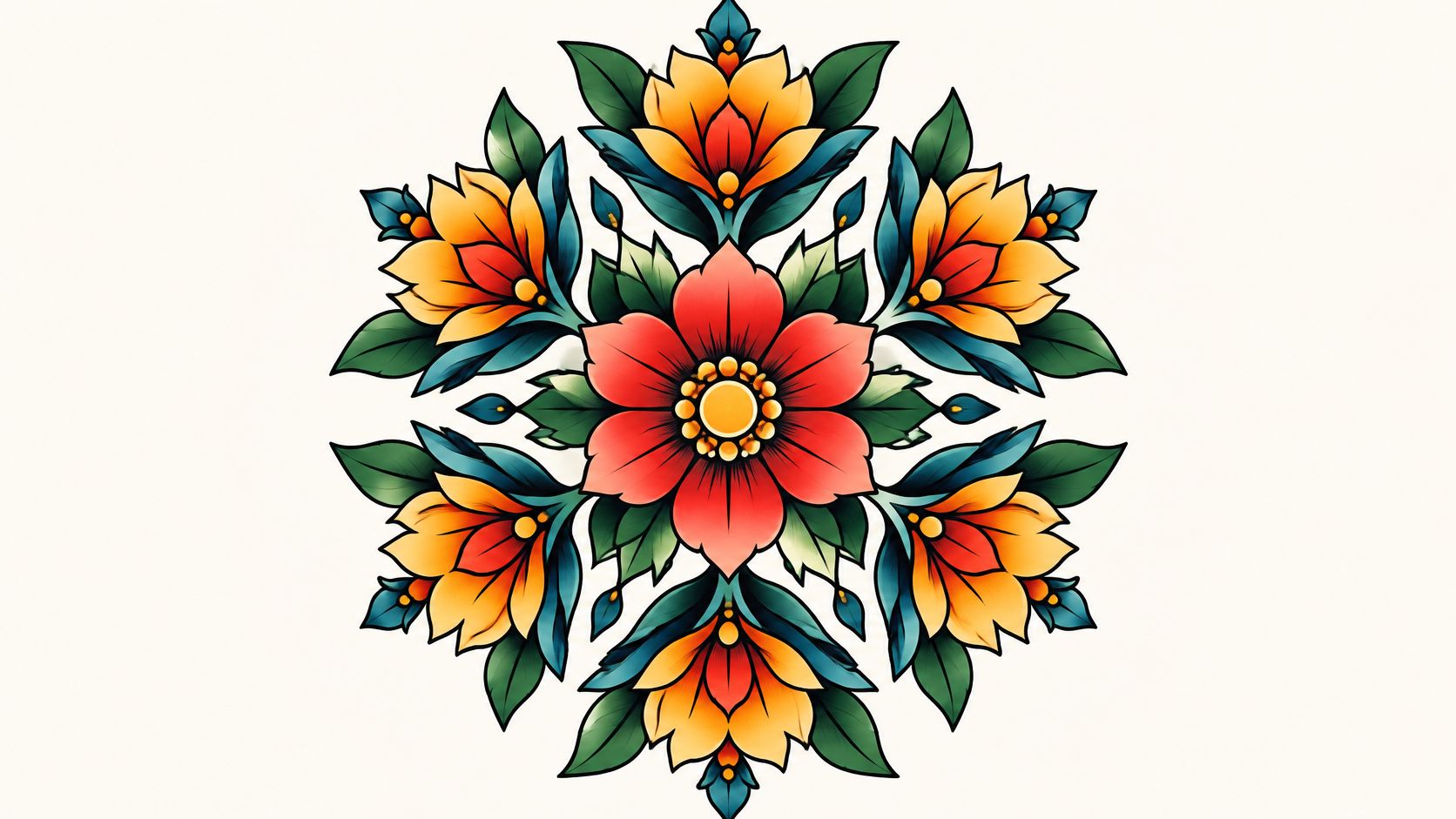
Full back pieces can carry floral and animal motifs across eight or more segments. Thigh and calf placements suit smaller mirrored butterflies or blooms, where the curve of the leg adds movement. Decide your segment count early, because it controls everything else, from stencil construction to session length.
Color is the risk. Treat vivid screen palettes as provisional, since a 2020 Swiss market surveillance study found 19 of 85 tested tattoo inks (22%) contained one or more banned pigments, as reported in the Journal of the European Academy of Dermatology study. Ask your studio which ink brands they'll use and whether a substitution changes your palette.
Build in a fallback. Strong black contours between wedges preserve the mirrored illusion even if one bright hue needs swapping or fades faster than its neighbors.
Prompt to test: "Kaleidoscope floral tattoo, eight mirrored segments, central red flower, golden petals, bold black wedge outlines, thigh placement."
5. Psychedelic Dotwork
A portrait that fades into open skin can make dotwork feel both precise and unsettled. The image is built from individual points: tight clusters read darker, while wider spacing leaves lighter areas. Gradual shifts between them create a stippled texture suited to psychedelic designs.
For a forearm portrait dissolving into a cosmic background, keep the facial features clear and let dots thin out toward the edges. A chest or back mandala can use the same technique, with dot gradients shaping its forms instead of solid shading. These concepts need room for the transitions; in a small placement, simplify the image before fine details blur together.
Our Dotwork style page on TattoosAI offers over 40 dotwork design ideas, so you can compare how spacing and density change the look before you choose.
Protecting the Dots
- Spacing over density: Dots placed too close can merge into a grey smudge, so ask your tattooist to preserve clear gaps.
- Low-friction placement: Inner forearm, upper back, and chest are less exposed to the friction common on hands and feet.
- Sun discipline: Regular unprotected sun exposure can reduce the contrast of dot gradients.
Ask your artist how they expect the design to hold up and whether a touch-up may be needed. Fine stipple work depends on clear spacing in the design and sensible aftercare once it is healed.
Prompt to test: "Psychedelic dotwork portrait with stippled gradient shading, cosmic dots fading into open skin, black ink, forearm placement."
6. Surreal Melting Forms
A clock draped over your forearm, a face stretching toward your elbow. Melting forms borrow from surrealist painting to show objects losing their shape, and the trippy effect comes from contrast. Something has to stay solid so the melt registers.
Decide that hierarchy before anyone draws. Tell your artist which edge stays sharp, which surface drips, and where the form dissolves completely into skin or background pattern. Without those instructions, you get a wobbly object instead of a melting one.
Back and thigh placements suit surreal faces and wide scenes that need room to stretch. Forearm and calf placements suit single objects like clocks, mushrooms, or chess pieces, where the drip can follow the limb downward.
Color heavy versions carry maintenance. In a 2025 report, 31.6% of European tattooists noticed more side effects with newer regulated color inks, including uneven color and increased retouching, according to the Journal of the European Academy of Dermatology report on regulated inks. Ask how your chosen palette behaves healed, not just fresh.
Ask for two variants, a full detail concept and a simplified stencil direction. Comparing them shows you exactly which drips and highlights your artist plans to keep.
Prompt to test: "Surreal melting clock draped over branch, sharp top edge, long drips below, soft shading, bold outline, outer forearm."
7. Cosmic Galaxy Nebula
A galaxy inside a silhouette solves a common problem. Nebula color on its own can look like a bruise from a distance, but a wolf, whale, or mountain outline gives the swirling blues and purples a shape your eye can hold.
Full sleeve cosmic work takes the opposite approach. Planets, starfields, and nebula clouds flow around the arm without a containing outline, which needs a strong value structure underneath. Dark space, mid tone nebula, and bright star points must stay separated, or the sleeve flattens into purple wash.
Making Space Read on Skin
- Silhouette first: Choose a shape recognizable in solid black before adding any galaxy fill.
- Value contrast: Keep the darkest nebula areas dark against your skin tone.
- Star restraint: Fewer, larger star points survive better than dust fine sparkle.
Vibrant blends fade unevenly. Blues and purples typically outlast pale pinks and soft pastels, so ask your artist which parts of your palette will need refreshing first and budget for that.
Review several color options side by side before deciding. A deep teal and magenta nebula ages differently than a pastel one, even with identical linework.
Prompt to test: "Galaxy nebula inside wolf silhouette, deep blue and magenta clouds, scattered bold stars, clean black outline, shoulder placement."
8. Psychedelic Third Eye
The third eye gives you an instant focal point. An eye at the center, radiating lines around it, then flowers, waves, or geometry filling the outer field. It's associated with intuition and inner vision, and it's one of the most copied trippy motifs, so personalization matters.
Chest and shoulder placements suit a single symmetrical eye, echoing where the symbol sits in the traditions it comes from. Sleeve versions let the eye blend into florals or waves, with lashes turning into petals or rays as the design travels down the arm.
Proportion is the technical trap. Eyes are the feature humans read most critically, so a slightly uneven iris or mismatched lash line stands out immediately. Ask for a stencil test and check it in a mirror at conversation distance, not just up close.
Use bold lines for the iris, pupil, and upper lash line. Fine radiating detail can stay delicate, but the eye itself needs structure that survives softening. Add one personal symbol, a birth flower, a small constellation, or a wave pattern from somewhere that matters to you, so the piece isn't interchangeable with stock flash.
Prompt to test: "Psychedelic third eye with radiating lines, iris containing mountain scenery, floral lashes, bold outlines, center chest."
9. Psychedelic Mushroom and Botanical Hybrid
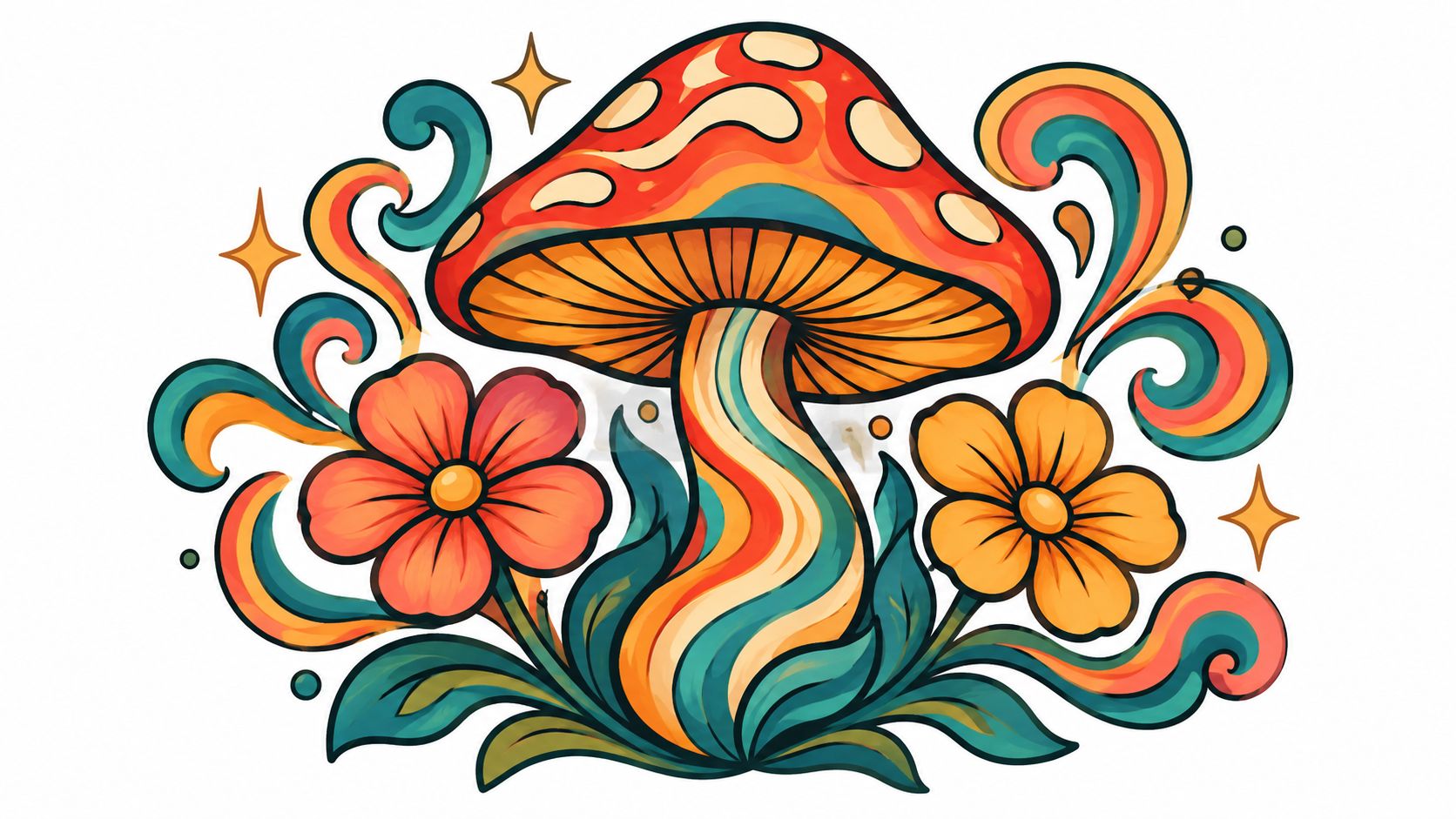
Build the design around one clear mushroom silhouette, then use oversized flowers, curling stems, and swirling fills to create a psychedelic botanical piece. Exaggerated forms and contrasting colors give it the feel of 1960s and 1970s poster art.
For a vertical cluster, consider the forearm, with flowers wrapping toward the wrist. The back or shoulder gives leaves and stems room to spread, while pattern can fill the spaces between caps. Describe the cap and stem shapes with simple photos of real mushrooms, including a side profile and a view from underneath, so the tattooist can draw the forms clearly. The Thrasher strain analysis from iMicrodosing concerns a specific strain, so use it for strain information rather than as a visual guide.
If you have sensitive skin, ask about ink before booking. A 2024 analysis found 45 of 54 commonly available U.S. tattoo inks contained unlisted additives or pigments, according to the PMC analysis of U.S. tattoo ink composition. Request the ink brand and ingredient information, and tell your tattooist about eczema or past reactions. Treat hypoallergenic claims cautiously.
Deep, saturated tones suit this design better than neon brights for long-term readability. Ask to see a limited-palette or black-and-grey option, too. It gives your tattooist a practical alternative if a pigment needs to change.
Prompt to test: "Psychedelic mushroom and flower cluster, swirling color fills, deep saturated palette, bold contours, upper arm wrap."
10. Linework Vortex and Abstract Waves
Not every trippy piece needs color. A single flowing line that spirals into a vortex, or parallel waves that ripple across your ribs, creates motion with almost nothing else. It's the quietest option here and often the most durable.
Forearm vortexes work because the spiral can tighten toward the wrist. Back and rib waves work because the lines can follow your body's existing curves instead of fighting them. Flat or gently curved placements keep the rhythm even.
Line weight is your main decision. Hairline spirals look elegant fresh and broken within a few years. Bolder line weights with consistent gaps between turns keep the vortex readable as lines naturally settle and thicken slightly.
Tuning the Spiral
- Turn count: More turns mean more hypnotic pull, but each added turn narrows the gaps.
- Wave spacing: Uneven spacing creates energy, random spacing creates mess.
- Endpoint plan: Decide whether lines fade into skin, end cleanly, or connect to a future piece.
Generate several spiral densities and print them at actual tattoo size. Density that looks fine on a phone screen often looks crowded at four inches wide.
Prompt to test: "Black linework vortex, continuous flowing spiral, bold even line weight, wide gaps between turns, inner forearm."
How the 10 Trippy Tattoo Designs Compare at a Glance
| Item | Best Placement | Core Style | Fade Risk |
|---|---|---|---|
| Psychedelic Mandala | Chest, back, or shoulder | Radial symmetry, petals, and ornamental rings | Fine details may blur over time |
| Sacred Geometry | Forearm, ribs, chest, or back | Precise geometric patterns and clean lines | Lines may fade; complex designs may need touch-ups |
| Op Art Optical Illusion | Forearm, calf, chest, or back | High-contrast patterns that create movement and depth | Dense patterns may blur or merge |
| Kaleidoscope Pattern | Back, thigh, or calf | Mirrored motifs in colorful symmetrical segments | Color may fade or blur over time |
| Psychedelic Dotwork | Forearm, chest, or back | Stippled shading and hypnotic dot textures | Dots may fade or spread |
| Surreal Melting Forms | Forearm, calf, back, or thigh | Dreamlike distorted objects with soft shading | Soft gradients may fade over time |
| Cosmic Galaxy Nebula | Forearm, shoulder, or sleeve | Nebula gradients, stars, and silhouette forms | Color gradients may fade faster |
| Psychedelic Third Eye | Chest, shoulder, or sleeve | Central eye with radiating or cosmic details | Fine lines may blur over time |
| Psychedelic Mushroom and Botanical Hybrid | Forearm, back, or shoulder | Vivid mushrooms and botanicals with swirling patterns | Bright colors and details may need touch-ups |
| Linework Vortex and Abstract Waves | Forearm, back, or ribs | Flowing lines, spirals, and abstract waves | Fine lines may blur or spread over time |
Pick One Direction, Then Brief Your Tattooist With Confidence
Start by cutting the list down. Choose the one or two trippy tattoos designs that match how you dress, work, and feel about visibility, not just the ones that look wildest in isolation. A chest mandala and a forearm vortex are both trippy, but they commit you to very different daily realities.
Then check the shape against your body. Print your favorite concept at realistic size, tape it where you want it, and look at it in a full length mirror. Circles need rounded, stable skin. Geometry needs flatter planes. Flowing linework wants a surface it can follow. If the paper version fights your anatomy, the tattoo will too.
Write your brief in plain terms. Name the style, the motif, the placement, the approximate size, and the color palette. State what must stay, what can change, and what you don't want at all. Artists work faster and argue less with clients who separate fixed requirements from open suggestions.
Ask the aging questions directly. Which lines are too close together, which colors will fade first, and what would the simplified version look like. Tattooing is now a mainstream practice, since a 2025 literature review included 86 studies and estimated tattoo prevalence at 11.7% to 31.5% in Western countries, according to the PubMed indexed literature review on tattoo prevalence. Experienced tattooists answer these questions routinely, so don't treat them as awkward.
Remember what a generated concept is. It's a reference for a tattoo artist, not a stencil, and the artist must adapt it to your body, skin, and how the design will age. Expect your tattooist to redraw contours, widen gaps, and drop detail that won't survive healing. That redraw is the professional work you're paying for, not a downgrade of your idea.
If color worries you, settle it before the appointment. Request the studio's ink brands, discuss substitutions, and agree on a blackwork or limited palette fallback. Bring any history of eczema, pigment reactions, or metal allergy into the consultation, and get medical advice separately if you're unsure. No design tool can assess that risk for you.
I recommend generating variants labeled by purpose rather than picking a single polished image. Keep one high detail concept, one simplified version, and one black and grey adaptation. That small set gives your tattooist real choices and shows you've thought about longevity, not just the first reveal photo. Once you have a direction you trust, take the design to a tattooist you trust and let them make it work on skin.
Ready to test your shortlist before booking? Describe your motif, placement, and palette in TattoosAI, choose a style such as Surreal, Geometric, or Dotwork, and generate multiple trippy concepts you can compare for line density and color. Bring the strongest variants to your consultation as a clear brief, then let your tattooist adapt the winner to your skin.