TattoosAI
Why choose a water dragon tattoo from a flat picture when you'll wear it on a moving, curved body? A dragon that looks powerful on a screen can become a confusing knot of scales, foam, and claws when the design wraps around an arm. Most galleries show the finished image without explaining what makes it readable.
Body flow and long-term clarity matter more than how much detail an artist can squeeze into the drawing. The head needs a clear focal point, the body needs a believable path, and the water needs enough space to remain separate from both. Color adds another decision, especially when you're comparing pale washes with solid outlines.
The directions below range from large Japanese compositions to restrained fine-line and geometric interpretations. Choose by the effect you want, not just the picture you like: protective and commanding, fluid and expressive, or quiet and discreet. Each approach calls for a different placement, a different compromise on detail, and a useful preview before you commit to an artist.
Table of Contents
- 1. Traditional Japanese Water Dragon (Ryu) with Wave Motifs
- 2. Chinese Water Dragon (Shui Long) with Pearl and Clouds
- 3. Blackwork Sea Serpent Dragon
- 4. Watercolor Splash Water Dragon
- 5. Realistic Emerging Water Dragon
- 6. Minimalist Fine-Line Water Dragon
- 7. Geometric Dotwork Water Dragon
- How the Seven Water Dragon Styles Compare
- Pick Your Style, Then Book the Consultation
1. Traditional Japanese Water Dragon (Ryu) with Wave Motifs
A Japanese-style water dragon works best when the dragon and its background form one composition. Whiskers, mane, scales, and curling waves should move together rather than compete for attention. Lighthouse Tattoo's guide to Japanese dragons connects the motif with rain, rivers, protection, wisdom, and benevolence.
The water isn't just scenery. World History Encyclopedia's account of Ryūjin describes the dragon king as a sea deity who controls tides through magical jewels, giving a water-centered design a stronger foundation than a generic fire-breathing creature.
Give the Body Room to Turn
For a sleeve, place the face where it remains recognizable with the arm relaxed, then let the torso coil around the limb. On a back piece, use the broader surface to separate the head, claws, and major waves. A large chest panel can work too, provided the artist plans how the composition crosses onto the shoulder.
Practical rule: Reduce background detail before shrinking the dragon's face.
Bold outlines and open spaces give the main forms room to remain distinct as the tattoo softens. Crowding every gap with foam, scales, or wind bars makes that harder.
Preview it with a full-placement sketch, not an isolated dragon. Ask for front, side, and rear views of a sleeve layout, plus a simplified line drawing. Check that the wave direction supports the dragon's movement and that the head doesn't disappear around the arm.
2. Chinese Water Dragon (Shui Long) with Pearl and Clouds
Choose this direction when symbolism and upward movement matter more than a heavy wave background. A long, serpentine dragon can curl toward a pearl, with clouds framing the head and water anchoring the lower body. The pearl gives the composition a destination, so its position deserves as much attention as the face.
A water dragon can also carry a specific birth-year connection. ANZ's discussion of Dragon-year traditions identifies 2012 and 1952 as Water Dragon years and connects Dragon symbolism with luck, power, success, and prosperity. Don't assume every dragon design communicates that personal meaning without explaining your intention to the artist.
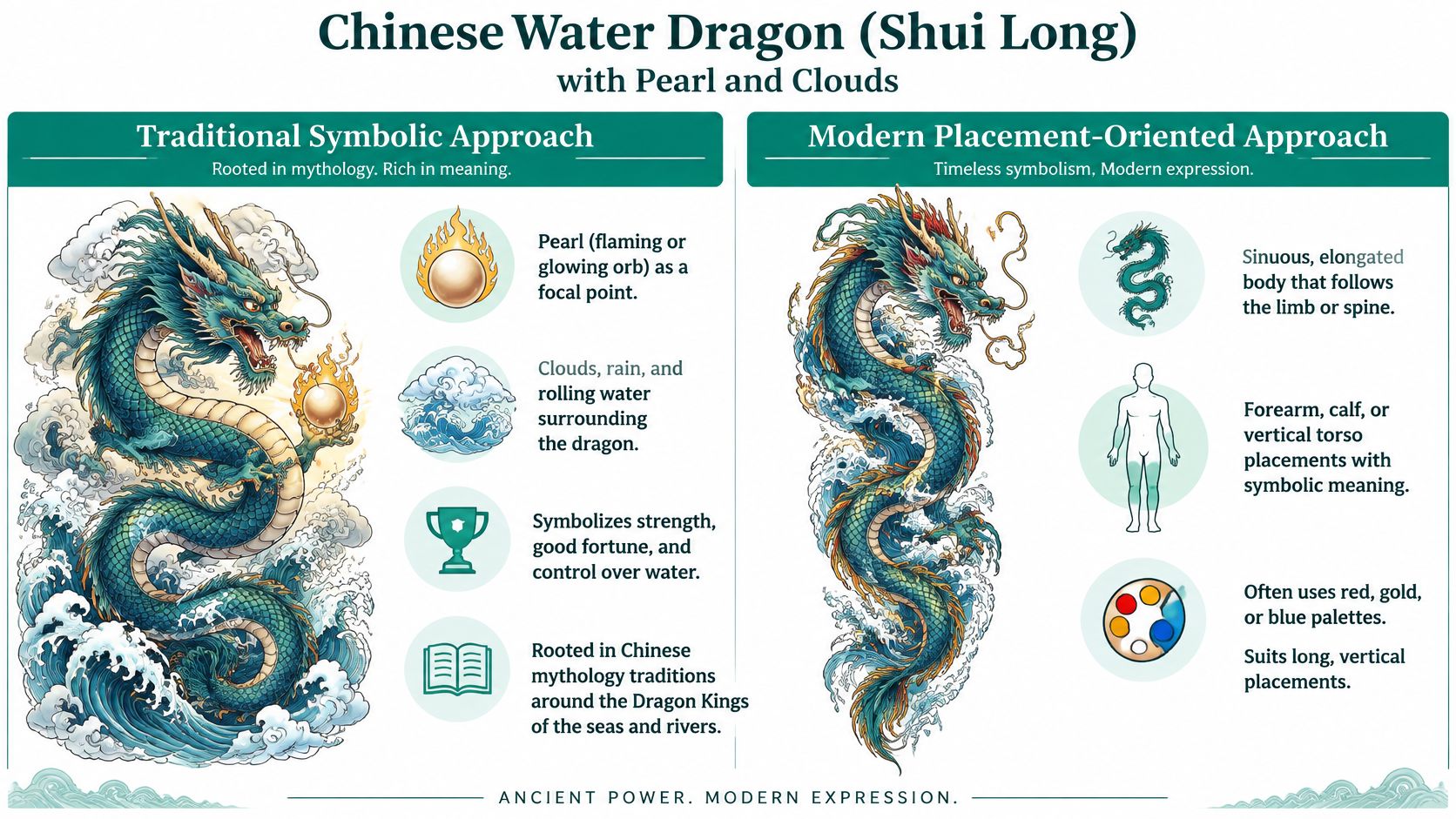
For a calf piece, try a rising dragon with the pearl near the upper outer calf. On the forearm, keep the head and pearl on the main viewing surface rather than hiding either in the wrap.
Give the pearl its own clear space. If whiskers, clouds, and claws all touch it, the focal point becomes clutter.
Preview the same composition in different palettes, rather than changing the drawing every time. Compare a mostly black version with restrained red, blue, or gold-colored accents, and ask how each would look with less saturation.
Our guide to Chinese dragon tattoo symbolism can help you refine the meaning before the artist resolves anatomy and layout.
3. Blackwork Sea Serpent Dragon
Blackwork is the strongest option when you want the silhouette to lead. Instead of relying on colored scales, the artist builds the dragon from solid black shapes, open skin, and controlled texture. Waves can appear as clean cutouts or broad bands beneath the body.
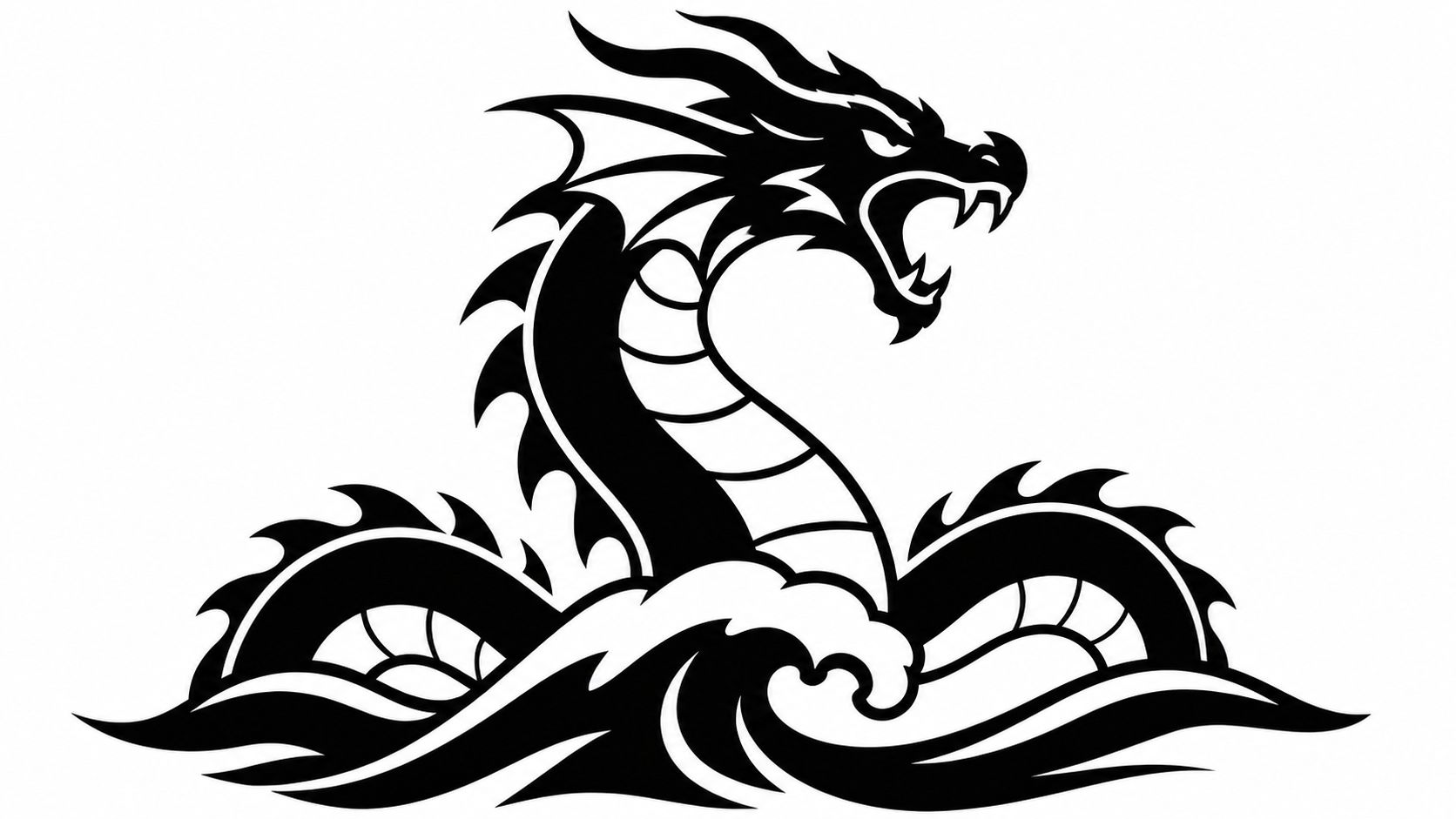
Say you want an outer-calf dragon that reads across a room. A dark, hooked silhouette emerging from open wave shapes will usually communicate more clearly than a field of tiny scales. A sleeve offers more room for texture, but it still needs deliberate gaps between the dragon and the sea.
Protect the Open Skin
Blackwork doesn't remove the need to plan for aging. Narrow skin channels can become less distinct as edges soften, while an overly dark head can lose its expression. Ask the artist to preserve clear separations around the eye, jaw, and claws.
The trade-off: Solid black gives you impact, but you can't recover a crowded design simply by adding more detail.
Before booking, discuss how the artist approaches solid packing, healing, and any areas that may need reassessment once healed. Ask to see healed blackwork, not only fresh photographs with shiny black fills.
Preview it as a flat silhouette first. Print the design at the proposed size and check it from across the room, then inspect the negative-space channels close up. Have the tattooist test the placement with a stencil before committing to the final outline.
4. Watercolor Splash Water Dragon
A watercolor water dragon tattoo suits someone who wants movement and atmosphere rather than a fully enclosed creature. Blue and teal washes can suggest a body passing through water, while splashes extend beyond the silhouette. The important decision is how much of the dragon remains recognizable without the color.
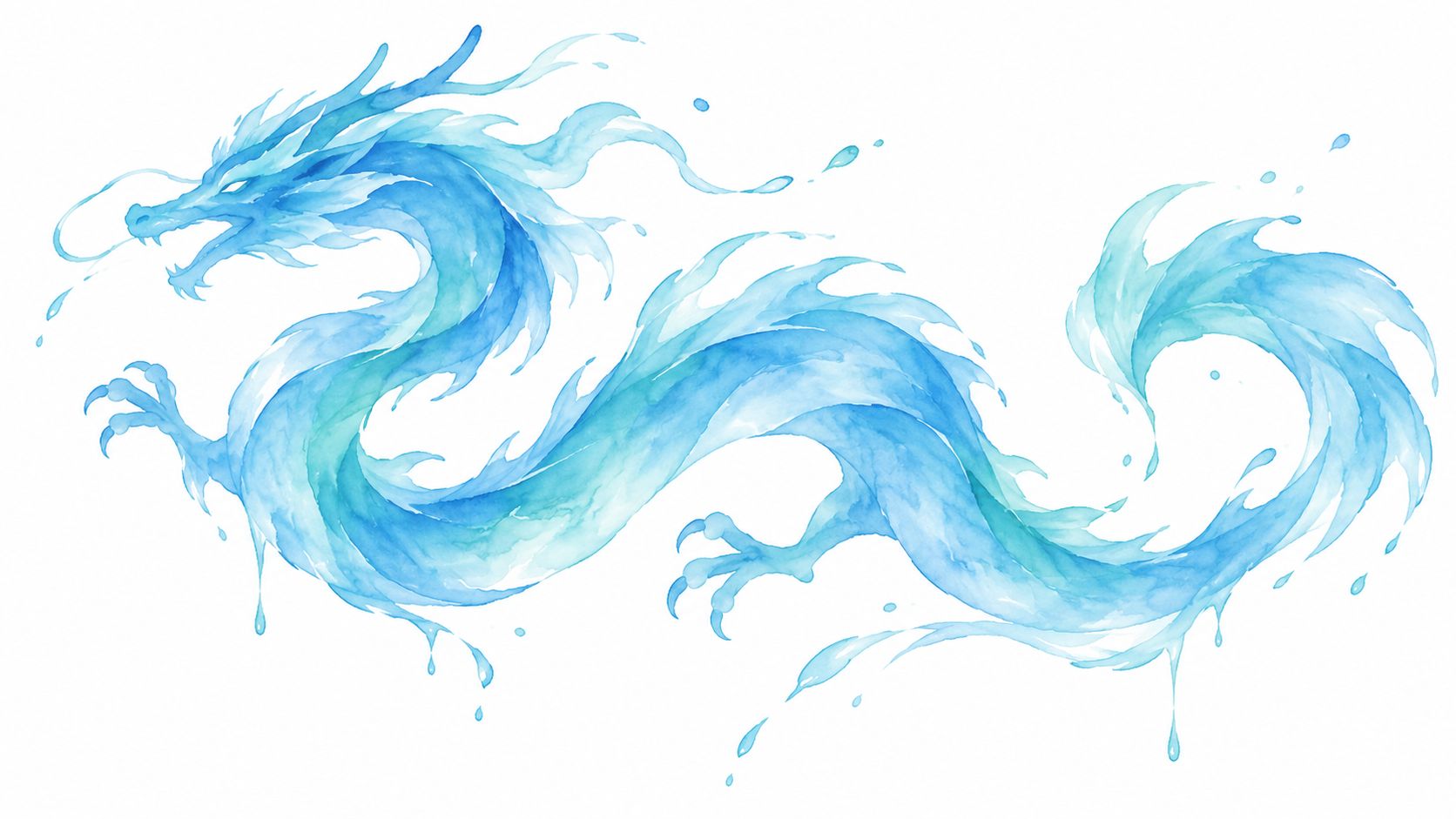
For an upper-back piece, keep a defined head and a dark curve through the body, then let the washes spread toward the shoulder. A forearm version needs tighter control: splashes shouldn't obscure the face or make the tail look detached.
Color-only softness is the compromise. Pale transitions can become less distinct, especially when there's little tonal separation underneath them. A restrained dark structure gives the artist a way to preserve the dragon's identity without outlining every splash.
Ask whether you'd still recognize the dragon if its lightest washes became harder to see.
Ink selection belongs in that conversation. The German Federal Institute for Risk Assessment's tattoo-ink guidance emphasizes composition, stability, and breakdown products, which is a reason to let the tattooist choose documented inks rather than insist on an exact screen color.
Preview both a color version and a grayscale version. If the grayscale image becomes an indistinct smear, strengthen the focal points. Ask for healed watercolor examples that show the same balance of outline and wash you're considering, and discuss protecting the finished tattoo from sun exposure.
5. Realistic Emerging Water Dragon
Start with the lighting, not the scales. A realistic dragon rising from water needs a believable relationship between the head, the waterline, and the light source. Without that structure, droplets and wet highlights are just extra marks.
For a back piece, a head breaking the surface can dominate the upper composition while submerged coils fade into darker water. On a sleeve, a semi-realistic approach often gives the artist more freedom to simplify reflections and fit the body around the arm.
This video offers another visual reference to discuss alongside still concepts.
Choose Depth Over Tiny Texture
Bring separate references for rippling water, reptile-like scales, and the lighting you prefer. Ask the artist to resolve them into one scene rather than copy unrelated textures. The face should remain readable without depending on tiny white highlights.
A convincing waterline does more for realism than covering every surface with droplets.
Fine texture will soften with healing and time. Strong shadow groups and deliberate skin breaks help preserve depth, while uniformly detailed scales can make the whole piece look flat. Discuss the session plan and budget before the artist develops an ambitious full-placement drawing.
Preview the design at actual size, then view a reduced version to test the broad tonal structure. Check the jaw, eyes, and waterline first. If those disappear, simplify the reflections before adding more detail, and choose an artist whose healed realism retains clear focal points.
6. Minimalist Fine-Line Water Dragon
A small dragon isn't automatically a minimalist dragon. Minimalism means removing information, not compressing a detailed back piece onto a wrist. Keep the long curve, a recognizable head, and a restrained water cue; omit scales that won't have room to stay separate.
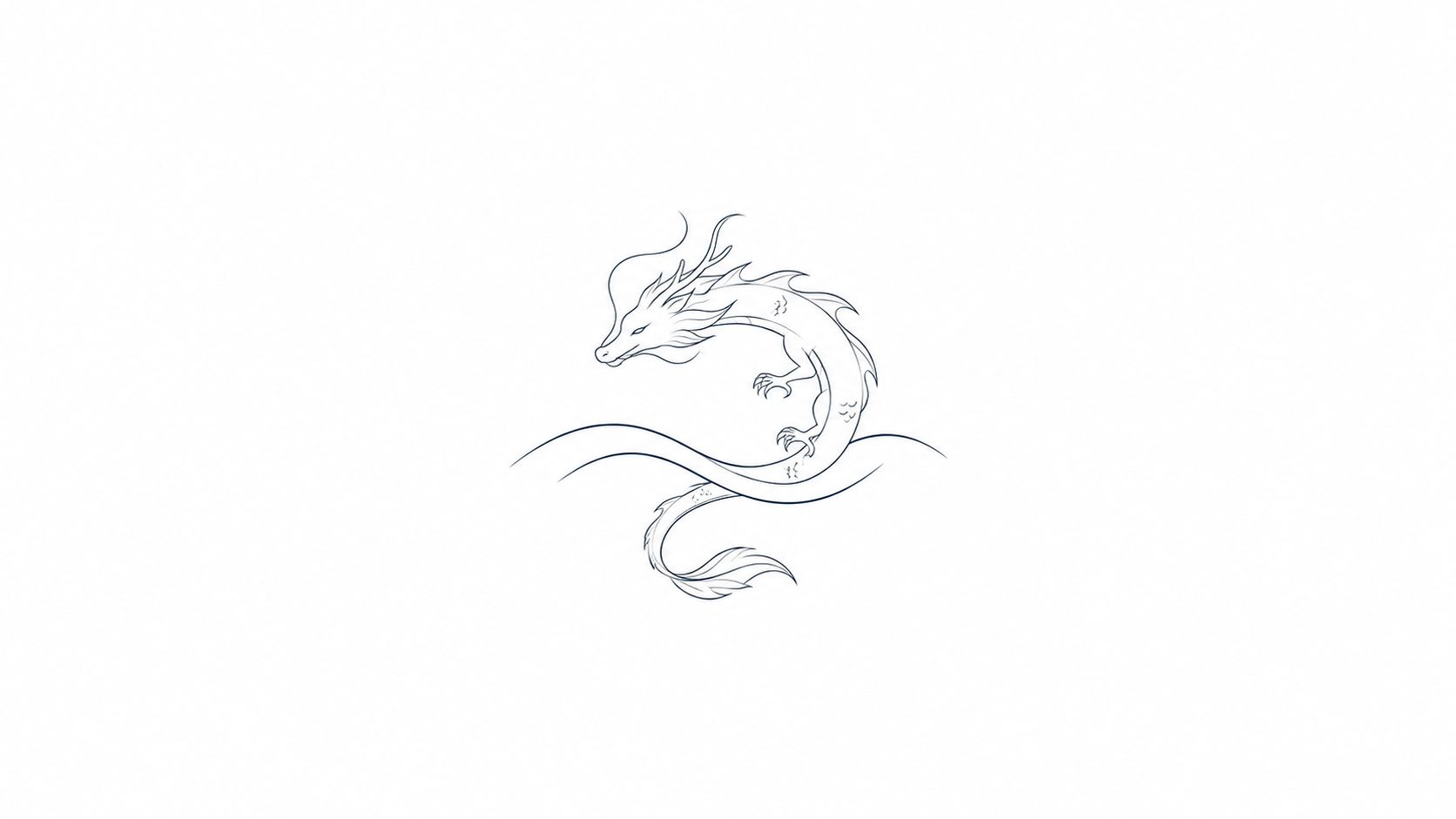
An inner-forearm design might use an open coil with a short wave beneath it. An upper-arm placement offers more discretion under clothing and more room than a cramped wrist or behind-the-ear design. If you choose an ankle, ask the artist to account for footwear contact and your usual sun exposure.
- Keep the face simple: Separate the eye, mouth, and whiskers instead of stacking them into a dark knot.
- Leave breathing room: Don't run parallel body curves so close together that they're difficult to distinguish.
- Accept a stronger line: The thinnest possible mark isn't always the best match for your intended size.
Small-design test: Remove the scales. If the dragon stops reading as a dragon, the silhouette needs work.
Fine lines can soften or heal unevenly, so avoid treating a fresh close-up as proof of the eventual result. Ask to see healed work with similar spacing and placement.
Preview a simplified line drawing at the intended size, not zoomed in on a phone. Hold the print against the placement and look in a mirror with your limb relaxed. Let the artist enlarge or redraw it if the head needs more room.
7. Geometric Dotwork Water Dragon
The appeal here is the contrast between an organic dragon and a controlled geometric frame. Circles can frame the head, repeated arcs can suggest waves, and stippled shading can describe the body without solid fills. The challenge is keeping the geometry supportive rather than letting it overwhelm the creature.
For example, a chest piece could place a dragon across an open circular frame, with dotwork water below. A sleeve needs a different approach: repeated arcs can follow the arm, but a perfect circle drawn flat won't appear perfectly circular from every viewing angle once wrapped.
Plan Density and Movement Together
Dotwork needs clear differences between light, middle, and dark areas. Packing dots closely across the whole design removes that distinction, while extremely delicate stippling may not retain the same appearance after healing. Ask how the artist will separate the dragon's body from similarly textured waves.
Our dotwork tattoo style guide offers a starting point for comparing stippled shading with more graphic pattern work.
Use geometry to organize the dragon, not to force its body into an awkward pose.
Preview the frame separately from the dragon, then combine them. This makes it easier to spot a circle crossing an eye, a triangle cutting through a claw, or a dense pattern hiding the tail.
Have the artist assess the stencil while you're standing naturally, not only while you're stretched into position. Discuss the touch-up policy and how healed dot density will be evaluated, without assuming every dotwork tattoo needs the same follow-up.
How the Seven Water Dragon Styles Compare
| Style | Signature Look | Color Use | Best Placement | Best For |
|---|---|---|---|---|
| Traditional Japanese Water Dragon (Ryu) with Wave Motifs | Bold dragon with stylized waves, spray, and wind bars | Bold traditional color fills and black outlines | Back, sleeve, or large chest panel | Large pieces with a traditional Japanese look |
| Chinese Water Dragon (Shui Long) with Pearl and Clouds | Sinuous dragon chasing a pearl amid clouds and water | Often red, gold, or blue | Forearm, calf, or vertical torso | Vertical designs with symbolic meaning |
| Blackwork Sea Serpent Dragon | High-contrast silhouette with graphic wave patterns and negative space | Solid black, sometimes gray | Sleeve or back | Bold graphic pieces with strong silhouettes |
| Watercolor Splash Water Dragon | Flowing dragon with translucent washes, splashes, and drips | Blues, teals, purples, and accent colors | Shoulder, upper back, or forearm | Expressive color pieces |
| Realistic Emerging Water Dragon | Detailed dragon breaking the water's surface with scales and reflections | Grayscale or subtle colors | Large back or sleeve | Centerpiece pieces focused on depth and detail |
| Minimalist Fine-Line Water Dragon | Simplified dragon and a few flowing wave lines | Fine black lines with minimal shading | Wrist, ankle, or forearm | Small, discreet designs, including first tattoos |
| Geometric Dotwork Water Dragon | Dragon formed with stippling and geometric patterns | Usually black or gray, with little or no color | Sleeve, chest, or back | Modern, symmetrical designs |
Pick Your Style, Then Book the Consultation
Choose the effect you want before choosing the details. Japanese and Chinese compositions suit a flowing, symbol-led piece with a clear relationship between dragon and water. Blackwork favors impact, watercolor favors fluid color, and realism favors depth and lighting. Fine-line and geometric approaches suit different kinds of restraint, one through omission and the other through structure.
Then choose a placement that gives that effect enough room. A full dragon with clouds, scales, claws, and waves asks more of the skin than a simplified coil. If your preferred size can't accommodate the face and the main turns of the body, reduce the background or increase the size rather than compressing everything.
Take a Focused Brief to the Artist
Shortlist the styles you'd wear, then develop concepts for each using the same pose and placement. That keeps the comparison useful: you're judging the style, not being distracted by a completely different dragon. Include the direction of movement, where the head should sit, and which symbolic elements matter to you.
Print the strongest reference at the proposed size. Bring it with a short explanation of what you like and what can change. A useful brief might prioritize a protective expression, a visible pearl, open water around the head, and a tail that follows the outer forearm.
We treat generated designs as references, not stencils. Your tattooist must adapt the anatomy, line spacing, color choices, and composition to your skin, body shape, and the way the work will age. Don't book solely because an artist's fresh photographs resemble your concept; examine healed examples in the style you want.
Before paying a deposit, agree on the placement, scope, likely session approach, and what the artist needs to redraw. You'll have a more productive consultation when you know which parts of the idea are essential and which parts you're happy to leave to their judgment.
TattoosAI lets you describe a water dragon tattoo, choose a style and color direction, and generate concepts to compare before your studio visit. Visit TattoosAI to explore your preferred approaches, then take the strongest reference to a tattooist who can adapt it for your body.