TattoosAI
Could a quiz identify a tattoo you love today but miss the reasons you might regret it later? Choosing a favorite animal, color, or mood can help you find an image. It doesn't tell you whether you want that image permanently, in that location, under circumstances you chose freely.
A useful what tattoo should I get quiz should produce two answers: a design direction and a decision about whether you're ready. Use the questions below to separate meaning from appearance, test your placement, and leave with a confidence band rather than an instruction to book.
Table of Contents
- The Six Quiz Questions and What Each Answer Reveals
- How to Score Your Answers and Read Your Result
- Placement and Regret Risk Before You Pick an Image
- How to Turn Your Result Into a TattoosAI Prompt
- Pre-Tattoo Checklist and Booking Your Artist
The Six Quiz Questions and What Each Answer Reveals
A tattoo can be popular and still be a personal, permanent choice. Pew Research Center's 2023 survey found that 32% of U.S. adults had a tattoo. Use the questions below to distinguish what draws you to a design from what might make you hesitate later.
Write your answers in order. Choose what you genuinely want, not what sounds meaningful or adventurous.
Why do you want a tattoo now?
Choose honoring someone, marking a milestone, liking a design, or feeling unsure or pressured. Honoring someone or marking a milestone can point toward a story-led concept. Liking a design gives you an aesthetic starting point. Uncertainty or pressure suggests pausing before choosing an image.What should it mean to you in ten years?
Choose a specific symbol or name, a general mood or visual pleasure, or I haven't thought about that. A specific meaning can guide the imagery; a mood leaves more room for interpretation. Neither answer is automatically better. If you have not considered the question, note it as something to revisit.Where will people see it?
Choose covered by work clothes, visible daily, or flexible. Check the choice against clothes you wear often and your work expectations. A design on the wrist or hand, for example, is harder to cover than one on the upper arm.Which style consistently attracts you?
Choose fine line, blackwork, traditional, watercolor, realistic, or unsure. Describe what you like: perhaps delicate outlines, strong silhouettes, or painterly color. A repeated preference is more useful than a style picked because one image caught your eye.What detail trade-off can you accept?
Choose bold and simple, intricate with room to enlarge, or intricate and small with no changes. Fine details need enough space to remain legible. If you want a small, intricate design, discuss its size and detail with your tattooist before settling on the image.Is this your first tattoo or part of a set?
Choose first tattoo, standalone addition, or planned collection. If you expect to add more pieces, consider how this tattoo's shape and placement might leave room for them.
Add the practical inputs
Record your budget and whether you expect to add more pieces. A limited budget is a reason to discuss options with an artist, not to squeeze a design into a size that does not suit its details.
If you want to reflect on your preferences more broadly, you can take a student personality test as a separate exercise. It can prompt reflection, but it does not decide which tattoo suits you.
Practical rule: Honest answers matter more than appealing ones. You do not need an impressive story to justify liking a design.
How to Score Your Answers and Read Your Result
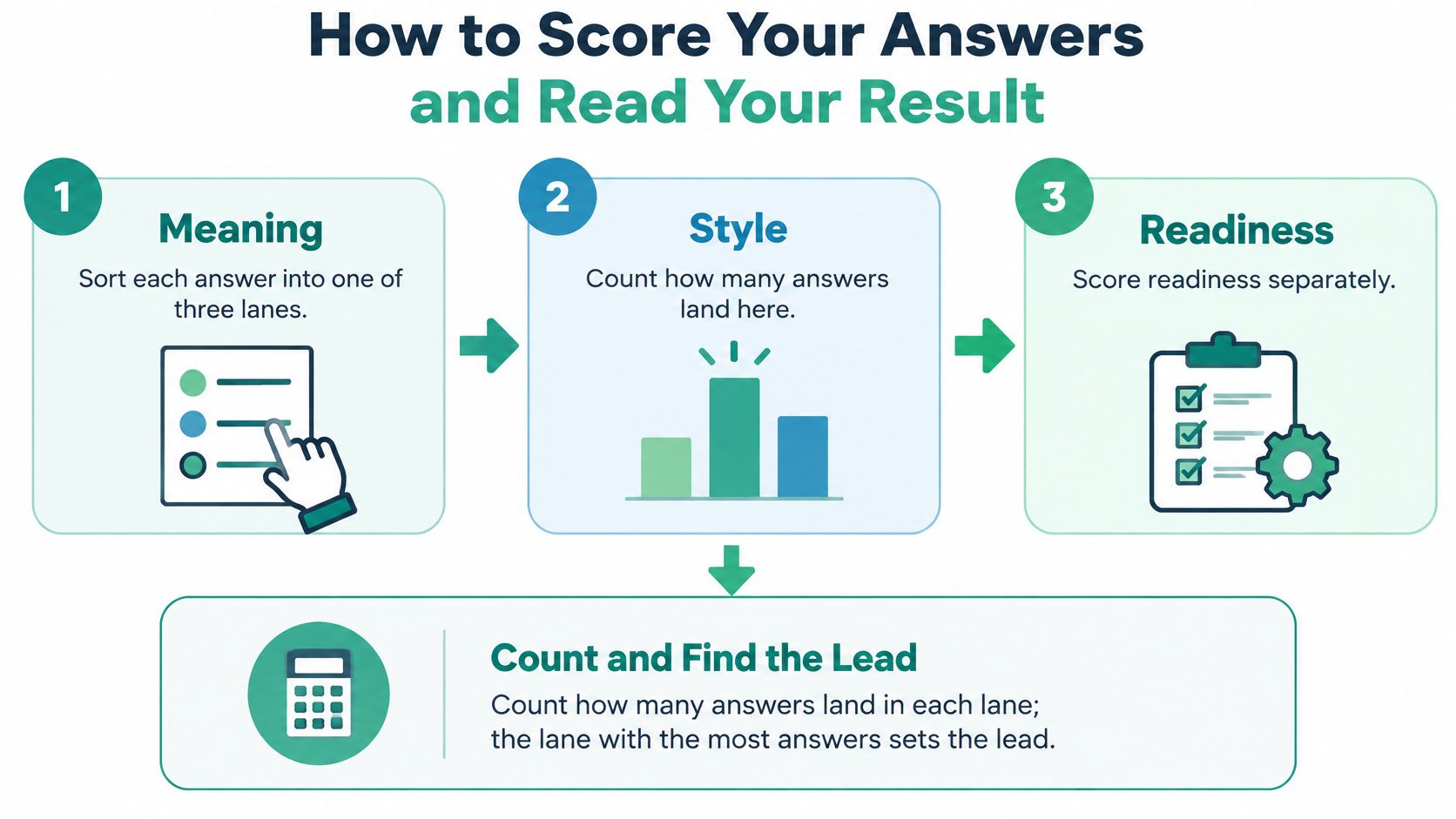
A quiz result is useful when it shows both what attracts you and how ready you feel to act. Sort each answer into one of three lanes:
- Meaning: honoring someone, marking a milestone, or choosing a symbol for a specific reason.
- Style: visual appeal, mood, preferred style, and the level of detail you can accept.
- Readiness: placement, tattoo history, uncertainty, and practical constraints.
Give each question one lane, based on your main answer. Count the labels. The lane with the most answers is your lead; a tie gives you a mixed result.
Then score readiness separately. Mark your motivation, visibility choice, detail compromise, budget, and plans for future tattoos as settled, partly settled, or unresolved. High readiness means those decisions feel settled and the choice is freely yours. If several remain unresolved, treat your result as a reason to pause, not a verdict that you should never get tattooed.
Result profiles and the next move for each
| Result | What It Means | Next Move |
|---|---|---|
| Meaning-led | The design rests on a specific story or symbol | Brief the artist on the story, names and dates |
| Style-led | You are drawn to a look more than a subject | Choose one style family and test two motifs |
| Readiness-first | Your reason or timing is not yet settled | Wait, then generate three concepts before deciding |
| Mixed or unsure | No single lane leads | Revisit the least confident answer, then retake the quiz |
A lane count organizes preferences. It is a reflection framework, not a validated psychological test or a prediction of regret. The readiness score adds a separate check, so a strong style preference does not hide decisions you have yet to settle.
Many people choose tattoos to honor or remember someone or something. That motivation can lead to a very different brief from choosing the same subject for its appearance.
For example, one person might choose a rose for its connection to a relative's garden. Another might like its shape in a traditional design. The first should explain the memory; the second should show visual references for the treatment they prefer.
Use a confidence band to guide your timing:
- High confidence: One lane leads, readiness is high, and you still like two concept directions after a week. You can start preparing a brief for an artist.
- Medium confidence: Your lead is clear, but one answer or practical choice remains unsettled. Revisit it before booking.
- Low confidence: Your answers are split, or your motivation and timing feel unresolved. Wait and retake the quiz when your preferences feel clearer.
The week is a practical pause, not a scientifically established threshold. It gives you time to see whether the idea still feels like yours.
Placement and Regret Risk Before You Pick an Image
Loving an image doesn't settle where it belongs. A wolf on your thigh and the same wolf on your hand create different everyday choices about visibility.
A 2023 study of tattoo regret found that 18.2% of tattooed participants regretted at least one tattoo; its regression model identified peer pressure with an odds ratio of 3.02, impairment during tattooing with 2.98, head or neck placement with 2.10, and hand, wrist, or finger placement with 2.00. These are associations within that study, not your personal probability of regret.
An odds ratio isn't a percentage. It also doesn't establish that placement caused regret, so don't interpret the figures as a guarantee that a covered tattoo will satisfy you.
Use the placement choices as a separate decision from the artwork.
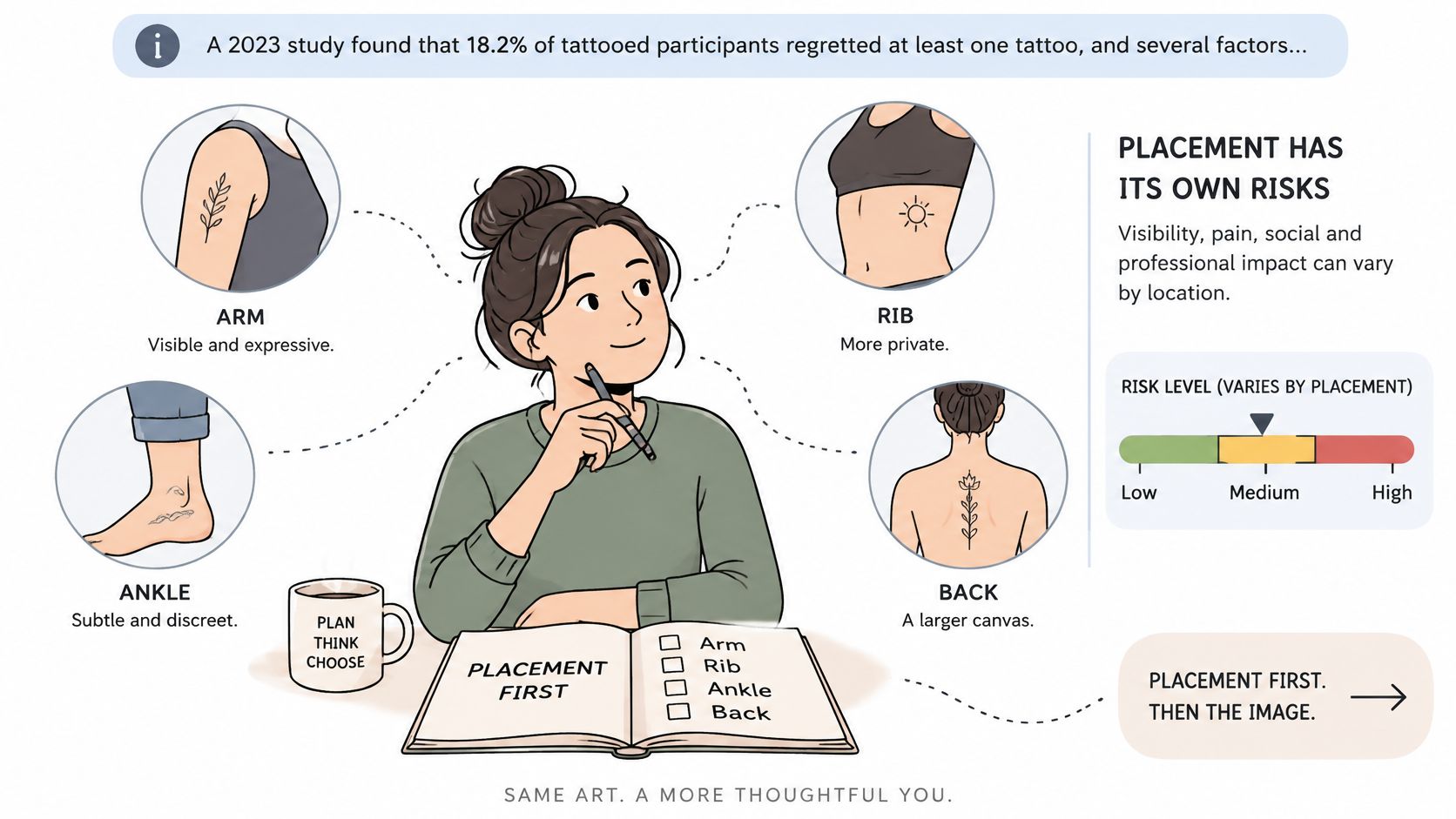
Placement regret odds and visibility
The placement figures below come from the same study's model.
| Placement | Regret Odds Ratio | Visibility | Practical Move |
|---|---|---|---|
| Head or neck | 2.10 | Highest, hard to hide at work | Test a smaller version first |
| Hand, wrist or finger | 2.00 | Visible in most jobs and social settings | Choose a small motif you can live with |
| Upper arm, back or chest | Not reported in the cited findings | Usually covered by clothing | Good starting point for a first piece |
A smaller version is a visibility experiment, not an instruction to squeeze intricate artwork into less space. Head and neck designs still require deliberate consideration even when small. Wrist coverage also changes with sleeves, while an upper-arm piece may be exposed in your usual summer clothes.
Use our tattoo placement guide to compare locations against the clothes and activities that fill your week.
When the quiz should tell you to pause
Peer pressure and impairment aren't design preferences. If either is part of the decision, stop the booking process and reconsider sober, without someone else's deadline.
For a highly visible site, ask whether visibility itself is something you want. Don't accept it merely because the reference photo looked good.
Look at a paper sketch beside the planned location every day for a week. Would you still choose it on a bad day at work, when you don't feel like explaining it?
That check can't eliminate regret. It can expose a mismatch before the image becomes permanent.
How to Turn Your Result Into a TattoosAI Prompt
Turn your result into a specification rather than a string of mood words. Our generator works in three steps: enter your idea, select style and color, then get your tattoo design.
The interface is a place to explore a brief, not approve its technical suitability.
- Name the subject and symbolism. Describe the visible object first. Keep private names or sensitive personal history out of the prompt unless they're necessary to the image.
- Choose a style family. Our generator offers 19 tattoo styles, including Minimalist, Blackwork, Old School, Realistic, and Watercolor. Avoid combining conflicting treatments until you understand what you like about each.
- Set approximate dimensions and orientation. State width or height, then explain whether the subject faces upward, inward, or outward. These are starting preferences for consultation.
- Specify placement separately. Name the body area without assuming the generated image has been fitted to your anatomy.
- Describe lines and color. Ask for delicate outlines, bold shapes, black-and-grey shading, or a defined color palette.
- Set a detail limit. Explain what may be removed or enlarged to preserve clarity. Give the artist permission to simplify.
Prompt examples you can adapt
The dimensions below are example design requests, not recommendations that these subjects will work at those sizes.
Small fine-line swallow in flight, a single black line, approximately 5 cm wide, intended for the inner forearm. Keep the silhouette simple enough to read at arm's length, without feather texture.
Blackwork wolf head with bold shapes, approximately 10 cm tall, intended for the outer thigh. Concentrate detail around the eyes and simplify the fur into clear areas of black and open space.
Watercolor sunflower with blue accents, approximately 7 cm across, intended for the wrist. Explore soft edges that can fade, with a recognizable central flower shape; allow enlargement or stronger outlines if the artist recommends them.
Compare each concept at three scales and two detail levels as a practical readability exercise. Print the references at their proposed dimensions rather than judging everything enlarged on your phone.
For a walkthrough of the generation process, watch the demonstration.
Keep the artist's judgment in the process
The output is a reference, not a stencil. Your tattooist must adapt it to your body, skin, and how the design will age, including line spacing and detail density.
Durability also involves care after healing. The American Academy of Dermatology recommends broad-spectrum, water-resistant sunscreen with SPF 30 or higher because ultraviolet exposure can fade tattoo ink, and notes that skin reactions can occur immediately or years later. A convincing screen image doesn't answer those skin-health questions.
Pre-Tattoo Checklist and Booking Your Artist
You don't need absolute certainty about every future version of yourself. You do need a decision that remains acceptable when the excitement of choosing wears off.
The conventional wikiHow tattoo-selection guide offers a useful starting point for exploring preferences. Your final check should go further than selecting a pleasing image: it should address your health, the permanence of the choice, and the person who will perform the tattoo.
Complete the checks before paying a deposit
Write down health disclosures. Include allergy history, previous ink reactions, keloid or unusual scarring tendency, relevant skin conditions, and expected sun exposure. Tell the artist before the appointment rather than when the equipment is ready. If you have a condition that may affect tattooing or healing, ask a qualified healthcare professional whether you need precautions.
Ask about licensing, sterilization, and ink. Verify the credentials required where the studio operates. Ask how reusable equipment is sterilized, which items are single-use, and how work surfaces are protected and cleaned. Request information about the inks planned for your design and written aftercare instructions.
Run the permanence test. Consider whether you'd still accept the piece at sixty, after changing jobs, or after losing interest in the trend that introduced you to it. Acceptance isn't the same as expecting it to remain your favorite artwork forever. A design can remain welcome without representing your entire identity.
Consider cover-up and removal before relying on them. Ask an artist what a future cover-up could require for the proposed size, placement, and darkness. If removal is central to your willingness to proceed, consult a qualified removal practitioner first. Don't treat either option as a simple undo button.
Resolve the budget without compromising the brief. Request a quote for an artist-approved size and detail level. If it exceeds your budget, save longer or discuss a simpler concept rather than demanding the same intricate design at a smaller scale.
Use this checklist to prepare the studio conversation.
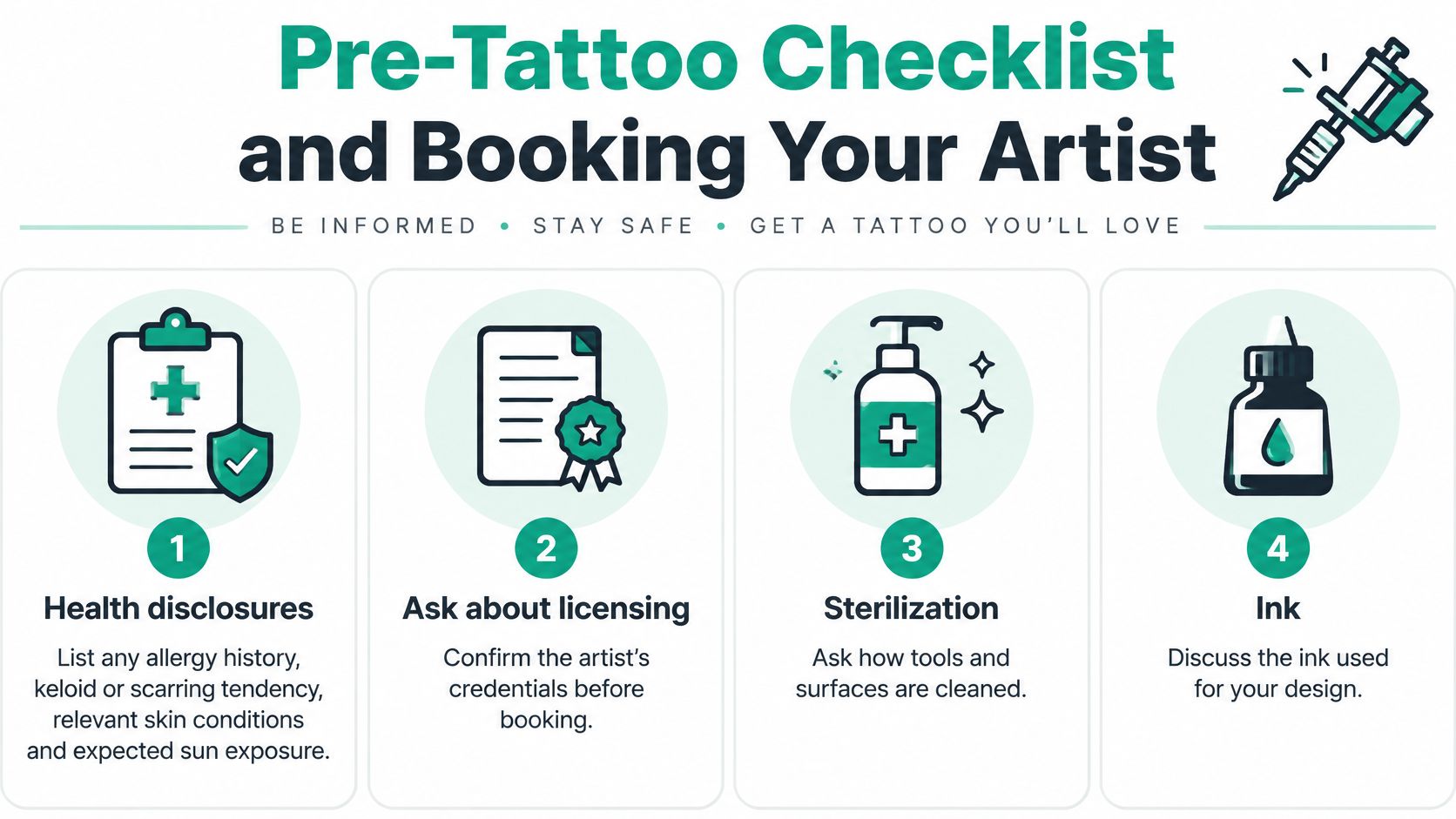
Choose your confidence band
These bands are decision rules, not measured probabilities. An unresolved health or safety concern overrides an otherwise appealing result.
| Confidence Band | What It Means | Next Move |
|---|---|---|
| High | Clear lead lane, readiness high, two concepts still liked after a week | Book a consultation |
| Middling | Readiness partly settled, one element uncertain | Choose a smaller or less visible version |
| Low | Reason, timing or permanence unresolved | Wait before booking |
For a middling result, test the proposed change rather than assuming it fixes the problem. A less visible placement may resolve a workplace concern, but it won't resolve pressure from a partner. A smaller version may feel less imposing, but it won't preserve details that need more room.
A low result is permission to stop without abandoning tattoos altogether. Keep the concept, remove the booking deadline, and return when you can explain what changed.
Booking boundary: You should be able to decline the tattoo even after enjoying the design process. Time spent choosing isn't a reason to commit.
Bring a useful consultation packet
Save your preferred concepts at the actual sizes you tested, along with your quiz result, placement choice, and permanence answers. Mark the features you consider essential and the ones you're willing to change. That distinction helps the artist preserve the idea without copying an unsuitable layout.
Choose someone whose healed work demonstrates the style you want, not someone with an available appointment. Our guide to finding tattoo artists can help you assess portfolios and prepare questions.
During the consultation, ask what the artist would enlarge, simplify, or reposition. Listen for an explanation you understand, and request clarification if the recommended design differs substantially from your reference. You don't have to approve changes immediately.
If you want the tattoo done, take the design to a tattooist you trust. We provide a starting point for that conversation; the tattooist evaluates the design and performs the tattoo.
Use your quiz answers to explore design directions with TattoosAI, then save the concepts that match both your style and your readiness. Our free 3-day trial lets you test the product before committing to a paid subscription, so you can compare ideas without treating generation as a promise to get tattooed.