TattoosAI
A photo of your cat can suggest several very different tattoos: a detailed portrait, a single continuous line, or a bold design with peonies. Choose by balancing likeness, placement and how the work will age. A realistic face needs a flat area and enough space for the eyes and muzzle. A single-line design can be smaller because it relies on silhouette, not fine detail. Put either style in the wrong spot and it may lose clarity as it heals and ages.
The same placement rule applies to any motif, including the designs in Triforce hand tattoo design ideas. Match the style to the body area and the size it needs to stay readable. The following guide compares cat portrait styles by placement, minimum readable size and how they age. Use a TattoosAI concept as a visual reference, then ask your tattoo artist to adapt it to your body and the design's long-term readability.
Table of Contents
- 1. Realistic Pet Portrait Cat Tattoo
- 2. Maneki-neko (Lucky Cat) Tattoo
- 3. Ukiyo-e Inspired Cat Tattoo
- 4. Single-Line Minimalist Cat Tattoo
- 5. Watercolor Cat Portrait Tattoo
- 6. Geometric or Dotwork Cat Tattoo
- 7. Neo-Traditional Cat with Florals Tattoo
- Cat Portrait Tattoo Styles at a Glance
- Choosing Your Cat Portrait Tattoo and Briefing Your Artist
1. Realistic Pet Portrait Cat Tattoo
A realistic portrait succeeds when the small details that identify your cat remain distinct: an ear notch, an unusual eye, or the break in a tabby's stripes across the nose. Choose a clear reference photo where those features are visible. A tightly cropped image can help the artist focus on the face rather than guess at missing detail.
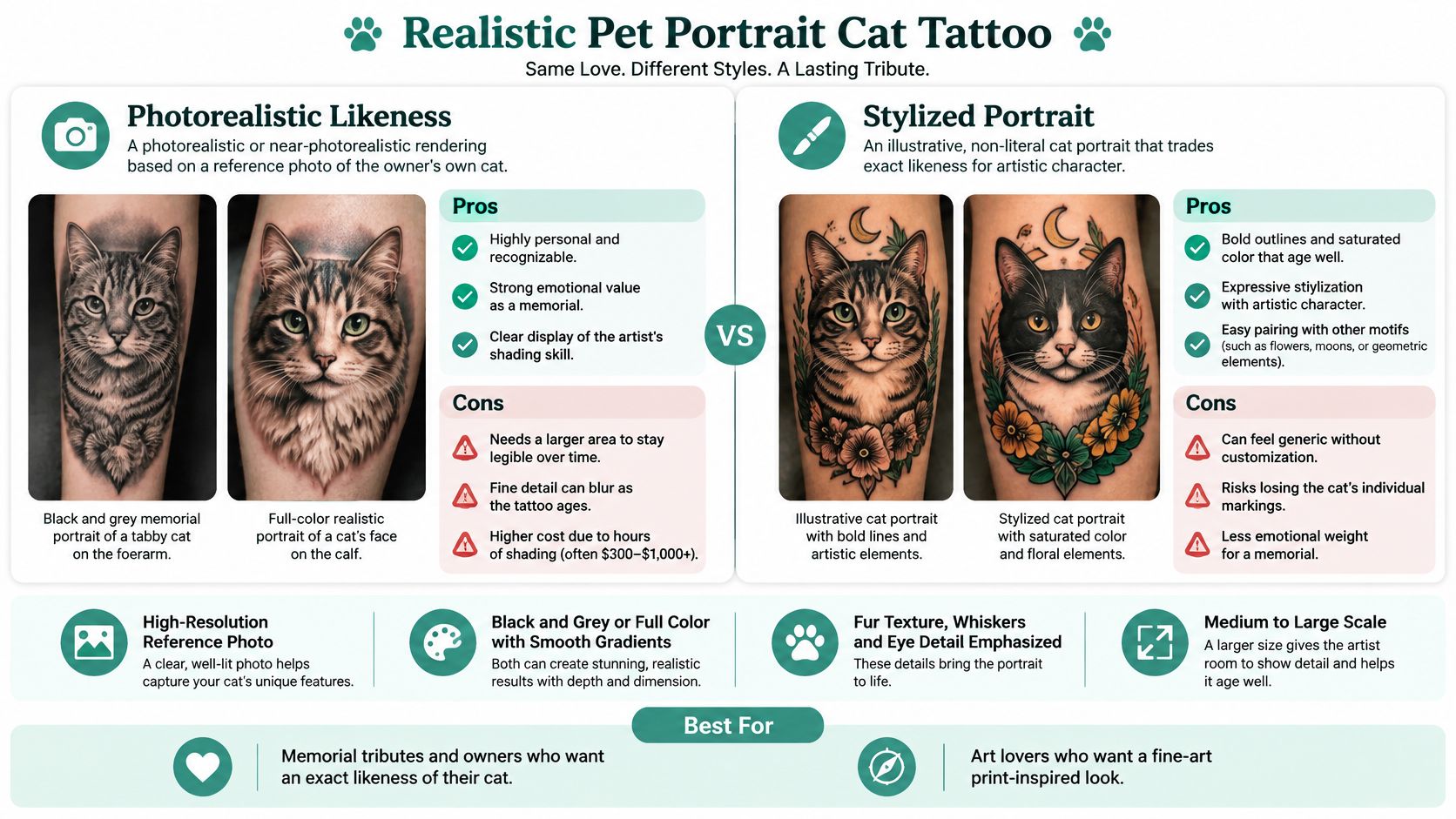
A 2023 survey of 2,000 cat and dog owners found that 25% would consider tattooing their current pet, another 25% were already planning a pet tattoo, and 16% already had one (StudyFinds on the pet-owner survey). For a memorial portrait, the likeness carries particular weight. Choose a photo that feels meaningful, but also gives the artist enough information to draw the eyes, muzzle, and coat clearly.
Placement and Minimum Size
- Forearm: A practical choice for a 10 to 15 cm portrait. The relatively flat surface gives the face room without wrapping it around the arm.
- Calf or outer thigh: A good fit for 15 to 20 cm, with space for fur direction and fine facial features. The larger canvas also gives the artist more room to balance light and dark areas.
- Chest or ribs: These placements can suit a personal portrait, but the curve may distort a face viewed straight on. Keep the composition simple enough to follow the body, and consider that discomfort can make a long session harder to sit through.
For a portrait to stay readable, contrast and controlled line weight matter as much as fine detail. Soft midtones can make a fresh tattoo look subtle, but they may leave the features indistinct as the tattoo ages. Ask the artist to preserve clear separation around the eyes, nose, and muzzle rather than filling every patch of fur with delicate shading.
Here's how the style behaves on skin once the bandage comes off and the piece settles.
For a memorial portrait, gather a few clear photos before discussing the design. This guide to pet memorial tattoo ideas can help you consider ways to make the image personal, and memorial tattoo guidance for grieving families offers support for choosing references during a difficult time. You can use TattoosAI to generate composition concepts, then show your preferred result to a tattooist as a reference. It is not a stencil. Your artist should adapt the design to the chosen placement, your skin, and how the portrait will age.
2. Maneki-neko (Lucky Cat) Tattoo
Plenty of people get the raised paw without ever learning it means something. In maneki-neko imagery the right paw is read as money and fortune, the left as invitation and trade, and a cat with both paws up changes the message again. Settle which one you want before you approve a sketch.
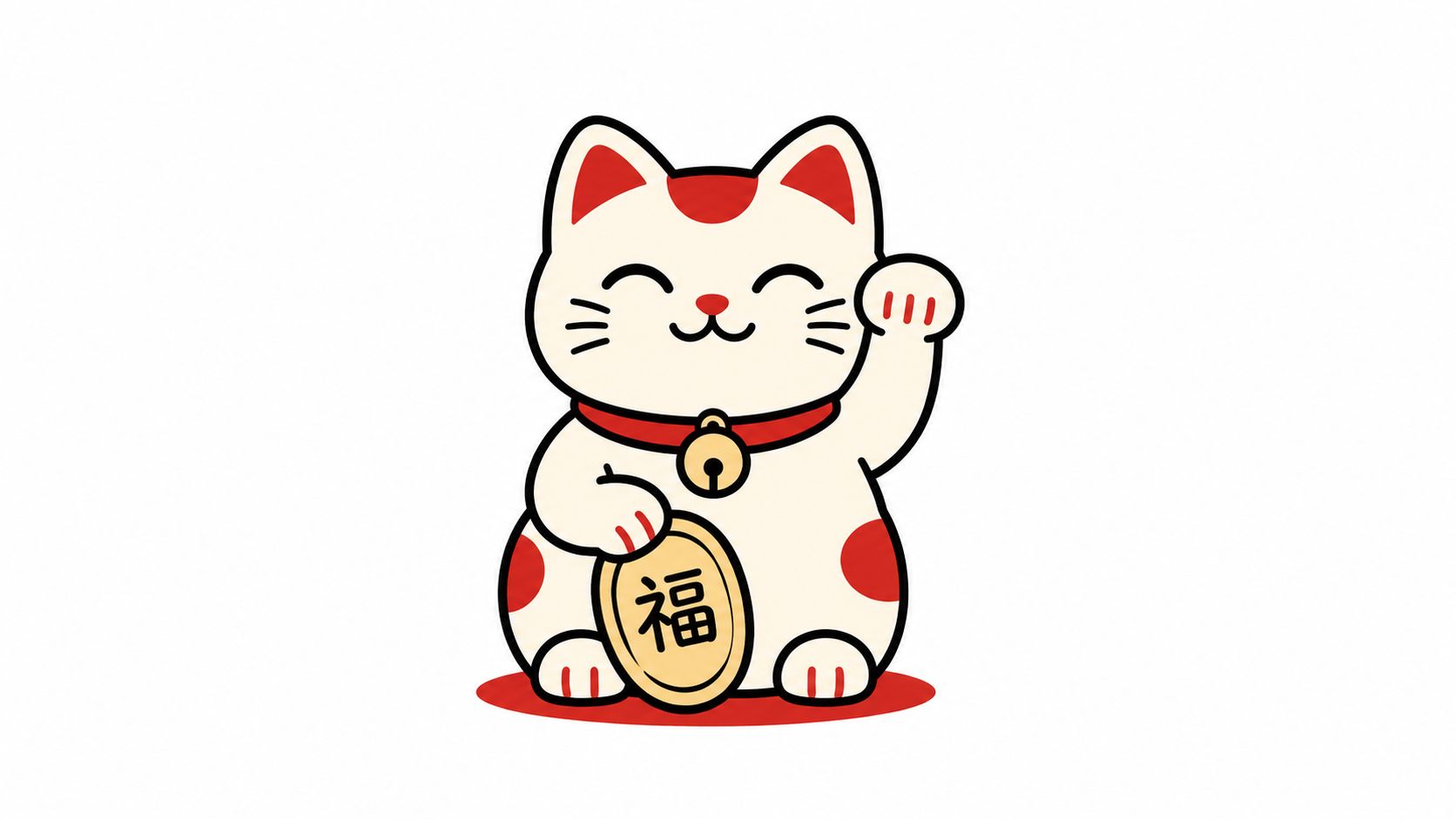
Two placements do most of the work. A traditional irezumi-style lucky cat with cherry blossoms sits well on the upper arm or shoulder, where a bold outline and flat color can run 12 to 15 cm without fighting the anatomy. A minimal black-line maneki-neko on the wrist works at 4 to 5 cm, and at that size you drop the koban coin and the bell collar because both turn into a dark smudge.
Ask first: which paw is raised and what the cat holds. That's a meaning decision, not a composition decision, and it's far easier to settle before the stencil than after.
Take a fat orange tabby as an example. Ask for the classic pose and posture, then swap in your cat's striping and eye colour rather than accepting the generic calico that comes back in most search results. Bold-outline styles last because the line weight does the structural work; hairline detail around the coin and collar merges into a single shape within a few years, especially on the wrist where sun and friction hit hardest.
In a TattoosAI prompt, spell out the paw position, the coin, the collar and the era you're aiming for instead of typing "lucky cat" and taking the first result. That one extra sentence is the difference between a design brief and a lottery ticket.
3. Ukiyo-e Inspired Cat Tattoo
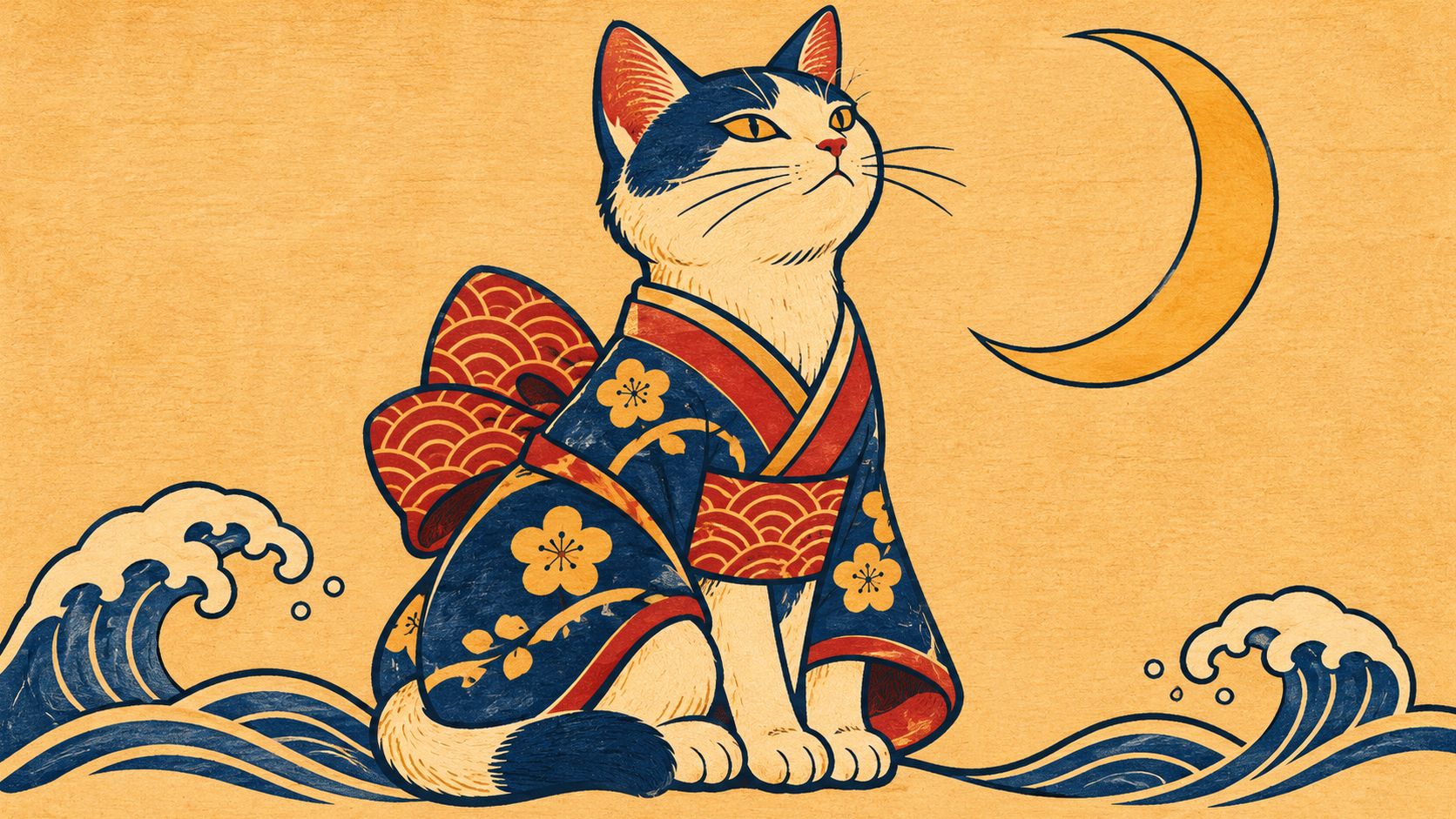
Ukiyo-e gives you a cat built on a printmaker's logic: flat colour fields, a hard contour, and decorative pattern doing the work that shading normally does. It's the one style here that's supposed to look printed rather than photographic, which makes it unusually forgiving on skin.
Why Flat Colour Ages Well
Flat areas of pigment hold their shape. What fails in woodblock-style pieces is inconsistency, a delicate contour in one section and a heavy one in another, because the eye reads the whole thing as a print and expects even weight throughout. A thigh piece framed with waves at 15 to 18 cm gives you room for that evenness. A back piece with a moon and clouds can go much larger and will look better for it.
Say you want your black cat with her white chest patch rendered in indigo and red, wrapped in stylised waves. Keep the palette to three or four colours and let the negative space do the highlights. More colours dilute the print effect rather than enrich it.
- Reference real prints: bring two or three images in the style of Utagawa Kuniyoshi, whose cat prints are the usual touchstone, so the artist sees the contour quality you mean.
- Pick the right portfolio: look for artists with Japanese or traditional work, not a realism specialist experimenting.
- Steer the generator: specify "ukiyo-e" and "Japanese woodblock" alongside the cat pose in TattoosAI, or you'll get a stylised cat that reads as neither.
The failure mode is a piece that looks like a greyscale portrait with a wave added afterwards. Decide early whether you want a portrait of your cat in a woodblock style or a woodblock print of a cat. They're different tattoos.
4. Single-Line Minimalist Cat Tattoo
A single continuous line is the most unforgiving style on this list and the easiest to get wrong. There's no fur, no shading and nowhere to hide a wobble, so the entire piece rests on a silhouette reading as your cat and nobody else's.
The inner wrist suits it at 4 to 5 cm, and the ankle works just as well if you want it less visible. Choose a pose with a strong shape: a curled sleeping cat, a full stretch, a head tilt that catches how she holds herself. Ask for a slightly heavier line than the sketch suggests, because a very fine line softens and spreads as it heals.
A minimal cat tattoo is a drawing test, not a detail test. If the silhouette doesn't read from across a room, adding more lines won't rescue it.
Minimalism beats realism on longevity. A specialist discussion of cat tattoo meaning warns that portraits leaning on close detail can blur into a generic cat somewhere between five and ten years, while strong contrast and a clear silhouette keep their identity. The fewer marks you make, the harder each one has to work, and the less there is to lose.
Test four or five poses in TattoosAI before you book. Save the ones that still read as your cat when you shrink them to thumbnail size, then show the artist those and let them redraw the line with a needle in mind. A designer's continuous line and a tattooist's continuous line are not the same object.
5. Watercolor Cat Portrait Tattoo
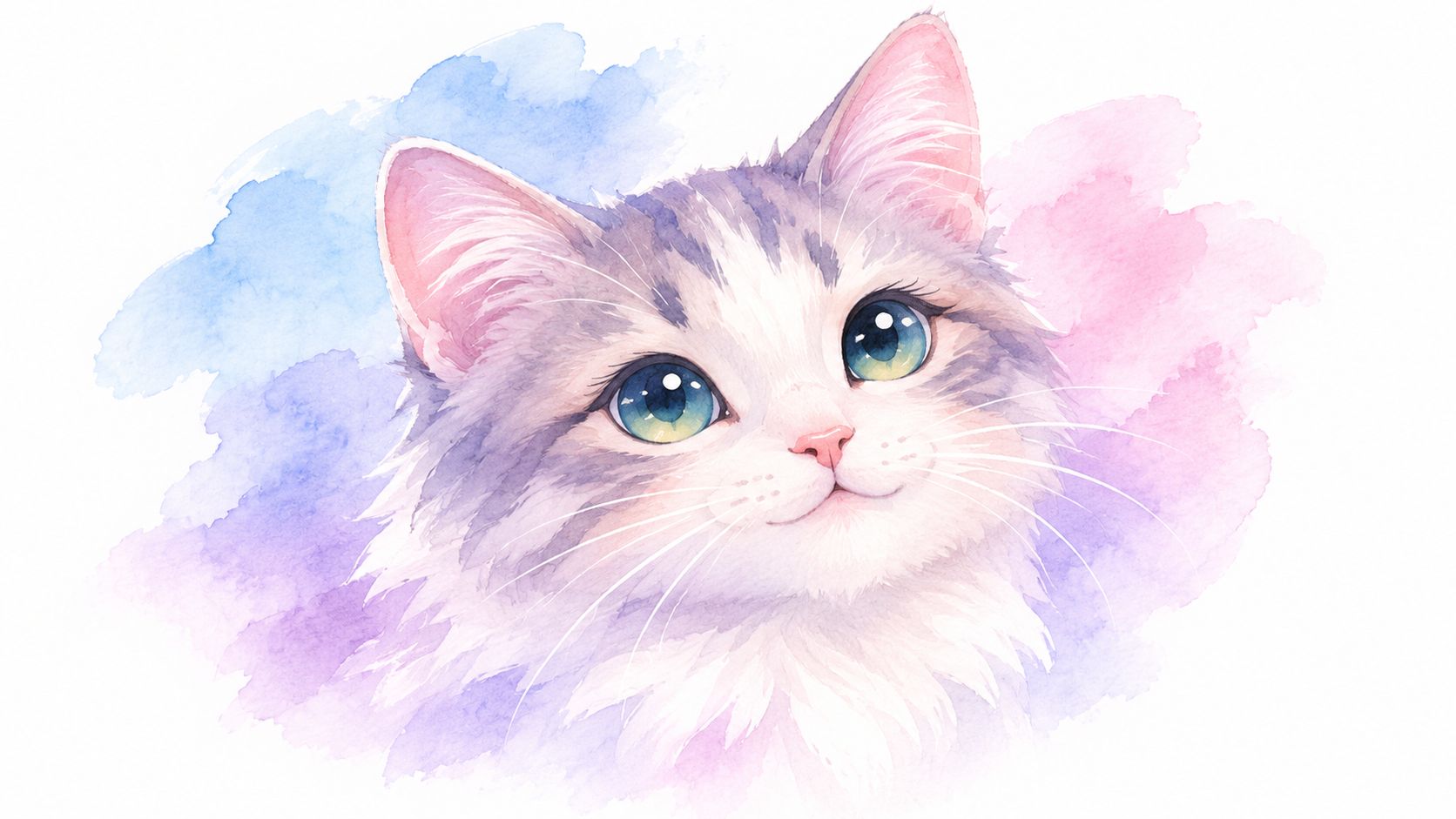
Watercolour is the style that most often looks better on the day than in year five. Soft washes, splashes and drips with no hard outline produce a painterly result that photographs beautifully while the skin is still fresh. Knowing why it changes is the difference between a piece you still love and one you book laser sessions for.
The Ink-Depth Problem
Pigment occupies a narrow band inside the skin. A technical guide to tattoo ink places typical deposition at roughly 1.5 to 2.0 mm, with shallow placement shedding during healing and excessive depth causing pigment to spread. Watercolour lives on soft edges, and spreading is the exact mechanism that destroys soft edges.
Making It Last
- Anchor the shape: ask for a fine outline or two structural lines around the head, even if the rest stays loose.
- Limit the palette: two or three washes keyed to your cat's coat and eye colour read better healed than a full spectrum.
- Pick a low-friction spot: upper arm or shoulder over hand or foot, and keep it out of direct sun.
- Plan a touch-up: colour pieces usually want one at the two to three year mark, and that's maintenance rather than failure.
A ginger cat works beautifully in warm orange and a single cool blue wash behind the ears. State the palette and the splash direction in your TattoosAI prompt, then compare a heavily rendered version against a simplified one and take the simplified one to the studio.
6. Geometric or Dotwork Cat Tattoo
Geometric cat work turns the head into triangles, circles and arcs. Dotwork achieves a similar result with stipple instead of line. Both are structured styles, which means they either align with the body or they look like an accident someone agreed to.
The forearm carries a geometric cat head well at 10 to 12 cm, where the shapes stay crisp and you can see the whole design in one glance. A dotwork silhouette inside a circular mandala wants 15 cm or more on the calf, because the pattern needs air between elements to read as pattern rather than texture.
Dots don't fade evenly, they spread. A dotwork piece packed tight at 5 cm is a grey smudge within a few years.
That's the trade-off nobody mentions in inspiration threads. Dot density buys contrast now and costs definition later. On high-friction areas like the hand, side of the finger or ankle bone, dotwork degrades fastest of any style on this list. On the upper arm or calf, under a skilled hand that spaces the dots deliberately, it holds up well for a decade or more.
Take a tuxedo cat and ask for the head reduced to six or seven triangles with two circles for the eyes. If the maths works, the piece reads instantly. If it doesn't, you'll see it in the sketch before anyone touches skin. Generate geometric and dotwork versions side by side in TattoosAI so you're comparing the two rather than guessing from other people's photos.
7. Neo-Traditional Cat with Florals Tattoo
Neo-traditional takes the bold outline and readable shape of American traditional and adds richer colour, a wider value range and a decorative frame. Drop a portrait head into that structure and you get a piece that reads as a portrait up close and a strong graphic shape from across a room.
Placement drives the composition. A full sleeve gives you a cat portrait at the centre with roses or peonies climbing the forearm and shoulder. A back piece with peonies and a crescent moon can run 25 cm and more, which is where the style sings. On a smaller scale, a 10 to 12 cm upper-arm piece works if you keep the flowers to two blooms.
Keeping the Cat the Focal Point
- Size the flowers down: if a bloom is larger than the cat's eye, the cat stops being the subject.
- Hold the outline: neo-traditional depends on consistent black line weight around every element, so don't let the florals get delicate.
- Watch saturation: ask about colour packing on the eyes, since that's the first area to look tired if the saturation is thin.
Say your cat is a soft grey and you want her framed by two peonies in muted red. Test the balance first with this cat and flowers tattoo guide before you commit to a frame you'll wear for decades. Then run a couple of floral combinations through TattoosAI with the cat portrait fixed in the centre, so you're judging real proportions rather than imagining them.
Cat Portrait Tattoo Styles at a Glance
| Item | Best For | Ideal Size | Key Trade-off |
|---|---|---|---|
| Realistic Pet Portrait Cat Tattoo | Memorial tributes and an exact likeness of a cat | Medium to large, at least 10–15 cm | Fine facial detail needs room and can soften as the tattoo ages |
| Maneki-neko (Lucky Cat) Tattoo | Good-luck symbolism and traditional designs | Wrist at 4–5 cm, or upper arm at 12–15 cm | Clear symbolism, but the design can feel generic without personal details |
| Ukiyo-e Inspired Cat Tattoo | Art lovers who want a fine-art, print-inspired look | Larger placements, such as the back or thigh | Bold shapes suit larger areas; the layered composition loses clarity at small sizes |
| Single-Line Minimalist Cat Tattoo | First-time tattoo seekers wanting a subtle design | Small to medium, at least 4–5 cm | Simple and understated, but thin lines can spread and leave little room for detail |
| Watercolor Cat Portrait Tattoo | Creative personalities seeking a colorful, expressive portrait | Upper arm or shoulder, about 10–15 cm | Painterly color can soften over time and gives less precise likeness than defined linework |
| Geometric or Dotwork Cat Tattoo | Design-savvy creatives who like symmetry and abstraction | Forearm at 10–12 cm; calf at 15 cm or more | Strong pattern and contrast, but fine dots can blur and dense dotwork takes longer to tattoo |
| Neo-Traditional Cat with Florals Tattoo | Tattoo enthusiasts planning sleeves or large decorative pieces | Large area, such as a sleeve or back | Bold outlines keep the design readable, but florals need room and add detail |
Choosing Your Cat Portrait Tattoo and Briefing Your Artist
A cat's markings, expression and the space available on your body should guide the design. A realistic portrait needs room for facial detail. A line drawing suits a smaller area, but carries less likeness. A lucky-cat design can use bold shapes that remain clear as the tattoo ages.
The Short Checklist
- Style: Match the design to your cat and the placement. A rib tattoo can be more painful than one on the forearm.
- Placement and size: Set a minimum size before refining details. Fine facial features need enough space to stay readable over time.
- References: Choose sharp photos at your cat's eye level, with the eyes in focus and natural light.
- Portfolio: Ask to see healed animal tattoos, not only fresh work.
- Ink records: Ask for the brand, colour and batch number of each ink used.
Keeping ink details gives you useful information if you have a reaction. The FDA's tattoo safety guidance describes risks including infection, allergic reactions, granulomas and keloids. It also reports bacterial contamination in tested samples and unlisted additives in some inks.
TattoosAI's library contains 26,000 tattoo ideas, and includes a Portrait style among its 19 options. You can design a cat concept to help compare compositions, markings and styles. Treat the result as a reference, not a stencil. Take it to a tattooist you trust, who can adapt it to your body, skin and how the design will age.
Your brief should be specific: describe the cat's markings, eye colour, expression, preferred style and intended placement. Use a TattoosAI concept to show the direction you like, then ask the artist what needs changing for clarity and longevity. The tool does not preview a design on your body, so confirm scale and placement with your tattooist before committing. Start a concept with TattoosAI.