TattoosAI
Why does the dragon keep turning up in every fine line portfolio you open? Because it's the motif that punishes ambition hardest, and working artists know it. A dragon hands you scales, whiskers, claws, horns, a mane and a tail in a single drawing, then asks you to fit all of it into a few square inches of living skin.
Most fine line dragon tattoo advice is written about the picture. This is written about the skin the picture ends up in. Seven distinct dragon compositions follow, each judged on how its thinnest lines will look after five summers of sun and a decade of skin turnover, not on how sharp they looked under studio lighting on day one.
Placement and line weight settle more of that outcome than the concept does. A clever drawing in the wrong spot is a fading drawing.
Table of Contents
- 1. Continuous Single-Line Dragon
- 2. Fine-Line Eastern Serpentine Dragon
- 3. Fine-Line Dragon with Botanical Accents
- 4. Dotwork-Shaded Fine-Line Dragon
- 5. Fine-Line Skeletal Dragon
- 6. Geometric Fine-Line Dragon
- 7. Fine-Line Coiled Dragon Portrait
- 7 Fine Line Dragon Tattoo Concepts at a Glance
- From Concept to Consultation, Making Your Dragon Real
1. Continuous Single-Line Dragon
One line, drawn without lifting, starting and ending at the same point. That's the whole rule, and it's stricter than it sounds. The dragon becomes a gesture: a loop for the head, a long ripple for the spine, a flick for the tail, and every proportion has to work alone because a single-weight drawing has nowhere to hide a bad decision.
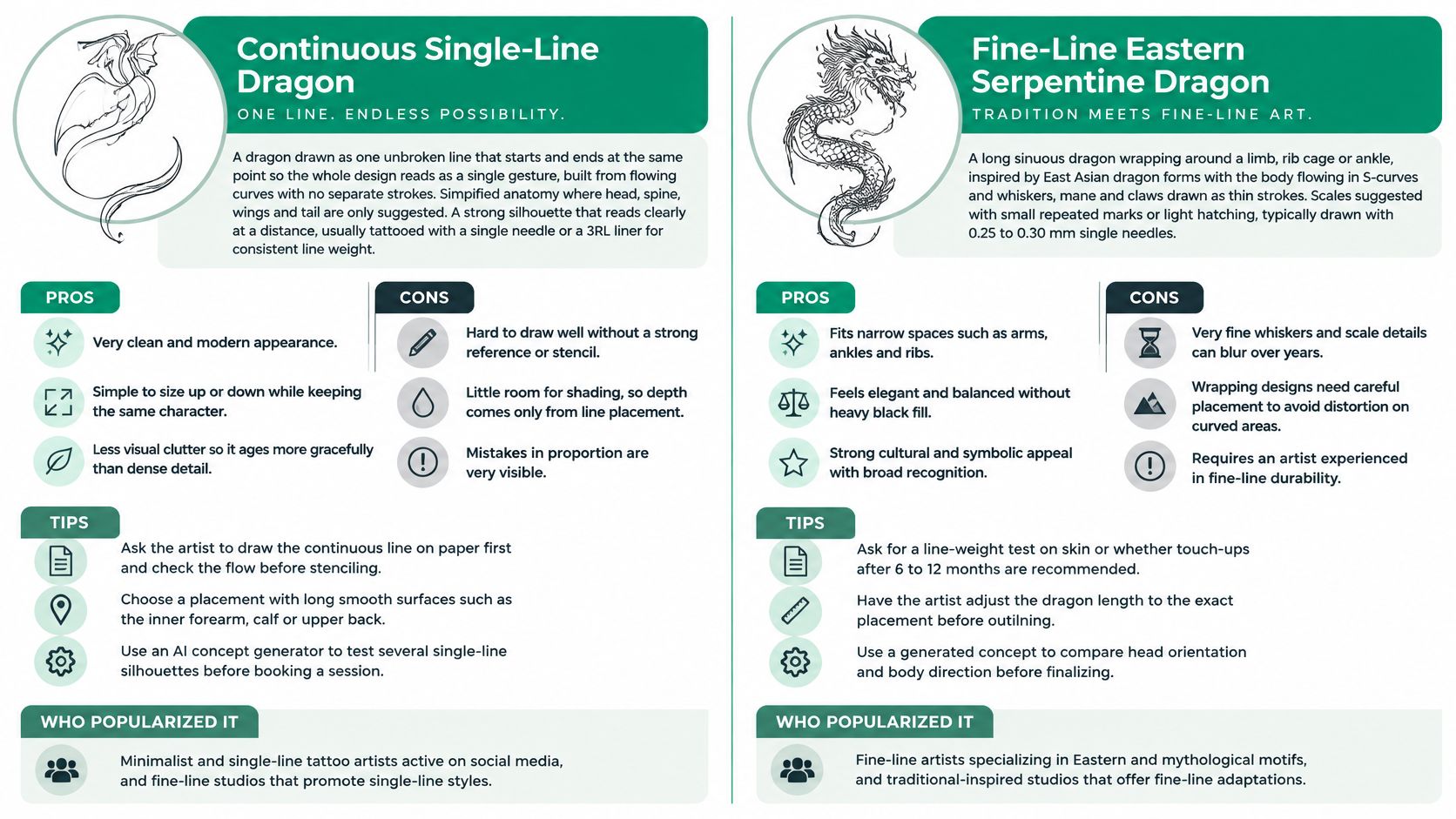
That single weight is also why the design ages well. There are no parallel lines sitting close enough to bleed into each other, and nothing depends on shading. What you're protecting is silhouette, and silhouette is the last thing to go.
Where a single line actually fails
Speed. When the line races to keep up with a long body, it thins unevenly, and thin spots fade first. No long-term study tracks fine-line durability specifically, but the Tatulogue guide to fine line tattoos lists placement, sun exposure, pigment migration and artist technique among the factors that make fine lines soften or fade faster, with chronic sun exposure a major accelerator.
- Pick long, smooth real estate: inner forearm, calf, upper back. A surface that flexes and creases constantly will break the gesture.
- Draw it in one pass before booking: if the line wobbles on paper, it will wobble on skin.
- Compare silhouettes first: generate five or six single-line versions of the same dragon and choose the one that still reads from across a room.
Say the plan is a four-inch continuous dragon down the inner forearm with the head at the wrist end. It works because the line has one job, describing motion. Stretch the same drawing across a shoulder blade and the weight thins where the arm swings. Scale isn't vanity here. It's the only thing keeping a constant weight constant. For the wider technique, the fine line tattoo style overview covers needle choice and line discipline.
2. Fine-Line Eastern Serpentine Dragon
This is the composition many picture when searching for a fine line dragon tattoo. A long body in S-curves, whiskers trailing off the jaw, mane and scales drawn as individual thin strokes, the whole thing wrapping a forearm, a rib panel or an ankle. It fits body contours better than any other dragon shape because it was designed to wrap, not to sit flat.
The lineage is documented. The Seattle Art Museum connects Japanese tattoo culture closely to Edo-period print culture, dated 1615 to 1868, and notes that dragon imagery developed alongside tattooing's association with outsider identities. In the late nineteenth century, tattooing Japanese people became illegal while artists kept working on foreign visitors, many of whom chose dragon tattoos as souvenirs.
Chinese sources run older still. Early dragon depictions date to approximately the 5th millennium BCE, making the motif at least 7,000 years old, and the creatures were tied to rain, water, good fortune and imperial authority, as the World History Encyclopedia dragon gallery sets out. Fine-line rendering can carry those references through silhouette, horns, claws, clouds and water.
Why the S-curve survives
Curvature gives the eye something to follow even after ink has softened, which is why a long serpentine body outlasts a compact detailed dragon at the same size. The lines that betray you are the small ones: whiskers, individual scale rows, the fine teeth of the mane. Draw them as few, widely spaced strokes and the dragon still reads at year ten.
If the body's path isn't traceable with a finger at arm's length, the design is too tight for the placement.
Before you blend traditions, read up on what you're borrowing. A Chinese dragon carries specific symbolic weight, and Japanese compositional ideas are a different vocabulary with a different history.
3. Fine-Line Dragon with Botanical Accents
Choose the flower before you choose the composition, because the flower is doing the talking. Cherry blossoms read Japanese, peonies read Chinese, lotus reads Buddhist, and a rose reads European. Pairing a serpentine Eastern dragon with a rose isn't wrong, but it's a hybrid, and you should know you're making one on purpose.
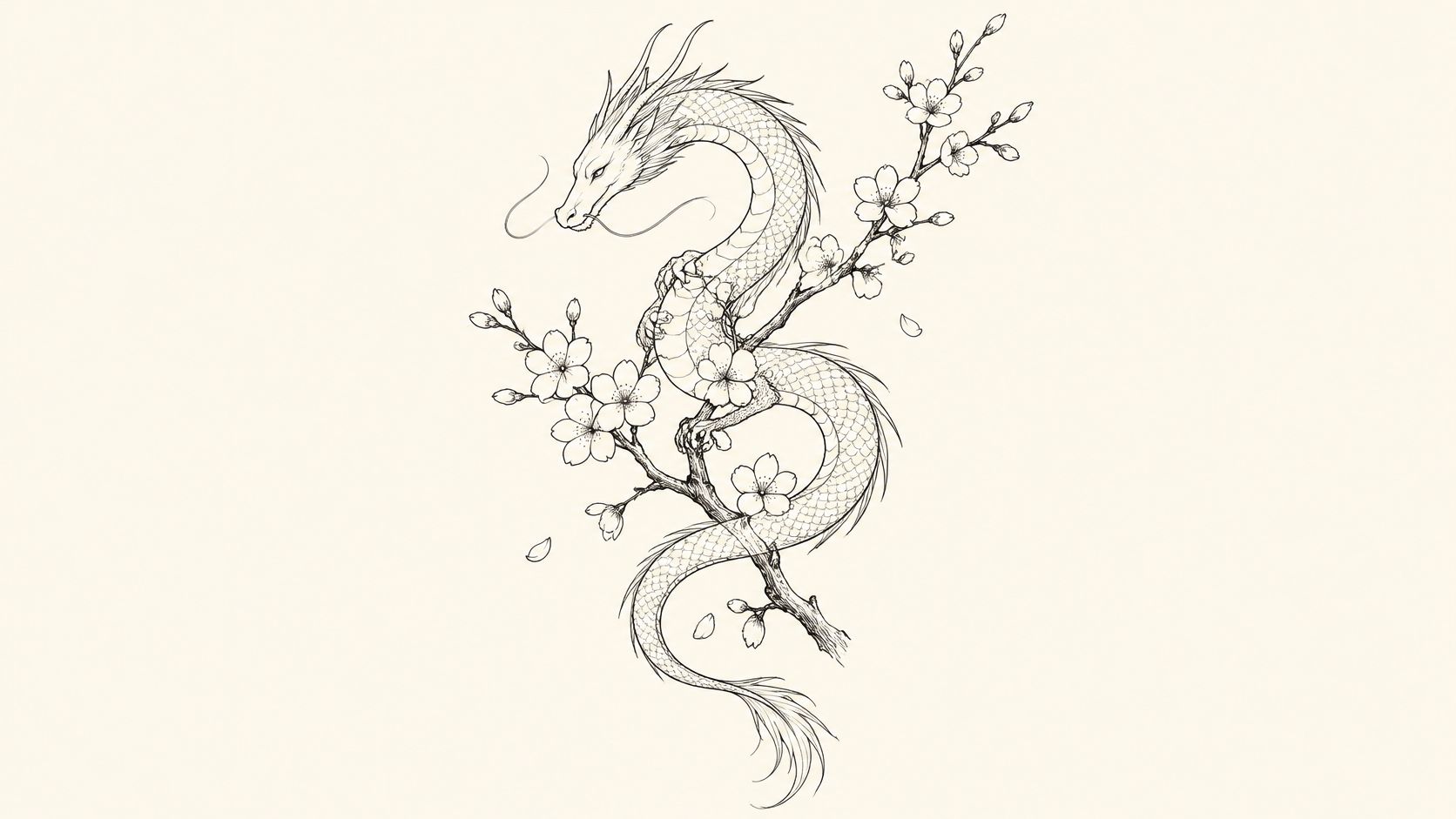
Botanical accents are where delicate dragons most often fail. A petal outline drawn two millimeters from a dragon's jaw looks elegant on a stencil, then turns into a smudge within a few years, because two thin lines close together migrate toward each other as the ink settles.
- Keep one dominant element: a single peony behind the head beats a bouquet that competes with it.
- Reserve real separation: a few clear millimeters between every petal edge and the nearest dragon line, not a hairline gap.
- Check healed photos: ask specifically for pieces two years old or more, since fresh work tells you nothing about spacing.
Delicate work has also become easier to find. U.S. employment in the "other personal care services" industry, which includes tattoo parlors, grew from 150,000 workers at the start of 2020 to slightly more than 180,000, Business Insider reported, which means more studios advertising fine work and more reason to vet portfolios properly.
A shoulder piece with one blossom works because the dragon's spine runs clean and the flower sits in negative space beside it, never woven through the coils.
4. Dotwork-Shaded Fine-Line Dragon
Outline in thin lines, shade with dots. Stippling replaces solid fill, so scales, wing membranes and the underbelly pick up depth without a heavy black mass. The look is light and dimensional at once, and it is the fine-line dragon that punishes extra shading hardest once the ink settles.
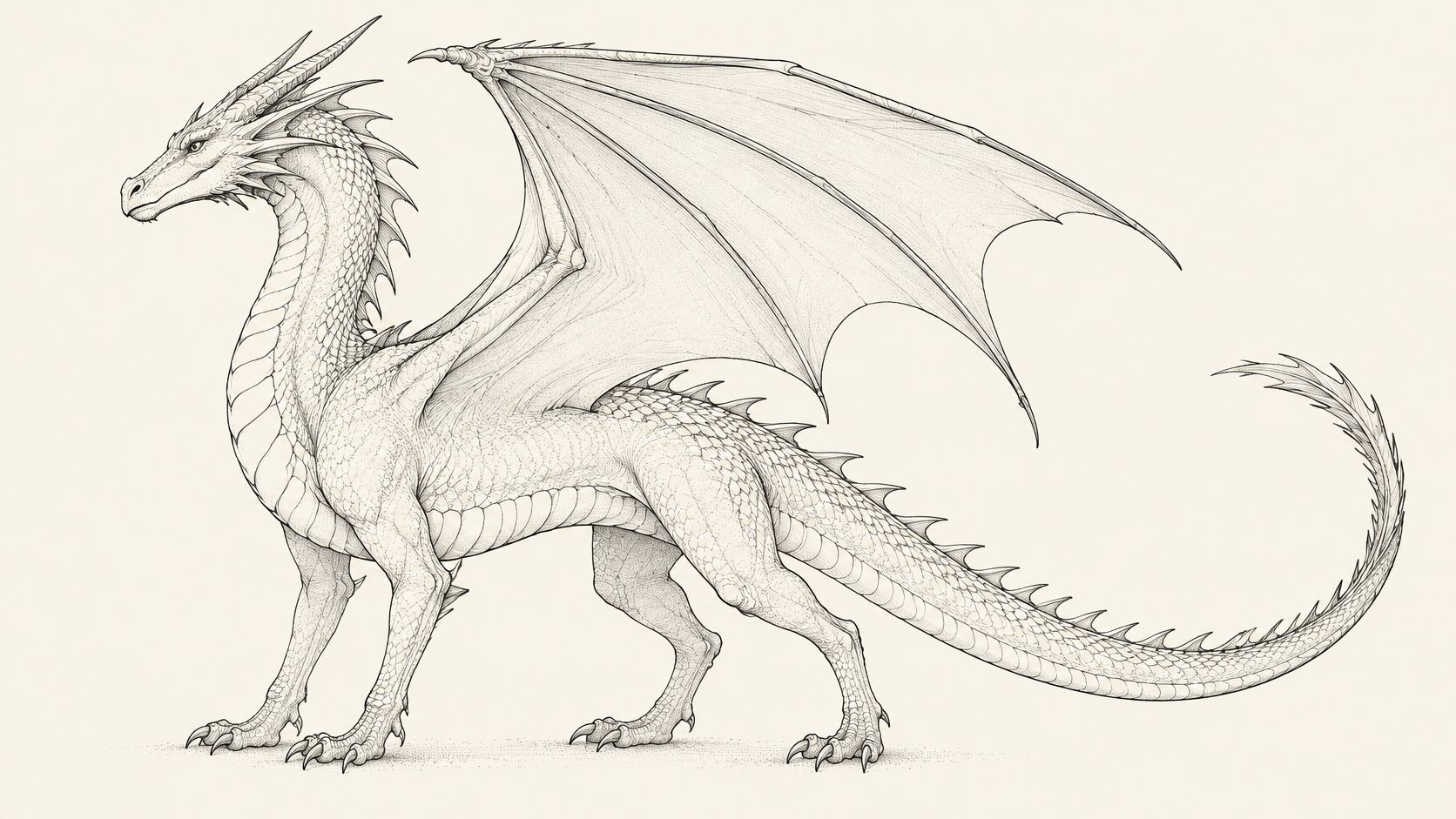
Solid black on a scale looks richer in the chair. It also spreads into a flat patch as the skin heals and pigment migrates. Dots age on a different rule, and only if they stay apart. Even gaps heal as soft tone. Dots packed close enough to touch fuse into a gray smear, and the scale that used to sit there is gone. Count is the vanity number. Gap size is what the healed tattoo keeps.
Dot density and what it costs you
- Fix the spacing before the density: evenly spaced dots survive as tone; clustered ones merge into a gray smear.
- Shade selectively: scales, a wing membrane, the shadow under the jaw. Stippling every surface flattens the design and gives the ink more places to blend.
- Brief with a reference: show the artist a photo of the exact dot density you want, not a word like "subtle".
A back-of-arm dragon with dots only in the wing membrane stays readable for years. The same dragon stippled across every scale becomes noise once the edges soften. I would drop body shading before I would tighten those gaps.
5. Fine-Line Skeletal Dragon
A skeletal dragon puts ribs, spine, wing bones and a skull on the skin in clean thin lines. Other dragons hide that structure under scales. This one has to live on the bones alone. Bone shapes stay readable after the edges soften, so the tattoo can look clearer once it has settled.
Choose realistic or stylized at the consultation, before needle talk. Realistic anatomy means more bones and closer spacing, and that spacing is the risk. As fine lines heal they widen a little, and ribs packed tight can merge into one dark band. A stylized skeleton, maybe nine ribs a side instead of a full cage, keeps the silhouette and leaves gaps. I would choose stylized on a smaller canvas. A realistic cage only lasts where there is room for each bone to blur without touching its neighbor.
Bone spacing is everything
Structural rule: outline first, anatomy second, decoration last. If the ribcage doesn't read on its own, no amount of extra detail will save it.
That hierarchy is how thin-line work is planned. In a published interview with a fine-line specialist, the central challenges are named as producing extremely thin lines, minimizing skin trauma and predicting how the work will heal. Draw one contour, then a second layer for joints and motion, then optional cracks you can drop and still recognize a skeleton. Final line weight stays the artist's call. Machine setup, needle configuration, skin type, placement and hand speed decide what thin can survive on your skin.
A sternum-to-navel spine with the skull at the top holds because the bones run down a stable surface. Pull the same drawing across a shoulder joint and every overhead reach stretches those ribs, then lets them collapse. The gaps you left for aging disappear in the fold.
6. Geometric Fine-Line Dragon
A geometric dragon is built from triangles, circles and angular facets, drawn with the same thin lines as everything else on this list but assembled on a grid. It appeals to design-minded clients because the dragon becomes a system, not just a creature.
Geometry is less forgiving than organic linework. A one-millimeter drift in a scale that should be identical to its neighbor is visible to anyone, and symmetry errors read as mistakes rather than style. The trade-off is real: fewer soft details to blur, but a higher bar for execution.
Precision you can check yourself
- Ask about the layout method: a ruler, a digital draft or a printed template. Freehand symmetry on a twelve-inch back piece is a gamble.
- Keep tight grids off joints: dense geometry over a knee, elbow or ankle distorts with every movement and ages badly.
- Test angles before booking: generate three or four geometric variations and compare them side by side rather than approving the first draft.
Say you want a shoulder-blade piece with a triangular facet head and a diamond-patterned body. Ask the artist to draw the whole grid on paper first. If two facets don't meet exactly, that error will be permanent, and it will be the only thing you see.
7. Fine-Line Coiled Dragon Portrait
Coiled dragons solve a hard problem. They compress a long body into a circle or spiral, keep the head in profile or facing out, and fit the wrist, behind the ear, the sternum or the inner upper arm. The eye, horns and snout carry the whole design.
Small is where this composition gets dangerous. In 2024, small fine-line dragon tattoos measuring 1 to 3 inches were priced at $80 to $200 in U.S. studios, according to The Tattoos Designs, which is both the entry price band and the size band where fine detail tends to disappear.
The smallest size that still reads
The eye and horns survive compression. Whiskers and individual scales don't. Ask for the smallest size that preserves the eye and horn shapes, then open the coil slightly so the innermost loop doesn't crowd the head.
Take the design at the size the artist recommends, not the size that fits your phone screen. You can always add around a good tattoo. You can't subtract a crowded one.
Friction matters as much as size. Behind the ear and on the wrist look clean, but both take daily contact from hair, sleeves and watch straps, so expect a touch-up long before a sternum piece needs one. An inner upper arm coil, drawn three inches wide with a clear gap between each loop, is the version most likely to still look deliberate in a decade.
7 Fine Line Dragon Tattoo Concepts at a Glance
| Concept | Best Placement | Line Technique | Aging & Durability Notes |
|---|---|---|---|
| Continuous Single-Line Dragon | Inner forearm, calf, or upper back | One unbroken contour; usually a single needle or 3RL liner | Sparse detail tends to age gracefully; proportions are especially visible if lines shift |
| Fine-Line Eastern Serpentine Dragon | Arm, ankle, ribs, or calf | Flowing S-curve with fine whiskers, mane, claws, and small scale marks | Fine details may blur over time; careful placement helps prevent distortion on curved areas |
| Fine-Line Dragon with Botanical Accents | Forearm, shoulder, or back of calf | Consistent fine lines for dragon and botanicals, separated by negative space | Dense floral details can blur together; spacing helps preserve clarity |
| Dotwork-Shaded Fine-Line Dragon | Upper arm or back | Thin outline with stippled shading; dot density creates gradients | Closely spaced dots may soften or spread; controlled spacing supports legibility |
| Fine-Line Skeletal Dragon | Back, sides, or forearm | Thin contours define the spine, ribs, skull, and wing bones with minimal fill | Generous spacing helps prevent bone details from merging over time |
| Geometric Fine-Line Dragon | Forearm, shoulder blade, or calf | Precise, uniform lines form geometric shapes, grids, or symmetrical patterns | Tight geometry may spread in high-movement areas; avoid placing dense grids over joints |
| Fine-Line Coiled Dragon Portrait | Inner upper arm or sternum; wrist or behind the ear for compact designs | Circular or spiral outline with fine facial details and minimal shading | Small details may blur or fade in high-friction areas; choose a size that preserves facial features |
From Concept to Consultation, Making Your Dragon Real
Judge every concept on two questions before aesthetics get a vote. How far apart are the closest lines, and where will this sit on your body? Generous spacing on a smooth, low-friction surface will still read in ten years. A dense design on a hand, ankle or inner elbow won't, no matter how good the first photograph looked.
Bring four things to the consultation: your concept, at least one healed photo you admire, the placement you have in mind, and an honest idea of your sun exposure. Then let the artist redraw.
- Rank spacing first: the design with fewer, better-separated lines wins on longevity every time.
- Name the cultural reference: Japanese, Chinese, European and modern hybrid dragons mean different things, so say which you want.
- Ask about touch-up policy: fine work sometimes needs a second pass, and you want to know the cost before you book.
- Commit to sun protection: fading is driven more by UV exposure than by anything the artist does on the day.
Concept generation shortens the front end of this considerably. TattoosAI includes a fine line style among its nineteen available options, and each generated image is created for your description rather than copied from an existing tattoo or another artist's portfolio. Treat what comes out as a reference for your artist, not a stencil, because the person holding the machine adapts it to your skin, your placement and how those lines will age.
The decade test is simple and brutal. Print your favorite concept, stick it on a wall, and look at it from six feet away. If the dragon reads as a dragon rather than a gray patch, you've chosen well.
Your dragon idea deserves more than a mood board of other people's healed tattoos. At TattoosAI you describe the dragon in your own words, choose the fine line style, and get several original concepts to compare for silhouette, spacing and placement before you pay a deposit. Take the two or three strongest versions to your consultation and let a trusted artist turn them into something your skin can carry for years.