TattoosAI
You bring your late mother's signature to a tattoo consultation, alongside a sketch of a cross. Before choosing the lettering, you pause: does this cross express her faith, your love for her, or something different?
Table of Contents
- Why a Memorial Cross Says More Than Decoration
- Cross Types and the Message Each One Sends
- Adding Names, Dates and Symbols Without Crowding the Cross
- Matching the Design to Faith, Family and Privacy
- Placement, Size and Legibility Over the Years
- Safety Checks and Warning Signs After Your Appointment
- Build a TattoosAI Prompt for Your Memorial Cross
- Take Your Concept to a Tattooist Before You Book
Why a Memorial Cross Says More Than Decoration
A memorial tattoo cross combines a shared religious symbol with a profoundly personal loss. In Christianity, the cross represents Jesus Christ's Crucifixion and, more broadly, redemption, faith, and victory over death. Its connection with remembrance isn't merely decorative.
Early Christians sometimes avoided displaying it because of ridicule or persecution; after Constantine promoted it in the fourth century, it became widespread in Christian art and funerary monuments, as Britannica's history of the cross explains.
Shared meaning and personal memory
Think of the cross as the familiar lettering on a headstone. Other people recognize the language, while the name, dates, and individual details identify the person you're remembering.
Your intention might be:
- Religious devotion, preserving a faith you shared.
- Hope after loss, expressing belief beyond death.
- Personal remembrance, keeping someone's presence close.
- Endurance through grief, acknowledging what you're carrying.
The meaning begins with what you and your family intend, but viewers bring their own associations. Form, details, and placement determine how clearly your intention reads.
A meaningful memorial doesn't need to tell a stranger everything. It needs to preserve what matters to you.
That principle also applies when remembering an animal companion. If that's your loss, you can explore cat companion tattoo designs from Soulknit before deciding whether a cross belongs in the tribute.
Start with the symbol's meaning, then choose personal details, visibility, and a design your tattooist can safely translate onto skin.
Cross Types and the Message Each One Sends
Choose the cross form before the decoration. A name tells viewers whom you're remembering; the cross's structure can suggest a religious tradition before they read it.
Cross forms, their signals and memorial fit
| Cross form | Shape | Traditional signal | Best memorial use |
|---|---|---|---|
| Latin cross | Longer lower stem | Western Christianity and the Crucifixion | A straightforward Christian memorial |
| Greek cross | Equal-length arms | Christian symbolism with a distinct structural tradition | A symmetrical tribute, after checking the intended faith association |
| Crucifix | Cross bearing Christ's body | Especially Roman Catholic and Eastern Orthodox devotion | An explicitly devotional memorial |
| Empty or plain cross | Cross without Christ's body | Resurrection and triumph over death | A tribute centered on hope after loss |
| St Anthony, or tau, cross | T-shaped | A named historical Christian cross form | A tribute where this form has personal or devotional relevance |
| St Andrew, or saltire, cross | X-shaped | A named historical Christian cross form | A memorial with a specific connection to this form |
| Jerusalem cross | Central cross surrounded by smaller crosses | Christ's wounds, the Evangelists, or Christianity's spread | A spiritually layered composition with room for detail |
| Celtic cross | Ringed cross form | A culturally specific form whose intended meaning needs checking | A heritage-led tribute developed with family input |
| Orthodox three-bar cross | Three-bar structure | Eastern Orthodox identity | Remembrance rooted in an Orthodox family or community |
Britannica's cross classification identifies the Greek, Latin, St Anthony, and St Andrew forms as basic Christian cross types. It also describes the Jerusalem cross's central cross and four smaller Greek crosses, tracing the design to approximately the eleventh century onward.
The distinctions that matter most
A Latin cross and an empty cross aren't competing categories. “Latin” describes the proportions; “empty” describes the absence of Christ's body. You can choose a plain Latin cross that communicates both a recognizable Christian form and hope in the Resurrection.
A crucifix makes a more explicit devotional statement. If your loved one prayed before a crucifix, that may be an important distinction rather than an extra decorative detail.
The Jerusalem cross requires a different decision. Its surrounding crosses are part of its structure, so removing them to make the tattoo smaller changes the design rather than merely simplifying it.
Treat the final column as guidance, not a religious rulebook. An equal-armed cross isn't automatically neutral for a mixed-faith family, and a culturally specific form shouldn't be chosen solely because its outline looks attractive.
Pick the form first, then confirm its meaning with someone familiar with the tradition. Your tattooist can refine the drawing, but family or community knowledge may be needed to confirm the symbolism.
Adding Names, Dates and Symbols Without Crowding the Cross
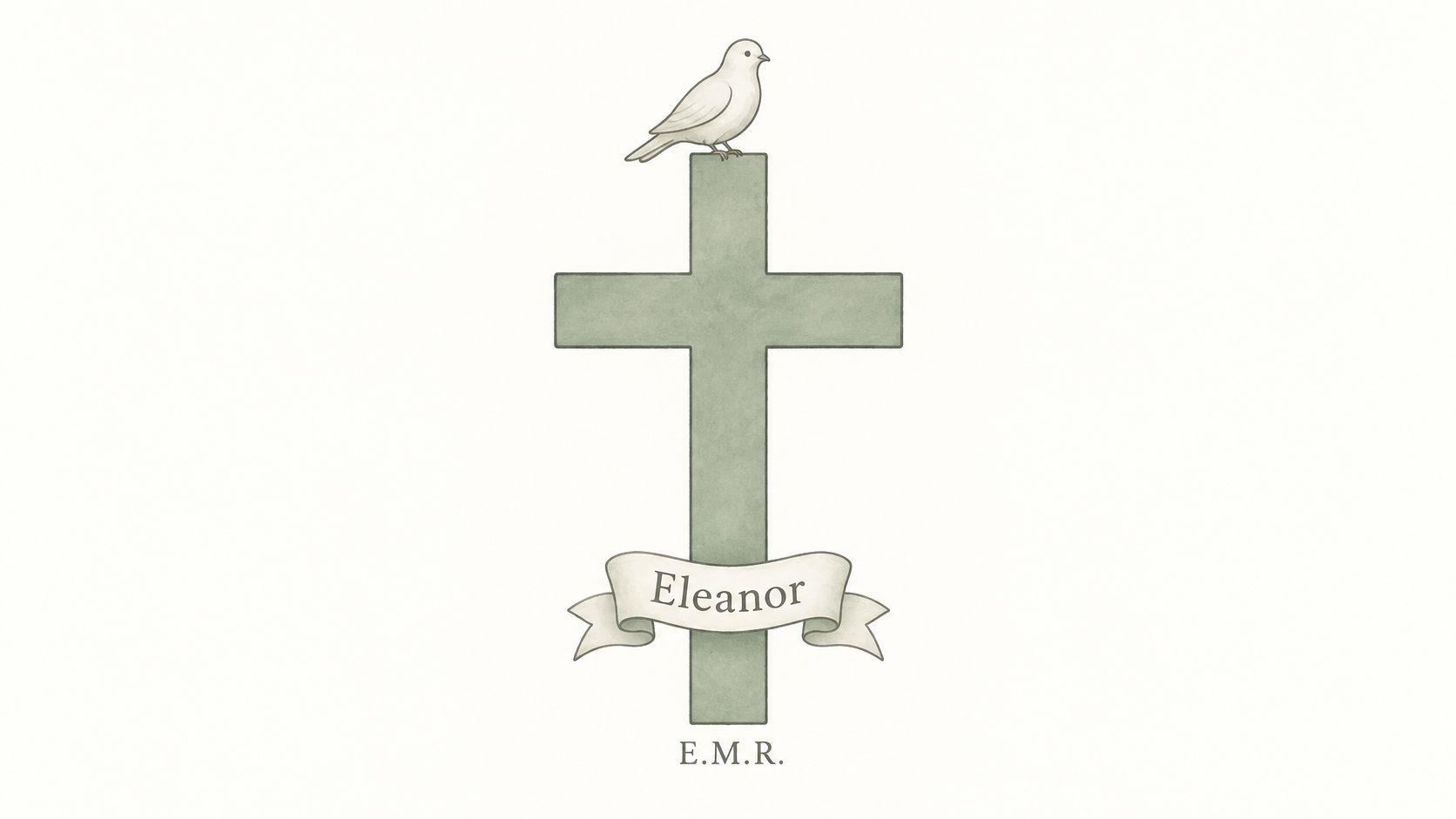
Let the cross carry the faith message and the personal details identify the person. When every element demands equal attention, the tribute can become harder to read.
This illustration shows one possible hierarchy, with the cross remaining prominent beside a name and dove.
Build the text before adding decoration
Start with the name. Compare a full name, the name you really called the person, and initials. "Eleanor" might feel more personal than a formal name you never used, while initials can leave more space around a small cross.
Next, decide whether dates are necessary. Birth and death years use less space than full dates, but an anniversary may matter more to you than either. Verify every character against a reliable family record before approving the stencil.
A phrase or Bible reference should earn its space. If you want a full passage, consider whether it belongs in a larger composition rather than forcing tiny lettering around the cross.
- Names need breathing room. Don't shrink the lettering just to preserve an ornamental border.
- Handwriting needs interpretation. Bring a clear original sample and let the tattooist identify which delicate strokes need adjustment.
- Script needs restraint. Choose lettering that complements the cross rather than competing with it.
Choose a symbol with a specific job
Rosaries can emphasize Catholic devotion, while a dove can introduce peace or the Holy Spirit, as discussed in Busted Halo's guide to faith and tattoos. Neither is merely filler for an empty corner.
A birth flower, meaningful place outline, constellation, or everyday object can instead identify the person. A small gardening tool might recall your father more precisely than a generic floral border. Don't assume a constellation corresponds to a birth date without checking the intended reference.
For a small piece, try this editing rule:
- Keep one dominant cross.
- Choose one name or set of initials.
- Add a date pair only if it remains readable.
- Allow at most one supporting symbol.
Use the video as a separate viewing reference while considering which elements deserve space.
Finish with a removal test. If taking away the extra symbol leaves the cross's intended message intact, the symbol is supporting the design rather than confusing it. Then ask whether it adds a memory worth keeping.
Matching the Design to Faith, Family and Privacy
The most traditional-looking cross isn't automatically the most faithful tribute. You're remembering a person, not completing a standard religious design.
A useful starting point is the relationship between their beliefs and yours. The personalized approach to memorial tattoo ideas supports considering the individual relationship rather than relying only on conventional imagery.
Ask what the tattoo should preserve
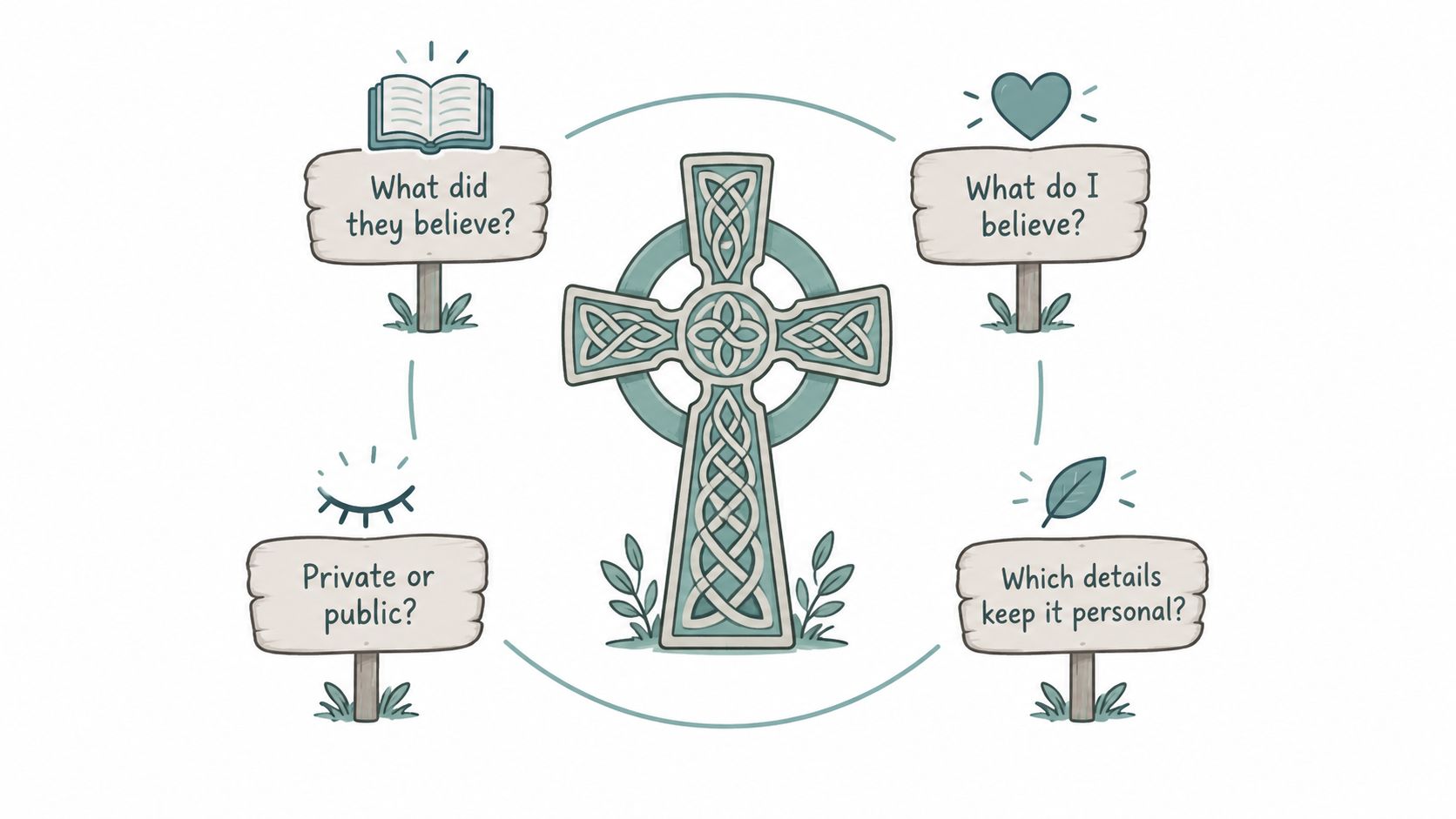
Use these questions before choosing a final drawing:
- What did they believe? Consider their actual practice, not just the religion associated with their family.
- What do you believe? Decide whether you're expressing shared faith or your own way of mourning.
- Who should see it? Separate private remembrance from a visible statement about your identity.
- What makes it theirs? Identify a detail that couldn't belong equally to any memorial.
A plain cross for a Catholic grandmother may feel exactly right. For a nonreligious father, the same design could express your hope for him while giving relatives a different impression of his beliefs.
Neither intention is automatically wrong. The important step is recognizing the distinction before making it permanent.
Keep individuality without assuming neutrality
An abstract cross can make the tribute feel less conventional, but it doesn't guarantee a nonreligious reading. Likewise, a Celtic form may suit a family connection, but it's worth confirming what that connection means rather than assuming the shape communicates heritage alone.
Handwriting, a place, or an object can help make the tribute more specific. If the cross keeps feeling wrong, compare a different memorial structure, such as the ideas in this memorial angel wing tattoo guide, while checking those symbols' associations too.
You don't owe anyone a religious statement that doesn't reflect the relationship you're remembering.
Try a small interpretation check: show the sketch to two people who knew your loved one and ask what it says about them. Don't explain it first.
Their answers aren't a vote on your grief. They're a way to discover unintended messages while changing the design is still easy.
You can also prepare a boundary for public questions. A simple response such as “It's a family remembrance, and I keep the story private” lets you acknowledge the tattoo without discussing the loss whenever someone notices it.
Placement, Size and Legibility Over the Years
Use the upper back or chest for a more detailed composition, simplify for the forearm, and approach wrists or ankles with a plain-form mindset. These are starting points for a consultation, not fixed anatomical rules.
Typical memorial cross sizes and detail limits by body area
There isn't a universal size range that guarantees a readable result. The size descriptions below are planning categories, and your tattooist should set the actual dimensions.
| Body area | Typical cross size | Detail it can hold | Visibility |
|---|---|---|---|
| Upper back | Larger composition | Full name, dates, and a rosary or script if space permits | Usually covered; room for an expanded layout |
| Chest, over the sternum | Medium to larger composition | Detailed cross, dates, and a supporting symbol | Usually covered; clothing dependent |
| Outer upper arm | Medium composition | Cross with a name or initials | Visible with some short sleeves |
| Inner forearm | Compact to medium composition | A cross with restrained supporting elements | Often visible |
| Wrist or ankle | Small, simplified composition | Plain cross or carefully assessed initials | Clothing and accessory dependent |
| Behind the ear or finger | Tiny, minimal composition | Cross outline without additional text | Visibility depends on exact location |
For help comparing how clothing and everyday visibility affect the decision, use this tattoo placement guide.
Design for aging, not just the fresh photograph
Tattoo pigment sits within the skin rather than on top of it. Over time, ultraviolet exposure can alter pigment, while changing contrast and skin movement can soften fine detail, making dense lettering and micro-detail a concern for long-term readability; the FDA's tattoo and permanent makeup fact sheet provides the relevant pigment and safety background.
That's why a beautiful screen rendering isn't enough. A sharp digital image doesn't show how your skin will hold the design over decades.
Ask your tattooist to assess:
- Silhouette, so the cross remains recognizable without its shading.
- Letter spacing, including open spaces inside and between characters.
- Shading, keeping enough separation between dark areas.
- Line weight, chosen for the body site and the intended scale.
Black-and-gray artwork can provide strong value contrast, but black ink doesn't make tightly packed detail immune to softening. Don't treat a dark fill as a substitute for adequate space.
Sun protection belongs in the long-term plan, using your artist's healing instructions before applying products to newly tattooed skin. Placement should account for how you dress and spend time outdoors, not just where a mockup looks appealing.
For a practical preview, display or print the concept at its proposed physical size and view it at arm's length. Can you still distinguish the cross and read the name? If not, enlarge the composition or remove detail, then let the tattooist make the final judgment.
Safety Checks and Warning Signs After Your Appointment
Grief doesn't reduce ordinary tattoo risks. Give the studio, ink, and healing plan the same attention you give the memorial's meaning.
Before booking, make these checks:
- Studio credentials, confirming licensing or registration requirements where you live.
- Sterile equipment, asking how single-use items and reusable equipment are handled.
- Ink information, requesting the brand, ingredient details, and available product records.
- Health history, sharing allergies, previous skin reactions, and relevant medical concerns.
- Written aftercare, obtaining instructions and knowing whom to contact with questions.
The FDA states that no color additives are approved for injection into skin for cosmetic tattooing. That doesn't mean an artist can make tattooing risk-free by choosing a particular brand, so ask questions rather than relying on the word “approved.”
Healing signs, what they usually mean and what to do
The FDA's tattoo safety guidance advises contacting both the tattooist and a healthcare professional when a tattoo isn't healing or a rash develops, especially with fever. Don't wait for an artist's reply before seeking care for concerning symptoms.
| Sign | Usually normal? | What to do |
|---|---|---|
| Mild redness, tenderness, or light swelling early in healing | Can occur, but should improve rather than worsen | Follow written aftercare and ask for advice if you're unsure |
| Warmth or swelling that spreads or worsens | Possible infection warning | Contact a healthcare professional promptly and inform the tattooist |
| Pus, oozing, or increasing pain | Concerning, not something to dismiss | Get medical evaluation |
| Fever or swollen lymph nodes | Serious warning | Seek urgent medical assessment |
| Itchy, raised rash appearing later | Possible allergic reaction | Contact a healthcare professional |
| Firm raised bumps or scar-like tissue | Could reflect granuloma or keloid formation | Ask a clinician before further tattoo work |
Don't diagnose a problem from a photograph
A photo sent to your artist may help explain what changed, but it can't replace medical assessment. A tattoo that feels hot, becomes increasingly painful, or produces discharge needs more than reassurance from an online image comparison.
Follow the gentle washing, moisturizing, sun avoidance, and swimming restrictions in your aftercare plan. Ask the artist to explain when each instruction changes rather than guessing from a generic calendar.
A reaction can also occur long after the appointment, including years later. Keep the ink information with your tattoo records so you can share it if a clinician needs to investigate a delayed reaction.
Build a TattoosAI Prompt for Your Memorial Cross
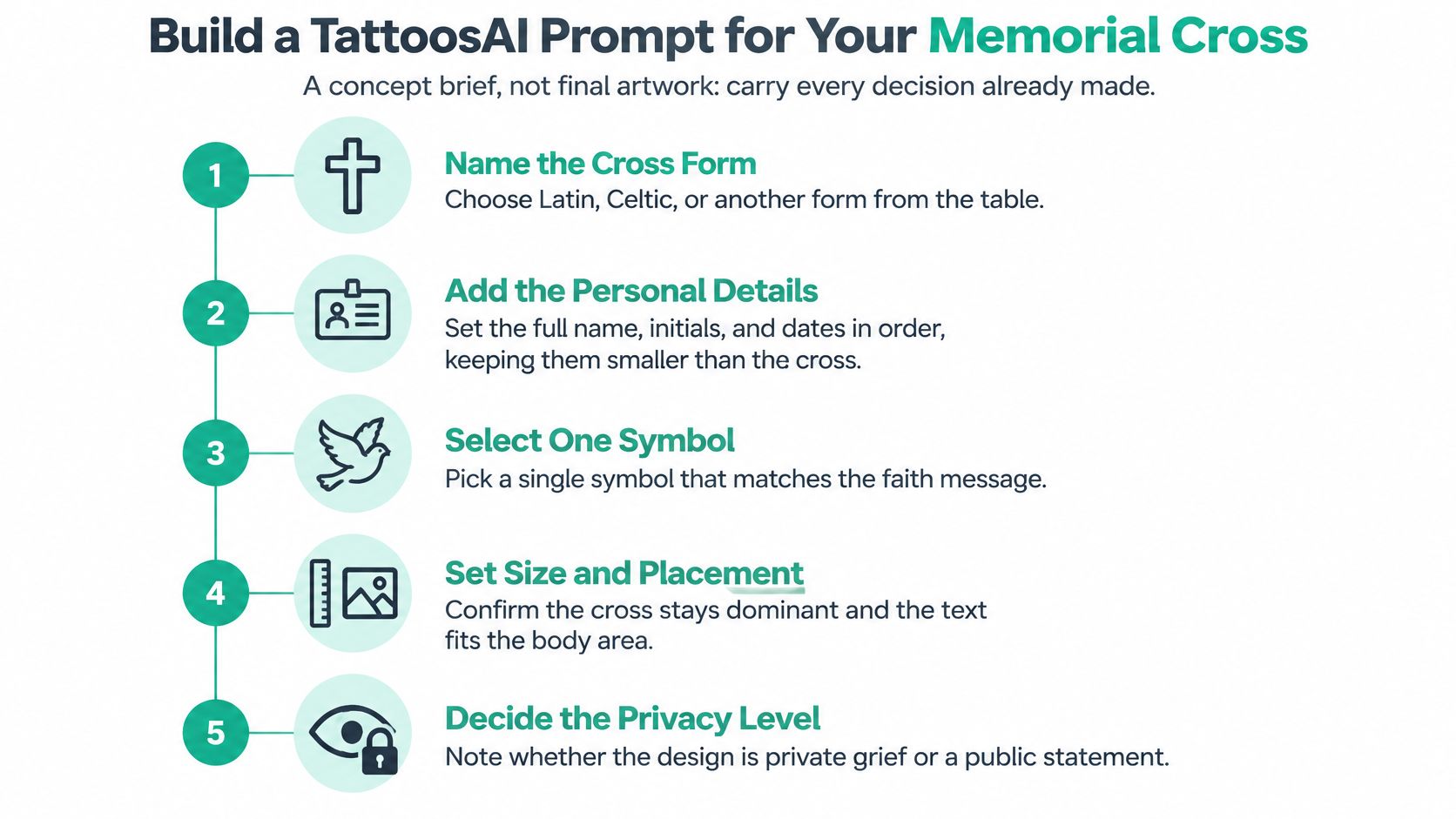
- Name the cross form. Specify Latin, Jerusalem, Celtic, or another form you've checked.
- State the faith or heritage intention. Explain what the form should communicate, without assuming decoration will make that clear.
- Identify the personal element. Choose handwriting, a flower, a place, or another detail with a specific connection.
- Give the exact text separately. Mark initials, names, and dates clearly, then verify every generated character.
- Choose a visual style. Minimalist, blackwork, or restrained fine-line styling can describe the direction.
- Specify treatment and placement. Include color preferences and artist-approved dimensions, or say the scale is awaiting consultation.
Treat the prompt as a concept brief, not final artwork. Include what should be left out, such as ornamental borders, extra flowers, or a full passage of script.
This graphic provides a visual worksheet for organizing the decisions.
A wrist concept with strict priorities
Create a restrained fine-line Latin cross for the wrist. Include the initials [initials]. Show birth and death years as an optional separate variation, using [years]. No border, flowers, or shading. Leave generous space around all lettering.
The brackets are instructions to replace with your own information. Ask for the initials-only version first; if the years require cramped text, move them elsewhere or leave them out.
“Fine-line” describes the visual direction, not a demand for the thinnest possible needlework.
An upper-back concept with layered symbolism
Create a black-and-gray Jerusalem cross for the upper back, with a rosary as the only supporting element. Keep every cross distinguishable. Use restrained shading, no background scene, and no text until the main composition is approved.
The larger placement gives the tattooist more room to organize the structural crosses and rosary. Combining them should reflect a deliberate devotional choice rather than a request for maximum detail.
A forearm concept with a personal accent
Create a minimalist empty Latin cross for the inner forearm with a small lavender sprig beside the lower stem. Keep the cross dominant, use open spacing, and omit lettering and decorative background.
Lavender here is a personal choice, not a claim about universal symbolism. It might recall a garden you shared or a scent you associate with home.
Compare concepts by their meaning and readability, not by how polished the rendering looks. Your tattooist should redraw or adjust line spacing, scale, and placement before any design is final.
Take Your Concept to a Tattooist Before You Book
Book only when the form, personal details, placement, and safety arrangements all pass your checks. A design can feel emotionally right while still needing practical changes.
Use a final go-or-no-go review
- The size test passes. The reduced design still reads without needing to zoom in.
- The meaning test passes. People who knew your loved one understand the intended message, or you're comfortable with the differences.
- The artist review passes. Your tattooist has confirmed the placement, scale, and line spacing on your actual skin.
Resolve the allergy and ink questions from your safety checklist, and make sure you have a written aftercare plan. You shouldn't have to improvise those decisions after the appointment.
Removal is another reason not to rush. In a 2025 report, GQ described small-tattoo removal as averaging approximately $600, typically across about eight sessions. That's a reported estimate, not a quote for your situation.
Waiting isn't a failure to honor someone. It's permission to make the tribute carefully.
Consider living with a printed concept for a few weeks, especially if the loss is recent and booking feels urgent. Notice whether you still want the same symbol on an ordinary day, not only during a difficult evening.
Save the strongest concept and bring it to a licensed tattooist for adaptation. Book when the checks pass, not because you feel you must prove how much the person mattered.
TattoosAI turns written tattoo ideas into visual concepts you can compare before a studio consultation. Visit with your chosen cross form, personal detail, and placement in mind, then bring the clearest concept to your tattooist for a skin-ready interpretation.