TattoosAI
You've saved an octopus sketch you love, then held it against your forearm and noticed the problem: the head fits, but the tentacles stretch sideways, disappear around the wrong edge, or bunch up near your wrist. A strong drawing isn't automatically a strong tattoo layout. The artist needs to arrange it for a moving, tapered surface, not a flat page.
The forearm's cylindrical shape gives an octopus room to curl around the limb, while its length supports a flowing wrist-to-elbow composition. It's also a familiar tattoo placement: a 2024 survey of people interested in tattoos found that 28.1% of tattoos were located on the forearms and hands, although it didn't separately report octopus designs.
Good octopus tattoos on forearm placements balance that wrapping potential with readable detail. The mantle, meaning the rounded body above the eyes, needs a clear focal position. Tentacles need breathing room, and their tips shouldn't land in creases because the sketch runs out of space.
Choose by how you want the tattoo to sit when your arm hangs naturally, turns palm-up, and bends. These styles offer different ways to solve that practical design problem.
Table of Contents
- 1. Traditional American Octopus with Nautical Elements
- 2. Realistic Black and Grey Octopus
- 3. Japanese Irezumi-Style Octopus with Waves
- 4. Fine-Line Minimalist Octopus Tentacle
- 5. Blackwork Geometric Octopus
- 6. Watercolor Octopus with Splash Effects
- 7. 3D Trompe-l'oeil Octopus Emerging from Skin
- Octopus forearm tattoo styles at a glance
- Turn Your Forearm Octopus Idea into a Studio-Ready Plan
1. Traditional American Octopus with Nautical Elements
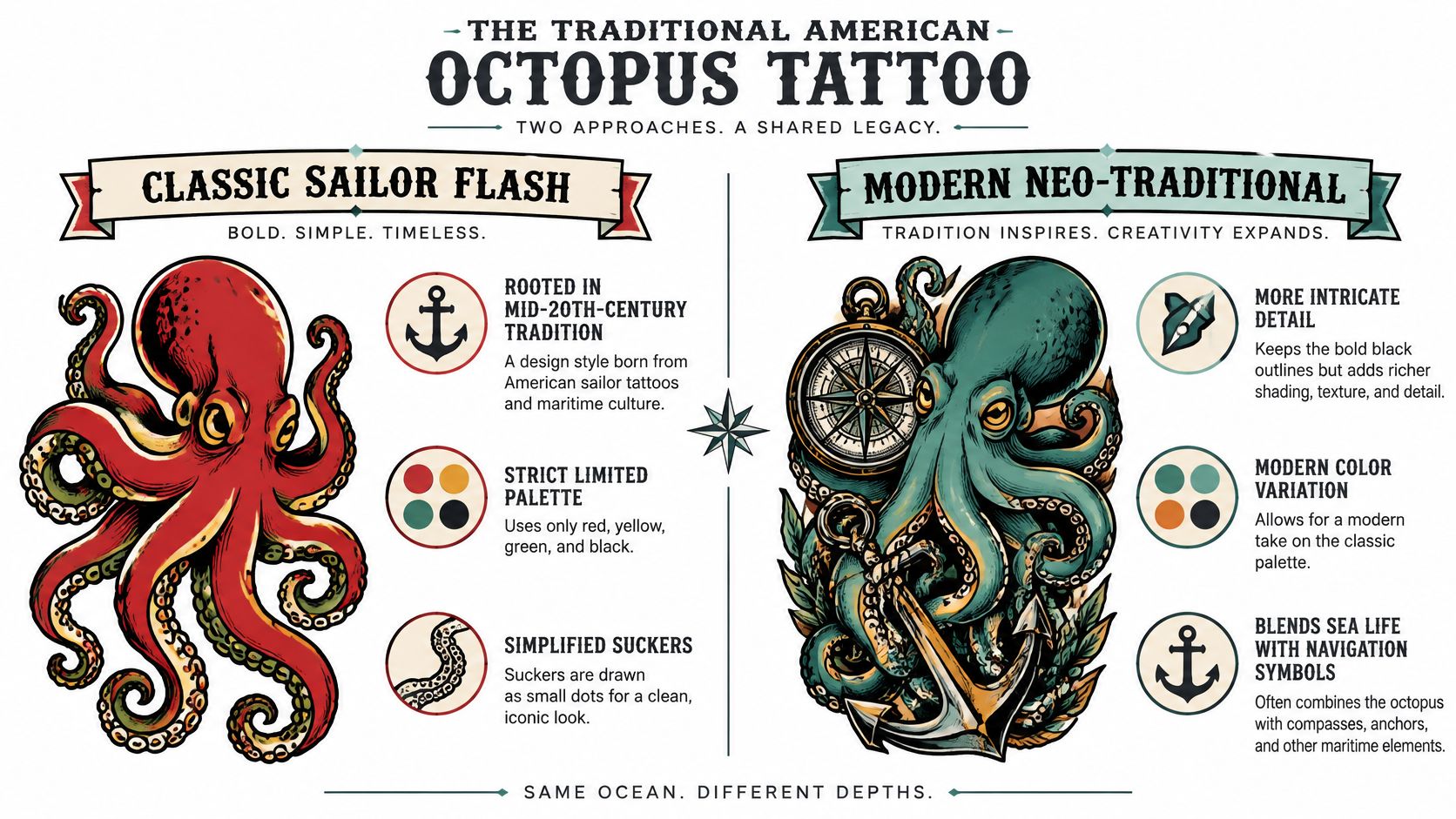
Traditional American styling works best when you want the octopus to read immediately. Thick black contours, simplified suckers, and a restrained red, yellow, green, and black palette give the animal a clear silhouette. You trade delicate skin texture for a more graphic result.
Place the mantle on the broad outer forearm, below the elbow, then let the tentacles descend and turn around the sides. Avoid arranging them as a tight bracelet near the wrist. The taper leaves less room there, so overlapping curls can quickly become crowded.
Give the Nautical Symbol Its Own Space
An anchor makes a useful vertical partner because its shaft can follow the forearm's length. A compass needs a broader, less distorted area. Don't squeeze a compass beneath the mantle if its markings would end up wrapping out of sight.
- For a standalone piece: Keep the anchor behind the octopus and leave bare skin between the main tentacle curls.
- For a future sleeve: Leave the upper edge open for waves or other marine imagery.
- For a smaller forearm: Remove background objects before shrinking the animal's identifying features.
Say you want an anchor to represent stability and the octopus to suggest adaptability. Ask the artist to make the animal dominant, with the anchor partially obscured rather than equally detailed. If you prefer neo-traditional embellishment, spend that extra detail on the face, not every available gap.
TattoosAI prompt: Traditional American octopus on the outer forearm, mantle below the elbow, tentacles flowing toward the wrist and curling around the sides, bold black outlines, restrained nautical colors, anchor behind the body, open skin between curls, tips ending above the wrist crease.
2. Realistic Black and Grey Octopus
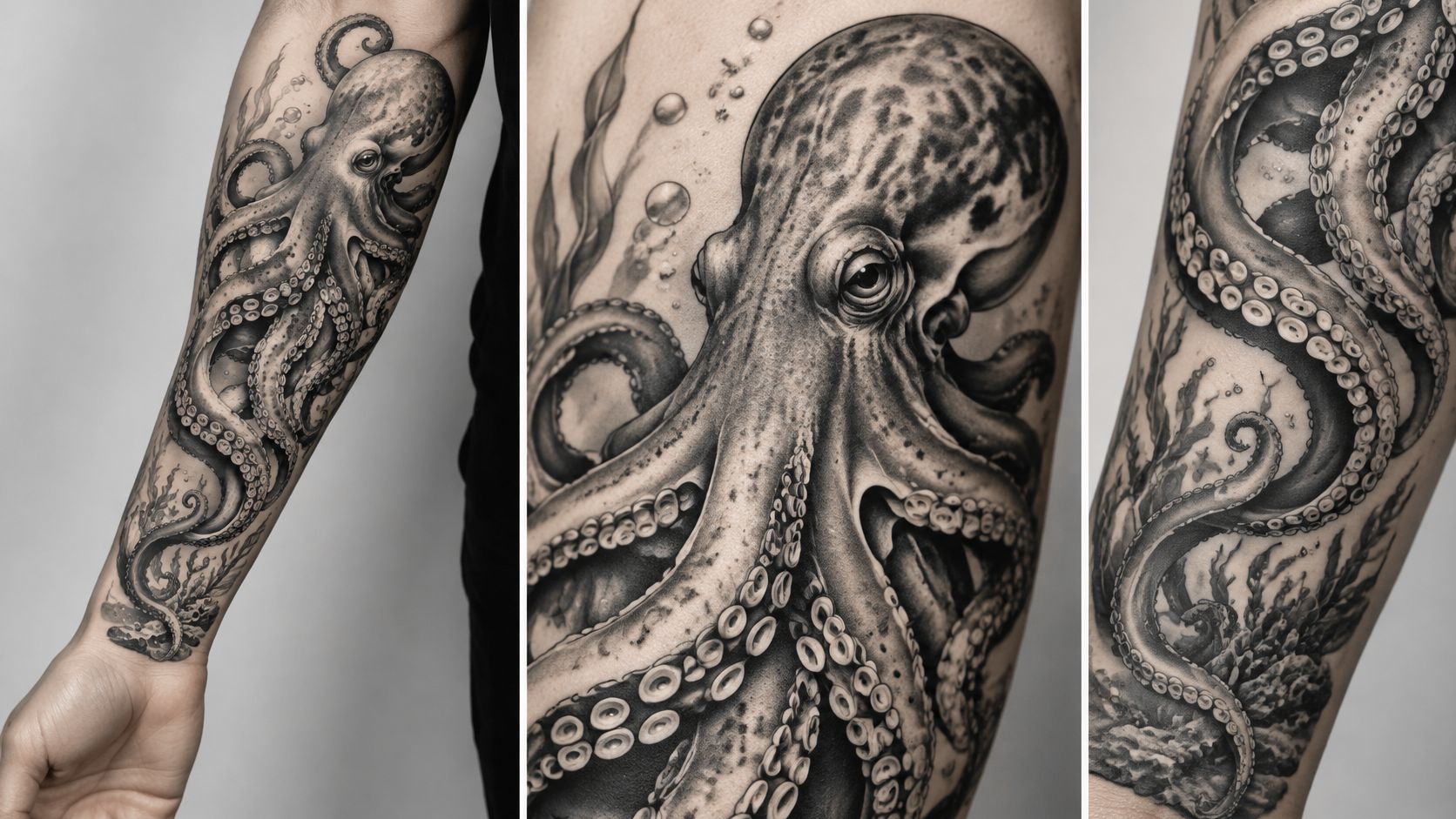
A realistic octopus needs enough space for light, shadow, and recognizable anatomy, not just a long list of tiny details. The strongest forearm versions concentrate texture around the mantle and eye, then simplify the suckers as the tentacles taper.
For a vertical layout, place the mantle toward the elbow and extend the arms toward the wrist. Let a prominent tentacle turn onto the inner forearm so the tattoo offers another view when you rotate your arm. Keep the face on a broad visible plane rather than directly on the side edge.
Prioritize Healed Contrast
Histological research on tattoo pigment describes pigment migration within the dermis that can contribute to softer edges over time. For realism, that makes separation between tentacles more useful than covering every surface with fine texture.
Practical rule: Ask to see healed black and grey work, especially the transitions between dark tentacles and shaded backgrounds.
A useful scenario is an octopus emerging from a dark ocean background. Keep the darkest background behind the light-facing mantle, but leave skin breaks around the descending arms. Otherwise, the lower forearm can become an indistinct grey mass.
If you're building beyond the forearm, compare octopus sleeve tattoo layouts before finalizing where the upper tentacles end. Leave room below the elbow crease instead of forcing the face into the bend.
TattoosAI prompt: Realistic black and grey octopus for an outer forearm, mantle near the elbow, eye facing outward, long tentacles descending toward the wrist, a prominent arm wrapping inward, directional lighting, selective skin texture, enlarged suckers, clear negative space, no dense detail in joint creases.
3. Japanese Irezumi-Style Octopus with Waves
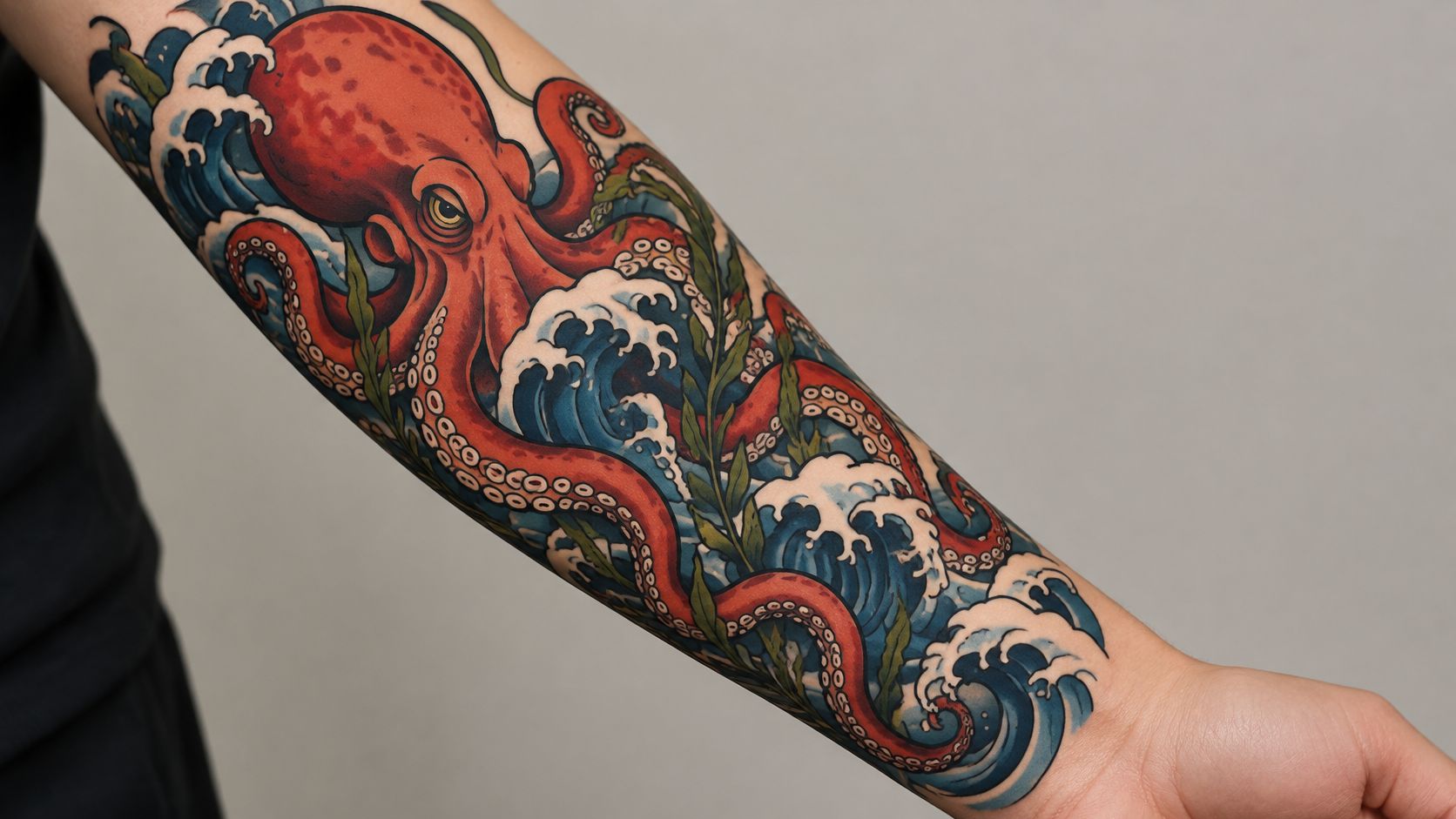
Use the waves to organize the wrap, not merely fill the background. A Japanese-inspired octopus can follow a broad spiral around the forearm, with water directing the eye between the outer and inner surfaces. The composition feels more connected when the waves and tentacles share a deliberate direction.
Octopus imagery has documented roots in Japanese visual culture, including Edo-period prints and marine imagery, as discussed in an Oxford Academic art-history study. That background is worth discussing with an artist who understands Japanese composition rather than treating the style as a generic wave border.
Decide Whether the Background Will Continue
For a forearm-only piece, establish a deliberate finish above the wrist and below the elbow. For a future sleeve, ask the artist to leave a route for the water to continue upward. A hard decorative cap at the elbow can make that connection awkward.
- Mantle placement: Use the broad outer forearm for the principal expression.
- Tentacle direction: Alternate lengthwise movement with open wrapping curves.
- Wave spacing: Separate water edges from tentacle edges so they don't merge visually.
Say you want a red octopus against dark waves. Keep the red animal distinct with clear skin breaks and avoid placing similarly sized wave curls beside every tentacle tip. The trade-off is space: a full animal plus substantial water usually needs most of the usable forearm rather than a compact patch.
TattoosAI prompt: Japanese-inspired octopus forearm composition, red mantle on the broad outer forearm, tentacles spiraling lengthwise around the arm, dark stylized waves with open skin breaks, readable animal silhouette, uncluttered wrist finish, upper water flow suitable for a future sleeve.
4. Fine-Line Minimalist Octopus Tentacle
A small tentacle can fit the forearm better than a miniature whole octopus. It preserves the curling gesture without compressing the face, body, and suckers into a cramped patch. Choose it because you want restraint, not because you expect a tiny design to contain the same information as a larger piece.
The Los Angeles Tattoo Shop octopus design guide distinguishes a mantle-centered portrait from an isolated wrapping tentacle. That's a useful planning distinction: decide whether you need the animal's identity or its movement.
Keep the Curve Open
Run a slender S-curve along the forearm rather than wrapping it tightly around the wrist. Place the terminal curl above the wrist crease, where it can remain a complete shape when your hand bends. Near the elbow, finish the line before the bend instead of using the crease as a convenient endpoint.
A minimalist tentacle should still look intentional when you remove the smallest sucker marks.
For example, a discreet inner-forearm piece might use a flowing outline, a tapered tip, and selectively placed suckers. It won't read as a full octopus from every angle, but that's an acceptable trade-off if you want an understated marine motif.
Bring the artist a version at your intended size. Ask which gaps need widening and which marks should disappear entirely. Fine-line doesn't mean every line must be equally thin, and a little contour hierarchy can help the design remain understandable.
TattoosAI prompt: Minimalist octopus tentacle along the inner forearm, elongated open S-curve following the wrist-to-elbow axis, delicate but readable contour, sparse enlarged sucker details, generous negative space, tapered tip above the wrist crease, no bracelet wrap, no background.
5. Blackwork Geometric Octopus
Blackwork suits a forearm octopus when you want strong shape and deliberate negative space rather than naturalistic shading. Geometric framing can establish a vertical axis, while organic tentacles break beyond it. The contrast works best when the geometry supports the animal instead of competing with it.
Start with the mantle on the outer forearm and a long central shape running toward the wrist. Let the tentacles cross the geometric boundary, then turn around the sides with clear skin corridors between them. A rigidly symmetrical flat drawing will distort around a tapered limb, so check the stencil from different angles.
Choose Where the Black Stops
- Solid areas: Reserve dense black for selected mantle sections or major tentacle shadows.
- Pattern areas: Enlarge repeating shapes enough that they remain distinct.
- Joint boundaries: Taper the composition before the wrist and keep its busiest intersections away from the elbow crease.
For a geometric sleeve starter, try an octopus breaking out of an angular frame, with unfilled space toward the elbow for later additions. Our blackwork tattoo style guide can help you distinguish solid-fill work from pattern-led approaches.
Dense artwork also deserves a specific aftercare discussion. A published medical case report linked allergic contact dermatitis from a scented lotion to scarring and premature fading in a new tattoo. Tell your artist about known product sensitivities, and seek clinical advice for a suspected reaction rather than adding more products.
TattoosAI prompt: Blackwork geometric octopus on the outer forearm, mantle centered in an elongated angular frame, bold tentacles breaking through the border and wrapping around the sides, broad negative-space corridors, selective solid black, simplified pattern fills, tapered finish above the wrist.
6. Watercolor Octopus with Splash Effects
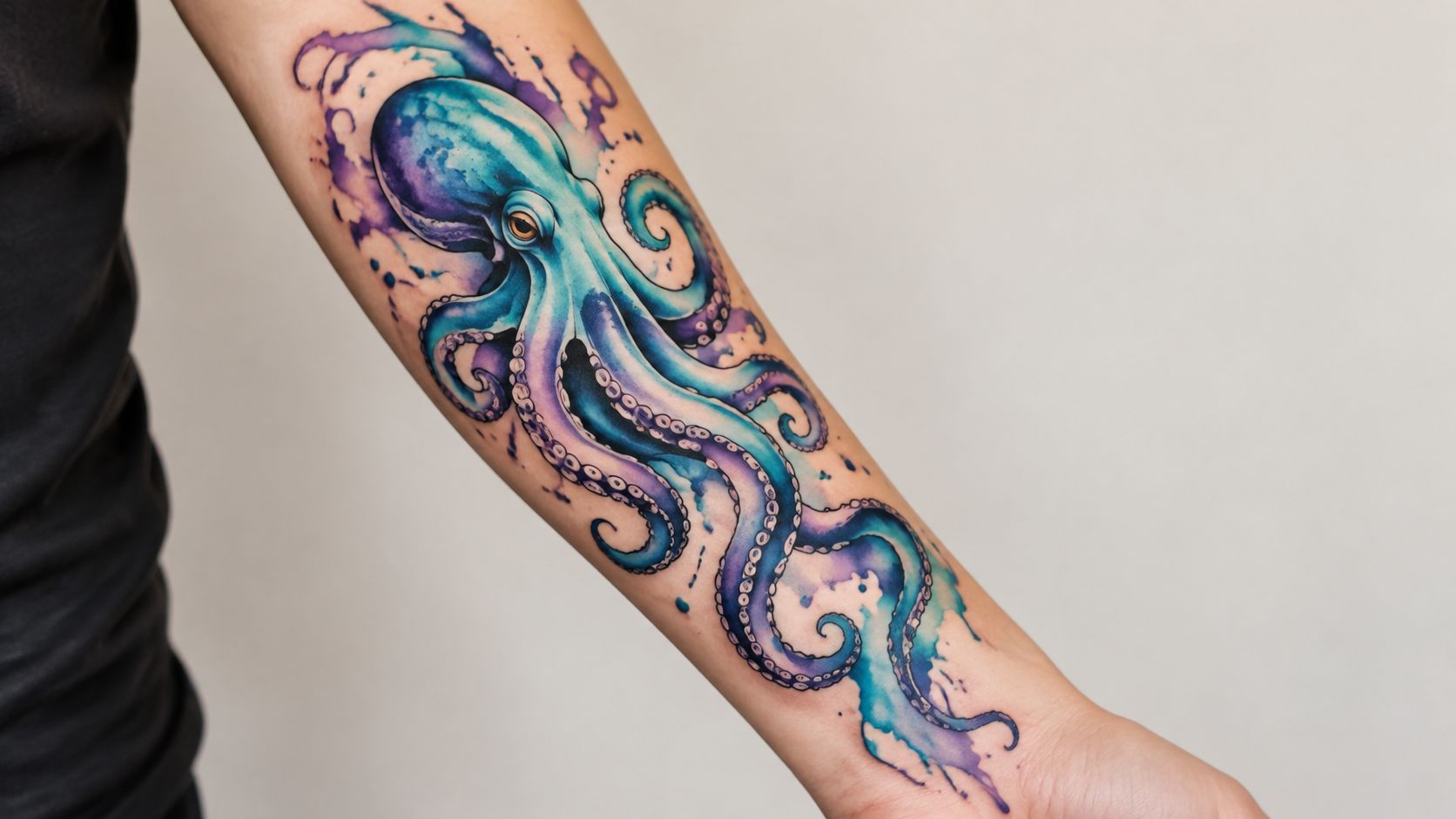
The appealing part of watercolor is its looseness. The placement still needs structure. Soft blue and purple washes can look fluid around the forearm, but the animal needs a readable mantle and tentacle arrangement underneath the splashes.
Place the body on the upper outer forearm and direct the longest tentacles toward the wrist. Let color drift sideways around the limb without making every splash follow a tentacle. This separates the animal's movement from the background and avoids a crowded lower edge.
Keep an Identifiable Core
Ask for healed watercolor examples, not just fresh photographs with vivid color. Compare how clearly you can identify the subject once the soft transitions are less dramatic. A selective dark contour around the mantle and main arms gives the artist a way to preserve structure without outlining every splash.
Layout check: Temporarily ignore the color wash. If you can't follow the tentacles, revise the underlying drawing.
Say you want a painterly ocean-themed tattoo without a full sleeve. Keep the recognizable octopus on the outer forearm and allow a lighter wash to turn inward. You get a wrapping effect without needing dense imagery across the entire circumference.
Leave the wrist finish quieter than the upper composition. Tiny isolated droplets at the crease can look disconnected from the main piece, while an open taper feels intentional. Choose a closely related palette for visual cohesion, not as a promise that certain colors will last indefinitely.
TattoosAI prompt: Watercolor octopus for the outer forearm, recognizable mantle below the elbow, long separated tentacles flowing toward the wrist, blue and purple washes drifting around the sides, selective dark contour, open skin between arms, restrained splash effects, clean taper above the wrist crease.
7. 3D Trompe-l'oeil Octopus Emerging from Skin
A dimensional octopus succeeds when the viewer understands what sits above, below, and behind the skin surface. The illusion needs consistent lighting and a stable focal area. Extra torn-skin edges won't rescue contradictory shadows.
Place the main emergence point on the broad outer forearm, away from the wrist and elbow creases. Let the tentacles appear to rest across the surface, with selected arms curling around the sides. The central illusion should remain understandable from your preferred viewing angle, even though it won't look identical during rotation.
Build the Illusion Around the Arm
A review of tattoo pigment placement and skin appearance explains why controlled dermal placement matters, including the hazy or bluish appearance associated with pigment deposited too far beneath the skin. Treat a generated rendering as a visual brief, not an instruction to reproduce every dark edge exactly.
- Choose the main view: Decide whether the reveal faces outward with your arm relaxed or inward when you look at it.
- Unify the lighting: Keep cast shadows consistent beneath the raised tentacles.
- Protect the focal point: Place the eye and emergence opening away from the limb's side edges.
For example, an octopus emerging through a dark opening can use its mantle as the focal point and a curling arm as the secondary feature. Filling the surrounding forearm with splashes, cracks, and additional openings would weaken that hierarchy.
Ask for healed illusion work in the artist's portfolio. This style offers dramatic depth, but it's less forgiving of cramped scale than a graphic silhouette.
TattoosAI prompt: Trompe-l'oeil octopus emerging from the broad outer forearm, central opening below the elbow, mantle and eye facing outward, tentacles resting across the skin and wrapping around the sides, consistent directional lighting and cast shadows, restrained skin-break effect, clear wrist margin.
Octopus forearm tattoo styles at a glance
| Item | Key Feature | Main Advantage | Main Drawback |
|---|---|---|---|
| Traditional American Octopus with Nautical Elements | Bold outlines, limited colors, wrapping tentacles, optional nautical symbols | Strong, durable visual impact with room for personal meaning | Traditional palette may feel dated; extra elements can crowd the forearm |
| Realistic Black and Grey Octopus | Detailed shading, textured skin, and individually rendered suckers | Highly detailed and visually striking | Fine details may blur; requires more time and an experienced artist |
| Japanese Irezumi-Style Octopus with Waves | Bold outlines, flowing waves, and deep blue, red, and black tones | Cohesive, flowing design with strong artistic heritage | Often needs a larger area and longer sessions |
| Fine-Line Minimalist Octopus Tentacle | Delicate lines, a few curling tentacles, and open negative space | Shorter session and easy to conceal | Fine lines may fade or spread over time |
| Blackwork Geometric Octopus | Solid black shapes and geometric or repeating patterns | Bold, modern look that can scale into a sleeve | Dense coverage may be painful and need touch-ups |
| Watercolor Octopus with Splash Effects | Blended color washes, paint-like edges, and splash effects | Eye-catching, artistic style with flexible color choices | Colors may fade or blur faster and require touch-ups |
| 3D Trompe-l'oeil Octopus Emerging from Skin | Dramatic shading and highlights create a skin-breaking illusion | Striking focal point that showcases advanced shading | Expensive and time-intensive; the illusion may soften over time |
Turn Your Forearm Octopus Idea into a Studio-Ready Plan
Start with the shape of your arm, not the most elaborate image in your saved folder. A forearm octopus should have a clear main view, readable tentacle paths, and a deliberate finish near the wrist and elbow. If the design only works when displayed flat, it needs another composition pass.
Measure the usable area before choosing the detail level. Use a flexible tape along the intended placement and around the forearm where the mantle will sit. Note where your wrist and elbow creases fall, then compare those boundaries with the proposed artwork.
Bring a Clear Brief
- Measure the forearm: Record usable length and circumference at the main focal area.
- Choose wrap or vertical: Decide whether the octopus primarily travels along the arm or around it.
- Pick a dominant style: Keep realism, geometric pattern, watercolor, or traditional linework in charge rather than combining every option.
- Name the direction: Specify mantle position, tentacle movement, and where the tips should stop.
- Identify what can simplify: Mark background textures and tiny suckers as optional if space becomes tight.
Our generator offers 19 tattoo styles, so you can compare different treatments while keeping the same placement brief. We don't currently offer a way to preview a tattoo on your body. Print the preferred concept at the intended scale, or use measurements to check it against your arm before the consultation.
A flat print can check approximate size, but it can't settle a wraparound layout. Ask your tattooist to adapt the drawing and assess the stencil with your arm relaxed, rotated, and bent. Don't assume that every generated tentacle connection is anatomically coherent.
Bring your preferred concept, real octopus references, and examples of healed work you like. Explain your usual sun exposure, work-related rubbing, known skin sensitivities, and whether you plan to extend the piece into a sleeve. Your tattooist can then adjust spacing, detail, and technique to the actual canvas.
TattoosAI turns descriptive prompts into tattoo concepts you can take to a tattooist you trust. Visit TattoosAI and try your preferred forearm layout, naming the mantle position, tentacle direction, style, and wrist boundary so the results give you a focused starting point for consultation.