TattoosAI
A red dragon tattoo requires more safety planning than the same design in black ink because red pigment carries the highest risk of delayed allergic reaction among tattoo colors. In clinical reviews, red or red-spectrum ink appeared in 96.9% of allergic tattoo reactions, while another review found hypersensitivity in 90.6% of cases involving red-pigment tattoos.
You may be at the stage of saving reference images, picturing a vivid dragon curling around your arm, or wondering how a design would look across your back. That excitement makes sense. A red dragon has instant visual force, but it isn't only a fantasy creature with dramatic scales and flames. Its color, posture, surrounding symbols, and artistic lineage can communicate prosperity, protection, authority, resilience, or personal transformation.
The strongest design usually comes from treating the tattoo as both cultural artwork and a permanent biological commitment. You need to understand what kind of dragon you're borrowing from, decide how much red you really need, ask informed questions about pigment, and leave enough flexibility for the design to age or change with you. AI concept tools can help you explore those decisions before you sit in the artist's chair, but they can't replace a skilled tattooist or medical advice.
Table of Contents
- Why the Red Dragon Captivates Tattoo Seekers
- Cultural Roots of the Red Dragon Tattoo
- Style Variations That Change the Dragon's Meaning
- How Red Ink Affects Your Safety
- Designing the Dragon with AI Before You Commit
- Planning for Long-Term Flexibility and Cover-Ups
- Turning Inspiration Into a Confident Tattoo Plan
Why the Red Dragon Captivates Tattoo Seekers
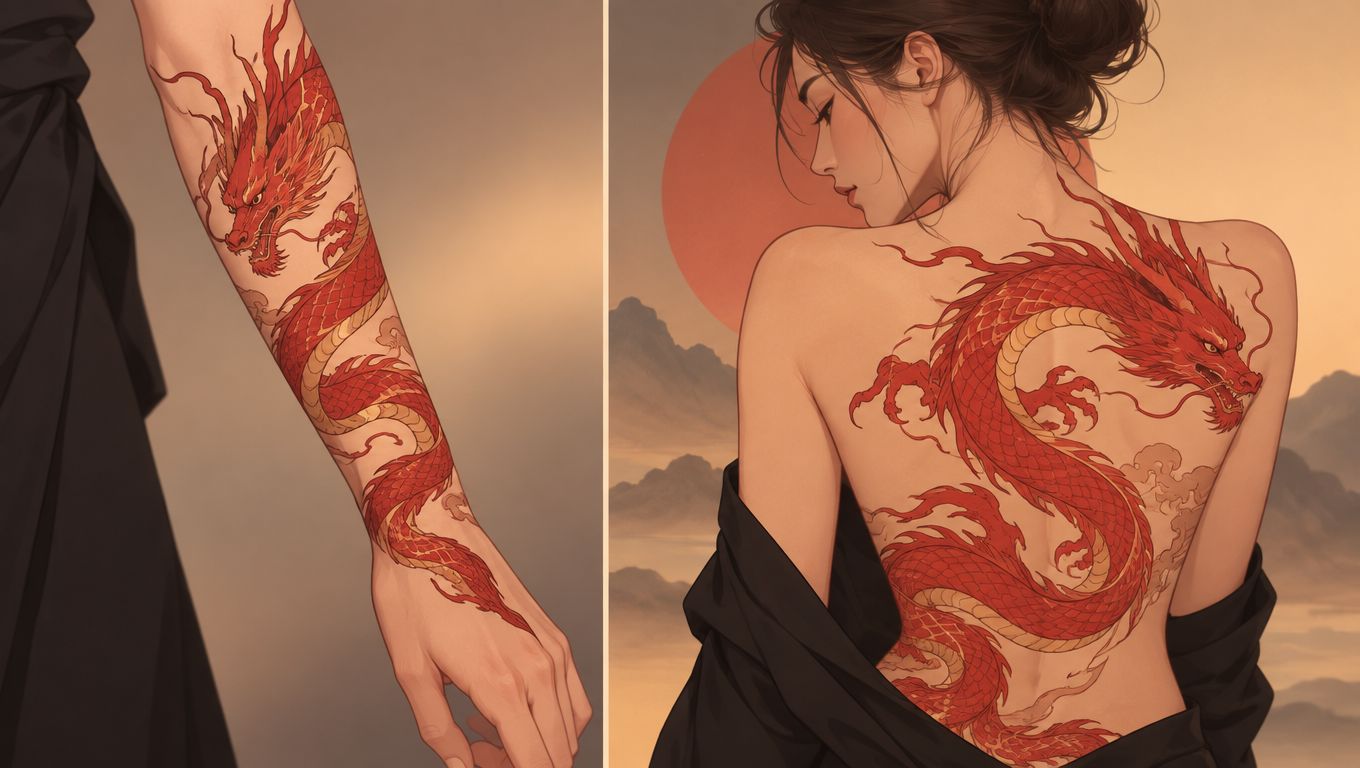
The usual first idea is cinematic. You see a dragon with a wide-open mouth, red scales catching the light, clouds or flames behind its head, and a body wrapping naturally around the arm. On a back, the same creature can feel monumental, with the head placed near the shoulder and the tail guiding the eye downward. That fantasy is a useful starting point because it reveals the emotional purpose of the piece. You may want to mark ambition, survival, luck, protection, or a decisive change in your life.
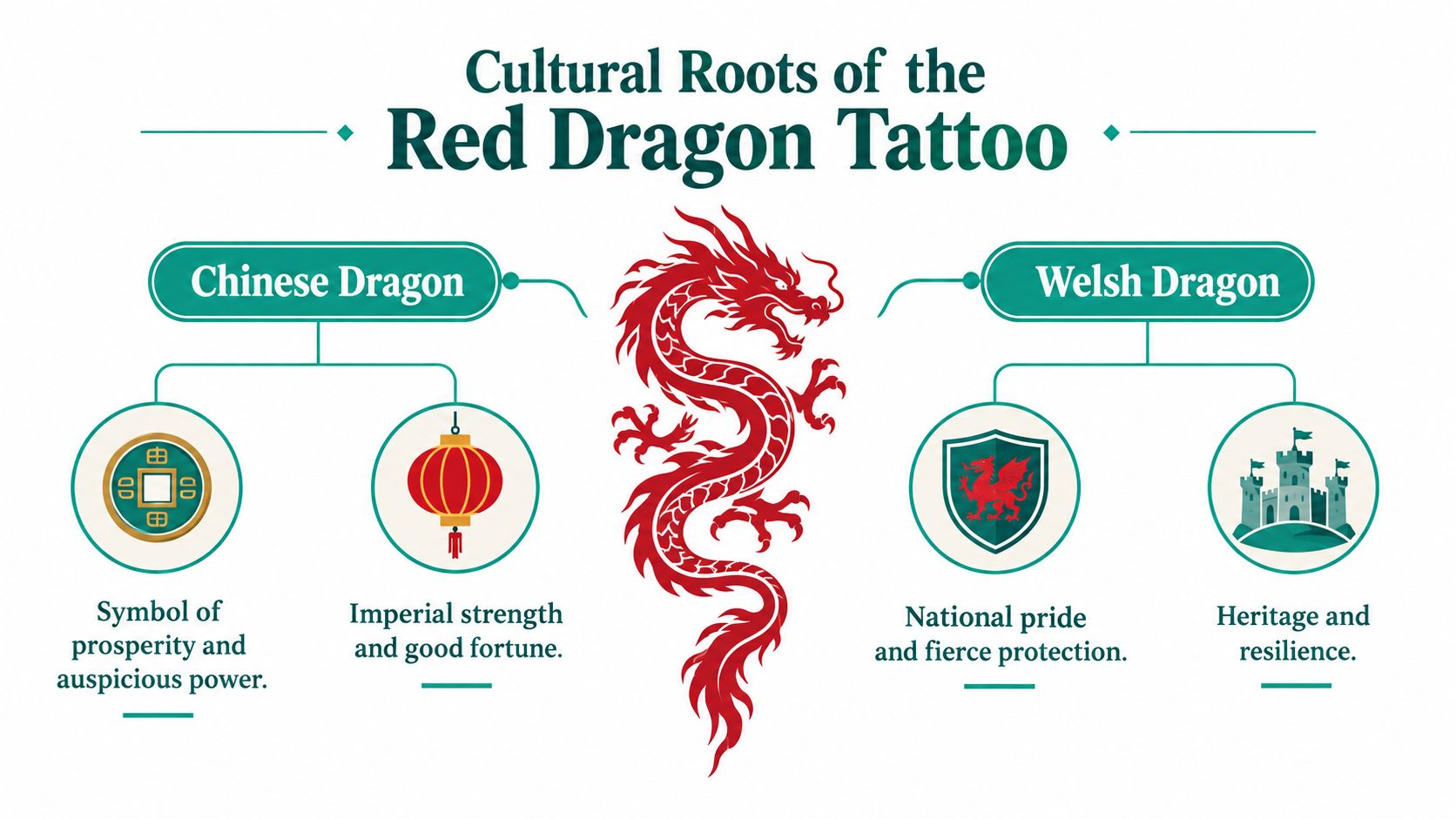
A red dragon tattoo becomes more meaningful when you move beyond spectacle. In Chinese symbolism, the dragon connects with prosperity, auspicious power, vitality, and political authority, while red adds associations with good fortune and wealth. In Japanese tradition, dragons are generally benevolent figures linked with water, clouds, wisdom, strength, protection, and good fortune rather than destructive monsters. The same red body can therefore suggest different stories depending on whether the composition follows Chinese symbolism, Japanese irezumi, or a modern fantasy language.
Meaning and responsibility belong together
The image's emotional pull shouldn't make you rush the practical decisions. Red ink is the main technical variable, and a large saturated dragon may expose you to more of that color than a blackwork design with small red accents. Placement also matters because movement, sun exposure, clothing friction, and the available skin area affect how an artist builds the composition.
Practical rule: Choose the story before you choose the saturation. A dragon that represents protection may need a calm, rising posture and water, while one representing defiance may need sharper angles and stronger contrast.
A thoughtful consultation can turn the initial fantasy into a piece with a clear visual grammar. Before you book, decide whether you want a guardian, a symbol of prosperity, a fierce survivor, or an image rooted in a particular cultural tradition. That answer will guide the dragon's face, direction, background, color coverage, and eventual placement.
Cultural Roots of the Red Dragon Tattoo
Two major traditions can lead someone toward a red dragon, and they shouldn't be treated as interchangeable.
In a Chinese context, the dragon carries a long association with prosperity and auspicious power. During the traditional fifteen-day Chinese New Year festival, usually held between January and February, dragon dances commonly use a large red dragon puppet. Red is specifically associated with good fortune and prosperity in that setting. Historical symbolism adds another layer. From the Song dynasty, AD 960–1279, people prayed to dragon deities for rain, while the dragon represented imperial power. During the Manchu period, the imperial flag depicted a dragon against a red background, and the five-clawed dragon was reserved as the emperor's personal emblem. These details make red more than a surface color. It can signal luck, wealth, vitality, protection, and social power. The history of Chinese dragon tattoo symbolism can help you investigate that lineage before settling on a design.
A Chinese-inspired concept might use clouds, a pearl, a rising posture, or carefully considered claws. Clouds can suggest celestial protection, a pearl can point toward wisdom or spiritual value, and a rising dragon can imply aspiration. You don't need to combine every symbol. Selecting fewer elements with a clear intention is usually more respectful and visually coherent.
A different lineage in Japanese tattooing
Japanese dragon imagery developed within the broader history of irezumi, whose recognizable artistic form flourished during Japan's Edo period, from 1603 to 1868. Tattoo composition became closely connected with ukiyo-e visual culture and large pictorial motifs, helping establish the flowing bodies, clouds, waves, and dynamic backgrounds associated with traditional Japanese dragon designs. The Yokohama Tattoo Museum's background on Japanese tattooing provides useful context for that history.
A Japanese dragon typically feels like a guardian of natural forces rather than a European-style monster. Water, waves, clouds, and wind bars can make the creature appear to move around the body, while a rising head may communicate wisdom or protection. An aggressive expression can still suggest resilience or power, but the overall meaning comes from the whole composition, not just the teeth or red scales.
That distinction matters in a studio conversation. Saying “I want a Japanese red dragon” describes a starting point, not a complete brief. Explain whether you want an irezumi-inspired composition, a Chinese ceremonial reference, or a contemporary dragon that borrows selectively from both. A respectful artist can then help you avoid mixing symbols without understanding their context.
Style Variations That Change the Dragon's Meaning
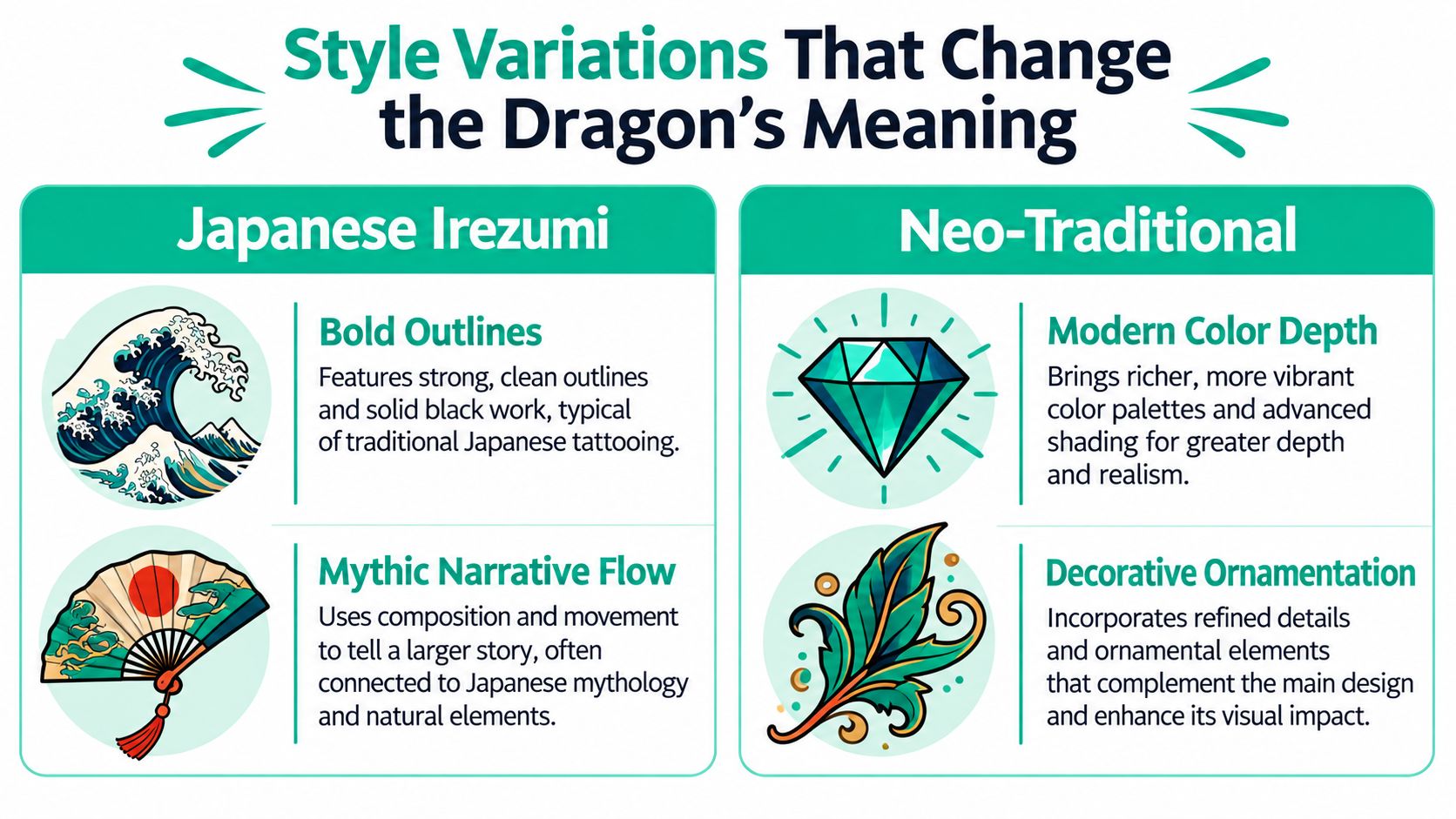
The same red dragon can look protective, ornamental, rebellious, or almost abstract depending on how the artist draws it. Style changes more than surface appearance. It affects the way the body moves, how much skin remains open, how easily the silhouette reads from a distance, and what emotional tone the viewer receives.
| Style | Visual language | Meaning it tends to emphasize |
|---|---|---|
| Japanese irezumi | Flowing body, waves, clouds, wind bars, bold structure | Protection, wisdom, mastery of natural forces |
| Neo-traditional | Strong outlines, stylized anatomy, deliberate color blocks | Power, drama, confidence, decorative symbolism |
| Watercolor | Soft transitions, pigment-like movement, negative space | Motion, emotion, imagination, transformation |
| Minimalist or dotwork | Reduced anatomy, fine structure, controlled detail | Personal symbolism, restraint, quiet strength |
Japanese irezumi
A Japanese-style red dragon often works best as a connected composition rather than an isolated sticker. The body can coil around an arm, travel across the back, or follow the curve of a thigh with water and clouds filling the spaces between major forms. Because irezumi dragons are associated with water, clouds, the sky, wisdom, strength, good fortune, and protection, a dragon integrated with waves usually communicates guardianship and control of natural forces.
Its historical visual language flourished during Japan's Edo period, from 1603 to 1868, and differs from the Western fire-breathing dragon archetype, which is more often framed as a monster or adversary. That contrast gives the client a useful choice. A calm, serpentine dragon with a pearl may feel wise and protective, while a sharply angled head with exposed claws may emphasize courage and resistance.
Neo-traditional and watercolor approaches
Neo-traditional work uses bold outlines, simplified anatomy, and concentrated areas of color. The artist might enlarge the head, exaggerate the eyes, or frame the dragon with flowers, ornamental shapes, or flames. Red becomes a graphic block that immediately attracts attention. This can suit someone who wants a confident emblem rather than a historically structured body composition.
Watercolor designs take a different route. Soft pigment transitions and deliberate negative space can suggest smoke, motion, or an almost dreamlike transformation. They can be beautiful, but a dragon has many overlapping forms, so the artist still needs strong underlying structure. Without clear contours and value separation, scales, flames, and shadows can blur together.
Minimalist and dotwork designs
Minimalist and dotwork dragons rely less on saturated color and more on silhouette, rhythm, and carefully placed marks. A small red eye, a crimson pearl, or a few red scales can carry the focal emphasis while black or gray defines the body. This approach can preserve readability and reduce the amount of red ink without abandoning the central idea.
Ask to see a grayscale value map before approving a complex piece. The darkest areas should establish contour and occlusion, midtones should model the body, and red should work as chromatic emphasis rather than the only source of contrast. Digital color isn't a color-accurate prediction because skin tone, healing, saturation, and long-term pigment change all affect the result.
How Red Ink Affects Your Safety
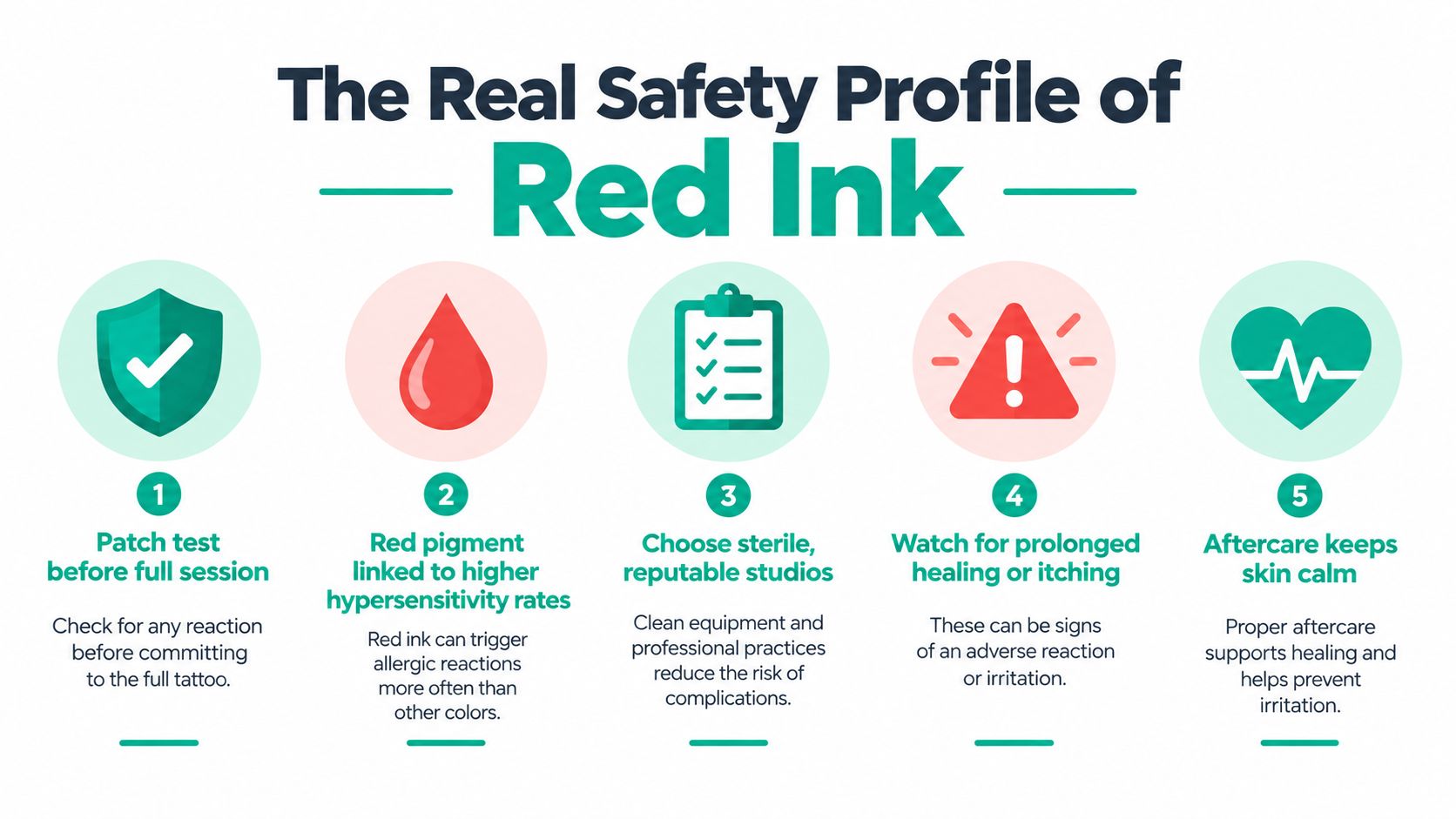
Red pigment deserves its own safety discussion because its risk profile differs from how tattoo inspiration pages often present it. Dermatology reviews consistently identify red as the color most often associated with chronic tattoo hypersensitivity. A reaction can emerge months or years after application, rather than only during the first healing period. Pigment particles may break down and form chemically active haptens, which can trigger delayed, T-cell-mediated inflammation.
Allergic red-tattoo biopsies have identified the azo pigments Pigment Red 22, Pigment Red 170, and Pigment Red 210. One biopsy study found PR 22 in 35% of analyzed cases, PR 210 in 24%, and PR 170 in 12%, as reported in this dermatology review of tattoo pigment reactions. These findings do not mean every red tattoo will cause a reaction. They do mean red ink should be treated as a material for informed discussion, since different colors can involve different considerations.
What a reaction can look like
A red-ink reaction may remain limited to the red portions of a multicolor dragon. Persistent itching, raised texture, lichenoid plaques, swelling, or inflammation can appear after the rest of the tattoo seems settled. If the red scales itch while the black outline remains unchanged, tell a dermatologist where the symptoms occur and when they began.
Early healing normally includes tenderness, redness, and surface changes as the skin repairs itself. Persistent or delayed symptoms require a different response. Avoid repeatedly tattooing over an irritated area, and do not rely on self-treatment to explain a raised or painful tattoo.
Medical reality: A small test spot does not reliably rule out a future tattoo allergy. Conventional patch testing has limited diagnostic sensitivity for tattoo pigments, so discuss your allergy history and concerns with a licensed professional.
Reduce exposure without losing the image
Ask the studio for the ink manufacturer, color name, batch information, and ingredient or pigment disclosure. Ask how the studio handles sterile setup, unopened cartridges, surface barriers, and aftercare instructions. A reputable artist should answer these questions clearly.
A practical decision matrix can guide the design:
- Maximum visual impact: Use red across large scale fields, flames, and membranes, while accepting greater pigment exposure and asking detailed safety questions.
- Balanced color: Use black and gray to build the anatomy, then place red on the head, eyes, selected scales, or fire.
- Lower red exposure: Keep the dragon mainly black and gray, with small crimson accents and negative-space scales.
- Uncertain history: Discuss previous pigment reactions, medications, skin conditions, and planned colors with a healthcare professional before booking.
A safer design is not automatically the least colorful. Black linework and value contrast can keep the dragon readable if red needs to be limited or avoided later. That flexibility matters when a culturally meaningful image must also work with your long-term skin health.
Designing the Dragon with AI Before You Commit
An AI concept generator can turn “a powerful red dragon” into a visual brief that an artist can discuss. The useful role isn't to replace the tattooist. It's to help you discover whether your idea needs a coiled body, a rising head, clouds, waves, negative space, or a different balance of red and black before permanent work begins.
A practical workflow has three stages:
- Describe the concept clearly. Include the cultural lineage, posture, body placement, symbolism, background, and color limits. “Red dragon” is too broad to produce a reliable direction.
- Compare styles. Explore Japanese-inspired, neo-traditional, watercolor, minimalist, dotwork, blackwork, or other available approaches. Style selection changes the amount of detail and pigment the final design may require.
- Generate multiple concepts. Compare head direction, body flow, focal point, and red coverage instead of becoming attached to the first attractive result.
The guide to using AI for Japanese tattoo concepts can help you think about how style language affects a prompt. You can also treat the resulting image as a conversation starter. A professional tattooist still needs to redraw the design for your anatomy, skin, movement, technical execution, and studio standards.
Prompt structure changes the result
| Prompt detail | Example | Likely design effect |
|---|---|---|
| Symbolic intent | Protective Chinese dragon linked with prosperity | More ceremonial posture and auspicious elements |
| Composition | Dragon coiling from shoulder toward forearm | Stronger body flow and placement awareness |
| Background | Clouds and water, open negative space | Clearer natural-force theme and breathing room |
| Color direction | Black-and-gray structure with crimson accents | Less reliance on red for anatomy and contrast |
| Style | Japanese irezumi-inspired, flowing lines | Larger connected composition with waves and wind bars |
Be honest about what the image is for. If you want a studio reference, ask for a clean silhouette, front and side views of the head, a grayscale value map, and a version with reduced red. If you want inspiration only, explore more expressive color and unusual poses. The clearer the prompt, the less time your artist spends guessing what you meant.
A digital concept should also show alternatives. Generate one predominantly black-and-gray version, one with muted crimson and negative-space scales, and one with saturated red limited to the head or eyes. This turns color safety into a design choice rather than a last-minute compromise.
Planning for Long-Term Flexibility and Cover-Ups
A tattoo can look perfect on the day you approve it and still be difficult to modify later. Dense red areas, tightly packed scales, heavy black outlines, and connected background elements leave fewer clean options for recoloring or covering. Planning for flexibility doesn't mean expecting regret. It means respecting the fact that your body, taste, work, and circumstances can change.
Laser removal isn't risk-free. A recent practitioner-reported study estimated complications in 8.1% of laser-removal treatment sessions, including swelling, blistering, bruising, pigment changes, scarring, infection, and allergic reactions. Complications were reported more often for colored tattoos and for people with Fitzpatrick skin types III or higher, according to this study of laser tattoo-removal complications. Red-ink reactions add another concern because laser exposure can sometimes trigger or worsen an allergic response.
Compare the design choices before committing
| More adaptable | Harder to revise |
|---|---|
| Readable silhouette with open skin around major forms | Full-saturation background connected to every scale |
| Moderate red coverage on focal areas | Dense red fields across most of the body |
| Deliberate breathing room between elements | Tight linework with little negative space |
| Clear black or gray value structure | Color carrying all anatomy and contrast |
| Placement that leaves neighboring skin available | A composition packed edge to edge |
No feature guarantees painless removal, perfect fading, or an easy cover-up. A tattooist may be able to work over some colors, but the outcome depends on the existing pigment, new design, skin response, placement, and the artist's approach. You shouldn't assume that a large black outline automatically makes a dragon easier to revise.
Think beyond the first photograph
Ask your artist to show how the design might read as it heals and ages. Discuss whether the smallest scales are large enough to remain distinct, whether the background supports the silhouette, and whether the red can be reduced without making the dragon feel unfinished. If you're considering a sleeve, plan the surrounding composition before placing a single isolated element that later restricts the rest of the arm.
A good red dragon tattoo gives the current artist room to work and gives your future self room to adapt. That may mean choosing fewer flames, leaving open skin between waves, or using gray to build depth instead of saturating every available area.
Turning Inspiration Into a Confident Tattoo Plan
A meaningful red dragon tattoo comes from four decisions made together: cultural reference, visual style, pigment strategy, and long-term flexibility. Choosing the symbolism first but ignoring red-ink safety leaves a gap. Reducing the color without considering the dragon's silhouette can weaken the design. Planning a beautiful composition without considering future changes can limit your options later.
Bring this checklist to your consultation:
- Meaning: Explain whether the dragon represents prosperity, protection, wisdom, ambition, resilience, or another personal idea.
- Cultural direction: Tell the artist whether you're drawing from Chinese symbolism, Japanese irezumi, or a contemporary fusion, and ask for help keeping the references intentional.
- Style: Bring examples of posture, linework, background movement, and scale treatment, not only finished tattoos.
- Color plan: Ask about the red pigment manufacturer, color name, batch information, ingredients, and the option of using black or gray for the main structure.
- Placement: Review the design on the body's actual curve and discuss movement, visibility, clothing, sun exposure, and how future work could connect.
- Healing response: Learn which early changes are expected and which persistent itching, swelling, pain, raised texture, or red-only inflammation should receive medical attention.
AI-generated concepts can make this conversation more concrete, especially when you bring several versions with different red coverage and body flow. Your licensed artist remains responsible for adapting the artwork to skin and executing it safely, while a dermatologist is the right person to assess a persistent reaction.
TattoosAI lets you describe a red dragon, explore styles and color directions, and generate multiple concepts to bring into a focused studio consultation. Visit TattoosAI to turn your rough idea into a clearer reference before you commit to ink.